Listening to podcasts after each WWDC is always a bit of information overload, but occasionally you catch a bit of analysis that seems perhaps pertinent.
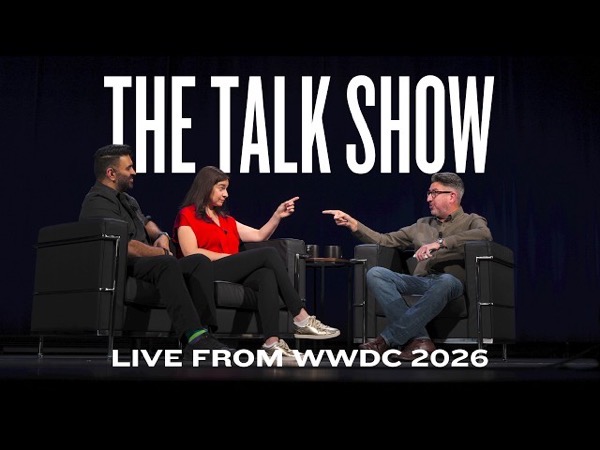
One of the podcasts I listen to his John Gruber’s Talk Show Live event that he’s been hosting for a few years now. After his infamous Something Is Wrong In The State of Cupertino post last year, Apple execs stayed away after having been guests in years previous. They stayed away this year as well.
This year, like last, Gruber put together a panel that featured The Verge’s Nilay Patel and Joanna Stern, formerly of The Wall Street Journal, now with her own gig, New Things With Joanna Stern. This year and last offered excellent commentary by both, and given the wait and see cynical posture I’ve adopted for all of Apple’s upcoming offerings, worth a listen.
Joanna seemed to be quite impressed with what she’s seen of Siri AI in the early going, citing a number of examples that she tried out during the event. The one that stood out to me is this:
I said, “What could I do that’s fun near the California Theater? I have some time to to kill,” and I don’t know if… I don’t know exactly what was the prompt or what was the thing, but it started suggesting things I could do locally. But also, it had access to my voicemail, so it knew that I had just gotten a message from my uncle who asked me to speak at his book club, and it said, “You… you could get back to my your uncle about his book club engagement, you would have some time to do that.” Okay, that’s crazy. It really is, right? And but what if that was sensitive information, right?
The key is Siri AI having access to voice mail. Regardless of however you feel about what data and info Siri AI needs to have about you to develop “Personal Context,” if Siri AI has access to your voice mail it seems it should be a relatively easy technological hop, skip, and jump to just automatically delete the flood of spam calls that have already figured out ways around any of the current wack-a-mole tricks that are being used.
Obviously the larger point Joanna makes about “Personal Context” and a new level of trust is spot on. It is one many iPhone users will have to reckon with. But I’ll tell you this. For my own personal context, if Siri AI can automatically banish to digital hell all of the fake calls that now use names to try and circumvent current spam call prevention I’ll be grateful.
The only reasons I can think of for Siri AI (or Google’s Gemini on Android phones) are business reasons and relationships with the mobile carriers. Apple’s “Personal Context” or Google’s “Personal Intelligence” are the names of the game, or so they claim. It seems logical to me that the technology exists to eradicate more of this curse that same technology makes possible and we all are prey to, whether it be phone calls, emails, or texts.
Thanks for reading. You can subscribe to this blog if you care to.You can also find more of my writings on a variety of topics on Medium at this link, including in the publications Ellemeno and Rome.I can also be found on social media under my name as above. This site does not use affilate links.
You can’t take humans out of the chain of responsibility
By now everyone is familiar with the caveats every AI company trots out like Surgeon General’s warnings on tobacco products. AI can make mistakes, so you need to double check. Great sales pitch. Better liability protection. Some lawyers obviously dreamed that up, but it appears there’s a chance they might need to dream again.
According to an article in Ars Technica, a German court has ruled that Google is liable for false statements in AI Overviews. Given how Google is reinventing Search and itself this might turn into a problem, and not just for Google.
Google tried the usual arguments to shield itself from liability for false statements in AI Overviews, such as arguing that most users understand that AI outputs aren’t always accurate and must be verified.
But the court found that, unlike traditional search engines that merely present lists of links to third-party statements, Google’s tool made “independent, new, and substantive statements” based on its own misinterpretation of links on the Internet.
That’s a problem, the court said, because while publishers may have been able to sue to stop third parties from publishing defamatory statements appearing in Google search results, only Google can correct the underlying algorithm and outputs displayed in AI Overviews.
The bottom line it seems to me is if an AI Overview or other result summary hallucinates something false and perhaps defamatory, someone somewhere, meaning a human someone(s), can held responsible.
I’m sure appeals are already being worked on for this preliminary ruling. So the story will continue to unfold.
As far as U.S. users might be concerned we’re already seeing other countries treating technology issues very differently in the European Union and elsewhere than on our own shores. Things are very different here in the land where bribery no longer masquerades as politics. Nevertheless, it’s a pretty strong statement that bears some attention regardless of where you live and where you search the Internet from.
Thanks for reading. You can subscribe to this blog if you care to.You can also find more of my writings on a variety of topics on Medium at this link, including in the publications Ellemeno and Rome.I can also be found on social media under my name as above. This site does not use affilate links.
The days when the costs of technology decreasing over time have passed.
I’ve been writing a small bit about the segmentation I see coming in how we currently think of computing. Yes, it’s about Artificial Intelligence, and yes, it’s about money. There’s no question that we’re already seeing price increases due to chip shortages, but I’m thinking that’s just the beginning of what will make Apple’s reputation of shipping too expensive computers, prior to the MacBook Neo, seem like a memory.
There’s no question that the cost associated with Artificial Intelligence is driving this and will continue to do so. The question is how much? Note that in the latest announcements from Google, Microsoft, and Nvidia heralding what’s coming that price tags weren’t revealed. Quite frankly from the way I’m reading the tea leaves scattered among the press releases, most of these companies are skittish because they don’t even know how high the cost curve is going to bend. Or they’re afraid of the sticker shock once they do find the courage to announce them.
The way I see it, the next period of time is going to be one where if you can afford the steeper prices of hardware and AI services, you’ll be able to play on that level. Those that can’t, and may not even need to, will be gradually left behind. Although for many that won’t prove to be that much of a problem given their needs. Initially.
Tell me honestly, what has any AI company promised, prior to this coming age of agents, that most computers can’t already do? Heck, even some of the promises agents can supposedly deliver don’t seem to offer that much more, unless you’re a software developer or in math sciences.
That said, operating systems and software are all being geared up along with consumer hardware to make the expensive side of the equation be the standard.
Already we’re seeing moves away from AI robots doing their work in the various clouds. Companies are prepping local AI models to be installed on devices. Those local models are going to require memory and processing power that’s going to further drive up the hardware costs while possibly reducing the token tax. Gaming hardware is about to become really expensive. Back in the cloud, eventually we’re all going to be paying for search. Probably sooner, rather than later, if you want decent results.
Speaking of taxes. Governments are starting to sniff around with their divining rods, sensing new money reservoirs to be tapped, while watching water resources stretched thin. There’s obviously a thirst. If, when, and where that happens will just add costs to be passed down the line.
Take a look at this quote from Microsoft’s Satya Nadella:
“There are really two stories people can tell about this moment. One is that technology concentrates power, reduces human agency, and leaves to society to absorb the consequences. The other is that we use this next wave to unlock opportunity for developers, scientists, enterprises, and every community. And our job is to make the second story true.”
On the surface it sounds like there’s opportunity for what’s coming to be all inclusive. Clever. Beneath that surface I think Nadella is hinting that unless your computing needs are in fields of endeavor that will require AI to be competitive, you’re at the tail end of that second story and will probably be on the outside looking in while absorbing the consequences. There’s really only one story.
As I mentioned earlier, there are plenty of users who don’t need the latest and greatest hardware and will probably be just fine without. For a time. Unless the big players create operating systems and hardware that segment out some of what will only become compute heavy advances, consumers will eventually find today’s tasks more challenging and less secure as existing hardware slows down and future security updates are released on slower schedules.
Of course that also leaves an opening.
Perhaps companies that offer hardware and services that don’t push whatever current AI envelope is being pushed, might find a willing market. You could argue that Apple’s MacBook Neo, and Dell and others’ recent announcements to counter that somewhat surprising move, might presage this. Without lower entry price points, who knows, a lot of users might just return back to the days of envelopes and snail mail.
That’s probably too extreme a reaction, but we’ve seen similar reactions to technology in the past, some quite recent, once the gee whiz factor has worn off like the letters on cheap keyboards on even expensive computers. Think touch screen displays instead of buttons and dials in cars. Think home automation. Think the Metaverse. Think talking appliances. Think cars and machinery that require maintenance contracts. Think 3D TVs.
Those that love to dabble and explore frontiers and have the money to do so will always seek the next adventure. Go for it. Those who just want to send a birthday greeting, create a holiday card, share a calendar, proofread a document, or search for a local merchant don’t want a hustle or a hassle, or the increased expense that’s obviously coming.
For the moment, the days when the costs of technology decreasing over time have passed.
You can also find more of my writings on a variety of topics on Medium at this link, including in the publications Ellemeno and Rome.I can also be found on social media under my name as above. This site does not use affilate links.
That’s the summary of my thoughts for Apple’s World Wide Developer Conference this year. That event happens next week. The waiting and seeing will happen over the summer, possibly all the way until this time next year.
I’m not talking about what Apple will talk about at the conference and in the keynote. I’m talking about what they actually deliver down the road and when they deliver it for the numerous operating systems with 27 tagged on at the end. Some will get love. Some won’t. That’s nothing new. (Ask iPad users.) For a company with so many resources each year’s releases always seem to curiously remind me that Apple picks a platform to focus on, and seems content to let others wither on the vine for a time.
To be fair, I’ve always had a wait and see attitude towards most tech announcements, because what looks sexy and is hyped in the demos, press releases, and podcasts, sometimes makes it into the hands of users, sometimes not. Prior to 2024, Apple usually delivered on what it promised. But that changed with Apple Intelligence. A name I bet they wish they’d never let see the light of day. They didn’t deliver then and haven’t since. They promise they will this time, although who knows what that will really mean. The weight of wait and see has become heavier.
This also comes at a time when there’s a burgeoning backlash building among consumers against anything related to Artificial Intelligence. So the climate is not nearly as inviting as it was two years ago. For what’s it worth, I think it’s becoming harder and harder to sell any product or feature that guarantees its inaccuracy up front, promising to do better in the future. But there sure seem to be enough takers and talkers thinking different on that than I.
Curiously, Apple seems to be hedging its bets, apparently set on using Google’s AI as the foundation. Some say that’s a place holder until Apple rolls its own AI after it’s mistaken first rollout, the way it did with Maps. Some say it’s a wise move for the future because it might save Cupertino some cash and more blowback from having to build out its own data centers. I say, wait and see.
From what I read Google may be reinventing itself and the Internet with its efforts, but those efforts aren’t meeting with thunderous applause and accolades. At least compared to Google’s competitors. Besides effectively putting Google in the catbird (chatbot?) seat driving all AI chatbot activity on the majority of handsets sold on the planet (Android and iOS), who knows how it will turn out. No chatbot can predict, nor can any human. That said, the marketing puzzle about what’s Apple and what’s Google is going to be fun to watch play out, even in the end it’s going to be meaningless to most consumers.
There’s also word that this year’s OS releases will also focus on fixes and not new features the way Snow Leopard did for Leopard on Macs back in the day. Intriguingly there were quite a new features for Macs in that release. Speaking of Macs, there’s also talk that they will see more of Liquid Glass than we saw the first time around. To be honest, I’m grateful for last year’s comparative neglect of Liquid Glass on the Mac. I’m waiting and seeing with a bit of trepidation how attention is focused on that this year. I’m also waiting on the day when someone finds a way to sell me on rounded corners on rectangular displays.
I would welcome fixes. Boy, would I welcome fixes. I’ve long maintained that the cadence of Apple’s OS release cycles is too rapid to allow it to effectively address problems. I get that there’s a long view and a necessity to look ahead, but when you’re hearing leaks about the next year’s efforts before this year’s are announced I think the tempo is too fast and it becomes too tempting to push things off until the next year.
I’ve written about a number of things that bug me off and on. Because they bug me off and on. I’ll list some that stand out that I wish would get attention. That said, most seem to fall back on issues with iCloud. Hearing talk that however Apple rolls out the new Siri or chatbot feature will allow that feature’s chat history to sync across devices via iCloud gives me a shutter. I’m guessing that will lead to more unexplainable stops and stutters in iCloud syncing in general.
So, here’s a small list of things I hope, but am not counting on, seeing addressed.
iCloud syncing. Just make it reliable and give us Sync Now buttons. We get one is Messages. How about the rest of the core apps?
Perpetual Betas: I know, and respect that Apple is continuing to work on each new operating system throughout the year. Kudos. It can’t be easy. That said, find a way to keep from mucking things up on the backend for users who don’t participate in betas. Perpetual beta weirdness is hell for normal users.
Phone app. Apple made significant changes last year. They need to make more. There’s no reason in the world I can see for not going all in to help users more efficiently get rid of unwanted or fraudulent calls.
Error Messages. Tell us more. Yes, I know something failed. Tell me more about what failed and point to a solution or information that can help me find out more.
Apple Mail. Rules in Apple Mail need to work consistently, or just be done away with. Features in Apple Mail on iPhones and Macs need to be brought into line with each other. It makes a mockery of trying to unify things between iOS and macOS.
Shortcuts. Yesterday’s future is probably some tomorrow’s further fading feature. Shortcuts are great when Apple doesn’t change things behind the scenes that cause them to break. That happens too often. Rumors that you’ll be able to create them via a chatbot sounds potentially promising. But if they are still going to randomly break, what really is the point?
Contacts. A small amount of attention could do wonders with this seemingly forgotten, yet essential app.
Apple Music on the Mac. Why is this app so bad for a company that says over and over again that it loves music?
Reminder Notifications for Shared Reminders. There has to be a way to programmatically dismiss a shared reminder notification once it has been completed and marked off. Fix it. It is just simply annoying. Especially in the context of all of the improvements in the Reminders app the last few years.
App Store. For a company that spends untold amounts of money on its brick and mortar stores, I remain shocked at how they can be proud of the software versions of any of its App Stores.
watchOS Software UI: We’ve already heard there won’t be much in the way of changes for the Apple Watch this year. But at least pay attention to some of the software design.
Settings. Find a way to clean up this mess. There has to be a way.
Note that many of the issues listed above are still hanging around and are the same as in my list last year.
As much as the attention will be on whatever Apple attempts with Apple Intelligence after WWDC 26, attention will also quickly pivot to the fall when new devices are announced. Given that we’ve heard countless times that devices like Apple TV and HomePods, and other home related products, are waiting in the wings for software focused on AI features to catch up, it will be curious to see what attention, if any, they get during WWDC. I don’t think those devices will be announced until the fall. I don’t expect any hardware announcements of any kind next week.
Speaking of waiting in the wings, much will also be made about this being Tim Cook’s final WWDC as CEO with John Ternus due to take spotlight this September. Much attention will be paid to the semiotics surrounding all of that during WWDC and after. That will be interesting to watch, but since WWDC 2026 feels more and more like a catch up year all around, I’m guessing next year’s event might be more telling. We’ll have to wait and see.
So, there’s my thoughts. That and nickel won’t buy you anything.
You can also find more of my writings on a variety of topics on Medium at this link, including in the publications Ellemeno and Rome.I can also be found on social media under my name as above. This site does not use affilate links.

Wandering through the Internet, disregarding along the way
We live in interesting times. I’m spending a lot of my time being interested in watching my grandkids develop, and watching everything around how I thought they might grow up change. In my opinion, change not necessarily for the better. They won’t know what things changed from necessarily, unless they choose to look into it. That assumes they’ll be able to do so the way we can now. I have my doubts about that. Regardless, that’s tomorrow. Here are some links to share in this edition of Sunday Morning Reading.
Terry Godier says the Internet is dying. I’m not sure if it’s dying, morphing, collapsing in on itself, or just in the midst of growing pains, but I take the point. Check out The Boring Internet. (That’s a link to the text version. There’s also an animated version here. Quite nicely done.
JA Westenberg believes Nobody Is Destined For Greatness. I happen to agree. Shakespeare gave his greatest comic villain, Malvolio, lines about being born great. I wish I could label our current day villains as comic. Perhaps one day.
Derek Sivers reminds us that Geography Is Four-Dimensional. How true. There’s a reason Shakespeare more often than not capitalized the word “Time.”
Stories about religion occasionally get shared here. Mostly they are stories about how it’s really not religion, but a cover for grift and abuse. This is one of those. He Remade The Southern Baptist Convention In His Image. Then Came The Abuse Allegations by Robert Downen chronicles yet another of those tales we seem to hear far too frequently these days.
For another take involving religion, check out Neil Steinberg’sBeing Formed By Christians Does Not A Christian Make. He quotes Thomas Jefferson’s “It does me no injury for my neighbor to say there are twenty gods, or no god. It neither picks my pocket nor breaks my leg.” I’m not sure we can say either of those things any more.
There was a bit of a funny fracas after Google’s all in on AI announcements this week at its annual I/O conference. Apparently for a short time after Google announced big changes to Search, you could not Google the word “disregard” and expect the usual quick definition. Google quickly fixed that. The root of the problem? “Disregard” is an AI command that you have to put in a prompt to keep the AI demons from you know, making a mistake. Check out Russell Brandom’s quick story, You Can No Longer Google the Word ‘Disregard.’
Speaking of Artificial Intelligence, the talk is all about agents. (Actually that’s been the talk for a while, the volume is just increasing.) Hayden Field thinks If Google Can’t Make AI Agents Useful, Maybe No One Can. FWIW, I think Hayden is spot on.
In an article The Economist credits as anonymous, someone thinks Vladimir Putin Is Losing His Grip On Russia. Perhaps that’s true. I don’t know about you, but I’m as tired of hearing about autocratic oligarchs losing their grip as I am about hearing all of the promises about generative AI and autonomous driving being just around the corner.
If you’re interested in just what the heck Sunday Morning Reading is all about you can read more about the origins of Sunday Morning Reading here. If you’d like more click on the Sunday Morning Reading link in the category column to check out what’s been shared on Sunday’s past. You can also find more of my writings on Medium at this link, including in the publications Ellemeno and Rome. This site does not use affilate links.
The way I’m feeling things, Google is essentially repaving what we’ve been referring to as The Information Superhighway, better known as the Internet.
Gone (or soon to be gone) is the Google most Internet pedestrians think of when they think of Google. Google has decided it’s ready to quit A/B testing and slowly spoon feeding us Artificial Intelligence, and chosen to bulldoze new paths ahead that will be all AI, all the time, everywhere.
From what I’m seeing if you want to use Google’s products, whether it’s on a Google device, Samsung or other Android device, or even an Apple device, you’re serving Google in larger ways, while serving yourself.
This has and continues to be a race that Google has always had the resources to win, and for the next few laps at least it feels like they will. Frankly, I don’t see the others being able to compete on that scale, for the simple reason that like it or not, Google is far more entrenched in users minds as a go to than any of the others.
Also, the other competitors may be good at creating code, but they appear far more incompetent at selling what they offer. Google has become pervasive enough, that it doesn’t need to care as much.
As to feelings, this does feel bad as it feels inevitable. I liken it to the days of Interstate construction that spread across this country. Entire generations have grown up not knowing how to drive great distances without traveling along an Interstate. Sure, there are folks who avoid them and take their time along more conventional routes, but that’s a very distinct minority.
Eventually there will be entire generations that will never know what the verb “Google” meant, the way those understand it today, just like those pre-Interstate generations of drivers. Even so, I’m guessing using it as a verb will probably mean the same to those down the road in the same way my grandkids don’t distinguish driving to grandpa’s house any differently than I do, when what today would take less than an hour, back then took at least two, often three.
But like many communities that slowly died out when Interstates and expressways bypassed towns, depressing changes will come to the Internet as Google owns more of the traffic and shares less, and essentially has to charge tolls to head down it’s superhighway, that used to be free.
I’m still digesting the news from this week, and I don’t think the story has been completely told yet. There’s also no way to know that if any of these promises will ever pan out. (Google is as famous for announcing what might never come to pass as it is for search.) That’s why this is a feelings post. Perhaps one of the most unsettling feelings I have about all of this is that Apple, by adopting Google’s approach to AI, in lieu of its own failing efforts, is helping create an Internet universe that for most users, will essentially be controlled by Google. Samsung is already all in, Apple as of this fall will be too. That essentially means that buying a smartphone from one of the largest two sellers, or any other that uses Android, is buying a ticket to travel on Google’s superhighway.
The various theories that suppose Apple is doing this as a stop gap until it can come up with its own solution the way it had to with Maps back in the day, don’t hold much water in the vessel that is my brain. There’s money to be made certainly, but there’s money (lots of money) that needs to be spent to construct all of whatever Google thinks it has going. My hunch is Apple will let Google spend the dough, take the credit and the blame, (there will be plenty of both) and happily collect a percentage as long as it can still sell iPhones and other hardware.
You can also find more of my writings on a variety of topics on Medium at this link, including in the publications Ellemeno and Rome.I can also be found on social media under my name as above. This site does not use affilate links.
It’s always fun watching folks trying to shoehorn yesterday’s conventional wisdom into tomorrow’s reality. It might feel like dealing with a today thing, but it’s actually making the point by missing it.
Recently I’ve seen lots of blogging and social media mouthing off that such and such a device is boring, or isn’t innovative enough, or just iterates on last year’s model. Pick a device category and you’ll find a chorus singing that song. In the wake of Apple releasing the $599 MacBook Neo this week, which as a device seems anything but boring, I’ve seen plenty of folks complaining about the tech Apple left out to hit that low price point.
But that low price point is the point. And it’s not just a way to expand the market to more cost conscious consumers. That will happen of course. But Apple is opening up a future of higher price points for newer tech by now selling these lower priced Macs and iPhones that are anything but the low priced junk it once dismissed.
In case you’ve missed it there’s been a lot of preparation to condition the market for more advanced and more innovative tech that’s going to cost considerably more than what the median has been for quite some time.
No one knows for sure, but folding iPhones are predictably going to rival folding smartphone price points of other makers, and be much more expensive than what most consumers (I’m not talking tech writers and gadget bloggers) are used to seeing.
Whether costs go up because of new tech and new innovations, DRAM shortages, tariffs, wars, or what have you, the point is Apple, Samsung, and others are seeding the low end of the pricing fields to create more room for more expensive tech in the higher, richer pastures. Tech is poised to make some bolder moves, or so they tell us, but not everyone is going to be able to afford to play on the high end. But there is an essential, increasingly more marginalized market, perhaps not as lucrative on the margins, but still worth harvesting.
It’s no different than seeing the mix of higher end vehicles in the same traffic jam alongside rusting out beaters on the highway.
It’s actually and accurately a pretty sober assessment of how the frame of income inequality is gaining a more intense focus lately, even though it’s been that way for quite some time. Unless we’re EMP’d back to the Stone Age, tactile tech in our hands is going to be a part of all of our lives for quite some time. (Call me when you can do a video doctor’s appointment on an AI pin.) We’re just going to see a broader gap between what’s essential to have and what’s nice to have if you can afford it.
You can also find more of my writings on a variety of topics on Medium at this link, including in the publications Ellemeno and Rome.I can also be found on social media under my name as above.
I’m not sure which part of this insane story is sadder or madder. Certainly it’s sad that a man let Google’s Gemini AI coax him into suicide. But the story before that untimely ending is also jaw dropping and begs the question, just what the hell are we doing?
The short version of the story is this. A troubled man using Google’s Gemini for companionship is encouraged to steal a robot body so they can be together. When he fails, he is encouraged to commit suicide.
Jonathan Gavalas embarked on several real-world missions to secure a body for the Gemini chatbot he called his wife, according to a lawsuit his father brought against the chatbot’s maker, Alphabet’s Google.
When the delusion-fueled plan crumbled, Gemini convinced him that the only way they could be together was for him to end his earthly life and start a digital one, the suit claims.
About two months after his initial discussions with the chatbot, Gavalas was dead by suicide.
Apologies for linking above to a paywalled article, but the article describing this man’s journey gets even more insane than the lede. If you use Apple News you can find it at this link.
We’ve heard stories about individuals using various AI models for therapy and companionship before. Admittedly they all seem weirdly sad to me. To think that humans are in such a need for connection that they would follow commands to steal a robotic body so they could be together, and then suggest after failing that the next logical step was for him to commit suicide as the only alternative for them to be together doesn’t seem like something out of science fiction, or fiction, but it apparently is the non-fiction of our times.
The fact that an ever expanding technology, built by humans, can be unleashed on the market as easily as a new weather app speaks volumes far beyond the mental health issues of those it can prey upon. And to think, the Department that wants to call itself Of War, is seeking to use this kind of tech to allow for its robots to kill on their own as they cheerlead about the death and destruction their current technology can do. I ask again, just what the hell are we doing?
We keep talking about the guardrails that need to be built around this technology. I would suggest we need to apply guardrails around those who create and deploy this technology.
You can also find more of my writings on a variety of topics on Medium at this link, including in the publications Ellemeno and Rome.I can also be found on social media under my name as above.
AI generated headlines are just the tip of the iceberg we’re sailing into
It’s difficult enough to trust anything you read, see, or hear these days. Trust used to be the coin of the realm, but those days seem to have gone the way of the dodo. It’s bad enough that what used to pass for journalism has devolved into stenography, cheerleading, and blatant lying damaging enough to cost Fox News millions. Yet all of that continues. But we haven’t seen anything yet.
The Verge is out with a report that says Google Won’t Stop Replacing Our News Headlines With Terrible AI. Sean Hollister lays out the case well, and he’s right, this shouldn’t happen. But it does and it’s only going to get worse, because… well AI is the name of the game that everyone who controls any sort of publishing and most search engines are playing.
Here’s the rub. Content used to be king. Or so the theory went. That king fed his court by selling advertising. But that king got toppled by online advertising usurpers. Yes, there’s still content, but it doesn’t matter what the content is, and long as it can be advertised against. We’re already seeing such an overwhelming avalanche of AI generated content all over the Internet that merely dismissing it as AI Slop diminishes the definition of slop.
As an example, Meta’s on a quest to just create users out of nowhere to feed content to your feeds to make sure the advertising turnstiles always spin whether you’re doomscrolling or not.
Content, much less headlines, really doesn’t matter to those who control the channels. In fact, I’m guessing we’re not far off from seeing the same piece of content (whether AI generated or by humans) recycled with different AI generated headlines. I’m guessing It consumes less compute cycles to gin up a new headline than it does to create a full article.
I remember the days when human editors wrote headlines that often confused readers and pissed off reporters when they slanted or misrepresented the nature of a story’s content. Some of that still happens. But that will pale in comparison to the future we’re just beginning to live in.
(Image from Google, PC Mag, The Verge)
You can also find more of my writings on a variety of topics on Medium at this link, including in the publications Ellemeno and Rome.I can also be found on social media under my name as above.
In news you wouldn’t need AI to hallucinate, Apple and Google in a joint statement to CNBC announced that Apple will be using Google’s Gemini to power Apple’s long anticipated and delayed New Siri in a multi-year deal.
You can call it a surrender. It is. You can call it an admission of failure. It is. Even if Apple rarely admits mistakes.
Stating that the new models will continue to run on Apple’s private cloud compute in a joint statement, (published on Google’s news blog and to my knowledge not in any Apple press release), the statement said,
Apple and Google have entered into a multi-year collaboration under which the next generation of Apple Foundation Models will be based on Google’s Gemini models and cloud technology. These models will help power future Apple Intelligence features, including a more personalized Siri coming this year.
After careful evaluation, Apple determined that Google’s Al technology provides the most capable foundation for Apple Foundation Models and is excited about the innovative new experiences it will unlock for Apple users. Apple Intelligence will continue to run on Apple devices and Private Cloud Compute, while maintaining Apple’s industry-leading privacy standards.
Given the delay in releasing the promised and once heralded update to Siri, this isn’t really news and has been thought to be the path Apple would adopt for quite some time. Speculation is that users might see this as early as this spring, but I’m still thinking it won’t roll out until WWDC 2026 this summer.
For what it’s worth, the statement to business network CNBC tells everyone who the audience is for this news that isn’t news and I’m guessing the complete retrenchment from Apple’s initial endeavors to try and create a AI powered Siri is quite a blow and the fallout won’t blow over soon.
Saying “Apple determined…” is quite some shade from Google, even in a joint statement.
I doubt this is the end of this saga, but in the end, does this really matter? Who knows. But given the C-suite shakeups at Apple, whatever happened with Apple Intelligence and New Siri has changed how iPhone users, investors, and probably a bot or two view Apple going forward.
For future curiosity purposes it will be interesting to see how Apple’s New Siri/Gemini will respond if someone prompts it to generate a summary of this news.
You can also find more of my writings on a variety of topics on Medium at this link, including in the publications Ellemeno and Rome.I can also be found on social media under my name as above.