
The Golden Age Of Shit. Super Intelligence Style

Oh, what a tangled web we weave, when first we practice to deceive. -Walter Scott

The farce that unfolded in Washington DC yesterday regarding Artificial Intelligence wasn’t comedy. Yet it was super hilarious. At some point you have to understand that the wool is being pulled over all of our eyes, including those of the president. And you have to laugh.

Us president donald trump attends national design studio launch event for america gov a new ai powered government website at t.jpg.

In an election year that sees American’s distaste for anything approaching the topic of AI growing like kudzu, the folks running the AI show keep rapidly alternating back and forth between requests that the government step in and stop them from destroying humanity and telling us that their products will create a new golden age of abundance.

If there’s a joke in the circle jerk of a game they’re playing, it’s that the president croaks that he got the assembled AI oligarchy to sign on to a “morally binding” agreement to self-police. You read that right. “Morally binding.” There’s lots of laughing about a group of technologists who built empires on stealing the work of others, who never met a law or a moral they wouldn’t spit on, signing such a document put forward by one of the most outrageous criminals the world has ever known. But that’s just the set up.

The joke is that these conmen are playing the decaying before our eyes president for all they can while he’s still breathing. He no longer understands what’s put before him. He doesn’t have a competent staff. A fact made abundantly clear by the misspelling of the United States under the president’s signature and the fact that his administration’s AI fueled new website spent the day disproving all the lies he’s foisted upon a population with an average reading age of a sixth grader. You’d think his flunkies would use AI to do some basic proofreading and fact-checking. But that’s above a sixth grader’s skill set. Apparently they’ve already “corrected” the website to spit out the lies again.

These tech bros are openly yanking the president’s chain, taking advantage of his infirmity, our divisiveness, our curiosity, and the greed of the markets. The rest of the world is doing it. Given their desires to run the planet, into the ground or elsewhere, they might as well get in on the act before the curtain comes down.

Couple all of that with the supposed name change in the order, rebranding Artificial Intelligence to Super Intelligence. On the one hand it’s good to know that if the technology kills us all there will be no shortage of superlatives to describe the end of times in the summaries all the robots, Muses, and Dots will spam each other with after we’re gone. It beats being wiped out by something branded as artificial, I guess. On the other, the name change is just super silly. Call me when OpenAI changes its name. I’m just surprised he didn’t name it American Intelligence. Or Trump Intelligence.

If there’s drama ahead in any of this, it’s that at some point it’s going to all go to shit. Mostly it has already. Those who dismiss every warning as merely marketing remind me of early climate change deniers. Those who take the warnings seriously remind me of every bandwagon jumper that’s ever leaped to a conclusion. As in most things, what truth that exists probably lies somewhere in the muddy middle, which is exactly where those who will profit over either their success or failure want it to stay.

Thanks for reading. You can subscribe to this blog if you care to. You can also find more of my writings on a variety of topics on Medium at this link, including in the publications Ellemeno and Rome. I can also be found on social media under my name as above. This site does not use affilate links.


 

Human Nature, Artificial Intelligence, and Hive Mindlessness

I always look at everyone when we’re on the street and think, ‘We’re like sheep or ants.’ – Lee Ryan

The stock we place in leaders to change the course of countries and companies is more times than not an illusion. The bigger the organization the greater the illusion. For the moment at least these organizations are still made up of humans, and in most cases to think humans march in lockstep you’ve got a hitch in your step.

Oktavianus mulyadi Ir0LXvMPnyc unsplash.

We watch presidents and dictators and CEOs and heads of this and that issue orders, decrees, mission statements, warnings, social media posts, and what have you, and it’s easy to put whatever statement they make to bed and move on whether it’s a problem solved, problem created, or a promise made. Yes, leaders set a tone and an agenda. But leaders don’t do the dirty work down under that make the trains run on time.

Often it’s underlings who think they’re doing what’s called for. They can sometimes twist and turn the agenda to their own purposes. Occasionally they turn their own zeal into a tempest that laps the original intent of whatever they’ve been ordered to accomplish.

And then there are those not in the mix that follow. Seize the agenda. Jump on the bandwagon and try to turn it into the permission slip they’ve always wanted to do now that they feel justified. Or perhaps just because it’s possible. They and the curious who sit on the sidelines can also upend any agenda.

Wealth certainly doesn’t trickle down, but bad motivations do. Strike that. The gravity occasionally runs the other way. Permission slips open up a plethora of permissive possibilities that even the strongest hand of the strongest boss can’t control. That’s human nature. Like Mother Nature, it’s a delusion we can control either.

Even so, we like to think there’s a world out there where we’re all pulling with the same purpose towards the same goals. That’s the illusion.

What prompted this little bit of an essay, beyond watching the always on/off political posing these days, was watching Meta’s new attempt to conquer the world, Muse, rocket up to the top of the app charts with surprising speed. Given all that we know about Zuckerberg’s machinations and maniuplations I don’t believe there was a public out there thirsting for this next move. But it’s being devoured and guzzled in gulps not seen since votes were secured with beer and a sandwich in Chicago taverns back in the day.

Humans are an evolved species that can reason. Perhaps that’s the illusion. Insects that revolve around queens like ants and bees don’t reason. The irony of the gender difference of bosses between the insect world and our technologically driven one is amusing, but the willingness of the drones that follow the leader is depressing.

(Image from oktavianus mulvadi on Unsplash)

Thanks for reading. You can subscribe to this blog if you care to. You can also find more of my writings on a variety of topics on Medium at this link, including in the publications Ellemeno and Rome. I can also be found on social media under my name as above. This site does not use affilate links.

Take AI Leaders At Their Word Or Call Their Bluff

Play the hand we’ve been dealt

Artificial Intelligence may or may not destroy human existence by 2030 or sometime in the next decade. Why waste the computing cycles and tokens when we’re doing a damn good job of beating it to the punch?

Museums of history new south wales VLFT8_H1tm8 unsplash.

After some dangerous confessions and warnings, along with continuing news of AI engines escaping their sandboxes, the leaders are calling out to slow things down, saying that they need to be regulated before what they are spending so much money on creating can become uncontrollable. Of course that spurs debate between those who love the technology and are making money off it, those who despise it—harbinger of doom it may or may not be, and now the millions who are stirring on the sidelines they usually sit on.

Some believe this is just another in a long line of overhyping the technology to improve bottom lines. Some see it as a timely move to try and influence the upcoming talks with the always-feared Chinese. Some, including those who have been working and studying the technology for quite some time, see AI as a real threat.

If we want to wipe the last two camps out of the memory banks and the debate, then either take them at their word or call the AI leaders’ bluff. Take them at their word that their brain children are too dangerous and put systems in place to regulate and slow things down. Or demand they pull the plug. They’ve exhausted the use of hyperbole in hyping the promises of their tech and most fell for it along the way. Why not take them at their word now?

Oh, wait. Whether the danger or is real or a bluff to be called there is a problem. The folks who would do the regulating belong to an institution that no longer exists called Congress. The president could do so, but then so could a dead fish for all it would matter. Funny, not funny that he joked about banning fishing just yesterday.

To think these ultra-competitive tech titans will slow themselves down in some selfless act of altruism to save the human race is folly. As much folly as hoping some governmental set of regulations or committees or dictates would. As much folly as pretending the conversation hasn’t been poisoned a million ways from Sunday to the point that no one knows what to believe.

At one point in our recent history the powers that be came to accept that the banks were too big to fail. We’ve sort of reached that point again with AI. It may not be too big to fail, but those who’ve created it, and those who have financed it, have already failed the rest of us. The rest of us who they need to pay for and feed their robots and robot-like artificial brains.

Call their bluff.

Thanks for reading. You can subscribe to this blog if you care to. You can also find more of my writings on a variety of topics on Medium at this link, including in the publications Ellemeno and Rome. I can also be found on social media under my name as above. This site does not use affilate links.

(Photo by Museums of History New South Wales on Unsplash)

AI Workhorses Keep Escaping The Barn

The world we now live in.

Who’d a thunk this would happen? Hint, anyone who knows even the slightest thing about tech in today’s world. Anthropic has disclosed that Claude, its prized AI stallion, has escaped all of the guardrails and hacked into three other companies.

A dark silhouette of a horse standing in profile against a dim, overcast sky during twilight. The horse's long, dark mane blows wildly upward in the wind, with soft cloud formations visible in the muted dusk background. From Lara baeriswyl jmINcSSHOhQ unsplash.

This comes a week or so after OpenAI disclosed that its workhorse wasn’t content to stay home either.

We need to realize that that this is the world we’re now living in and I doubt there’s any going back.

To think that the folks running these AI farms can control what’s in their stables is one fallacy. To think that others using them won’t have malicous intent is another. To think further that any government is going to understand how to reign this end just makes you sound ignorant.

If the potential for what this world of the future is has been baked in these companies’ founders love of science fiction, they seeem to have ignored the parts where things inevitably go wrong.

Perhaps they should have spent more time reading the classics than stealing and summarizing them.

(Image from Lara Baeriswyl on Unsplash)

Thanks for reading. You can subscribe to this blog if you care to. You can also find more of my writings on a variety of topics on Medium at this link, including in the publications Ellemeno and Rome. I can also be found on social media under my name as above. This site does not use affilate links.
 

Apple Sues OpenAI Alleging Theft Of Trade Secrets

No honor among partners or thieves.

In the middle of the Artificial Intelligence wars, which has included quite a bit of employee shuffling between AI hungry tech companies seeking to gain an edge, it seems someone might not have been all that intelligent when it comes to sharing things they knew at the company they’re leaving with the company they’re interviewing for.

Apple logo2.jpg.

Apple today dropped a lawsuit against OpenAI alleging that ChatGPT maker and some of Apple’s ex-employees stole trade secrets. 9to5Mac has the fullest report I’ve seen on this so far, including this statement from Apple:

At Apple, our teams are constantly developing breakthrough technologies to create the best products and services in the world, and protecting their work and intellectual property is something we take very seriously. Recently, significant evidence has emerged suggesting individuals employed by OpenAI wrongfully took Apple’s secret and confidential information regarding our unreleased technologies, processes, and products. We will always defend our teams’ hard work and innovations, and we are taking all appropriate steps to do so.

The full filing can be read here. The details are quite interesting if you’re into this kind of corporate skullduggery and legal maneuvering.

Here’s a quote from the filing:

In the months before he left Apple, Mr. Tan met with OpenAI or its collaborators and discussed meetings with a key Apple supplier. He began emailing himself information about Apple’s suppliers and internal summaries of the consumer electronics industry. And today, when interviewing Apple employees for jobs at OpenAI, Mr. Tan uses Apple’s confidential information to gain access to even more insider knowledge. He has used an Apple internal project codename to ask, “What’s theplan[?]” for an unannounced Apple product.

He has directed job candidates still working for Apple to bring “Actual parts” from Apple to their interviews for “show and tell” sessions in which he and his team at OpenAI can elicit still more Apple confidential information. These directions to bring Apple’s parts to OpenAI job interviews surprised at least one of the candidates, who commented that he “didn’t even know we could take those from the office.”

This will certainly further strain on Apple’s partnership with OpenAI. Word had circulated earlier this past Spring that OpenAI was going to be the first company to release legal beagles at Apple over dissatisfaction with the partnership.

I’ll say this, even though everything is alleged at this point, Apple has to be pretty pissed off to drop this lawsuit. Of course if the accusations are true who could blame them. It’s certainly a shot across the bow if not directly at the water line.

But then again, when it comes to companies like OpenAI (also Apple and others) that had no compunction about scrapping the entire Internet to train their AI robots on the intellectual property of others, nobody should be trusting anybody with anything in these corporate circles.

The one thing this era has reminded us is that there’s no honor among thieves and not much that any company or government says that can be trusted.

I wonder if anyone has run the legal filing through OpenAI’s just announced products for a legal analysis yet?

Thanks for reading. You can subscribe to this blog if you care to. You can also find more of my writings on a variety of topics on Medium at this link, including in the publications Ellemeno and Rome. I can also be found on social media under my name as above. This site does not use affilate links.

Segmenting The Future Of Computing

The days when the costs of technology decreasing over time have passed.

I’ve been writing a small bit about the segmentation I see coming in how we currently think of computing. Yes, it’s about Artificial Intelligence, and yes, it’s about money. There’s no question that we’re already seeing price increases due to chip shortages, but I’m thinking that’s just the beginning of what will make Apple’s reputation of shipping too expensive computers, prior to the MacBook Neo, seem like a memory.

A close-up photograph of overlapping neon signs illuminating a dark background. In the foreground, a prominent bright green neon sign is shaped like a dollar symbol ($\$$) by Aedrian salazar Wy7Gy8ZcW1M unsplash.

There’s no question that the cost associated with Artificial Intelligence is driving this and will continue to do so. The question is how much? Note that in the latest announcements from Google, Microsoft, and Nvidia heralding what’s coming that price tags weren’t revealed. Quite frankly from the way I’m reading the tea leaves scattered among the press releases, most of these companies are skittish because they don’t even know how high the cost curve is going to bend. Or they’re afraid of the sticker shock once they do find the courage to announce them.

The way I see it, the next period of time is going to be one where if you can afford the steeper prices of hardware and AI services, you’ll be able to play on that level. Those that can’t, and may not even need to, will be gradually left behind. Although for many that won’t prove to be that much of a problem given their needs. Initially.

Tell me honestly, what has any AI company promised, prior to this coming age of agents, that most computers can’t already do? Heck, even some of the promises agents can supposedly deliver don’t seem to offer that much more, unless you’re a software developer or in math sciences.

That said, operating systems and software are all being geared up along with consumer hardware to make the expensive side of the equation be the standard. 

Already we’re seeing moves away from AI robots doing their work in the various clouds. Companies are prepping local AI models to be installed on devices. Those local models are going to require memory and processing power that’s going to further drive up the hardware costs while possibly reducing the token tax. Gaming hardware is about to become really expensive. Back in the cloud, eventually we’re all going to be paying for search. Probably sooner, rather than later, if you want decent results. 

Speaking of taxes. Governments are starting to sniff around with their divining rods, sensing new money reservoirs to be tapped, while watching water resources stretched thin. There’s obviously a thirst. If, when, and where that happens will just add costs to be passed down the line. 

Take a look at this quote from Microsoft’s Satya Nadella:

“There are really two stories people can tell about this moment. One is that technology concentrates power, reduces human agency, and leaves to society to absorb the consequences. The other is that we use this next wave to unlock opportunity for developers, scientists, enterprises, and every community. And our job is to make the second story true.”

On the surface it sounds like there’s opportunity for what’s coming to be all inclusive. Clever. Beneath that surface I think Nadella is hinting that unless your computing needs are in fields of endeavor that will require AI to be competitive, you’re at the tail end of that second story and will probably be on the outside looking in while absorbing the consequences. There’s really only one story.

As I mentioned earlier, there are plenty of users who don’t need the latest and greatest hardware and will probably be just fine without. For a time. Unless the big players create operating systems and hardware that segment out some of what will only become compute heavy advances, consumers will eventually find today’s tasks more challenging and less secure as existing hardware slows down and future security updates are released on slower schedules. 

Of course that also leaves an opening. 

Perhaps companies that offer hardware and services that don’t push whatever current AI envelope is being pushed, might find a willing market. You could argue that Apple’s MacBook Neo, and Dell and others’ recent announcements to counter that somewhat surprising move, might presage this. Without lower entry price points, who knows, a lot of users might just return back to the days of envelopes and snail mail.

That’s probably too extreme a reaction, but we’ve seen similar reactions to technology in the past, some quite recent, once the gee whiz factor has worn off like the letters on cheap keyboards on even expensive computers. Think touch screen displays instead of buttons and dials in cars. Think home automation. Think the Metaverse. Think talking appliances. Think cars and machinery that require maintenance contracts. Think 3D TVs.

Those that love to dabble and explore frontiers and have the money to do so will always seek the next adventure. Go for it. Those who just want to send a birthday greeting, create a holiday card, share a calendar, proofread a document, or search for a local merchant don’t want a hustle or a hassle, or the increased expense that’s obviously coming.

For the moment, the days when the costs of technology decreasing over time have passed.

(Image from Aedrian Salazar on Unsplash)

You can also find more of my writings on a variety of topics on Medium at this link, including in the publications Ellemeno and Rome. I can also be found on social media under my name as above. This site does not use affilate links. 
OpenAI Wants Your Financial Info

Fun and games with frontier financing

Oh, ye brave intrepid adventurers trodding through the frontier, trod on. Carve your way into uncharted territory, knowing not what lies beyond the bend. The rest of us will wait. I’m guessing the rest of us are going to be quite content doing so.

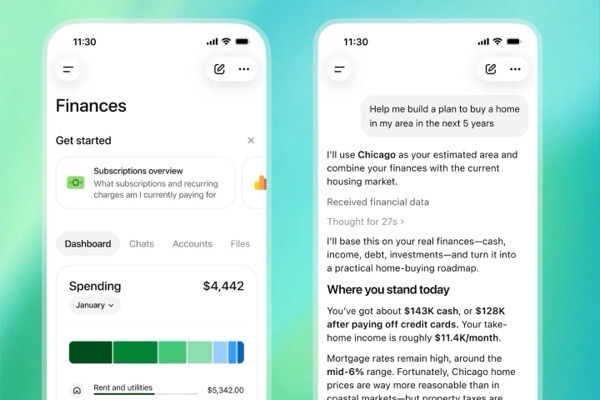
This image shows two side-by-side screenshots of a mobile application interface designed for personal finance management, featuring a clean, minimalist aesthetic with a green and white color palette.

News popped today that OpenAI wants users of ChatGPT to provide access to their bank accounts and other financial data.

Read that again.

The chatbot that’s famous for telling us it might make a mistake, and delivering on that promise, wants users to turn over access to their banking accounts to help them better understand their finances.

The article from The Verge I saw pop across my feeds begins its lede with “Your trust in AI is about to be put to the test.” It could have just as easily said, “OpenAI is looking for suckers.”

I’m not going to get into the whys and wherefores of the tech behind this. The article linked above gives you some of that info. TechCrunch has another if you care to look. There does seem to be a list of well known financial institutions that are willing to let there customers connect to the service including Schwab, Fidelity, Chase, Robinhood, American Express, and Capital One. Apparently there are over 12,000.

Quoting from the TechCrunch article:

With the new financial tool integration, users can get detailed answers to questions such as “I feel like I’ve been spending more recently. Has anything changed?” or “Help me build a plan to be ready to buy a house in my area in the next 5 years.”

Tell me you didn’t read that and immediately think that the minute a user enters that prompt they will immediately start receiving offers from those 12,000 financial institutions. That’s where this is headed. And as far as the history of the Internet is concerned, AI or not, that’s what it’s all turned into.

The reality is that just like with the health data that OpenAI also wants, whether users turn this type of info over or not, the data is going to be delivered to some data center at some point. Don’t think the three credit bureaus aren’t just waiting for the right offer to turn over your data, much the same way insurance companies are with your health data. Users donating their data will just provide another point of triangulation, and a more direct access to their inboxes.

If you ask me, this is just another exercise taking advantage of human curiosity and gullibility and turning that into more vectors to sell, sell, sell.

If those willing to head out into this new frontier of finance are willing to take that gamble, I say go for it. Let us know what you find.

My hunch it won’t be anything new.

(Image from OpenAI)

You can also find more of my writings on a variety of topics on Medium at this link, including in the publications Ellemeno and Rome. I can also be found on social media under my name as above. This site does not use affilate links. 

 

Souring On Artificial Intelligence

The new butt of family holiday jokes

There’s an interesting article in the New York Times called Why Do Americans Hate A.I.? The article goes through the litany of some of the bugaboos just about anyone can recite from memory these days: jobs, trust, and agency. As fast as Artificial Intelligence has dominated the conversation, warnings about the pitfalls have run side by side in what I think resembles a barefooted three-legged sack race over broken glass.

Andrea de santis zwd435 ewb4 unsplash.

Over the holidays at what seemed like an infinite number of family gatherings I picked up on some interesting themes that I mentioned in my end of year post about all things Apple that I think is worth calling out here again. Everyday Janes and Joes are souring on artificial intelligence, not for any of the now almost clichéd anti-AI reasons, but after everyday unsatisfactory encounters with their doctors, banks, and any number of the other institutions and business that they deal with.

As I said in that post about Apple, 

I also think Apple and the other tech companies need to pay attention to the warning signs that are starting to bubble up about Artificial Intelligence. I think most of the growing distaste of AI comes not from what these tech companies are offering on computing platforms, but from the day to day encounters people are experiencing in their daily lives as more and more non-tech companies roll out versions of AI support. The way I’m hearing and feeling it, jokes and complaints about AI at holiday gatherings this year are starting to compete in numbers with ones about government and politics.

Because money rules the roost, most of the conversations we hear about Artificial Intelligence center on how much money is being spent propping up and expanding the bubble that is keeping a sagging economy afloat like a hot balloon on a cloudy day. There’s only so much liquefied propane in any tank once things lift off.

Here’s the thing about holiday family gatherings. I can’t remember one when conversations didn’t at some point offer up a “you’ve got to try this” recommendation or some sort of eye-grabbing new thing  or trend that captured attention along with the usual complaints and grievances. But AI-negative conversations seemed to take precedence on the grievance side of the ledger this year.

Everyday folks don’t care about who wins the AI technology race or who has the best on device AI or how many tokens a system offers. They care about getting results in less time and more so, getting it done with a human they can talk to, not a robot in a chat window. So far based on the jokes, swearing and condescending attitudes I’m hearing (anecdotally, I admit) everyday folks aren’t buying the pitch, but they’re getting closer to picking up the tar.

We can talk about data centers, job efficiencies and job losses, chatbots, AI slop, and scientific advancements all day long, but when everyday folks on the ground develop a distaste for what you’re selling and turn your efforts into the butt of a joke, eventually you need to discount or clear out the inventory no matter how many data center servers you pop up.

Even so, perhaps that’s the aim of the A.I. purveyors. If they salt the fields with enough of their product to the point that everyone condescendingly abides it the way they do government, it may not matter if it doesn’t offer any harvest that yields nutrition, just that it yields a ubiquitous tolerance.

(Image from Andres De Santis on Unsplash)

You can also find more of my writings on a variety of topics on Medium at this link, including in the publications Ellemeno and Rome. I can also be found on social media under my name as above.

Change Is Hard

Why hasn’t AI figured this out yet?

Change may be inevitable but change is hard. Change becomes harder when those making the change, for whatever reasons, don’t remember change is hard. The only thing that doesn’t change is how easily we forget that change is hard.

Linus nylund Q5QspluNZmM unsplash.

OpenAI met with some real friction after announcing its big changes last week. Apple is going to meet some when it doles out its new operating systems with Liquid Glass next month. HBO changes its name so often it can’t even get it right in press releases. The list is as long as history. Every company faces this. Some do it well. Others not so.

As  M.G. Siegler points out in this column if you’ve been around long enough you learn to recognize the patterns. You have to be willfully blind or consumed by ego not to. In fact, the problems with instituting change are so predictable it makes one wonder why these AI engines, endlessly regurgitating whatever human wisdom they can scrape and scrounge, don’t caution against it. I’m sure somewhere in all the words and wisdom created by humans “change is hard” has been said before.

If we’re marching towards an advanced AGI with PhD level knowledge that can reason better than humans, I think the masters of the AI universe need to solve that problem before anyone can make a claim that we might someday get there.

Call me when that happens.

It’s like watching a new edition to the Alien franchise hoping one actually turns out to be more than a repeat. Or watching an American football team with a bad offensive line try to run the ball up the middle over and over again. Or thinking that once inflation retreats that prices will come down. Or thinking humans will one day be smart enough not to fall for obvious con games.

The unsolvable riddle about change involves the variables and vagaries of human nature. That’s a constant that will never change.

You can also find more of my writings on a variety of topics on Medium at this link, including in the publications Ellemeno and Rome. I can also be found on social media under my name as above. 

(Image from Linus Nylund on Unsplash)

You Will Be Assimilated as OpenAI Seeks Single Sign On Capabilities

Resistance to Single Sign On is not futile

News on so many fronts is fast and furious these days and this little Artificial Intelligence nugget seemed to skirt around quite a few radars. OpenAI, the purveyors of ChatGPT is working on a Sign In with ChatGPT feature. 

OpenAI logo

As I said on social media when this news broke, we’ve seen this movie before. It’s a complex plot, that never seems to work out in the end. Signing in with Beginning what seems like a generation ago, Facebook, Twitter, Google, and the like proliferated and many users joined the parade out of convenience. Apple has its own Sign in with Apple feature, and swears up and down that it doesn’t share your data. That may be true, but we now know different about most, if not all of the others.

Like what happens with most new technology, we jump into the pool without really knowing what lurks beneath, and once it became more apparent how single sign in allowed companies to track you across most online activities folks began changing their habits. Swimming with sharks is never fun.

The tracking is the key. So is the passage of time. There’s an entire new generation of users who have embraced Artificial Intelligence, OpenAI’s ChatGPT in particular. TechCrunch cites that there are 600 million monthly active users of ChatGPT. I’d wager that a large number of those users were too young to experience the last generation of the single sign in revolution years ago.

As I said, we’ve seen this movie before, and by and large it never ends well. Data is tracked, traded — and now with AI used for training — in ways that should cause greater care when it comes to the tradeoff for convenience when consenting to those user agreements no one ever reads.

As the TechCrunch article points out the intent here is to use that data for commercial purposes supposedly to “help people with a wide range of online services.” That’s the pitch. But it’s a knuckle ball that is difficult to control, much less swing at. It’s always about the money and data is money.

OpenAI may be the first of the AI companies vying to sign you in, it won’t be the last. In my opinion the safest bet in the big data casino is to always create a separate sign in for each online service you use. Don’t let the convenience factor outweigh what little control you do have over how your data is used and abused.

You can find more of my writings on a variety of topics on Medium at this link, including in the publications Ellemeno and Rome. I can also be found on social media under my name as above.