Listening to podcasts after each WWDC is always a bit of information overload, but occasionally you catch a bit of analysis that seems perhaps pertinent.
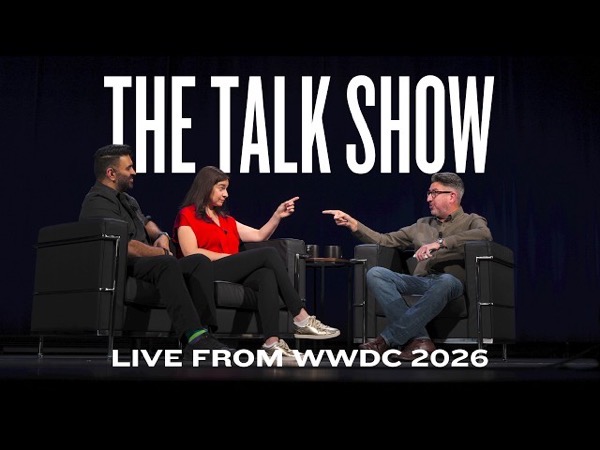
One of the podcasts I listen to his John Gruber’s Talk Show Live event that he’s been hosting for a few years now. After his infamous Something Is Wrong In The State of Cupertino post last year, Apple execs stayed away after having been guests in years previous. They stayed away this year as well.
This year, like last, Gruber put together a panel that featured The Verge’s Nilay Patel and Joanna Stern, formerly of The Wall Street Journal, now with her own gig, New Things With Joanna Stern. This year and last offered excellent commentary by both, and given the wait and see cynical posture I’ve adopted for all of Apple’s upcoming offerings, worth a listen.
Joanna seemed to be quite impressed with what she’s seen of Siri AI in the early going, citing a number of examples that she tried out during the event. The one that stood out to me is this:
I said, “What could I do that’s fun near the California Theater? I have some time to to kill,” and I don’t know if… I don’t know exactly what was the prompt or what was the thing, but it started suggesting things I could do locally. But also, it had access to my voicemail, so it knew that I had just gotten a message from my uncle who asked me to speak at his book club, and it said, “You… you could get back to my your uncle about his book club engagement, you would have some time to do that.” Okay, that’s crazy. It really is, right? And but what if that was sensitive information, right?
The key is Siri AI having access to voice mail. Regardless of however you feel about what data and info Siri AI needs to have about you to develop “Personal Context,” if Siri AI has access to your voice mail it seems it should be a relatively easy technological hop, skip, and jump to just automatically delete the flood of spam calls that have already figured out ways around any of the current wack-a-mole tricks that are being used.
Obviously the larger point Joanna makes about “Personal Context” and a new level of trust is spot on. It is one many iPhone users will have to reckon with. But I’ll tell you this. For my own personal context, if Siri AI can automatically banish to digital hell all of the fake calls that now use names to try and circumvent current spam call prevention I’ll be grateful.
The only reasons I can think of for Siri AI (or Google’s Gemini on Android phones) are business reasons and relationships with the mobile carriers. Apple’s “Personal Context” or Google’s “Personal Intelligence” are the names of the game, or so they claim. It seems logical to me that the technology exists to eradicate more of this curse that same technology makes possible and we all are prey to, whether it be phone calls, emails, or texts.
Thanks for reading. You can subscribe to this blog if you care to.You can also find more of my writings on a variety of topics on Medium at this link, including in the publications Ellemeno and Rome.I can also be found on social media under my name as above. This site does not use affilate links.
One day perhaps we’ll move beyond AI cliché demos.
My nephew occasionally takes a look at this blog and gives me feedback on what I think and write. Actually, he mostly gives me shit. He certainly does when I write about Artificial Intelligence. He often asks why I’m so “down” on AI. At least we agree on politics.
I keep reminding him that I’m not “down” on the technology per se. I’d love to see the press release announcing AI led to a a cure for cancer. Who wouldn’t? I’m down on the way it continues to be sold to us and the ramifications that brings on so many levels, while still feeling like it’s not what the sellers keep promising. (I also remind him to read what I write more carefully, but he’s probably using some AI to summarize what I write.)
In truth, that’s the essence of my skeptical reaction to what we know as AI at the moment. There’s a lot going on, but how it’s being sold to most consumers still feels like it will ultimately be no more, no less than just another tool we use on a computer, after exacting high costs to do so, and dumbing down the general learning curve in the bargain.
Take for example the demos we constantly see about what AI can do when each company rolls out its latest version. As demos they all look slick as far as party and trip planning go.
(Coding is another case entirely. I’m not talking about that here, simply because I don’t have the expertise to do so. I’m strictly speaking of the sell to consumers.)
Even Apple fell back on these examples that have become clichés in this year’s WWDC 2026 announcement. Those clichés define the market companies think are ripe for the come on and then the plucking. I’m guessing they also define the current limitations of the technology. Or at least the limitations companies don’t want to risk pushing beyond in a live demo.
Here’s the AI Siri demo I wish Apple had shown us yesterday.
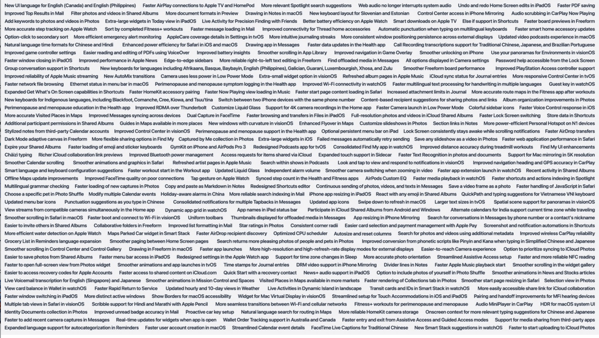
If you watched Apple’s keynote presentation you might remember this slide.
Maybe not. It flew by pretty quickly. It’s a word cloud of all of the other non Siri AI improvements Apple is bringing to its various operating systems this year.
Yes, the print is that tiny and crammed together. To call it unreadable is accurate. For those who didn’t watch the demo, the length of time it was on our screens was equally tiny, certainly compared to all the travel time each presenter took to walk on and hit their mark prior to speaking. To be honest, the slide’s quick and unreadable inclusion felt insulting given the long list of improvements it’s touting.
(To my knowledge no such list appears yet in Apple’s Newsroom or on its website heralding the other announcements. If I’m wrong, point me to it and I’ll link to it here. I’m sure it won’t be long before one of the sites that covers Apple distills it down and publishes it. Probably using AI.)
(UPDATE: Right after hitting publish, I noticed that John Gruber linked to this post on the Oneberri Blog listing all of those improvements.)
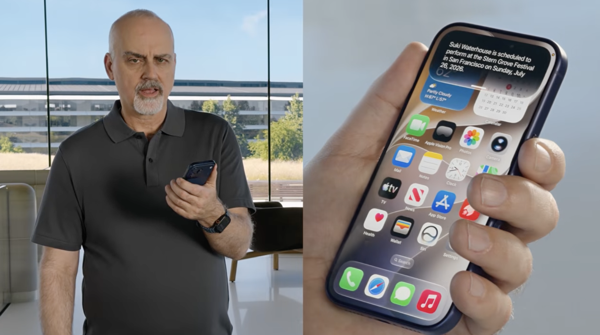
What if Mike Rockwell, the Apple Executive who did the Siri AI demos, had asked Siri AI to take that slide, and present the info into a bulleted list in Apple Notes, and then prepare a PDF for distribution? In the post keynote tech talk he and other Apple execs participated in, he could have followed that up by asking Siri AI to distribute the PDF to the other Apple execs on stage. Essentially it would have demonstrated the same Siri AI capability to gather info across native Apple apps, using context, in the same way the clichéd party planning demos do.
It certainly would have been more impressive than the usual clichés.
Perhaps AI Siri and the apps needed to do that work aren’t ready for such a challenge just yet. Things are still in beta after all. Perhaps it’s just too risky to stray outside of what’s made these kinds of demos a laughable cliché. Perhaps we’ll get there someday. Who knows?
Meanwhile I’ll remain “down” on AI the way my nephew likes to give me shit about my AI skepticism. I hope one day this technology might indeed lead to a cure for cancer. I also hope my nephew keeps reading this blog. It might help him learn to think for himself more often. 😉
Thanks for reading. You can subscribe to this blog if you care to.You can also find more of my writings on a variety of topics on Medium at this link, including in the publications Ellemeno and Rome.I can also be found on social media under my name as above. This site does not use affilate links.
Apple works to make good on Apple Intelligence with Siri AI
At WWDC 26 Apple today announced new operating systems all ending in OS27. (The numbering thing drives me nuts.) The entire keynote felt different to me from recent years. I’m not talking about the presentation organization that strayed from the usual by device format. Rather it felt like Apple felt a bit humbled. Almost as if Apple is in a we’re in a thinking different mode these days. I may be reading more into that than is real, but I’m usually pretty good at sniffing these things out.
Apple chose the name Golden Gate for its macOS 27 version this year, and it looks like the folks in Cupertino heard the criticisms about Liquid Glass and have taken some steps to correct what I and many other consider design flaws. I’ve seen as many negative as positive reactions to the design changes, so we’ll see how that goes throughout the summer.
There was also quite a bit of time devoted to Parental Controls. Given the political heat big tech in general is taking politically here in the US and elsewhere that’s probably a smart move. The announcement stirred up a bit of controversy from folks not in favor of efforts like age verification. The devil will be in the details.
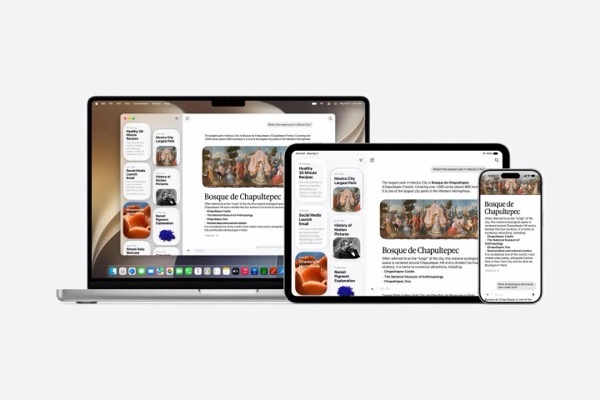
The big push though is all about Apple Intelligence and the New Siri, now called Siri AI. Trying to play catch up and recover from the mistakes of two years ago, Apple showed off some live demos in a separate meeting from the keynote. You can read about that on The Verge. So you have to consider showing live demos a plus over two years ago, although it was still in a protected environment. I’ll be looking for users to do the same as the betas roll out, even if it appears that there’s a waiting list for the New Siri. So, we’ll see how that goes.
The announcements were solid. They appeared to address past problems of Apple’s own making, user complaints about recent design changes, and the promise of under the hood bug busting. Announcing speed increases across the platforms is promising. But we’ve been here before. Every keynote from every company makes promises. The devil is always in the details, and when life is a beta, you never know what’s final and when. Especially when you’re in a mode of trying to rebuild trust.
You can check out the entire keynote reduced to 26 minutes, also from The Vergehere. And Jonny Evans has a nice collection of the headline announcements from the keynote here.
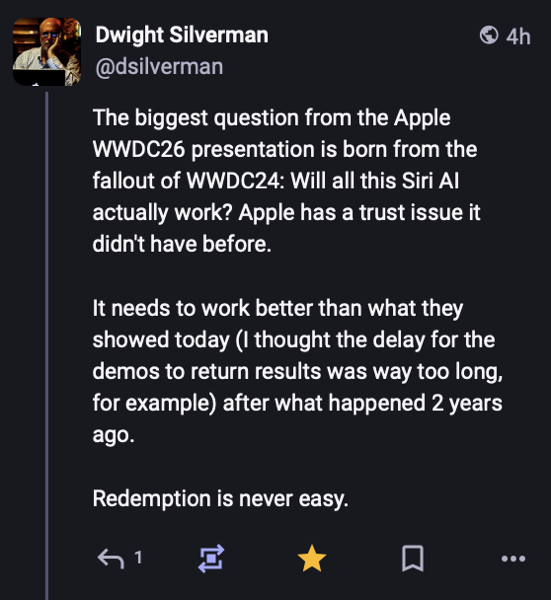
And this Mastodon post from Dwight Silverman sums up my some of my early thoughts as well.
To further sum it up my early thoughts, I’ll just say this. It’s going to be an interesting summer watching folks hammer on the betas, the first of what was released to developers today. The public betas will roll out in July. But we’ll have some early indications later in the week as developers begin working with the betas.
Thanks for reading. You can subscribe to this blog if you care to.You can also find more of my writings on a variety of topics on Medium at this link, including in the publications Ellemeno and Rome.I can also be found on social media under my name as above. This site does not use affilate links.
“An acre of performance is worth a whole land of promise.”
You know what a litany is. It’s a series of prayers with predictable responses, learned, ingrained, and repeated without much thought. Call it “call and response.” As we finally arrive at the beginning of Apple’s WWDC 2026 today, the call has been summarized down to Apple needs a Siri that works.
But how the hell do you respond to that?
Siri was once a surprising computer gimmick, before Apple got its hand on it in 2010. Siri has been surprisingly bad at most things ever since. Sure you can set a timer, or a reminder, occasionally play the right play list and a few other things. If that were the extent of the promise the jokes wouldn’t be funny. But the promises were always more. They never lived up to the personal assistant aspirations. It’s still largely a gimmick. One too easily made fun of.
Amazon’s Alexa and Google’s Assistant, (now Gemini) have taken bigger steps forward than Siri, but also continue to fall down and scrape their knees. Chatbots have come along and for some have replaced the need for someone to talk to. But each of those efforts still yield mistakes and failures. You know the way, humans do.
So do pleas for a “Siri that works” mean something that will always work? I doubt it. I think the expectation is that these chatbot like companions will continue to fail. Again, the way humans do. But you can’t sell that.
Does it mean a “Siri that works” does something new? I doubt that also. The entire promise of computer assistants, chatbots and artificial intelligence is to do things we already do more efficiently. In fact, that’s the history of computing. When spreadsheets replaced pencils, green eyeshades, and then calculators we were on to something.
We haven’t yet figured out a way to help us communicate better in person, much less in front of a screen or into a microphone. A “working Siri” (or any other chatbot) isn’t going to help us with that. They may teach us a new way to communicate to set that reminder, but the respondents failure makes us all feel like we’re wrong. Until we just stop talking.
I’m not sure how you reconcile doing things more efficiently with the failure rate. One that seems all but guaranteed by the “mistakes will happen” caveats that prove lawyers always earn their keep. Frankly, I don’t ever see a “fire and forget it” guarantee in what remains of my lifetime. Maybe someday.
Word is that whatever Apple rolls out as “a working Siri” will roll out with a beta label attached to it. That’s a good preemptive legal response, but a sad commentary on the state of things. We expect things to go wrong in betas. Talk about setting a low bar. Even a necessary one.
Speaking of the history of computing, when it comes to mobile computing we’ve gone through at least one cycle where the focus shifted away from keeping us addicted to our phones, to an entire wave of ways to help us escape the tyranny of the small screens, put them down and enjoy more of life without them. Call me crazy, but the rush to chatting away to smartphones, AirPods, pendants, pucks, cars, etc… seems contradictory to solving our tech addictions. Out with the old trend, in with the rerun.
Gimmicks work. They help sell devices and feed trends. Think pet rocks. We’re already seeing talk of children’s toys with AI voice assistants and reactions against them. At least this time around the reactions are coming more quickly.
I’m guessing it’s not long before we see a pet rock product that contains an AI powered voice assistant. We can always use another paperweight.
Thanks for reading. You can subscribe to this blog if you care to.You can also find more of my writings on a variety of topics on Medium at this link, including in the publications Ellemeno and Rome.I can also be found on social media under my name as above. This site does not use affilate links.
That’s the summary of my thoughts for Apple’s World Wide Developer Conference this year. That event happens next week. The waiting and seeing will happen over the summer, possibly all the way until this time next year.
I’m not talking about what Apple will talk about at the conference and in the keynote. I’m talking about what they actually deliver down the road and when they deliver it for the numerous operating systems with 27 tagged on at the end. Some will get love. Some won’t. That’s nothing new. (Ask iPad users.) For a company with so many resources each year’s releases always seem to curiously remind me that Apple picks a platform to focus on, and seems content to let others wither on the vine for a time.
To be fair, I’ve always had a wait and see attitude towards most tech announcements, because what looks sexy and is hyped in the demos, press releases, and podcasts, sometimes makes it into the hands of users, sometimes not. Prior to 2024, Apple usually delivered on what it promised. But that changed with Apple Intelligence. A name I bet they wish they’d never let see the light of day. They didn’t deliver then and haven’t since. They promise they will this time, although who knows what that will really mean. The weight of wait and see has become heavier.
This also comes at a time when there’s a burgeoning backlash building among consumers against anything related to Artificial Intelligence. So the climate is not nearly as inviting as it was two years ago. For what’s it worth, I think it’s becoming harder and harder to sell any product or feature that guarantees its inaccuracy up front, promising to do better in the future. But there sure seem to be enough takers and talkers thinking different on that than I.
Curiously, Apple seems to be hedging its bets, apparently set on using Google’s AI as the foundation. Some say that’s a place holder until Apple rolls its own AI after it’s mistaken first rollout, the way it did with Maps. Some say it’s a wise move for the future because it might save Cupertino some cash and more blowback from having to build out its own data centers. I say, wait and see.
From what I read Google may be reinventing itself and the Internet with its efforts, but those efforts aren’t meeting with thunderous applause and accolades. At least compared to Google’s competitors. Besides effectively putting Google in the catbird (chatbot?) seat driving all AI chatbot activity on the majority of handsets sold on the planet (Android and iOS), who knows how it will turn out. No chatbot can predict, nor can any human. That said, the marketing puzzle about what’s Apple and what’s Google is going to be fun to watch play out, even in the end it’s going to be meaningless to most consumers.
There’s also word that this year’s OS releases will also focus on fixes and not new features the way Snow Leopard did for Leopard on Macs back in the day. Intriguingly there were quite a new features for Macs in that release. Speaking of Macs, there’s also talk that they will see more of Liquid Glass than we saw the first time around. To be honest, I’m grateful for last year’s comparative neglect of Liquid Glass on the Mac. I’m waiting and seeing with a bit of trepidation how attention is focused on that this year. I’m also waiting on the day when someone finds a way to sell me on rounded corners on rectangular displays.
I would welcome fixes. Boy, would I welcome fixes. I’ve long maintained that the cadence of Apple’s OS release cycles is too rapid to allow it to effectively address problems. I get that there’s a long view and a necessity to look ahead, but when you’re hearing leaks about the next year’s efforts before this year’s are announced I think the tempo is too fast and it becomes too tempting to push things off until the next year.
I’ve written about a number of things that bug me off and on. Because they bug me off and on. I’ll list some that stand out that I wish would get attention. That said, most seem to fall back on issues with iCloud. Hearing talk that however Apple rolls out the new Siri or chatbot feature will allow that feature’s chat history to sync across devices via iCloud gives me a shutter. I’m guessing that will lead to more unexplainable stops and stutters in iCloud syncing in general.
So, here’s a small list of things I hope, but am not counting on, seeing addressed.
iCloud syncing. Just make it reliable and give us Sync Now buttons. We get one is Messages. How about the rest of the core apps?
Perpetual Betas: I know, and respect that Apple is continuing to work on each new operating system throughout the year. Kudos. It can’t be easy. That said, find a way to keep from mucking things up on the backend for users who don’t participate in betas. Perpetual beta weirdness is hell for normal users.
Phone app. Apple made significant changes last year. They need to make more. There’s no reason in the world I can see for not going all in to help users more efficiently get rid of unwanted or fraudulent calls.
Error Messages. Tell us more. Yes, I know something failed. Tell me more about what failed and point to a solution or information that can help me find out more.
Apple Mail. Rules in Apple Mail need to work consistently, or just be done away with. Features in Apple Mail on iPhones and Macs need to be brought into line with each other. It makes a mockery of trying to unify things between iOS and macOS.
Shortcuts. Yesterday’s future is probably some tomorrow’s further fading feature. Shortcuts are great when Apple doesn’t change things behind the scenes that cause them to break. That happens too often. Rumors that you’ll be able to create them via a chatbot sounds potentially promising. But if they are still going to randomly break, what really is the point?
Contacts. A small amount of attention could do wonders with this seemingly forgotten, yet essential app.
Apple Music on the Mac. Why is this app so bad for a company that says over and over again that it loves music?
Reminder Notifications for Shared Reminders. There has to be a way to programmatically dismiss a shared reminder notification once it has been completed and marked off. Fix it. It is just simply annoying. Especially in the context of all of the improvements in the Reminders app the last few years.
App Store. For a company that spends untold amounts of money on its brick and mortar stores, I remain shocked at how they can be proud of the software versions of any of its App Stores.
watchOS Software UI: We’ve already heard there won’t be much in the way of changes for the Apple Watch this year. But at least pay attention to some of the software design.
Settings. Find a way to clean up this mess. There has to be a way.
Note that many of the issues listed above are still hanging around and are the same as in my list last year.
As much as the attention will be on whatever Apple attempts with Apple Intelligence after WWDC 26, attention will also quickly pivot to the fall when new devices are announced. Given that we’ve heard countless times that devices like Apple TV and HomePods, and other home related products, are waiting in the wings for software focused on AI features to catch up, it will be curious to see what attention, if any, they get during WWDC. I don’t think those devices will be announced until the fall. I don’t expect any hardware announcements of any kind next week.
Speaking of waiting in the wings, much will also be made about this being Tim Cook’s final WWDC as CEO with John Ternus due to take spotlight this September. Much attention will be paid to the semiotics surrounding all of that during WWDC and after. That will be interesting to watch, but since WWDC 2026 feels more and more like a catch up year all around, I’m guessing next year’s event might be more telling. We’ll have to wait and see.
So, there’s my thoughts. That and nickel won’t buy you anything.
You can also find more of my writings on a variety of topics on Medium at this link, including in the publications Ellemeno and Rome.I can also be found on social media under my name as above. This site does not use affilate links.

 Siri was once a surprising computer gimmick, before Apple got its hand on it in 2010. Siri has been surprisingly bad at most things ever since. Sure you can set a timer, or a reminder, occasionally play the right play list and a few other things. If that were the extent of the promise the jokes wouldn’t be funny. But the promises were always more. They never lived up to the personal assistant aspirations. It’s still largely a gimmick. One too easily made fun of.