AI May Make Mistakes But Court Finds AI Makers Are Still Responsible

You can’t take humans out of the chain of responsibility

By now everyone is familiar with the caveats every AI company trots out like Surgeon General’s warnings on tobacco products. AI can make mistakes, so you need to double check. Great sales pitch. Better liability protection. Some lawyers obviously dreamed that up, but it appears there’s a chance they might need to dream again. 

Googles Gemini AI Is Reading Your Emails_AdobeStock_1766730889_FT.

According to an article in Ars Technica, a German court has ruled that Google is liable for false statements in AI Overviews. Given how Google is reinventing Search and itself this might turn into a problem, and not just for Google.

I love the title of the Ars Technica article describing the case by Ashley Belanger that says simply: Nobody Needs AI To Search The Internet, Court Says in Ruling Against Google. Google recently would beg to differ. Here’s an excerpt for the Ars Technica article:

Google tried the usual arguments to shield itself from liability for false statements in AI Overviews, such as arguing that most users understand that AI outputs aren’t always accurate and must be verified.

But the court found that, unlike traditional search engines that merely present lists of links to third-party statements, Google’s tool made “independent, new, and substantive statements” based on its own misinterpretation of links on the Internet.

That’s a problem, the court said, because while publishers may have been able to sue to stop third parties from publishing defamatory statements appearing in Google search results, only Google can correct the underlying algorithm and outputs displayed in AI Overviews.

The bottom line it seems to me is if an AI Overview or other result summary hallucinates something false and perhaps defamatory, someone somewhere, meaning a human someone(s), can held responsible. 

I’m sure appeals are already being worked on for this preliminary ruling. So the story will continue to unfold.

As far as U.S. users might be concerned we’re already seeing other countries treating technology issues very differently in the European Union and elsewhere than on our own shores. Things are very different here in the land where bribery no longer masquerades as politics. Nevertheless, it’s a pretty strong statement that bears some attention regardless of where you live and where you search the Internet from.

Thanks for reading. You can subscribe to this blog if you care to. You can also find more of my writings on a variety of topics on Medium at this link, including in the publications Ellemeno and Rome. I can also be found on social media under my name as above. This site does not use affilate links.

Segmenting The Future Of Computing

The days when the costs of technology decreasing over time have passed.

I’ve been writing a small bit about the segmentation I see coming in how we currently think of computing. Yes, it’s about Artificial Intelligence, and yes, it’s about money. There’s no question that we’re already seeing price increases due to chip shortages, but I’m thinking that’s just the beginning of what will make Apple’s reputation of shipping too expensive computers, prior to the MacBook Neo, seem like a memory.

A close-up photograph of overlapping neon signs illuminating a dark background. In the foreground, a prominent bright green neon sign is shaped like a dollar symbol ($\$$) by Aedrian salazar Wy7Gy8ZcW1M unsplash.

There’s no question that the cost associated with Artificial Intelligence is driving this and will continue to do so. The question is how much? Note that in the latest announcements from Google, Microsoft, and Nvidia heralding what’s coming that price tags weren’t revealed. Quite frankly from the way I’m reading the tea leaves scattered among the press releases, most of these companies are skittish because they don’t even know how high the cost curve is going to bend. Or they’re afraid of the sticker shock once they do find the courage to announce them.

The way I see it, the next period of time is going to be one where if you can afford the steeper prices of hardware and AI services, you’ll be able to play on that level. Those that can’t, and may not even need to, will be gradually left behind. Although for many that won’t prove to be that much of a problem given their needs. Initially.

Tell me honestly, what has any AI company promised, prior to this coming age of agents, that most computers can’t already do? Heck, even some of the promises agents can supposedly deliver don’t seem to offer that much more, unless you’re a software developer or in math sciences.

That said, operating systems and software are all being geared up along with consumer hardware to make the expensive side of the equation be the standard. 

Already we’re seeing moves away from AI robots doing their work in the various clouds. Companies are prepping local AI models to be installed on devices. Those local models are going to require memory and processing power that’s going to further drive up the hardware costs while possibly reducing the token tax. Gaming hardware is about to become really expensive. Back in the cloud, eventually we’re all going to be paying for search. Probably sooner, rather than later, if you want decent results. 

Speaking of taxes. Governments are starting to sniff around with their divining rods, sensing new money reservoirs to be tapped, while watching water resources stretched thin. There’s obviously a thirst. If, when, and where that happens will just add costs to be passed down the line. 

Take a look at this quote from Microsoft’s Satya Nadella:

“There are really two stories people can tell about this moment. One is that technology concentrates power, reduces human agency, and leaves to society to absorb the consequences. The other is that we use this next wave to unlock opportunity for developers, scientists, enterprises, and every community. And our job is to make the second story true.”

On the surface it sounds like there’s opportunity for what’s coming to be all inclusive. Clever. Beneath that surface I think Nadella is hinting that unless your computing needs are in fields of endeavor that will require AI to be competitive, you’re at the tail end of that second story and will probably be on the outside looking in while absorbing the consequences. There’s really only one story.

As I mentioned earlier, there are plenty of users who don’t need the latest and greatest hardware and will probably be just fine without. For a time. Unless the big players create operating systems and hardware that segment out some of what will only become compute heavy advances, consumers will eventually find today’s tasks more challenging and less secure as existing hardware slows down and future security updates are released on slower schedules. 

Of course that also leaves an opening. 

Perhaps companies that offer hardware and services that don’t push whatever current AI envelope is being pushed, might find a willing market. You could argue that Apple’s MacBook Neo, and Dell and others’ recent announcements to counter that somewhat surprising move, might presage this. Without lower entry price points, who knows, a lot of users might just return back to the days of envelopes and snail mail.

That’s probably too extreme a reaction, but we’ve seen similar reactions to technology in the past, some quite recent, once the gee whiz factor has worn off like the letters on cheap keyboards on even expensive computers. Think touch screen displays instead of buttons and dials in cars. Think home automation. Think the Metaverse. Think talking appliances. Think cars and machinery that require maintenance contracts. Think 3D TVs.

Those that love to dabble and explore frontiers and have the money to do so will always seek the next adventure. Go for it. Those who just want to send a birthday greeting, create a holiday card, share a calendar, proofread a document, or search for a local merchant don’t want a hustle or a hassle, or the increased expense that’s obviously coming.

For the moment, the days when the costs of technology decreasing over time have passed.

(Image from Aedrian Salazar on Unsplash)

You can also find more of my writings on a variety of topics on Medium at this link, including in the publications Ellemeno and Rome. I can also be found on social media under my name as above. This site does not use affilate links. 

Sunday Morning Reading

Wandering through the Internet, disregarding along the way

We live in interesting times. I’m spending a lot of my time being interested in watching my grandkids develop, and watching everything around how I thought they might grow up change. In my opinion, change not necessarily for the better. They won’t know what things changed from necessarily, unless they choose to look into it. That assumes they’ll be able to do so the way we can now. I have my doubts about that. Regardless, that’s tomorrow. Here are some links to share in this edition of Sunday Morning Reading. 

A close-up photograph captures a bronze statue of a young boy sitting on a stone bench outdoors, absorbed in reading a book.

Terry Godier says the Internet is dying. I’m not sure if it’s dying, morphing, collapsing in on itself, or just in the midst of growing pains, but I take the point. Check out The Boring Internet. (That’s a link to the text version. There’s also an animated version here. Quite nicely done.

JA Westenberg believes Nobody Is Destined For Greatness. I happen to agree. Shakespeare gave his greatest comic villain, Malvolio, lines about being born great. I wish I could label our current day villains as comic. Perhaps one day.

Derek Sivers reminds us that Geography Is Four-Dimensional. How true. There’s a reason Shakespeare more often than not capitalized the word “Time.”

Stories about religion occasionally get shared here. Mostly they are stories about how it’s really not religion, but a cover for grift and abuse. This is one of those. He Remade The Southern Baptist Convention In His Image. Then Came The Abuse Allegations by Robert Downen chronicles yet another of those tales we seem to hear far too frequently these days.

For another take involving religion, check out Neil Steinberg’s Being Formed By Christians Does Not A Christian Make.  He quotes Thomas Jefferson’s “It does me no injury for my neighbor to say there are twenty gods, or no god. It neither picks my pocket nor breaks my leg.” I’m not sure we can say either of those things any more.

There was a bit of a funny fracas after Google’s all in on AI announcements this week at its annual I/O conference. Apparently for a short time after Google announced big changes to Search, you could not Google the word “disregard” and expect the usual quick definition. Google quickly fixed that. The root of the problem? “Disregard” is an AI command that you have to put in a prompt to keep the AI demons from you know, making a mistake. Check out Russell Brandom’s quick story, You Can No Longer Google the Word ‘Disregard.’

Speaking of Artificial Intelligence, the talk is all about agents. (Actually that’s been the talk for a while, the volume is just increasing.) Hayden Field thinks If Google Can’t Make AI Agents Useful, Maybe No One Can. FWIW, I think Hayden is spot on.

In an article The Economist credits as anonymous, someone thinks Vladimir Putin Is Losing His Grip On Russia. Perhaps that’s true. I don’t know about you, but I’m as tired of hearing about autocratic oligarchs losing their grip as I am about hearing all of the promises about generative AI and autonomous driving being just around the corner. 

If you’re interested in just what the heck Sunday Morning Reading is all about you can read more about the origins of Sunday Morning Reading here. If you’d like more click on the Sunday Morning Reading link in the category column to check out what’s been shared on Sunday’s past. You can also find more of my writings on Medium at this link, including in the publications Ellemeno and Rome. This site does not use affilate links. 

Google Is Paving A New Information Superhighway

Getting from here to there is about to change

This is a feelings post. Meaning it contains things I feel, more than things I know or can reliably speculate about. It comes in the wake of Google’s announcements at its recent I/O conference

An expansive aerial, high-angle photograph captures a major highway demolition and construction zone cutting through a dense, forested landscape under an overcast sky.
In the immediate foreground, an old concrete overpass bridge is actively being demolished. Several large excavators—colored in yellow, blue, and orange—are positioned around the rubble, using hydraulic breakers to smash the concrete structure into a large pile of grey debris, sending up small plumes of dust. Stripped brown dirt embankments frame either side of the demolition site, bordered by bright blue temporary construction barriers.

The way I’m feeling things, Google is essentially repaving what we’ve been referring to as The Information Superhighway, better known as the Internet. 

Gone (or soon to be gone) is the Google most Internet pedestrians think of when they think of Google. Google has decided it’s ready to quit A/B testing and slowly spoon feeding us Artificial Intelligence, and chosen to bulldoze new paths ahead that will be all AI, all the time, everywhere.

From what I’m seeing if you want to use Google’s products, whether it’s on a Google device, Samsung or other Android device, or even an Apple device, you’re serving Google in larger ways, while serving yourself. 

This has and continues to be a race that Google has always had the resources to win, and for the next few laps at least it feels like they will. Frankly, I don’t see the others being able to compete on that scale, for the simple reason that like it or not, Google is far more entrenched in users minds as a go to than any of the others. 

Also, the other competitors may be good at creating code, but they appear far more incompetent at selling what they offer. Google has become pervasive enough, that it doesn’t need to care as much.

As to feelings, this does feel bad as it feels inevitable. I liken it to the days of Interstate construction that spread across this country. Entire generations have grown up not knowing how to drive great distances without traveling along an Interstate. Sure, there are folks who avoid them and take their time along more conventional routes, but that’s a very distinct minority. 

Eventually there will be entire generations that will never know what the verb “Google” meant, the way those understand it today, just like those pre-Interstate generations of drivers. Even so, I’m guessing using it as a verb will probably mean the same to those down the road in the same way my grandkids don’t distinguish driving to grandpa’s house any differently than I do, when what today would take less than an hour, back then took at least two, often three.

But like many communities that slowly died out when Interstates and expressways bypassed towns, depressing changes will come to the Internet as Google owns more of the traffic and shares less, and essentially has to charge tolls to head down it’s superhighway, that used to be free. 

I’m still digesting the news from this week, and I don’t think the story has been completely told yet. There’s also no way to know that if any of these promises will ever pan out. (Google is as famous for announcing what might never come to pass as it is for search.) That’s why this is a feelings post. Perhaps one of the most unsettling feelings I have about all of this is that Apple, by adopting Google’s approach to AI, in lieu of its own failing efforts, is helping create an Internet universe that for most users, will essentially be controlled by Google. Samsung is already all in, Apple as of this fall will be too. That essentially means that buying a smartphone from one of the largest two sellers, or any other that uses Android, is buying a ticket to travel on Google’s superhighway.

The various theories that suppose Apple is doing this as a stop gap until it can come up with its own solution the way it had to with Maps back in the day, don’t hold much water in the vessel that is my brain. There’s money to be made certainly, but there’s money (lots of money) that needs to be spent to construct all of whatever Google thinks it has going. My hunch is Apple will let Google spend the dough, take the credit and the blame, (there will be plenty of both) and happily collect a percentage as long as it can still sell iPhones and other hardware.  

We live in interesting times. 

(Photo from Rob J. Follet on Shutterstock)

You can also find more of my writings on a variety of topics on Medium at this link, including in the publications Ellemeno and Rome. I can also be found on social media under my name as above. This site does not use affilate links. 

Yo! Companies on the Web: Find The Courage To Say Never

Always say Never

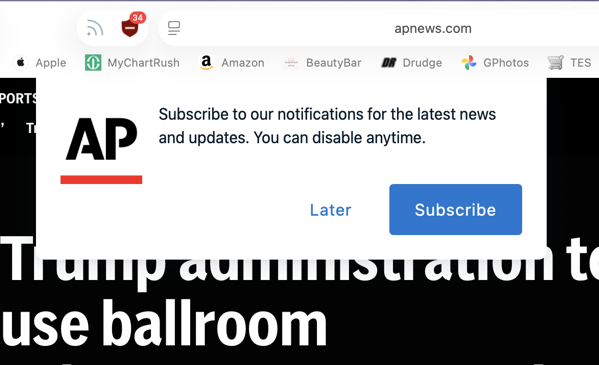
Years ago when Apple and others started allowing websites viewed in a browser to send notifications I knew we were headed to the mess things eventually turned into.

CleanShot 2026-03-31 at 14.26.

Sure, you can turn off notifications from individual websites, and I do. But in reality that’s just another wack-a-mole game that takes advantage of most users not having the time or wanting to do the necessary pruning. Whether websites are asking you to subscribe, or receive notifications it doesn’t really matter. Website notifications are just another fart noise on the enshittified web that stinks up the joint.

You’d think that website publishers would actually want to know who they turn off with their tactics, but that’s probably too much truth to handle. “Hey, boss. The majority of our users never want to see a notification from us.”

In my opinion, there’s an easy way to do so if companies have the guts to face the truth. Just add a button on any of those drop down notifications that says “Never.”

You can also find more of my writings on a variety of topics on Medium at this link, including in the publications Ellemeno and Rome. I can also be found on social media under my name as above.


The Potholes of the Internet

“Your Frustration Is The Product”

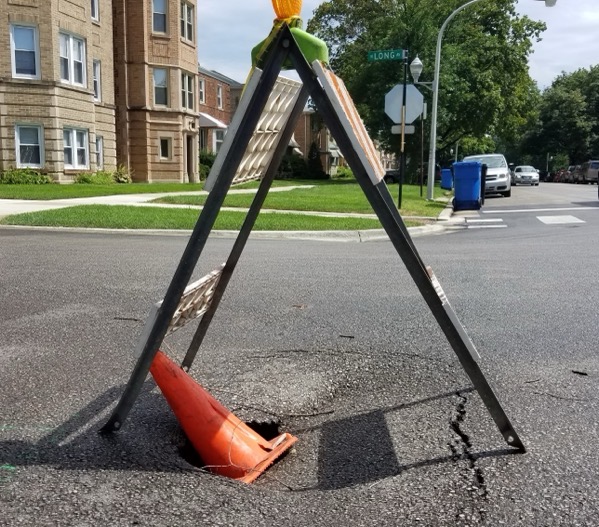
Some call it enshittification. I largely agree with that when it comes to the Internet. But that’s true in most endeavors that result in building something. Anything made for good, can and will be used in ways that turn it into a shitty experience.

20160824 121009.

I’m not just talking about advertising and how it’s junked up the web. I’m also talking about human nature, and how there’s a part of too many of us that see something wonderfully created to solve a problem, who then consequently turn it into a range of unintended consequences that leave us mourning our losses at the expense of somebody else’s gain.

Any one of us could run down a list of things in each of our lives that demonstrate that history, so I won’t even begin to spool one out. Have at it yourselves.

In the majority of instances the road to ruin is typically a path worn thin by greed and there’s never been a road we travel that doesn’t eventually fill with potholes. But back to the Internet and enshittification.

If this excellent post by Shubham Bose called The 49MB Web Page doesn’t make you yearn for a simpler age, I’m not sure what will, assuming you were alive and on the Internet before things went south. Remember, there’s a generation for which the way things are today on the Internet is the way things always have been.

Here’s Bose’s lede:

If active distraction of readers of your own website was an Olympic Sport, news publications would top the charts every time.

I went to the New York Times to glimpse at four headlines and was greeted with 422 network requests and 49 megabytes of data. It took two minutes before the page settled. And then you wonder why every sane tech person has an adblocker installed on systems of all their loved ones.

It is the same story across top publishers today.

The entire piece is worth your time if for no other reason than that misery loves company. We’re all in that same boat and there does’t seem to be any shoreline in view, given how the waters are being churned up anew by Artificial Intelligence.

As Bose puts it:

Your frustration is the product.

Back in the day I can remember getting a credit for complaining that my newspaper was delivered wet and unreadable. Good luck finding someone to express your frustration to these days.

(Photo by the author)

You can also find more of my writings on a variety of topics on Medium at this link, including in the publications Ellemeno and Rome. I can also be found on social media under my name as above.


Sunday Morning Reading

Small acts

It’s only business they say. Nothing personal. That’s the way the world works. Well, what I share each week in Sunday Morning Reading always comes from a place of personal interest. That may not be how the world works, but it works for me and I hope it does for you. Call it a small act.

Ganesh narayanan SU3zvkxttrE unsplash.

In the wake of the continuing and confounding ICE occupation of Chicago comes a terrific piece by Kyle Kingsbury called I Want You To Understand Chicago.

Follow that up with a ProPublica piece by Melissa Sanches, Jodi S. Cohen, T. Christian Miller, Sebastian Rotella and Mariam Elba about the nighttime raid on a Chicago apartment building that featured men rappelling from Black Hawk helicopters, and all of the residents emptied on to the streets with many of their belongings. The punchline is in the article’s title, “I Lost Everything”; Venezuelans Were Rounded Up In A Dramatic Midnight Raid But Never Charged With A Crime. 

A Nation of Heroes, A Senate Of Cowards by Will Bunch calls it like it is and much the way I see things after last weekend’s actions in the U.S. Senate.

Growing up, I never understood the cliché, “it’s nothing personal, it’s only business.” Frankly I still don’t. It excuses too much that I find wrong about the way the world works. Charles Broskoski examines the personal side in Personal Business.

And speaking of the way the world works (or doesn’t) in the midst of the Epstein fever I don’t think we’ll ever shake, Sarah Lyons points out that the violence in his and others’ actions is something we all live with in This Is How The World Works. It shouldn’t be.

Corbin Trent says We Didn’t Kill American Manufacturing—We Let It Die. He’s spot on.

Mark Jacob tells us How News Coverage Eases Us Into Tyranny.  However this saga we’re living through ends up, one thing is for certain. The media has killed any chance of returning to what it once was.

Hardly a day goes by that we don’t read of some nefarious business practice spilling out of Mark Zuckerberg’s Meta. Turns out Meta is knowingly leeching off of scammers to the tune of about 10 percent of its revenue. I guess that makes Meta and Zuckerberg a scammer too. Cath Virginia has the writeup with Meta Must Rein In Scammers — Or Face Consequences. I doubt they will.

The Internet Archive is under attack in the same way libraries, media organizations, and text book publishing is. It shouldn’t be. Mathew Ingram has the lowdown in The Internet Archive Should Be Protected Not Attacked.

On a more positive note, Jeff Veen tells us how Small Acts Build Great Cultures. Boy, do we need lots of small acts these days.

To close out, did you ever wonder where collective nouns like “a watch of nightingales” or “an ostentation of peacocks” come from? For many years it was assumed that the anonymous author of this collection of collective nouns was the work of a “gentleman of excellent gifts” written down in one of the first books printed after the invention of The Gutenberg Press, The Book of Hawking, Hunting, and Blazing of Arms. Turns out the author was a woman named Juliana Barnes. Maria Popova has the story in A Parliament of Owls And A Murder Of Crows: How Groups Of Birds Got Their Names, With Wondrous Vintage Illustrations By Brian Wordsmith. 

(Image form Ganesh Narahanan on Unsplash)

If you’re interested in just what the heck Sunday Morning Reading is all about you can read more about the origins of Sunday Morning Reading here. If you’d like more click on the Sunday Morning Reading link in the category column to check out what’s been shared on Sunday’s past. You can also find more of my writings on Medium at this link, including in the publications Ellemeno and Rome.

Sunday Morning Reading

No tricks. No treats. Just thoughts and reading worth sharing.

The frights of Halloween have passed us by, but real life horrors remain and expand. Never had more gut wrenching emotions this weekend than spending it with my grandkids costumed in their bountiful innocence, avoiding what’s out there in a life they’ll one day have to face, but in the present doesn’t exist beyond the edges of any joyful moment of wonder and exuberance they can conjure. This week’s Sunday Morning Reading won’t touch on too much of that, but then again, I think it just did.

David Todd McCarty thinks amidst it all We Can Be Heroes. Making my grandkids laugh uncontrollably makes me feels damn close.

Adam Gropnik visits the home of the poet Wislawa Szymborska and returns with How To Endure Authoritarianism.

Will Bunch says It Didn’t take A Reichstag Fire To Burn Down Congress. He’s correct. It didn’t even take a match.

Some interesting writing on Artificial Intelligence and the Internet this week that’s worth your while, first up Cory Doctorow tackles When AI Prophecy Fails.

Will Douglas Heaven explains How AGI Became The Most Consequential Theory Of Our Time.

Tim Chinenov wonders Who’s Creating The Rage Bait That’s Radicalizing You?

Decidedly not on the Internet Friday night while trick-or-treating with my grandkids, though not in my besieged town of Chicago, I witnessed not only kids howling with fun, but adults who joined in on the fun with their own costumes and decorated homes, some elaborate, some not so, all with love and honoring a tradition I’ve never seen in the communities I’ve lived in. Many families set up in their driveways, some with small fire pits, some with tents, tables full of food (and candy), welcoming all comers to their Halloween semi-tall gating front yards. I also noticed the adults who just sat in their cars and slowly followed their children down the block. The entire experience reminded me of this piece from the summer in which Joan Westenberg says every creator pays a tax while the rest stay spectators in The Unbearable Lightness of Cringe. Pay the tax.

And closing out this week, kudos to both the Los Angeles Dodgers and the Toronto Blue Jays for an excellent World Series, which the Dodgers won. Both teams played a splendid series and provided an incredible Game 7 finish to one of those contests you never want to see end, but know it must. Grown men over compensated for incredible talent, playing a kid’s game like kids, thrilling and heart breaking in the same breath. Too bad we don’t have any great, or even good, baseball writers to chronicle the moment these days.

If you’re interested in just what the heck Sunday Morning Reading is all about you can read more about the origins of Sunday Morning Reading here. If you’d like more click on the Sunday Morning Reading link in the category column to check out what’s been shared on Sunday’s past. You can also find more of my writings on Medium at this link, including in the publications Ellemeno and Rome.

Typepad to Shut Down on September 30

Ending an act

This blog is named Life on the Wicked Stage: Act 3. I may be a theatre geek, but I’m not a fan of the three-act structure. The name came about because there were first and second acts preceding it. The first act was on Windows Live Spaces (long since dead and gone) back in the day before I ever thought of this as something I’d enjoy doing. Then there was a Life on the Wicked Stage: Act 2 on Typepad. 

Well all plays, regardless of act structure have an ending. The curtain is coming down on that second act in the same way it did on the first one. Typepad is shutting down. Per the announcement on the Everything Typepad blog, the service will shut down on September 30th, 2025.

Typepad users have until September 30 to export their data. After that, all access will be terminated.

Everything in the corporeal world reverts back to dust. So do all the bits in the digital one.

Sunday Morning Reading

There’s a creeping inevitability to much of what’s happening around us.

Some Sunday’s when I sit down to collect what I find interesting enough to share it seems like things around us are just bad. Or going from bad to worse. It feels inevitable. This is one of those Sundays. Nevertheless, there’s some good writing and good thinking in the articles linked below that I believe are worthy of your attention. But paying attention is not one of our strong suits. Cue up a little Crosby, Stills, Nash and Young, pay attention, and read away.

‘Tin Soldiers and Nixon’s Coming’ is an excellent look back as we stare at this moment we’re in from Robert Cohen and Michael Konciewicz on the 2020 50th anniversary of Kent State and Jackson State.

You’re Not Ready, is an excellent, yet somewhat frightening compilation of articles by various authors at Wired, comprising info on AI hacker attacks, grid attacks, or a GPS blackout. I say “somewhat” simply because many of us have had inklings about this. Or at least those who pay attention.

Josh Marshal of Talking Points Memo has an excellent piece on Artificial Intelligence and The Posture of Skepticism.

Mathew Ingram’s fascinating piece, How Marc Andreessen and I (and you) Created The Web is informative and entertaining history and context that’s worth your time about the time we’re in.

Paul M. Sutter tells us that A New Theory Says Time Has Three Dimensions. It ‘Really Messes Up’ What We Know About the Cosmos, Scientists Say. We seem to be doing a good job of that at the moment given our current understanding of time, so why not go ahead and mess things up.

Timothy Snyder wonders what happens with The Next Terrorist Attack. It’s far deeper than the headline suggests.

Michael Podhorzer writes about something I’ve been thinking and saying for a while: The Courts Will Not Save Us. It’s a long read but more than worth your time. Read this instead of watching TV lawyers.

Most of the articles I’ve already linked to this Sunday morning in one way or another deal with trust. That trust gap is widening these days. It doesn’t help when we do find out things that break trust, but the finding out at least helps us understand the gap better. Take a look at Aruna Viswanatha’s piece The Pentagon Disinformation That Fueled America’s UFO Mythology.

Tomorrow, June 9th, Apple kicks off its annual World Wide Developer Conference. There are trust issues there as well. These next few links contain some interesting thoughts heading into WWDC, beginning with Sebastiann De With’s Physicality: the new age of UI, which anticipates the coming design changes rumored for all of Apple’s operating systems. A fresh coat of paint may not hurt. I’m not sure it’ll help.

As I said, Apple faces a number of problems, some legal and regulatory. Jérôme Marin explains how A Simple Comma is going to cost Apple Billions in Europe. Commas can indeed cause all sorts of chaos. Just ask US constitutional scholars about a comma and the 2nd Amendment.

And to close things out, one of my favorite developers _DavidSmith talks about his optimism heading into WWDC in Let’s Get Started. I admire the optimism and the reality check approach _DavidSmith brings to this.

If you’re interested in just what the heck Sunday Morning Reading is all about you can read more about the origins of Sunday Morning Reading here. You can also find more of my writings on Medium at this link, including in the publications Ellemeno and Rome.