The Siri AI Demo Apple Should Have Done

One day perhaps we’ll move beyond AI cliché demos.

My nephew occasionally takes a look at this blog and gives me feedback on what I think and write. Actually, he mostly gives me shit. He certainly does when I write about Artificial Intelligence. He often asks why I’m so “down” on AI. At least we agree on politics. 

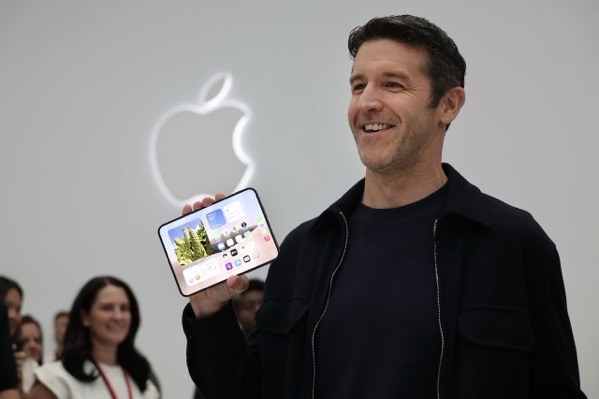
Apple Executive Mike Rockwell demos Siri AI at WWDC 2026

I keep reminding him that I’m not “down” on the technology per se. I’d love to see the press release announcing AI led to a a cure for cancer. Who wouldn’t? I’m down on the way it continues to be sold to us and the ramifications that brings on so many levels, while still feeling like it’s not what the sellers keep promising. (I also remind him to read what I write more carefully, but he’s probably using some AI to summarize what I write.) 

In truth, that’s the essence of my skeptical reaction to what we know as AI at the moment. There’s a lot going on, but how it’s being sold to most consumers still feels like it will ultimately be no more, no less than just another tool we use on a computer, after exacting high costs to do so, and dumbing down the general learning curve in the bargain.

Take for example the demos we constantly see about what AI can do when each company rolls out its latest version. As demos they all look slick as far as party and trip planning go.

(Coding is another case entirely. I’m not talking about that here, simply because I don’t have the expertise to do so. I’m strictly speaking of the sell to consumers.)

Even Apple fell back on these examples that have become clichés in this year’s WWDC 2026 announcement. Those clichés define the market companies think are ripe for the come on and then the plucking. I’m guessing they also define the current limitations of the technology. Or at least the limitations companies don’t want to risk pushing beyond in a live demo. 

Here’s the AI Siri demo I wish Apple had shown us yesterday. 

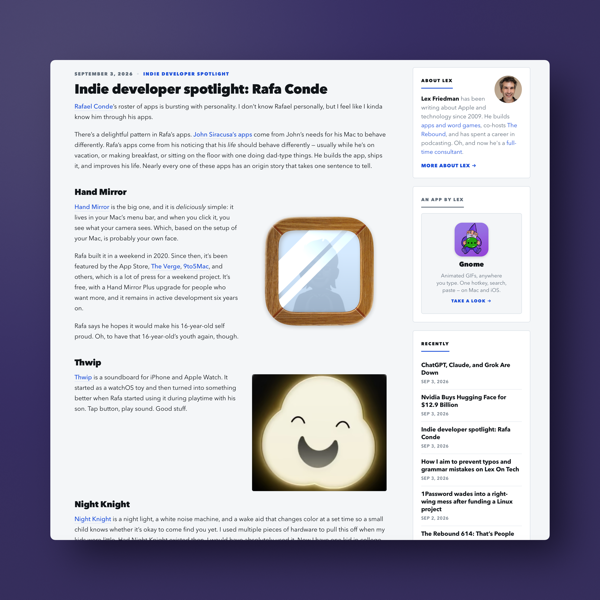
If you watched Apple’s keynote presentation you might remember this slide. 

Maybe not. It flew by pretty quickly. It’s a word cloud of all of the other non Siri AI improvements Apple is bringing to its various operating systems this year.

Yes, the print is that tiny and crammed together. To call it unreadable is accurate. For those who didn’t watch the demo, the length of time it was on our screens was equally tiny, certainly compared to all the travel time each presenter took to walk on and hit their mark prior to speaking. To be honest, the slide’s quick and unreadable inclusion felt insulting given the long list of improvements it’s touting. 

(To my knowledge no such list appears yet in Apple’s Newsroom or on its website heralding the other announcements. If I’m wrong, point me to it and I’ll link to it here. I’m sure it won’t be long before one of the sites that covers Apple distills it down and publishes it. Probably using AI.)

(UPDATE: Right after hitting publish, I noticed that John Gruber linked to this post on the Oneberri Blog listing all of those improvements.)

What if Mike Rockwell, the Apple Executive who did the Siri AI demos, had asked Siri AI to take that slide, and present the info into a bulleted list in Apple Notes, and then prepare a PDF for distribution? In the post keynote tech talk he and other Apple execs participated in, he could have followed that up by asking Siri AI to distribute the PDF to the other Apple execs on stage. Essentially it would have demonstrated the same Siri AI capability to gather info across native Apple apps, using context, in the same way the clichéd party planning demos do.

It certainly would have been more impressive than the usual clichés.

Perhaps AI Siri and the apps needed to do that work aren’t ready for such a challenge just yet. Things are still in beta after all. Perhaps it’s just too risky to stray outside of what’s made these kinds of demos a laughable cliché. Perhaps we’ll get there someday. Who knows? 

Meanwhile I’ll remain “down” on AI the way my nephew likes to give me shit about my AI skepticism. I hope one day this technology might indeed lead to a cure for cancer. I also hope my nephew keeps reading this blog. It might help him learn to think for himself more often. 😉

Thanks for reading. You can subscribe to this blog if you care to. You can also find more of my writings on a variety of topics on Medium at this link, including in the publications Ellemeno and Rome. I can also be found on social media under my name as above. This site does not use affilate links.


Apple Announces New OS’s. I’m Still In Wait And See Mode

Apple works to make good on Apple Intelligence with Siri AI

At WWDC 26 Apple today announced new operating systems all ending in OS27. (The numbering thing drives me nuts.) The entire keynote felt different to me from recent years. I’m not talking about the presentation organization that strayed from the usual by device format. Rather it felt like Apple felt a bit humbled. Almost as if Apple is in a we’re in a thinking different mode these days. I may be reading more into that than is real, but I’m usually pretty good at sniffing these things out. 

Apple announces Siri AI and its next generation of Apple Intelligence.jpg.

Apple chose the name Golden Gate for its macOS 27 version this year, and it looks like the folks in Cupertino heard the criticisms about Liquid Glass and have taken some steps to correct what I and many other consider design flaws. I’ve seen as many negative as positive reactions to the design changes, so we’ll see how that goes throughout the summer. 

There was also quite a bit of time devoted to Parental Controls. Given the political heat big tech in general is taking politically here in the US and elsewhere that’s probably a smart move. The announcement stirred up a bit of controversy from folks not in favor of efforts like age verification. The devil will be in the details. 

The big push though is all about Apple Intelligence and the New Siri, now called Siri AI. Trying to play catch up and recover from the mistakes of two years ago, Apple showed off some live demos in a separate meeting from the keynote. You can read about that on The Verge. So you have to consider showing live demos a plus over two years ago, although it was still in a protected environment. I’ll be looking for users to do the same as the betas roll out, even if it appears that there’s a waiting list for the New Siri. So, we’ll see how that goes.

Note that Siri AI, announced to roll out this fall, will be delayed in the European Union and China.

The announcements were solid. They appeared to address past problems of Apple’s own making, user complaints about recent design changes, and the promise of under the hood bug busting. Announcing speed increases across the platforms is promising. But we’ve been here before. Every keynote from every company makes promises. The devil is always in the details, and when life is a beta, you never know what’s final and when. Especially when you’re in a mode of trying to rebuild trust.

You can check out the entire keynote reduced to 26 minutes, also from The Verge here. And Jonny Evans has a nice collection of the headline announcements from the keynote here.

And this Mastodon post from Dwight Silverman sums up my some of my early thoughts as well.

To further sum it up my early thoughts, I’ll just say this. It’s going to be an interesting summer watching folks hammer on the betas, the first of what was released to developers today. The public betas will roll out in July. But we’ll have some early indications later in the week as developers begin working with the betas.

So, I’m still in wait and see mode. As should most of us be.

Thanks for reading. You can subscribe to this blog if you care to. You can also find more of my writings on a variety of topics on Medium at this link, including in the publications Ellemeno and Rome. I can also be found on social media under my name as above. This site does not use affilate links.

What Does A “Siri That Works” Mean?

“An acre of performance is worth a whole land of promise.”

You know what a litany is. It’s a series of prayers with predictable responses, learned, ingrained, and repeated without much thought. Call it “call and response.” As we finally arrive at the beginning of Apple’s WWDC 2026 today, the call has been summarized down to Apple needs a Siri that works.

But how the hell do you respond to that?

An official "Everything Everywhere All at Once" Pet Rock, featuring a smooth, dark grey oval stone with two plastic googly eyes attached to the front. The rock sits nestled inside a bed of shredded brown kraft paper. Behind it is its custom light-blue cardboard carrier box designed like a pet crate, complete with a carrying handle and circular air holes. The box has white text that reads "Oh good. You're here too." on top, with "PET ROCK" in a bold, stylized white font on the front.Siri was once a surprising computer gimmick, before Apple got its hand on it in 2010. Siri has been surprisingly bad at most things ever since. Sure you can set a timer, or a reminder, occasionally play the right play list and a few other things. If that were the extent of the promise the jokes wouldn’t be funny. But the promises were always more. They never lived up to the personal assistant aspirations. It’s still largely a gimmick. One too easily made fun of. 

Amazon’s Alexa and Google’s Assistant, (now Gemini) have taken bigger steps forward than Siri, but also continue to fall down and scrape their knees. Chatbots have come along and for some have replaced the need for someone to talk to. But each of those efforts still yield mistakes and failures. You know the way, humans do.

So do pleas for a “Siri that works” mean something that will always work? I doubt it. I think the expectation is that these chatbot like companions will continue to fail. Again, the way humans do. But you can’t sell that.

Does it mean a “Siri that works” does something new? I doubt that also. The entire promise of computer assistants, chatbots and artificial intelligence is to do things we already do more efficiently. In fact, that’s the history of computing. When spreadsheets replaced pencils, green eyeshades, and then calculators we were on to something.

We haven’t yet figured out a way to help us communicate better in person, much less in front of a screen or into a microphone. A “working Siri” (or any other chatbot) isn’t going to help us with that. They may teach us a new way to communicate to set that reminder, but the respondents failure makes us all feel like we’re wrong. Until we just stop talking.

I’m not sure how you reconcile doing things more efficiently with the failure rate. One that seems all but guaranteed by the “mistakes will happen” caveats that prove lawyers always earn their keep. Frankly, I don’t ever see a “fire and forget it” guarantee in what remains of my lifetime. Maybe someday.

Word is that whatever Apple rolls out as “a working Siri” will roll out with a beta label attached to it. That’s a good preemptive legal response, but a sad commentary on the state of things. We expect things to go wrong in betas. Talk about setting a low bar. Even a necessary one. 

Speaking of the history of computing, when it comes to mobile computing we’ve gone through at least one cycle where the focus shifted away from keeping us addicted to our phones, to an entire wave of ways to help us escape the tyranny of the small screens, put them down and enjoy more of life without them. Call me crazy, but the rush to chatting away to smartphones, AirPods, pendants, pucks, cars, etc… seems contradictory to solving our tech addictions. Out with the old trend, in with the rerun.

Gimmicks work. They help sell devices and feed trends. Think pet rocks. We’re already seeing talk of children’s toys with AI voice assistants and reactions against them. At least this time around the reactions are coming more quickly.

I’m guessing it’s not long before we see a pet rock product that contains an AI powered voice assistant. We can always use another paperweight.

Thanks for reading. You can subscribe to this blog if you care to. You can also find more of my writings on a variety of topics on Medium at this link, including in the publications Ellemeno and Rome. I can also be found on social media under my name as above. This site does not use affilate links.
Segmenting The Future Of Computing

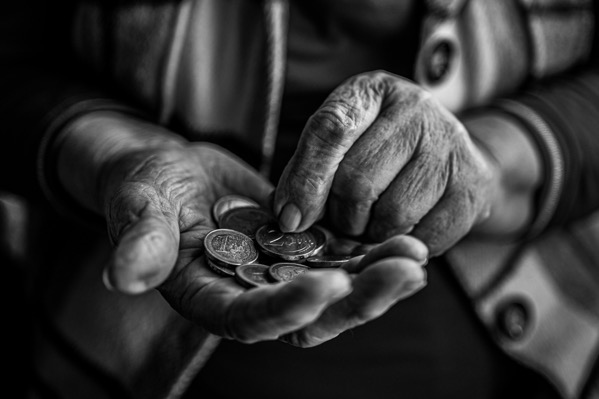
The days when the costs of technology decreasing over time have passed.

I’ve been writing a small bit about the segmentation I see coming in how we currently think of computing. Yes, it’s about Artificial Intelligence, and yes, it’s about money. There’s no question that we’re already seeing price increases due to chip shortages, but I’m thinking that’s just the beginning of what will make Apple’s reputation of shipping too expensive computers, prior to the MacBook Neo, seem like a memory.

A close-up photograph of overlapping neon signs illuminating a dark background. In the foreground, a prominent bright green neon sign is shaped like a dollar symbol ($\$$) by Aedrian salazar Wy7Gy8ZcW1M unsplash.

There’s no question that the cost associated with Artificial Intelligence is driving this and will continue to do so. The question is how much? Note that in the latest announcements from Google, Microsoft, and Nvidia heralding what’s coming that price tags weren’t revealed. Quite frankly from the way I’m reading the tea leaves scattered among the press releases, most of these companies are skittish because they don’t even know how high the cost curve is going to bend. Or they’re afraid of the sticker shock once they do find the courage to announce them.

The way I see it, the next period of time is going to be one where if you can afford the steeper prices of hardware and AI services, you’ll be able to play on that level. Those that can’t, and may not even need to, will be gradually left behind. Although for many that won’t prove to be that much of a problem given their needs. Initially.

Tell me honestly, what has any AI company promised, prior to this coming age of agents, that most computers can’t already do? Heck, even some of the promises agents can supposedly deliver don’t seem to offer that much more, unless you’re a software developer or in math sciences.

That said, operating systems and software are all being geared up along with consumer hardware to make the expensive side of the equation be the standard. 

Already we’re seeing moves away from AI robots doing their work in the various clouds. Companies are prepping local AI models to be installed on devices. Those local models are going to require memory and processing power that’s going to further drive up the hardware costs while possibly reducing the token tax. Gaming hardware is about to become really expensive. Back in the cloud, eventually we’re all going to be paying for search. Probably sooner, rather than later, if you want decent results. 

Speaking of taxes. Governments are starting to sniff around with their divining rods, sensing new money reservoirs to be tapped, while watching water resources stretched thin. There’s obviously a thirst. If, when, and where that happens will just add costs to be passed down the line. 

Take a look at this quote from Microsoft’s Satya Nadella:

“There are really two stories people can tell about this moment. One is that technology concentrates power, reduces human agency, and leaves to society to absorb the consequences. The other is that we use this next wave to unlock opportunity for developers, scientists, enterprises, and every community. And our job is to make the second story true.”

On the surface it sounds like there’s opportunity for what’s coming to be all inclusive. Clever. Beneath that surface I think Nadella is hinting that unless your computing needs are in fields of endeavor that will require AI to be competitive, you’re at the tail end of that second story and will probably be on the outside looking in while absorbing the consequences. There’s really only one story.

As I mentioned earlier, there are plenty of users who don’t need the latest and greatest hardware and will probably be just fine without. For a time. Unless the big players create operating systems and hardware that segment out some of what will only become compute heavy advances, consumers will eventually find today’s tasks more challenging and less secure as existing hardware slows down and future security updates are released on slower schedules. 

Of course that also leaves an opening. 

Perhaps companies that offer hardware and services that don’t push whatever current AI envelope is being pushed, might find a willing market. You could argue that Apple’s MacBook Neo, and Dell and others’ recent announcements to counter that somewhat surprising move, might presage this. Without lower entry price points, who knows, a lot of users might just return back to the days of envelopes and snail mail.

That’s probably too extreme a reaction, but we’ve seen similar reactions to technology in the past, some quite recent, once the gee whiz factor has worn off like the letters on cheap keyboards on even expensive computers. Think touch screen displays instead of buttons and dials in cars. Think home automation. Think the Metaverse. Think talking appliances. Think cars and machinery that require maintenance contracts. Think 3D TVs.

Those that love to dabble and explore frontiers and have the money to do so will always seek the next adventure. Go for it. Those who just want to send a birthday greeting, create a holiday card, share a calendar, proofread a document, or search for a local merchant don’t want a hustle or a hassle, or the increased expense that’s obviously coming.

For the moment, the days when the costs of technology decreasing over time have passed.

(Image from Aedrian Salazar on Unsplash)

You can also find more of my writings on a variety of topics on Medium at this link, including in the publications Ellemeno and Rome. I can also be found on social media under my name as above. This site does not use affilate links. 
Thoughts Before WWDC 2026

Looking ahead and looking back

Wait and see. 

That’s the summary of my thoughts for Apple’s World Wide Developer Conference this year. That event happens next week. The waiting and seeing will happen over the summer, possibly all the way until this time next year. 

I’m not talking about what Apple will talk about at the conference and in the keynote. I’m talking about what they actually deliver down the road and when they deliver it for the numerous operating systems with 27 tagged on at the end. Some will get love. Some won’t. That’s nothing new. (Ask iPad users.) For a company with so many resources each year’s releases always seem to curiously remind me that Apple picks a platform to focus on, and seems content to let others wither on the vine for a time. 

To be fair, I’ve always had a wait and see attitude towards most tech announcements, because what looks sexy and is hyped in the demos, press releases, and podcasts, sometimes makes it into the hands of users, sometimes not. Prior to 2024, Apple usually delivered on what it promised. But that changed with Apple Intelligence. A name I bet they wish they’d never let see the light of day. They didn’t deliver then and haven’t since. They promise they will this time, although who knows what that will really mean. The weight of wait and see has become heavier.

This also comes at a time when there’s a burgeoning backlash building among consumers against anything related to Artificial Intelligence. So the climate is not nearly as inviting as it was two years ago. For what’s it worth, I think it’s becoming harder and harder to sell any product or feature that guarantees its inaccuracy up front, promising to do better in the future. But there sure seem to be enough takers and talkers thinking different on that than I. 

Curiously, Apple seems to be hedging its bets, apparently set on using Google’s AI as the foundation. Some say that’s a place holder until Apple rolls its own AI after it’s mistaken first rollout, the way it did with Maps. Some say it’s a wise move for the future because it might save Cupertino some cash and more blowback from having to build out its own data centers. I say, wait and see.

From what I read Google may be reinventing itself and the Internet with its efforts, but those efforts aren’t meeting with thunderous applause and accolades. At least compared to Google’s competitors. Besides effectively putting Google in the catbird (chatbot?) seat driving all AI chatbot activity on the majority of handsets sold on the planet (Android and iOS), who knows how it will turn out. No chatbot can predict, nor can any human. That said, the marketing puzzle about what’s Apple and what’s Google is going to be fun to watch play out, even in the end it’s going to be meaningless to most consumers. 

There’s also word that this year’s OS releases will also focus on fixes and not new features the way Snow Leopard did for Leopard on Macs back in the day. Intriguingly there were quite a new features for Macs in that release. Speaking of Macs, there’s also talk that they will see more of Liquid Glass than we saw the first time around. To be honest, I’m grateful for last year’s comparative neglect of Liquid Glass on the Mac. I’m waiting and seeing with a bit of trepidation how attention is focused on that this year. I’m also waiting on the day when someone finds a way to sell me on rounded corners on rectangular displays.  

I would welcome fixes. Boy, would I welcome fixes. I’ve long maintained that the cadence of Apple’s OS release cycles is too rapid to allow it to effectively address problems. I get that there’s a long view and a necessity to look ahead, but when you’re hearing leaks about the next year’s efforts before this year’s are announced I think the tempo is too fast and it becomes too tempting to push things off until the next year.

I’ve written about a number of things that bug me off and on. Because they bug me off and on. I’ll list some that stand out that I wish would get attention. That said, most seem to fall back on issues with iCloud. Hearing talk that however Apple rolls out the new Siri or chatbot feature will allow that feature’s chat history to sync across devices via iCloud gives me a shutter. I’m guessing that will lead to more unexplainable stops and stutters in iCloud syncing in general. 

So, here’s a small list of things I hope, but am not counting on, seeing addressed.

iCloud syncing. Just make it reliable and give us Sync Now buttons. We get one is Messages. How about the rest of the core apps?

Perpetual Betas: I know, and respect that Apple is continuing to work on each new operating system throughout the year. Kudos. It can’t be easy. That said, find a way to keep from mucking things up on the backend for users who don’t participate in betas. Perpetual beta weirdness is hell for normal users.

Phone app. Apple made significant changes last year. They need to make more. There’s no reason in the world I can see for not going all in to help users more efficiently get rid of unwanted or fraudulent calls.

Error Messages. Tell us more. Yes, I know something failed. Tell me more about what failed and point to a solution or information that can help me find out more. 

Apple Mail. Rules in Apple Mail need to work consistently, or just be done away with. Features in Apple Mail on iPhones and Macs need to be brought into line with each other. It makes a mockery of trying to unify things between iOS and macOS.

Shortcuts. Yesterday’s future is probably some tomorrow’s further fading feature. Shortcuts are great when Apple doesn’t change things behind the scenes that cause them to break. That happens too often. Rumors that you’ll be able to create them via a chatbot sounds potentially promising. But if they are still going to randomly break, what really is the point?

Contacts. A small amount of attention could do wonders with this seemingly forgotten, yet essential app.

Apple Music on the Mac. Why is this app so bad for a company that says over and over again that it loves music? 

Reminder Notifications for Shared Reminders. There has to be a way to programmatically dismiss a shared reminder notification once it has been completed and marked off. Fix it. It is just simply annoying. Especially in the context of all of the improvements in the Reminders app the last few years.

App Store. For a company that spends untold amounts of money on its brick and mortar stores, I remain shocked at how they can be proud of the software versions of any of its App Stores. 

watchOS Software UI: We’ve already heard there won’t be much in the way of changes for the Apple Watch this year. But at least pay attention to some of the software design.

Settings. Find a way to clean up this mess. There has to be a way.

Note that many of the issues listed above are still hanging around and are the same as in my list last year.

As much as the attention will be on whatever Apple attempts with Apple Intelligence after WWDC 26, attention will also quickly pivot to the fall when new devices are announced. Given that we’ve heard countless times that devices like Apple TV and HomePods, and other home related products, are waiting in the wings for software focused on AI features to catch up, it will be curious to see what attention, if any, they get during WWDC. I don’t think those devices will be announced until the fall. I don’t expect any hardware announcements of any kind next week.  

Speaking of waiting in the wings, much will also be made about this being Tim Cook’s final WWDC as CEO with John Ternus due to take spotlight this September. Much attention will be paid to the semiotics surrounding all of that during WWDC and after. That will be interesting to watch, but since WWDC 2026 feels more and more like a catch up year all around, I’m guessing next year’s event might be more telling. We’ll have to wait and see.

So, there’s my thoughts. That and nickel won’t buy you anything.  

You can also find more of my writings on a variety of topics on Medium at this link, including in the publications Ellemeno and Rome. I can also be found on social media under my name as above. This site does not use affilate links. 
Two Weeks and Pinky Promises

Promises, promises

Two weeks. We’re all more familiar than we’d like to be with Donald Trump’s announcing anything and telling us it will manifest in two weeks. It’s become a joke worth laughing at, but without a punch line. It’s become mundane.

Two hands joined in a pinky promised. Photo by Olivia anne snyder wT_BwKOeEik unsplash.

We’ve also become accustomed to hearing promises from tech companies, that a safer and perhaps smarter course of action is to look askance with a skeptical eye, or perhaps turn a deaf ear. Autonomous driving is one of those, (as is anything Elon Musk promotes) and so too are most of the promises about achieving some sort of Generative Artificial Intelligence that might lead us all into some future where we all don’t have to work, money becomes no object, and all of our problems are solved. Let’s not forget curing cancer.

If we’re standing in the “foothills of the singularity,” I’m guessing those enjoying that view drove there instead of climbed.

It’s one thing for politicians and anyone trying to sell a product to make promises. It’s quite another when the world’s economy turns on the hype, yet never seems to suffer ill effects when deadlines are missed, ignored, or just punted down the road again and again.

Apple caught much deserved grief over its Apple Intelligence promises in 2024, as of yet still unrealized. But that seems to be one of the rare occasions when failure actually left a mark. Even so, that gigantic mistake seems to be have been quickly forgotten. It certainly doesn’t seem to have affected Apple’s bottom line. Even a class action settlement between Apple and those who bought into the promise when they bought a new iPhone doesn’t seem to have caused much of a ripple.

Even when software products are released, it feels like we’re too often in a perpetual beta, always waiting for the next update. When it comes to AI, there are so many bets being made on it being our future, even with all of the products today warning us that they are imperfect and capable of mistakes. When will someone pushing that hype tells us that those warnings will one day be gone? I’m guessing never. At least if the lawyers have a say.

I guess I’m showing my age when I say I grew up in a time when if you announced a product you were judged on whether or not you delivered. If you didn’t, how you handled the broken promise mattered. 

They say all good things come to those who wait. These days there are times when I wonder if any of it is worth any of the wait. The promises sure aren’t.

(Image from Olivia Anne Synder on Unsplash)

You can also find more of my writings on a variety of topics on Medium at this link, including in the publications Ellemeno and Rome. I can also be found on social media under my name as above. This site does not use affilate links. 
Sunday Morning Reading

Wandering through the Internet, disregarding along the way

We live in interesting times. I’m spending a lot of my time being interested in watching my grandkids develop, and watching everything around how I thought they might grow up change. In my opinion, change not necessarily for the better. They won’t know what things changed from necessarily, unless they choose to look into it. That assumes they’ll be able to do so the way we can now. I have my doubts about that. Regardless, that’s tomorrow. Here are some links to share in this edition of Sunday Morning Reading. 

A close-up photograph captures a bronze statue of a young boy sitting on a stone bench outdoors, absorbed in reading a book.

Terry Godier says the Internet is dying. I’m not sure if it’s dying, morphing, collapsing in on itself, or just in the midst of growing pains, but I take the point. Check out The Boring Internet. (That’s a link to the text version. There’s also an animated version here. Quite nicely done.

JA Westenberg believes Nobody Is Destined For Greatness. I happen to agree. Shakespeare gave his greatest comic villain, Malvolio, lines about being born great. I wish I could label our current day villains as comic. Perhaps one day.

Derek Sivers reminds us that Geography Is Four-Dimensional. How true. There’s a reason Shakespeare more often than not capitalized the word “Time.”

Stories about religion occasionally get shared here. Mostly they are stories about how it’s really not religion, but a cover for grift and abuse. This is one of those. He Remade The Southern Baptist Convention In His Image. Then Came The Abuse Allegations by Robert Downen chronicles yet another of those tales we seem to hear far too frequently these days.

For another take involving religion, check out Neil Steinberg’s Being Formed By Christians Does Not A Christian Make.  He quotes Thomas Jefferson’s “It does me no injury for my neighbor to say there are twenty gods, or no god. It neither picks my pocket nor breaks my leg.” I’m not sure we can say either of those things any more.

There was a bit of a funny fracas after Google’s all in on AI announcements this week at its annual I/O conference. Apparently for a short time after Google announced big changes to Search, you could not Google the word “disregard” and expect the usual quick definition. Google quickly fixed that. The root of the problem? “Disregard” is an AI command that you have to put in a prompt to keep the AI demons from you know, making a mistake. Check out Russell Brandom’s quick story, You Can No Longer Google the Word ‘Disregard.’

Speaking of Artificial Intelligence, the talk is all about agents. (Actually that’s been the talk for a while, the volume is just increasing.) Hayden Field thinks If Google Can’t Make AI Agents Useful, Maybe No One Can. FWIW, I think Hayden is spot on.

In an article The Economist credits as anonymous, someone thinks Vladimir Putin Is Losing His Grip On Russia. Perhaps that’s true. I don’t know about you, but I’m as tired of hearing about autocratic oligarchs losing their grip as I am about hearing all of the promises about generative AI and autonomous driving being just around the corner. 

If you’re interested in just what the heck Sunday Morning Reading is all about you can read more about the origins of Sunday Morning Reading here. If you’d like more click on the Sunday Morning Reading link in the category column to check out what’s been shared on Sunday’s past. You can also find more of my writings on Medium at this link, including in the publications Ellemeno and Rome. This site does not use affilate links. 

Google Is Paving A New Information Superhighway

Getting from here to there is about to change

This is a feelings post. Meaning it contains things I feel, more than things I know or can reliably speculate about. It comes in the wake of Google’s announcements at its recent I/O conference

An expansive aerial, high-angle photograph captures a major highway demolition and construction zone cutting through a dense, forested landscape under an overcast sky.
In the immediate foreground, an old concrete overpass bridge is actively being demolished. Several large excavators—colored in yellow, blue, and orange—are positioned around the rubble, using hydraulic breakers to smash the concrete structure into a large pile of grey debris, sending up small plumes of dust. Stripped brown dirt embankments frame either side of the demolition site, bordered by bright blue temporary construction barriers.

The way I’m feeling things, Google is essentially repaving what we’ve been referring to as The Information Superhighway, better known as the Internet. 

Gone (or soon to be gone) is the Google most Internet pedestrians think of when they think of Google. Google has decided it’s ready to quit A/B testing and slowly spoon feeding us Artificial Intelligence, and chosen to bulldoze new paths ahead that will be all AI, all the time, everywhere.

From what I’m seeing if you want to use Google’s products, whether it’s on a Google device, Samsung or other Android device, or even an Apple device, you’re serving Google in larger ways, while serving yourself. 

This has and continues to be a race that Google has always had the resources to win, and for the next few laps at least it feels like they will. Frankly, I don’t see the others being able to compete on that scale, for the simple reason that like it or not, Google is far more entrenched in users minds as a go to than any of the others. 

Also, the other competitors may be good at creating code, but they appear far more incompetent at selling what they offer. Google has become pervasive enough, that it doesn’t need to care as much.

As to feelings, this does feel bad as it feels inevitable. I liken it to the days of Interstate construction that spread across this country. Entire generations have grown up not knowing how to drive great distances without traveling along an Interstate. Sure, there are folks who avoid them and take their time along more conventional routes, but that’s a very distinct minority. 

Eventually there will be entire generations that will never know what the verb “Google” meant, the way those understand it today, just like those pre-Interstate generations of drivers. Even so, I’m guessing using it as a verb will probably mean the same to those down the road in the same way my grandkids don’t distinguish driving to grandpa’s house any differently than I do, when what today would take less than an hour, back then took at least two, often three.

But like many communities that slowly died out when Interstates and expressways bypassed towns, depressing changes will come to the Internet as Google owns more of the traffic and shares less, and essentially has to charge tolls to head down it’s superhighway, that used to be free. 

I’m still digesting the news from this week, and I don’t think the story has been completely told yet. There’s also no way to know that if any of these promises will ever pan out. (Google is as famous for announcing what might never come to pass as it is for search.) That’s why this is a feelings post. Perhaps one of the most unsettling feelings I have about all of this is that Apple, by adopting Google’s approach to AI, in lieu of its own failing efforts, is helping create an Internet universe that for most users, will essentially be controlled by Google. Samsung is already all in, Apple as of this fall will be too. That essentially means that buying a smartphone from one of the largest two sellers, or any other that uses Android, is buying a ticket to travel on Google’s superhighway.

The various theories that suppose Apple is doing this as a stop gap until it can come up with its own solution the way it had to with Maps back in the day, don’t hold much water in the vessel that is my brain. There’s money to be made certainly, but there’s money (lots of money) that needs to be spent to construct all of whatever Google thinks it has going. My hunch is Apple will let Google spend the dough, take the credit and the blame, (there will be plenty of both) and happily collect a percentage as long as it can still sell iPhones and other hardware.  

We live in interesting times. 

(Photo from Rob J. Follet on Shutterstock)

You can also find more of my writings on a variety of topics on Medium at this link, including in the publications Ellemeno and Rome. I can also be found on social media under my name as above. This site does not use affilate links. 
MacBook Neo and iPad: Here We Go Again

Tired arguments get a new leash on life

When Apple released the MacBook Neo it was obvious to most that Apple had introduced a product that would shake up the larger laptop market. Lurking just underneath that obviousness was how it might or might not affect the iPad market. It was only a matter of time and timing, before those who, both rightly in some cases and wrongly in others, criticized Apple for not delivering the iPad of their dreams that could do anything and everything seized on the Neo’s success as a pivot point in the discussion.

An iPad Pro with a scribbled message that says iPads and Neos. There is an Apple Pencil laying on the iPad

The quest for the perfect device for everyone is and will always be an imperfect one. Much like the arguments. In addition to its impact on the laptop manufacturing markets, the MacBook Neo proves just how imperfect those arguments are. Yet, there’s already a large dollop of discourse saying that the Neo proves Apple’s iPad strategy needs adjusting. Add to that the rumors of a touchscreen Mac that continue to recirculate the same way the iPad discussion does just prior to WWDC each year.

On Michael Tsai’s Blog there’s an excellent collection of links and comments that’s worth a look if you’re at all interested in this ultimately meaningless debate. The links feed off a post from Craig Mod, titled MacBook Neo and How The iPad Could Be, that argues “iPads should be radically touch only and MacBooks should be keyboard-first.” I can’t say I disagree. But I think the discussion should go further than either/or.

There’s got to be several data centers worth of AI-scraped web articles on the ups and downs of the iPad floating around and how Apple’s strategy held it back. And yes, the iPad has had its ups and downs. But I would argue that’s mostly, not completely, a question of preference rather than any “the iPad should be this or that” win or lose proposition.

Being an iPad user since the first edition, I’ll say this. Most of the dissatisfaction I’ve seen over the years comes from those who wanted the iPad to be more like a Mac than those who used it primarily as a tablet. Without trying to be derisive, I’d venture to say that most who complained were keyboard jockeys by trade. I don’t begrudge them their complaints. From that perspective the complaints did and still do make sense. In many ways they were following Apple’s lead from the “What’s a computer?” days, before Apple abandoned that tack and sailed into broader and more lucrative waters with Apple Silicon.

Admittedly I’m showing my own preference here. I use an iPad as a tool in my work as a theatre practitioner. I’m on my feet with a script on my iPad, using an Apple Pencil to take notes. If I need to do keyboard work in the rehearsal room, I plop the iPad on a Magic Keyboard, do the keyboard related task, then pop the iPad off again and get back on my feet. When I’m back in my digs, I mostly work on a Mac. Apple’s ecosystem makes this all possible. When it works well.

Personally, I hope Apple keeps developing and delivering all of its current line of products. Stretch capabilities in some to the limit, and limit others with less.

The current lineup serves me well. Frankly, I can’t imagine any changes Apple could make that would alter how I work. I’d be content with that future, even though I know the tools I’m going to use are going to change regardless of my current comfort zone. If that future is all about creating hardware to run AI, as it appears to be, the decision points are  going to shift away from most of the spec and capability differences we’ve been accustomed to in the past anyway.

Craig Mod argues that “the specificity of our tools should be radically clear.” I buy the argument, but extending the discussion I’ll say it’s better to have more capability than less. Most users don’t touch anywhere near what even the most limited devices can offer. In my experience they find their way to whatever level they need, which is a much lower one than most realize. Those of us who may made need more, don’t understand that most users couldn’t care less.

Moving on, and with the “What’s a Computer?” miscues behind us, Apple’s current challenge and our headaches stem more from Apple trying to meld its operating systems into some sort of grand cohesive vision that feels the same across all of its devices. Admirable. But ultimately flawed in the same way that each different computing device Apple sells is as different as any two users who use that same device. Vive la différence.

I’m sure Apple gets that, but until the MacBook Neo that wasn’t quite as smack the Apple press in the face apparent, even though there have been lesser featured iPads at lower price points prior to the Neo. You could argue the same about the iPhone Air, but the higher price obscures the point.

With talk of higher priced “ultra” iPhones and who knows what else supposedly on the horizon, who knows where all of this really leads. I’m guessing Apple will be more than content to have a multi-layered series of price points attracting customers from both the low end and the high end. That all leads to more users spending money on Apple services and that’s the key to Apple’s continued growth. More hardware entry points (price) bring in more users than new features most won’t ever use. It’s simple math.

As long as Apple’s hardware profit margins can be maintained across its lineup, even with lower priced and perhaps less capable hardware, it’s pretty much a slam dunk. The success of the Neo not only points to this strategy, it should also point ahead to a diversified hardware lineup that fills many needs, as long as there is a clear and distinct choice for the toolsets that suits them best.

(image from the author)

You can also find more of my writings on a variety of topics on Medium at this link, including in the publications Ellemeno and Rome. I can also be found on social media under my name as above. This site does not use affilate links. 
 

More Thoughts On The Cook/Ternus Changeover

Honeymoon timing

Yesterday’s news of Tim Cook handing over the CEO mantle to John Ternus was news only in the sense of the timing. As I said then, it’s been expected for a while. It reminds me of any Apple rumor. It’s not true until it’s announced, even though most of the announcements turn into mostly confirmation these days. Note that Wall Street barely moved a tick on that news today. That tells you how well the ground was laid.

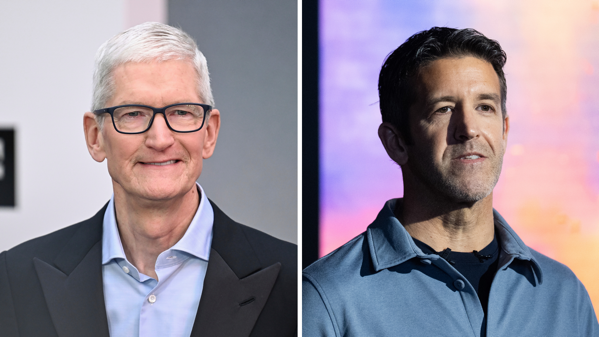
Apple ceo jpg.

Of course yesterday’s announcement has prompted exactly what you would expect, yielding tons of coverage on websites and podcasts. For Cook there have been accolades and brickbats, both deserved. For Ternus there has been excitement and a little caution.

Before I get to some thoughts of my own, here are a few links I found worthy of sharing because they stepped outside of the expected.

M.G. Siegler takes us on A Cook’s Tour.

Daryl Baxter saw more shock in the Apple community than I did. He reminds us that Tim Cook introduced the first Siri as part of his first iPhone event in 2011. He points ahead to this year’s announcement by John Ternus possibly poised to announce a promised better Siri. What goes around, might come around again. Let’s hope it doesn’t take another 15 years to get it right this time.

And Horace Dediu looks way ahead to 2040, when Ternus himself steps down to begin the transition to the next CEO. John Ternus Has Left Big Shoes To Fill is quite a trip into the future. You’ll get a chuckle or two.

The first of my thoughts has to do with timing. Not specifically the timing of the announcement, but the timing that any new leader gets when stepping into that role. There’s a window of time in which new leaders get a bit of grace. Most call it a honeymoon. While enjoying that honeymoon it’s perfectly acceptable to foist off blame for anything that goes wrong on the last guy.

That will obviously be difficult with Tim Cook stepping into the role of Executive Chairman of the Board. Sort of like going on your honeymoon with your significant other’s father tagging along. But it will be even more challenging given the apparently well deserved narrative being hyped about Ternus’ hardware smarts and his responsibilities in recent years. He’s had his hands on much of the Apple Silicon generation of products, almost presaging the announcement of his ascension to CEO with his role in the recent release of the MacBook Neo.

Adding to the challenge is the well known and well worn narrative about Apple’s long view roadmap of rolling out new products. The story is that Apple is always working ahead on the next generation of a product as it is preparing to release the newest version. What products will we see over the next period of time were green lighted by Cook?

Ternus’s prior role in overseeing hardware also means all of the products rumored to be in Apple’s pipeline for later this year and into next year will certainly feature his fingerprints. But they will also have Tim Cook’s. The question will one day be which product can the world accept as the first Ternus only product. Does it matter? Not really. But it will be treated as if it does. Ask Tim Cook about how that went once he assumed the CEO mantle.

We also all know that there are apparently hardware products (HomePods, Apple TV, other home products) waiting to be shipped once Apple gets its act together with whatever the new Siri is, and how well that works with whatever they will call what heretofore has been labeled Apple Intelligence.

In my way of scoring, the success or failure of those products will fall into the Tim Cook column, regardless of any contributions by Ternus. Again, does it matter? And again, not really. But there is much riding on that this year. One way or the other it will be an imprint on Ternus’ first efforts, whether that’s fair or not.

As to that last thought on Siri and Apple Intelligence, that’s software. That’s software holding back the release of hardware products for Apple, which is first and foremost a hardware company that relies on its own software.

As I’ve said many times, the hardware I’ve seen the since the dawn of the Apple Silicon era is very good, if not exceptional. The software needs lots of attention and work. It’s not just the design choices, it’s the chinks here and there in the armor that sour.

Ternus may be the hardware product guy, but he’s now going to be the guy responsible for the famous and coveted “whole widget.” Obviously that includes the software. And also, the marketing of that whole widget. Software design and implementation has been a bitter bite of the Apple lately, as has some of the marketing. As Ternus expands his view, I will be watching how Apple’s software develops under his leadership with a keen eye.

That expanded view also includes services. New CEOs always like to make a bold statement when they first sit in the chair. While there’s a lot being made of the semiotics trying to show continuity between Cook and Ternus,  I can think of one thing Ternus could do on September 1, that would immediately set him apart an Apple on a new course.

Announce an increase in the base amount of iCloud storage users get for free. 5GB hasn’t cut it for awhile. Cut and run from that legacy and begin making a bold new path.

You can also find more of my writings on a variety of topics on Medium at this link, including in the publications Ellemeno and Rome. I can also be found on social media under my name as above. This site does not use affilate links.