The Debate Over This Writing Thing

Words, words, words. Bits, bits, bits.

Several weeks ago there was quite a debate bouncing around about what writing is or might or might not become in this era of Artificial Intelligence. Quite a lot was written about the subject. I watched and read most of it beginning with John Gruber’s piece on Daring Fireball about Anthropic’s use of watermarks for AI-generated writing. Gruber called it a “perversion of writing.” Many others weighed in with words, words, words. And more words.

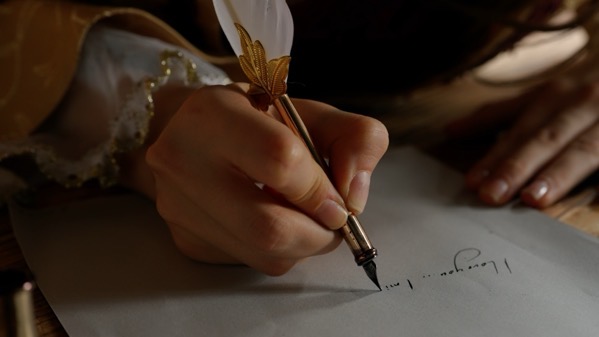
Shutterstock 2525907005. A hand writing with a quill an ink.

I particularly liked Dan Moren’s piece in response, primarily because it lines up with what I’ve learned and currently think about AI-writing. Here’s a quote:

That might be the case if AIs were writing. But they are not; they are simply generating text. Those two things are not the same. As per the premise of John’s piece, writing is about carefully picking the words and crafting the meaning of what you’re saying, things that AI do not—and patently cannot—do.

In case you’re wondering, I’m in the camp that says that AI isn’t capable of “writing.” If you know anything about the tech at all, you should be too. AI might be able to predict the next word, but that’s a mathematical equation not writing. If you insist otherwise, I hope the kool-aid tasted good on the way down.

Back in the days of my youth, one of the many rituals of sorting wheat from the chaff in childhood education was teaching us to to write mechanically, moving slowly but steadily up to writing things with meaning (remember book reports?) and once we moved into college there was Freshman Comp. Do they still teach Freshman Comp these days?

It wasn’t until later in college when I actually learned what I came to believe writing was all about. Dr. Ralph Cohen, an English professor who taught courses on Shakespeare, film as a narrative art, and surveys of literature, was one of the few professors who kicked my butt. He challenged me in ways others didn’t and I ended up taking most of the classes he offered.

In teaching Shakespeare, he laid out what the physical act and monetary cost of writing during the Bard’s time actually required. There was a real cost to committing an idea to the paper he made out of rags and old linens. Simply put, it meant the work of writing happened in the man’s brain and soul either before or as he was scribbling away with his quill and ink.

I was never good at writing with pen/pencil and paper. Nevertheless, I fought my mother tooth and nail when she insisted I take a typing class in high school. She won. I’m glad she did. Writing for me did become easier on a keyboard and a keyboard has been the primary medium of committing my thoughts to paper or digital bits ever since.

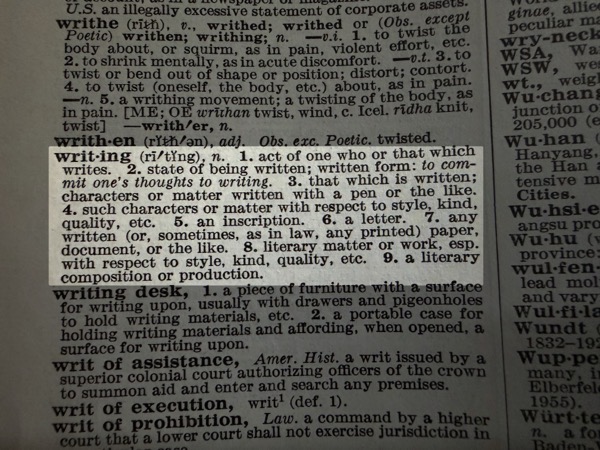
In thinking about this debate I pulled a dust covered dictionary off of one of my book shelves to look up the definition of writing. It’s The American College Dictionary published by Random House copyrighted in 1961. Here’s what that says below:

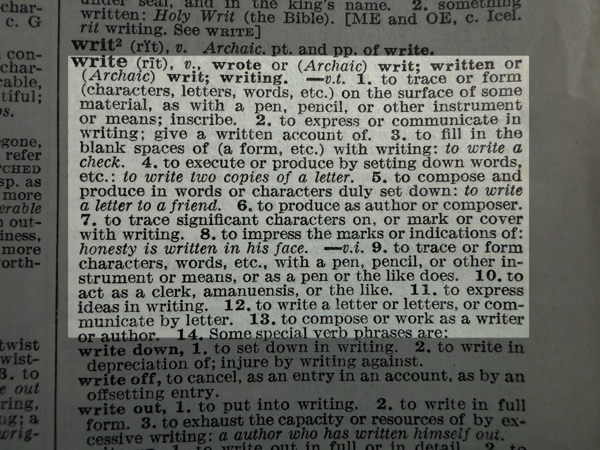
I also looked up the word “write.”

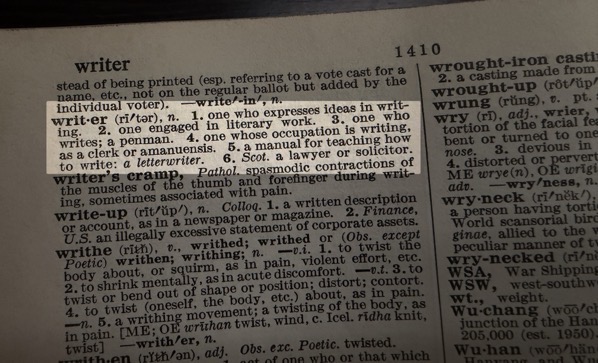
And the word “writer.”

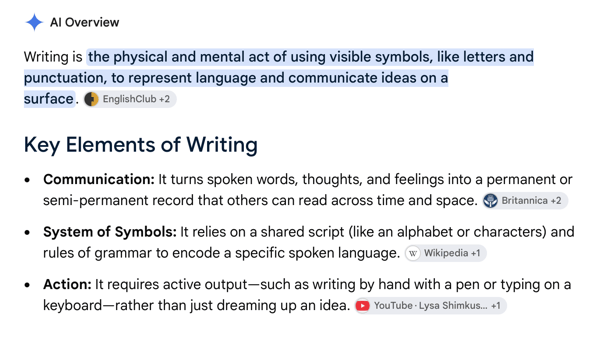
Google Gemini’s AI summary provides the following:

The highlights in that result are Google’s. Certainly there are many other dictionaries with differing and distinct definitions spelled out. I’d wager that most, like those above, focus on the mechanical. Perhaps that would steer the debate more towards those who think AI can “write.” Frankly, I find that devaluing when I think of the act, or dare I say the art of writing.

Having spent a life in the theatre, written a few plays and musicals along the way, and heard the chimes at midnight with many a playwright and composer searching for the right words or notes, I believe there’s an element that’s missing when most engage in this debate. I’d call it the soul.

Otherwise the infinite monkey theorem comes into play and renders all writing reductive to a fault. Or if The Simpsons is more your cup of tea, 1000 monkeys with a 1000 typewriters.

There are some that are trying to define parameters of this debate as being about process. But that’s any creator’s thing. Some want to frame the discussion about how the march of technological progress always presents change. So, why resist it?

If writing, or any other art form was supposed to be easy or easier that’s when the devaluing kicks in. The playing fields of creation have never be level. Why start doing so now?

That last link above is from a piece from Tim O’Reilly on the subject. I’m not sure if he wrote it or he coached an AI to do so. You’ll understand that if you do read the piece. Regardless, it’s worth your time if you have interest in the debate. Here’s a quote:

We’re in the early days, still shooting filmed stage plays. The masters of this instrument will uncover themselves. When they do, what they produce isn’t going to be slop. In the meantime, I don’t think we should be shooting down people who are trying to push AI’s limits in writing or art. Writers should be trying to figure out the medium, just as software developers are doing in coding.

We may indeed be in the early days. I translate that in our current moment to folks paying for and investing a lot of money to use beta software that promises much, doesn’t always work, and more often than not yields different responses to the same prompt. But that’s the slippery slope we’ve fallen down with most tech these days.

Early filmmakers may have indeed been constantly adapting and evolving the technology they used and the way they used it. Although to pick a nit, the early filmmakers analogy doesn’t really hold up, as most early films were shot outdoors until lighting technology caught up, allowing for better filming of interiors. That’s when filming stage plays really began. (Thanks, Dr. Cohen.)

The distinction is that those early filmmakers were pushing their technology envelopes to better tell a story in a new medium of motion pictures. Not mimic one that had existed since man first painted tales of the hunt on cave walls. That assumes you accept the pieces of the definitions of writing  that describe it as a method of using symbols, characters or words on some surface in order to communicate an idea.

But back to my thoughts on writing in opposition to those I disagree with. It’s safe to say that my bet is anything AI writes, no matter how well prompted, won’t endure for 400 or so years the way Shakespeare has. Or in later generations, Chekov, Ibsen, Miller, Mamet or Shepard. Not even the summaries. Of course, who knows what will endure 400 years into this wacky future we seem hell bent on creating? Or is that erasing?

I’ll end this with a quote from Mr. Shakespeare:

Write till your ink be dry, and with your tears
Moist it again, and frame some feeling line
That may discover such integrity.

Two Gentlemen From Verona, Act 3, Scene 2

A 1000 monkeys indeed.

(Images from KinoMasterskaya on Shutterstock. Dictionary photos by the author.)

Thanks for reading. You can subscribe to this blog if you care to. You can also find more of my writings on a variety of topics on Medium at this link, including in the publications Ellemeno and Rome. I can also be found on social media under my name as above. This site does not use affilate links.
Getting Used To The Phrase: “Without Human Involvement”

Like shouting at the wind

John Gruber links to an interesting story about Dutch regulators fining Uber almost $1 billion for suspending dishonest drivers “without warning or human involvement.”

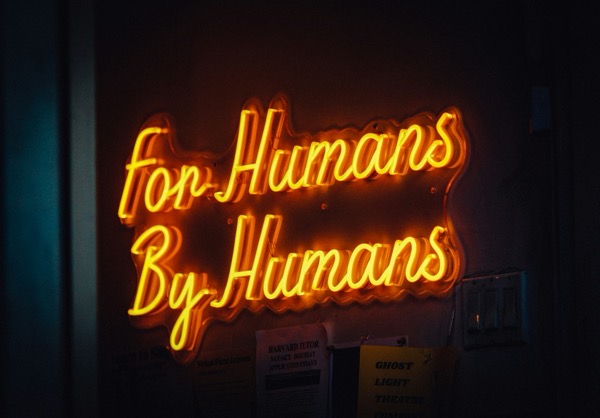
Jon tyson tEVKC91Qm6c unsplash. A neon sign saying For Humans By Humans

Say what you want about Uber’s practices, dishonest drivers, scams, and what have you. That’s not my interest in linking to the story. What struck me this morning was that phrase “without warning or human involvement.

It struck me because I’ve been dealing with a similar issue with one of my prescriptions that keeps getting changed. According to my pharmacy and my doctor, it appears that the change keeps happening without “any human involvement” because they are seeing this happen with other patients and customers on the same medication.

A few thoughts.

1. There is always “human involvement.” Someone made a decision at some point in the process. Otherwise it wouldn’t be happening. If the robots are capable of making these decisions on their own, I guess we’re headed to a world where the only legal remedy is to pull the plug. And we all know that ain’t happening.

2. We’ll never be able to track these decisions back to whomever is culpable. Although maybe we will if the AI responsible for note taking and code changes can actually do that job and maintain the logs responsibly, “without any human involvement.”

3. This kind of thing is going to replace the usual bullshit excuses we used to get when various customer service operations actually had humans you could talk to. Computers hang up more easily on customers than humans do, so the day-to-day customer service battles are going to become more frustrating than they are already. Who knew that AI was an acronym for avoiding interaction?

Looks like we’ll all be blaming the AI robots more and more in the future. For the record, I’m not a fan of shouting at the wind.

(Image from Jon Tyson on Unsplash

Thanks for reading. You can subscribe to this blog if you care to. You can also find more of my writings on a variety of topics on Medium at this link, including in the publications Ellemeno and Rome. I can also be found on social media under my name as above. This site does not use affilate links.
 

Siri AI and The Spam Call Problem

Put AI to work banishing spam

Listening to podcasts after each WWDC is always a bit of information overload, but occasionally you catch a bit of analysis that seems perhaps pertinent. 

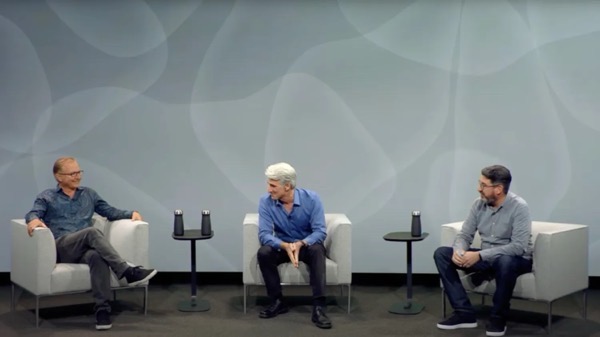
One of the podcasts I listen to his John Gruber’s Talk Show Live event that he’s been hosting for a few years now. After his infamous Something Is Wrong In The State of Cupertino post last year, Apple execs stayed away after having been guests in years previous. They stayed away this year as well.

This year, like last, Gruber put together a panel that featured The Verge’s Nilay Patel and Joanna Stern, formerly of The Wall Street Journal, now with her own gig, New Things With Joanna Stern. This year and last offered excellent commentary by both, and given the wait and see cynical posture I’ve adopted for all of Apple’s upcoming offerings, worth a listen. 

One interesting tidbit stood out that I want to highlight in the context of my ongoing complaints and requests to Apple about making the handling of spam and unwanted phone calls easier. 

Joanna seemed to be quite impressed with what she’s seen of Siri AI in the early going, citing a number of examples that she tried out during the event. The one that stood out to me is this:

I said, “What could I do that’s fun near the California Theater? I have some time to to kill,” and I don’t know if… I don’t know exactly what was the prompt or what was the thing, but it started suggesting things I could do locally. But also, it had access to my voicemail, so it knew that I had just gotten a message from my uncle who asked me to speak at his book club, and it said, “You… you could get back to my your uncle about his book club engagement, you would have some time to do that.” Okay, that’s crazy. It really is, right? And but what if that was sensitive information, right?

The key is Siri AI having access to voice mail. Regardless of however you feel about what data and info Siri AI needs to have about you to develop “Personal Context,” if Siri AI has access to your voice mail it seems it should be a relatively easy technological hop, skip, and jump to just automatically delete the flood of spam calls that have already figured out ways around any of the current wack-a-mole tricks that are being used. 

Obviously the larger point Joanna makes about “Personal Context” and a new level of trust is spot on. It is one many iPhone users will have to reckon with. But I’ll tell you this. For my own personal context, if Siri AI can automatically banish to digital hell all of the fake calls that now use names to try and circumvent current spam call prevention I’ll be grateful. 

The only reasons I can think of for Siri AI (or Google’s Gemini on Android phones) are business reasons and relationships with the mobile carriers. Apple’s “Personal Context” or Google’s “Personal Intelligence” are the names of the game, or so they claim. It seems logical to me that the technology exists to eradicate more of this curse that same technology makes possible and we all are prey to, whether it be phone calls, emails, or texts. 

Thanks for reading. You can subscribe to this blog if you care to. You can also find more of my writings on a variety of topics on Medium at this link, including in the publications Ellemeno and Rome. I can also be found on social media under my name as above. This site does not use affilate links. 
Apple Opts Out of John Gruber’s Talk Show Live at WWDC

Is Apple simply missing an opportunity or heading into the bunker?

This is significant. Apple — under fire from many directions — is opting out of having executives participating in a now decade-long tradition on John Gruber’s The Talk Show Live podcast. Gruber made the announcement on his blog, Daring Fireball. 

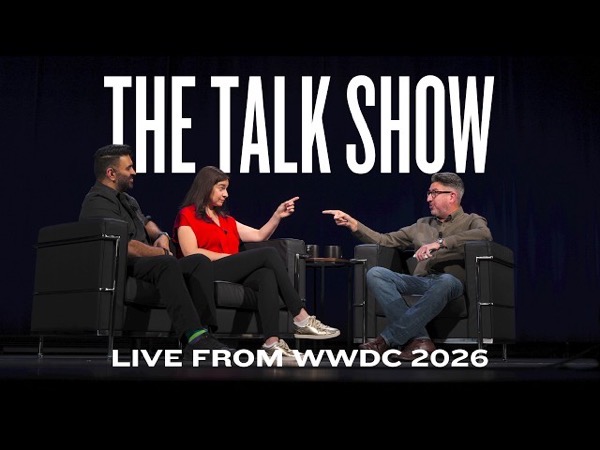
The talk show wwdc.

On the one hand, given the number of fires the folks at Cupertino are fighting at the moment, it’s easy to say you can’t fault the decision. To my way of thinking though, that’s an injured hand you’re afraid to show. If it were my decision — and granted I certainly do not know what the folks at Apple know — I’d use the other hand, with a whip in it.

Here’s why.

There’s nothing that each of the audiences Apple plays to at WWDC aren’t aware of. Who are those audiences? There are the fans, the developers, the media, and Wall Street. Like it or not each of those audiences already have enough awareness of Apple’s problems delivering Apple Intelligence, tariff battles, developer relations, and court and regulatory actions. They each come in with their own set of expectations and agendas.

I would also suggest that those paying attention at WWDC — and who have read Patrick McGee’s new book Apple in China — will be approaching whatever Apple announces this year and going forward in a new context. That book not only alters the Apple narratives; in my opinion, it forces a reset.

Already I’ve seen several in the community respond to the news that Apple is forgoing an opportunity to put on a human face and connect in the midst of all that’s going on.  Here’s Marco Arment and Parker Ortolani to link to two.

These Talk Show Live events have indeed been a welcome side show — an opportunity to catch a glimpse of a bit of the humanity behind the corporate front. By and large I think the history of the Gruber’s event has been a net positive. Think of it like seeing the filmmakers on stage after a screening. To a certain degree I also think those days are over with the current leadership.

In this moment of high stakes on so many fronts, Apple has obviously calculated that not putting its executives in the relatively warm seat  — no offense to Gruber, but the past questions and follow up have usually not been too tough — is the better bet than attempting to meet things head on.

Again, I’d argue for the head-on approach. If you ignore what your audience is already thinking you essentially ignore (and further offend) them. If ever there was a crowd that might be receptive to some honesty (admittedly PR-coached,) Gruber’s forum would be the place to find it. Does Apple need to issue some mea culpas? Maybe, maybe not. But even well coached honesty in a discussion can go a long way to creating good will. If you ask me, Apple needs more than a little of that presently.

In my professional life I’ve faced some high-stakes presentations. None on this level certainly. I may have been working to save a theatre or two, but my success or failure never had a large piece of the world’s economy depending on it. Still, the minute stakeholders assemble for such an event you only have several choices. Distract. Deny. Or be honest.

WWDC is going to happen. Arms among the audiences will be crossed, waiting for answers and clues. Apple will certainly have enough well-packaged announcements to distract at WWDC. They can’t deny their way out of the problems they brought on themselves. Being honest, however, can’t cause any more damage than has already been done.

I certainly wouldn’t want to be involved in the planning or presenting of this year’s WWDC event — even if it is pre-taped and packaged within an inch of its life. Apple has made its choice for The Talk Show Live. While the big packaged show always takes precedence, this year seems very ripe for a side show that clears the air a bit. As Parker Ortolani says, not having that will speak volumes. It is already a very loud signal about how things might play out going forward.

You can find more of my writings on a variety of topics on Medium at this link, including in the publications Ellemeno and Rome. I can also be found on social media under my name as above. 

Sunday Morning Reading

Tough reads for tough times with a nod to the Commodore 64.

The rapid decay of all things continues. I’m not even sure if “decay” is the right word. “Collapse” might be a better choice. Regardless, there’s no “decay” or “collapse” in my sharing articles and writing every week in Sunday Morning Reading. Enjoy.

Russell Shorto tells us that the fracture we’re facing shouldn’t surprise in America’s Fatal Division Is Nothing New: It Was Baked In From The Beginning. He’s right and that’s also nothing new. We just have a propensity for ignoring what we shouldn’t.

Marc Elias says We Can’t Give In To Fear. He’s right. But with those we mistakenly counted on having already done so, it makes it tougher for the rest of us.

Brian Barrett of Wired (which continues to do excellent reporting) gives us a rundown on The United States of Elon Musk. Good piece with good context. I don’t disagree with his premise that it’s unsustainable. The larger concern is what’s left in its wake.

NatashaMH opens up a personal tale of exploring justice, relationships, and personal power in The Price of Guns And Butter.

Things aren’t just decaying on political and social fronts, technology is marching right alongside, if not leading the charge. John Gruber lays out a mea culpa of sorts in discussing Apple’s less than intelligent move into Artificial Intelligence in Something Is Rotten In The State of Cupertino. Om Malik also weighs in with Apple Intelligence, Fud, Dud or Both. I’ll have more to say on this later this week. I wrote a bit about it last week also.

Will Knight, (again in Wired) tells us that Under Trump, AI Scientists Are Told To Remove ‘Ideological Bias’ From Powerful Models. Tell me. Who didn’t see this kind of thing happening?

Cory Doctorow in Pluralistic lays out how Amazon Annihilates Alexa Privacy Settings, Turns On Continuous Nonconsensual Audio Uploading. One way user agreements flow only one way. Again, who didn’t see this coming?

In times of uncertain futures it’s always somewhat uncomfortably comforting to reminisce about simpler times. When it comes to technology there was perhaps no simpler or more innocent time than during the age of the Commodore 64, which was my first home computer. We’ve come a long way. Gareth Edwards takes a look at Jack Tramiel’s success in How Commodore Invented The Mass Market Computer.

(Image from Ashni on Unsplash)

If you’re interested in just what the heck Sunday Morning Reading is all about you can read more about the origins of Sunday Morning Reading here.  You can also find more of my writings on Medium at this link, including in the publications Ellemeno and Rome.