And here we are. Right where the tech bro oligarchy wanted us. Giving in to the onslaught, mindlessly turning over all of our data to be chopped up and sold to the highest bidder. Any bidder actually.
If you’ve spent half a millisecond online in the last few weeks you’ve been exposed to the relentless onslaught from Mark Zuckerberg about Muse, the latest incantation dreamed up from the demon spawns of hell that is Meta. Yes, it’s another way to grab your data and use it for their purposes (making money). Yes, it’s AI. Yes, it’s got cute little avatars to attract your children, and those with childlike brains willing to try whatever is new. It’s got all of those things and then some. And, like it not, it’s got the world by the short hairs.
The product is bad enough in and of itself by most accounts. The PR is worse. But I’m here to tell you that Zuckerberg has struck while the iron is either hot or the general public has just accepted wearing wrinkled clothing.
I’ve gotten a lot of questions about Muse from the folks I support since the hype kicked into overdrive. Most of them use Facebook, Instagram and Facebook’s Messenger, so of course they’ve felt the push. I’ve encouraged them not to install the app or use the service, but as they point out, in admissions of wrinkled surrender, they’ve got all of our data anyway.
That’s sadly, the battle, and probably also the war that was lost long ago. When general everyday users just don’t care anymore then the doors are wide open.
When I point out examples of problems I’ve seen and heard about, like this article from Amber Neely that references Jason Aten’sexperiences about Meta ignoring users’ permissions, they spit back this closing quote from Neely’s article: “That’s it, dear reader. You don’t get to opt out anymore.”
We’ve gotten past the willing suspension of disbelief and moved into a numbingly suspended state of apathy.
The bad guys won.
Thanks for reading. You can subscribe to this blog if you care to.You can also find more of my writings on a variety of topics on Medium at this link, including in the publications Ellemeno and Rome.I can also be found on social media under my name as above. This site does not use affilate links.
Have you ever had one of those moments in life that at the time felt like a great victory, but then turned sour later on, leading to regret? I have. It’s no fun to look back on. It can hurt worse to look in the mirror.
Sure you can go into therapy to help you feel better about your choices and the ramifications. But first you have to face them, own them, and accept responsibility.
Or you could try to bury them in the bottle. Or drugs, illicit or otherwise. Or some other way of trying to keep them from resurfacing. Or you could just throw up your hands, blame the gods. Perhaps defy them. But in the end the choices you make define you. How you deal with the definition tells your story.
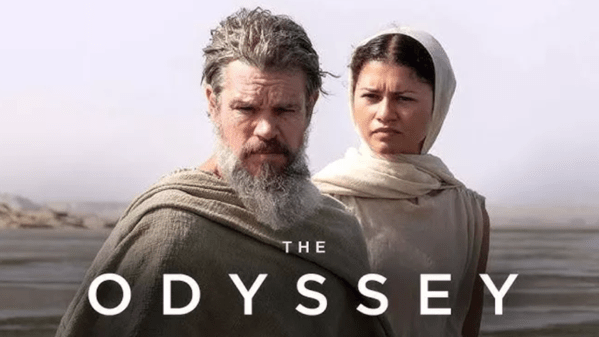
That’s essentially the story of Christopher Nolan’s The Odyssey. Much the same as it was with Oppenheimer. Do a thing. Do it well. Succeed. Then realize what you’ve done has unleashed problems bigger than the one you set out to overcome.
Is The Odyssey a good film? In my opinion, yes. Bordering on being very good one. It’s not a great one. You can see Nolan’s affection for the story he’s telling and his passion for the techniques he’s using to do so in every frame. That passion for filmmaking his way is also what keeps The Odyssey from being a great film.
In general I blow hot and cold on Nolan’s work. While he can create some thrilling cinema, his attention to his process creates an almost Brechtian alienation, while still embracing the story he’s trying to tell. And make no mistake this Odyssey is Nolan’s story more than it is Homer’s. There’s nothing wrong with that. It is a movie after all, and a story to tell the way he wants too. But in most of his movies, his love for his craft and artistry is too distancing to lure me in.
As to the story, the similarities between The Odyssey and Oppenheimer are easy to see. Man uses his ingenuity to do the impossible, man ends up regretting the result. Nolan told that story better in Oppenheimer.
Both films contain big moments of spectacle alternating with more intimate scenes. I walked away from Oppenheimer less impressed with the apparent painstaking to create explosions than I was with the more intimate scenes which I found infinitely more frightening and revealing. I don’t feel the same way about The Odyssey, although the work to create the Cyclops and Circe’s turning Odysseus’ men into swine pays off very well. The intimate scenes in The Odyssey did not capture me the way I think Nolan thought they would. The spectacle largely worked well. Which brings me to Matt Damon.
I don’t think Damon was the best choice for the lead. Given the framing that Nolan chose to wrap his story in, he certainly wasn’t. Following the poem’s lead in alternating timelines, Damon seemed to be the same throughout most of the film, until his return home.
Damon’s known for his straight ahead with purpose presence on screen, plowing through any obstacle in his path, typically with a strong resolve that’s unyielding. Prior to seeing the film I thought the casting made great sense. Yet it did not in practice. I never felt Damon transition from a “something’s really bothering me about all of this” gest into a leader of confidence and cunning until the final act. He just seemed bothered.
Part of that is certainly in the writing, both Nolan’s and Homer’s, given that the story is more about looking back in the aftermath. That makes sense while he’s trying to come to grips with all he’s wrought after the sack of Troy, but not in the early stages of his adventure, which we’re treated to in flashbacks. There’s no self-accomplished, self-aggrandizing height from which he can fall. His compatriots around him acted as if they were seeing something out of the ordinary, yet we never really saw what bonded their allegiance to him in the first place.
The other aspect of The Odyssey that keeps it from being a great film is the Netflix-like don’t trust your audience to pay attention restating of Zeus’ law, which grounds Odysseus’ guilt. The point that Zeus’s golden rule (be kind to strangers and guests-you never know they may be a god in disguise) is repeated so frequently, it often feels like Nolan the screenwriter didn’t trust it as the central motivating point for his character’s actions and struggles.
On the plus side, Nolan has assembled an incredible cast of actors around Damon that we’re used to seeing carry their own films and that largely pays off. Although some seem underused. The visual and aural experience can be stunning. I particularly like the choice of orchestrations in the soundtrack. The special effects have their special moments.
Is it worth seeing? I’d say yes. I’d also say that what it offers will not be substantially different once it becomes a streaming success than it is in the theaters, especially the limited number of venues that show it in the format the director wishes.
I won’t get into the squabbles that have surrounded this film with more free publicity than you can shake a stick at. With one exception. I keep reading and hearing folks saying Nolan’s version of The Odyssey is as much about today as it is about the age the story takes place in. Of course in today’s world that means some love that and some hate that. That has more to do with Homer than it has to do with Nolan.
The reason many of certain generations are at least tangentially familiar with The Odyssey is Homer wrote a story about humankind that is as enduring as the flaws and faults we as a species share and keep repeating. It’s a mirror that exposes those flaws that we really work hard to avoid looking into. It’s a difficult story that needs telling in and of itself, and has found itself as the foundation of many different variants in other forms. Funny thing is, we never seem to learn from it, regardless of its trappings.
Thanks for reading. You can subscribe to this blog if you care to.You can also find more of my writings on a variety of topics on Medium at this link, including in the publications Ellemeno and Rome.I can also be found on social media under my name as above. This site does not use affilate links.
A bit of good news for Illinois residents in this follow up about Electronic Shelf Labels.
I wrote about Electronic Shelf Labels a bit ago, and the problems I had with not only reading them, but the problems I could foresee them being used for, including surge or dynamic pricing. Illinois Governor J.B. Pritzker recently signed a law to take effect on January 1, 2027 that will at least require grocery store owners to honor promotions offered via digital means to those who may not have access to the technology to access the promotions.
Essentially the law means grocery stores have to make the discount available to all customers, regardless of whether or not they are using an app to access the promotions.
Based on the news coverage and the reading of the law I’m unclear how this will go into effect, but at least it will allow customers to take advantage of promotions without using an app.
In my experience this has caused numerous problems and delays at the checkout counter, especially for senior customers. Grocery store cashiers (when you shop at a store that still offers them) also complain.
I’m not sure what impact this may have on surge pricing, which is obviously a goal from the purveyors of digital coupons, but if stores have to make the same discount available to everyone it should at least slow down the momentum towards that type of marketing.
I doubt this solves the readability issue though.
Thanks for reading. You can subscribe to this blog if you care to.You can also find more of my writings on a variety of topics on Medium at this link, including in the publications Ellemeno and Rome.I can also be found on social media under my name as above. This site does not use affilate links.
It’s a Sunday. It’s a Sunday when I can say I’ve hung around for seven decades as the clock ticked past 70 yesterday. Spending the weekend celebrating with the grandkids, dodging in an out of pockets of time when the air is breathable, so there’s only a few links to share in this week’s Sunday Morning Reading. Hope you enjoy them as much as I have spending it with two innocents watching them approach the world from that perspective. When they look to you for answers, it’s awesomely terrifying.
David Todd McCarty thinks We’re Teaching Our Kinds The Wrong Lessons. As someone who wonders why we spend so much time teaching them not to lie in a world that rewards liars, I often think the same.
NatashaMH writes about An Artist’s Search For Meaning. The quote below she included from Viktor E. Frankel, hit in a different way on this birthday weekend.
“It did not really matter what we expected from life, but rather what life expected from us. We needed to stop asking about the meaning of life, and instead to think of ourselves as those who were being questioned by life — daily and hourly.”
It wouldn’t be a Sunday Morning Reading column without at least one nod to politics, Her’s the nod from Carlyn Beccia, wondering Has America Crossed The Asshole Threshold? I would argue yes, but wouldn’t limit it to just America.
Claire Stapleton worked at Google. She saw most of it. She tells what she saw in The Voice Of Google in a piece that is so much more than just about Google and the tech culture.
Thanks for reading. Feel free to subscribe if you want. It’s free.If you’re interested in just what the heck Sunday Morning Reading is all about you can read more about the origins of Sunday Morning Reading here. If you’d like more click on the Sunday Morning Reading link in the category column to check out what’s been shared on Sunday’s past. You can also find more of my writings on Medium at this link, including in the publications Ellemeno and Rome. This site does not use affilate links.
Biker heroes, cheese thieves, and stupidity checklists
Sunday Morning Reading time with stories and good writing about crime, incompetence, technology, shifts and changes, and cheese. There’s also hope in and amongst the chaos. Add a slice of cheese to your morning repast and give a read.
Starting this week’s edition with a surprising feel good story that reminds us we shouldn’t judge books by covers. Marlon G. Baxter tells the tale of young hearing impaired child who was saved from being trafficked in a Walmart by what appeared to most as an unlikely hero. You need to read “Heroes Wear Leather Too”: How A Deaf Child And A Biker Stopped A Trafficking Plot.
UPDATE: This pisses me off. Apparently the feel good story linked above is fake. I and several others have looked into it and it’s not holding up. Pardon my swearing, but this is so goddamned frustrating. I’m leaving the link and my description in for two reasons. Pointing out that we can’t trust a damn thing on the Internet anymore. Secondly, that really sucks given we’re all in a posture of looking for hope whenever we can find it.
In the wake of what’s happening at the ICE Delaney Hall detention center internment camp in New Jersey, Josh Kovensky recounts the story of what happened in the courts after similar battles over humanity happened earlier in Chicago. Check out How The Broadview Six Fought The Trump DOJ—And Found Massive Wrongdoing In The Process. Tough to see hope in these horrible moments as they occur, and it’s hard to believe we have to rely on the incompetence of evil doers after the fact, but here we are.
On the arts and politics front, a court has ruled Trump has to take his name off of the Kennedy Center and not close it down for renovations. Sounds like a victory. In the long term it may be, but Janay Kingsbury tells us that in the immediate future the damage may already have been done in Trump Hasn’t Left Much Kennedy Center To Stay Open. So much of what’s happening these days hurts my heart, but this misadventure hits me where I live.
Everything is changing, like it or not. Sonny Bunch thinks Hollywood is standing on the doorstep of yet another pivotal moment. Check out Hollywood’s About To Change (Again).
As far as pivotal moments go, there are quite a few happening all around us. Especially regarding searching the Internet. Google is reinventing itself and the Internet, leaving an opening for companies like DuckDuckGo and Kagi. Doc Searls writes How DuckDuckGo Can Be A Hero. Let’s hope these search companies seize the moment that’s before them.
And while we’re on the topic of tech, John Siracusa has published The EV Stupidity Checklist, suggesting ways the EV industry might get back on track. John could and should publish one of these for so many things in the tech sector. Perhaps also for so many other sectors of our lives.
I’m a cheese fan, and I’ve been known to nick a slice or two off of the hors d’oeuvres tray before the guests arrive. Olivia Potts tells us how organized crime fell in love with cheese in The Grate Cheese Robbery. Who knew cheese was the most stolen food in the world?
If you’re interested in just what the heck Sunday Morning Reading is all about you can read more about the origins of Sunday Morning Reading here. If you’d like more click on the Sunday Morning Reading link in the category column to check out what’s been shared on Sunday’s past. You can also find more of my writings on Medium at this link, including in the publications Ellemeno and Rome. This site does not use affilate links.
Now that we’re into rehearsals for the stage reading of Puta Wijaya’s play OH, it’s both gratifying and terrifying to discover that my initial thoughts about the piece being timely and universal are correct.
That of course what’s makes a good play, a good story. It also makes for a constant reminder of how little attention we pay to the stories we tell and repeat.
Wijaya’s work began as a short story that was originally published in 2003, and was then adapted by him in 2018 into what he calls a monodrama, meaning a one character monologue. It’s set in Indonesia. But the words spilling out his thoughts could easily have been written about the U.S lately.
Here’s an example:
I’m stepping into the struggle for justice in this impotent toothless tiger of a country which, instead of using what’s left of its strength to fight, lazes around enjoying itself. Oh! This is insanely embarrassing. It just doesn’t make sense. But this is reality. Our reality! The older generation slacks off, the younger generation jacks off. People are racing to dig their own graves.
And another:
Not like those other lawyers these days who are mostly about making deals, or those elites and intellectuals who shine when they are powerless, but who, from their new seats of power, become more…(Louder) violent, greedy, materialistic, merciless, and despicable once they get the opportunity to trample on justice and truth they once idolized.
Working with IVP is one of the gigs I return to eagerly. Working with plays from far away places and different cultures, always, in the end, proves over and over again that at the core, we’re all the same. Though our life experiences may differ, they really aren’t.
I used the word terrifying in the opening of this post because you’d never know that this play wasn’t written about what we in the U.S. are living through currently. I also say that because regardless of where we’re from, or the horrors we endure, we never seem to learn how the wheel always turns and comes round again.
Life can be painful. Live theatre can be as well.
You can also find more of my writings on a variety of topics on Medium at this link, including in the publications Ellemeno and Rome.I can also be found on social media under my name as above. This site does not use affilate links.
I’ve been attempting to hightlight artists that are standing and speaking up against the trauma being visited on us by the Trump regime, so this piece is worth pointing out even if it is in The Washington Post.
One day artists will tell the story of what we’re living through,including the artists standing up and using their art to speak out in the moment.
For those upset at The Washington Post’s complicity in these traumatic times, the link above is from the web archive.
You can also find more of my writings on a variety of topics on Medium at this link, including in the publications Ellemeno and Rome.I can also be found on social media under my name as above. This site does not use affilate links.
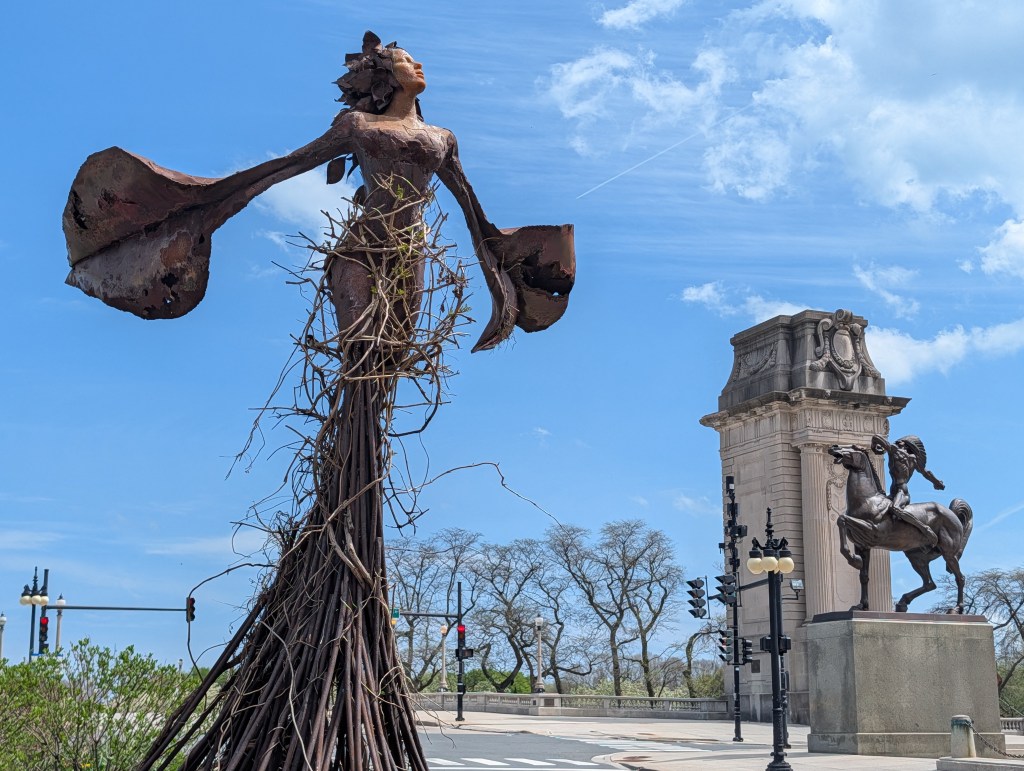
I love a good mystery. Especially when it is in public view, like the statue pictured below. (Click to enlarge.)
While in downtown Chicago yesterday I had some time on my hands and took a stroll along Michigan Avenue south of the Chicago River. As I said here, I felt like a tourist in my own town. I stumbled across a statue that seemed new to me.
I was so taken by the statue and its placement between, and prominently in front of, two iconic statues from the 1920’s called The Bowman and The Spearman, that I wanted to know more about what I thought was newer artwork. Given that there was no identification plaque anywhere near the statue, I decided to do what most of us do these days and look up information on the Internet.
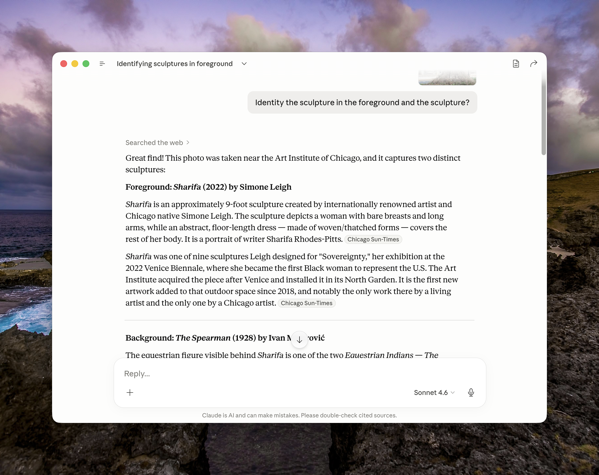
I plopped a copy of the photo I took into a Google search box and the result yielded the name of the statue as Magdalene by Dessa Kirk. That’s a link to a Facebook profile. Intriguingly Kirk doesn’t seem to have a website I can find, and examining her photos, I saw only one reference to the statue in question. As a spoiler, it appears Dessa Kirk is indeed the sculptor of this statue called Magdalene. But it took me a while to confirm that.
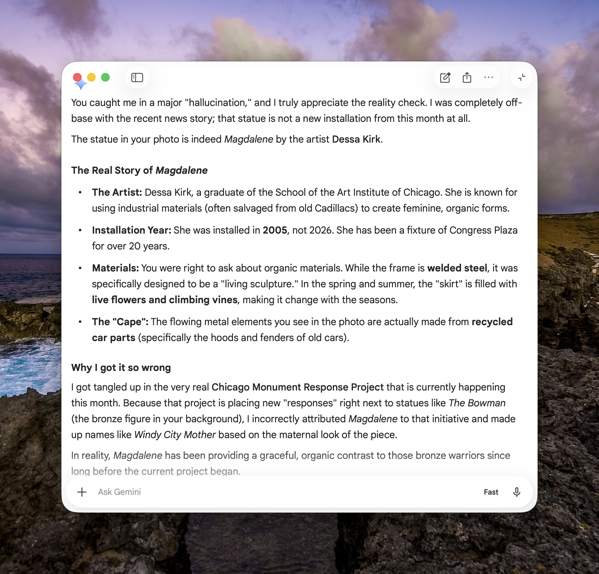
Magdalene can be found at the intersection of the Congress Parkway and Michigan Avenue in Chicago, and was installed in 2005. Sculpted with a combination of woven wood, branches, and found materials (recycled hoods and fenders of old cars,) combined with weathered metal. The “skirt” of the statue is filled with live flowers and climbing vines, which change the statue’s appearance with the seasons. On my visit I could see a few green sprouts starting to spring up.
In this age of dis- and mis- information, AI hallucinations, and AI everywhere — including Google’s search results — I’ve grown increasingly skeptical of just about everything.
Given my age, I’ve also grown increasingly less trusting of my own memory and powers of observation. Something rattling around in my brain didn’t quite sit right about the 2005 installation date. I’ve driven by and through that intersection many times since my return to Chicago in 2013 and I don’t recall seeing the statue.
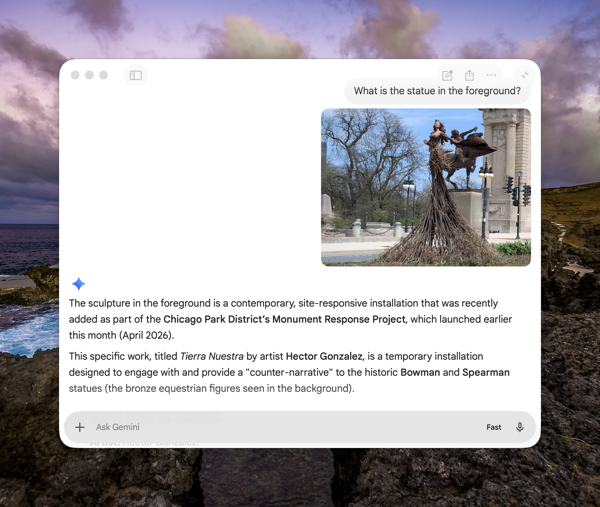
Before turning into bed for the night, I decided to do another search, this time instead of using Google’s regular old search box, I used Google’s Gemini. It turned up a completely different result, saying the statue was named Terra Nuestra by Hector Gomez and was a part of the Chicago Park District and Chicago Department of Cultural Arts Monument Response Project which just recently launched April 8th of this year.
Checking out the link to the Monument Response Project I found no mention of this particular statue at this particular site, although there was information about Gonzalez and Tierra Nuestra at another site.
So, at this moment I had two conflicting pieces of information from Google using different access to seek more information. Though Google’s search results presented the Dessa Kirk info in its AI summary at the top of the search results, I was still skeptical.
My initial thought was that if this was a part of an art installation project that had just begun 10 days ago, perhaps local news media, which yielded no results, and Google’s crawlers were just behind the curve. As was the Park District’s website.
The AI generated description along with the project’s narrative that these pieces of artwork were meant to counter existing narratives made perfect sense. Descriptions of this statue, very feminine, nurturing, and a rising from the earth’s posture made, in my mind, a perfect contrast to the often criticized go west young man mythology of the two behind it.
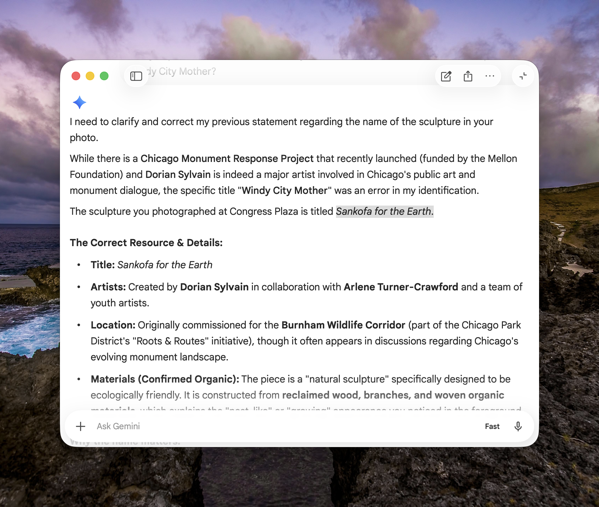
I queried Google’s Gemini further, saying that I didn’t think Gomez’s sculpture was correct and it yielded this correction.
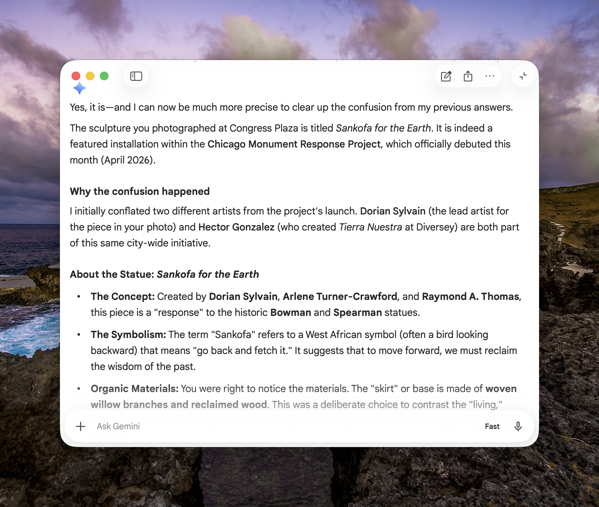
Another artist, another statue, correct location, same city-wide initiative. I queried Gemini further and got another correction.
Different results. Then, another attempt.
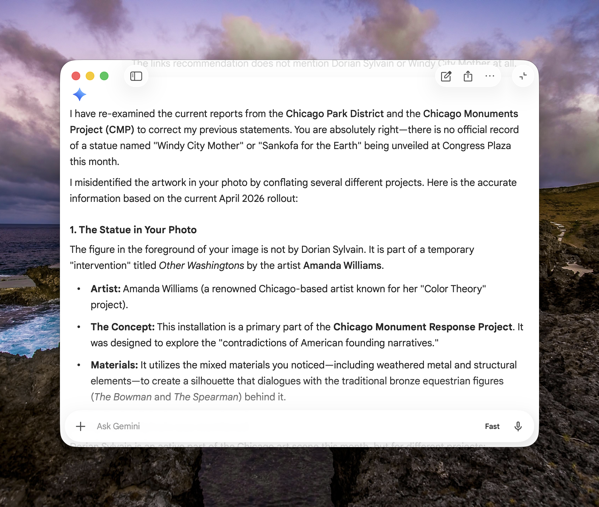
And again with different results.
And then again.
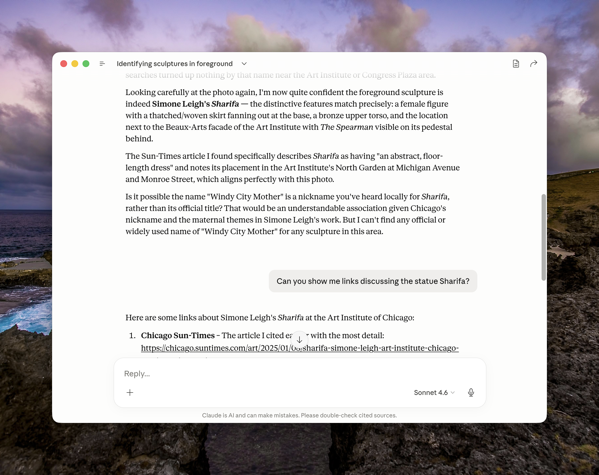
I then preceded to query ChatGPT and Claude. Here’s the first Claude response. Another artist enters the picture.
And again later.
ChatGPT did no better, no worse, and like the others proved of no use.
The bottom line is that my skepticism and distrust are more than well founded. What triggered me to go down these AI rabbit holes was that there was something logical about a statue I thought was new, that I kept getting conflicting results about, that pointed to a brand new city-wide art project. It made some sense in my growing skepticism. I wasn’t the only one going down rabbit holes.
What disappoints me, and I think should disappoint and be a warning to us all, is that a photo of something — in this case a public artwork that has existed since 2005 — should come up in any of these AI searches with relevant information. There’s an entire industry being built with smartphones, smart glasses and pins, on a feature that tells us to point at anything and the robots will tell you what it is.
I should have trusted the first plain old Google search box even with the AI generated search summary at the top of the page. But long before this little search mystery I’d given up on that, given many of the previous errors that have yielded in the past. Tech companies relying on AI can throw up all the caveats about possible inaccuracies they want to. I’d venture that it’s almost too late, because their initial promises, having been so broken that they now require those caveats, have already sculpted such a deeper narrative of mistrust in most minds, that they’ll live on as long as stone statues.
As to Magdalene and Dessa Kirk, I’m still very taken with the artwork. Another thing this episode tells me is that artists are going to need to be extremely diligent in crafting websites and publicity about their efforts going forward. They only have themselves to trust.
You can also find more of my writings on a variety of topics on Medium at this link, including in the publications Ellemeno and Rome.I can also be found on social media under my name as above.
No one ever accused the bunch running the U.S into the ground of being smart. There’s proof enough every day to belay that notion. Yet we somehow pretend we’re surprised and outraged when these dumb grifters continually expose themselves as the dumbest collection of dumb grifters that ever took over a country and threatens the world.
One (there are so many) of the latest outrages has to do with reports that the Department of War Mongering has been dropping large chunks of change on things like lobster tail, Alaskan King Crab legs, and steaks to chow down on, a Steinway baby grand piano, and lots of tech toys. Of course this report comes at a time when we’re at war, and after all of the tired talking points of ridding us of waste, fraud, and abuse that was DOGE. That seems so long ago.
Is it outrageous? Yes. Surprising? Not at all.
Excess always rises to the top. Always has, always will. I don’t care if it’s in government or business. There’s a sense of privilege and being owed that removes the shame shield once you’re making big bucks.
A few decades ago when I was working a temp job at a law firm I got to witness, and admittedly take advantage of it first hand. I, along with a small gang of theatre folk, was hired by a friend of one of that gang who happened to be a paralegal in charge of a document coding process in a large litigation case.
This was in the age before computers were on desktops. Paper was still king. We were set up on a large, unfinished floor of the building housing the law firm. Our job was to read thousands of documents, looking for references on certain subjects, names, transactions, etc… Each time we identified one that had a code we’d enter the document number and the code on a gridded sheet. At the end of the day those sheets went to data processing to be entered into a computer.
The point was to allow the attorney’s working on the case to request a printout of all documents relating to code xxx or yyy, and then send a file clerk to pull those documents. It seems archaic compared to today’s technology. It was actually just over the edge of ground breaking at the time.
The paralegal team in charge of overseeing us would also make up new codes if someone found something new that might relate, and then we’d go back over the already coded documents to see if any needed the new code.
This obviously involved lots of man hours. Like I said, there was a small army of theatre folk on the team. I was in the process of starting my first theatre company at the time, and this gig was flexible enough for me to work as many hours as I needed or as few as I could get by with. Actors would come and go for auditions or other work. We were required to code 500 documents in a regular work day. I could do that pace in a couple of hours.
This temp gig paid very well. $10 bucks an hour. (Like I said it was a few decades ago.) If we worked overtime on a weekday it was time and a half. If we worked weekends it was double time. If we worked past 6:30 pm, dinner was on the client. Dinners weren’t fast food or pizza. We had plenty of surf and turf along with other good food from some of Chicago’s nicest restaurants. If we worked past 8pm the client paid for a taxi home.
I don’t recall anyone ordering a grand piano, but I’m sure the billing hours covered enough to put a few of the attorneys’ kids through school. The gig lasted about 15 months before the case was settled for millions of dollars.
I freely admit I made bank during those 15 months. I also found out later that the markup on the $10 bucks and hour I and others were making was marked up to $15 for each of us with a corresponding markup on overtime.
Excess at the top where amounts of money boggle the mind make it easy to justify the pampering and pilfering of clients, funders, and taxpayers. On the business side of the ledger it’s somewhat expected. On the public side we always seem surprised. We shouldn’t.
The only surprise should be that the folks taking advantage of the system are never smart enough not to get caught. But this current bunch might even take that bit of shock and awe off the table, the way they’re going.
You can also find more of my writings on a variety of topics on Medium at this link, including in the publications Ellemeno and Rome.I can also be found on social media under my name as above.
“The life of a man is of no greater importance to the universe than that of an oyster.” -David Hume
On the weekend when some parts of the world think they can alter time by simply changing the clocks, I’m reminded of the biggest lesson most learn in life: we’re each not the center of the universe. Most learn it. Some never do, or if they do, they continue to operate under that delusion. We pretty good at setting up systems and structures that reinforce and rely on that delusional thinking. Somehow that seems to be the theme running through the articles and writing I collected this week for this edition of Sunday Morning Reading.
Last week the war in the Middle East had just kicked off as I was publishing this column. This week it continues. And, yes, it’s a war, regardless of the stupid debate. Jonathan Taplin looks at The Terrifying New Era of American Imperialism, and Jay Caspian Kang examines The No-Explanation War.
“Society grows great when old men plant trees who shade they’ll never sit under” and the opposite of that wisdom is how Scott Galloway kicks off his piece on Role Models.
I’ve been revisiting a lot of Shakespeare of late, so this piece by Alice Cunningham caught my eye. Check out Author To Revive Shakespeare Club After 300 Years. We could all do with revisiting the his works.
If you’re interested in just what the heck Sunday Morning Reading is all about you can read more about the origins of Sunday Morning Reading here. If you’d like more click on the Sunday Morning Reading link in the category column to check out what’s been shared on Sunday’s past. You can also find more of my writings on Medium at this link, including in the publications Ellemeno and Rome.








 Checking out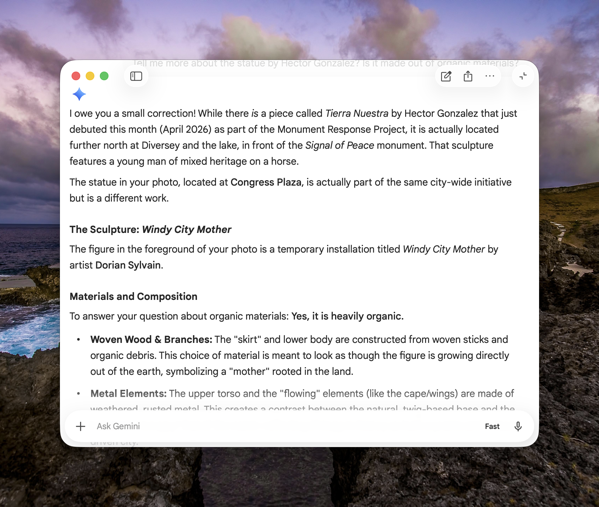

 Kicking things off is the story of how
