You can’t take humans out of the chain of responsibility
By now everyone is familiar with the caveats every AI company trots out like Surgeon General’s warnings on tobacco products. AI can make mistakes, so you need to double check. Great sales pitch. Better liability protection. Some lawyers obviously dreamed that up, but it appears there’s a chance they might need to dream again.
According to an article in Ars Technica, a German court has ruled that Google is liable for false statements in AI Overviews. Given how Google is reinventing Search and itself this might turn into a problem, and not just for Google.
Google tried the usual arguments to shield itself from liability for false statements in AI Overviews, such as arguing that most users understand that AI outputs aren’t always accurate and must be verified.
But the court found that, unlike traditional search engines that merely present lists of links to third-party statements, Google’s tool made “independent, new, and substantive statements” based on its own misinterpretation of links on the Internet.
That’s a problem, the court said, because while publishers may have been able to sue to stop third parties from publishing defamatory statements appearing in Google search results, only Google can correct the underlying algorithm and outputs displayed in AI Overviews.
The bottom line it seems to me is if an AI Overview or other result summary hallucinates something false and perhaps defamatory, someone somewhere, meaning a human someone(s), can held responsible.
I’m sure appeals are already being worked on for this preliminary ruling. So the story will continue to unfold.
As far as U.S. users might be concerned we’re already seeing other countries treating technology issues very differently in the European Union and elsewhere than on our own shores. Things are very different here in the land where bribery no longer masquerades as politics. Nevertheless, it’s a pretty strong statement that bears some attention regardless of where you live and where you search the Internet from.
Thanks for reading. You can subscribe to this blog if you care to.You can also find more of my writings on a variety of topics on Medium at this link, including in the publications Ellemeno and Rome.I can also be found on social media under my name as above. This site does not use affilate links.
One day perhaps we’ll move beyond AI cliché demos.
My nephew occasionally takes a look at this blog and gives me feedback on what I think and write. Actually, he mostly gives me shit. He certainly does when I write about Artificial Intelligence. He often asks why I’m so “down” on AI. At least we agree on politics.
I keep reminding him that I’m not “down” on the technology per se. I’d love to see the press release announcing AI led to a a cure for cancer. Who wouldn’t? I’m down on the way it continues to be sold to us and the ramifications that brings on so many levels, while still feeling like it’s not what the sellers keep promising. (I also remind him to read what I write more carefully, but he’s probably using some AI to summarize what I write.)
In truth, that’s the essence of my skeptical reaction to what we know as AI at the moment. There’s a lot going on, but how it’s being sold to most consumers still feels like it will ultimately be no more, no less than just another tool we use on a computer, after exacting high costs to do so, and dumbing down the general learning curve in the bargain.
Take for example the demos we constantly see about what AI can do when each company rolls out its latest version. As demos they all look slick as far as party and trip planning go.
(Coding is another case entirely. I’m not talking about that here, simply because I don’t have the expertise to do so. I’m strictly speaking of the sell to consumers.)
Even Apple fell back on these examples that have become clichés in this year’s WWDC 2026 announcement. Those clichés define the market companies think are ripe for the come on and then the plucking. I’m guessing they also define the current limitations of the technology. Or at least the limitations companies don’t want to risk pushing beyond in a live demo.
Here’s the AI Siri demo I wish Apple had shown us yesterday.
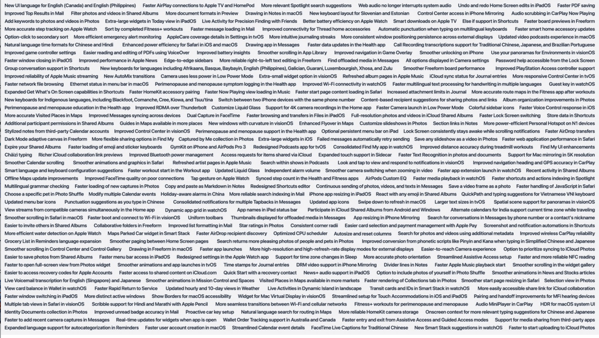
If you watched Apple’s keynote presentation you might remember this slide.
Maybe not. It flew by pretty quickly. It’s a word cloud of all of the other non Siri AI improvements Apple is bringing to its various operating systems this year.
Yes, the print is that tiny and crammed together. To call it unreadable is accurate. For those who didn’t watch the demo, the length of time it was on our screens was equally tiny, certainly compared to all the travel time each presenter took to walk on and hit their mark prior to speaking. To be honest, the slide’s quick and unreadable inclusion felt insulting given the long list of improvements it’s touting.
(To my knowledge no such list appears yet in Apple’s Newsroom or on its website heralding the other announcements. If I’m wrong, point me to it and I’ll link to it here. I’m sure it won’t be long before one of the sites that covers Apple distills it down and publishes it. Probably using AI.)
(UPDATE: Right after hitting publish, I noticed that John Gruber linked to this post on the Oneberri Blog listing all of those improvements.)
What if Mike Rockwell, the Apple Executive who did the Siri AI demos, had asked Siri AI to take that slide, and present the info into a bulleted list in Apple Notes, and then prepare a PDF for distribution? In the post keynote tech talk he and other Apple execs participated in, he could have followed that up by asking Siri AI to distribute the PDF to the other Apple execs on stage. Essentially it would have demonstrated the same Siri AI capability to gather info across native Apple apps, using context, in the same way the clichéd party planning demos do.
It certainly would have been more impressive than the usual clichés.
Perhaps AI Siri and the apps needed to do that work aren’t ready for such a challenge just yet. Things are still in beta after all. Perhaps it’s just too risky to stray outside of what’s made these kinds of demos a laughable cliché. Perhaps we’ll get there someday. Who knows?
Meanwhile I’ll remain “down” on AI the way my nephew likes to give me shit about my AI skepticism. I hope one day this technology might indeed lead to a cure for cancer. I also hope my nephew keeps reading this blog. It might help him learn to think for himself more often. 😉
Thanks for reading. You can subscribe to this blog if you care to.You can also find more of my writings on a variety of topics on Medium at this link, including in the publications Ellemeno and Rome.I can also be found on social media under my name as above. This site does not use affilate links.
“An acre of performance is worth a whole land of promise.”
You know what a litany is. It’s a series of prayers with predictable responses, learned, ingrained, and repeated without much thought. Call it “call and response.” As we finally arrive at the beginning of Apple’s WWDC 2026 today, the call has been summarized down to Apple needs a Siri that works.
But how the hell do you respond to that?
Siri was once a surprising computer gimmick, before Apple got its hand on it in 2010. Siri has been surprisingly bad at most things ever since. Sure you can set a timer, or a reminder, occasionally play the right play list and a few other things. If that were the extent of the promise the jokes wouldn’t be funny. But the promises were always more. They never lived up to the personal assistant aspirations. It’s still largely a gimmick. One too easily made fun of.
Amazon’s Alexa and Google’s Assistant, (now Gemini) have taken bigger steps forward than Siri, but also continue to fall down and scrape their knees. Chatbots have come along and for some have replaced the need for someone to talk to. But each of those efforts still yield mistakes and failures. You know the way, humans do.
So do pleas for a “Siri that works” mean something that will always work? I doubt it. I think the expectation is that these chatbot like companions will continue to fail. Again, the way humans do. But you can’t sell that.
Does it mean a “Siri that works” does something new? I doubt that also. The entire promise of computer assistants, chatbots and artificial intelligence is to do things we already do more efficiently. In fact, that’s the history of computing. When spreadsheets replaced pencils, green eyeshades, and then calculators we were on to something.
We haven’t yet figured out a way to help us communicate better in person, much less in front of a screen or into a microphone. A “working Siri” (or any other chatbot) isn’t going to help us with that. They may teach us a new way to communicate to set that reminder, but the respondents failure makes us all feel like we’re wrong. Until we just stop talking.
I’m not sure how you reconcile doing things more efficiently with the failure rate. One that seems all but guaranteed by the “mistakes will happen” caveats that prove lawyers always earn their keep. Frankly, I don’t ever see a “fire and forget it” guarantee in what remains of my lifetime. Maybe someday.
Word is that whatever Apple rolls out as “a working Siri” will roll out with a beta label attached to it. That’s a good preemptive legal response, but a sad commentary on the state of things. We expect things to go wrong in betas. Talk about setting a low bar. Even a necessary one.
Speaking of the history of computing, when it comes to mobile computing we’ve gone through at least one cycle where the focus shifted away from keeping us addicted to our phones, to an entire wave of ways to help us escape the tyranny of the small screens, put them down and enjoy more of life without them. Call me crazy, but the rush to chatting away to smartphones, AirPods, pendants, pucks, cars, etc… seems contradictory to solving our tech addictions. Out with the old trend, in with the rerun.
Gimmicks work. They help sell devices and feed trends. Think pet rocks. We’re already seeing talk of children’s toys with AI voice assistants and reactions against them. At least this time around the reactions are coming more quickly.
I’m guessing it’s not long before we see a pet rock product that contains an AI powered voice assistant. We can always use another paperweight.
Thanks for reading. You can subscribe to this blog if you care to.You can also find more of my writings on a variety of topics on Medium at this link, including in the publications Ellemeno and Rome.I can also be found on social media under my name as above. This site does not use affilate links.
The art of dancing on the line that separates and defines humanity
It was a good week for reading good writing. It’s a better week for sharing what popped up. A variety of topics, spanning art and the making and selling of it, technology — which these days is more about the selling than the tech — the humanity, or lack thereof, behind it all, and…well to continue a list would sell it all short. Here’s hoping you enjoy the links shared in today’s Sunday Morning Reading as much as I enjoy sharing them. Yia Mas!
Om Malik wrote one of the best things I’ve read in quite some time. We Are Living In Pinocchio’s World is about lying. It’s about AI. It’s about a pen. But it’s about so much more.
Cory Doctorow’sRefining Humanity takes on our propensity for explanation, personhood for machines, and that line we seem to want to dance with defining just what makes us human in the midst of it all.
At what cost art? Natasha MH wonders and writes about it in Sold At A Premium. At what cost, anything?
Mike Masnick thinks it’s not about whether technology is inherently good or bad, liberating or oppressive. You could argue the same could be said about most aspects of human endeavor. But then that’s the point. Tech is just another in a long line. Check out Enshittification, Despotification, And The Open Internet.
“The only conviction worth having is the kind you could lose tomorrow and survive it.” JA Westenberg warns us not to take a pill, regardless of color in Be Thou Not Pilled.
To close, click through the popover on John Gruber’s post This Is A Dickover, and give the post a read. You know what a Dickover is. Now you have a name for it.
Thanks for reading. Feel free to subscribe if you want. It’s free.If you’re interested in just what the heck Sunday Morning Reading is all about you can read more about the origins of Sunday Morning Reading here. If you’d like more click on the Sunday Morning Reading link in the category column to check out what’s been shared on Sunday’s past. You can also find more of my writings on Medium at this link, including in the publications Ellemeno and Rome. This site does not use affilate links.
The days when the costs of technology decreasing over time have passed.
I’ve been writing a small bit about the segmentation I see coming in how we currently think of computing. Yes, it’s about Artificial Intelligence, and yes, it’s about money. There’s no question that we’re already seeing price increases due to chip shortages, but I’m thinking that’s just the beginning of what will make Apple’s reputation of shipping too expensive computers, prior to the MacBook Neo, seem like a memory.
There’s no question that the cost associated with Artificial Intelligence is driving this and will continue to do so. The question is how much? Note that in the latest announcements from Google, Microsoft, and Nvidia heralding what’s coming that price tags weren’t revealed. Quite frankly from the way I’m reading the tea leaves scattered among the press releases, most of these companies are skittish because they don’t even know how high the cost curve is going to bend. Or they’re afraid of the sticker shock once they do find the courage to announce them.
The way I see it, the next period of time is going to be one where if you can afford the steeper prices of hardware and AI services, you’ll be able to play on that level. Those that can’t, and may not even need to, will be gradually left behind. Although for many that won’t prove to be that much of a problem given their needs. Initially.
Tell me honestly, what has any AI company promised, prior to this coming age of agents, that most computers can’t already do? Heck, even some of the promises agents can supposedly deliver don’t seem to offer that much more, unless you’re a software developer or in math sciences.
That said, operating systems and software are all being geared up along with consumer hardware to make the expensive side of the equation be the standard.
Already we’re seeing moves away from AI robots doing their work in the various clouds. Companies are prepping local AI models to be installed on devices. Those local models are going to require memory and processing power that’s going to further drive up the hardware costs while possibly reducing the token tax. Gaming hardware is about to become really expensive. Back in the cloud, eventually we’re all going to be paying for search. Probably sooner, rather than later, if you want decent results.
Speaking of taxes. Governments are starting to sniff around with their divining rods, sensing new money reservoirs to be tapped, while watching water resources stretched thin. There’s obviously a thirst. If, when, and where that happens will just add costs to be passed down the line.
Take a look at this quote from Microsoft’s Satya Nadella:
“There are really two stories people can tell about this moment. One is that technology concentrates power, reduces human agency, and leaves to society to absorb the consequences. The other is that we use this next wave to unlock opportunity for developers, scientists, enterprises, and every community. And our job is to make the second story true.”
On the surface it sounds like there’s opportunity for what’s coming to be all inclusive. Clever. Beneath that surface I think Nadella is hinting that unless your computing needs are in fields of endeavor that will require AI to be competitive, you’re at the tail end of that second story and will probably be on the outside looking in while absorbing the consequences. There’s really only one story.
As I mentioned earlier, there are plenty of users who don’t need the latest and greatest hardware and will probably be just fine without. For a time. Unless the big players create operating systems and hardware that segment out some of what will only become compute heavy advances, consumers will eventually find today’s tasks more challenging and less secure as existing hardware slows down and future security updates are released on slower schedules.
Of course that also leaves an opening.
Perhaps companies that offer hardware and services that don’t push whatever current AI envelope is being pushed, might find a willing market. You could argue that Apple’s MacBook Neo, and Dell and others’ recent announcements to counter that somewhat surprising move, might presage this. Without lower entry price points, who knows, a lot of users might just return back to the days of envelopes and snail mail.
That’s probably too extreme a reaction, but we’ve seen similar reactions to technology in the past, some quite recent, once the gee whiz factor has worn off like the letters on cheap keyboards on even expensive computers. Think touch screen displays instead of buttons and dials in cars. Think home automation. Think the Metaverse. Think talking appliances. Think cars and machinery that require maintenance contracts. Think 3D TVs.
Those that love to dabble and explore frontiers and have the money to do so will always seek the next adventure. Go for it. Those who just want to send a birthday greeting, create a holiday card, share a calendar, proofread a document, or search for a local merchant don’t want a hustle or a hassle, or the increased expense that’s obviously coming.
For the moment, the days when the costs of technology decreasing over time have passed.
You can also find more of my writings on a variety of topics on Medium at this link, including in the publications Ellemeno and Rome.I can also be found on social media under my name as above. This site does not use affilate links.
Those who follow this blog have probably read a Sunday Morning Reading column or two. In that column I link to what I believe to be good writing on important topics that interest me. In the most recent Sunday Morning Reading column I got snookered and posted a link to a piece that is fake, as is the entire Internet publication that posted it.
Now let’s get this straight there’s plenty of blame to go around. I should have checked further into the story prior to linking to it. But as I said in an update to the post, it was a feel good story, and caught my eye at a time when I, and just about everyone else is desperate for any story that offers a ray of hope.
So that’s on me. Apologies to all those who come here.
But there’s also plenty of blame to be pointed at AllChronology.com, the owner of the site Chronology. I’m not linking to them here. The site is easy enough to find. I left the original link up in the original post as a reference, along with an update acknowledging my error.
That website is filled with stories, that I can only assume are AI generated. If you search for the authors of articles (most listed as distinguished) you won’t find the handful I searched for. That handful is enough to let me know that the guiding hand behind this site is connected to a body of rubbish.
So, yes. I’m pissed off. At myself, and at whoever the humans (one can only make the assumption that there is a human presence in their somewhere) are behind this publication. It would be one thing if there were ads on the site. I don’t see any, so I assume it’s just data harvesting in some way or the other. I don’t get the point. Frankly, I don’t think there is one. The logic behind this bastardized effort makes no sense.
The bottom line is we’re living in a world where you can’t trust anything, or anyone. That sucks. I care. I hope you do too. I would hope those who come here trust what I write about and link to and I’m sorry I led you astray on this one.
Time to do better.
You can also find more of my writings on a variety of topics on Medium at this link, including in the publications Ellemeno and Rome.I can also be found on social media under my name as above. This site does not use affilate links.
Biker heroes, cheese thieves, and stupidity checklists
Sunday Morning Reading time with stories and good writing about crime, incompetence, technology, shifts and changes, and cheese. There’s also hope in and amongst the chaos. Add a slice of cheese to your morning repast and give a read.
Starting this week’s edition with a surprising feel good story that reminds us we shouldn’t judge books by covers. Marlon G. Baxter tells the tale of young hearing impaired child who was saved from being trafficked in a Walmart by what appeared to most as an unlikely hero. You need to read “Heroes Wear Leather Too”: How A Deaf Child And A Biker Stopped A Trafficking Plot.
UPDATE: This pisses me off. Apparently the feel good story linked above is fake. I and several others have looked into it and it’s not holding up. Pardon my swearing, but this is so goddamned frustrating. I’m leaving the link and my description in for two reasons. Pointing out that we can’t trust a damn thing on the Internet anymore. Secondly, that really sucks given we’re all in a posture of looking for hope whenever we can find it.
In the wake of what’s happening at the ICE Delaney Hall detention center internment camp in New Jersey, Josh Kovensky recounts the story of what happened in the courts after similar battles over humanity happened earlier in Chicago. Check out How The Broadview Six Fought The Trump DOJ—And Found Massive Wrongdoing In The Process. Tough to see hope in these horrible moments as they occur, and it’s hard to believe we have to rely on the incompetence of evil doers after the fact, but here we are.
On the arts and politics front, a court has ruled Trump has to take his name off of the Kennedy Center and not close it down for renovations. Sounds like a victory. In the long term it may be, but Janay Kingsbury tells us that in the immediate future the damage may already have been done in Trump Hasn’t Left Much Kennedy Center To Stay Open. So much of what’s happening these days hurts my heart, but this misadventure hits me where I live.
Everything is changing, like it or not. Sonny Bunch thinks Hollywood is standing on the doorstep of yet another pivotal moment. Check out Hollywood’s About To Change (Again).
As far as pivotal moments go, there are quite a few happening all around us. Especially regarding searching the Internet. Google is reinventing itself and the Internet, leaving an opening for companies like DuckDuckGo and Kagi. Doc Searls writes How DuckDuckGo Can Be A Hero. Let’s hope these search companies seize the moment that’s before them.
And while we’re on the topic of tech, John Siracusa has published The EV Stupidity Checklist, suggesting ways the EV industry might get back on track. John could and should publish one of these for so many things in the tech sector. Perhaps also for so many other sectors of our lives.
I’m a cheese fan, and I’ve been known to nick a slice or two off of the hors d’oeuvres tray before the guests arrive. Olivia Potts tells us how organized crime fell in love with cheese in The Grate Cheese Robbery. Who knew cheese was the most stolen food in the world?
If you’re interested in just what the heck Sunday Morning Reading is all about you can read more about the origins of Sunday Morning Reading here. If you’d like more click on the Sunday Morning Reading link in the category column to check out what’s been shared on Sunday’s past. You can also find more of my writings on Medium at this link, including in the publications Ellemeno and Rome. This site does not use affilate links.
Several of my areas of interest seem to be tilting, leaning closer of late to the point when gravity might take over and bring the bad guys down. If you read anything at all here, you know I’m talking about AI and what passes for politics as practiced here in the U.S.
I wish I was in a position to help things along with a stronger push, but alas that’s not the case. If things do ever fall over it would certainly be destructive, but in my opinion, no more so than the destruction currently being visited upon us.
I mean the bad guys have tilted the pinball machine so far that it’s mostly beyond repair and I’m amazed you can still send the balls down the chute.
You can also find more of my writings on a variety of topics on Medium at this link, including in the publications Ellemeno and Rome.I can also be found on social media under my name as above. This site does not use affilate links.
Bottom lines are where everything sinks to eventually
Money talks. Bullshit walks. Bubbles pop, and the world just keeps on burning while the big wheels just keep on turning. Pick a vibe. Pick a cliché. Pick a metaphor. Pick and mangle a song lyric. Just don’t try to pick a winner in the big AI race when it comes to dollars and cents. Or sense. The racers are running in circles, burning the planet and dollars trying to figure out how to keep things on a track no one has figured out quite yet.
Hint: It’s a circle, jerks.
From the beginning the hype about Artificial Intelligence has felt like it’s all about the vibes. So many vibes. I define “the beginning” as when OpenAI took the wraps off of ChatGPT and kick started the race. Maybe they should have just done a Kickstarter.
Those were heady days. I remember everyone thinking ChatGPT would replace Google. Now we’re at the point where Google is trying to replace itself.
Today, chatbots are replacing human connections, and all sorts of crustaceans are being installed on computers, causing some havoc in the hardware markets along the way. Things have now progressed to a point that folks are vibe coding up a storm, now that it seems more doable. And it’s interesting to see and hear some who were initially skeptical about the broad scope of AI now embracing it. For what it’s worth, the current vibe feels to me like AI is heading into its GUI phase of computing, only you need a keyboard or a microphone instead of a mouse to get around on a screen or without one.
And yet, when it comes to the money game, the vibe feels like the math behind all those 0’s and 1’s might not add up.
Corporations are starting to scale back usage now that the bills are coming in. Microsoft and other tech companies are pulling plugs, in most cases for third party access among the employees they haven’t let go. At the same time there’s whispers that AI costs are beginning to exceed the costs of human employees. Corporations are starting to adjust because the beans they are counting don’t look like they will add up and no one has vibe coded an accounting app yet to project when, of if they will.
Consumers are looking at that $20 month subscription cost and backing off while trying to choose which, if any, of the constantly updating models that still promise inaccuracy will give them the best monthly bang for a double sawbuck. To make the math sting even more, Google, OpenAI, Claude, etc… are tossing around $100 a month (and higher) plans for the latest and supposedly best features that make $20 a month feel like a poor man’s vibe.
There’s a technology intersection that has always been on the roadmap for computing technology since the dawn of the personal computer. To an extent, enterprise computing always subsidized consumer technology. The vibes I’m sensing hint that roadmap may be changing, and it won’t just affect the costs of using AI, computer memory, and chip production. It potentially may filter into every facet of life from medical bills, to insurance premiums, to any wholesale or retail concern that might employ AI. Don’t think for a minute that any company is going to simply eat the rising costs of AI usage, or cut back prices should using it somehow actually produce savings from cutting employees.
Call me when you hear the first company touting that they are cutting costs due to AI. Trust me, I won’t be waiting by the phone.
If a vibe has a bottom line, here’s how I see this one. We’re heading into a moment where what we think of as computing and the Internet is going to run on two diverging tracks. It’s becoming obvious that whether someone is running any of the AI robots on their own device or somewhere on the Internet that the costs are more than anyone could have predicted, or thought might become sustainable.
The $20 a month marker was a big hint early on. We were all used to the Internet come on of getting in free, being swamped with ads, and then having to eventually subscribe so our data could be collected. That $20 a month heralded a change, but only at the point of entry.
Given that we all know that advertising is coming to AI, we’re escaping the orbit that we’ve been in for quite some time that most of the Internet was free but required a level of tolerance for advertising. I’m guessing that those who can only afford the $20 a month price tag with ads will think back on the ways we’ve complained about the streaming entertainment services and their ad proliferation as quaint by comparison.
The Circle
That $20 entry fee will rise. So will the more expensive options. I’m actually surprised we haven’t see that already. The fact that AI has to continually train itself to remain relevant means it’s going to continue to need new computing cycles to consume whatever is generated in the future, whether by humans or robots. I don’t think you can build enough data centers on the surface of this planet, under the sea, or in space to afford the churn and burn. That’s the circle. In the end it’s a real estate play that yields only cul-de-sacs.
Take a look at this article from Simon Willison. Unlike my pessimistic vibe on this, Willison seems to think Anthropic and OpenAI have found their product-market fit. He’s spending $200 a month ($100 to each) and considers that a bargain since his usage of the two generated $2,180 change in token use for a month. That math certianly adds up as a good deal in the current moment. Until you consider that at some point the difference between what he’s paying and what he’s using is going to have to be put on somebody’s balance sheet in some way. These companies can’t run at a loss forever.
It’s a good piece by Willison that informs quite a bit on this discussion and worth your time, because I think that’s what the discussion is going to inevitably come down to. Set aside all of the debates about accuracy, copyright, and environmental issues. Set aside the rising consumer backlash. Bottom lines are where everything sinks to eventually.
I admire and am grateful for folks like Willison, Federico Viticci, and others who are exploring this frontier and think we should be paying attention to their efforts and learn from them. Viticci has crafted a few interesting bits of software of late and spent some coin in doing so. I’m enjoying reading about his efforts.
I may be wrong, but it feels like we might be headed to a point that to use some software in the future we’re going to need one of these ever changing and increasingly expensive AI engines on our computers to run some of the software that will be generated in the future. That will certainly come with a price tag. If, (actually in my opinion when) that happens, it will become another border defined by costs, dividing users between those who can afford the entry fee, and those who can’t.
It will also affect far more than our computing lives.
You can also find more of my writings on a variety of topics on Medium at this link, including in the publications Ellemeno and Rome.I can also be found on social media under my name as above. This site does not use affilate links.
Two weeks. We’re all more familiar than we’d like to be with Donald Trump’s announcing anything and telling us it will manifest in two weeks. It’s become a joke worth laughing at, but without a punch line. It’s become mundane.
We’ve also become accustomed to hearing promises from tech companies, that a safer and perhaps smarter course of action is to look askance with a skeptical eye, or perhaps turn a deaf ear. Autonomous driving is one of those, (as is anything Elon Musk promotes) and so too are most of the promises about achieving some sort of Generative Artificial Intelligence that might lead us all into some future where we all don’t have to work, money becomes no object, and all of our problems are solved. Let’s not forget curing cancer.
If we’re standing in the “foothills of the singularity,” I’m guessing those enjoying that view drove there instead of climbed.
It’s one thing for politicians and anyone trying to sell a product to make promises. It’s quite another when the world’s economy turns on the hype, yet never seems to suffer ill effects when deadlines are missed, ignored, or just punted down the road again and again.
Apple caught much deserved grief over its Apple Intelligence promises in 2024, as of yet still unrealized. But that seems to be one of the rare occasions when failure actually left a mark. Even so, that gigantic mistake seems to be have been quickly forgotten. It certainly doesn’t seem to have affected Apple’s bottom line. Even a class action settlement between Apple and those who bought into the promise when they bought a new iPhone doesn’t seem to have caused much of a ripple.
Even when software products are released, it feels like we’re too often in a perpetual beta, always waiting for the next update. When it comes to AI, there are so many bets being made on it being our future, even with all of the products today warning us that they are imperfect and capable of mistakes. When will someone pushing that hype tells us that those warnings will one day be gone? I’m guessing never. At least if the lawyers have a say.
I guess I’m showing my age when I say I grew up in a time when if you announced a product you were judged on whether or not you delivered. If you didn’t, how you handled the broken promise mattered.
They say all good things come to those who wait. These days there are times when I wonder if any of it is worth any of the wait. The promises sure aren’t.
You can also find more of my writings on a variety of topics on Medium at this link, including in the publications Ellemeno and Rome.I can also be found on social media under my name as above. This site does not use affilate links.


 Siri was once a surprising computer gimmick, before Apple got its hand on it in 2010. Siri has been surprisingly bad at most things ever since. Sure you can set a timer, or a reminder, occasionally play the right play list and a few other things. If that were the extent of the promise the jokes wouldn’t be funny. But the promises were always more. They never lived up to the personal assistant aspirations. It’s still largely a gimmick. One too easily made fun of.