Indigo: A Well Designed Social Media App For Those Who Need It

Good design and execution matter.

Here’s something I’ve been recently thinking about software. There’s really nothing new under the sun. And the skies have been cloudy for a good while. It feels like we’ve reached a point where the only difference between apps within a category boil down to execution and design. Often not even then.

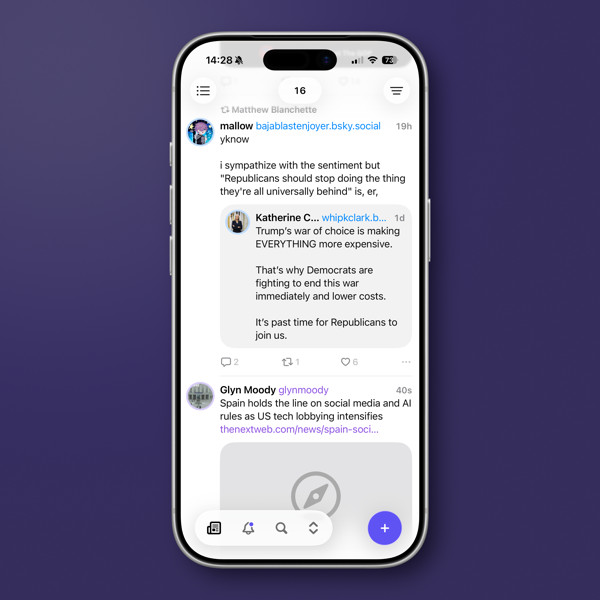
Screenshot of new social media app Indigo

Perhaps we’ve exhausted all of the ideas for what software can do and we’re just looking for a better iteration of what we already have at hand.

I’m talking on a consumer level. Beyond whatever AI supposedly offers, and the explosion of social media apps that happened when Twitter x-ed itself out, I can’t name an app or piece of software in the last few years that wasn’t a different version of something that already existed. Even AI software feels like it’s more of the same, just at a quicker pace.

Certainly there are nuances. But over time they tend to blur. As an example, take weather apps. They’ve all recently followed the leader (I don’t know which app that was) to display variable forecasts from different weather sources. It’s a good feature given that weather services can offer different forecasts. But as most weather apps have quickly adopted similar features, once again there isn’t much of a differentiator between them. Unless Carrot Weather’s bell weather use of insults is your cup of tea.

Don’t get me wrong. Execution and design can (and should) go a long way. Even more so when all things seem much the same or serve the same purpose. Beyond price, that’s really the only big differentiator.

It’s why I’ll try out an app that looks like it doesn’t offer anything beyond what I already have. Within that personal scope, let me say that the new social media browsing and crossposting app Indigo is worth your attention if its functionality fits how you use social media.

Indigo is the creation of Soapbox, the developers who created crossposting app Croissant. (I wrote about it when it released.) While Croissant allows you to cross post to Mastodon, Bluesky, and Threads, (functionality I find useful), Indigo is meant primarily to merge and scroll through a single timeline of your Mastodon and Bluesky feeds. You can also crosspost to both if that’s your desire. Threads isn’t included, as it doesn’t allow for viewing its timelines in the same way, which is curious as it is supposedly federated with Activity Pub.

If scrolling social media feeds is your thing, Indigo is certainly worth a look. It’s very well designed, and easy to discover its functionality.

It’s a first version of the app, and as one of the developers, Aaron Vegh says on his blog, “The Indigo we’re shipping today is going to be the worst version.” For the worst and first version, I believe Aaron and Ben McCarthy have done an excellent job. (You should read both Aaron’s and Ben’s blog posts. Ben’s describes the functionality quite well.) Having followed the development of Croissant since its release, I’ll say that the care they’ve used in the past with that app points to the same for the future of Indigo.

If you use both Mastodon and Bluesky, once you sign in to both through Indigo, you see your feeds merged together. You don’t need to use both social networks. The functionality is the same if you prefer only one of the two social networks. So, if you’re user of only one, it could replace whatever app you might currently be using.

One of the nicest design touches, and obviously an essential one, is that it’s easy to distinguish where things are coming from if you merge your timelines. Mastodon links are purple and those from Bluesky are, well they’re blue.

You can tell if a post is crossposted between the two networks, and another nice feature is that Indigo will merge the two in some cases (timing plays a part) so you don’t see them twice. You can switch between each version and take actions like quoting or replying to both at the same time.

If you’ve used Croissant to crosspost, doing so on Indigo will feel very familiar. Notifications, should you choose to receive them on your device, work as you would expect. The Notification tab in the app is quite well done and easy to understand.

The app is available for the iPhone, iPad, and Mac, and a single subscription covers you across devices. There is a free tier that’s read-only. If you’re interested in Indigo, the free tier is read only. That’s good way to determine if the excellent design of the app appeals to you.

If you use both social networks and would like to combine your feeds into one timeline I think Indigo is worth a look. Let me say this about Indigo and my social media usage. The single merged timeline feature has its attraction, but it’s not something that’s a high priority for me and that brings me back to the beginning of this post.

I like to keep my eye out for developers who focus on good design and good functionality. That’s the case with Indigo. As in this case, an app may not fit my needs, but I’ll remember the developers or company behind it. It’s much the same way I follow good theatre or film directors, and good writers.

I don’t see many new ideas or new needs to fill coming down the software or app pike in the near future. That may say more about me than it does the software market these days. Even so, that view of mine has me paying even closer attention to those who care about the look and feel of what they produce.

(image from the author)

You can also find more of my writings on a variety of topics on Medium at this link, including in the publications Ellemeno and Rome. I can also be found on social media under my name as above. This site does not use affilate links. 

 

Sunday Morning Reading

It’s all a loop

Back from spending time with the grandkids and back for some Sunday Morning Reading. There’s an interesting context to the many issues we face that evolves while watching the little ones grow and learn. Things are happening that will affect their lives in the years ahead. Yet there’s a blissful innocence cocooning them from it all. At the moment.

In my reading, and in my sharing of that reading, I find I’m doing so mostly for the thousands of tomorrows they have in their future, much more so than for anything that will happen in this week’s tomorrows that might affect me in the moment. Read on.

Neil Steinberg’s Meet My Metaphors #5: ConAgra is about so much more than the agricultural giant moving to Chicago years ago. If you like metaphors, it’s a must read. If you’re approaching the last leg of the journey, it’s a must read. If you’re concerned about what you may leave behind, well, it’s a must read.

JA Westenberg posits that it’s all a loop. Joke’s on us, I guess. Check out The Loop: Everything Has Happened Before, And Everything Will Happen Again. 

Ky Decker wonders, Do I Belong In Tech Anymore? I find if you’re asking that question about anything, you already know the answer.

Wesley Hilliard thinks we should Stop With The Tech Celebrity Worship. I concur. AND I’m for knocking down all the pedestals we erect for celebrities to ascend in any and all fields of human endeavor.

Timothy Noah takes a look at How The Tech World Turned Evil. Pop the bubbles. Tear down the pedestals. Endless loops.

Meanwhile, Makena Kelly examines how Palantir Employees Are Talking About The Company’s Descent Into Fascism. 

Follow that up with Jasmine Sun’s piece, Silicon Valley Is Bracing For A Permanent Underclass. 

The previous four links speak to a much darker future in one way or the other. Read them. Then go back and re-read the first two links by Steinberg and Westenberg. Looping context.

Closing out this week, here’s a couple of links that feel a bit more uplifting. First up, check out Mat Duggan’s Boy Was I Wrong About the Fediverse. 

Then follow that up with David Todd McCarty’s Becoming A Local. Sometimes the horizon is much closer than you think.

If you’re interested in just what the heck Sunday Morning Reading is all about you can read more about the origins of Sunday Morning Reading here. If you’d like more click on the Sunday Morning Reading link in the category column to check out what’s been shared on Sunday’s past. You can also find more of my writings on Medium at this link, including in the publications Ellemeno and Rome. This site does not use affilate links. 

 

Sunday Morning Reading

A basket of good writing to share

For those who celebrate Easter and Passover, and all who do not celebrate either, may you find some bit of peace on this Sunday morning, however you see yourself and the world. I’d like to say this week’s edition of Sunday Morning Reading is filled with Easter eggs, but instead it’s just the usual basket stuffed with links to interesting topics and stories that I like to share. Enjoy.

PXL 20260403 165116674.PORTRAIT.

It’s good to be seen, certainly the way you see yourself. When seen by someone who doesn’t know you, that’s eye-opening. Check out Natasha MH’s The Taxi Driver Knew.

The war that isn’t a war in Iran continues. Whatever that story is, it is still being written. Given that this might be heading to the culmination of a conflict that has simmered, and occasionally boiled over, for decades if not longer, there are a few stories out there that offer preface. He Helped Stop Iran From Getting The Bomb by David D. Kirkpatrick is one worth reading.

JA Westenberg’s The “Passive Income” Trap Ate A Generation of Entrepreneurs is also one heckuva a read. There’s nothing passive about this take.

Seva Gunitsky takes on The Incel Global Order. Somebody needs to.

As the technology we use advances, in some spheres some are stepping back. Joshua Cohen takes a look in Sweden Goes Back To Basics, Swapping Screens For Books In The Classroom.

Social Media is under the microscope again after two recent court verdicts against Meta. Chris Castle takes a look with The Social Media Verdicts Are In. Now Ask The Hard Question: Where Was The Board? Counting the money, I imagine. Hat tip to Stan Stewart for this one.

In the category of no easy answers, Mathew Ingram also examines what’s going on in social media with Social Media May Be Bad For You But The Remedy Could Be Worse.

On the Artificial Intelligence front there are always interesting topics cooking as the AI purveyors cook the planet. I wrote about two fascinating pieces yesterday, and today I’m highlighting Angela Fu’s An AI Company Set Out To Fix News Deserts. Instead, It Copied Local Journalists Work. Something tells me we’re going to be seeing more of this going forward.

Apple is, I assume, winding up its week celebrating its 50th Anniversary. So much has been written on that topic because there is indeed much to celebrate and much history to contemplate while looking ahead. Here are four pieces that caught my eye, the first three primarily because they are more personal than historical, the fourth is a look ahead.

John Moltz gives us Missed Connections: Me and Apple.

James Thomson is one of my favorite Apple developers. His Apple At 50: Gonna Be, Gonna Be Golden is indeed a personal journey.

Adam and Tonya Engst have been writing Tidbits since 1990. I started reading it shortly thereafter. What Apple’s 50th Anniversary Misses is certainly different than most, but one that mirrors the thoughts of many on this anniversary.

And Marco Arment, looking ahead, has penned A Letter To John Ternus, the guy everyone assumes will don the CEO mantle in the future.

Baseball is back. And every team and their fans are dreaming of a championship. David Todd McCarty spins a bit of fiction that’s baseball adjacent, but rooted deep in dreams in The Taste Of A Dream.

To conclude this week, this story by Audrey Pachuta very much sums up the contradictions we’re living through at the moment. Check out A Student Set A Goal To Run Every Street In Chicago And Inspired A City. Now He Must Leave The Country. 

May you find peace however you can.

(Photo from the author.)

If you’re interested in just what the heck Sunday Morning Reading is all about you can read more about the origins of Sunday Morning Reading here. If you’d like more click on the Sunday Morning Reading link in the category column to check out what’s been shared on Sunday’s past. You can also find more of my writings on Medium at this link, including in the publications Ellemeno and Rome.


The Potholes of the Internet

“Your Frustration Is The Product”

Some call it enshittification. I largely agree with that when it comes to the Internet. But that’s true in most endeavors that result in building something. Anything made for good, can and will be used in ways that turn it into a shitty experience.

20160824 121009.

I’m not just talking about advertising and how it’s junked up the web. I’m also talking about human nature, and how there’s a part of too many of us that see something wonderfully created to solve a problem, who then consequently turn it into a range of unintended consequences that leave us mourning our losses at the expense of somebody else’s gain.

Any one of us could run down a list of things in each of our lives that demonstrate that history, so I won’t even begin to spool one out. Have at it yourselves.

In the majority of instances the road to ruin is typically a path worn thin by greed and there’s never been a road we travel that doesn’t eventually fill with potholes. But back to the Internet and enshittification.

If this excellent post by Shubham Bose called The 49MB Web Page doesn’t make you yearn for a simpler age, I’m not sure what will, assuming you were alive and on the Internet before things went south. Remember, there’s a generation for which the way things are today on the Internet is the way things always have been.

Here’s Bose’s lede:

If active distraction of readers of your own website was an Olympic Sport, news publications would top the charts every time.

I went to the New York Times to glimpse at four headlines and was greeted with 422 network requests and 49 megabytes of data. It took two minutes before the page settled. And then you wonder why every sane tech person has an adblocker installed on systems of all their loved ones.

It is the same story across top publishers today.

The entire piece is worth your time if for no other reason than that misery loves company. We’re all in that same boat and there does’t seem to be any shoreline in view, given how the waters are being churned up anew by Artificial Intelligence.

As Bose puts it:

Your frustration is the product.

Back in the day I can remember getting a credit for complaining that my newspaper was delivered wet and unreadable. Good luck finding someone to express your frustration to these days.

(Photo by the author)

You can also find more of my writings on a variety of topics on Medium at this link, including in the publications Ellemeno and Rome. I can also be found on social media under my name as above.


Meta’s Not So Smart Approach To Smart Glasses With Facial Recognition

Leave the timing to comedians

If you’re a comedian, timing is everything. But not so much if you’re SOBs who don’t give a damn about anything other than feathering your own nest at the expense of everyone else’s safety and privacy. Or if you have employees who leak memos to the press.

Alireza heidarpour FiafJwLQfR4 unsplash.

The New York Times has a report on Meta’s second attempt at launching facial recognition, this time with smart glasses. The idea is sketchy enough, but according to a memo that the NYT obtained Meta thinks our political and social turmoil might just provide the right timing. Here’s the money quote:

We will launch during a dynamic political environment where many civil society groups that we would expect to attack us would have their resources focused on other concerns

I’m not so sure civil society groups will take their eye off of the ball now, no matter how much Meta helps the administration continue to stir things up.

There are already reports of people using smart glasses photography for what sounds very much like the reason Mark Zuckerberg created Facebook as Facemash in the first place as a  “hot or not” game. It doesn’t take any leap of imagination to know what kind of mischief this will cause once facial recognition is added into the mix.

The Electronic Frontier Foundation says, There are Seven Billion Reasons For Facebook To Abandon Its Face Recognition. 

But as we continue to see, but never learn, some prepubescent boys with toys will never grow up, always remaining prebubescent boys, even if they accumulate wealth enough to do better things.

There might be money in smart glasses, but if you ask me there might be more money in creating some sort of gadget that we can all carry or wear that blurs our faces and interferes with this kind of photography.

(Photo by Alireza heidarpour on Unsplash

You can also find more of my writings on a variety of topics on Medium at this link, including in the publications Ellemeno and Rome. I can also be found on social media under my name as above.


“Then No Line Exists”

Musk’s Grok has erased them all

I recently linked to Eizabeth Lopatto’s excellent and scathing article pointing fingers at Apple and Google for continuing to allow Elon Musk’s Grok AI to undress without consent adults and children. Calling Tim Cook and Sundar Pichai cowards in the headline on this issue is, in my opinion, table stakes and will be until they take public action and actually apologize for violating their own rules and the privacy of the users that pump money into their bank accounts.

1001 PandorasBox.

Following that up I’m linking to another excellent article on the topic from Charlie Warzel and Matteo Wong, published in the Atlantic. The headline is strong, saying Elon Musk Cannot Get Away With This. The article is stronger still. Yet, the sad reality is that he already has, and even if Cook and Pichai suddenly change direction, the damage has already been done. Like the political figures they have bent knees to, they won’t be able to find a mirror to look in that won’t reflect their cowardice back at them.

Hiding under their respective rocks, both Cook and Pichai have let Musk turn this from a ruinous troubling feature into a paid premium feature, which is not only ridiculous but makes a mockery of both Apple and Google. I’ve already said that any X users who still hang onto that platform are just as culpable.

But then that’s the world we live in. We ignore the horrible nature of what’s unfolding in front of our faces. So many demons have flown out of this era’s Pandora’s Box we find ourselves it is impossible to count them, much less have any hope of banishing them. But then, that’s what the demons are counting on. As the article says:

This crisis is an outgrowth of a breakneck information ecosystem in which few stories have staying power. No one person or group has to flood the zone with shit, because the zone is overflowing constantly. People with power have learned to exploit this—to weather scandals by hunkering down and letting them pass, or by refusing to apologize and turning any problem into a culture-war issue.

As Warzel and Wong also say, “the silence says everything.”

You can also find more of my writings on a variety of topics on Medium at this link, including in the publications Ellemeno and Rome. I can also be found on social media under my name as above.

The Taint of X

Elizabeth Lopatto calls out Apple and Google

With the pretense, facades, and myths we’ve all lived with for some time being stripped away in most areas of our lives, we’re also beginning to see more and more folks finally calling things like they actually see them.

Just a quick post here to highlight Elizabeth Lopatto’s epic Verge post called Tim Cook and Sundar Pichai Are Cowards. She’s talking about the fact that Elon Musk’s X social network is still up on both app stores as of this writing, given that he’s not only allowing deepfake porn, which violates guidelines on both app store platforms, but in some bizarre twist of reality, somehow paying to post that kind of heinous crap apparently should ameliorate any concerns.

The bottom line has always been the bottom line and knows no morality when it comes to shoring it up. There’s no new bottom here, just the same old greedy capitalistic depravity.

Just remember allowing this to continue is essentially working as a pimp. I don’t care what your business model is, that’s the business you’re in.

You can also find more of my writings on a variety of topics on Medium at this link, including in the publications Ellemeno and Rome. I can also be found on social media under my name as above.

Sunday Morning Reading

Small acts

It’s only business they say. Nothing personal. That’s the way the world works. Well, what I share each week in Sunday Morning Reading always comes from a place of personal interest. That may not be how the world works, but it works for me and I hope it does for you. Call it a small act.

Ganesh narayanan SU3zvkxttrE unsplash.

In the wake of the continuing and confounding ICE occupation of Chicago comes a terrific piece by Kyle Kingsbury called I Want You To Understand Chicago.

Follow that up with a ProPublica piece by Melissa Sanches, Jodi S. Cohen, T. Christian Miller, Sebastian Rotella and Mariam Elba about the nighttime raid on a Chicago apartment building that featured men rappelling from Black Hawk helicopters, and all of the residents emptied on to the streets with many of their belongings. The punchline is in the article’s title, “I Lost Everything”; Venezuelans Were Rounded Up In A Dramatic Midnight Raid But Never Charged With A Crime. 

A Nation of Heroes, A Senate Of Cowards by Will Bunch calls it like it is and much the way I see things after last weekend’s actions in the U.S. Senate.

Growing up, I never understood the cliché, “it’s nothing personal, it’s only business.” Frankly I still don’t. It excuses too much that I find wrong about the way the world works. Charles Broskoski examines the personal side in Personal Business.

And speaking of the way the world works (or doesn’t) in the midst of the Epstein fever I don’t think we’ll ever shake, Sarah Lyons points out that the violence in his and others’ actions is something we all live with in This Is How The World Works. It shouldn’t be.

Corbin Trent says We Didn’t Kill American Manufacturing—We Let It Die. He’s spot on.

Mark Jacob tells us How News Coverage Eases Us Into Tyranny.  However this saga we’re living through ends up, one thing is for certain. The media has killed any chance of returning to what it once was.

Hardly a day goes by that we don’t read of some nefarious business practice spilling out of Mark Zuckerberg’s Meta. Turns out Meta is knowingly leeching off of scammers to the tune of about 10 percent of its revenue. I guess that makes Meta and Zuckerberg a scammer too. Cath Virginia has the writeup with Meta Must Rein In Scammers — Or Face Consequences. I doubt they will.

The Internet Archive is under attack in the same way libraries, media organizations, and text book publishing is. It shouldn’t be. Mathew Ingram has the lowdown in The Internet Archive Should Be Protected Not Attacked.

On a more positive note, Jeff Veen tells us how Small Acts Build Great Cultures. Boy, do we need lots of small acts these days.

To close out, did you ever wonder where collective nouns like “a watch of nightingales” or “an ostentation of peacocks” come from? For many years it was assumed that the anonymous author of this collection of collective nouns was the work of a “gentleman of excellent gifts” written down in one of the first books printed after the invention of The Gutenberg Press, The Book of Hawking, Hunting, and Blazing of Arms. Turns out the author was a woman named Juliana Barnes. Maria Popova has the story in A Parliament of Owls And A Murder Of Crows: How Groups Of Birds Got Their Names, With Wondrous Vintage Illustrations By Brian Wordsmith. 

(Image form Ganesh Narahanan on Unsplash)

If you’re interested in just what the heck Sunday Morning Reading is all about you can read more about the origins of Sunday Morning Reading here. If you’d like more click on the Sunday Morning Reading link in the category column to check out what’s been shared on Sunday’s past. You can also find more of my writings on Medium at this link, including in the publications Ellemeno and Rome.

Sunday Morning Reading

No tricks. No treats. Just thoughts and reading worth sharing.

The frights of Halloween have passed us by, but real life horrors remain and expand. Never had more gut wrenching emotions this weekend than spending it with my grandkids costumed in their bountiful innocence, avoiding what’s out there in a life they’ll one day have to face, but in the present doesn’t exist beyond the edges of any joyful moment of wonder and exuberance they can conjure. This week’s Sunday Morning Reading won’t touch on too much of that, but then again, I think it just did.

David Todd McCarty thinks amidst it all We Can Be Heroes. Making my grandkids laugh uncontrollably makes me feels damn close.

Adam Gropnik visits the home of the poet Wislawa Szymborska and returns with How To Endure Authoritarianism.

Will Bunch says It Didn’t take A Reichstag Fire To Burn Down Congress. He’s correct. It didn’t even take a match.

Some interesting writing on Artificial Intelligence and the Internet this week that’s worth your while, first up Cory Doctorow tackles When AI Prophecy Fails.

Will Douglas Heaven explains How AGI Became The Most Consequential Theory Of Our Time.

Tim Chinenov wonders Who’s Creating The Rage Bait That’s Radicalizing You?

Decidedly not on the Internet Friday night while trick-or-treating with my grandkids, though not in my besieged town of Chicago, I witnessed not only kids howling with fun, but adults who joined in on the fun with their own costumes and decorated homes, some elaborate, some not so, all with love and honoring a tradition I’ve never seen in the communities I’ve lived in. Many families set up in their driveways, some with small fire pits, some with tents, tables full of food (and candy), welcoming all comers to their Halloween semi-tall gating front yards. I also noticed the adults who just sat in their cars and slowly followed their children down the block. The entire experience reminded me of this piece from the summer in which Joan Westenberg says every creator pays a tax while the rest stay spectators in The Unbearable Lightness of Cringe. Pay the tax.

And closing out this week, kudos to both the Los Angeles Dodgers and the Toronto Blue Jays for an excellent World Series, which the Dodgers won. Both teams played a splendid series and provided an incredible Game 7 finish to one of those contests you never want to see end, but know it must. Grown men over compensated for incredible talent, playing a kid’s game like kids, thrilling and heart breaking in the same breath. Too bad we don’t have any great, or even good, baseball writers to chronicle the moment these days.

If you’re interested in just what the heck Sunday Morning Reading is all about you can read more about the origins of Sunday Morning Reading here. If you’d like more click on the Sunday Morning Reading link in the category column to check out what’s been shared on Sunday’s past. You can also find more of my writings on Medium at this link, including in the publications Ellemeno and Rome.

Instagram Shows Up Very Late to the iPad Party

What’s the point and who cares?

The folks at Meta must have something up their sleeve. The reason I say that is they have finally, after all of these years released an iPad version of the app, long after most folks just figured it would never happen. Other than speculating on what might be behind the late to the party move, at this point it begs the question, Who cares?

Reels with Comments 16_9.

I’m sure plenty do care. I’m not one of them. Instagram is one of a few apps that I begrudgingly use. Begrudgingly because I hate it. I use it because my family on all sides continues to do so and it’s a way to keep up with grandkids, nieces, nephews, and other family news. But I honestly despise that I have to. Believe me I’ve tried to wean them off onto other apps and services, but it never sticks.

Every time I do open Instagram I have to block somewhere between 5 and 10 spam accounts (too often porn or ridiculous come ons.) And of course the algorithm doesn’t show me what I want to see, but what it wants me to see. There’s even an increased sense of desperation from both Instagram and Facebook sending out notifications telling me someone replied, is waiting for my reply, or commented on something I haven’t seen yet. It’s like begging in the street. Apologies to those who might actually need to do so.

Sure I could turn off the notifications, but sadly, that’s the least worst way to use the app to keep up with family happenings.

I’d say that since it took 15 years for Meta to finally roll this out that perhaps the adolescents in charge finally are growing up. But then, there are those porn accounts that pop up with the frequency like prepubescent zits.

I won’t be putting it on my iPad. It’s troubling enough that I still have it on my iPhone. And as I watch the over excited coverage rolling in, I haven’t seen any image of the iPad version that makes it look the least bit appealing. It’s like Meta didn’t really care based on what I’ve seen so far.

So, Instagram is on the iPad. What’s the point and who cares?

You can also find more of my writings on a variety of topics on Medium at this link, including in the publications Ellemeno and Rome. I can also be found on social media under my name as above.