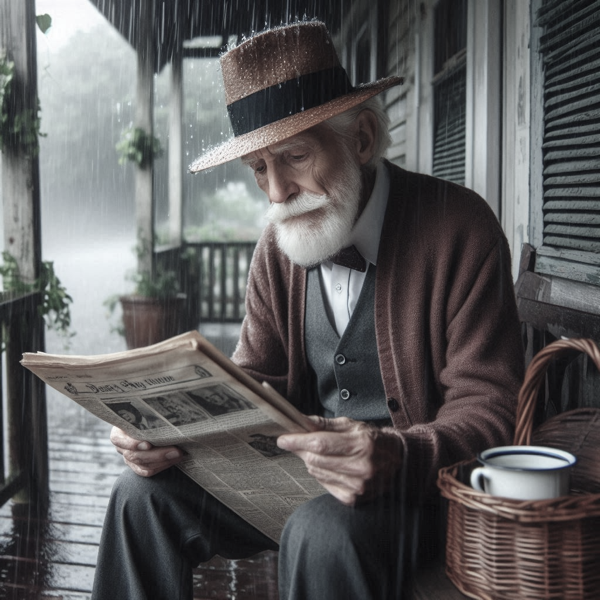
File this one in the “Depressing If True” category. Rose Horowitch has written an excellent piece for The Atlantic entitled The End Of Reading Is Here. Yes, you read the title correctly. Unless you’ve already given up on reading you should give the piece more than just a look. If you have given up, try to remember how.

I’m not sure I’d agree completely that we’ve reached or are nearing the end point of reading, but I have to admit that we sure seem to be rushing headlong to cliff noting, bullet pointing, and summarizing everything to a point that it’s far too easy for some to break the habit and shy away from reading as a way to discover knowledge, new ideas, and well…advance ourselves and civilization while understanding from whence we came.
An excerpt:
Reading has never been natural. Humans have no innate cognitive machinery designed to string letters into words and connect them to their real-world analogues. To read, people had to repurpose regions of their brain used for speech and object recognition. The practice first emerged 6,000 years ago in Mesopotamia.
Horowitch traipses through the history of the written word hitting the high and low water marks, many easily recognizable, some not nearly as discernible, pointing to an age when Marshall McLuhan predicted we would become “post-literate.” He predicted that in 1962. She marches on from there.
The usual, and occasionally unusual, list of the enemies of writing and reading make their appearance on her march through the ages, but Horowitch lays them out, dare I say, in only the way a writer could. And yes, AI makes its appearance on that list. For it is not just reading, it’s also the writing of the words we read that is under threat.
Another excerpt:
The written word is fundamentally different from oral language. Writing detaches the message from the messenger, allowing for a more dispassionate spread of information than was possible in oral societies. Because writing a phrase takes longer than speaking it, writing forces the author to slow down and reflect. Written language tends to employ more complex sentence structures and vocabulary than spoken language. And unlike speech, it doesn’t disappear into the ether.
In her conclusion Horowitch reminds us that in our digital age we have the capability to read much more than at any point in human history.
When the Library of Alexandria disappeared, the knowledge inscribed on its scrolls was lost forever. We can only guess what else Eratosthenes and Euclid might have written. The text turned to dust. That won’t happen today; all of the words in the great library could be stored on a single computer chip. Nowadays, even the most obscure academic monographs are scanned and digitized. Google Books and the Internet Archive represent libraries of unfathomable proportions. We can navigate to them with a few keystrokes, not a perilous journey across the Mediterranean. There’s little risk of their texts succumbing to humidity or mice.
But the threat of apathy remains. What we’re losing is the ability and inclination to read those texts. An astonishing wealth of information and wisdom has been bequeathed to us. What we’ll do with this inheritance is up to us.
That makes it all a choice, does it not?
I won’t question the assumptions, nor the excellent way she has written them. I will add that if we are indeed reaching the end of reading, the logical next step is the end of thinking.
The piece is more than worth your time, should you have in the inclination to read it. I hope you do. It might actually make you think.
Thanks for reading. You can subscribe to this blog if you care to. You can also find more of my writings on a variety of topics on Medium at this link, including in the publications Ellemeno and Rome. I can also be found on social media under my name as above. This site does not use affilate links.
 Of course I’m referring to all of the insane stunts that are happening during these early days of the end of the American Experiment. Don’t blowback on the use of the word “stunts.” People get hurt doing stunt work all the time. Some have died. Both are going to happen at some point in our future.
But make no mistake, these “shock and awe” stunts are literally intended to do real harm while overwhelming any attempt to impede them. It’s designed to create chaos. Sadly, it’s working.
To say the Democrats are in disarray is to spit out a bad cliché like a rotten sunflower seed. To say whatever used to be the GOP has surrendered everything except their daughters to Trump is also old news. That last part might also be premature. To say the fourth estate is complicit misses the point completely. Ask yourself where the cameras were during all of Elon Musk’s frat boy takeovers this weekend. Perhaps if a plane had crashed into the Treasury building they would have been there. To say the oligarchs and tech bros are the real winners is watching a trailer for a comedy action thriller that leaves out the spoiler in which everybody dies in the end.
Josh Marshall has two good pieces about this that are worth reading
Of course I’m referring to all of the insane stunts that are happening during these early days of the end of the American Experiment. Don’t blowback on the use of the word “stunts.” People get hurt doing stunt work all the time. Some have died. Both are going to happen at some point in our future.
But make no mistake, these “shock and awe” stunts are literally intended to do real harm while overwhelming any attempt to impede them. It’s designed to create chaos. Sadly, it’s working.
To say the Democrats are in disarray is to spit out a bad cliché like a rotten sunflower seed. To say whatever used to be the GOP has surrendered everything except their daughters to Trump is also old news. That last part might also be premature. To say the fourth estate is complicit misses the point completely. Ask yourself where the cameras were during all of Elon Musk’s frat boy takeovers this weekend. Perhaps if a plane had crashed into the Treasury building they would have been there. To say the oligarchs and tech bros are the real winners is watching a trailer for a comedy action thriller that leaves out the spoiler in which everybody dies in the end.
Josh Marshall has two good pieces about this that are worth reading