
Several weeks ago there was quite a debate bouncing around about what writing is or might or might not become in this era of Artificial Intelligence. Quite a lot was written about the subject. I watched and read most of it beginning with John Gruber’s piece on Daring Fireball about Anthropic’s use of watermarks for AI-generated writing. Gruber called it a “perversion of writing.” Many others weighed in with words, words, words. And more words.
I particularly liked Dan Moren’s piece in response, primarily because it lines up with what I’ve learned and currently think about AI-writing. Here’s a quote:
That might be the case if AIs were writing. But they are not; they are simply generating text. Those two things are not the same. As per the premise of John’s piece, writing is about carefully picking the words and crafting the meaning of what you’re saying, things that AI do not—and patently cannot—do.
In case you’re wondering, I’m in the camp that says that AI isn’t capable of “writing.” If you know anything about the tech at all, you should be too. AI might be able to predict the next word, but that’s a mathematical equation not writing. If you insist otherwise, I hope the kool-aid tasted good on the way down.
Back in the days of my youth, one of the many rituals of sorting wheat from the chaff in childhood education was teaching us to to write mechanically, moving slowly but steadily up to writing things with meaning (remember book reports?) and once we moved into college there was Freshman Comp. Do they still teach Freshman Comp these days?
It wasn’t until later in college when I actually learned what I came to believe writing was all about. Dr. Ralph Cohen, an English professor who taught courses on Shakespeare, film as a narrative art, and surveys of literature, was one of the few professors who kicked my butt. He challenged me in ways others didn’t and I ended up taking most of the classes he offered.
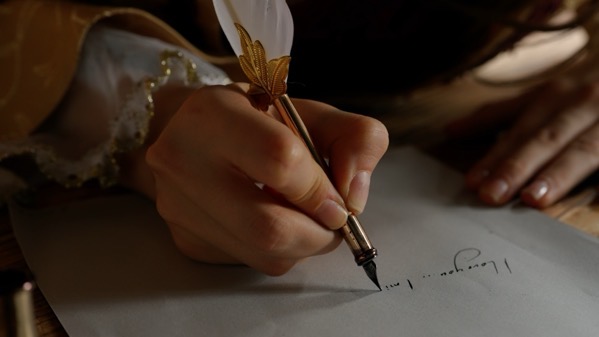
In teaching Shakespeare, he laid out what the physical act and monetary cost of writing during the Bard’s time actually required. There was a real cost to committing an idea to the paper he made out of rags and old linens. Simply put, it meant the work of writing happened in the man’s brain and soul either before or as he was scribbling away with his quill and ink.
I was never good at writing with pen/pencil and paper. Nevertheless, I fought my mother tooth and nail when she insisted I take a typing class in high school. She won. I’m glad she did. Writing for me did become easier on a keyboard and a keyboard has been the primary medium of committing my thoughts to paper or digital bits ever since.
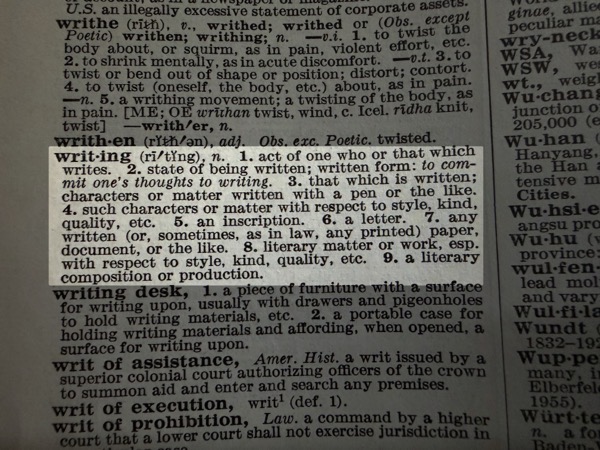
In thinking about this debate I pulled a dust covered dictionary off of one of my book shelves to look up the definition of writing. It’s The American College Dictionary published by Random House copyrighted in 1961. Here’s what that says below:
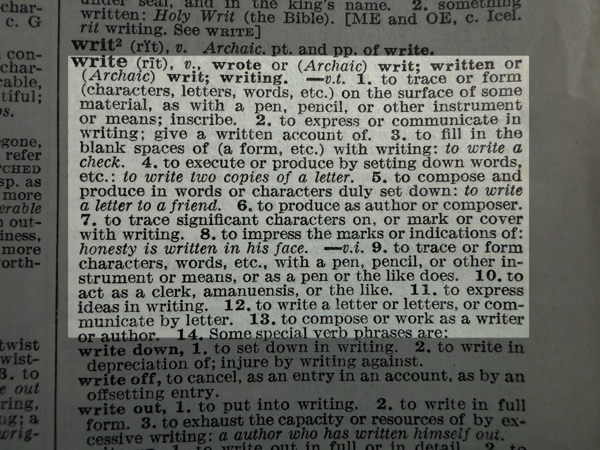
I also looked up the word “write.”
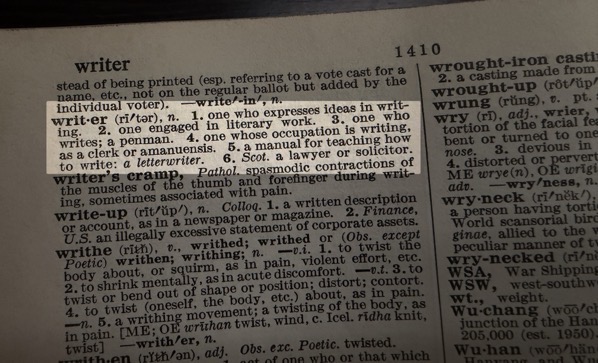
And the word “writer.”
Google Gemini’s AI summary provides the following:
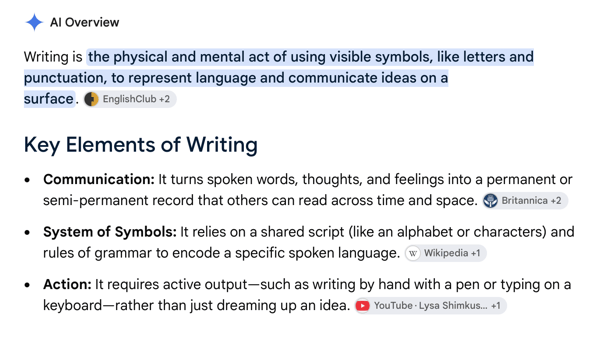
The highlights in that result are Google’s. Certainly there are many other dictionaries with differing and distinct definitions spelled out. I’d wager that most, like those above, focus on the mechanical. Perhaps that would steer the debate more towards those who think AI can “write.” Frankly, I find that devaluing when I think of the act, or dare I say the art of writing.
Having spent a life in the theatre, written a few plays and musicals along the way, and heard the chimes at midnight with many a playwright and composer searching for the right words or notes, I believe there’s an element that’s missing when most engage in this debate. I’d call it the soul.
Otherwise the infinite monkey theorem comes into play and renders all writing reductive to a fault. Or if The Simpsons is more your cup of tea, 1000 monkeys with a 1000 typewriters.
There are some that are trying to define parameters of this debate as being about process. But that’s any creator’s thing. Some want to frame the discussion about how the march of technological progress always presents change. So, why resist it?
If writing, or any other art form was supposed to be easy or easier that’s when the devaluing kicks in. The playing fields of creation have never be level. Why start doing so now?
That last link above is from a piece from Tim O’Reilly on the subject. I’m not sure if he wrote it or he coached an AI to do so. You’ll understand that if you do read the piece. Regardless, it’s worth your time if you have interest in the debate. Here’s a quote:
We’re in the early days, still shooting filmed stage plays. The masters of this instrument will uncover themselves. When they do, what they produce isn’t going to be slop. In the meantime, I don’t think we should be shooting down people who are trying to push AI’s limits in writing or art. Writers should be trying to figure out the medium, just as software developers are doing in coding.
We may indeed be in the early days. I translate that in our current moment to folks paying for and investing a lot of money to use beta software that promises much, doesn’t always work, and more often than not yields different responses to the same prompt. But that’s the slippery slope we’ve fallen down with most tech these days.
Early filmmakers may have indeed been constantly adapting and evolving the technology they used and the way they used it. Although to pick a nit, the early filmmakers analogy doesn’t really hold up, as most early films were shot outdoors until lighting technology caught up, allowing for better filming of interiors. That’s when filming stage plays really began. (Thanks, Dr. Cohen.)
The distinction is that those early filmmakers were pushing their technology envelopes to better tell a story in a new medium of motion pictures. Not mimic one that had existed since man first painted tales of the hunt on cave walls. That assumes you accept the pieces of the definitions of writing that describe it as a method of using symbols, characters or words on some surface in order to communicate an idea.
But back to my thoughts on writing in opposition to those I disagree with. It’s safe to say that my bet is anything AI writes, no matter how well prompted, won’t endure for 400 or so years the way Shakespeare has. Or in later generations, Chekov, Ibsen, Miller, Mamet or Shepard. Not even the summaries. Of course, who knows what will endure 400 years into this wacky future we seem hell bent on creating? Or is that erasing?
I’ll end this with a quote from Mr. Shakespeare:
Write till your ink be dry, and with your tears
Moist it again, and frame some feeling line
That may discover such integrity.
Two Gentlemen From Verona, Act 3, Scene 2
A 1000 monkeys indeed.
(Images from KinoMasterskaya on Shutterstock. Dictionary photos by the author.)
Thanks for reading. You can subscribe to this blog if you care to. You can also find more of my writings on a variety of topics on Medium at this link, including in the publications Ellemeno and Rome. I can also be found on social media under my name as above. This site does not use affilate links.

