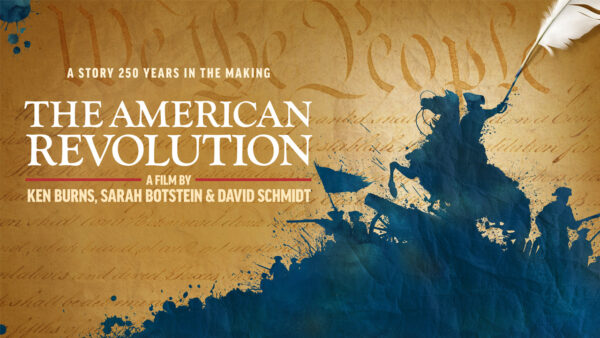
Finishing Ken Burns’ The American Revolution

The series is complete. As a nation the question remains open.

We completed watching Ken Burn’s excellent The American Revolution this week. Thank goodness for streaming, allowing us to view it on our schedule. Two spoiler alerts. First, we won the war. Second, we’re still struggling with many of the differences that made the formation (and perhaps the continuation) of what would become the Untied States such a close thing. 

 The series is excellent and I highly recommend it. Burns and his team do their expected thorough job of researching and producing the documentary. We’re lucky there were so many letters written by those beneath the status of the cast of characters most of us could identify at a glance, because that material provides much of the content and texture inside the frame. 

The production does it’s job so well that my hunch is some will come away learning things they never knew about a period of our history we’ve wrapped in so many myths it would keep troops at Valley Forge warm. I would also guess that in today’s political and social climate there will be far too many who tune out or don’t tune in because they prefer the comfort of the mythology. 

Which is a damned shame. As I said in an earlier post about the series:

I’m not hearing things differently, but I’m hearing how folks can take their own meaning out of many of the things written and said during that period that led to this country’s founding. History may indeed rhyme, but it also echoes. Often in strange ways.

If you have followed any of Burns’ work you know his approach to American history is to tell the parts of stories we leave out of the picture. I grew up in a part of the country where you could turn your head left or right, spit, and hit the history of the American Revolution or the Civil War. I count myself lucky that my 10th grade history teacher kept reminding us that there was so much more to discover about our past than he had the time to teach us, planting a seed of curiosity that continues to grow inside of me to this day decades later. 

Ken Burns and his team continue to keep that curiosity growing. We should all be grateful and unafraid that they do so.

You can also find more of my writings on a variety of topics on Medium at this link, including in the publications Ellemeno and Rome. I can also be found on social media under my name as above.

Sunday Morning Reading

Art matters. If you listen.

It’s another Sunday in this insane world, so it’s time for some Sunday Morning Reading. It won’t cure what ails you, or the world. But there are those who are listening. Listen as you read.

Roman kraft _Zua2hyvTBk unsplash 1.

Aren’t You Tired Of Feeling Insane All The Time? Marie Le Conte asks that question. I’m not sure anyone can plug the hole in that boat, but acknowledging that we’re sinking is the first step.

David Todd McCarty tackles The Lost Art of Listening.

NatashaMH recently launched an exhibition of her art. Launching anything can take life out of you, launching any display of art exacts even more of the soul than it does the physical being. But as she says in The Social Life of Art, “art demands resilience, and resilience demands a sense of humor.”

I wrote a bit this week about what Mark Leydorf has to say about The Rise of Resistance Cinema In The Era of Trump. It’s worth highlighting his piece again here.

I’ve been watching the Apple TV series Pluribus with great curiosity. If nothing else, the show echoes Mr. McCarty’s opening to his piece linked above. (Warning. Don’t watch the show with my wife.) Dani Di Placido thinks he’s got it all figured out in What Is ‘Pluribus’ Really About?  Perhaps he does. I’m not so sure. I’m also not sure the show’s success or failure relies on figuring it out in the end.

I’ve been linking to some of the goings on at The Kennedy Center under this corrupt administration. Trust me when I say what’s happening there is causing shock waves across board rooms in arts institutions across the country as everyone looks to uncertain and unknown futures with no script to follow. It’s affecting the art. It’s affecting the business of art. It will affect the art in ways we can’t begin to imagine. Janay Kingsberry examines how Senate Democrats Are Investigating Kennedy Center’s Deals And Spending. 

Most of the links this week touch on the arts in one way or the other. In a way this tech topic does as well, given that so many want to turn emoji’s into some form of art. Benji Edwards examines the origins of this move back to hieroglyphics with the piece, In 1982, A Physics Gone Wrong Sparked The Invention Of The Emoticon. Art by accident often is the art that sticks.

(Image by Roman Kraft on Unsplash)

If you’re interested in just what the heck Sunday Morning Reading is all about you can read more about the origins of Sunday Morning Reading here. If you’d like more click on the Sunday Morning Reading link in the category column to check out what’s been shared on Sunday’s past. You can also find more of my writings on Medium at this link, including in the publications Ellemeno and Rome.

Sunday Morning Reading

Politics, the arts, a little snow, and the end of an era

It’s a Sunday and Fall is homing in on Winter as the first snow of the season hits Chicago this morning. Perfect time for a little Sunday Morning Reading featuring some interesting stories about the arts, AI, and home.

As the first flakes of this winter of discontent fall, two interesting reads highlight some of the chaos the art-less U.S administration is inflicting on the American arts scene, specifically The Kennedy Center. Shawn McCreesh takes a look at the damage being done in The Kennedy Center Crackup.

Meanwhile, Charlotte Higgins reports that the Washington National Opera May Move Out Of The Kennedy Center Due to Trump ‘Takeover.’ I’m here to tell you that while what’s happening on the banks of the Potomac may feel very inside the beltway, the repercussions are being felt in the boardrooms of arts organizations across the country.

The above, like most of our news of late, is certainly not something to laugh at. That doesn’t mean we shouldn’t find ways to laugh at the incompetent, ignorant and dangerous players wreaking havoc in their wake. Laughter gets under their all too thin skins, no matter how made up or stretched too tight by surgery. Mike Monteiro offers up How To Point At Fascists And Laugh.

NatashaMH, far too young to worry about being old, takes a look at creating art as she nears the mid-century mark in I Don’t Paint For Your Sofa. Youngsters these days.

Art and politics might be an unholy mix in dangerous times like these, but there’s another foul concoction brewing. Adam Willems points to An ex-Intel CEO’s Mission To Build A Christian AI: ‘Hasten The Coming of Christ’s Return.’ If you ask me these folks wishing for these kind of end times have really missed the points. All of them.

Continuing on the AI front there seems to be a bit of weakening in the walls of what most concede is an economic bubble. The cliché is that bubbles pop. Those that don’t, just disappear as they float away. Ben Thompson takes a look at what happens in either case in The Benefits of Bubbles. 

Home is where hearts are and often places you can’t return back to. I’ve lived both. Chris Andrei is Searching For The Elusive Feeling Of Home.

With the weather changing and snowflakes falling out my window, there’s a passage of time marker about to be set. The Farmers’ Almanac is about to shut down. Growing up in rural America there were only two publications that everyone I knew received in the mail. It was always a big deal in our house when my dad, who was the postmaster, brought those home. The Sears Catalog and The Farmer’s Almanac. The Sears Catalog is long gone. The 2026 edition of the latter will be its last. Grace Snelling takes a look back and ahead in After More Than 200 Years, The Farmers’ Almanac Is Shutting Down For Good. 

Returning to where this week’s column began, the arts, Jack Rodolico’s The Blue Book Burglar examines how New York’s once vaunted Social Register, was not only a destination that social climbers desired to be included in, but was also a hit list for the country’s hardest working art thief. I just don’t understand how the current thieves doing today’s pillaging have it so damn easy.

If you’re interested in just what the heck Sunday Morning Reading is all about you can read more about the origins of Sunday Morning Reading here. If you’d like more click on the Sunday Morning Reading link in the category column to check out what’s been shared on Sunday’s past. You can also find more of my writings on Medium at this link, including in the publications Ellemeno and Rome.

Sunday Morning Reading

Everything you can imagine is different, yet it’s the same.

It’s a Sunday. It’s a Sunday in Chicago. The Cubs lost. (Not surprising.) The Trump regime continues its horrendous snatch and grab policies all over the city (Increasingly not surprising but still terrifying.) Leaves are falling, but somehow they feel dirtier and without the bursts of color we’re used to seeing beforehand. And the world marches on. Time for a little Sunday Morning Reading. 

Neil Steinberg wrote a terrific piece about Chicago amidst all that’s going on called What A Lovely Day in Chicago. It’s a love letter. It’s an homage. It’s a snapshot. As he puts it “We need to remember that this is oppression for oppression’s sake, a practice built on lies. The city is fine.” That’s the odd thing. The city is fine. It’s the oppression that’s not.

Timothy Burke’s The News: Reign of Error expands on a piece by Henry Farrell that says that institutions and communities need to coordinate their resistance to Trump. As Burke puts it one of the obstacles is that “the closer that institutions get to one another in character and mission, and the less necessary it is to be competitive, the more that they are overwhelmed by the narcissism of small differences.” It’s an excellent dissection that reveals why some in higher places of different sectors might be holding their tongues while their mouths are agape at what’s going on around us.

Empywheel thinks The Nativists Are Getting Restless: How The Comey Prosecution May Backfire. I’m not sure it matters in the end if the point is do damage as loudly as possible.

David Todd McCarty asks the question Is Your Imagination Robbing You of Real Experiences? Cogito, ergo sum?

I wrote a play years ago about John Brown and Harpers Ferry, one of those moments in American history that we seem to want to forget, yet never goes away. Robert S. Levine tells us Why Donald Trump Wants To Erase John Brown’s Fiery Abolitionist Legacy (and Why He Will Fail.)

There was so much craziness about the Nobel Peace Prize this year given, well you know why. So much so that many of the other awards were overlooked. The Nobel Prize for Literature went to Hungarian author Lázló Krasznahorkai. I have several acquaintances who adore his work and were tremendously excited. I did some reading on Krasznahorkai and stumbled up on this 2011 piece by James Wood called Madness and Civilization about the author. Worth your while.

On the Artificial Intelligence beat, Sora is the latest thing everyone has an immediate love/hate relationship with. But this isn’t about that. Sarah Perez says It’s Not Too Late For Apple To Get AI Right. Frankly, I think it’s too late for any of these companies to get it right, unless “right” is about winning the con game.

Resting my case on that last statement, Alexandra Jones looks into the connections folks can’t make in real life and are turning to AI for in ‘I Realized I’d Been ChatGPT-ed Into Bed’: How ‘Chatfishing Made Finding Love On Dating Apps Even Weirder.”

And as Autumn continues its march, New Englanders Are Fed Up With Leaf-Peeping Tourists Ruining Their Fall, so says Jared Mitovitch.

(Image is a photo I took last Fall)

If you’re interested in just what the heck Sunday Morning Reading is all about you can read more about the origins of Sunday Morning Reading here. If you’d like more click on the Sunday Morning Reading link in the category column to check out what’s been shared on Sunday’s past. You can also find more of my writings on Medium at this link, including in the publications Ellemeno and Rome.

Sunday Morning Reading

Winter is coming. Or is it here?

It’s a Sunday and that means it’s time for Sunday Morning Reading. Fall is beginning its march towards Winter, but the chill in the unusually warm Chicago temperatures this weekend aren’t weather related. Some of that is reflected in today’s selections as well as other topics, some that feed the soul, while others fuel the fires.

Shutterstock 632908457.

It’s tough to watch what’s going on in the streets of some of our cities and towns, and there’s no denying what Ian F. Blair points out That The United Police State of America Has Arrived.

Another Ian, this time Ian Dunt, discusses The Politics of Drawing a Moral Line, sketching a parallel between events in Britain and the Ezra Klein interview with Ta-Nehisi Coates. By the way, I encourage you to listen to that interview. It’s not easy, but nothing is these days.

Chicago’s Neil Steinberg comments that Next, Dyeing the River Green Will Be Cast As A Terrorist Act. I don’t think he’s far off.

On the Artificial Intelligence front, what was bound to happen happened when OpenAI released Sora, its tool for creating short movies, or better yet (worse yet?) putting yourself into one. That followed quickly on the heels of the uproar over the creation of Tilly Norwood, an AI actress created out of bits and bytes, and her creator seeking talent agent representation. Hollywood producers and bean counters are thirsting over better bottom lines ahead. Maureen Dowd has an interesting look at When A.I. Came For Hollywood.

Meanwhile one of the tech overlords, Peter Thiel, is obsessed with the antichrist and thinks tech is the only way to keep whatever that is from destroying us all. Laura Bullard takes a look at what’s behind Thiel’s obsession. Don’t be surprised at where Thiel drew some of his inspiration in The Real States, and Real Story, of Peter Thiel’s Antichrist Obsession. 

Continuing on the Artificial Intelligence beat, Bullsh*t Warning from John Warner, examines how to think about writing in the age of AI.

Mathew Ingram asks So What’s So Great About Reading Books? 

And to wrap things up this week, take a look at Christopher Michael Hefner’s On Letting Go Of The Idea Of The Tortured Artist. 

I included the image above from Fotgraf Petrova Olga on Shutterstock of an empty playground because I noticed this week that Chicago’s parks and playgrounds are empty of the laughter and life we usually experience due to ICE activity throughout the city before Winter begins to set in. There’s a different chill in the air this Fall.

If you’re interested in just what the heck Sunday Morning Reading is all about you can read more about the origins of Sunday Morning Reading here. If you’d like more click on the Sunday Morning Reading link in the category column to check out what’s been shared on Sunday’s past. You can also find more of my writings on Medium at this link, including in the publications Ellemeno and Rome.

Sunday Morning Reading

Back home from travels. Still sharing stuff that warrants attention.

Back home after a couple of weeks on the road. Good times. Crazy times. Nevertheless, it’s Sunday and there’s Sunday Morning Reading to share.

Shutterstock 1626610513.

“Life isn’t just about knowing what you should do, or having the resources to do it, it’s about following through.” So says, John Burn-Murdoch in his piece The Troubling Decline In Conscientiousness. I agree there’s a decline. I’m not so sure the remedy is as simple as it sounds.

The AI race is continuing whether we want it to or not. Apparently there’s now a way to create your own TV show if you want to keep diving deeper into your own delusions. Nina Metz has a great piece on this intrusion into the entertainment industry saying After A Long Day, The Last Thing I Want Is To Tell GenAI To Create a TV Show For Me To Watch.

In Notes From The Circus, Mike Brock takes a look at The Faux Intellectuals of Silicon Valley. “When oligarchs treat human civilization as thought experiments while sophisticated courtiers provide intellectual cover, democratic discourse itself becomes impossible.” Nailed it.

I don’t know about you, but my handwriting went downhill mere minutes after I was no longer graded on it. So it has always sucked. So, I’m not sure if NatashaMH’s latest applies in my case, but she is taking a look at what happens When The Handwriting Changes, suggesting that the body keeps score and so does the pen. Damn, if I’d know there was score keeping…

Mathew Ingram takes a look at age gating, the move afoot to protect kids from the perils of the Internet in The UK’s Well-Meaning Online Safety Law Is A Dumpster Fire. American dumpsters won’t be far behind, because we like to hide from the things we think are bad, pretending we’ve solved the problem, instead of addressing the problem.

Matthew Wolfe tells a great story about Chicago and America’s first black detective, who had a few secrets of his own in The Talented Mr. Bruseaux.

The turmoil among Apple users continues to roil for lots of reasons. Certainly this week’s obsequious bending of the knee by Tim Cook has added more to it. I wrote a bit about that here. I like John Gruber’s take on the issue in Gold, Frankincense, and Silicon. 

(Image from OlegRi on Shutterstock)

If you’re interested in just what the heck Sunday Morning Reading is all about you can read more about the origins of Sunday Morning Reading here. If you’d like more click on the Sunday Morning Reading link in the category column to check out what’s been shared on Sunday’s past. You can also find more of my writings on Medium at this link, including in the publications Ellemeno and Rome.
Sunday Morning Reading

Notice the good things amidst the bad.

It’s been a week. But I repeat myself. These days it seems like that’s always the case. Superman’s back. (Again.) So too are this season’s butterflies. Everything circles back. Today’s Sunday Morning Reading is a potpourri of topics of interest that stroke a number of chords, some familiar, some not so, some good, some not so. Either way, enjoy.

Photo 1693722379283 fd3627e18cea.

In That Was Good, Merlin Mann says that smart people always find the best reasons for being very sad. I can relate. He suggests the cure for that might be noticing some good things. Even the small ones. Check it out. It’s a good thing.

This week featured the news revisiting the subject matter of several plays I’ve written or directed in the past. One of those, Inherit the Wind, the play by Jerome Lawrence and Robert Edwin Lee, is a semi-fictional retelling of the Scopes Monkey Trial in Dayton, Tennessee. This year marks the 100th year anniversary of that trial. Neil Steinberg has a terrific piece, both commemorating and commiserating. Given how short a distance we’ve traveled in this circle we keep walking in. Check out 100 Years Ago, The Scopes Trial Gripped The Nation, And Here We Go Again.

Twice a week on social media I post “This is your now weekly, and continuing reminder that we’re still fighting the Civil War.” Frankly, I don’t see it any other way for reasons I shouldn’t have to explain. I don’t often post interviews in this column, but I’m making an exception this week to post Amita Sharma’s interview with political scientist Barbara Walter who has helped forecast civil wars in other countries. Take a look at San Diego Political Expert Details Steps That Could Lead To US Civil War.

I blow hot and cold on Tom Nichols’ political commentary. I very much like his piece Damn You All To Hell! Find out his thoughts on how Hollywood taught a generation to fear nuclear catastrophe. It might have worked with that horror. Funny, yet sad, how it hasn’t worked with all of the goings on currently.

History is indeed always an incomplete picture that’s always evolving and struggling to take hold. In Texas Man’s Fight To Move A Lynching Marker Sparks New Battle For Truth, Christina Carrega pinpoints one of those moments of evolution.

Mathew Ingram says We Shouldn’t Blame AI For The Stupid Things That People Do. I agree. AI is the prime example.

Chris Castle takes on a piece of the Section 230 argument, thinking that a new theory of liability is emerging, grounded not in speech, but in conduct. Give a look at The Duty Comes From The Data: Rethinking Platform Liability In The Age of Algorithmic Harm. 

And to round out the circle this week, take a look at David SparksA Remarkable, Unremarkable Thing. Don’t let the small things go unnoticed.

(Image from Anya Chernik on Unsplash)

If you’re interested in just what the heck Sunday Morning Reading is all about you can read more about the origins of Sunday Morning Reading here. You can also find more of my writings on Medium at this link, including in the publications Ellemeno and Rome.
Sunday Morning Reading

Mixed feelings and mixed emotions on a Summer Sunday by the lake.

The 4th of July weekend is wrapping up in the U.S. and many are having mixed feelings this year. Today’s edition of Sunday Morning Reading will feature some excellent writing on some of those mixed feelings in addition to some interesting reads on familiar topics from familiar writers, and some not so familiar. Enjoy.

Giuseppe argenziano J04GmVkKSLQ unsplash.

First up, let’s take a look at Elizabeth Lopatto’s view on the state of things in the states in her post The American System of Democracy Has Crashed. Excellent. Should be required reading.

Neil Steinberg also has thoughts well worth your time in He’s baaaaaaack.

Jack Hopkins gives us The 4th of July: What We Were Meant to Celebrate — and How We’re Failing It. Again, worth a read as we close out the long holiday weekend and this section of today’s Sunday Morning Reading.

Now for some catching up on some links I’ve delayed too long in sharing.

First up is The Chosen Few and the Cost of Global Silence from NatashaMH. History repeats. All the damn time. As she also demonstrates in this piece The Cruelty of Indifference.

Relative youngster, David Todd McCarty writes about aging in When I Am Old.

Writers are having trouble finding the right fit when it comes to how to make a living. Matthew Ingram tells us Why Substack Shouldn’t Be The Future of Online Publishing. We

Chuck Wendig argues about and bemoans the loss of downtime in his writing process given all that’s happening around us in A Small But Vital Thing, Taken.

While writers search for new ways and new homes, Joshua Rothman wonders What’s Happening To Reading?

Never Forgive Them is a piece from Edward Zitron from December 2024 that seems relevant again in more ways than it was intended then.

Composer and poet Stan Stewart recently had his computer die on him. He writes about what he lost and found in Of Dead Computers and Really Living.

Matteo Wong says The Entire Internet Is Reverting to Beta. Sure everything is a janky work in progress, certainly in the janky days of AI. But I think that’s how those who think they run the joint like running the joint.

And to close out this week, take a good look at this wonderful long read from Eric Konigsberg from all the way back in 2001, entitled My Uncle The Hit Man.

Image from Giuseppe Argenziano on Unsplash.

If you’re interested in just what the heck Sunday Morning Reading is all about you can read more about the origins of Sunday Morning Reading here. You can also find more of my writings on Medium at this link, including in the publications Ellemeno and Rome.
Sunday Morning Reading

When caring becomes a commodity, should we care more or less?

Lots to care about. On all the usual fronts. But in the grand scope of the universe does much of it really matter? Some interesting links to share in this week’s Sunday Morning Reading.

Dan Sinker, taking a look at The Chicago Sun-Times AI flaps calls it The Who Cares Era. His theory is that along the way, nobody cared. I’d venture they cared about the wrong things.

Apple’s annual developer conference WWWDC is a week away and given the many issues the company is confronting lots of folks care and are curious about how Apple begins to address them. Some don’t see Apple changing how it deals with developers, like Aaron Vegh in his post, They’re Not Going to Change.

Some, like John Siracusa, are rooting for Apple and even offering advice. Siracusa’s piece Apple Turnaround is a companion to his recent previous post Apple Turnover. All worth a read, regardless of how you feel about the predicaments Apple finds itself in.

The tech bros who seem to be in the pole position running to rule the world may be making bank, but they’re not winning any friends in the process. They most likely don’t care given that they think they’re on their way to conquering the universe. John Kaag is offering up A Reality Check For Tech Oligarchs. Frankly, I don’t think they live in anything close to reality.

Meanwhile, down here on planet reality, some are looking for ways to survive and perhaps beat the odds seemingly stacked against us. A.M. Hickman lays out a vision for How To Live on $432 a Month In America.

Much of what’s going on around us might seem profane and vulgar, leading to quite a few expletives coming out of our mouths as we cope. David Todd McCarty takes us on an exploration of his love of four-letter words in Frequently Profane But Never Vulgar. For what it’s worth, all words have value in my opinion. Hiding from them is fucking stupid.

Natasha MH is Reclaiming the Joy of Struggle in an AI-Driven World. Better grab that joy while we can, because that struggle is only going to become more intense.

Just when you thought we might have begun to figure out the new landscape of insanity we’re currently struggling through, comes along Ross Anderson who informs us about The Nobel Prize Winner Who Thinks We Have The Universe All Wrong. It may someday stop expanding the way we thought and might just remain stagnant for longer than originally theorized, allowing intelligent life to continue longer than we thought. One may ask, should we care?

(Photo from Vincent Nicolas on UnSplash.)

If you’re interested in just what the heck Sunday Morning Reading is all about you can read more about the origins of Sunday Morning Reading here. You can also find more of my writings on Medium at this link, including in the publications Ellemeno and Rome.

Yes, There’s More on The Chicago Sun-Times AI Flap

Content is no longer king. Revenue generation is the boss.

You probably remember last week’s adventure in AI and The Chicago Sun-Times. A special section featuring summer activities called The Heat Index included a traditional list of fifteen books for summer reading. Ten of the books didn’t exist, even though they are listed as being written by actual authors. Yes, AI was the culprit. But so too were the humans.

Well, it turns out there’s more to the story. Other parts of The Heat Index also included things like quotes from folks who claim they never made them and in the case of one chef was never solicited for an interview. The Sun-Times began checking the Heat Index and discovered 10 stories they checked all had similar erroneous sources, some phony, and multiple errors and information that couldn’t be verified.

The digging also unveiled that similar errors existed in past special supplements put together by King Features, a division of Hearts Corp, the newspaper published. The Sun-Times typically does about 10 such special supplements a year.

Here are some examples from the latest article describing the scenario:

One of the first stories in the summer section, touted as “a look at the hammock boom,” quoted several people who may not exist, or at least are not who Buscaglia said they were.

For example, a Ryan Leidecker was described as a product line manager at Eagles Nest Outfitters. The company said Leidecker is not an employee nor ever has been.

Buscaglia also cited a Dr. Jennifer Campos as professor of leisure studies at the University of Colorado. The university says it has no record of an employee named Jennifer Campos.

The story quoted Campos as saying a “hammock has become this generation’s equivalent of the Frisbee on the quad,” from her “2023 research paper published in the Journal of Contemporary Ethnography.” A search of her name in the journal yielded nothing.

In the same story, Mark Ellison is identified as an employee at Great Smoky Mountains National Park and warns about the damage that “improper hammock hanging techniques” can do to trees, with Buscaglia noting the information appeared on the park’s website.

Ellison posted on Facebook that he was not an employee of the park and said no such thing. The national park confirmed to the Sun-Times that Ellison does not work there and that there is no such information about hammocks on its website.

Also cited in the DIY article was a 2024 Wired magazine story by a tech writer named Brian Kahn, about setting up an outdoor movie area in your backyard. Wired told the Sun-Times that Kahn has not written for the publication and the quote was inaccurate.

The author of the content, Mark Buscaglia, did come clean about using AI and his failure to fact check. The Sun-Times has also come clean and said that no Sun-Times employees proofed the content before publishing it under its own banner.

What’s interesting, though not surprising, is The Sun-Times reasoning for how it got into this mess. Using King Features and not Sun-Times staff to prepare the supplements was, as you would expect, a cost-saving move according to Chicago Public Media’s CEO Melissa Bell, who also called the episode a series of “human mistakes.

Here’s another quote:

Bell said the decision to buy special sections from King Features — which predated her arrival at CPM last year — was a “creative solution to keep hitting revenue goals while we transition from print to digital revenue.” She said she had no objection: “I didn’t deeply investigate the editions, and quickly approved the team to continue the practice in place. My reasoning: let’s not sacrifice any revenue.”

As a side note to this story, and pointing to the bigger picture human mistakes I think all of these AI companies have made, it seems to me that a lot of these kind of error prone mistakes or hallucinations — too easily overlooked by most humans — could easily be rectified if the AI output included some sort of watermark or other identifier to say that it was generated by machines. That technology certainly should be easy to implement. At least given the promises of what AI is supposed to offer. But then that lets the air out of the balloon.

When it comes to scraping nickels off the pavement or bigger bucks from investors, and appearing that you’re something you’re not, we humans are far too accomplished at those skills. It’s no wonder Artificial Intelligence spits it back in our faces from time to time.

You can find more of my writings on a variety of topics on Medium at this link, including in the publications Ellemeno and Rome. I can also be found on social media under my name as above.