I’ve got questions, some observations, and a few thoughts after Apple’s latest product announcements. In my opinion this was the best product introduction, canned or live, that Apple has done in quite some time. It makes a difference that they actually had something new to show off.
And there is newness. There’s also quite a bit of new work for developers ahead.
iPhone Pro
There’s nothing really to say about the iPhone 18 Pro and Pro Max models beyond steady as she goes. Apple changed some colors, added some camera updates, a few other new features internally along with the latest generation chip, and incrementally advanced the very successful iPhone 17 Pro. The 17 Pro is one of the best iPhones I’ve owned and probably Apple’s peak for that design. Nothing about the 18 Pro versions seem likely to change that. Only reinforce it.
But in all the hype about the shiny new iPhone Duo much of that will be largely ignored.
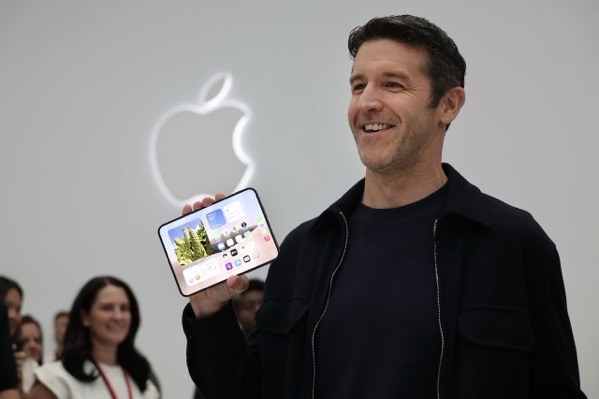
iPhone Duo
It’s both tiresome and accurate to say Apple is playing follow the leader as a late entry into the minuscule market (<2%) that is the folding smartphone game. Samsung and others have been trying to make creases disappear for some time now. Crease or no, I believe the jury is still out on whether or not folding smartphones will ever be more than a niche market. If that proves to be the case there’s nothing wrong with that, though I think Apple has more hopeful thoughts.
However this new chapter turns out, it begins with Apple replaying the same game of catchup they played after Samsung introduced large smartphones. Remember when they were called phablets? Quite frankly, I imagine Samsung and the rest are glad Apple is entering this segment because it might spark new life for the concept of folding smartphones, which hasn’t caught fire like larger smartphones did.
To lay out my bias up front, I’ve never been attracted to the folding phone concept. I’m an iPad guy and if I need a larger screen that’s my weapon of choice. And when I’m wielding an iPad I don’t want my iPhone near me, or any of the distractions like notifications I use my iPhone or Apple Watch for. Apple isn’t hyping the Duo as an iPad and that’s a good thing. That hasn’t and won’t stop the comparisons from others, although it may herald the end of the iPad mini down the road.
So, that’s my preference and my choice. And I’m both sure and glad that others have different preferences and make different choices. With that in mind, I’m glad that Apple is offering a new category of smartphone for those who do see their technology worlds unfolding differently than I do. I’m glad Apple’s competitors do as well.
I took a look at some of the earlier foldables when they started hitting the market years ago and largely wrote them off. This summer I took a look at Samsung’s most recent foldables and was actually quite surprised with the quality of the tech. I imagine once I get a chance to fondle the iPhone Duo in a store that my response will be much the same. Impressive tech, but not something I have a need for, no matter how cool it may be.
The iPhone Duo does indeed look cool. If nothing else, Apple knows how to market a product. As I’ve said many times before, the verdict on the Duo’s success or failure will be determined at a later date once we see how Apple’s claims about durability and the display hold up. Early reviews will be just that. Early. I’m also guessing there will be some attacking that screen and hinge to check out Apple’s durability claims. October is going to be an interesting month for those who follow these things.
What stood out most was Apple’s “own the whole widget” reimagining of the iPhone UX/UI to take advantage of the new device. It looks both new and familiar. Doing some reading post event I can see how much work developers have ahead of them to fully take advantage of the new device. Here’s hoping most do, because some of what I’ve seen about apps that aren’t tuned to the new device leave a lot to be desired, reminding me of how insufficient and wrong iPhone apps looked on iPads in the early days. Remember when Apple sold using iPhone apps on the iPad as a feature?
Apple’s developer website promises workshops and labs, but the Xcode 27.1 beta for developing apps for the Duo is listed as coming later this month. I’m guessing it’s going to be a challenging transition. For some, a long one.
Speaking of transitions, the fancy fading transition between the closed and open screen is not only impressively eye-catching, and speaks to the aspiration of Apple’s designers and is certainly not something we’ve seen from any competitors. Time will tell where that takes us beyond the wow factor of that first introduction.
To Crease Or Not To Crease
Apple’s engineers seem to have done a good job of hiding the crease. It’s still there, but hidden under a “perpetually flat matte surface” under a nano-texture finish. Perhaps we now know why Apple recently and surprisingly reduced by half the price of the Apple Polishing Cloth that was first introduced alongside the first nano-texture screens on the Pro Display XDR.
Left and Right Handedness
One of the questions I have that I’ve yet to see an answer for has to do with that new UI/UX. Apple claims that like the iPad, the iPhone Duo can be used in any orientation. Part of the UI/UX reimagining places the dock and controls in most images on the right of the display(s) away from the hinge. I’ve seen one image from Apple that places a menu on the left in landscape mode when two apps are in split view.
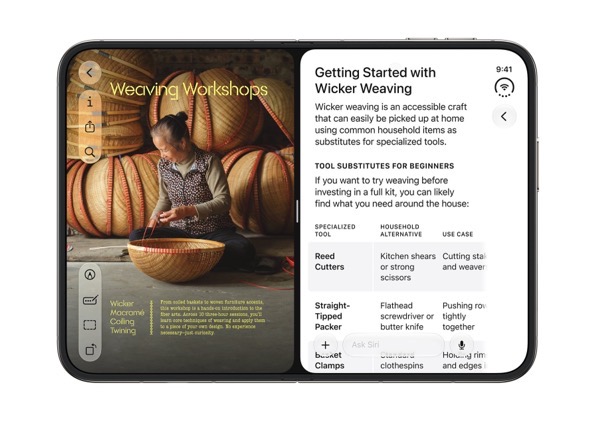
I haven’t seen any that might do so when the device is closed and the indications from what I’ve seen is that the controls and dock mostly stay situated on the curved edge, whether the display is open or closed. This raises a question about right and left handed usage. This question came to me last night as I was using my iPhone to scroll through some reading about the Duo and realized that though I’m right-handed, I more often than not hold the iPhone in my left hand when reading or scrolling. I do the same with my iPad mini. I’m reasonably certain that if I ever purchased an iPhone Duo I would adjust. I’m not sure if the same is true for left-handers or how much it matters, even with what appears to be a very “hold it in your right hand” approach for the Duo when it is closed. I’m sure we’ll hear about it from left-handers if it does.
FaceID is one of the features iPhone and iPad users have become accustomed to. The iPhone Duo does not have FaceID, instead reverting back to TouchID for identification purposes. I’m not sure how many this might be a deal breaker for, if any. Quite a few folks are saying that if you’re wearing an Apple Watch you can use the unlock feature similarly to how you can use an Apple Watch to unlock a Mac. That might work. Although in my usage the feature worked so sporadically in unlocking my Mac that I turned it off. Maybe it’s been improved. We’ll have to wait and see.
iPhone Handoff
It’s often easy to forget that The iPhone Duo, like the iPhone Pro and other models that will be released next spring are phones. But they are. I remember when we called them cell phones rather than smartphones. Intriguing that I don’t recall seeing any imagery during the presentation of someone using the Duo to make a phone call.
Apple introduced an interesting feature that might appeal to some and might see some turbulence among carriers.
In these days of eSIMs, iPhone Handoff allows the use of one phone number between two devices so a user can switch back and forth whenever they want. I’m not sure what the demand for this will be, but some will certainly enjoy the feature. Depending on if the carriers can get their acts together.
At launch only T-Mobile and Germany’s Telekom support the feature, with Verizon saying they will later this year. AT&T apparently has some work to do on its infrastructure to make the feature possible.
Given how carriers love their ridiculous fees when you activate a new phone I wonder how this will get priced out. As I got ready to publish this, I noticed T-Mobile has announced that it will charge $5 a month for the feature.
Apple Watch Health and Privacy
Both the Apple Watch and the Apple Watch Ultra got updates to Series 12 and Ultra 4 respectively. Both also increased RAM to 4GB from 2GB. Apple continues its push into Health and Fitness in these next editions. Both got improved, but not new, health sensors to go along with a slew of new health features in the Health app, including something Apple calls Readiness that will let you know if you’re ready to take on whatever task or adventure awaits you or take it easy for the day.
There’s also a new Longevity tab that includes a feature called Health Age that lets you compare your statistics relative to others. Apple has entered into a partnership with Quest Diagnostics so that you can order a comprehensive lab test for $119 directly through the app to use as a baseline. This is sure to trigger a raft of social media posts bragging or complaining about how people’s Health Age scores compare in the way we have with sleep scores since that feature was introduced.
All of these features continue Apple’s forays into health guidance with wearables and are now promoted as being made possible by Apple Intelligence.
Speaking of Apple Intelligence, there’s also a controversial couple of new audio features for the Apple Watch that can record conversations. The privacy conscious, legal beagles, and pervert glasses foes have already begun stirring the pot and sounding alarms in this age when any kind of always on surveillance draws increasingly extreme negative pushback. Throw AI in the mix and the brew boils a lot faster.
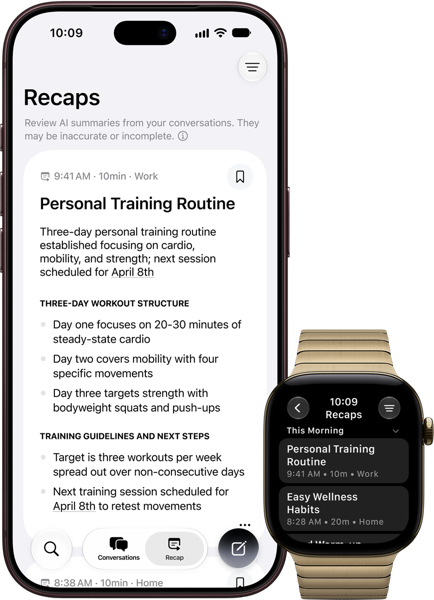
Live Rewind lets you transcribe the last 15 seconds of a conversation you might have missed. The transcription can be saved to the new Siri app for viewing later. Siri Recap is an always listening feature that that uses ambient listening to take notes of conversations, summaries of which again can also be reviewed in the Siri App.
With Apple’s traditional bent towards privacy protection, they swear up and down that users are in control and that any of the summaries can only be viewed by you, are not accessible by Apple, and that audio is not recorded or stored. All of these features are opt-in and can be turned off. Apple also suggests “Be mindful of those around you. While audio is not recorded and stored, and no speakers are attributed, consider those around you where conversations might be private or sensitive.”
Seriously.
My bottom line observation here is that this move into wearable AI by Apple is seeding the ground before Apple does or does not roll out any of the products we’ve heard rumored such as AirPods with cameras and its own smart glasses. Apple’s moves here, while cloaked in its usual privacy protection mantra comes at a time when there’s a growing distaste for anything AI related, a real backlash against smart glasses and any other surveillance tech no matter how cool or how beneficial it may be to those with accessibility challenges, and a blatant lack of trust for anyone on any level these days, especially big tech. That’s a broad brush to tar with, but it’s one that’s fully loaded and dripping these days.
It’s an old story now that Apple is behind when it comes to Artificial Intelligence. It’s not just the technology that’s lagging. It’s also that Apple has let others with much less social awareness define use cases in ways that turn off potential customers.
Even if this tech is only audio related, and all of Apple’s privacy claims prove out, I certainly don’t think Apple wants people to associate its popular Apple Watch brand with the toxicity of pervert glasses. And that’s before we get to the legal issues given how different states have different laws about the recording of conversations. Glenn Fleishman has an excellent article about this that you should read.
Timing is everything and I just don’t think this is the time, nor will there ever be a time when this kind of thing is accepted by a majority of users. Just because you can, doesn’t mean you should.
A few other topics that caught my eye were announced during the day.
AppleCare One Family Plan
Apple has been offering AppleCare One allowing users to insure and get support for up to three devices for $19.99 and add other eligible devices for a cost. Apple’s new family plan will allow users who are or start a shared family group to ensure all eligible devices for each family member for $50 a month. This is a potential for real savings for some.
Apple Reference Image
This is a good thing that I wish wasn’t necessary. But these are the times we live in. Apple Reference Image is a way of providing proof that a photo was captured on an iPhone, and not an AI generated image. From Apple’s website:
Users can now prove the authenticity of a photo taken on iPhone 18 Pro models with Apple Reference Image, powered by the new sensor in the Main camera that can sign every pixel it sees. When a photo is taken in the new Reference mode, the camera captures signed sensor data that Private Cloud Compute develops into an unalterable reference image. Reference images can be viewed in the Photos app alongside the main image, like a digital negative, to visually compare the two assets and determine if any edits were made. APIs are available in iOS, iPadOS, and macOS 27 for third-party apps to enable viewing of these reference images.
Image metadata and upcoming support for the SynthID standard can also help users identify images generated or edited with AI. Together with Apple Reference Image, this set of features represents a multifaceted approach to image authenticity — vital for photojournalists, photographers, and everyday viewers.
The Debut of John Ternus as CEO
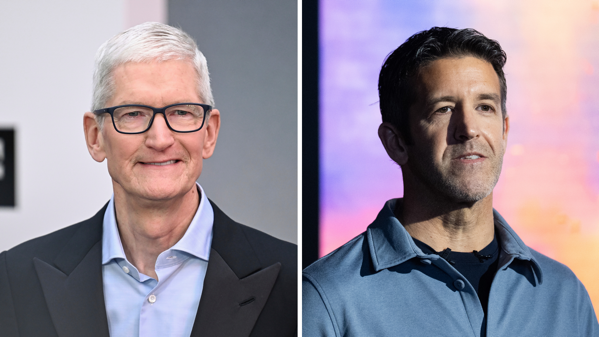
Ternus did an admirable job in the canned presentation, though at times he looked a little gun shy. The opening film featuring a clever hand off from Tim Cook to Ternus was well done. Although it felt like it was two beats too long and would have been better served by getting to the punch line sooner. What’s apparent from how the event was structured is that Apple is loudly saying that they have a product guy at the top again. Ternus is “the guy” and there’s no doubt the pressure is now on for him to deliver.
As I said earlier. I felt Apple’s event was well done and the best it has done in some time. Picking a nit though, I was not a fan of all of the extras walking through the various locations while information was being presented. Each time someone walked through in the background it pulled my focus. The idea certainly established a nice mise-en-scène, but I largely found the extraneous traffic distracting.
It’s going to be interesting to follow how all of this continues to roll out. We won’t begin to hear real substance about the Duo from reviewers and users until October. That gives developers time to try and catch up, and it also will put the focus on Apple Intelligence and Siri AI as the operating systems that end in OS27 roll out next week for those with devices that support it. Note that most older Apple Watches do not support a lot of the new features. New Apple Watches and iPhone Pros will be getting in users’ hands late next week as well.
My hunch is there will be a lot of news unfolding this fall.
Thanks for reading. You can subscribe to this blog if you care to. You can also find more of my writings on a variety of topics on Medium at this link, including in the publications Ellemeno and Rome. I can also be found on social media under my name as above. This site does not use affilate links.