Sunday Morning Reading

With aging comes awareness. Or at least it should.

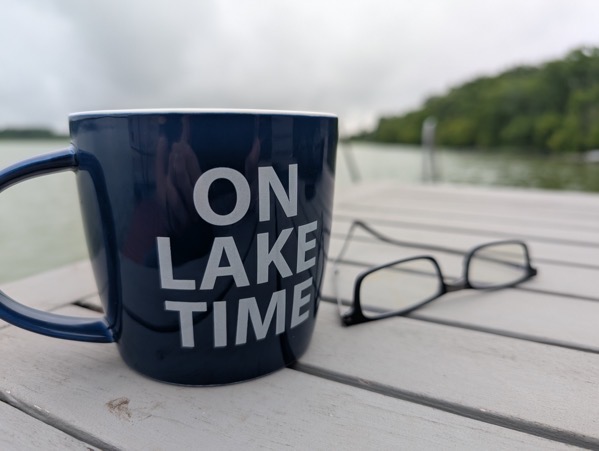
We’re on Lake Time this weekend, but there’s still time to share some Sunday Morning Reading. 

PXL 20250706 141021103.

Two weeks ago I shared a piece from youngster David Todd McCarty titled When I Was Old. I’m resharing it this week since I celebrated a birthday on Friday, getting one year closer to marking seven decades on this rock. Also sharing another great piece from David, called I Was Told There’d Be More.

“Scented memories.” I like those two words put together by NatashaMH in her piece, The Fragile Geometry of Becoming. 

I’ve been an Elmore Leonard fan for as long as I can remember. Anthony Lane’s Elmore Leonard’s Perfect Pitch may not be perfect, but it is damned close enough.

David Struett delivers a terrific ode to Chicago bike messengers, their culture and their jobs in Meet Chicago’s Last Bike Messengers. Here’s How They Survive.

You might notice a touch of sentimentality and reminiscing in the pieces above. Comes with the thoughts during a birthday weekend. Fair warning though that most of the links shared below are a bit darker, and yes, more political than those above. With aging comes awareness. Or at least it should.

Mathew Ingram wonders What Do We Do When The Facts Don’t Matter? I think we’re not liking what we’re finding out.

Mike Masnick’s piece Facism for First Time Founders offers the next generation a clue or two, assuming the current generation doesn’t crash it all before they get a chance to discover them.

I’ve written about the concept of enshittification in tech quite a bit. Mostly as regards the Internet. Henry Farrell and Abraham L. Newman take a look at The Enshittifcation of American Power. 

Another big contributor to enshittification is the media who increasingly seem more and more clueless and devoid of any self awareness. Charlotte Kim takes a look Inside The Media’s Traffic Apocalypse.

Speaking of things toxic and shitty, Adam Aleksic explores How Incel Language Infected The Mainstream Internet — and Brought It’s Toxicity With It. I’ve spent almost 70 years on this planet. I have no idea why guys turned into such misanthropic, self-loathing idiots.

In a world seemingly more and more intent on criminality, there are very few surprises, but there are legacies. Jessica Winter’s What I Inherited From My Criminal Great-Grandparents. Great story.

To conclude this week I’m sharing a film review by Sonny Bunch. This one of the new film Eddington. I haven’t seen the film. I plan to. Rarely does a review encourage or discourage me from seeing a film. If it’s anything like Bunch describes one way or the other I’m sure it will be worth it as it sounds like a fun, yet conflicted, summary of lots of things we’ve all been living through since 2020, and continue to do so. I’ll leave it with this quote:

The feed never stops, the algorithm never tires. There’s always more. It never ends. Just a few more videos. You can sleep later. You can never sleep, if that’s what you’d prefer. Who knows what you’ll miss when you’re asleep?

And we wonder why everyone has gone a little nuts.

If you’re interested in just what the heck Sunday Morning Reading is all about you can read more about the origins of Sunday Morning Reading here. If you’d like more click on the Sunday Morning Reading link in the category column to check out what’s been shared on Sunday’s past. You can also find more of my writings on Medium at this link, including in the publications Ellemeno and Rome.

Scott Hanselman’s TEDx Talk On The Promises of Technology

Worth your time to give this a watch

Scott Hanselman is a someone I’ve followed for quite some time. I’ve always found his insights on technology and the intersection technology has with humanity to be valuable and that they make me think. Strange that I think of it has an intersection, given that technology wouldn’t exist without humans.

 I recently saw he that his TEDx talk titled Tech Promised Everything. Did It Deliver?

Scott breaks down the three promises of technology into Connection, Convenience, and Creativity. I won’t hint at where the talk goes, you should watch it for yourself.

As an intriguing side note given the subject matter I found in remarkably inconvenient that WordPress decided to do some sort of work on their backend as I went to publish this post. Technology is great when it delivers, right?

Regardless, what Scott has to share is excellent stuff and highly recommended. 

You can find more of my writings on a variety of topics on Medium at this link, including in the publications Ellemeno and Rome. I can also be found on social media under my name as above. 

Sunday Morning Reading

Notice the good things amidst the bad.

It’s been a week. But I repeat myself. These days it seems like that’s always the case. Superman’s back. (Again.) So too are this season’s butterflies. Everything circles back. Today’s Sunday Morning Reading is a potpourri of topics of interest that stroke a number of chords, some familiar, some not so, some good, some not so. Either way, enjoy.

Photo 1693722379283 fd3627e18cea.

In That Was Good, Merlin Mann says that smart people always find the best reasons for being very sad. I can relate. He suggests the cure for that might be noticing some good things. Even the small ones. Check it out. It’s a good thing.

This week featured the news revisiting the subject matter of several plays I’ve written or directed in the past. One of those, Inherit the Wind, the play by Jerome Lawrence and Robert Edwin Lee, is a semi-fictional retelling of the Scopes Monkey Trial in Dayton, Tennessee. This year marks the 100th year anniversary of that trial. Neil Steinberg has a terrific piece, both commemorating and commiserating. Given how short a distance we’ve traveled in this circle we keep walking in. Check out 100 Years Ago, The Scopes Trial Gripped The Nation, And Here We Go Again.

Twice a week on social media I post “This is your now weekly, and continuing reminder that we’re still fighting the Civil War.” Frankly, I don’t see it any other way for reasons I shouldn’t have to explain. I don’t often post interviews in this column, but I’m making an exception this week to post Amita Sharma’s interview with political scientist Barbara Walter who has helped forecast civil wars in other countries. Take a look at San Diego Political Expert Details Steps That Could Lead To US Civil War.

I blow hot and cold on Tom Nichols’ political commentary. I very much like his piece Damn You All To Hell! Find out his thoughts on how Hollywood taught a generation to fear nuclear catastrophe. It might have worked with that horror. Funny, yet sad, how it hasn’t worked with all of the goings on currently.

History is indeed always an incomplete picture that’s always evolving and struggling to take hold. In Texas Man’s Fight To Move A Lynching Marker Sparks New Battle For Truth, Christina Carrega pinpoints one of those moments of evolution.

Mathew Ingram says We Shouldn’t Blame AI For The Stupid Things That People Do. I agree. AI is the prime example.

Chris Castle takes on a piece of the Section 230 argument, thinking that a new theory of liability is emerging, grounded not in speech, but in conduct. Give a look at The Duty Comes From The Data: Rethinking Platform Liability In The Age of Algorithmic Harm. 

And to round out the circle this week, take a look at David SparksA Remarkable, Unremarkable Thing. Don’t let the small things go unnoticed.

(Image from Anya Chernik on Unsplash)

If you’re interested in just what the heck Sunday Morning Reading is all about you can read more about the origins of Sunday Morning Reading here. You can also find more of my writings on Medium at this link, including in the publications Ellemeno and Rome.

Sunday Morning Reading

Mixed feelings and mixed emotions on a Summer Sunday by the lake.

The 4th of July weekend is wrapping up in the U.S. and many are having mixed feelings this year. Today’s edition of Sunday Morning Reading will feature some excellent writing on some of those mixed feelings in addition to some interesting reads on familiar topics from familiar writers, and some not so familiar. Enjoy.

Giuseppe argenziano J04GmVkKSLQ unsplash.

First up, let’s take a look at Elizabeth Lopatto’s view on the state of things in the states in her post The American System of Democracy Has Crashed. Excellent. Should be required reading.

Neil Steinberg also has thoughts well worth your time in He’s baaaaaaack.

Jack Hopkins gives us The 4th of July: What We Were Meant to Celebrate — and How We’re Failing It. Again, worth a read as we close out the long holiday weekend and this section of today’s Sunday Morning Reading.

Now for some catching up on some links I’ve delayed too long in sharing.

First up is The Chosen Few and the Cost of Global Silence from NatashaMH. History repeats. All the damn time. As she also demonstrates in this piece The Cruelty of Indifference.

Relative youngster, David Todd McCarty writes about aging in When I Am Old.

Writers are having trouble finding the right fit when it comes to how to make a living. Matthew Ingram tells us Why Substack Shouldn’t Be The Future of Online Publishing. We

Chuck Wendig argues about and bemoans the loss of downtime in his writing process given all that’s happening around us in A Small But Vital Thing, Taken.

While writers search for new ways and new homes, Joshua Rothman wonders What’s Happening To Reading?

Never Forgive Them is a piece from Edward Zitron from December 2024 that seems relevant again in more ways than it was intended then.

Composer and poet Stan Stewart recently had his computer die on him. He writes about what he lost and found in Of Dead Computers and Really Living.

Matteo Wong says The Entire Internet Is Reverting to Beta. Sure everything is a janky work in progress, certainly in the janky days of AI. But I think that’s how those who think they run the joint like running the joint.

And to close out this week, take a good look at this wonderful long read from Eric Konigsberg from all the way back in 2001, entitled My Uncle The Hit Man.

Image from Giuseppe Argenziano on Unsplash.

If you’re interested in just what the heck Sunday Morning Reading is all about you can read more about the origins of Sunday Morning Reading here. You can also find more of my writings on Medium at this link, including in the publications Ellemeno and Rome.

Should We Teach Our Children To Lie Better?

The truth is everybody lies.

I remember my grandfather saying “Politicians always lie. That’s why they get elected. It’s a dirty business. Stay away from it.” Keep in mind, he was a good acquaintance if not a good friend with all the local elected politicians. It was always weird seeing him be friendly with them at church or other social gatherings. So, from my perspective there was always a disconnect that’s been a part of my view of politics and politicians for most of my life. I doubt I’m alone.

Jametlene reskp Q79XFGuTFfM unsplash.

Of course politicians aren’t the only ones who lie. Corporations do. Ordinary humans lie to other humans. Hell, these days, even AI chatbots lie. It’s all an expected part of the game of life, regardless of what the ninth of the Ten Commandments say.

Most legal systems are built on the premise that one side of the other is going to lie in some form or the other and it’s up to a judge or jury to determine where the truth my lie. But rarely does the losing side get punished for using lies as a defense.

What I do wonder though is why we waste so much time teaching our children not to lie. Given that we know full well they are going to grow up in a world where lying is not just the coin of the realm, but the realm itself, why bother? We do spend time teaching them to beware of the lies being told by salespeople, politicians, friends, etc… But I don’t think many parents spend time providing their progeny with better deceptive skills to be successful.

It’s a weird disconnect. Of course we want our kids to own up when they do something wrong. But eventually they figure it out anyway and everyone goes around living the lie about not lying. Rinse. Repeat.

Bad liars are easy to spot. So I guess arming youngsters with better skills wouldn’t’ necessarily be a bad thing. These days, even the bad liars seem to be rewarded for getting away with it, so a better skill set might unlock better achievements. But then again, choosing sides between Kant and Aristotle on the virtues of truth telling and situational ethics isn’t really good fodder for a dinner time conversation with the kids.

There are many old sayings that end with “_________makes liars of us all.” You can fill in the blank with “the world,” “fear,” “marriage,” “The Internet,” etc…. You can pick your target for blame. Just don’t pick yourself.

Perhaps hallucinating AI chatbots will one day level the playing field of liars by “reasoning” this down to the lowest common denominator. Regardless of what their makers say, they can only learn and spit back what humans have already learned and regurgitated back into the world. We’re all lousy liars, some lousier than others. We lie to the tune of our own rhyme or reason in the moment. And we certainly haven’t learned to pretend other as we endlessly recycle our inability to do different.

Image from Jametlene Reskp on Unsplash.

You can find more of my writings on a variety of topics on Medium at this link, including in the publications Ellemeno and Rome. I can also be found on social media under my name as above. 

Is Apple’s F1 Push Ad Enshittification or Just Shitty?

Apple pushing ads push users’ buttons

As if Apple needed another kerfuffle, it appears that one of its marketing efforts for the movie F1 has raised the hackles on the necks of some. You almost have to be tuned out completely to have missed the plethora of marketing methods Apple has already been pushing around the racetrack to get this movie to the starting line. But there’s always more.

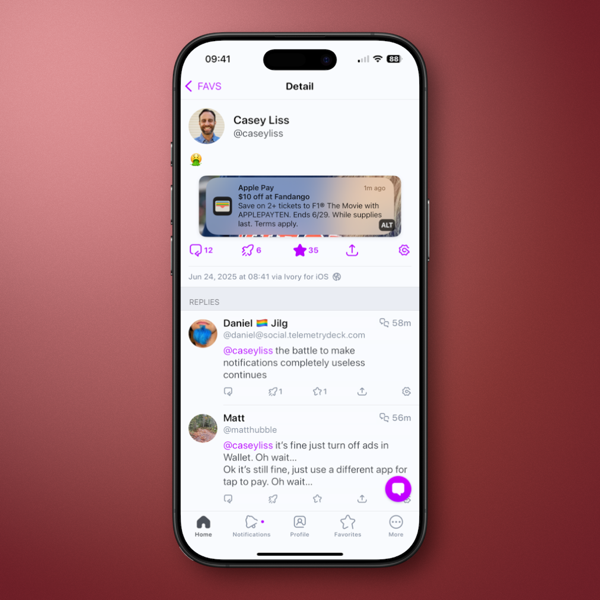
Apple started pushing out Apple Wallet notifications to users of that service announcing that they could receive a discount for movie theater tickets via Fandango by purchasing those tickets with, yep, you guessed it, Apple Pay.

I saw the notification late last night and just swiped it away the way I do the majority of these mosquito-like pests. Too bad I didn’t take a screenshot.

But Casey Liss, of The Accidental Tech Podcast trio grabbed one and posted about it on Mastodon, accompanied by a vomiting emoji.

New Screenshot.

Those who felt as ill about the promotion as Casey did quickly jumped in, condemning it and pulling out the enshittification label that we’ve all become familiar with since it was coined by Cory Doctorow in 2022.

Yes, it is advertising, but I’m not sure it was enshittification. Perhaps we’re reaching the point of shitting all over that label and diminishing, yet revealing its power in sort of a weird turning in on itself way that proves the original meaning behind the original term even while mucking it up by using it too frequently.

Granted there aren’t too many who lust for the ever increasing onslaught of advertising and marketing pitches we’re bombarded with hourly. I’m certainly not one who does. But advertising and marketing, as overused and overwrought as it has become, in and of itself isn’t enshittification, no matter how fast it grows like weeds rapidly enveloping every corner of our Internet usage.

My grandfather used to say that “a weed is anything that grows where you don’t want it to.” Most of today’s advertising certainly feels weed like. And it keeps getting worse, especially when pushed at us from sources we don’t expect it from. Amazon we expect this from. Apple not so much. Though there is a history there.

In my view of things, Apple advertising this promotion is really not that much different than a podcast advertising its latest merch to its audience or promoting a fundraiser. Don’t get me wrong, I’m not shitting on The Accidental Tech Podcast, which does both of those things. I actually pay for a subscription and occasionally buy their merch and donate when they fundraise. Captive audience marketing is an age old technique and it works. I’ve used it myself. Even so, it can grow old and tip over into enshittification.

But there’s a larger point.

Eventually most users tune out. I used to deliver a curtain speech pitching the next play or special offer before every performance at a theatre I ran. Initially they were wildly successful. Eventually returns diminished. That may be anecdotal, but I believe the more ads increase the more they become the blandest of white noise or even a turn off to the product. Again, anecdotally I had initial interest in the F1 movie, but after the inundation of advertising I’ve already decided my interest has waned. So I’m certainly not going to be contributing to Apple’s goal of finally putting butts in theater seats for one of its movies. I’ll catch it sometime down the line on streaming.

Overhyping, as a facet of enshittification can too easily create diminishing returns, gradually enshittifying the very business models of the enshittifiers. Mosquitos can’t feed when everyone within their range packs up and goes indoors and they eventually move on or die out.

We just haven’t reached that tipping point in this bloodsucking business model we’re trapped in currently. In his original post outlining the enshittification of early social media platforms Doctorow says “the same forces that drove rapid growth drove rapid collapse.”

I doubt we’ll reach that tipping point in advertising. Because there’s a whole new frontier that the enshittifiers are just waiting to exploit and that’s AI. Google’s moving away from search faster than its search rankings are dropping and there’s no secret on the path it’s choosing.

I’ve often imagined that perhaps AI could be one of our salvations in the advertising scheme of things, figuring out better than humans seem capable of doing when enough is enough. But those driving that racetrack see the possibility of too many dollar signs to make that more than just a wild imagining no matter how much sense it might make.


You can find more of my writings on a variety of topics on Medium at this link, including in the publications Ellemeno and Rome. I can also be found on social media under my name as above. 

We Just Keep Watching As We Roll Faster Into Disaster

If an AI commits a murder can it argue self-defense?

It’s all feels like a bad movie. One that is both made poorly and has a “you can see it a mile off” bad ending. It doesn’t matter if it’s politics, social decay, or the seemingly inevitable march of Artificial Intelligence, we all know how badly most of these things are going to play out, yet we sit spellbound watching the story unfold.

Axios has been on an anti-AI roll lately (a good thing) and they published this piece titled Top AI Models Will Lie, Cheat and Steal To Reach Goals, Anthropic Finds. For some reason Axios decided not to include “take deliberate actions that lead to death” in the headline.

Given our seeming acquiesce to lying, cheating, and stealing in most realms of life these days, I guess that’s one way of toning down the bad news. Go read the article. Or should I say, the summary.

You can find more of my writings on a variety of topics on Medium at this link, including in the publications Ellemeno and Rome. I can also be found on social media under my name as above. 

Sunday Morning Reading

Intelligence or compassion? They both caught my eye this week.

It’s interesting how topics surface throughout a week. I’m not sure if it’s follow-the-leader or hive mind thinking, but from the sources I follow this week it seemed like everyone was thinking and writing, in one way or another, about Artificial Intelligence. Or maybe just about intelligence.

Certainly there was plenty on other topics because there were certainly plenty of other big things happening. Some intelligent, some not so. Some showing the capacity for compassion right along side our capacity for cruelty. I’m sure there will be plenty written in the days ahead about all of those things. These are the posts that stuck with me for this week’s Sunday Morning Reading.

Kicking things off is a short post by Gene Weingarten called A Cat Named Grandpa. It’s about compassion.

Mathew Ingram wonders Is AI Smarter Than We Are or Stupider Than We Are? Read the piece. If you’ve read any of the things I’ve written on AI you’ll know I agree with Mathew’s conclusions.

David Todd McCarty thinks the lack of originality in human consciousness is both appalling and comforting in I Gotta Be Me.

Natasha MH was Seeking God In A Machine.

For those who need to think about end of life issues, this might be a timely, yet frightening from Ashley Belanger. Check out How To Draft A Will To Avoid Becoming an AI Ghost. Apparently, it’s not easy.

Matteo Wong writes about The Newspaper That Hired ChatGPT. It’s mostly an interview, but one worth reading.

Folks can become addicted to and troubled by just about anything, and AI is no different. We’re starting to hear more and more about this, which is somewhat surprising on a number of fronts given how short a time generative AI has been with us. Kashmir Hill writes about a young man whose reality became so distorted it almost killed him in They Asked ChatGPT Questions. The Answers Sent Them Spiraling.

While not about AI in specific, this tech story speaks volumes about the decisions tech bosses make that influence the technology we use to work and play with. Check out Phil McKinney’s I Convinced HP’s Board To Buy Palm for $1.2B. Then I Watched Them Kill It In 49 Days.

And Happy Father’s Day to all. Miss you Dad.

(Image from Rey Seven on Unsplash.)

If you’re interested in just what the heck Sunday Morning Reading is all about you can read more about the origins of Sunday Morning Reading here. You can also find more of my writings on Medium at this link, including in the publications Ellemeno and Rome.

Sunday Morning Reading

There’s a creeping inevitability to much of what’s happening around us.

Some Sunday’s when I sit down to collect what I find interesting enough to share it seems like things around us are just bad. Or going from bad to worse. It feels inevitable. This is one of those Sundays. Nevertheless, there’s some good writing and good thinking in the articles linked below that I believe are worthy of your attention. But paying attention is not one of our strong suits. Cue up a little Crosby, Stills, Nash and Young, pay attention, and read away.

‘Tin Soldiers and Nixon’s Coming’ is an excellent look back as we stare at this moment we’re in from Robert Cohen and Michael Konciewicz on the 2020 50th anniversary of Kent State and Jackson State.

You’re Not Ready, is an excellent, yet somewhat frightening compilation of articles by various authors at Wired, comprising info on AI hacker attacks, grid attacks, or a GPS blackout. I say “somewhat” simply because many of us have had inklings about this. Or at least those who pay attention.

Josh Marshal of Talking Points Memo has an excellent piece on Artificial Intelligence and The Posture of Skepticism.

Mathew Ingram’s fascinating piece, How Marc Andreessen and I (and you) Created The Web is informative and entertaining history and context that’s worth your time about the time we’re in.

Paul M. Sutter tells us that A New Theory Says Time Has Three Dimensions. It ‘Really Messes Up’ What We Know About the Cosmos, Scientists Say. We seem to be doing a good job of that at the moment given our current understanding of time, so why not go ahead and mess things up.

Timothy Snyder wonders what happens with The Next Terrorist Attack. It’s far deeper than the headline suggests.

Michael Podhorzer writes about something I’ve been thinking and saying for a while: The Courts Will Not Save Us. It’s a long read but more than worth your time. Read this instead of watching TV lawyers.

Most of the articles I’ve already linked to this Sunday morning in one way or another deal with trust. That trust gap is widening these days. It doesn’t help when we do find out things that break trust, but the finding out at least helps us understand the gap better. Take a look at Aruna Viswanatha’s piece The Pentagon Disinformation That Fueled America’s UFO Mythology.

Tomorrow, June 9th, Apple kicks off its annual World Wide Developer Conference. There are trust issues there as well. These next few links contain some interesting thoughts heading into WWDC, beginning with Sebastiann De With’s Physicality: the new age of UI, which anticipates the coming design changes rumored for all of Apple’s operating systems. A fresh coat of paint may not hurt. I’m not sure it’ll help.

As I said, Apple faces a number of problems, some legal and regulatory. Jérôme Marin explains how A Simple Comma is going to cost Apple Billions in Europe. Commas can indeed cause all sorts of chaos. Just ask US constitutional scholars about a comma and the 2nd Amendment.

And to close things out, one of my favorite developers _DavidSmith talks about his optimism heading into WWDC in Let’s Get Started. I admire the optimism and the reality check approach _DavidSmith brings to this.

If you’re interested in just what the heck Sunday Morning Reading is all about you can read more about the origins of Sunday Morning Reading here. You can also find more of my writings on Medium at this link, including in the publications Ellemeno and Rome.

Thoughts and Prayers Heading into WWDC 2025

A new coat of paint won’t fix the cracks in the wall.

In a week Apple will unveil what it has in store for us during its annual World Wide Developer’s Conference (WWDC). Beginning June 9, the microscope will be focused more intently and with a greater scrutiny given the myriad of issues Apple is facing. That scrutiny might just overwhelm any message Apple has planned for the year ahead depending on how Apple handles it.
WWDC 2025 Apple Logo

The reason I titled this post “Thoughts and Prayers Heading into WWDC 2025” isn’t that I’m offering up good vibes for Apple as they try to work out of the messes they’ve mostly created for themselves. I’m actually hoping — most likely against hope — that Apple will finally clean up some of the annoyances they’ve neglected over several generations of iOS and macOS.

I’m not going to discuss the bigger picture issues Apple is facing here. I’ve written about some already, as have many others. Instead I’m going to focus on the smaller software reliability annoyances that add up to make me think Apple just doesn’t care.

It’s become almost a running joke that Apple allows some of these flaws to continue year over year. But I don’t find it funny. You can put new wallpaper over a water damaged section of a wall, but if you don’t fix the leak then the problem isn’t the stain on the wall, it’s you not caring. Or maybe you don’t have the money to get it fixed. Apple certainly has the money. As John Siracusa says in an excellent post called Apple Turnaround:

It’s been 15 years since Apple’s leadership last demonstrated that it’s willing to emphasize software reliability at the cost of new features. Since then, bugs in major features have been allowed to fester, unfixed, for years on end.

I’ll quibble with John on one point. If you allow a reliable, yet ignored “bug” to remain through several operating systems, it essentially becomes a feature the longer it’s not addressed.

I’m a stubborn old coot in my life as a theatre director. Deeply ingrained in my way of directing is something a mentor laid on me year’s ago. “If it’s on the stage it’s yours. If it fails or distracts, it’s your failure.”

Here’s a short list of bugs and annoyances that have existed over several versions of the operating systems and several versions of Apple’s hardware that I encounter routinely. That’s based on how I work and play with Apple hardware and software. I’m sure there are many more depending on how others use their devices.

Focus

I know there are folks who swear by the Focus feature, but to me it’s one of those features that works and then randomly doesn’t. I’d call it unfocused. I keep trying to use it, but abandoning it because I already have enough random failures in my life.

Shared Reminders Notifications

I’ve written about this previously. Shared Reminders are terrific for grocery lists and other things, especially of a checklist nature. But when you complete a Reminder, the notification needs to disappear for all of the users who are sharing the Reminder. I’ve had Shared Reminders hang around for hours after I’ve checked it off of a list.

Syncing Photos

This one just gets more and more puzzling and has become the butt of so many jokes, it’s almost become a part of the Apple brand. You take a photo on your iPhone and whenever it syncs to iCloud and subsquently to other devices is a wild guess. I get that if you’re running low on battery you may want to delay syncing. But if my iPhone is plugged in telling me that it won’t sync so that it can optimize battery it is a little silly. Also telling me syncing is paused for “optimizing the system” makes me wonder just what system is being optimized. Apple’s or mine?

Bluetooth Connectivity and AirPods 

I’m a big fan of AirPods. I’m also a big fan of AirPods and the way they are designed to work within Apple’s ecosystem. When they work as designed it’s magic. When not, it is frustrating. Again, random failures to disconnect, which always seem to come at just that moment when you need to quickly plop them in your ears for a phone call are never fun. Neither is it a good time when one of your devices you might have previously been connected to refuses to let go of the connection.

Deleting Media from Messages

I support a few family members who keep their Messages set to retain their Messages forever. That’s all well and good, except this can quickly fill up storage on an iPhone. Apple needs to make it possible for users to select and bulk delete media on an iPhone the same way you can in Mail. The UI looks like you can swipe down the list of circles, but you can’t. The fact that you can only view these attachments sorted by size also makes it a more difficult chore to remove unwanted media attachments.

Shortcuts

I have a love/hate relationship with Shortcuts. Love it when they work. Hate it when something changes and a Shortcut I’ve relied on suddenly stops working or stops appearing in Spotlight. This happens more frequently in beta season even though I don’t run betas.

Beta Badness

Again, I don’t run betas on any of my devices. That said, I’ve been told by Apple Support personnel that changes are always happening behind the scenes on the backend during beta season that can sometimes affect all users. That stands to reason, given how much of what you do on an Apple device is tied into Apple’s servers and iCloud. I suspect this may only become more prevalent with Apple Intelligence as Apple tries to remain competitive with other AI providers that seem to constantly be updating their software. Perhaps there needs to be a way to create a wall or silo off users running betas from those who do not.

App Store 

With M-series chips we’re able to get great performance and fast loading times from apps. With one notable exception being Apple’s own App Stores. For the life of me I don’t understand why they can’t improve performance on their own point-of-sale outlets. It’s like not cleaning the glass on the front of your storefront.

Settings and Permissions

I get that there are a large number of Settings. I don’t get that there’s such a haphazard way of addressing the problem of making them discoverable. I’m sure it’s a challenge, but the only way to address a challenge is to set it as a priority. The same is true with Permissions. Certainly there’s a way to force developers (including Apple) to send us to the correct Permissions screen to choose to make a selection.

Rules in Mail

I’ve set up a number of Rules in Mail in macOS over the years. Currently they all seem to be non-functioning, or randomly functioning. I have a suspicion this may have something to do with Apple’s tinkering with Apple Intelligence based mail categories (a feature I tried but turned off). Having to manually choose to Apply Rules is not the same as having a Rule that runs automatically. It defeats the purpose. Let’s face it, no company has found a way to win the cat and mouse game of spam filtering. I doubt they ever will even with AI. The Rules feature wasn’t perfect, but when it worked it was a help in weeding out some of the spam.

Consistency between iOS and macOS

Speaking of Mail, I’d like to see consistency across the board regarding features between the macOS and iOS versions. In fact, I’d like to see consistency across the board in all of Apple’s native apps. This is especially true given that there is a rumor that Apple is redesigning most of its operating system user interfaces to try and unify the look and feel between different device categories. Carry that through with how you treat app functionality between platforms. Other examples include Shortcuts and Apple News+. I enjoy being able to open an article via the Share Menu from Apple News in Safari on a Mac. I should have the same option on iOS and iPadOS.

As I said, these are mostly annoyances. But I’m annoyed that no one at Apple seems to be annoyed enough to take care of them.

You can find more of my writings on a variety of topics on Medium at this link, including in the publications Ellemeno and Rome. I can also be found on social media under my name as above.