Click bait headline writing has become so ever present, overused, and tired that it has certainly lost all meaning to anyone except the chronically bored or the algorithmically programmed.
Whether it was “Pow!” or “Bam! Zoom!” it was usually the preface to “Right in the Kisser!” That’s what Jackie Gleason’s Ralph Cramden would exclaim to his wife Alice in The Honeymooners when she got under his skin. For some reason SEO experts think we’re attracted to this kind of cartoonish, wrestlemania-type of violence and have slobbishly skewed that assumption into the seemingly never ending stream of headlines saying “So and So Slams So and So” or “So and So Destroys So and So.” Internet publications and ad mills have followed the gravy train right along. “Rips,” “blasts,” and “bashes” also seem popular.
This type of click bait headline writing has become so ever present, overused, and tired that it has certainly lost all meaning to anyone except the chronically bored or the algorithmically programmed. As lazy as it is, I guess it works. Which is not only a sad commentary on humanity but a sadder one on algorithms and the SEO industry.
I mean where’s the creativity? Why not use “lambasts,” “harangues,” “admonishes,” “berates,” “objurgates?” Or for those with syllabaphobia how about “dress down,” “haul over the coals,” “lays into,” “lace into, or “slag off?”
And just imagine how many of those boringly inept and inutile headlines are being fed into AI training engines.
You can find more of my writings on a variety of topics on Medium at this link, including in the publications Ellemeno and Rome.
Part of the Information Super Highway traveled some rough road this morning. Meta experienced an outage in all of its services today that took down Facebook, Threads, Instagram, Messenger, and I imagine everything else in the Metaverse. A source told the Daily Mail that the company’s internal systems were also down. Boomshakalaka, another day on the Internet.
We’re somewhat accustomed to Internet outages. In much the same way we’re sadly becoming accustomed to extreme weather events. Some are caused by malicious hacks, some by incompetence, some by rodents chewing through cables. Internet connectivity has made so much of our current world more convenient and convenience always comes with a cost. It’s a cost that those who own the servers, the services, and the connections, sometimes don’t want to pay for, leaving users stranded at times. It’s apparently tough to value an ounce of prevention on the Internet.
We hear about these outages when big ones hit. That’s sensational news. But far too often there are “backend” issues that happen that we never hear about. Those are the ones that only affect “a small percentage of users” or companies that don’t command the public’s day in day out appetite for connectivity.
Intriguingly enough, those charged with communicating with users when problems do arise sometimes never hear about them either, or if they do are they are told not to talk about them. Again, nothing surprising.
The corporate PR pros may or may not issue lawyered up responses, but rarely do users get any nuts and bolts answers as to what went wrong. Vague apologies, promises to do better, free credit monitoring when user info is hacked, etc… We’ll’ hear the now-clichéd “small percentage of users” modifier trotted out whenever things get righted. It’s funny/not funny how we all just move on.
Earlier this morning I was chatting with some folks on Threads who were seeing issues with Apple’s Weather app not updating as designed on their Apple Watches. I casually replied that it was probably an issue with iCloud’s backend and how it was associated with the provider Apple uses to offer up weather info. These issues with Apple always seem to manifest as they are rolling out new operating system updates, so my guess is more than a guess. (Apple rolled out iOS updates today.)
I’ve been going round and round with Apple for almost two years now trying to solve what is apparent to me, after much effort and investigation, an iCloud related issue. It’s not just apparent to me, there are several other users experiencing the same issues I’m having, as well as other users with other iCloud related issues in similar but different veins.
When I talk to Apple Support (a regular occurrence) we’ve developed this coded, often unspoken, acknowledgment that the issues are iCloud related. But as I said in this post, Apple needs to allow its support personnel to acknowledge directly what the problems are. And in my case, and those of others, so far that continues to not happen.
(Side note for those who might read the links above or are familiar with the situation: I’ve discovered a workaround to sometimes get things back to normal thanks to Dwight Silverman. Signing out of Messages and then back in works about 8 times out of 10. Otherwise I just have to wait it out.)
The problem is bigger than a social media network going down, or a streaming service buffering out during the big game for lack of bandwidth. Those may be frustrating but in the grand scheme of things merely inconveniences. But the more connected our daily lives become to our banks, our medical institutions, our governments, etc… the more reliant we become on services being well run, well maintained, and frankly just available and working as advertised.
I think of it as I think of streets and roads. We’re reliant on them and need them well maintained. The big difference is we see the potholes and understand the inconvenience we’re about to experience when the construction barriers go up.
When Apple, Microsoft, or Google releases a software update, they are not just updating the bits and bytes on your device. Corresponding updates happen on the backend as well. When your favorite app updates the same thing occurs. If that app provides a service, whether it be a social network, streaming media, or checking your bank balance something’s cooking on the backend.
And that’s just the backend updates we’re at least peripherally aware of. Perhaps we need better signage on the Information Super Highway.
You can find more of my writings on a variety of topics on Medium at this link, including in the publications Ellemeno and Rome
Still bouncing back and through some health issues, but it’s Sunday and we’re approaching the start of the baseball season. So here’s some Sunday Morning Reading to share.
David Todd McCarty wonders how we convince friends and family that they’re wrong and we’re right in today’s mixed up world in Those Closest To Us. My hunch is that’s becoming no longer possible.
The Internet is as mixed up and crazy as everything else in the world these days. Was it always? Joan Westenberg published a zine that you can download for free called I Miss The Internet: a zine. I’d grab a copy if I were you.
It didn’t take long for someone to create an AI worm. Makes one wonder where the good guys are who might use AI to beat this stuff back. Matt Burgess sounds the alarm in Here Come the AI Worms.
Sports analytics has been the latest craze for quite some time now. With the Major League Baseball season just around the corner, some are concerned that AI will eventually overwhelm the new wave of analysts and the games. The AP has this report from Jimmy Golen, Sports Analytics May Be Outnumbered When It Comes to Artificial Intelligence.
If you’re interested in just what the heck Sunday Morning Reading is all about you can read more about the origins of Sunday Morning Reading here. You can also find more of my writings on Medium at this link, including in the publications Ellemeno and Rome.
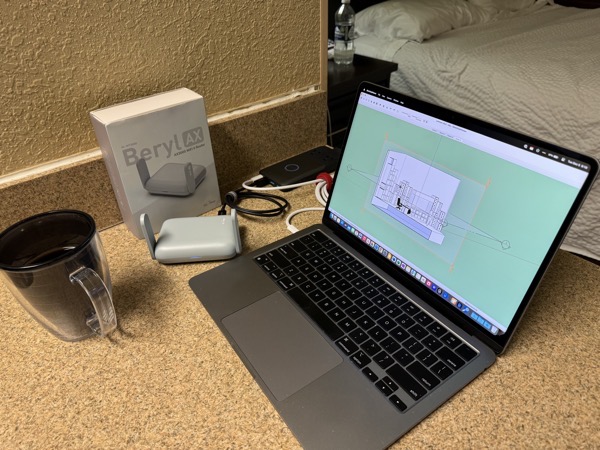
This is quick review of my favorite gadget purchase of 2023. The GL.iNet Beryl AX (GL-MT3000) Travel Router proves that big and amazing things can come in small packages. They need to work on that name though. It certainly doesn’t just roll off the tongue. This small router that fits in the palm of your hand allows you to do any number of router like things in order to get connected, stay connected, and stay safe while connected.
I started looking into travel routers early this past fall as my November/December schedule started firming up. Our family was expecting a new granddaughter. (Yay! She arrived and is gorgeous.) I had a work gig that was going to take me out of town the week before Christmas and for five weeks after that to direct The Lehman Trilogy at Playhouse on the Square in Memphis. That gig meant we had to do some of our many family holiday trips earlier in the month of December.
All of that combined meant some hotel stays and visits to relatives with large houses that don’t exactly have great WiFi coverage. Essentially I was looking for a way to piggyback on and extend WiFi reception in those destinations. Some of the travel would mean both my wife and I would be working at times from those various locations in addition to enjoying family time.
The GL.iNet Beryl AX (GL-MT3000) Travel Router filled that bill and more. Not only am I able to piggyback and extend WiFi when needed, but it provides built in VPN services that can help when you don’t exactly want to use hotel WiFi without some form of VPN protection.
In addition, it can combine an existing WiFi signal with a tethered connection to a smartphone to boost the signal even more. I’m not quite sure how they make that magic work, but they do. You can grab existing WiFi by plugging into a router or over the air. The connection can handle up to 70 devices. I don’t have that many, but when we’re traveling we have more than a few.
And as far as small packages go, the device is small enough to toss into your bag when you need to travel light. Once the show I’m working on moves into the theatre i’m looking forward to extending and boosting the signal of the public WiFi channel there where I work so I don’t have to log in to the networks we used for technical theatre operations.
I won’t get into all the technical ins and outs but I will say this is a bit fiddly to set up. But once you’re up and running it’s certainly a keeper for my kit. Here’s a link to a review from the Gadgeteer that goes into more detail if you’re interested.
All in all for a $100 purchase it’s already proven it’s value.