Through A Glass Darkly: Apple’s Liquid Glass Future Isn’t Clear

Continuing to watch Apple’s Betas from the sidelines.

Apple’s adventures with its new Liquid Glass design language reminds me of the title of a terrific, yet gloomy, Ingmar Bergman film, Through a Glass Darkly. Keep in mind that I’m not running the beta and living vicariously through the reactions of those whose opinions I trust. That said, based on some of those opinions of the recently released 4th developer beta, the future of Apple’s new design approach appears less than clear. 

Image from @davemark on Mastodon

From most accounts it’s a battle between legibility and the “coolness” of the design’s featured transparency that overlays content with the intent for the content below to bleed through. The challenge seems to be finding the right amount of bleed through that also allows users to easily read a notification or a control. 

In my view, the challenge with that challenge seems to be one of fighting things you can’t control. Holding liquid in your bare hands without spilling a drop might be easier. Every website and app designer has their own preference and approach. Even Apple apparently has difficulty as some of their own apps with background bleed through obscuring text. 

Image from @viticci on Mastodon

Since Apple announced Liquid Glass there have been three iterations of the approach. In a sort of Goldilocks and the Three Bears adventure with Apple dialing transparency features back and forth. Now in the 4th version of the developer beta reengaging more transparency. Searching for a “just right” solution doesn’t yet seem to be yielding any clear direction. But then, Apple’s ambitions, perhaps by design, have created a lose-lose short term future. The eventual product will never please everyone with this design change. But to be fair, that’s always the case with design changes and the folks at Apple knew that going in.

There are other usability issues as well, including things like making it easy to tell which tab or control is in focus, and having to tap multiple times to perform a function that used to be one tap to name a couple I see repeatedly mentioned.

But the clear focus of complaints (and some praise) is Liquid Glass. I would venture that for users it’s still too early to judge, but supposedly the Public Beta is due soon and the consensus is that what we see there will be pretty close to what we see in the Fall. Developers on the other hand are increasingly worried about Apple’s search for a “just right” solution while they try to find a path forward to have their own apps ready for the big release alongside or close to the release of this new wave of operating systems. 

CleanShot 2025-07-24 at 08.38.27@2x.

The problem becomes magnified when designing for the lowest common denominator with so many users. From my perspective of supporting clients and family members, most folks just want to pick up their devices and do what they want or need to do. They don’t want a new learning curve getting in the way. They certainly don’t want legibility issues to get in the way. There’s a real tension between what Apple needs to do to keep the cash registers ringing and the familiarity users want that I don’t think the folks in Cupertino understand given the annual pace they seem locked into. 

Image from @jsnell on Mastodon

The Bigger Picture

From where I sit on the sidelines, I think Apple has also created some real and perhaps less transparent problems beyond how Liquid Glass eventually rolls out.

Coming on the heels, and at least somewhat intended as a distraction from last year’s Apple Intelligence and Siri woes, Apple needs to create a clear narrative surrounding Liquid Glass in order to sell this year’s new crop of iPhones. (I imagine the commercials have already been scripted if not filmed.)

That already seemed like quite a challenge given that the only big hardware news this year is the rumored introduction of a smaller, lighter, apparently with less features iPhone Air. I don’t imagine that Apple’s traditional iPhone lineup is going to have new features to tout that makes those familiar device form factors must haves or must upgrades. 

If you’re counting on a flashy UI design change as the distraction that gets criticized as much as the issue you’re trying to distract from you’re magnifying your problems. Unless of course, you bank on criticism of the distraction further distracting from bigger issues.

Adding to that, the larger narrative has somewhat already passed by this year’s iPhones to what comes next year, with just about everyone assuming Apple’s version of folding iPhones will be the new focus. 

Sum all of that up and this is starting to feel potentially like a lost year for Apple. Sure, Apple will sell lots of iPhones, but if it can’t capture the imagination the way Apple usually does, much of the narrative will be wait ’til next year. Apple historically takes a long view. Time will tell if they have lost control of the visible horizon.

iPadOS 26

That said, somewhat under the radar, iPad beta users continue to trumpet the success of changes made in iPadOS 26. I’m looking forward to seeing that myself. That said, as much as those potential changes will be welcome, I can’t imagine that’s the tentpole Apple wants to rely on to create excitement this year.

CleanShot 2025-07-23 at 07.19.00@2x.

I mentioned the film Through A Glass Darkly in the opening of this post. The story of that classic film is about a family that gathers to try and heal after a member diagnosed with schizophrenia is released from an asylum. If you ask me, the challenges we’re seeing at Apple with design changes, Apple Intelligence and Siri among other things demonstrate that there are multiple personalities exhibiting control at various times within Apple, at a time when some turnover at the top is already underway, with quite a few calling for more.

As always, I recommend Michael Tsai’s Blog as a good source to keep track of how all of this continues to develop.

And with that, I’ll leave this update from the sidelines with this. 

CleanShot 2025-07-24 at 08.29.28@2x.

Update: The public betas for all of Apple’s new operating systems were released shortly after this post was originally published.

You can find more of my writings on a variety of topics on Medium at this link, including in the publications Ellemeno and Rome. I can also be found on social media under my name as above. 

Thoughts and Prayers Heading into WWDC 2025

A new coat of paint won’t fix the cracks in the wall.

In a week Apple will unveil what it has in store for us during its annual World Wide Developer’s Conference (WWDC). Beginning June 9, the microscope will be focused more intently and with a greater scrutiny given the myriad of issues Apple is facing. That scrutiny might just overwhelm any message Apple has planned for the year ahead depending on how Apple handles it.

WWDC 2025 Apple Logo

The reason I titled this post “Thoughts and Prayers Heading into WWDC 2025” isn’t that I’m offering up good vibes for Apple as they try to work out of the messes they’ve mostly created for themselves. I’m actually hoping — most likely against hope — that Apple will finally clean up some of the annoyances they’ve neglected over several generations of iOS and macOS.

I’m not going to discuss the bigger picture issues Apple is facing here. I’ve written about some already, as have many others. Instead I’m going to focus on the smaller software reliability annoyances that add up to make me think Apple just doesn’t care.

It’s become almost a running joke that Apple allows some of these flaws to continue year over year. But I don’t find it funny. You can put new wallpaper over a water damaged section of a wall, but if you don’t fix the leak then the problem isn’t the stain on the wall, it’s you not caring. Or maybe you don’t have the money to get it fixed. Apple certainly has the money. As John Siracusa says in an excellent post called Apple Turnaround:

It’s been 15 years since Apple’s leadership last demonstrated that it’s willing to emphasize software reliability at the cost of new features. Since then, bugs in major features have been allowed to fester, unfixed, for years on end.

I’ll quibble with John on one point. If you allow a reliable, yet ignored “bug” to remain through several operating systems, it essentially becomes a feature the longer it’s not addressed.

I’m a stubborn old coot in my life as a theatre director. Deeply ingrained in my way of directing is something a mentor laid on me year’s ago. “If it’s on the stage it’s yours. If it fails or distracts, it’s your failure.”

Here’s a short list of bugs and annoyances that have existed over several versions of the operating systems and several versions of Apple’s hardware that I encounter routinely. That’s based on how I work and play with Apple hardware and software. I’m sure there are many more depending on how others use their devices.

Focus

I know there are folks who swear by the Focus feature, but to me it’s one of those features that works and then randomly doesn’t. I’d call it unfocused. I keep trying to use it, but abandoning it because I already have enough random failures in my life.

Shared Reminders Notifications

I’ve written about this previously. Shared Reminders are terrific for grocery lists and other things, especially of a checklist nature. But when you complete a Reminder, the notification needs to disappear for all of the users who are sharing the Reminder. I’ve had Shared Reminders hang around for hours after I’ve checked it off of a list.

Syncing Photos

This one just gets more and more puzzling and has become the butt of so many jokes, it’s almost become a part of the Apple brand. You take a photo on your iPhone and whenever it syncs to iCloud and subsquently to other devices is a wild guess. I get that if you’re running low on battery you may want to delay syncing. But if my iPhone is plugged in telling me that it won’t sync so that it can optimize battery it is a little silly. Also telling me syncing is paused for “optimizing the system” makes me wonder just what system is being optimized. Apple’s or mine?

Bluetooth Connectivity and AirPods 

I’m a big fan of AirPods. I’m also a big fan of AirPods and the way they are designed to work within Apple’s ecosystem. When they work as designed it’s magic. When not, it is frustrating. Again, random failures to disconnect, which always seem to come at just that moment when you need to quickly plop them in your ears for a phone call are never fun. Neither is it a good time when one of your devices you might have previously been connected to refuses to let go of the connection.

Deleting Media from Messages

I support a few family members who keep their Messages set to retain their Messages forever. That’s all well and good, except this can quickly fill up storage on an iPhone. Apple needs to make it possible for users to select and bulk delete media on an iPhone the same way you can in Mail. The UI looks like you can swipe down the list of circles, but you can’t. The fact that you can only view these attachments sorted by size also makes it a more difficult chore to remove unwanted media attachments.

Shortcuts

I have a love/hate relationship with Shortcuts. Love it when they work. Hate it when something changes and a Shortcut I’ve relied on suddenly stops working or stops appearing in Spotlight. This happens more frequently in beta season even though I don’t run betas.

Beta Badness

Again, I don’t run betas on any of my devices. That said, I’ve been told by Apple Support personnel that changes are always happening behind the scenes on the backend during beta season that can sometimes affect all users. That stands to reason, given how much of what you do on an Apple device is tied into Apple’s servers and iCloud. I suspect this may only become more prevalent with Apple Intelligence as Apple tries to remain competitive with other AI providers that seem to constantly be updating their software. Perhaps there needs to be a way to create a wall or silo off users running betas from those who do not.

App Store 

With M-series chips we’re able to get great performance and fast loading times from apps. With one notable exception being Apple’s own App Stores. For the life of me I don’t understand why they can’t improve performance on their own point-of-sale outlets. It’s like not cleaning the glass on the front of your storefront.

Settings and Permissions

I get that there are a large number of Settings. I don’t get that there’s such a haphazard way of addressing the problem of making them discoverable. I’m sure it’s a challenge, but the only way to address a challenge is to set it as a priority. The same is true with Permissions. Certainly there’s a way to force developers (including Apple) to send us to the correct Permissions screen to choose to make a selection.

Rules in Mail

I’ve set up a number of Rules in Mail in macOS over the years. Currently they all seem to be non-functioning, or randomly functioning. I have a suspicion this may have something to do with Apple’s tinkering with Apple Intelligence based mail categories (a feature I tried but turned off). Having to manually choose to Apply Rules is not the same as having a Rule that runs automatically. It defeats the purpose. Let’s face it, no company has found a way to win the cat and mouse game of spam filtering. I doubt they ever will even with AI. The Rules feature wasn’t perfect, but when it worked it was a help in weeding out some of the spam.

Consistency between iOS and macOS

Speaking of Mail, I’d like to see consistency across the board regarding features between the macOS and iOS versions. In fact, I’d like to see consistency across the board in all of Apple’s native apps. This is especially true given that there is a rumor that Apple is redesigning most of its operating system user interfaces to try and unify the look and feel between different device categories. Carry that through with how you treat app functionality between platforms. Other examples include Shortcuts and Apple News+. I enjoy being able to open an article via the Share Menu from Apple News in Safari on a Mac. I should have the same option on iOS and iPadOS.

As I said, these are mostly annoyances. But I’m annoyed that no one at Apple seems to be annoyed enough to take care of them.

You can find more of my writings on a variety of topics on Medium at this link, including in the publications Ellemeno and Rome. I can also be found on social media under my name as above. 

Scorched Apple Trust

Hey Siri, how do you rebuild trust?

Trust is not an easy thing to earn. It’s far easier to burn. When it catches fire, it quickly consumes whatever is in its path. Such a conflagration is made worse when it singes those who have long cozied up, supported, and promulgated that trust as their own. Apple and those who make a living covering the company are both fighting a fire neither can put out without the other, regardless of what caused Apple’s rush to market whatever Apple Intelligence and the new personalized Siri was supposed to be.

New Screenshot.

The money quote of this episode and this moment is from John Gruber at Daring Fireball in Something Is Rotten in the State of Cupertino.

The fiasco is that Apple pitched a story that wasn’t true, one that some people within the company surely understood wasn’t true, and they set a course based on that.

You could say it starts and stops there. You wouldn’t be wrong.

Here’s a quote for Lance Ulanoff on TechRadar:

WWDC 2024 changed all that and gave me hope that Apple was in the AI race, but there were worrisome signs even back then that because, well, it was Apple, I chose to ignore or forgive.

Om Malk says:

It’s clear Apple must radically rethink its reason for being.

The heat on Apple has been smoldering for some time now with smoke in the air, wafting on a number of fronts. While I’m not pointing fingers and criticizing Apple pundits directly, (they were misled in my view), they’ve carried a lot of water for Apple, keeping these other recent flare-ups from burning too hot.

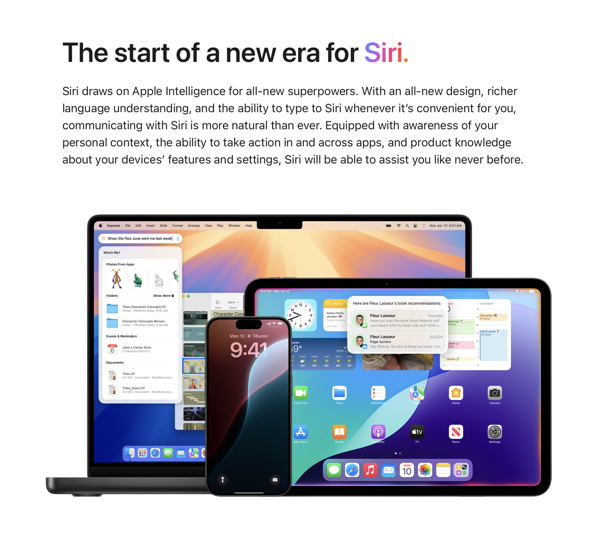
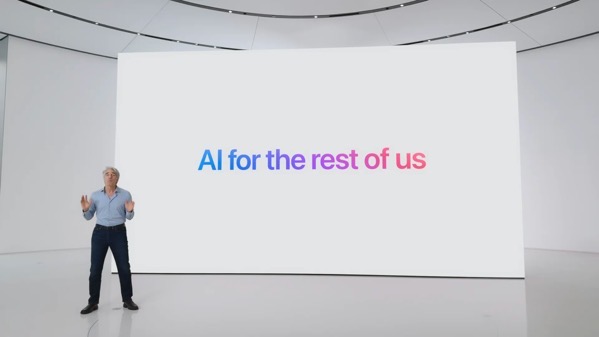
I’ve written about this Apple Intelligence episode previously, but to recap the particulars: Apple announced its flavor of Artificial Intelligence at last year’s World Wide Developers Conference (WWDC), carving out a fire line to slow down the burning narrative that it was behind and possibly missing the moment with AI. Boldly branding it as Apple Intelligence, the key reveal was unveiling a more personalized Siri, that unlike all of the other AI efforts on the market, would give users “AI For The Rest Of Us,” that would retain the firewall of Apple’s marketing mantra of being more secure and private.

Turns out it was a reveal that wasn’t really a reveal, but has now proven all too revealing.

As has been typical with new operating system features the last few years, Apple was clear at WWDC that some of this newness would roll out over the course of the year, so there was no surprise there. Also typical since COVID is that Apple’s announcement was a canned commercial.

Atypical, however,  none of the flashier features were ever shown to pundits and journalists, even under cover of an NDA. As Gruber and others are now saying, that smoky smell reeks of vaporware.

Each year Apple faces some degree of heat as it heads into WWDC. I think things will be hotter than most this year with a higher degree of skepticism. What we’re witnessing is a landscape built by years of trust, earning the benefit of doubt, turned to ashes. They say that hell has no fury like a woman scorned, but I’m here to tell you that might take second place when it comes to torching the trust relationship between a company’s PR reps and those who cover them.

Let’s talk about that trust.

Back in my gadget blogging days for GottaBeMobile.com the first rule of thumb was always be skeptical of PR. I’ve been on both sides of that fence, pushing out PR for my own projects and covering it for others. A PR pro tells you the story they want you to cover. Covering that story, you look for the holes in addition to covering it. By and large most of the well know Apple pundits have done a reasonably good job of revealing those holes in my opinion.

Apple was different in that for the most part if they made a claim it usually held up. I remember distinctly when the first iPad was released with a claimed battery life of 10 hours. Those of us at GBM were surprised when those claims proved accurate once we had the devices in our hands. Promise made. Promise fulfilled. Trust earned.

No company is perfect, certainly not Apple. But Apple has been reasonably consistent for most of the time I’ve been covering or using their hardware and software. There have been lapses — Siri being a prime example — but nothing that wasn’t overcome and perhaps, now in retrospect, wrongly overlooked because of the trust Apple built with the media and enthusiasts who covered the company. As most now realize, the smoke and mirror show of last year’s WWDC Apple Intelligence announcement was a red flag warning that needed more scrutiny than relying on trust banked through good will and follow through.

It’s currently being endlessly debated whether or not this failure was caused by a rush to satisfy Wall Street deep in its AI bubble, poor leadership, or just trying to climb too high a mountain too fast in an attempt to create a technical solution that, as announced, would one up those already on the market. In the end I don’t think it matters much what exactly sparked this blaze. I do think it matters how Apple chooses to put out the fire. Those who cover Apple, and more importantly users, feel scorched. I’m guessing there are some in Cupertino feeling that as well.

Burn scars don’t heal well or quickly.

You can find more of my writings on a variety of topics on Medium at this link, including in the publications Ellemeno and Rome. I can also be found on social media under my name as above. 

Sunday Morning Reading

Tough reads for tough times with a nod to the Commodore 64.

The rapid decay of all things continues. I’m not even sure if “decay” is the right word. “Collapse” might be a better choice. Regardless, there’s no “decay” or “collapse” in my sharing articles and writing every week in Sunday Morning Reading. Enjoy.

Russell Shorto tells us that the fracture we’re facing shouldn’t surprise in America’s Fatal Division Is Nothing New: It Was Baked In From The Beginning. He’s right and that’s also nothing new. We just have a propensity for ignoring what we shouldn’t.

Marc Elias says We Can’t Give In To Fear. He’s right. But with those we mistakenly counted on having already done so, it makes it tougher for the rest of us.

Brian Barrett of Wired (which continues to do excellent reporting) gives us a rundown on The United States of Elon Musk. Good piece with good context. I don’t disagree with his premise that it’s unsustainable. The larger concern is what’s left in its wake.

NatashaMH opens up a personal tale of exploring justice, relationships, and personal power in The Price of Guns And Butter.

Things aren’t just decaying on political and social fronts, technology is marching right alongside, if not leading the charge. John Gruber lays out a mea culpa of sorts in discussing Apple’s less than intelligent move into Artificial Intelligence in Something Is Rotten In The State of Cupertino. Om Malik also weighs in with Apple Intelligence, Fud, Dud or Both. I’ll have more to say on this later this week. I wrote a bit about it last week also.

Will Knight, (again in Wired) tells us that Under Trump, AI Scientists Are Told To Remove ‘Ideological Bias’ From Powerful Models. Tell me. Who didn’t see this kind of thing happening?

Cory Doctorow in Pluralistic lays out how Amazon Annihilates Alexa Privacy Settings, Turns On Continuous Nonconsensual Audio Uploading. One way user agreements flow only one way. Again, who didn’t see this coming?

In times of uncertain futures it’s always somewhat uncomfortably comforting to reminisce about simpler times. When it comes to technology there was perhaps no simpler or more innocent time than during the age of the Commodore 64, which was my first home computer. We’ve come a long way. Gareth Edwards takes a look at Jack Tramiel’s success in How Commodore Invented The Mass Market Computer.

(Image from Ashni on Unsplash)

If you’re interested in just what the heck Sunday Morning Reading is all about you can read more about the origins of Sunday Morning Reading here.  You can also find more of my writings on Medium at this link, including in the publications Ellemeno and Rome.

Picking Your Tech Poison

It’s not easy loving tech these days.

There are no good options when it comes to choosing your tech these days. Let me rephrase that slightly, if you’re hesitant or resistant to AI taking over your tech there are no good options these days. Whether it be mobile devices, laptops, or desktop rigs, the makers of the major operating systems have all jumped on the Artificial Intelligence band wagon and are doing really poor Harold Hill impersonations trying to sell us on it. Sure there are different flavors, but they’ve become or are becoming intrusively the default. We all know where this appears to be heading. Computing devices without AI will be the flip phones of tomorrow, If they are even available. Apple has turned on Apple Intelligence by default, (even though it is still in beta). Microsoft is forcing Copilot into Office 365 and its operating system and charging you more for it, wanted or not. (There are ways to ditch it.) Google is doing the same thing with Android. Even if you don’t use an Android device, but use Google services, Google’s AI now accompanies anything you do with those services. Of course other smartphone users that rely on Android are following along, but there’s really no choice. If Artificial Intelligence was a virus, we’ve all been infected and there’s no vaccine to argue over, nor will wearing a mask help, because it extends beyond our own computing lives to the interactions we have with our doctors, banks, any form of customer service, and other affiliations of our daily lives. Yes, there are still refuges where you can attempt to avoid AI, but that’s not the real world of daily commerce and daily personal interaction. Now, it sounds like I’m 100% in the anti-AI camp. I’m not. I think there are legitimate uses. Some are even quite good. Some offer promise. I actually experiment with some of that. But I also think that there’s too much that isn’t useful, too much that just doesn’t work as advertised (beta or not), and too much that’s more than potentially harmful, especially in greedy hands. I can get excited about the technology, especially on some of the exciting hardware we now see. I just consider it a shame that all of that computing power is going to be put to the uses it appears we’re in for. We’ve been here before with new technology. First it’s a curious trickle then it becomes a tidal wave that sweeps us along in its path.  It’s tough to live daily life without a smartphone these days. That’s a more recent fact than many want to acknowledge. There’s another factor. Part of the hesitancy and resistance I know I’m feeling is that I don’t feel like I can trust the likes of Apple, Google, and Microsoft, much less the social networks and other applications that run on their hardware. I’ve always been skeptical, but that trust level took a knock with the recent knee-bending by these companies, trading cash for favors from the evil regime now in place in the U.S. I’m not sure how much more capitulation will be required, but I’m betting the folks trying stay in the game will find themselves laying prostrate before this is all over. I’ve used Apple products and have been a fan for quite some time. I imagine I will continue to be a user of those products going forward, given the investment I have in that ecosystem. But I also use Microsoft and Google products and support a coterie of folks who do as well. I also use services on my Apple devices by both Google and Microsoft. In order to support the folks I do, I keep up to speed with this increasing and haphazard pace we’re all forced into. The questions I deal with lately focus on how to remove or prevent these AI features more than they do about how to guide them through new features. When every day users are asking those questions there’s obviously a problem. As for me, tasting the poison in order to understand the which antidote is needed feels unhealthy, a bit dangerous, and just plain dirty. So, I’m starting to check out other hardware to become even more familiar, but also to look at my own options. Again, there’s no easy choice. I picked up a Pixel Pro 9 recently and am checking that out. Does that mean I’m thinking of changing horses in this stream we’re in? Probably not. As I said, there are no good choices. It really is a pick your poison era we’re in. I’m not happy about it. I’ve always been tech curious, it’s just sad my current curiosity is bred from such distaste, distrust, and disgust. You can find more of my writings on a variety of topics on Medium at this link, including in the publications Ellemeno and Rome. I can also be found on social media under my name as above. 

My Year With Apple: A Mixed Fruit Basket

It’s been quite a year toiling in Apple’s orchard.

For those who know me, they are familiar with my use of Apple products. Typically when I pick up a new piece of Apple gear I’ll write a review after using it for a few weeks. I didn’t do that this year. Part of the reason for that is Apple’s possibly panicky piecemeal rollout of iOS and macOS, which in many ways also changes the game for some of the new hardware releases. So to lay out my thinking I’ll post my thoughts here on the new Apple hardware I picked up along the way this year, as well as the still unfinished operating system releases.

PXL 20241230 172543463.

The Hardware

I’ll tackle the hardware first as that’s the least complicated. This year I acquired an 11 inch iPad Pro M4, and iPad mini, and iPhone 16 Pro and an Apple Watch series 10. Unlike many in the tech and gadget geek community I’m personally in a place where the lack of significant form factor changes to each new hardware version isn’t a detriment, it’s a bonus.

Essentially, each of those devices I acquired required no new learning curve. Set them up out of the box and I was back and operating the way I was before trading in the previous versions.

Yes, each is snappier, but that’s always expected. The iPads sport newer M-series chips, but with an exception or two they are essentially the same as the previous models. Some find that boring. I do not. Quite honestly, I actually prefer it this way. I “upgrade” my hardware when there is a new release and I move on. In the case of the two iPads that cycle isn’t an annual one, so it works for me and my budget.

Here’s a rundown on what is actually new that I do and don’t appreciate. (Notice I’m leaving the iPhone 16 Pro until the end.)

iPad Pro M4 (11 inch)

PXL 20241230 172903105.

 The upgrade to the display to what Apple calls Ultra Retina XDR is a clear improvement that I notice daily and very much appreciate. Beyond that marketing moniker, Apple says the “groundbreaking tandem OLED technology” is, well, groundbreaking. In my use, I will say it’s simply gorgeous to look at.

The other big change is the iPad Pro is thinner. It’s noticeable, but when I’m using the device for work it’s in a case for protection so the benefit there is often negligible for me. I do notice it when I use it with the Magic Keyboard and lift it off of that accessory to read or watch while relaxing on the sofa or in bed.

Speaking of the Magic Keyboard, I will say the newer version feels like a more significant upgrade physically than does the iPad Pro it is meant as an accessory for. It is sleeker and lighter, and I much prefer the stability of the aluminum construction to the previous model.

iPad mini

PXL 20241230 173113624.

The iPad mini is my travel device on short trips and reading device at home. While I occasionally alternate it with the iPad Pro there is no discernible difference in how I use either device, other than viewing entertainment on the iPad Pro’s screen.

The newer version brings the M-series to the iPad mini for the first time with the A17 Pro chip, and the difference in performance is notable but not overwhelmingly so. Beyond that, there’s not much else new in the hardware to speak of. Apple updates the iPad mini lineup less frequently than its other iPads, so I’m sure this one will more than suffice until the next update a few years down the road.

Apple Watch Series 10

PXL 20241230 173306742.

The most significant upgrade to the Apple Watch hardware here is a slight increase in the size of the device that allows for an even slightly larger display, alongside of a size reduction in the depth of the body of the watch itself. Both are notable, but not really significant in how the series 10 feels on my wrist as compared to the Series 9.

I’m veering into software a bit here to say that upon release, the Series 10 had much less battery life than the Series 9. We’re now currently on watchOS 11.2 and the battery life seems to have improved, getting closer to expectations. But there are still mornings when I’m puzzled as battery life will drop significantly in the first few hours after I wake up.

I’m puzzled because when I’d see the battery life drop quickly in the morning, I’ll slap the Apple Watch on its charger for a bit and then I will see expected battery life throughout the day.

I don’t take advantage of the overnight sleep and health tracking features and my watch normally sits on a charger overnight, so I don’t know what effect that might or might not have. I do run a couple of third party apps that track medical data during daylight hours and that may be a part of the battery life discrepancies and my comparison to the previous version.

iPhone 16 Pro

PXL 20241230 173421049.

Apple’s cash cow, the iPhone, is also the prime example of the paradox Apple finds itself in. You can argue, and I have, that we reached peak smartphone design a while ago. That’s evident not only with Apple but also with other companies continuing to search for something, anything to make their smartphones appear new and fresh, in parallel with the search for the next big thing that might eventually replace the smartphone. Searches that have so far been fruitless.

With the exception of the annual chip evolution and newer camera technology nothing much of substance has changed in smartphone hardware recently. Yes, there have been attempts with folding smartphones and new buttons but the core value of the hardware remains the same.

I get it. Apple has to serve multiple masters: customers, the easily distracted tech press, shareholders and the markets. Sales numbers always go up when there is a major hardware change. The siren song for something new in hardware is real, loud, and I think ultimately somewhat defeating.

The perfect example is the big new thing on the iPhone 16 Pro: the Camera Control button.
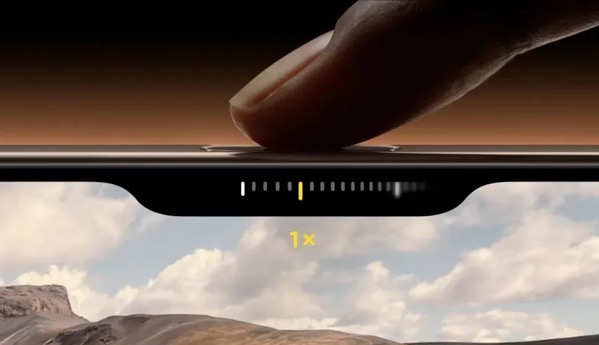
IPhone 16 Camera Control Button 1000x576.

This looked enticing (shiny new things always do), but I just don’t find it useful. It’s too finicky and fiddly to be of use. I’ve worked hard to use it, but I find it distracting when the act of taking a photo should be instinctive. Beyond that fiiddliness, anything the functions of the camera control button offer I can do later with software and not miss the shot I’m trying to take.

Perhaps there are features to come for the Camera Control function. Apple actually added one with iOS 18.2, allowing users to press and hold on an object and then search for info on what the camera captures. But again, we’ve been able to do this through other software for some time now.

AirPods Pro 2

I didn’t purchase new AirPods this year, but the new Head Gestures feature of nodding or shaking your head to dismiss or respond to a notification is a winner. The rolling, gurgling, burbling sounds are a bit much at times, but I find I really like this feature.

Software

As I was writing most of the above about hardware I noticed myself veering into talking about software changes that impact the hardware. The obvious reason for that is that Apple makes the entire widget and functionally it’s becoming harder and harder to distinguish where success reigns and failure begins.

This year’s software releases of iOS and macOS do contain new features, but the big tent pole is Apple Intelligence. That’s a tent that is far from being fully erected and, in my opinion, not ready for the paying public.

Apple Intelligence
97686290 157a 4cf4 a2d1 e7c87303c1bc_1920x1080.In my use, Apple Intelligence so far is nothing more than a curiosity. On the one hand, advertised as the next big thing, on the other still labeled a beta. Yes, it’s well known Apple is playing catch up, but given how fast anything in the AI market evolves (or doesn’t), I’m not sure there will ever be a race with a destination, much less a finish line. That’s not just true for Apple, but for all the players in this game.

If I had to rate Apple Intelligence at this point I’d say it’s not worth all of the mis-placed marketing dollars Apple is spending. In fact, it is precariously close to feeling like a shell game. I’ve tried all of the currently offered features and don’t really see any at the moment that will be of continued use for me going forward.

Notification Summaries are sometimes worth a laugh, but currently not worth the candle when I try to decipher the mixed messages. I’ve stopped taking screenshots of them, because they are too numerous to collect. If I have to click a second time for understanding, what’s the point?

Summaries of web pages at the moment seems to be a feature not well implemented. I rarely see anything beyond the title when I do look.

Genmoji and Image Playground have no value to me whatsoever. (I’ve never been that big on the whole Emoji thing as I prefer language to hieroglyphics. That used to be a distinction demonstrating society was advancing.) If I want some generative AI to create an image there are much better tools around. Apple’s Writing Tools don’t have any real value for me either.

As for the changes with Siri, there’s no way to judge currently, because what’s there is not what I think we might see someday either in a galaxy far, far away or in a Kubrick film of the last century.

If the point of the Apple Intelligence rollout was to please the markets and shareholders, their “meh” reactions after this piecemeal rollout demonstrate they are even dumber than I thought, or care less than Apple thought they would. Apple seems to have successfully silenced the “Can Apple do AI?” doubters with its smoke and mirror show, but smoke eventually fades and just stinks up your clothes.

I can only base my thoughts on its usefulness on my own experiences, but I’d rate Apple Intelligence as less than “meh.”. If this is “AI For The Rest of Us,” it doesn’t feel much like Apple understands us or AI.

I guess the question becomes if we’re always on the cusp of something new and promising, then why not slow things down and focus on getting it accomplished instead of being slave to an annual release cycle? Certainly it seems that it is proving more and more burdensome. Rumors that iOS 19 might have problems meeting deadlines while Apple continues hammering on Apple Intelligence features for iOS 18 might just be rumors, but I would bet there are more than a few sparks smoldering under that smoke.

iOS 18 and macOS Sequoia Other Features

That said there are some other improvements in iOS 18 and macOS Sequoia worth mentioning. I’m going to talk about those in combination, because new features increasingly blend across device platforms via Continuity. Speaking of, I’m glad I finally got my Continuity headaches solved in 2024. Though it took an intervention from Craig Federighi.

iPhone Mirroring

The new iOS and macOS feature I remain most pleased with is iPhone Mirroring. This looked cool when it was revealed. It has proven both cool and more useful than I ever thought it would be. It’s great not to always have to pick up my iPhone when I’m heads down working but need to check a notification.

macOS Notifications

In my column of new features I like and  tied with iPhone Mirroring is the ability to see iPhone notifications on a Mac. Again, this is more useful than I thought it would be, even though I think Apple still has work to do with this on a consistency level, I rate this a winner.

That rating is also bolstered because along with it finally comes the ability to dismiss all notifications on a Mac. This has been too long in coming, so I’m glad it’s here.

I am puzzled why it is a two step process though.

When you view notifications you have three options at the bottom of the list, one being an X. Clicking on that X reveals only a single option to Clear All Notifications. That seems like an unnecessary step to me, unless there’s something else planned for the X in the future.

Photos

Lots of noise was made about the changes in Photos, but frankly I don’t think it was a big deal. I base that on my own usage and from the bevy of family and friends who I support, none of who complained.

What would be a big deal is if Apple would allow users more control to reliably sync photos. Apple actually made things a bit worse with iOS 18 by further hiding where you can see if photos are syncing behind your avatar instead of at the bottom of your Photo library.

Searching for photos is also much better in both iOS and macOS Sequoia. If that’s an Apple Intelligence feature, then it’s one of the few pluses. It isn’t perfect, but it is much better. I do wish I could delete a photo when I’m viewing search results. Currently I can only remove it from the album it creates with those results, even though I’m not saving the search as an album. This would be a great way to help delete duplicates and declutter.

Control Center

The changes here almost feel like a bad April Fools prank in that you can make changes, but playing the game to move icons around on a screen or between the new screens is nigh on near impossible and ultimately user unfriendly for a theoretically user friendly UI experience. If you think chasing Apps around a screen is fun, this will cure you of that.

Math Notes

More useful on an iPad than I find it on an iPhone or Mac, Math Notes is a significant new feature, especially when used with the Apple Pencil. Speaking of the Apple Pencil, I’m glad that both the new iPad Pro and iPad mini can use the same Apple Pencil interchangeably.

Handwriting Smoothing

This might work for some, but it is a marginal and almost negligible benefit to me as my handwriting is so awful. That said, searching notes that include my handwriting has yielded surprisingly good results even with my lousy handwriting.

Bluetooth

There seems to be something good under the hood added with Bluetooth. I base this on connectivity with my car. My car isn’t equipped with CarPlay but I do connect my iPhone via Bluetooth. Previous issues I had with connectivity seem to have vanished with iOS 18. I have to give credit to Apple, because nothing in my car has changed.

There was some early jankiness using Bluetooth on my Mac with peripherals, but that seems to have disappeared in later point releases of macOS Sequoia.

Safari and Distraction Control
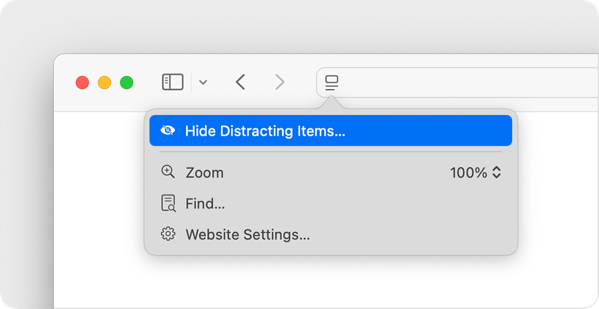
Macos sequoia safari page menu distraction control hide distracting items.

I like the new Distraction Control feature in Safari and hope Apple continues improving it. It’s a bit clunky to use at times, but it does help quite a bit with the continued enshittifcation of the web.

RCS Messaging

This is a notable improvement in my case, because it does improve messaging back and forth with some family, friend, and work threads when images are shared.

Smart Stack on Apple Watch

I find myself blowing hot and cold on the Smart Stack feature. At times it does approach the magic it promises. At other times it’s just an annoyance. I’ve tied turning it off and that can solve the annoyance factor, but I find myself wanting this to work and be smarter.

There are plenty of other new features across Apple’s platforms, but these are the ones that I find myself using the most, outside of Apple Intelligence.

Summing Up

To sum all of this up, without using any Artificial Intelligence, Apple or otherwise, I’d say this year’s hardware and software releases from Apple are one of those years we’ll look back on as a transitional one. Note that the only M4 series device I acquired this year was an iPad Pro, so I can’t speak beyond that on that new M-series evolution. Given how I use my iPad Pro, I’d say it was a winner, but not a life-changing one.

And quite frankly, AI marketing and money grubbing pitches aside, I am extremely comfortable upgrading my hardware as new generations of mobile devices roll out, and equally comfortable sitting on my computer purchases for as long as they hold out.

I am becoming increasingly uncomfortable though with the pace of operating system releases that seem to keep us all in a perpetual beta state whether or not we opt-in to the actual betas themselves. I don’t have a problem with Apple rolling out features over a period of time. I’d rather they do that than release something unfinished and full of bugs. But, I do have a problem with the heavy marketing push that trumpets what’s to come, long before the music is even ready to be played.

I’m able to keep up with what’s real and what’s not or not yet in the hype cycle, but the family and friends I support feel confused, and then become uninterested. If the goal is for folks to actually want to buy new hardware and to use new features, that’s ultimately a self-defeating strategy.

The Vision

Further summing things up, I think Apple’s release of the Vision Pro encapsulates the challenges within Apple’s vision. No, I didn’t buy one of those devices, but I did do the demo several times. I do buy the long term vision behind Spatial Computing, but I think Apple overreached with its hardware and design ambitions. Apple was able to recover from a similar overreach with the original Apple Watch, but the ante wasn’t so high for the consumer. The Vision Pro comes with a steep price to get in on the ground floor, and as of this writing it feels like it was so steep that it will actually change the floor itself.

I think a similar thing is going to take place with Artificial Intelligence, Apple’s version, and that of others. So many have ambitiously bet so much on that being the next big driver in tech, but I’m guessing in the long run it’s going to just be another passenger, perhaps in a side-car, along for the ride in an increasingly slower pace in the smartphone and mobile device race.

I feel almost Luddite-like saying this, but I wish Apple and others would focus on making what we have better than trying to make it new.

You can find more of my writings on a variety of topics on Medium at this link, including in the publications Ellemeno and Rome. I can also be found on social media under my name as above. 

 

Apple and the EU Squabble Over Inclusion of Apple Intelligence and Other New Features

Apple and the EU squabbles continue now over new features.

It’s a Friday free-for-all between Apple and the European Union. Miffed at, or stymied by, the EU’s DMA regulations, Apple announced in the Financial Times that all of the ballyhooed (but still not seen in the real world) Apple Intelligence features along with a few others might not be coming to the EU when they launch in the U.S this fall or even this year.

Screenshot%202024 06 10%20at%2011.36.33%E2%80%AFAM.

John Gruber of Daring Fireball has the full statement from Apple as reproduced here:

Two weeks ago, Apple unveiled hundreds of new features that we are excited to bring to our users around the world. We are highly motivated to make these technologies accessible to all users. However, due to the regulatory uncertainties brought about by the Digital Markets Act (DMA), we do not believe that we will be able to roll out three of these features — iPhone Mirroring, SharePlay Screen Sharing enhancements, and Apple Intelligence — to our EU users this year.

Specifically, we are concerned that the interoperability requirements of the DMA could force us to compromise the integrity of our products in ways that risk user privacy and data security. We are committed to collaborating with the European Commission in an attempt to find a solution that would enable us to deliver these features to our EU customers without compromising their safety.

Apple PR is obviously hard at work here and I’m sure the EU’s PR operations will be following suit shortly. I’m particularly entertained by the phrase “we do not believe.” It’s also fascinating to watch the sideshow of reactions that might turn into something more: how Apple users on their respective sides of the pond are responding to this. Generally speaking from the early reactions I’ve seen the majority of American sympathies tend to lean towards Apple, while it’s just the opposite in Europe. But it’s early and it’s a Friday.

The timing of this suggests an opening salvo in further negotiations given that none of the features in question have been rolled out yet. However, according to Gruber a few of the non Apple Intelligence features (iPhone Mirroring and SharePlay Screen Sharing) are scheduled to roll out in the next betas to be released. iPhone Mirroring is one of the sexier features announced, so it will be interesting to see how that is handled with the next round of betas.

It is obvious that at some point down the road there will be some sort of compromise. Apple doesn’t want to lose the EU market no matter what those who suggest Apple should just pull out of the EU markets might say.  And somehow I doubt EU Apple users will exert enough pressure to change any strong position the EU might cling to.

In the meantime the sideshow commentary in addition to the news will make for an interesting Summer beta season.

You can find more of my writings on a variety of topics on Medium at this link, including in the publications Ellemeno and Rome. I can also be found on social media under my name as above. 

Apple Intelligence Crawling Under the Skin for Some

Apple Intelligence is the latest AI effort upsetting web publishers.

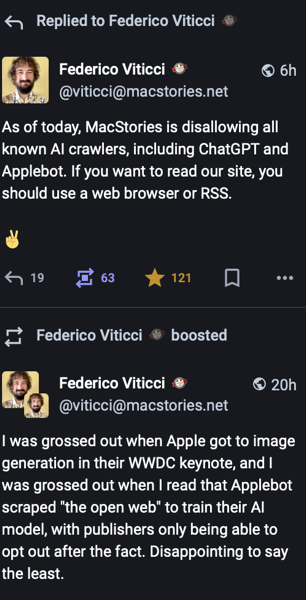
As we learn more about Apple Intelligence how Apple is training its AI efforts is crawling under the skin of some web publishers. Apple has been reasonably transparent about how it’s crawling the open web and using data it can grab for its efforts. Even so that’s not sitting well with everybody. But that’s been an uneasy road we’ve all been on with AI in a general sense since those gates were thrown open by OpenAI in 2022.

Screenshot%202024 06 10%20at%2011.36.33%E2%80%AFAM.This is a sticky wicket. Web publishers justifiably don’t feel great about having their content grabbed, regurgitated and spit back out without some consent or control. The other side of that coin is that the info is on the open web and by and large folks can access it through a variety of methods. There’s also the reality that the horse is already far from the barn because most of these AI models have been doing the same thing Apple is doing. AI has a been both a cash grab and a content grab from the get go, because without the content there’s diminishing returns on the cash.

There are methods to exclude a website from being crawled. Dan Moren at Six Colors has posted a good piece on how to do so and what that could mean here. Keep in mind any method used for this only excludes content and data going forward. Federico Viticci at MacStories has already stated that he’ll be excluding his website going forward.

Also keep in mind that this isn’t the only way Apple will be putting Apple Intelligence to work. Regardless, this is going to be an issue to follow as we continue to learn more about Apple Intelligence, which is just the latest in these Artificial Intelligence efforts that we all need to pay attention to. Like it or not it’s here and a fact of life. AND this isn’t the only issue getting under some folk’s skin since Apple made its announcement.

As a side note, my reading list on Apple Intelligence continues to grow with both punditry and technical info that I discover along the way. I imagine that list will just keep growing.

You can find more of my writings on a variety of topics on Medium at this link, including in the publications Ellemeno and Rome. I can also be found on social media under my name as above. 

Terrific MKBHD Interview with TIm Cook

A relaxed Tim Cook talks Apple Intelligence with MKBHD

There are several Tim Cook interviews bouncing around the Internet while Apple’s WWDC is ongoing this week. They focus on all of what Apple has publicly announced, and it doesn’t take artificial intelligence to know a big part of the discussion is Apple Intelligence. 

 Prolific YouTuber Marques Brownlee (MKBHD) sat down with Tim Cook in one of the most relaxed interviews I’ve ever seen Apple’s CEO give. Given the promotional nature and pace during WWDC week, I think that’s a bit of a rarity. So credit to MKBHD.

Yes, the interview covers Apple Intelligence, but it’s fun to watch MKBHD challenge Cook to a blind ranking of Apple products. Cook doesn’t take the bait of picking favorites, but does talk about the five products MKBHD brings up and it is especially fun to watch Cook’s reaction as he spins a bit about the Magic Mouse. 

All in all it’s well worth watching and Cook’s answers to MKBHD’s questions do shed a bit more light on what Apple is thinking about Apple Intelligence and where that might take technology.

You can find more of my writings on a variety of topics on Medium at this link, including in the publications Ellemeno and Rome. I can also be found on social media under my name as above. 

Getting Smart About Apple Intelligence

Time to start getting smart about Apple Intelligence

Everybody on the Apple Intelligence Bus! Everybody on the bus! That sure seems to be the rallying cry from Wall Street to tech blogs and the pundit beat. It’s quite exciting but only in the way a trailer for the next big movie might get us excited. The story the feature will tell isn’t ready yet, and only those in the know have knowledge of the script and what secrets it might contain.

I’m not poo-pooing what Apple will be offering. I have no way to make any judgment on whether it’ll be the next big thing, the future of computing, a train wreck or an also ran. All we have to go on is a very polished presentation designed to illicit interest. Apple boldly promises Apple Intelligence is AI for the rest of us. If that proves to be the case it begs the question as to who are the “them” or “they” that aren’t “us.”

On a promotional level alone Apple achieved success and at the moment it looks like it accomplished one of its goals with the announcement. Wall Street is certainly jumping on the Apple Intelligence bus based. Investment trends don’t always prove that intelligence and common sense go hand in hand but the market has indeed moved with Apple setting a new record high.

If all or most of what Apple promises comes close to reality it indeed does look promising. But as most of us should have learned by now, technology promises, especially AI promises of late, can have some bumps along the hallucination highway.

The timing will also be interesting, given that most of this won’t be rolling out when new iPhones debut this fall. Apple may have shifted the focus and succeeded in swinging the spotlight squarely back onto itself and yet, all we really know at the moment are the promises with a big helping of “coming later this year” tagged on at the end.

That said, it is probably wise to add to our own knowledge bases with what we do know about Apple Intelligence to this point and going forward. To that end I’ve put together a reading list of what I’ve seen so far that attracts my attention. Some of it is punditry. Some of it is technical. All of it makes for interesting reading.

First up is an interview with Apple CEO Tim Cook by Josh Tyrangiel in The Washington Post. When asked what his confidence was that Apple Intelligence will not hallucinate Cook responded:

“It’s not 100 percent. But I think we have done everything that we know to do, including thinking very deeply about the readiness of the technology in the areas that we’re using it in. So I am confident it will be very high quality. But I’d say in all honesty that’s short of 100 percent. I would never claim that it’s 100 percent.”

John Hwang in Enterprise AI Trends lays out what he views as Apple’s AI Strategy in a Nutshell.From what I know his thoughts make sense to me.

Casey Newton says Apple’s AI Moment Arrives. Here’s a quote:

“The question now is how polished those features will feel at release. Will the new, more natural Siri deliver on its now 13-year-old promise of serving as a valuable digital assistant? Or will it quickly find itself in a Google-esque scenario where it’s telling anyone who asks to eat rocks?”

Craig Federighi did an interview with Michael Grothaus of Fast Company about Apple Intelligence.

For some historical context and picking up on the discussion on how this changes (hopefully improves?) Siri, M.G. Siegler gives us The Voice Assistant Who Cried Wolf.

Wes David on The Verge gives us a list of every new AI feature coming to the iPhone and Mac. 

Security and privacy are two of the big picture concerns that accompany anything about AI in general. A couple of technical entries into the discussion that I find informative include Private Cloud Computer: A new frontier for AI privacy in the Cloud from Security Research and Introducing Apple’s On-Device and Server Foundation Models. Both are released via Apple and focus on privacy and responsible AI development.

A terrific interview with Tim Cook from YouTuber MKBHD. Most relaxed I’ve ever seen Cook in an interview.

Brian Fung of CNN takes a look at how Apple is handling your data with Apple Intelligence and the differences between Apple Intelligence and ChatGPT.

Sebastiaan de With ponders Apple’s Intelligent Strategy. 

Michael Parekh weighs in with his thoughts on how Apple is thinking different.

Steven Aquino weighs in talks about how Apple’s efforts have the potential to affect Accessibility.

Peter Kafka has published a transcript of an interview with Ben Thompson. Here’s a quote:

The real risk is execution risk. Apple does have the luxury of coming to market later, and they benefited from a huge amount of research and improvements. Like shrinking down these models, giving them high efficiencies, so they can run on-device. They’ve had all those benefits.

What they are proposing to do — to actually orchestrate different apps and different bits of data — no one has done well, yet. Apple’s bet is they can do it well because they have the data, because they are on the device. But there is a real execution risk.

Will Knight on Wired suggests that Apple Proved AI is a Feature, Not a Product. 

Some folks are concerned that one of the ways Apple is training its Apple Intelligence includes crawling the open web. If you run a website there are ways to exclude it from being crawled, but unless whatever data has already been crawled is jettisoned by Apple prior to a new training it’s a bit late. Here’s some coverage from MacStories and Six Colors on that. This issue will be one to watch in the future.

Jason Snell of Six Colors opines that Apple’s skin the game might not have been as willingly all in as Apple would have preferred.

Dwight Silverman of The Houston Chronicle wonders Will Apple’s new AI plans Help Siri Fulfill its Promise or will it disappoint again?

You can find more of my writings on a variety of topics on Medium at this link, including in the publications Ellemeno and Rome. I can also be found on social media under my name as above.