Sunday Morning Reading

Wandering through the Internet, disregarding along the way

We live in interesting times. I’m spending a lot of my time being interested in watching my grandkids develop, and watching everything around how I thought they might grow up change. In my opinion, change not necessarily for the better. They won’t know what things changed from necessarily, unless they choose to look into it. That assumes they’ll be able to do so the way we can now. I have my doubts about that. Regardless, that’s tomorrow. Here are some links to share in this edition of Sunday Morning Reading. 
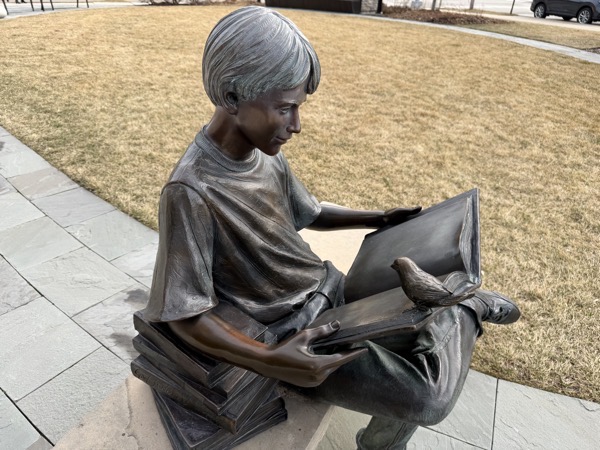
A close-up photograph captures a bronze statue of a young boy sitting on a stone bench outdoors, absorbed in reading a book.

Terry Godier says the Internet is dying. I’m not sure if it’s dying, morphing, collapsing in on itself, or just in the midst of growing pains, but I take the point. Check out The Boring Internet. (That’s a link to the text version. There’s also an animated version here. Quite nicely done.

JA Westenberg believes Nobody Is Destined For Greatness. I happen to agree. Shakespeare gave his greatest comic villain, Malvolio, lines about being born great. I wish I could label our current day villains as comic. Perhaps one day.

Derek Sivers reminds us that Geography Is Four-Dimensional. How true. There’s a reason Shakespeare more often than not capitalized the word “Time.”

Stories about religion occasionally get shared here. Mostly they are stories about how it’s really not religion, but a cover for grift and abuse. This is one of those. He Remade The Southern Baptist Convention In His Image. Then Came The Abuse Allegations by Robert Downen chronicles yet another of those tales we seem to hear far too frequently these days.

For another take involving religion, check out Neil Steinberg’s Being Formed By Christians Does Not A Christian Make.  He quotes Thomas Jefferson’s “It does me no injury for my neighbor to say there are twenty gods, or no god. It neither picks my pocket nor breaks my leg.” I’m not sure we can say either of those things any more.

There was a bit of a funny fracas after Google’s all in on AI announcements this week at its annual I/O conference. Apparently for a short time after Google announced big changes to Search, you could not Google the word “disregard” and expect the usual quick definition. Google quickly fixed that. The root of the problem? “Disregard” is an AI command that you have to put in a prompt to keep the AI demons from you know, making a mistake. Check out Russell Brandom’s quick story, You Can No Longer Google the Word ‘Disregard.’

Speaking of Artificial Intelligence, the talk is all about agents. (Actually that’s been the talk for a while, the volume is just increasing.) Hayden Field thinks If Google Can’t Make AI Agents Useful, Maybe No One Can. FWIW, I think Hayden is spot on.

In an article The Economist credits as anonymous, someone thinks Vladimir Putin Is Losing His Grip On Russia. Perhaps that’s true. I don’t know about you, but I’m as tired of hearing about autocratic oligarchs losing their grip as I am about hearing all of the promises about generative AI and autonomous driving being just around the corner. 

If you’re interested in just what the heck Sunday Morning Reading is all about you can read more about the origins of Sunday Morning Reading here. If you’d like more click on the Sunday Morning Reading link in the category column to check out what’s been shared on Sunday’s past. You can also find more of my writings on Medium at this link, including in the publications Ellemeno and Rome. This site does not use affilate links. 
Sunday Morning Reading

Looking beyond and beneath the words on the page

Good writing is good writing. But underneath the surface or the subject matter of good writing, you find subtext, perhaps buried, that surprises beyond the words on the page, the summaries, and the top lines that often reduce more than broaden. That’s the case with this week’s edition of Sunday Morning Reading. Read on, dig beneath, and enjoy.

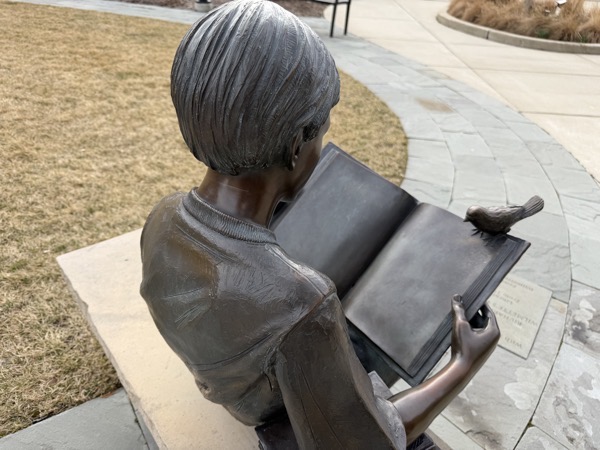
An over-the-shoulder view of a bronze statue depicting a young person with short hair sitting on a stone bench and reading a large open book. A small bronze bird is perched on the top right corner of the book's pages. The statue is situated outdoors in a paved park area with grass visible in the background.

First up, is a piece by film critic Sonny Bunch, discussing The Weird Right-Wing Freakout Over ‘They Odyssey’ Yes, it’s about casting and race and history and myths and all those things. On the surface a tired argument. Dig below the controversy, and you might find a morsel or two worth chewing on, but in reality only being upset about if you believe in exercising or conjuring demons through outrage. Maybe someday we’ll all eventually end up back where we started from. But like Odysseus, the homecoming might feel as hazardous as the journey we’re putting ourselves through to get there.

Things are certainly screwed up in U.S. Politics, but we’re not alone. In fact, we’ve got more than enough company. Great Britain is having its moment as well. Ian Dunt’s piece There Is A Light That Never Goes Out is one heckuva piece of writing that beneath the stormy surface of British politics, points to the problems far and wide and far below, regardless of what flag your ship might be flying when it sinks.

The trial between Elon Musk and Sam Altman over OpenAI and whatever the hell all of that means, sounds like a circus where the clowns won’t leave the center ring. M.G. Siegler takes a look at some of the shenanigans in Take Me Down To The “Amateur City.” 

Rex Reed was, if nothing else, a show into and of himself as a film critic. I always found him both entertaining and I occasionally agreed with his acerbic criticism. For better or worse he set a standard that presaged much of what passes for criticism today. He passed away this week. Merin Curotto has written quite a remembrance piece that’s so much more than about the one man. The Rex Reed I Knew (1938-2026) is worth a read even if you weren’t a fan or don’t have any sense of who Rex Reed was.

Alessandra Ram explores what happens when you might be married to a man who is smitten with AI in Meet The Sad Wives Of AI. I think this could also apply across any way the genders choose to partner. I’m sure there’s a promise out there somewhere that AI will fix all of this. Right?

Chicago baseball is having a moment with both of its major league teams doing reasonably well and playing each other in the Crosstown Classic. There were and are great expectations for the Chicago Cubs, not so much for the Chicago White Sox, which is why the exciting level of play on the South Side is capturing some of the North Siders glow. In the midst of all of that, this week marked the passing of Sam Sianis, the legendary owner of the Billy Goat Tavern, who placed a curse on the Chicago Cubs back in 1945 when the owner wouldn’t let him bring his goat into the stadium. Paul Sullivan has a great write up on the history, the myths, and the lore. Check out Sam Sianis And The Curse Of The Billy Goat Remind Chicago Fans Why We Love Baseball And It’s Myths. 

When you do look beneath the surface of a moment, a life, an obituary, or perhaps even the remains of what’s left, sometimes you find more than you might have imagined. Archaeologists Find Egyptian Mummy Buried With The ‘Iliad’ by Franz Lidz tells such a tale.  Homer says, “the sort of words a man says is the sort he hears in return.”

I’ll add, the sort one reads to that as well.

(Photo by the author)

If you’re interested in just what the heck Sunday Morning Reading is all about you can read more about the origins of Sunday Morning Reading here. If you’d like more click on the Sunday Morning Reading link in the category column to check out what’s been shared on Sunday’s past. You can also find more of my writings on Medium at this link, including in the publications Ellemeno and Rome. This site does not use affilate links. 
 

Sunday Morning Reading

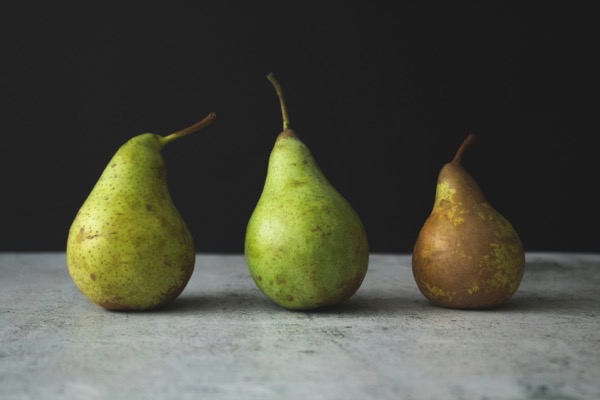
Sometimes a pear is just a pear.

Another Sunday dawns, so it must be time for Sunday Morning Reading. An interesting collection of pieces to share this week. On one hand it seems like any other week. On the other, this week’s edition offers a few nuggets worth chewing on. Don’t over think it. Enjoy.

Three green pears on a table top in various degrees of ripening. Photo by Tijana drndarski 3zmVSZQIozA unsplash.

Leading off, I’m highlighting an excellent series from The Baffler called The Profession That Does Not Exist. The Baffler bills itself as “America’s leading voice of incisive and unconventional left-wing criticism”, for what that’s worth. I find it an excellent source of good writing. Each of the pieces in the series that has the subhead “writing won’t make you a living”, is worth your time, but I’ll highlight two.

A Pear Is Just A Pear by Timmy Straw. Making your way in a crazy world you can find that sometimes a pear is just that. A pear.

Bertrand Cooper’s ISpyForGood recounts his experience as a social media investigator, a job that allowed the possibility of stepping out of poverty that entailed examining how others often scammed their ways to do the same.

Apparently the ruling class in Silicon Valley are worried that folks don’t take too kindly to their products or their ruling. David Wallace-Wells takes a look in A.I. Populism Is Here. And No One Is Ready. I guess when you threaten to turn the world upside down folks do get a bit antsy.

Open your arms and wave at just about anything happening around and to us and you can’t miss the obvious. Tom Wellborn takes it all on in The Frequency At Which Accountability Cannot Reach. Sometimes a pear is just a pear.

JA Westenberg says Outrage Is Letting Someone Else Set The Frame. Westenberg also offers up The War Between Fast And Legitimate Is Here. I suggest getting out of these messes we’re in calls for new frames or new acceptance of coloring outside the lines. Oh, wait. All the lines have been blurred.

James O’Sullivan thinks We’ll Soon Find Out What Is Truly Special About Human Writing. I suggest we’ll “rediscover” rather than finding out, but his point is spot on.

Meanwhile, Will Gottsegen says Sam Altman Wants To Know Whether You’re Human. It appears Altman and his ilk are looking at the problem through the wrong end of a telescope at a tiny mirror reflecting back.

On another front, Marianne Dhenin takes a look at The Small Wisconsin City That Defeated A Giant Data Center. I don’t think the robots will ever be able to muster this kind of civil action.

You, like I, may be overly tired of hearing anything having to do with the Epstein Files. Even so, I encourage you to take a look at this excellent piece from Gabrielle Glancy. I Grew Up With Epstein In Brooklyn. Our Neighborhood Held Dark Secrets not only tells a tale that should frighten, but one that I guess more might share than most ever want to acknowledge.

Happy Mother’s Day to all our mothers out there and all to come. Sometimes a pear is just a pear.

(Image from Tijana Drndarski on Unsplash)

If you’re interested in just what the heck Sunday Morning Reading is all about you can read more about the origins of Sunday Morning Reading here. If you’d like more click on the Sunday Morning Reading link in the category column to check out what’s been shared on Sunday’s past. You can also find more of my writings on Medium at this link, including in the publications Ellemeno and Rome. This site does not use affilate links. 
 

Sunday Morning Reading

It’s all a loop

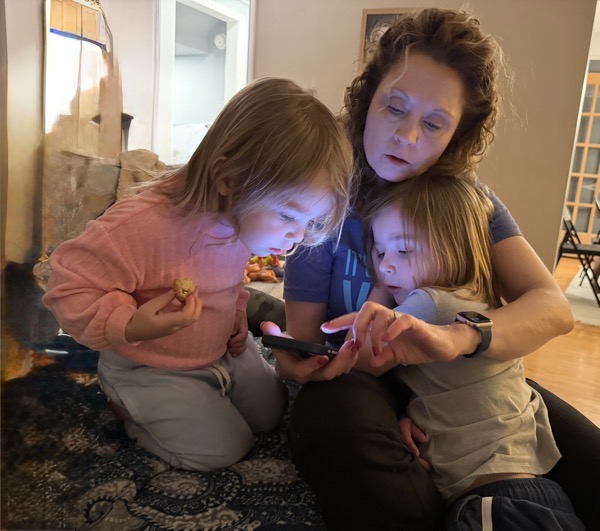
Back from spending time with the grandkids and back for some Sunday Morning Reading. There’s an interesting context to the many issues we face that evolves while watching the little ones grow and learn. Things are happening that will affect their lives in the years ahead. Yet there’s a blissful innocence cocooning them from it all. At the moment.

In my reading, and in my sharing of that reading, I find I’m doing so mostly for the thousands of tomorrows they have in their future, much more so than for anything that will happen in this week’s tomorrows that might affect me in the moment. Read on.

Neil Steinberg’s Meet My Metaphors #5: ConAgra is about so much more than the agricultural giant moving to Chicago years ago. If you like metaphors, it’s a must read. If you’re approaching the last leg of the journey, it’s a must read. If you’re concerned about what you may leave behind, well, it’s a must read.

JA Westenberg posits that it’s all a loop. Joke’s on us, I guess. Check out The Loop: Everything Has Happened Before, And Everything Will Happen Again. 

Ky Decker wonders, Do I Belong In Tech Anymore? I find if you’re asking that question about anything, you already know the answer.

Wesley Hilliard thinks we should Stop With The Tech Celebrity Worship. I concur. AND I’m for knocking down all the pedestals we erect for celebrities to ascend in any and all fields of human endeavor.

Timothy Noah takes a look at How The Tech World Turned Evil. Pop the bubbles. Tear down the pedestals. Endless loops.

Meanwhile, Makena Kelly examines how Palantir Employees Are Talking About The Company’s Descent Into Fascism. 

Follow that up with Jasmine Sun’s piece, Silicon Valley Is Bracing For A Permanent Underclass. 

The previous four links speak to a much darker future in one way or the other. Read them. Then go back and re-read the first two links by Steinberg and Westenberg. Looping context.

Closing out this week, here’s a couple of links that feel a bit more uplifting. First up, check out Mat Duggan’s Boy Was I Wrong About the Fediverse. 

Then follow that up with David Todd McCarty’s Becoming A Local. Sometimes the horizon is much closer than you think.

If you’re interested in just what the heck Sunday Morning Reading is all about you can read more about the origins of Sunday Morning Reading here. If you’d like more click on the Sunday Morning Reading link in the category column to check out what’s been shared on Sunday’s past. You can also find more of my writings on Medium at this link, including in the publications Ellemeno and Rome. This site does not use affilate links. 
 

Sunday Morning Reading

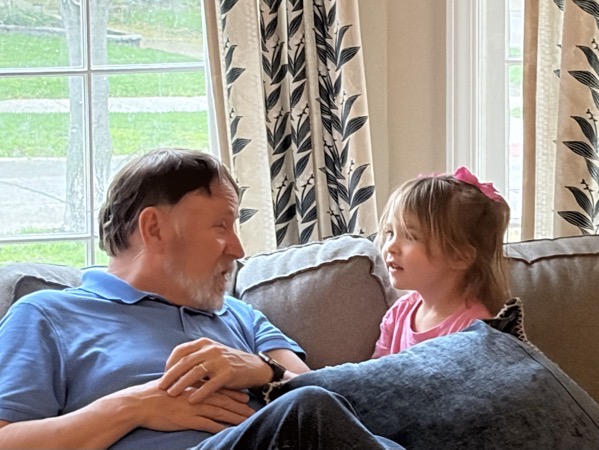
Sunday Morning Reading is on hiatus this weekend as we’re trading the chaos of what’s supposed to be the adult world for spending time with the grandkids. A chaos that’s easier to understand.

Enjoy your day.

If you’re interested in just what the heck Sunday Morning Reading is all about you can read more about the origins of Sunday Morning Reading here. If you’d like more click on the Sunday Morning Reading link in the category column to check out what’s been shared on Sunday’s past. You can also find more of my writings on Medium at this link, including in the publications Ellemeno and Rome. This site does not use affilate links. 
Sunday Morning Reading

“Scars speak more loudly than the sword that caused them.” – Paulo Coelho

It figures. You plan a weekend of yard work and Mother Nature reminds you she controls more than you do. In these parts that makes this a perfect chilly Sunday for a little Sunday Morning Reading. I’m not sure how, but a theme emerges in the collection of links I’m sharing this weekend, somehow suggesting that regardless of our feelings, the forces that seem to be conspiring against us just keep rolling. At some point, just like with the shifts in the weather, you just want some unshifting force to make it all stop.

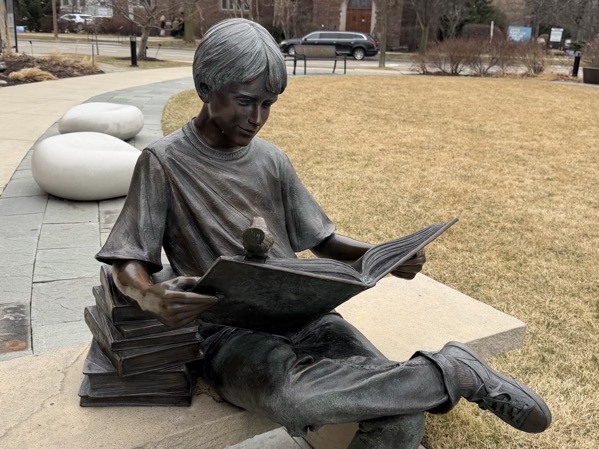
A dark bronze sculpture of a young boy with shaggy hair, wearing a t-shirt, jeans, and sneakers, sitting and reading a book on a light stone bench in a park setting. He is focused on an open book he holds in both hands, on which a small bronze bird is perched on the upper edge. A stack of four bronze books is tucked behind his right arm. His left leg is crossed over his right, revealing a highly detailed molded bronze sneaker. In the background, a curved stone path is lined with two white, pebble-shaped benches and a dormant lawn leading to a paved road, a church building, and a blue sign with text. The sky is overcast, and a dark sedan is visible on the street.

Here in Chicago we’re seeing a number of theatre spaces closing. (We’re also seeing a few open.) On the national stage, we’re  watching with dismay, anger, and sadness as The Kennedy Center is being shut down by cultural barbarians. Josef Palermo had an inside seat to that dismantling and tells the story in My Front-Row Seat To The Kennedy Center Implosion. 

And while Madison Square Garden is more a venue for pure entertainment than the arts, the story about how its owner is using surveillance on its patrons and employees that upset the powers that be is a harbinger of things to come in all arenas of our lives. Check out The Shocking Secrets of Madison Square Garden’s Surveillance Machine by Noah Shachtman and Robert Silverman.

Having experimented a bit with Artificial Intelligence in seeking information about a statue this weekend, my ongoing suspicions that this “way of the future” isn’t ready for today, much less tomorrow. The technology might be not ready for prime time, but the hype has never been. Kyle Chayka says A.I. Has A Message Problem Of It’s Own Making. I like this quote in the subhead, “If you tell people that your product will upend their way of life, take their jobs, and possibly threaten humanity, they might believe you.” True enough. And if those things are as incompetent as humans, what’s the damn point?

It’s all math. That’s one way to sum up any computing activity. Unless it comes to emotion. And yet, some think feelings are somewhere in the numbers. Mike Elgan writes, No, Math Doesn’t Have Feelings in response to those who must not have any feelings of their own, but are trying to add that into the AI equation.

Gaby Del Valle, says The Only Way To Fight Deepfakes Is By Making Deepfakes. Sounds like an arms race to me. We should be up in arms about it.

Speaking of arms races, Gideon Lewis-Kraus looks at AI in the war that isn’t a war, that’s over every week, but begins again every weekend once the markets close in How Project Maven Put AI Into The Kill Chain.

Apologies for so much AI linkage this week, but it’s been on my mind lately, especially since the news of Mythos broke. It’s the latest demon to fly out of Pandora’s box, and I’m afraid it’s not the last. Margie Murphy, Jake Bleiberg, and Patrick Howell O’Neill examine How Anthropic Learned Mythos Was Too Dangerous For The Wild.

CNN has a report by Saskya Vandoorne, Kara Fox, Niamh Kennedy, Eleanor Stubbs, and Marco Chacon called Exposing A Global Rape Academy. It’s a hard, but I think necessary read considering the topic is just how horrible humans can be to one another. Maybe we should hope the robots develop feelings. Too many humans seem to have stopped developing theirs.

Gail Beckerman says If You Want A Better World, Act Like You Live In It. I concur.

And to close out this week, Scars is a short story by Sigrid Nunez. Some scars can’t be seen. The ones we’re watching form daily, can be.

(Photo by the author.)

You can also find more of my writings on a variety of topics on Medium at this link, including in the publications Ellemeno and Rome. I can also be found on social media under my name as above.


Sunday Morning Reading

Optimism comes every Spring, but Winter always nips at the edges

Temperatures are warming. Every day brings more daylight, more blooms in the gardens and trees Yet on the edges of two of my interests, politics and tech, things continue to darken a bit. The common denominator between the two? Humans. But then again, humans are the ones who read this Sunday Morning Reading column. As well as the bots that scrape it of course.

PXL 20260411 142247979.

Some of the big news in tech this week was about a new AI product from Anthropic called Mythos. So fraught with potential peril that Anthropic gathered together the major tech heads to form a consortium to keep lid on it. Monica Verma has a good run down with her piece Did Claude Mythos Break The Cybersecurity Industry.

M.G. Siegler’s The Causal Catastrophe of AI takes a look at maneuvering around Mythos as well. Call me crazy, but I don’t think there’s anything casual about this development.

The reason I’m a pessimist on this is that I agree with a comment from JA Westenberg,  “Being wrong about doom costs you nothing.” Check out Optimism Is Not A Personality Flaw. The piece walks a line. You should read it and walk it too.

Mike Elgan takes a look at Black Traffic: The Corporate Sabotage Technique You’ve Never Heard Of. Now you have.

Ng Chong examines The Echo Chamber In Your Pocket. Follow that up with this from Julie Jargon: Over 4,732 Messages, He Fell In Love With An AI Chatbot. Now He’s Dead.(That’s an Apple News lnk. This is an archived link.)

David Todd McCarty thinks one path to reclaiming power over information might be in The Return Of The Local Newspaper.You don’t know what you had until it’s gone.

This Is What Will Ruin Public Opinion Polling For Good. The “this,” according to Lief Weatherby, is something called silicon sampling. Yes, you guessed it. AI.

Coming back around to my comment at the top about not having faith in humans, OpenAI’s Sam Altman got his turn in the barrel (again) this week. Ronan Farrow and Andrew Marantz spent quite a bit of time putting this piece together. Check out Sam Altman May Control Our Future — Can He Be Trusted? FWIW, I don’t need much more time than it takes to put this column together every week to answer their question in the negative. And not just about Altman.

Mean while Altman responded on his blog, after someone tossed a Molotov cocktail at his house. He says “I have underestimated the power of words and narratives.” For someone who has scraped all the words he can off of the Internet and tried to turn them into something smarter than humans, you’d think his machines could have at least figured out that words have power.

Natasha MH sums up a lot of my lack of faith in humans in her piece, Stop Blaming The Chatbot. As she puts it, “AI didn’t make you stupid. You were already getting there.”

Sorry to be so negative this week, but that’s where I’m living., But to change the tone, Neil Steinberg turns around the Latin term, memto mori, (remember to die) around to memento vivere, or remember to live. A nice little bit of humanity to close out this week with Little LIfe.

(Photo from the author)

If you’re interested in just what the heck Sunday Morning Reading is all about you can read more about the origins of Sunday Morning Reading here. If you’d like more click on the Sunday Morning Reading link in the category column to check out what’s been shared on Sunday’s past. You can also find more of my writings on Medium at this link, including in the publications Ellemeno and Rome.


Sunday Morning Reading

A basket of good writing to share

For those who celebrate Easter and Passover, and all who do not celebrate either, may you find some bit of peace on this Sunday morning, however you see yourself and the world. I’d like to say this week’s edition of Sunday Morning Reading is filled with Easter eggs, but instead it’s just the usual basket stuffed with links to interesting topics and stories that I like to share. Enjoy.

PXL 20260403 165116674.PORTRAIT.

It’s good to be seen, certainly the way you see yourself. When seen by someone who doesn’t know you, that’s eye-opening. Check out Natasha MH’s The Taxi Driver Knew.

The war that isn’t a war in Iran continues. Whatever that story is, it is still being written. Given that this might be heading to the culmination of a conflict that has simmered, and occasionally boiled over, for decades if not longer, there are a few stories out there that offer preface. He Helped Stop Iran From Getting The Bomb by David D. Kirkpatrick is one worth reading.

JA Westenberg’s The “Passive Income” Trap Ate A Generation of Entrepreneurs is also one heckuva a read. There’s nothing passive about this take.

Seva Gunitsky takes on The Incel Global Order. Somebody needs to.

As the technology we use advances, in some spheres some are stepping back. Joshua Cohen takes a look in Sweden Goes Back To Basics, Swapping Screens For Books In The Classroom.

Social Media is under the microscope again after two recent court verdicts against Meta. Chris Castle takes a look with The Social Media Verdicts Are In. Now Ask The Hard Question: Where Was The Board? Counting the money, I imagine. Hat tip to Stan Stewart for this one.

In the category of no easy answers, Mathew Ingram also examines what’s going on in social media with Social Media May Be Bad For You But The Remedy Could Be Worse.

On the Artificial Intelligence front there are always interesting topics cooking as the AI purveyors cook the planet. I wrote about two fascinating pieces yesterday, and today I’m highlighting Angela Fu’s An AI Company Set Out To Fix News Deserts. Instead, It Copied Local Journalists Work. Something tells me we’re going to be seeing more of this going forward.

Apple is, I assume, winding up its week celebrating its 50th Anniversary. So much has been written on that topic because there is indeed much to celebrate and much history to contemplate while looking ahead. Here are four pieces that caught my eye, the first three primarily because they are more personal than historical, the fourth is a look ahead.

John Moltz gives us Missed Connections: Me and Apple.

James Thomson is one of my favorite Apple developers. His Apple At 50: Gonna Be, Gonna Be Golden is indeed a personal journey.

Adam and Tonya Engst have been writing Tidbits since 1990. I started reading it shortly thereafter. What Apple’s 50th Anniversary Misses is certainly different than most, but one that mirrors the thoughts of many on this anniversary.

And Marco Arment, looking ahead, has penned A Letter To John Ternus, the guy everyone assumes will don the CEO mantle in the future.

Baseball is back. And every team and their fans are dreaming of a championship. David Todd McCarty spins a bit of fiction that’s baseball adjacent, but rooted deep in dreams in The Taste Of A Dream.

To conclude this week, this story by Audrey Pachuta very much sums up the contradictions we’re living through at the moment. Check out A Student Set A Goal To Run Every Street In Chicago And Inspired A City. Now He Must Leave The Country. 

May you find peace however you can.

(Photo from the author.)

If you’re interested in just what the heck Sunday Morning Reading is all about you can read more about the origins of Sunday Morning Reading here. If you’d like more click on the Sunday Morning Reading link in the category column to check out what’s been shared on Sunday’s past. You can also find more of my writings on Medium at this link, including in the publications Ellemeno and Rome.


Sunday Morning Reading

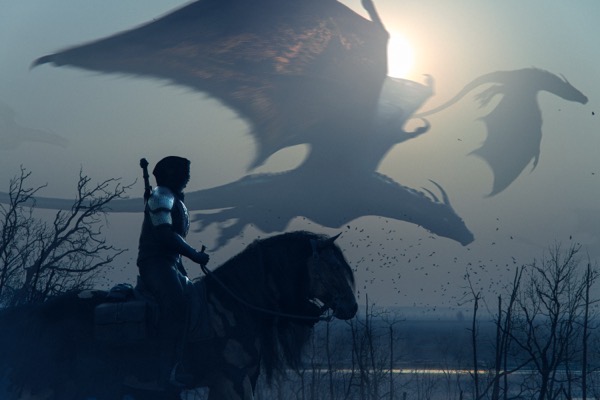
There be dragons, dogs, and humans. Trust the dogs.

Time for some Sunday Morning Reading.

There’s a great lyric and greater question in Lin-Manuel’s musical retelling of American history, “Who lives, who dies, who tells your story?” Control is a crazy concept. We strive to control what we can, while we’re around. Too often we delude ourselves into thinking we control more than we actually do. No one wants to define themselves or be defined as lacking control, much less under the control of others. We may think we’re masters and mistresses of our own universes and control our own narrative. Yet too often, when we do have control and things go askew, we foist the responsibility (blame) off on others. That may be essential to surviving on the paths we choose. But it’s not easy to control the reactions a dog may have to who’s good or who’s not, a dragon, or much less the demons of our own making.

Shutterstock 1766228261.

Kicking off this week is Natasha MH asking the question, What’s The Best Story You’ve Been Told About Yourself? There be dragons.

The Guardian published an editorial on the ‘unmasking’ of anonymous artists in the wake of the second unmasking of Bansky and the reveal of a hoax surrounding the death of Italian novelist writing under the nom-de-plume Elena Ferrante. Regarding Banksy, The Guardian opines that “his mask is his art — let’s not destroy it.”

I don’t often link to book reviews in this column, but this one struck my fancy. A.O. Scott’s A Treacherous Secret Agent, examines How Literature Spoke Truth To Power During The Red Scare. I’m looking forward to reading this.

Jason Perlow’s The Well We Never Tapped is a sequel to an earlier piece he wrote about the future of science fiction. He argues that in the runaway world of big sci-fi franchises like Star Trek and Star Wars  the answer to controlling the future of these and other properties isn’t retooling or reimagining, but perhaps to stop for a while.

Speaking of science fiction and stopping, on the Artificial Intelligence front a number of things happening in that wannabe industry that can’t really find a purchase beyond the flimflammery of the financial markets and bean counting boardrooms, have been prompting some interesting writing of late. kstenerud on the yoloai blog writes Why Your AI Agents Will Turn Against You. There be lobsters and dragons.

Kevin Baker takes a look at how AI Got The Blame For The Iran School Bombing. Follow that up with Anna Moore’s piece Marriage Over, €100,000 Down The Drain: The AI Users Whose Lives Were Wrecked By Delusion. Makes one suspect that we’re not looking for ways to better exert control over our lives, but to more easily avoid taking the rap when things inevitably go wrong.

Big news last week got kind of mushed about in wish casting about Facebook killing off the Metaverse. That sort of did and didn’t happen. Regardless, Neil Stephenson’s My Prodigal Brainchild caught quite a bit of attention.

Apple is celebrating its 50 year anniversary and there’s lots being written about its history and it’s present. Everyone’s vying for control of that story. Harry McCracken’s How Apple Became Apple: The Definitive Oral History Of The Company’s Earliest Days is worth a read.

So too is David Sparks’ The MacBook Neo’s Unfair Advantage and the Stephen Sinofsky piece he links to, Mac Neo And My Afternoon Of Reflection and Melancholy. The damn thing hasn’t even been on sale for a month, yet we’re already trying to define its legacy.

Two political pieces to conclude with after all of the good feelings surrounding yesterday’s No Kings Rallies. (Watch for the comical battle to control the narrative over that moment this week.)  Lydia Polgreen says what I’ve been saying for over a decade now. It’s Not Trump, It’s America. It’s hard to come out from under the burden of a myth.

Mike Lofgren’s How Trump Fits The “Great Man” Theory of History — Sort Of, taps into Hegel, Asimov, and the wisdom of dogs. He concludes his piece with:

History as we experience it at the sharp end is the aggregation of moral choices made by individual human beings. When those choices become corrupted by fear, resentment or inexcusable stupidity, and then amplified by mass suggestion, we get a creature like Trump, the reflection of a people’s image.

I’ll leave it at that this week.

(Image from Daniele Gay on Shutterstock

If you’re interested in just what the heck Sunday Morning Reading is all about you can read more about the origins of Sunday Morning Reading here. If you’d like more click on the Sunday Morning Reading link in the category column to check out what’s been shared on Sunday’s past. You can also find more of my writings on Medium at this link, including in the publications Ellemeno and Rome.


Sunday Morning Reading

Epidemics of reading, opinions, and the wild ways of artists

Spending a few days with the grandkids this weekend and into next week, yet still managed to find some time for a little Sunday Morning Reading. It’s a lesson in learning, watching as they begin to put it all together, compared to so many of the adults trying to own the world who seem stuck and unable to grow, or suffer some sort of reversion. With kids, it’s innocence. The rest of us have no excuses. Just stories. Makes you wonder what turns that on and off.

In the large discussion around screen time and attention spans, Carlo Iacono says What We Think Is A Decline In Literacy Is A Design Problem.The section looking back to “reading epidemics”  in the 18th and 19th century are more illuminating than any screen.

The First Casualty of Trump’s War In Iran Was The Truth. So says David Remick. That’s always true in warm even before the first bullets fly. But it’s become the truth in all aspects of how we try to survive together. Funny how we revert back to our early childhood ways of dealing with the world before disgarding the truth was supposedly trained out of us.

Everybody has an opinion about this war that we can’t call a war. Here’s one that I found interesting from Frida Ghitis. Check out What Everyone Gets Wrong About Iran.

David Todd McCarty tells us How I Learned To Hate AI. The more you know…

Chris Castle takes a look at The Great White House AI Copyright Dodge: Managed Decline, Global Spillover, And The Rise Of The Chief Personhood Denier.Hat tip to Stan Stewart for this one.

With everyone focused on The Strait of Hormus, Richard Bookstabler takes a look at our financial straits in I Predicted The 2008 Financial Crisis. What Is Coming May Be Worse. For the record, I didn’t predict the last one, but anyone with two nickels to rub together can predict the outcome of the one we’re heading into.

I did any number of odd (in all senses of the word) jobs in my early life supporting myself as an artist. Emily Watlington takes a look at The Wild Ways Artists Have Made Their Livings, From The Renaissance To Today.

Notes From A Burmese Prison is a comic by Danny Fenster and Amy Kurzweil. More than worth your time. Extrapolate the specific location and situation to any troublesome moment and remember whoever the guards are, you can’t trust them.

(Photo by the author)

If you’re interested in just what the heck Sunday Morning Reading is all about you can read more about the origins of Sunday Morning Reading here. If you’d like more click on the Sunday Morning Reading link in the category column to check out what’s been shared on Sunday’s past. You can also find more of my writings on Medium at this link, including in the publications Ellemeno and Rome.