Sunday Morning Reading

Traveling through the crazy paying attention along the way

It’s been a fortnight since I’ve published one of these columns due to travel. So much has happened. The travel adventures to London and Memphis were great. The way the world continues to pull itself apart continues to not be, as witnessed by protests and a madman’s threats of troops in the streets followed me from Chicago to London to Memphis. You can shut off and shut down to enjoy new places and visit dear friends, but the insanity keeps getting more insane. So, Sunday Morning Reading is back at it this week, with a mix of politics, culture and a bit of tech. (Oh, yeah, Apple released new iPhones during all of that.) If you can’t feel the currents flowing together, you’re not paying attention.

On my travels my wife and I caught some theatre. Two plays by Shakespeare and the contemporary play Stereophonic. The two Shakespeares were one of his worst, Merry Wives of Windsor, and one of the best, Hamlet. We’re theatre rats and know the importance of the medium and certainly recognize the role writers in all mediums play in our lives, history, and culture. So too does a favorite writer of mine, David Todd McCarty. Check out his important piece The Reason You Need To Be Making Art Right Now. And if I may be so bold, the other Sunday Morning Reading links below demonstrate that to a tee.

NatashaMH reflects on free speech, punk rebellion and British satire in When Satire Was Safe. Great piece. I dare say, satire has never been safe even when tolerated. Plenty of fools can attest to that. Ask Yorick.

I mentioned there’d be politics and here’s a few links to some excellent context on just how damn familiar all of what we’re living through is. For those who bother to pay attention. First up is Mark Hertling’s Beware Today’s ‘Fire-Eaters’. If you don’t know that term, read the piece. You’ll recognize today’s fire-eaters in a second.

On a broader scale, take a look at Nikki McCann Ramirez’s interview with Mike Duncan in Are We Witnessing The Fall Of The American Empire? My short answer is yes. Here’s the money quote that should terrify us all:

So if we go this route, we’re going to have congresses, we’re going to have Supreme Courts, we’re going to have a President of the United States, there will be governors, there will be elections, it’s just what’s happening underneath that facade. The facade is never going to go away, it’s how tissue-thin the facade is.

Follow that up with George Packer’s America’s Zombie Democracy.

For a bit of recent history and context, check out The Story of DOGE, As Told By Federal Workers from a team of Wired writers led by Zoe Schiffer.

As I mentioned Apple released new iPhones last week. Om Malik seems quite taken with the new iPhone Air, although he has some concerns in Go Out & Get Some Air.

In this column and other posts I’ve been following Denny Henke’s journey to de-Apple himself in his tech life with a keen interest. I greatly admire his drive and his sharing of his efforts. Check out My Ongoing Effort To de-Apple the iPad.

And to bring this all back around, take a look at Neely’s Tucker’s sharing of a guest post by Patrick Hastings,  Nobody Would Edit Shakespeare, Right? Right? They have and they do. David Garrick wasn’t the first or the last. Throughout history we always look for the ways to make it easier to swallow tragic moments and unhappy endings. In the theatre and on the stages of our lives.

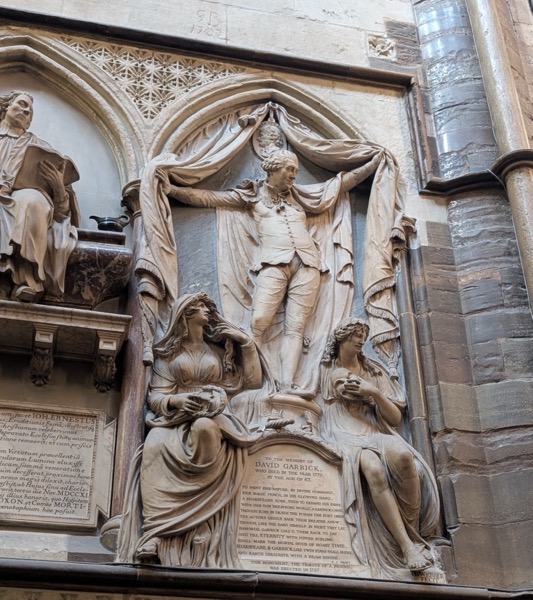
(The image above is of David Garrick’s monument in Westminster Abbey, taken by me on my recent travels.

If you’re interested in just what the heck Sunday Morning Reading is all about you can read more about the origins of Sunday Morning Reading here. If you’d like more click on the Sunday Morning Reading link in the category column to check out what’s been shared on Sunday’s past. You can also find more of my writings on Medium at this link, including in the publications Ellemeno and Rome.

We Have To Do Better. At What Exactly?

The time is out of joint

We’re burning up the words and phrases we use for comfort faster than out-of-control wildfires. We’re drowning meaning under flash floods of ravaging frequency. We’re dancing around sensitivities like so many angels on the head of a pin, ignoring that the pin has been smashed into smithereens by a sledge hammer. We keep looking for better angels of our nature to appear but they seem to have given up the ghost trying to reign things in. The time is out of joint.

PXL 20250913 090506555.

The meaningless phrase of the moment this morning that has gotten my goat is “we have to do better.”

What the hell does that even mean?

We pretend that everyone cares about the outrage of political violence. Not everyone does. There are those that care only enough to use it to their own advantage and want to see more of it. Yes, it’s about power. But it’s increasingly  become about the money, because you can make boatloads of it preaching hate and division. You know, free speech and all of that.

We have to do better.

There’s no “better” to do when it comes to language, because language only expresses what is felt inside. About self. About others. About domination. About fear. And when the “better” is about better profits… well, that’s the world we live in and at the moment it’s what’s making the world spin faster.

Step away from politics for a second.

When a sports team loses and coaches and players say “we have to do better” or “we have to play better” it means nothing. Of course they do. They lost.

When a business doesn’t meet its sales targets, they always say “we have to do better.” Unless of course they’re spinning losses into wins hoping no one pays attention.

Shift back to political world.

The spinning happens there as well, with a speed that can burn through the surface it’s spinning on. Yet, it’s a bit late to want to do better after the bullet has struck a target so broadly painted.

We can no longer expect appeals to better angels or doing better to work. It’s a naive call to a different past that in many respects never existed, even though on the surface it seemed to. We should no longer be afraid of phrases like civil war, because in case you haven’t noticed, we’re in one. People are being killed in their homes, at rallies, in schools, just about in any place. Sad fact of history, what we want to believe is random violence by extremists always happens before someone declares that a war is on. But hey, we’ve got a deranged lunatic of a leader who wants to meme one into being, while we spend so much time trying to figure out what we know is the why of it.

You can argue that the extremists aren’t the ones with the guns, but the ones with the big mouths and the AI bots at their command. No one is going to clamp down on the rhetoric any more than they are going to clamp down on guns, and it has already bubbled over into a toxic stew. How are you going to “do better” when all sides claim their way is the better way? I don’t have an answer for that question, because I’m afraid I actually know the answer and there’s nothing “better” about it.

The only thing we have to “do better” at is recognizing the horrors of the moment we’re in and facing it for the reality that it is. You and I certainly don’t want to see and hear what we’re seeing and hearing. But we’re too far down that road to not acknowledge we’ve arrived at a terrible place.

Hamlet says:

‘The time is out of joint: O cursed spite,
That ever I was born to set it right!’

I feel like we’re all caught in Hamlet’s dilemma. Wanting to fix it, but afraid to the point of cursing what will eventually need to be done.

You can also find more of my writings on a variety of topics on Medium at this link, including in the publications Ellemeno and Rome. I can also be found on social media under my name as above.

Things Apple Won’t Fix In The Next Round of OS 26 Updates

I’d bet money these issues persist after new OS releases

Apple is announcing new iPhones, Apple Watches and possibly other things today. They’ll also announce the release date for the operating systems for all of those new devices and previous generations already in use. All of the focus is going to be on everything new, improved, changed and Liquid Glassed.

55b31eb4ba867b00263c62f538280311 XL.

I’m sure I’ll write about some of that down the road. For today I’m writing about the things I’m thinking Apple won’t address in any of the new operating systems. These are lingering issues that in some cases have not been corrected over the life of multiple operating systems. As much as I get excited about a new software release I remain frustrated year after year when Apple steps forward while dragging its feet on correcting existing problems.

Believe me, I get that Apple has created such a large ecosystem that it is impossible to pay attention to every detail and correct every mistake. I get it, but I don’t sympathize with it. Introducing new operating systems pumped out on what seems like an impossible to meet annual cycle creates other issues that need to be addressed and it is apparently too easy to just let the older ones go unattended. And from what I’ve seen from developers I follow, there are going to be a host of new issues that are going to need to be resolved over the next year. Or longer. The longer you let an existing issue hang around without attention, the more the “control the whole widget” promises seem not quite in control.

Certainly it’s a question of priorities. How the priorities are set makes me question the priorities of those that set them.

Some of these issues I’ve highlighted before, others I have not. Here are a few that continue my questioning of Apple’s priorities. I’m sure there are some that others experience that fall into the same category of hoping Apple pays attention to them someday.

Syncing

I’ve seen a decrease in syncing issues with iCloud in general. That’s a good thing. But Apple still insists on syncing Photos on its own schedule. Whether it’s battery life optimization or system optimization the delay is never optimized for the user experience.

Shared Reminder Notifications

I’ve written about this before. The fact that this one hasn’t been corrected since Shared Reminders became a thing undercuts all of the very good work Apple has done with the Reminders app in general.

Bluetooth Weirdness

I don’t know how else to describe this other than it’s just weird. There are times when Bluetooth connectivity works as designed with my AirPods and other peripherals. There are times when things just go bonkers especially with AirPods. Things will work as designed for days on end, then they won’t. AirPods switch between devices as designed, but then stop doing so. Adaptive Listening will work well sometimes and sometimes not. Connectivity with my car works well and then it doesn’t. My car isn’t smart by any stretch of the imagination and gets no software updates so it makes sense to me that it’s a Bluetooth issue on the iPhone. Note that it happens at random times unrelated to iOS updates or those mysterious AirPod firmware updates. The Magic Trackpad works 98% of the time. Then not. It’s weird.

Shortcuts

It’s become either a legend or a joke that every time Apple releases a new update (full release or point release) something goes wrong with Shortcuts. Either way it’s a problem for “the future of automation.” I particularly love it when a Shortcut just hangs with no indication that there’s a problem after working well for days on end. This inconsistent problem is consistent.

The App Store

Apple’s biggest retail outlet is the slowest loading and buggiest piece of software it has ever designed. It’s also designed abysmally.

Focus Modes

I use very few Focus Modes. I do not share them between devices. Sometimes they work. Sometimes they don’t. I’ve never set a Sleep Focus on my iMac. Yet one mysteriously appears at random during the day about twice a month. The Focus I’ve set for listening to Podcasts inconsistently fails to kick in.

Mail Rules

I think Apple has just given up on Mail Rules because the ones I’ve built just don’t work anymore.

Apple News

I enjoy that on my Mac I can choose to open an article in Safari or that I can open a webpage in Apple News. I don’t understand why that can’t happen on the iPhone.

Notification Summaries

I long ago turned Notification Summaries off because they were just confusing and caused more work than just dealing with the Notification. I recently turned them back on to check and see if there had been any improvement. There has not.

As I said, I don’t anticipate Apple fixing any of the above with all of the new ’26 releases. I’ve learned to work around them the same way I work around the passenger side backdoor on my car won’t open from the inside and I have to open it from the outside whenever I’ve got a back seat passenger. It’s a walk around workaround. It’s not ideal. And each time I have to do it I’m reminded just how imperfect things are and can be. I’m sure it will diminish the value of the car when I do decide to trade it in, but it’s already reduced the value of it in my mind.

I feel the same way when Apple doesn’t address longstanding issues that I and others have brought to their attention. Here’s hoping Apple addresses some of these issues. Here’s hunching they won’t.

You can also find more of my writings on a variety of topics on Medium at this link, including in the publications Ellemeno and Rome. I can also be found on social media under my name as above. 

Sunday Morning Reading

Things AI can’t summarize: Nostalgia and what’s worth not forgetting.

A brief breather at home before travels resume, so there’s a full plate for this week’s Sunday Morning Reading including some nostalgia that shouldn’t be, some very interesting reading on AI, a defiant Chicago, and even a bit on gambling and baseball. Enjoy.

Roman kraft _Zua2hyvTBk unsplash 1.

Chicago is under threat from a madman and you can feel the tension in the crisp fall air. Dan Sinker has written an excellent Benediction for Chicago On the Eve of Occupation. You don’t hear thoughts and prayers in the check out lines at the grocery store,  just a growing sense of defiant preparation.

The pendulum seems to be swinging wildly in the opinion wars about Artificial Intelligence now that some are actually able to sift through the hype bubbles and see what’s what. EmptyWheel has an excellent 4-part series that is more than worth your time. It begins with A Normal Person’s Explainer On What Generative AI Is And Does and continues with The Other Half Of The AI Relationship, Proteins, Factories, And Wicked Solutions, and concludes with LLMs Are Lead.

Follow that excellent series with The Tech Industry Has a Dirty Secret: The More People Learn About AI, The Less They Trust it by Victor Tangermann. For what it’s worth, I’m also seeing AI naysayers riding the pendulum back the other way as they find ways to make some of the tools of this tool work for them. No AI could ever sort this out with a summary.

The Power We Use and The Power We Give is a brilliant piece by Philip Bump. As he transitions from his former job with The Washington Post he’s talking about where choosing to land next and why making the right choice about where to exercise what power the words you use live. This is a complicated moment in history on so many levels, well illustrated in this one man’s piece.

Also, here’s an excellent piece from Bump on the goings on in Chicago called Trump Wants To Make War On Chicago. He Picked The Wrong Fight.

Speaking of complexity, David Todd McCarty wonders why so many men find themselves alone later in life in Boys Don’t Cry, Men Don’t Bond.

Chris Armitage says It’s Time For Americans To Start Talking About “Soft Secession.” I take the point about the term and the concept. I’m not criticizing either or Armitage’s piece when I say this, but hell, when the president of the country mockingly riles up everyone with a threat to declare war on a city, I’m not sure there’s anything “soft” about anything anymore.

NatashaMH tackles political amnesia is what I think is a timely piece worth revisiting more than once. Our capacity to forget or set aside so much, so often, is astounding. Check out Inside The Fortress, Outside The Fire. Here’s the money quote:

As often as I can, I remind them how history is a reminder of the lives we lost and of how stupid we really are. “Senseless to the core. And once we’re done with the bloodshed, we write poetry.”

To clear the palette a bit, check out Tim Newcomb’s piece about how A Remarkable Discovery of A Document Shatters One of Shakespeare’s Biggest Mysteries. 

Fact checking may be a dying art, given that most of the world has decided we can each have our own facts. Zach Helfand as a wonderful long piece on The History Of The New Yorker’s Vaunted Fact-Check Department. Too damn bad we have to file this under nostalgia.

Speaking of nostalgia, check out Bettor Up by J.R. Moehringer about gambling and baseball. Yes, it’s about gambling and baseball, but it’s the closest thing I’ve seen to the good sports writing (especially about baseball) that I grew up with.

(Image from Roman Kraft on Unsplash.)

If you’re interested in just what the heck Sunday Morning Reading is all about you can read more about the origins of Sunday Morning Reading here. If you’d like more click on the Sunday Morning Reading link in the category column to check out what’s been shared on Sunday’s past. You can also find more of my writings on Medium at this link, including in the publications Ellemeno and Rome.

Sunday Morning Reading

The ant hill of humanity

Crazy travel rhythms this summer. Spending time at the lake this weekend. The good thing about lake time is there’s time to do some reading. Here’s some good stuff I stumbled onto, worth sharing for this week’s edition of Sunday Morning Reading.  Quite a bit revolving around Artificial Intelligence and other mind games. There’s also ants.

For some inexplicable reason defining what it means to be an American has actually become a chore these days. It shouldn’t be. Kieran Healy has written a piece simply titled American that recounts his thoughts and feelings on becoming an American citizen. Well worth your time, espeically in these crazy times.

“Memory isn’t linear; it’s relational.” That’s the thought NatashaMH leaves us with in her piece The Mind’s Mischief. The mind is indeed a curious thing.

Matteo Wong says the AI Doomers Are Getting Doomier. I don’t know about you, but if we’re all doomed at the hands of AI (does AI have hands?) human intelligence never really advanced as far as I thought it did. Or maybe we just hit the ceiling.

Speaking of AI doom, Charlie Warzel wonders why one of the impacts of AI it to make us feel like we’re losing it in  AI Is A Mass-Delusion Event. I get the points and they’re well made. Referring back to my comment from the previous entry, if we’re such easy marks for this kind of delusion… well…we are such easy marks.

David Todd McCarty argues why we should resist AI with ecclesiastical fervor, especially those who create for a living. Check out The Moral Failure Of Using AI In Your Art.

Reece Rogers is marking yet another change brought about by AI. Take a look at The AI-Powered PDF Marks The End of An Era.

Barry Betchesky tells us that It Took Many Years And Billions of Dollars, But Microsoft Finally Invented A Calculator That Is Wrong Sometimes. You read that right. The money quote is:

“But now we have Microsoft apparently determining that ‘unpredictability’ was something that some number of its customers wanted in their calculators.”

Rounding out this collection of links on AI, is another article by NatashaMH where she says instead of Fearing the Machinery, Interrogate The Mindset. Excellent piece. The underlying current is something I’ve been thinking about a lot. We’re creating these machines in our own images. Or at least the images we imagine of ourselves. Humans are far too human, even when we look past or try to accelerate beyond our humanity.

One of the joys of spending time in the great outdoors is that it reminds you we’re not the only intelligent species on the planet. Although as the theme of this week’s reading has emerged, we might want to reevaluate that, just not with Microsoft’s math tools. On another front, in politics it’s certainly easy to argue for a reevaluation. Kate Knibbs takes a swipe at it in a look at how Government Staff Cuts Have Fueled An Ant-Smuggling Boom.

I told you there’d be ants.

If you’re interested in just what the heck Sunday Morning Reading is all about you can read more about the origins of Sunday Morning Reading here. If you’d like more click on the Sunday Morning Reading link in the category column to check out what’s been shared on Sunday’s past. You can also find more of my writings on Medium at this link, including in the publications Ellemeno and Rome.

Who Controls History If AI Is In The Mix

Time in a bottle of bits

One of the scariest things about this insane period we’re living through is the attempt by those in power to rewrite, alter, or just get rid of history they don’t like. Whether it’s banning books, changing curriculums, forcing the closures of libraries, or what museums can display, I find it a cowardly, yet effective way to hide heads in the sand, bury the sins of the past, and admit we’re actually ashamed of ourselves.

Peter herrmann 9_FK2Tp kLA unsplash.

I know this because I have lived this. My early education certainly tilted the American narrative towards the mythology of the Old South. It wasn’t until I left home, and got involved in the theatre that I discovered just how much I hadn’t learned, how much more I needed to, and how the future depends on the past, no matter how complicated it was.

Fortunately the information was there. It was up to me to do the work.

What happens when it’s not there? Or it’s wrong?

I find It hard to imagine that large chunks of the world’s history can be erased, growing up in an era when my access to it seemed to expand exponentially. But it’s been tried before. It’s succeeded with entire generations of populations. Now we’re facing the very real possibility of it happening again in this digital age with the aid of Artifical Intelligence.

There’s an interesting piece by Benji Edwards in Ars Technica about a college student who trained a small AI model that he called TimeCapsuleLLM on Victorian texts. During his experiments his time capsule spit out some actual history he didn’t know about real protests during the era. He checked into the info and the LLM was indeed accurate.

At first glance, that feels like a very positive AI story. Discovering lost history is a good thing. However, with the way I understand AI training it all depends on what data it’s trained on. That leaves things up to who controls the training data. Leave out, change or bias the historical record and…

Well, you can see the problem.

Elon Musk has already hinted at this kind of manipulation. I’m sure there are others thinking the same. They say history repeats itself. Actually history doesn’t. Humans do. History is just the record of the repetition. Humans just use newer and different tools to mold the past into something more comfortable. I may be mistaken, but I think history, in the long run, also proves that never really works out.

Correcting and rewriting history is not for the faint of heart. But when there is no heart, there’s a problem.

Time machines and time travel have always been fraught with danger in the history of science fiction. So has Artificial Intelligence. I’m reasonably sure we’re not smart enough to walk whatever fine lines might exist in a future when the past can be more easily manipulated. We haven’t been in the past when the erasing was harder. But I am dead certain we’re going to be facing this unreal reality.

Again.

Just with newer methods.

Without anything resembling Artficial Intelligence, we’ve managed to forget, alter, or set aside many of the horrible lessons of human history. Why should any new tool we create be any different? I’m sure these AI geeks think they can strip ego and emotion out of these robots they are building.

I doubt they will ever remove hubris.

(Image from Peter Herrman on Unsplash.)

You can also find more of my writings on a variety of topics on Medium at this link, including in the publications Ellemeno and Rome. I can also be found on social media under my name as above. 

Sunday Morning Reading

The lazy days of Summer

We’re technically out of the Dog Days of Summer, but it doesn’t feel much like it. It’s the kind of hot Summer I remember as a kid when the dogs would spend the hot part of the day lazing under the porch. I’m spending mine traveling (too much traveling) and sharing what I can here and there. Find some shade and check out this week’s Sunday Morning Reading.

Shutterstock 2623809139.

Peter Wehner thinks the only way out of the wreckage we’re in is to rewrite the cultural script. Tall task. He spells it out in The Virtue of Integrity.

Knowing is half the battle. What you do with knowledge is an altogether different story as knowing and knowledge are two different things. Check out Jim Stewartson’s piece The War on Knowing. 

Somehow in all of the wreckage we’re sorting through, empathy became a bad thing for those doing the wrecking. NatashaMH thinks this crazy Artificial Intelligence race we’re in is taking the human out of being human. If you ask me it’s all a bit too human as we look to foist off responsibility for the choices we make. The Risks of Synthetic Empathy is a great piece. Give it a read.

Then take a look at Mathew Ingram’s piece, People Fall In Love With All Kinds of Things Including AI Chatbots. When chatbots start filing for divorce I think we might have created Artificial Generative Intelligence.

Kyle Chayka is exploring The Revenge of Millennial Cringe. Home may be where the heart is, but it was a terrible song.

Stephen Marche is talking about Profound and Abiding Rage: Canada’s Answer to America’s Abandonment.  Abandonment is a good way to describe what we’re all feeling these days.

Apple’s about to unleash new operating systems for its devices in a few weeks and the one that has my interest is for iPads. From what I’ve seen (I don’t run the betas) the changes to the multi-tasking capabilities will be a positive step forward. Craig Grannell takes a look at how long it took for Apple to finally make these changes in Apple Finally Destroyed Steve Jobs’ Vision of the iPad. Good.

Chicago’s Uptown Theatre celebrated 100 years this week. Robert Loerzel takes a look in Uptown Theatre: 100 Years of Glory and Decay. 

When you think you’re the center of the universe it can rock your world when you find out you’re not. Kids learn this. Republicans in the current administration have not. Eric Berger writes about NASA’s Acting Chief Calls For the End of Earth Science at the Space Agency.

(Image from Machekhin Evgenii on Shutterstock.)

If you’re interested in just what the heck Sunday Morning Reading is all about you can read more about the origins of Sunday Morning Reading here. If you’d like more click on the Sunday Morning Reading link in the category column to check out what’s been shared on Sunday’s past. You can also find more of my writings on Medium at this link, including in the publications Ellemeno and Rome.

Sunday Morning Reading

Back home from travels. Still sharing stuff that warrants attention.

Back home after a couple of weeks on the road. Good times. Crazy times. Nevertheless, it’s Sunday and there’s Sunday Morning Reading to share.

Shutterstock 1626610513.

“Life isn’t just about knowing what you should do, or having the resources to do it, it’s about following through.” So says, John Burn-Murdoch in his piece The Troubling Decline In Conscientiousness. I agree there’s a decline. I’m not so sure the remedy is as simple as it sounds.

The AI race is continuing whether we want it to or not. Apparently there’s now a way to create your own TV show if you want to keep diving deeper into your own delusions. Nina Metz has a great piece on this intrusion into the entertainment industry saying After A Long Day, The Last Thing I Want Is To Tell GenAI To Create a TV Show For Me To Watch.

In Notes From The Circus, Mike Brock takes a look at The Faux Intellectuals of Silicon Valley. “When oligarchs treat human civilization as thought experiments while sophisticated courtiers provide intellectual cover, democratic discourse itself becomes impossible.” Nailed it.

I don’t know about you, but my handwriting went downhill mere minutes after I was no longer graded on it. So it has always sucked. So, I’m not sure if NatashaMH’s latest applies in my case, but she is taking a look at what happens When The Handwriting Changes, suggesting that the body keeps score and so does the pen. Damn, if I’d know there was score keeping…

Mathew Ingram takes a look at age gating, the move afoot to protect kids from the perils of the Internet in The UK’s Well-Meaning Online Safety Law Is A Dumpster Fire. American dumpsters won’t be far behind, because we like to hide from the things we think are bad, pretending we’ve solved the problem, instead of addressing the problem.

Matthew Wolfe tells a great story about Chicago and America’s first black detective, who had a few secrets of his own in The Talented Mr. Bruseaux.

The turmoil among Apple users continues to roil for lots of reasons. Certainly this week’s obsequious bending of the knee by Tim Cook has added more to it. I wrote a bit about that here. I like John Gruber’s take on the issue in Gold, Frankincense, and Silicon. 

(Image from OlegRi on Shutterstock)

If you’re interested in just what the heck Sunday Morning Reading is all about you can read more about the origins of Sunday Morning Reading here. If you’d like more click on the Sunday Morning Reading link in the category column to check out what’s been shared on Sunday’s past. You can also find more of my writings on Medium at this link, including in the publications Ellemeno and Rome.

David Mamet’s Woke Pain Behind His Masks

“Always tell the truth. It’s the easiest thing to remember.” -David Mamet

I first arrived in Chicago in 1999 aiming for a theatre career. I arrived just as David Mamet, one of the bright lights in the theatre firmament at the time, was spreading his wings and moving on from the city that birthed the characters in his plays. Here’s the thing, I was never that big a fan of his work.

David Mamet 080425 1 3c82613a6ff24dc685b547d0b8bf0872.

I saw the genius in it, but in the viewing it was always as predictable as it was entertaining. In later years after Mamet had found success in film I actually came to believe that his work for the big screen was actually better than it ever was on a stage. As an example, I enjoy the film version of Glengarry Glenn Ross more than I ever have on stage and I attended the Amrerican premiere of that play at The Gooodman Theatre back in 1984. The Spainish Prisoner and State and Main are delights that I always enjoy revisting.

To be fair, I’m in a minority among my professional peers. There’s no denying Mamet’s influence in the theatre and film. Personally, I was more a fan of Sam Shepard’s work. The two ran neck and neck in popularity in my early days in the theatre. But that’s not what this is about.

Somewhere along the way, Mamet became even more of an enigma when he opened up about his political views, which in some ways spun in counter orbit to the milieu of much of what his plays seemed to profess. His plays had a power dynamic that while not completely in sync with the “eat the rich” vein, both celebrated and condemned the powerful, alongside empathy with the downtrodden or less capable.

He was always a gadfly who reveled in that reputation. But there’s reveling, and then there’s reveling. At times it seemed as if he aspired to assume a Bertolt Brecht-like influence. I’m referrring more about his views on theatre, than his political views. Check out his book True and False, or the videos and articles you can find all over the Internet.

No matter what you thought of his work on the stage or in the cinema, once he began commenting about politcal and social issues he became, I dare say,  more entertaining than any piece of dramatic literature he created.

In a recent podcast with Sam Fragoso, Mamet revealed that part of the reason for his seemingly 180 degree turn in professing his political beliefs was because those in the media and literary circles that had always promoted him turned away from his work. No criticism stings more than being ignored. I’m not sure what’s the chicken or what’s the egg in that discussion, but it was a statement that did leave quite a bit of egg on his face. He later got fed up with Fragaoso and walked off the podcast.

Continuing to stay in the entertainment news this week, Mamet authored an op-ed in the Wall Street Journal called Sorry, Billionaires — There’s No Escape, essentially saying we’e all doomed regardless of how we’re measured on the wealth scale in life. Biilionaires who think they’ve built doomsday hide-aways will be undone by the laborers they hire to keep the places running. Of course those less privileged don’t even matter in the equation. It’s a reguritation of the history of the world that Brecht and Sondheim did better.

The thing of it is, for many Mamet was always as entertaining as he was enigmatic . I find him more so in these later chapters of his story, even with its odd and often confusing mix of woke hurt feelings bouncing up against his conservative bent.

But then, as Mamet, contradicting his maxim about truth says, “it’s not a lie. It’s a gift for fiction.”

You can also find more of my writings on a variety of topics on Medium at this link, including in the publications Ellemeno and Rome. I can also be found on social media under my name as above. 

AI Customer Support Devalues Customers And The Company That Adopts It

AI customer support isn’t all that intelligent or supporting

I noticed an article on MacRumors that Apple is getting ready to roll out it’s “AI-powered Support Assistant.” Apparently Apple’s only willing to take the risk with tech support and not customer support. That’s where money might exchange bank accounts.
Shutterstock 2482823939.

This is the way the world is spinning at the moment. My prediction is that companies will ratchet back these cost saving moves but not until the realize what it costs in customer loyalty. We have to go through the suck, before we get to the less suck.

I base that prediciton on my experiences spending the better part of this Summer and past Spring helping clients and a few relatives, some elderly, work to cut back on expenses and take care of some warranty repairs for appliances. (Hint: Ditiching warranty services is one way to cut montly costs.)

Timing is everything. My efforts coincided with several of these companies caught in the process of switching to AI solutions for customer and tech support. To be direct, it was a mess. For me, the customer, and also for the employees left holding the bag on the other end of these crazy corporate strategies.

No one would argue that most customer and technical support systems were in good shape previous to these kind of moves. They were indeed ripe for re-inventing and they have always been easy marks for the bean counters to cut corners.

Chatbots had already begun to proliferate, descended from automated phone trees like some form of inverted evolution that only a sadist could love. No one would ever conclude that they had been intelligently designed. My previous experiences were always hit and miss, but at least I understood that if I followed the steps I could eventually reach someone on a phone or live chat. During these transitons that became nigh on near impossible.

Prior to one of the companies I worked making the switch, it had become obvious that they had abandoned call centers and let their agents work from home. I kid you not, I spent one phone call with a barking dog in the background of whatever small quarters this rep was in, and another with two small children fighting with each other in the background of another call.

Let me give you one example from my recent experience with one company undergoing a transiton to AI tech and customer support.

Sears Home Services

Sears Home Services has been a popular home warranty service for many throughout the years. It’s been apparent for a while that services like these have lost their luster and some have devolved into scams. But for folks of certain generations they were always in the monthly budget. In my experience with one of my clients, prior to their switchover, it worked about as well as it was advertised to work. You made a call, talked with an agent, set up an appointment, a technician arrived to check things out, ordered parts if necessary, rescheduled the appointment, and then came back to effect the repair or replacement.

The first repair I assisted with happened just like I described above. The entire process from first call to final signoff on the repair took 10 days.

The second call not so much.

I guessed things were in trouble when the phone number prominently displayed on the webpage would not yield a method of speaking with an agent, but kept pushing me to their chatbot. The chatbot had limited options that you could select. It did not have a way to enter any request beyond those options. My guess is the company didn’t want customers speaking to an agent.

Undaunted, I did the usual online searching for phone numbers and finally stumbled on to a Reddit thread where users experiencing the same problems were reporting phone numbers that worked. Until they didn’t. It was a cat and mouse game of dialing a phone number before it was changed or taken out of service. That lasted about a week.

Finally I succumbed and scheduled an appointment via the chatbot. That chatbot sure was happy. I was told the support technician would contact me the night before to schedule a more specific appointment window. Things were looking up. That call never came. The morning of the appointment I got a text telling me the appointment was scheduled between 8 and 5pm. In my previous experiences these appointments were scheduled in four hour windows.

On the afternoon of the repair, at 5:30pm I got a phone call from a support person saying he would be their in a half-hour. He showed up 45 minutes later. He diagnosed the issue, said he would order parts and they would be shipped directly to me. This was a change I’ll describe later. He then said he needed to go sit in his truck and work with the system to get the parts ordered and that would take a half-hour or so becuase the system was constantly kicking him out mid-order and he would have to start over.

When he came back to finalize everything for that appointment he reiterated that this new system was screwed up. I told him I wasn’t a fan either. We had a good conversation.

Previously, according to him, each night technicians like him would get a list of their appointments for the next day. They would go to a drop ship pickup location for any parts for that day’s appointments, head out and do the work. Now the system sent parts directly to the address of the repair and required the customer to reschedule the next appointment once the parts arrived. Because customers were not receiving notifications of these part shipments, the parts would just show up, often get returned, delaying the inevitable service.

Most striking in his telling was the fact that he no longer received the next day’s list of appointment the night before. Only the first one for the day. Once that was completed he would receive his next appointment. Again, according to him, the previous system in place for dispatching personnel was pretty good at scheduling the next day’s appointments with minimal travel time between appointments. Now with the new system, he would find himself traveling between appointments, often located far apart, more than he would working the repairs.

To begin to bring this ancedote about this repair to a close, suffice it to say that the entire episode from first call to eventual repair has not yet been completed. It begin on May 20. Once it was determined that the appliance needed to be replaced, not repaired (that took two appointments,) a new one was ordered. Then canceled by Sears Home Repair’s system. Then re-ordered.

On the night before the scheduled delivery I got a call that it would be delivered the next day. That morning I got a call saying the delivery would take place that morning. Ten minutes later I got a call saying that the appliance had not been delivered to the delivery driver. (It was too large for a home delivery.) This necessitated canceling the order, re-ordering and a repeat of the process.

Somewhere in the middle of the process phone calls with agents became possible again. Progress? Not quite.

After several discussions with several agents I discovered that they were as challenged as their customers were by the new system. I’m sure you’ve played the escalation game to get to a supervisor and I played that game here as well. At last count I’m waiting on approximately 7 phone calls from supervisors that never came in.

Eventually the appliance was delivered to the delivery person. But there was no record in the system of an appointment to install the new one and remove the old one as per the warranty.

It took a month and two more canceled appointments for installation before Sears finally gave up and said a check would be forthcoming to cover the installation costs. That check has yet to arrive. (That’s why I consider the transaction not completed.) We did get the appliance installed on our own.

But of course, we did receive the usual survey request asking us to rate how well Sears Home Repair Services performed. Once the check arrives and clears the bank, my client will be cancelling that warranty. That will be our response.

Xfinity

One bill I was working on reducing for another client was Xfinity. I probably don’t need to say more if you’ve ever dealt with that company. But I will. I simply wanted to call and discuss plan options for reducing the bill.

No where was I able to get through to a live person. I was sent links to chatbots that would promise a live person, if I followed along, but those calls never connected.

I eventually took a trip to an Xfinity store and got the info and made adjustments to my client’s bill in person. The staff member at that store told me that they were seeing more foot traffic because the online and phone systems were such a mess.

Back to Apple

Now, I began this post mentioning Apple’s move to a generative AI based technical support system. I find this greatly disappointing. In general, because I believe this type of cost cutting move represents a decline in how I value a company because it represents a decline in how these companies view their customers.  And in Apple’s case, I have typically found Apple’s tech support to be better than most companies. Not perfect. Still flawed. But better than most.

I’ve had to work through some tricky issues over the years with Apple’s technical support. Some easily resolved. Some not so. One of those issues required several months worth of conversations, eventually reaching up the chain to Craig Federeghi, before getting the issue resovled. I can’t imagine any tech support system being able to measure up to what Apple has currently, even with flaws and failures that require steadfast persistence and often negotiation.

In my attempts to aid my clients I’ve tried some of the AI chatbots that aren’t part of the specific company I’m working with. Typically they spit out much of what I imagine is in the documentation most phone bank customer service reps use to begin a diagnostic process. (Yes, the device or appliance is plugged in.)

I imagine that Apple will use this new system to handle those rudimentary requests that come in that I’m sure fill up the tech support queues and can be resolved easily. I can only hope Apple then passes more difficult issues to an actual human being who can do the type of intervention necessary to reach a resolution. Heaven help us all, and Apple, if they ever automate the degree of support that requires screen sharing over to a robot.

I have yet to meet anyone in the real world that thinks AI on any level is going to fulfill anything close to the promises made by those pushing it. Folks have already seen and felt the results of these early efforts and have turned sour on the entire concept. I think of this like I imagine the last century’s transition to the automobile. Regardless of how some felt upon seeing the first automobiles on the same streets as pedestrian and horse traffic, everyone knew, for better or worse, it was a future they would have to adapt to.

I have encountered a few business owners who think AI will help them create efficiency and reduce costs, but their discussions about what is possible demonstrate a real hype-fed ignorance and hoped for way of cutting costs. I have one client who is smitten with the promise, but is constantly getting bitten by the results.

I’m betting Apple’s move will take a bite out of its customer satisfacton numbers as well.

(Image from Munthia on Shutterstock)

You can also find more of my writings on a variety of topics on Medium at this link, including in the publications Ellemeno and Rome. I can also be found on social media under my name as above.