Sunday Morning Reading

Hands on with playwrights, movies, smart toilets, and a discomforting rooster

Another Sunday. More snow overnight. More shoveling later. The holidays creep closer or perhaps they’re already here, given that grandpa mode has kicked into high gear. Started writing a new play out of the blue yesterday. I have no idea why, but it just tumbled out of my brain on to the screen via the keyboard. Time to share some Sunday Morning Reading. Read as you will, even if it’s on a smart toilet.

I often save the softer pieces for later in this column, but I’ll lead today with David Todd McCarty’s Christmas Means Comfort. Tell that to the rooster.

The world lost a treasure this week with the passing of architect Frank Gehry. Lee Bray writes a nice obituary and tribute. Check out Architect Frank Gehry Who Designed Millennium Park’s Pritzker Pavillion and Foot Bridge Dies at 96.

Samuel Beckett’s Hands is a terrific piece by Rob Tomlinson about, well it’s about Samuel Beckett’s hands and how Dupuytren’s contracture may have influenced not just how, but what he wrote, given that Beckett always begin his writing with pen and paper.

While I’m sharing stories about playwrights, the movie Hamnet is garnering lots of attention and accolades. (I haven’t seen it yet.) Based on Maggie O’Farrell’s excellent novel of the same name, Hamnet mostly follows accepted scholarship that William Shakespeare wrote Hamlet while grieving the death of his son, Hamnet. (At the time, the two names were practically interchangeable.) As with most things Shakespeare, there’s generally accepted knowledge and there are always those who challenge it. James Shapiro takes a look at The Long History of the Hamnet Myth.

And while I’m sharing stories about movies, take a look at Susan Morrison’s piece on How Noah Baumbach Fell (Back) In Love With The Movies.

I linked earlier this week to a piece by Phillip Bump called There Are Limits to the Hitler-Trump Comparison. Just Ask These Historians. I don’t disagree with the thesis. I just think it stops short in the way most history usually does.

Rory Rowan and Tristan Sturm write that Peter Thiel’s Apocalyptic Worldview Is A Dangerous Fantasy. Here’s hoping this first draft of our current history proves lasting.

There’s been much talk about all things military recently given how the current administration is tossing away most of what we believe the military stands for as easy as my grandson tosses away toy soldiers. Carrie Lee says The Soldier In The Illiberal State Is A Professional Dead End. I concur. Sadly.

In the wake of the cataclysm that was Twitter, social media is essentially a messy muddle these days with users continuing to migrate from one platform to another seeking some sort of place that feels comfortable enough to share and often discomfort others. Ian Dunt writes what he calls a love letter to one platform with Thank God for Bluesky.

Smart toilets were in the news this week. I actually got to see and use one at a Christmas party last night. All I could think about while doing my business was this piece by Victoria Song called Welcome To The Wellness Surveillance State. 

And to conclude this week, Amogh Dimri informs us that the Oxford University Press has chosen Rage Bait as 2025’s Word of the Year. Dimiri thinks it’s a brilliant choice. I guess it begs the question, if we’re angry enough to rage, is it really baiting?

If you’re interested in just what the heck Sunday Morning Reading is all about you can read more about the origins of Sunday Morning Reading here. If you’d like more click on the Sunday Morning Reading link in the category column to check out what’s been shared on Sunday’s past. You can also find more of my writings on Medium at this link, including in the publications Ellemeno and Rome.

Sunday Morning Reading

Art matters. If you listen.

It’s another Sunday in this insane world, so it’s time for some Sunday Morning Reading. It won’t cure what ails you, or the world. But there are those who are listening. Listen as you read.

Roman kraft _Zua2hyvTBk unsplash 1.

Aren’t You Tired Of Feeling Insane All The Time? Marie Le Conte asks that question. I’m not sure anyone can plug the hole in that boat, but acknowledging that we’re sinking is the first step.

David Todd McCarty tackles The Lost Art of Listening.

NatashaMH recently launched an exhibition of her art. Launching anything can take life out of you, launching any display of art exacts even more of the soul than it does the physical being. But as she says in The Social Life of Art, “art demands resilience, and resilience demands a sense of humor.”

I wrote a bit this week about what Mark Leydorf has to say about The Rise of Resistance Cinema In The Era of Trump. It’s worth highlighting his piece again here.

I’ve been watching the Apple TV series Pluribus with great curiosity. If nothing else, the show echoes Mr. McCarty’s opening to his piece linked above. (Warning. Don’t watch the show with my wife.) Dani Di Placido thinks he’s got it all figured out in What Is ‘Pluribus’ Really About?  Perhaps he does. I’m not so sure. I’m also not sure the show’s success or failure relies on figuring it out in the end.

I’ve been linking to some of the goings on at The Kennedy Center under this corrupt administration. Trust me when I say what’s happening there is causing shock waves across board rooms in arts institutions across the country as everyone looks to uncertain and unknown futures with no script to follow. It’s affecting the art. It’s affecting the business of art. It will affect the art in ways we can’t begin to imagine. Janay Kingsberry examines how Senate Democrats Are Investigating Kennedy Center’s Deals And Spending. 

Most of the links this week touch on the arts in one way or the other. In a way this tech topic does as well, given that so many want to turn emoji’s into some form of art. Benji Edwards examines the origins of this move back to hieroglyphics with the piece, In 1982, A Physics Gone Wrong Sparked The Invention Of The Emoticon. Art by accident often is the art that sticks.

(Image by Roman Kraft on Unsplash)

If you’re interested in just what the heck Sunday Morning Reading is all about you can read more about the origins of Sunday Morning Reading here. If you’d like more click on the Sunday Morning Reading link in the category column to check out what’s been shared on Sunday’s past. You can also find more of my writings on Medium at this link, including in the publications Ellemeno and Rome.

Find Beauty When and Where You Can

Stop and smell the roses

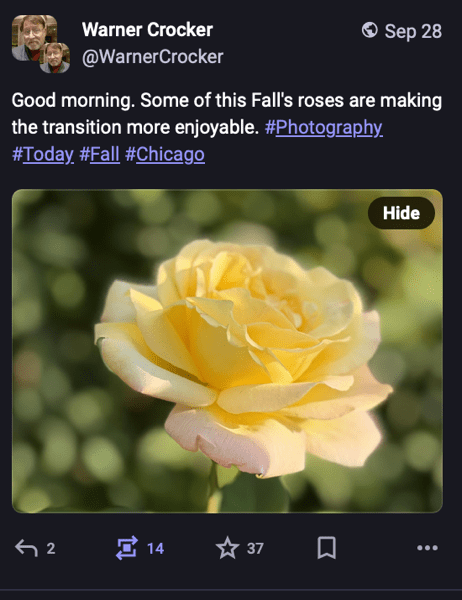
A Mastodon user sent me a direct message the other day asking why I felt so comfortable doing what I do every morning, which is posting a “Good Morning” toot featuring photos I’ve taken of flowers, tree leaves changing color, other shots of nature, holiday ornaments, etc….

CleanShot 2025-11-17 at 12.25.20@2x.

The context of the query was criticizing how I could continue to do that every morning given all of the terrible things going on in the United States, things I also rightfully describe on social media as horrors.

I get it. Believe me I get it. I’m overwhelmed at times as well. But my response was and is simple.

Stop and smell the roses.

While there are indeed horrors happening in the world there is always beauty. If we don’t take a moment to see and acknowledge the beauty around us and the spontaneity of discovering it, whether it be in nature, in very human moments, in a museum, a gallery, a stage, a movie theater, a concert hall, a photograph, a child’s laugh, or in a story, then what the hell are we fighting for?

I’m convinced those we are fighting against don’t see or even care to see the beauty around and within us, unless it involves increasing their bank account balances.

Sometimes you need to stop and smell the roses. I prefer doing so in the mornings, before I put on my armor to meet the challenges of the day.

You can also find more of my writings on a variety of topics on Medium at this link, including in the publications Ellemeno and Rome. I can also be found on social media under my name as above.

Sunday Morning Reading

No tricks. No treats. Just thoughts and reading worth sharing.

The frights of Halloween have passed us by, but real life horrors remain and expand. Never had more gut wrenching emotions this weekend than spending it with my grandkids costumed in their bountiful innocence, avoiding what’s out there in a life they’ll one day have to face, but in the present doesn’t exist beyond the edges of any joyful moment of wonder and exuberance they can conjure. This week’s Sunday Morning Reading won’t touch on too much of that, but then again, I think it just did.

David Todd McCarty thinks amidst it all We Can Be Heroes. Making my grandkids laugh uncontrollably makes me feels damn close.

Adam Gropnik visits the home of the poet Wislawa Szymborska and returns with How To Endure Authoritarianism.

Will Bunch says It Didn’t take A Reichstag Fire To Burn Down Congress. He’s correct. It didn’t even take a match.

Some interesting writing on Artificial Intelligence and the Internet this week that’s worth your while, first up Cory Doctorow tackles When AI Prophecy Fails.

Will Douglas Heaven explains How AGI Became The Most Consequential Theory Of Our Time.

Tim Chinenov wonders Who’s Creating The Rage Bait That’s Radicalizing You?

Decidedly not on the Internet Friday night while trick-or-treating with my grandkids, though not in my besieged town of Chicago, I witnessed not only kids howling with fun, but adults who joined in on the fun with their own costumes and decorated homes, some elaborate, some not so, all with love and honoring a tradition I’ve never seen in the communities I’ve lived in. Many families set up in their driveways, some with small fire pits, some with tents, tables full of food (and candy), welcoming all comers to their Halloween semi-tall gating front yards. I also noticed the adults who just sat in their cars and slowly followed their children down the block. The entire experience reminded me of this piece from the summer in which Joan Westenberg says every creator pays a tax while the rest stay spectators in The Unbearable Lightness of Cringe. Pay the tax.

And closing out this week, kudos to both the Los Angeles Dodgers and the Toronto Blue Jays for an excellent World Series, which the Dodgers won. Both teams played a splendid series and provided an incredible Game 7 finish to one of those contests you never want to see end, but know it must. Grown men over compensated for incredible talent, playing a kid’s game like kids, thrilling and heart breaking in the same breath. Too bad we don’t have any great, or even good, baseball writers to chronicle the moment these days.

If you’re interested in just what the heck Sunday Morning Reading is all about you can read more about the origins of Sunday Morning Reading here. If you’d like more click on the Sunday Morning Reading link in the category column to check out what’s been shared on Sunday’s past. You can also find more of my writings on Medium at this link, including in the publications Ellemeno and Rome.

Sunday Morning Reading

Things AI can’t summarize: Nostalgia and what’s worth not forgetting.

A brief breather at home before travels resume, so there’s a full plate for this week’s Sunday Morning Reading including some nostalgia that shouldn’t be, some very interesting reading on AI, a defiant Chicago, and even a bit on gambling and baseball. Enjoy.

Roman kraft _Zua2hyvTBk unsplash 1.

Chicago is under threat from a madman and you can feel the tension in the crisp fall air. Dan Sinker has written an excellent Benediction for Chicago On the Eve of Occupation. You don’t hear thoughts and prayers in the check out lines at the grocery store,  just a growing sense of defiant preparation.

The pendulum seems to be swinging wildly in the opinion wars about Artificial Intelligence now that some are actually able to sift through the hype bubbles and see what’s what. EmptyWheel has an excellent 4-part series that is more than worth your time. It begins with A Normal Person’s Explainer On What Generative AI Is And Does and continues with The Other Half Of The AI Relationship, Proteins, Factories, And Wicked Solutions, and concludes with LLMs Are Lead.

Follow that excellent series with The Tech Industry Has a Dirty Secret: The More People Learn About AI, The Less They Trust it by Victor Tangermann. For what it’s worth, I’m also seeing AI naysayers riding the pendulum back the other way as they find ways to make some of the tools of this tool work for them. No AI could ever sort this out with a summary.

The Power We Use and The Power We Give is a brilliant piece by Philip Bump. As he transitions from his former job with The Washington Post he’s talking about where choosing to land next and why making the right choice about where to exercise what power the words you use live. This is a complicated moment in history on so many levels, well illustrated in this one man’s piece.

Also, here’s an excellent piece from Bump on the goings on in Chicago called Trump Wants To Make War On Chicago. He Picked The Wrong Fight.

Speaking of complexity, David Todd McCarty wonders why so many men find themselves alone later in life in Boys Don’t Cry, Men Don’t Bond.

Chris Armitage says It’s Time For Americans To Start Talking About “Soft Secession.” I take the point about the term and the concept. I’m not criticizing either or Armitage’s piece when I say this, but hell, when the president of the country mockingly riles up everyone with a threat to declare war on a city, I’m not sure there’s anything “soft” about anything anymore.

NatashaMH tackles political amnesia is what I think is a timely piece worth revisiting more than once. Our capacity to forget or set aside so much, so often, is astounding. Check out Inside The Fortress, Outside The Fire. Here’s the money quote:

As often as I can, I remind them how history is a reminder of the lives we lost and of how stupid we really are. “Senseless to the core. And once we’re done with the bloodshed, we write poetry.”

To clear the palette a bit, check out Tim Newcomb’s piece about how A Remarkable Discovery of A Document Shatters One of Shakespeare’s Biggest Mysteries. 

Fact checking may be a dying art, given that most of the world has decided we can each have our own facts. Zach Helfand as a wonderful long piece on The History Of The New Yorker’s Vaunted Fact-Check Department. Too damn bad we have to file this under nostalgia.

Speaking of nostalgia, check out Bettor Up by J.R. Moehringer about gambling and baseball. Yes, it’s about gambling and baseball, but it’s the closest thing I’ve seen to the good sports writing (especially about baseball) that I grew up with.

(Image from Roman Kraft on Unsplash.)

If you’re interested in just what the heck Sunday Morning Reading is all about you can read more about the origins of Sunday Morning Reading here. If you’d like more click on the Sunday Morning Reading link in the category column to check out what’s been shared on Sunday’s past. You can also find more of my writings on Medium at this link, including in the publications Ellemeno and Rome.

Instagram Shows Up Very Late to the iPad Party

What’s the point and who cares?

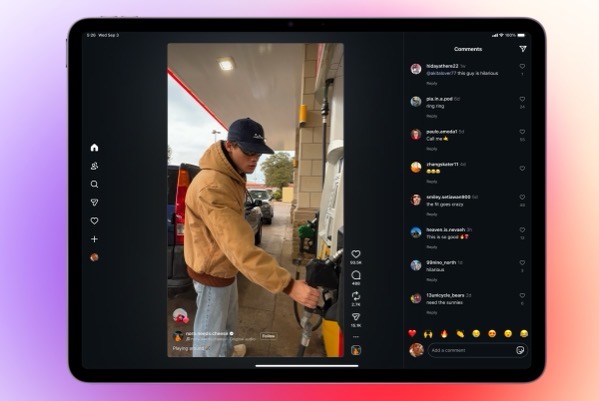
The folks at Meta must have something up their sleeve. The reason I say that is they have finally, after all of these years released an iPad version of the app, long after most folks just figured it would never happen. Other than speculating on what might be behind the late to the party move, at this point it begs the question, Who cares?

Reels with Comments 16_9.

I’m sure plenty do care. I’m not one of them. Instagram is one of a few apps that I begrudgingly use. Begrudgingly because I hate it. I use it because my family on all sides continues to do so and it’s a way to keep up with grandkids, nieces, nephews, and other family news. But I honestly despise that I have to. Believe me I’ve tried to wean them off onto other apps and services, but it never sticks.

Every time I do open Instagram I have to block somewhere between 5 and 10 spam accounts (too often porn or ridiculous come ons.) And of course the algorithm doesn’t show me what I want to see, but what it wants me to see. There’s even an increased sense of desperation from both Instagram and Facebook sending out notifications telling me someone replied, is waiting for my reply, or commented on something I haven’t seen yet. It’s like begging in the street. Apologies to those who might actually need to do so.

Sure I could turn off the notifications, but sadly, that’s the least worst way to use the app to keep up with family happenings.

I’d say that since it took 15 years for Meta to finally roll this out that perhaps the adolescents in charge finally are growing up. But then, there are those porn accounts that pop up with the frequency like prepubescent zits.

I won’t be putting it on my iPad. It’s troubling enough that I still have it on my iPhone. And as I watch the over excited coverage rolling in, I haven’t seen any image of the iPad version that makes it look the least bit appealing. It’s like Meta didn’t really care based on what I’ve seen so far.

So, Instagram is on the iPad. What’s the point and who cares?

You can also find more of my writings on a variety of topics on Medium at this link, including in the publications Ellemeno and Rome. I can also be found on social media under my name as above. 

Mainstream Media Continues to Dismantle Itself

MSBNC to become MS Now

It’s been an accepted part of conventional wisdom for quite some time that what we consider mainstream media is gradually fading away in the face of newer generations turning to other sources available on the Internet for news and entertainment. Heck, even some older generations are turning what used to be the dial.

MSNBC MS NOW name change.

The business models have suffered for a while now whether it’s print, broadcast or cable. The fading away has gained new and seemingly panicked momentum thanks to the depredations of the Trump administration, aided by the greedy cowardice of the corporations worried more about avoiding the wrath of the beast they helped create, than the standards they all proudly trumpeted for years. Those trumpets have largely fallen silent or just ring hollow.

The end of late night comedy shows captured a lot of attention recently, but eventually most broadcast scripted news and entertainment will also give way. Which is ironic given that the convicted felon largely responsible for this quickening pace came to prominence via Reality TV, which let me tell you is anything but reality and is very scripted.

Now NBC Universal, owned by Comcast, is making a move away from MSNBC, attempting to distance the Peacock from controversy by rebranding as MS Now. That little branding acronym stands for  My Source | News | Opinion | World.

Yeesh. I guess the marketing department was the first place they made changes. As a social media friend Judgment Dave says, “it sounds like a translation of something in Japanese that doesn’t translate well into English.”

It’s weird, yet it isn’t to hang onto the ‘MS’, given that MSNBC was birthed as partnership with Microsoft and NBC, long since dissolved. Somewhere Bill Gates is laughing because it also sounds like a software program delivered on a CD-ROM.

Whatever sturm and drang comes from this news of the moment, (news of the Now?) the bigger picture is that these troubled corporations, in what feels like desperate efforts to try and save themselves, are essentially hastening their eventual final curtains in the wake of current trends already overtaking them.

Some may lay blame on the rise of the Internet and mobile devices in every hand, but the fact of the matter is the smart folks at the top of these corporations missed the moment. Some eventually tried to make changes. Remember CNN Plus? But in my opinion their failures were less about the delivery mechanisms and more about the decline of the news and entertainment products that they delivered as the cost cutters held sway.

NBCUniversal isn’t done trimming the sails yet. Plans are in place to spinoff other properties as well (CNBC, USA, Oxygen, and E!).

Some will blame it on advertisers seeking the best way to reach customers. That’s mostly true, but ask podcasters how that’s going for them these days. Chasing advertising revenue is always a cyclical game for just about everything except sports.

It’s no wonder then that it feels like we see our politics more and more resembling blood sports. Of course the irony is audiences claim they want less, not more in that realm. What will be interesting to see in the next decade or so is how political advertising, which fills so many corporate media coffers sorts itself out, once the usual outlets fade away as they continue to play to ever diminishing audiences that keep spreading themselves wider and wider, attempting to flee the same old, same old.

Certainly ads will continue to be designed to run on social media and circulate that way. But the only folks making real money off of that trend are the political consultants and ad-makers.

I hope I’m around to see how my grandkids eventually consume what we once revered and respected as the news. I’ll regale them with what I imagine they will view as fairy tales and myths.

You can also find more of my writings on a variety of topics on Medium at this link, including in the publications Ellemeno and Rome. I can also be found on social media under my name as above. 
Sunday Morning Reading

Back home from travels. Still sharing stuff that warrants attention.

Back home after a couple of weeks on the road. Good times. Crazy times. Nevertheless, it’s Sunday and there’s Sunday Morning Reading to share.

Shutterstock 1626610513.

“Life isn’t just about knowing what you should do, or having the resources to do it, it’s about following through.” So says, John Burn-Murdoch in his piece The Troubling Decline In Conscientiousness. I agree there’s a decline. I’m not so sure the remedy is as simple as it sounds.

The AI race is continuing whether we want it to or not. Apparently there’s now a way to create your own TV show if you want to keep diving deeper into your own delusions. Nina Metz has a great piece on this intrusion into the entertainment industry saying After A Long Day, The Last Thing I Want Is To Tell GenAI To Create a TV Show For Me To Watch.

In Notes From The Circus, Mike Brock takes a look at The Faux Intellectuals of Silicon Valley. “When oligarchs treat human civilization as thought experiments while sophisticated courtiers provide intellectual cover, democratic discourse itself becomes impossible.” Nailed it.

I don’t know about you, but my handwriting went downhill mere minutes after I was no longer graded on it. So it has always sucked. So, I’m not sure if NatashaMH’s latest applies in my case, but she is taking a look at what happens When The Handwriting Changes, suggesting that the body keeps score and so does the pen. Damn, if I’d know there was score keeping…

Mathew Ingram takes a look at age gating, the move afoot to protect kids from the perils of the Internet in The UK’s Well-Meaning Online Safety Law Is A Dumpster Fire. American dumpsters won’t be far behind, because we like to hide from the things we think are bad, pretending we’ve solved the problem, instead of addressing the problem.

Matthew Wolfe tells a great story about Chicago and America’s first black detective, who had a few secrets of his own in The Talented Mr. Bruseaux.

The turmoil among Apple users continues to roil for lots of reasons. Certainly this week’s obsequious bending of the knee by Tim Cook has added more to it. I wrote a bit about that here. I like John Gruber’s take on the issue in Gold, Frankincense, and Silicon. 

(Image from OlegRi on Shutterstock)

If you’re interested in just what the heck Sunday Morning Reading is all about you can read more about the origins of Sunday Morning Reading here. If you’d like more click on the Sunday Morning Reading link in the category column to check out what’s been shared on Sunday’s past. You can also find more of my writings on Medium at this link, including in the publications Ellemeno and Rome.

The Quest for the Unicorn AI Device

Hyping a tech war that won’t ever happen

Reporters love to declare war, crown winners and dismiss losers. Except of course when it comes to shooting wars and the rhetoric that often leads to them. But that’s not what this post is about. Tim Higgins of The Wall Street Journal, and his headline writers, are declaring that Mark Zuckerberg Just Declared War on the iPhone. 

I usually expect this kind of nonsense from the half-a-gazillion blogs and social media accounts out there that like to ginny up controversy to generate clicks. With AI glasses will clicks become blinks?

Now that I think about it, I’m wrong in my expectations because the WSJ, like most of the mainstream media is trying hard (too hard) to follow that pattern these days. It’s an easy game to play in the short term, but then so is the game of companies and governments making big announcements about the future. Remember the “pivot to video?” Remember “virtual reality?” The faux legs went out from underneath that pretty quick.

Higgins does and mentions those failures to capture marketshare beyond the initial hype and funding fevers. Nevertheless, he forgets a few simple things during his embedded tour on this march to the promise of “Personal Super Intelligence.” (That’s this fiscal quarter’s new label.) Zuckerberg might indeed be banging the war drums by propagandizing AI glasses as the latest form factor of mass destruction, but it’s too much hype without enough rhythm to marshall the troops. And to be fair, most of Higgins’ column is just regurgitating old news (AI summary?) that has been bouncing around in what passes for new news these days, tacking Zuckerberg’s recent announcement on as the headline war cry.

Bottom line in my opinion, we’re not going to see any new form factor take down iPhones, smartphones as a category, or computers, as the way we live, work and play in any near future. Folks have been waiting for all kinds of second comings for quite awhile now. I love how even the coming of advanced AI is now referred to as “near emergence.”

One day perhaps. Long after most of us interested in what this technological moment might eventually yield will have forgotten what Medicare and Medicaid were actually about. If and when that day arrives, the real clicks (blinks?)  will be in tutorials on how to turn off all of the notifications and other distractions and keep the tech from tracking you.

I’m old enough to remember when FourSquare came on the scene. The promise was you’d walk down the street and receive a notification from the coffee shop you just passed about the daily special. That never really materialized, but the tech was different then. Google and Waze later tried that and just annoyed any driver who stopped at stoplights looking for their next turn.

When the marketing survelllance mavens can figure out how not to send me ads for something I just bought I think there might actually be a chance for that kind of thing to work. A small chance, but a chance. But they’re not even close to that on the backend, let alone integrating them into some device that might pinch your nostrils after wearing them for too long.

Don’t get me wrong. I think it is indeed cool when companies create niche products that give some people joys and hobbies. Bits and pieces of that kind of innovation often creep into bigger things that do help our lives somewhere down the road. Even if they become creepy. Obviously I’d prefer they not become creepy, but that’s where the money is and the creeps always follow the money.

I’d much prefer to see the money and the hype meisters follow something like this that could probably actually help humanity. But even that kind of innovation can attract the creep factor.

Call me when a reporter can research, write, and submit for editing a column like this one I’m complaining about with a pair of AI glasses, an Alexa device, or a pendant, or any other smart device currently in the works.

Call me again, when the AI summary machines can actually deliver an accurate summarization of that article.

You can also find more of my writings on a variety of topics on Medium at this link, including in the publications Ellemeno and Rome. I can also be found on social media under my name as above. 

Sunday Morning Reading

Roads traveled too well

Some things defy understanding. Others appear less murky. Occasionally some hit the target. That’s why I read. That’s why I share. I’m still traveling and on the road for a bit, but there’s plenty to share in this week’s Sunday Morning Reading. Tomatoes and potatoes may be involved.

Shutterstock 1781559542.

Phillip Bump recently accepted a buyout from The Washington Post and hasn’t announced new plans yet. But he’s still writing. Glad he is. He has always been one of my favorite writers and chroniclers. Check out his latest piece Humans Didn’t Evolve To Understand Our World.

When you reach a certain age (certain is alwasy self-defined) you start looking back to the beginning and wonder what will mark the ending. Cris Andrei calls them Bookends. This piece hit the target given that I’m visiting some old haunts on this trip. Oh, and approaching a certain age (self-defined.)

Tuning out news, noise and distractions is never easy. NatashMH takes a look through the marking of Ozzy Osbourne’s passing and other recent cultural touchpoints in Fractals of Modern Life. If you don’t look too hard, all the news, noise and distractions don’t really touch or point towards much in the grand scheme of things. But are we entertained or just dulled into carrying on?

Sometimes writers write just for the fun of it. David Todd McCarty says that’s where this piece, Killing Time Waiting for Friend, came from. I need to find more of the fun of it. Anyway his piece, gave me a chuckle. I did not read it at Denny’s, although I visited one of my favorite locations of the past during my travels.

I’ve linked to and written about Cory Doctorow’s theory of enshittification quite a bit. I’m doing so again with this piece You Can’t Fight Enshittification. I don’t think it’s a question of not fighting, I think it’s a question of not knowing there was a fight to begin with.

Staying in the tech vein, I’ve been linking to Mathew Ingram and others who are talking about the demise of Google Search. Take a look at Pete Pachal’s piece, What Content Strategy Looks Like In The Age of AI. Look beyond the headline on this one.

Speaking of Mathew Ingram, you should read Social Media Didn’t Start The Fire, It Just Fanned The Flames. I agree. That said, if you drink acclerants through a firehose you’re bound to bust.

On the political beat, Jon Pavlovitz offers up Everyone Believes They’re Esssentially A Good Human Being.  Actors who play villains will always say that they look for what’s good in their evil character. It’s a form of coping. I happen to think this bunch of performance artists trying to burn down the country never bothered looking beyond the glee they take from their villainy. Apologies to real performance artists.

And to close things out on a competely different note, check out Will Dunham’s piece on the Evolutionary Origins of the Potato Revealed — and a Tomato Was Involved. Some things do defy understanding.

(Image from Mr. Abstract on Shutterstock.)

If you’re interested in just what the heck Sunday Morning Reading is all about you can read more about the origins of Sunday Morning Reading here. If you’d like more click on the Sunday Morning Reading link in the category column to check out what’s been shared on Sunday’s past. You can also find more of my writings on Medium at this link, including in the publications Ellemeno and Rome.