
Civil War Revisited

Hard times have come again

Twice a week, every week, I post the following on social media.
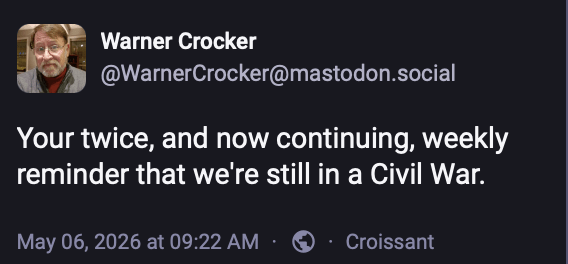
A Mastodon post from Warner Crocker that says, Your twice, now continuing, weekly reminder that we're still in a Civil War.

Set aside for the moment the arguments that some toss back at me that we’re not in a Civil War because we’re not fighting with guns and bullets. I find that argument naive, even if there’s a degree of truth about it. That said, it’s my contention that much of what we’ve been living through for the last decade is not only a continuation of the American Civil War that we thought ended in 1865, but an out in the open fight over the same issues. Denying that, I do find naive.

Yes, it’s about race, and yes, it’s also about so much more. But so was that conflict that’s bubbled and boiled since the founding of this country that finally spilled over into a conflagration at a time that men thought was the only way to solve that large of a disagreement. The question may have been called on the battlefields, but the larger questions were never settled.

I do find it ironic that a New York hustler and pedophile is leading the South’s charge this time around. The South could never rise again on its own, it appears.

But then as playwright Lanford Wilson says in his play, Talley’s Folly,

…there is New York City, isolated neighborhoods in Boston, and believe me, the rest is all the South.

The recent U.S. Supreme Court decision, Callais v. Lousiana, essentially dismantling the Voting Rights Act of 1965 by declaring that we’re so over racism that we don’t need voting rights protections any longer has ratcheted up the fight and placed it squarely in the halls of state capitals.  Given how the U.S. Congress has abrogated any real responsibility on and off for generations, it seems fitting and also ironic that the power will now reside in the states.

The new battlefields in those state capitals are all about redistricting and gerrymandering with states rushing into special sessions to cut out voters of one party or the other in some meaningless attempt to control who has the majority in that same inept U.S. Congress. I say meaningless, because that’s body that has essentially fought back and forth on this since the fighting ended in 1865.

However any and all of these redistricting battles turn out, and given the current number of states controlled by the forces that somehow still call themselves Republicans, what happens in Washington DC will be pre-ordained long before the swearing in of each new Congress takes place.

As long as states can continue to fight using political cartographers and gerrymandering pens as their weapons of choice, things might ebb and flow a bit, but not enough to radically alter the picture or turn back the clock for at least a couple of generations.

Of all of the terrible things that have happened since 2016, I think this just might be the worst of it. I hope I’m wrong. I doubt I am. Stephen Foster’s 1854 song that pleaded for relief, Hard Times Come Again No More, might just become popular again.

You can also find more of my writings on a variety of topics on Medium at this link, including in the publications Ellemeno and Rome. I can also be found on social media under my name as above. This site does not use affilate links. 
 

Sunday Morning Reading

Hands on with playwrights, movies, smart toilets, and a discomforting rooster

Another Sunday. More snow overnight. More shoveling later. The holidays creep closer or perhaps they’re already here, given that grandpa mode has kicked into high gear. Started writing a new play out of the blue yesterday. I have no idea why, but it just tumbled out of my brain on to the screen via the keyboard. Time to share some Sunday Morning Reading. Read as you will, even if it’s on a smart toilet.

I often save the softer pieces for later in this column, but I’ll lead today with David Todd McCarty’s Christmas Means Comfort. Tell that to the rooster.

The world lost a treasure this week with the passing of architect Frank Gehry. Lee Bray writes a nice obituary and tribute. Check out Architect Frank Gehry Who Designed Millennium Park’s Pritzker Pavillion and Foot Bridge Dies at 96.

Samuel Beckett’s Hands is a terrific piece by Rob Tomlinson about, well it’s about Samuel Beckett’s hands and how Dupuytren’s contracture may have influenced not just how, but what he wrote, given that Beckett always begin his writing with pen and paper.

While I’m sharing stories about playwrights, the movie Hamnet is garnering lots of attention and accolades. (I haven’t seen it yet.) Based on Maggie O’Farrell’s excellent novel of the same name, Hamnet mostly follows accepted scholarship that William Shakespeare wrote Hamlet while grieving the death of his son, Hamnet. (At the time, the two names were practically interchangeable.) As with most things Shakespeare, there’s generally accepted knowledge and there are always those who challenge it. James Shapiro takes a look at The Long History of the Hamnet Myth.

And while I’m sharing stories about movies, take a look at Susan Morrison’s piece on How Noah Baumbach Fell (Back) In Love With The Movies.

I linked earlier this week to a piece by Phillip Bump called There Are Limits to the Hitler-Trump Comparison. Just Ask These Historians. I don’t disagree with the thesis. I just think it stops short in the way most history usually does.

Rory Rowan and Tristan Sturm write that Peter Thiel’s Apocalyptic Worldview Is A Dangerous Fantasy. Here’s hoping this first draft of our current history proves lasting.

There’s been much talk about all things military recently given how the current administration is tossing away most of what we believe the military stands for as easy as my grandson tosses away toy soldiers. Carrie Lee says The Soldier In The Illiberal State Is A Professional Dead End. I concur. Sadly.

In the wake of the cataclysm that was Twitter, social media is essentially a messy muddle these days with users continuing to migrate from one platform to another seeking some sort of place that feels comfortable enough to share and often discomfort others. Ian Dunt writes what he calls a love letter to one platform with Thank God for Bluesky.

Smart toilets were in the news this week. I actually got to see and use one at a Christmas party last night. All I could think about while doing my business was this piece by Victoria Song called Welcome To The Wellness Surveillance State. 

And to conclude this week, Amogh Dimri informs us that the Oxford University Press has chosen Rage Bait as 2025’s Word of the Year. Dimiri thinks it’s a brilliant choice. I guess it begs the question, if we’re angry enough to rage, is it really baiting?

If you’re interested in just what the heck Sunday Morning Reading is all about you can read more about the origins of Sunday Morning Reading here. If you’d like more click on the Sunday Morning Reading link in the category column to check out what’s been shared on Sunday’s past. You can also find more of my writings on Medium at this link, including in the publications Ellemeno and Rome.

Context and Chicago History with Troops in the Streets

This isn’t the first time Chicago has seen troops in the streets

Chicago is on edge as it prepares for what may (or may not) be Federal troops being sent in by the convicted felon and child rapist Donald Trump. Chicago and Illinois politicians are standing up and speaking strong against what most see as just the next move in his racist retribution reaction. I say next move, because it won’t stop in Chicago. This is what was promised and there’s no reason for Trump to back down or slow down now.

 All of that said, troops on American streets is not a new phenomenon. That’s certainly true about Chicago. Neil Steinberg has an excellent piece in the Chicago Sun-Times that provides some context and history of past moments when the Windy City had troops in town. It’s worth your time, and not just for those in Chicago.

We tend to think of the military as a monolithic entity comprised of troops always taking orders and doing what they’re told. For the most part that’s true. But every military unit is no different than any unit of any other organization of individuals. You’ve got soldiers, sailors and airmen who do the right thing and you’ve got trouble makers. One of the problems is that some of the trouble makers have itchy trigger fingers, as do some of the officers.

This country is split down the middle with folks in and out of uniform who have a thirst for harming others and those who abhor violence. That’s not just common American history, that’s common human history. Those war movie clichés didn’t get created out of whole cloth.

Use that for the base of recipe that’s stirred up with demagoguery and it’s a dangerous brew ready to boil over.

I’m reasonably sure troops are going to show up in Chicago. Perhaps soon. Perhaps later. I’m also sure that if there is trouble it will come from the trouble makers, both in the ranks, and those ranking up and down the ladder of command, including the supposed tough guy at the top.

We’re already seeing reports that National Guard troops in L.A. and D.C. are having morale issues as they tire of being paraded around as B-roll fodder. (By the way, it’s lousy B-roll if the purpose is to show toughness.) We’ll see more of that as tensions increase all around the spectrum of this tough-guy wannabe spectacle. 

I think this is just getting started.

As I said, go and read, Steinberg’s piece. It’s well worth your time.

You can also find more of my writings on a variety of topics on Medium at this link, including in the publications Ellemeno and Rome. I can also be found on social media under my name as above.