Yo! Companies on the Web: Find The Courage To Say Never

Always say Never

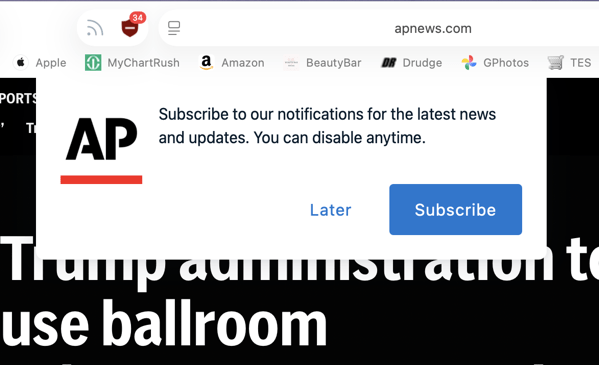
Years ago when Apple and others started allowing websites viewed in a browser to send notifications I knew we were headed to the mess things eventually turned into.

CleanShot 2026-03-31 at 14.26.

Sure, you can turn off notifications from individual websites, and I do. But in reality that’s just another wack-a-mole game that takes advantage of most users not having the time or wanting to do the necessary pruning. Whether websites are asking you to subscribe, or receive notifications it doesn’t really matter. Website notifications are just another fart noise on the enshittified web that stinks up the joint.

You’d think that website publishers would actually want to know who they turn off with their tactics, but that’s probably too much truth to handle. “Hey, boss. The majority of our users never want to see a notification from us.”

In my opinion, there’s an easy way to do so if companies have the guts to face the truth. Just add a button on any of those drop down notifications that says “Never.”

You can also find more of my writings on a variety of topics on Medium at this link, including in the publications Ellemeno and Rome. I can also be found on social media under my name as above.


The Potholes of the Internet

“Your Frustration Is The Product”

Some call it enshittification. I largely agree with that when it comes to the Internet. But that’s true in most endeavors that result in building something. Anything made for good, can and will be used in ways that turn it into a shitty experience.

20160824 121009.

I’m not just talking about advertising and how it’s junked up the web. I’m also talking about human nature, and how there’s a part of too many of us that see something wonderfully created to solve a problem, who then consequently turn it into a range of unintended consequences that leave us mourning our losses at the expense of somebody else’s gain.

Any one of us could run down a list of things in each of our lives that demonstrate that history, so I won’t even begin to spool one out. Have at it yourselves.

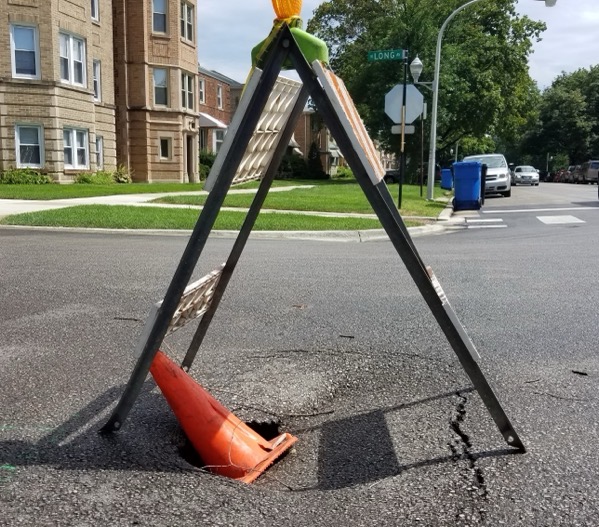
In the majority of instances the road to ruin is typically a path worn thin by greed and there’s never been a road we travel that doesn’t eventually fill with potholes. But back to the Internet and enshittification.

If this excellent post by Shubham Bose called The 49MB Web Page doesn’t make you yearn for a simpler age, I’m not sure what will, assuming you were alive and on the Internet before things went south. Remember, there’s a generation for which the way things are today on the Internet is the way things always have been.

Here’s Bose’s lede:

If active distraction of readers of your own website was an Olympic Sport, news publications would top the charts every time.

I went to the New York Times to glimpse at four headlines and was greeted with 422 network requests and 49 megabytes of data. It took two minutes before the page settled. And then you wonder why every sane tech person has an adblocker installed on systems of all their loved ones.

It is the same story across top publishers today.

The entire piece is worth your time if for no other reason than that misery loves company. We’re all in that same boat and there does’t seem to be any shoreline in view, given how the waters are being churned up anew by Artificial Intelligence.

As Bose puts it:

Your frustration is the product.

Back in the day I can remember getting a credit for complaining that my newspaper was delivered wet and unreadable. Good luck finding someone to express your frustration to these days.

(Photo by the author)

You can also find more of my writings on a variety of topics on Medium at this link, including in the publications Ellemeno and Rome. I can also be found on social media under my name as above.


Sunday Morning Reading

Small Pieces Loosely Joined

Connecting the dots can be one helluva hard game when you have so many dots. The volume of dots and the plots might seem overwhelming, but, if you care to look, it’s easy to find the connective threads, thin though they may be. String them together and the picture becomes clearer. Take a look at the links shared in this Sunday Morning Reading column. If you can’t find the connections, I suggest you’re not even trying to look.

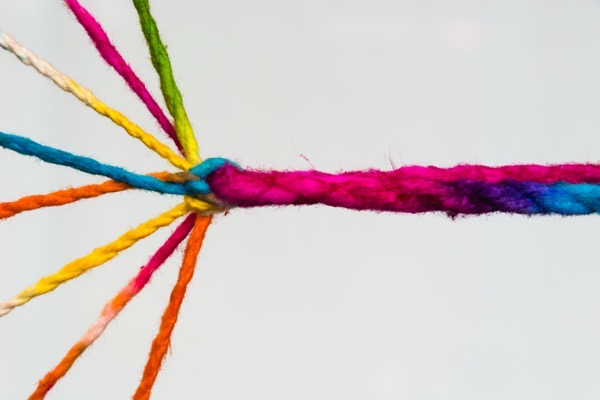
Different colored strands of yarn woven together into a strong strand. Shutterstock 504091696.

Dave Winer writes of Small Pieces Loosely Joined, what he considers the best description of the web. It fits for the web. It fits for most things.

JA Westenberg discusses Why Intelligence Is A Terrible Proxy For Wisdom. Smart.

Backseat Software. That’s how Mike Swanson sees the state of things with software that is constantly interrupting us. As he puts it, “the slow shift from software you operate as a tool to software as a channel that operates you.” Excellent read.

John Gruber thinks we should shift from calling the bad guys Nazis and facists, instead use The Names They Call Themselves. Come to think of it, not sure why it’s so hard to do so given the dictates of the brander-in-chief.

Good dots among the bad are easy to spot. Ava Berger tells the story of how A Red Hat, Inspired By A Symbol Of Resistance To Nazi Occupation, Gains Traction In Minnesota.

In the boiling battle that is Canada and the U.S., Cory Doctorow is elbows up with another of his speeches on enshittifcation. (I’m glad he publishes these.) Check out Disenshittification Nation.

If you’re looking for an antidote to all that’s flying around and at us, it’s tough. Gal Beckham says we can connect those dots through what we’re seeing in Minneapolis. She finds the right word to describe the activism, protests, political opposition, neighborism, and resistance. I won’t spoil it, but she threads them all together in There Is A Word For What Is Happening In Minneapolis. 

David Todd McCarty suggests America is a dual state in Then They Came For Me.

Steven Levy says After Minneapolis, Tech CEOs Are Struggling To Stay Silent. Silence speaks volumes. So do actions. So too do “tepid free-floating empathy” memos that mean nothing. Nothing will come of nothing. Speak again.

Joshua Panduro Preston tells the story of John Carter Of Minnesota: The “Convict Poet” Who Won His Freedom.

Pro football fans, especially those in Chicago know Charles ‘Peanut’ Tillman and the “peanut punch” well. Most don’t know that after his gridiron career he became a FBI agent. Even more don’t know that he walked away from that second career after the immigration raids started. Dan Pompeo connects the dots in After Charles Tillman Transformed Football, He Joined The FBI. Then The Immigration Raids Started.

(image from RA2016 on Shutterstock)

If you’re interested in just what the heck Sunday Morning Reading is all about you can read more about the origins of Sunday Morning Reading here. If you’d like more click on the Sunday Morning Reading link in the category column to check out what’s been shared on Sunday’s past. You can also find more of my writings on Medium at this link, including in the publications Ellemeno and Rome.

Sunday Morning Reading

Small acts

It’s only business they say. Nothing personal. That’s the way the world works. Well, what I share each week in Sunday Morning Reading always comes from a place of personal interest. That may not be how the world works, but it works for me and I hope it does for you. Call it a small act.

Ganesh narayanan SU3zvkxttrE unsplash.

In the wake of the continuing and confounding ICE occupation of Chicago comes a terrific piece by Kyle Kingsbury called I Want You To Understand Chicago.

Follow that up with a ProPublica piece by Melissa Sanches, Jodi S. Cohen, T. Christian Miller, Sebastian Rotella and Mariam Elba about the nighttime raid on a Chicago apartment building that featured men rappelling from Black Hawk helicopters, and all of the residents emptied on to the streets with many of their belongings. The punchline is in the article’s title, “I Lost Everything”; Venezuelans Were Rounded Up In A Dramatic Midnight Raid But Never Charged With A Crime. 

A Nation of Heroes, A Senate Of Cowards by Will Bunch calls it like it is and much the way I see things after last weekend’s actions in the U.S. Senate.

Growing up, I never understood the cliché, “it’s nothing personal, it’s only business.” Frankly I still don’t. It excuses too much that I find wrong about the way the world works. Charles Broskoski examines the personal side in Personal Business.

And speaking of the way the world works (or doesn’t) in the midst of the Epstein fever I don’t think we’ll ever shake, Sarah Lyons points out that the violence in his and others’ actions is something we all live with in This Is How The World Works. It shouldn’t be.

Corbin Trent says We Didn’t Kill American Manufacturing—We Let It Die. He’s spot on.

Mark Jacob tells us How News Coverage Eases Us Into Tyranny.  However this saga we’re living through ends up, one thing is for certain. The media has killed any chance of returning to what it once was.

Hardly a day goes by that we don’t read of some nefarious business practice spilling out of Mark Zuckerberg’s Meta. Turns out Meta is knowingly leeching off of scammers to the tune of about 10 percent of its revenue. I guess that makes Meta and Zuckerberg a scammer too. Cath Virginia has the writeup with Meta Must Rein In Scammers — Or Face Consequences. I doubt they will.

The Internet Archive is under attack in the same way libraries, media organizations, and text book publishing is. It shouldn’t be. Mathew Ingram has the lowdown in The Internet Archive Should Be Protected Not Attacked.

On a more positive note, Jeff Veen tells us how Small Acts Build Great Cultures. Boy, do we need lots of small acts these days.

To close out, did you ever wonder where collective nouns like “a watch of nightingales” or “an ostentation of peacocks” come from? For many years it was assumed that the anonymous author of this collection of collective nouns was the work of a “gentleman of excellent gifts” written down in one of the first books printed after the invention of The Gutenberg Press, The Book of Hawking, Hunting, and Blazing of Arms. Turns out the author was a woman named Juliana Barnes. Maria Popova has the story in A Parliament of Owls And A Murder Of Crows: How Groups Of Birds Got Their Names, With Wondrous Vintage Illustrations By Brian Wordsmith. 

(Image form Ganesh Narahanan on Unsplash)

If you’re interested in just what the heck Sunday Morning Reading is all about you can read more about the origins of Sunday Morning Reading here. If you’d like more click on the Sunday Morning Reading link in the category column to check out what’s been shared on Sunday’s past. You can also find more of my writings on Medium at this link, including in the publications Ellemeno and Rome.

Typepad to Shut Down on September 30

Ending an act

This blog is named Life on the Wicked Stage: Act 3. I may be a theatre geek, but I’m not a fan of the three-act structure. The name came about because there were first and second acts preceding it. The first act was on Windows Live Spaces (long since dead and gone) back in the day before I ever thought of this as something I’d enjoy doing. Then there was a Life on the Wicked Stage: Act 2 on Typepad. 

Well all plays, regardless of act structure have an ending. The curtain is coming down on that second act in the same way it did on the first one. Typepad is shutting down. Per the announcement on the Everything Typepad blog, the service will shut down on September 30th, 2025.

Typepad users have until September 30 to export their data. After that, all access will be terminated.

Everything in the corporeal world reverts back to dust. So do all the bits in the digital one.

Sunday Morning Reading

A bit of this, a bit of that. All good bits.

It’s the Dog Days of Summer and it’s been a hot one so far. We’re traveling again, but there’s still some interesting Sunday Morning Reading to share. Some of it hopeful, some elegiac. Some just geeky and fun. Enjoy.

Milen kolev zs9jdUCaP_4 unsplash.

Kicking things off is a piece in The Atlantic from Anna Deavere Smith called When You Don’t Look Like Anything. She’s a singular artist always worth paying attention to. Her story of her 50-year search for the American character is certainly more than worth your time. Damn good stuff.

A.R. Moxon popped up on my radar this week with a piece called Total Eclipses. It’s part 2 of a series, the first being Be Bolder, Not a Boulder. If you’re like me and looking for any light at the end of any tunnel these days, do give both pieces a read.

NatashaMH offers up An Ode To The Poetic Detours. It’s about writing and where she finds inspiration, but more broadly, it’s about observing, noticing, listening, seeing, and feeling between the lines we sometimes get trapped within.

Will Dunn asks Are Emoji’s Killing Language? I’ve been saying they are for quite some time. For the life of me I don’t understand why we seem intent on regressing back to an age of hieroglyphics instead using the complex beauty of words and language.

Mathew Ingram says The Google Link Economy Is Dying and It’s Not Coming Back. He’s not wrong. Actually, he’s very right.

Health is a big deal in tech these days, especially when it comes to adding features to improve monitoring what’s going on in our bodies. Frankly, as someone who uses medical devices for monitoring my diabetes, the promises to add that kind of monitoring to smart devices, along with blood pressure and other conditions, sound hollow, seeming as realistic to me as self-driving cars. We may get there one day, but for now it’s mostly a clever way to market something new to increase the bottom line. Victoria Song takes a look at Samsung’s recent effort to check out our level of antioxidants with their smartwatch in I ‘Fooled’ Samsung’s New Antioxidant Feature With a Cheez-It. 

Much has been made of Paramount’s caving to Donald Trump, leading to the firing of late not comedian Stephen Colbert. That was quickly followed up by the Trey Parker and Matt Stone’s skewering new season opener of South Park. Paramount paid up, got its merger, and in an Aristotelian, if not Mel Brooksian sense there’s some grand comedy in the entire thing. I’m a fan of Alexandra Petri’s piece examining the moment pre-South Park titled Are You Laughing Yet?

Sometimes we just need to laugh at what feels like no laughing matter.

(Image from Milen Kolev on Unsplash)

If you’re interested in just what the heck Sunday Morning Reading is all about you can read more about the origins of Sunday Morning Reading here. If you’d like more click on the Sunday Morning Reading link in the category column to check out what’s been shared on Sunday’s past. You can also find more of my writings on Medium at this link, including in the publications Ellemeno and Rome.

The Bad Guys Love The Law When It Is On Their Side

You only think you own what you bought.

I once wrote a line in a play that I cribbed from my mother that always got applause, “Just because it’s legal, don’t make it right.” I’d like to assume that most folks who might read a thing or two here understand that far too many laws have been written not to protect everyone or make things right, but instead to often give cover for blatant acts against the little guy in favor of the big guns. 

Copyright laws when used as a weapon to further corporate interests and feather CEO nests have been one of the  favorite tools for the bad guys. That’s been an ever increasing problem paralleling the advance of technology as more and more companies reject the idea that if you bought it you own it, and still claim rights that too often are protected by laws that were never written to contemplate the world we find ourselves in. 

With a hat tip to Denny Henke, take a look at this video from Louis Rossmann about a recent example of this. 

You can find more of my writings on a variety of topics on Medium at this link, including in the publications Ellemeno and Rome. I can also be found on social media under my name as above. 

Is Apple’s F1 Push Ad Enshittification or Just Shitty?

Apple pushing ads push users’ buttons

As if Apple needed another kerfuffle, it appears that one of its marketing efforts for the movie F1 has raised the hackles on the necks of some. You almost have to be tuned out completely to have missed the plethora of marketing methods Apple has already been pushing around the racetrack to get this movie to the starting line. But there’s always more.

Apple started pushing out Apple Wallet notifications to users of that service announcing that they could receive a discount for movie theater tickets via Fandango by purchasing those tickets with, yep, you guessed it, Apple Pay.

I saw the notification late last night and just swiped it away the way I do the majority of these mosquito-like pests. Too bad I didn’t take a screenshot.

But Casey Liss, of The Accidental Tech Podcast trio grabbed one and posted about it on Mastodon, accompanied by a vomiting emoji.
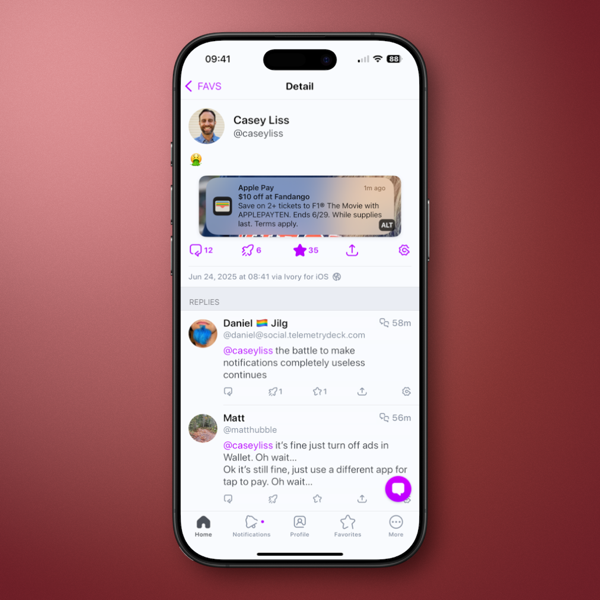
New Screenshot.

Those who felt as ill about the promotion as Casey did quickly jumped in, condemning it and pulling out the enshittification label that we’ve all become familiar with since it was coined by Cory Doctorow in 2022.

Yes, it is advertising, but I’m not sure it was enshittification. Perhaps we’re reaching the point of shitting all over that label and diminishing, yet revealing its power in sort of a weird turning in on itself way that proves the original meaning behind the original term even while mucking it up by using it too frequently.

Granted there aren’t too many who lust for the ever increasing onslaught of advertising and marketing pitches we’re bombarded with hourly. I’m certainly not one who does. But advertising and marketing, as overused and overwrought as it has become, in and of itself isn’t enshittification, no matter how fast it grows like weeds rapidly enveloping every corner of our Internet usage.

My grandfather used to say that “a weed is anything that grows where you don’t want it to.” Most of today’s advertising certainly feels weed like. And it keeps getting worse, especially when pushed at us from sources we don’t expect it from. Amazon we expect this from. Apple not so much. Though there is a history there.

In my view of things, Apple advertising this promotion is really not that much different than a podcast advertising its latest merch to its audience or promoting a fundraiser. Don’t get me wrong, I’m not shitting on The Accidental Tech Podcast, which does both of those things. I actually pay for a subscription and occasionally buy their merch and donate when they fundraise. Captive audience marketing is an age old technique and it works. I’ve used it myself. Even so, it can grow old and tip over into enshittification.

But there’s a larger point.

Eventually most users tune out. I used to deliver a curtain speech pitching the next play or special offer before every performance at a theatre I ran. Initially they were wildly successful. Eventually returns diminished. That may be anecdotal, but I believe the more ads increase the more they become the blandest of white noise or even a turn off to the product. Again, anecdotally I had initial interest in the F1 movie, but after the inundation of advertising I’ve already decided my interest has waned. So I’m certainly not going to be contributing to Apple’s goal of finally putting butts in theater seats for one of its movies. I’ll catch it sometime down the line on streaming.

Overhyping, as a facet of enshittification can too easily create diminishing returns, gradually enshittifying the very business models of the enshittifiers. Mosquitos can’t feed when everyone within their range packs up and goes indoors and they eventually move on or die out.

We just haven’t reached that tipping point in this bloodsucking business model we’re trapped in currently. In his original post outlining the enshittification of early social media platforms Doctorow says “the same forces that drove rapid growth drove rapid collapse.”

I doubt we’ll reach that tipping point in advertising. Because there’s a whole new frontier that the enshittifiers are just waiting to exploit and that’s AI. Google’s moving away from search faster than its search rankings are dropping and there’s no secret on the path it’s choosing.

I’ve often imagined that perhaps AI could be one of our salvations in the advertising scheme of things, figuring out better than humans seem capable of doing when enough is enough. But those driving that racetrack see the possibility of too many dollar signs to make that more than just a wild imagining no matter how much sense it might make.


You can find more of my writings on a variety of topics on Medium at this link, including in the publications Ellemeno and Rome. I can also be found on social media under my name as above. 

Sunday Morning Reading

There’s a creeping inevitability to much of what’s happening around us.

Some Sunday’s when I sit down to collect what I find interesting enough to share it seems like things around us are just bad. Or going from bad to worse. It feels inevitable. This is one of those Sundays. Nevertheless, there’s some good writing and good thinking in the articles linked below that I believe are worthy of your attention. But paying attention is not one of our strong suits. Cue up a little Crosby, Stills, Nash and Young, pay attention, and read away.

‘Tin Soldiers and Nixon’s Coming’ is an excellent look back as we stare at this moment we’re in from Robert Cohen and Michael Konciewicz on the 2020 50th anniversary of Kent State and Jackson State.

You’re Not Ready, is an excellent, yet somewhat frightening compilation of articles by various authors at Wired, comprising info on AI hacker attacks, grid attacks, or a GPS blackout. I say “somewhat” simply because many of us have had inklings about this. Or at least those who pay attention.

Josh Marshal of Talking Points Memo has an excellent piece on Artificial Intelligence and The Posture of Skepticism.

Mathew Ingram’s fascinating piece, How Marc Andreessen and I (and you) Created The Web is informative and entertaining history and context that’s worth your time about the time we’re in.

Paul M. Sutter tells us that A New Theory Says Time Has Three Dimensions. It ‘Really Messes Up’ What We Know About the Cosmos, Scientists Say. We seem to be doing a good job of that at the moment given our current understanding of time, so why not go ahead and mess things up.

Timothy Snyder wonders what happens with The Next Terrorist Attack. It’s far deeper than the headline suggests.

Michael Podhorzer writes about something I’ve been thinking and saying for a while: The Courts Will Not Save Us. It’s a long read but more than worth your time. Read this instead of watching TV lawyers.

Most of the articles I’ve already linked to this Sunday morning in one way or another deal with trust. That trust gap is widening these days. It doesn’t help when we do find out things that break trust, but the finding out at least helps us understand the gap better. Take a look at Aruna Viswanatha’s piece The Pentagon Disinformation That Fueled America’s UFO Mythology.

Tomorrow, June 9th, Apple kicks off its annual World Wide Developer Conference. There are trust issues there as well. These next few links contain some interesting thoughts heading into WWDC, beginning with Sebastiann De With’s Physicality: the new age of UI, which anticipates the coming design changes rumored for all of Apple’s operating systems. A fresh coat of paint may not hurt. I’m not sure it’ll help.

As I said, Apple faces a number of problems, some legal and regulatory. Jérôme Marin explains how A Simple Comma is going to cost Apple Billions in Europe. Commas can indeed cause all sorts of chaos. Just ask US constitutional scholars about a comma and the 2nd Amendment.

And to close things out, one of my favorite developers _DavidSmith talks about his optimism heading into WWDC in Let’s Get Started. I admire the optimism and the reality check approach _DavidSmith brings to this.

If you’re interested in just what the heck Sunday Morning Reading is all about you can read more about the origins of Sunday Morning Reading here. You can also find more of my writings on Medium at this link, including in the publications Ellemeno and Rome.

Mozilla Finally To Shut Down Pocket

End of an era.

Add another marker in the Internet/Tech graveyard. Mozilla has announced that it will shutting down Pocket on July 8th. Nothing lasts forever.

It’s not a surprise to me given how poorly the app was treated after Mozilla took it over in 2017. The read it later service became almost unusable and I had gradually moved away from my reliance on it for bookmarking web links. My move away quickened once they decided to discontinue the Mac app.  Making it a web only app ironically led to a pretty horrible user experience.

Pocket joins other apps like Evernote that were once old standbys that in order to grow and sustain felt like they needed to add feature upon feature in order to compete and attract funding and subscribers. You can’t blame anyone for trying to make a buck and run a company. You can blame them for doing such a poor job of it.

Mozilla has made a way for users to archive links they’ve saved with instructions to be found in their post about closing the doors. Users have until October 8th to export their data.

Update: On Friday Digg co-founder Kevin Rose has offered to step in and take over Pocket to save it from its demise. Anything’s possible I guess.

You can find more of my writings on a variety of topics on Medium at this link, including in the publications Ellemeno and Rome. I can also be found on social media under my name as above.