Quell The Outrage Over Apple Intelligence Taking Up Storage

Why the surprise?

I apologize in advance for being derisive in this post. But Lordy, do folks deserve a shake now and again.
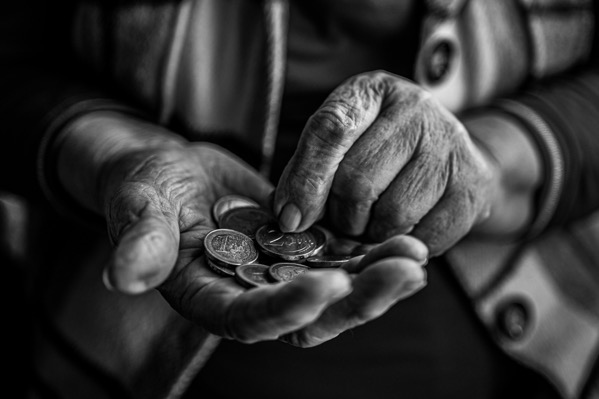
Hands of an older person counting out coins. Landsmann zxKlxvN5ZSg unsplash.

Not a day goes by that I don’t see complaints about Apple Intelligence taking up storage space on iPhones, Macs, or iPads. Some of it from so-called leading Apple blogs and websites. It begs the question, were people just not paying attention?

Apple’s entire pitch for Apple Intelligence is that most of it happens on your device, and is thus supposedly more secure than relying on other AI chatbots and the like that send every request to some data-slurping cloud or the other. At what point in that pitch did you not assume the index of your data wasn’t going to end up on your device and consume storage?

Granted one might be surprised by the amount of storage Apple Intelligence is taking up, but if you use your devices constantly, don’t purge older data like Messages and emails occasionally, the size of the index Apple is going to create, apparently every time the folks in Cupertino update the OS, is going to only grow.

I get the problem. I don’t get the outrage over it. Especially from websites that should know better and should have prepared their readers better. The reason I get it is that many users, especially in this age of spiraling costs, go for the least expensively configured device. Settling for 256GB of storage might have been a solid purchase decision two years ago. That’s no longer the case. I also get the surprise and the outrage from those who weren’t preparing to upgrade hardware in this or any immediate future cycles. That said, this writing has been on the wall for some time now.

The same is true with memory. Everyone was pleased when memory configs jumped to 16GB for the base of most of Apple’s computers. 16GB these days is what 8GB was just a short while ago. It’s the bare minimum you need to run Apple Intelligence effectively, especially if it’s only paired 256gb of storage that’s crammed with other data.

When Apple first started promoting its on-device Apple Intelligence approach quite a few were excited, thinking they might be able to reduce some of those $20 a month subscriptions they paid for other AI services. That may prove true for many, but in the end, it’s really just a transfer of costs.

Artificial Intelligence, regardless of flavor, is changing all aspects relating to purchasing decisions as rapidly as the technology itself is changing. If you think it’s hard for consumers to keep up, here’s a hint: the companies can’t keep up with it either. We would all be well served to think ahead given the unpredictability.

I hope I’m wrong, but I don’t buy into what I consider to be way too optimistic predictions that memory and storage costs are going to settle back in the next couple of years. And if we’ve learned anything at all about any kind of digital services, it’s that prices inevitably go up on that front. The money to pay for all the debt service on that financing for data centers has to come from somewhere.

In this day and age, 256GB of storage and 16gb of memory may be the minimum with a price point that makes it easier to get you in the door. But it’s as cramped and curmudgeonly as the free 5GB of iCloud storage that still comes with new iPhones.

(Image from  – Landsman on Unsplash.)

Thanks for reading. You can subscribe to this blog if you care to. You can also find more of my writings on a variety of topics on Medium at this link, including in the publications Ellemeno and Rome. I can also be found on social media under my name as above. This site does not use affilate links.

 

The Golden Age Of Shit. Super Intelligence Style

Oh, what a tangled web we weave, when first we practice to deceive. -Walter Scott

The farce that unfolded in Washington DC yesterday regarding Artificial Intelligence wasn’t comedy. Yet it was super hilarious. At some point you have to understand that the wool is being pulled over all of our eyes, including those of the president. And you have to laugh.

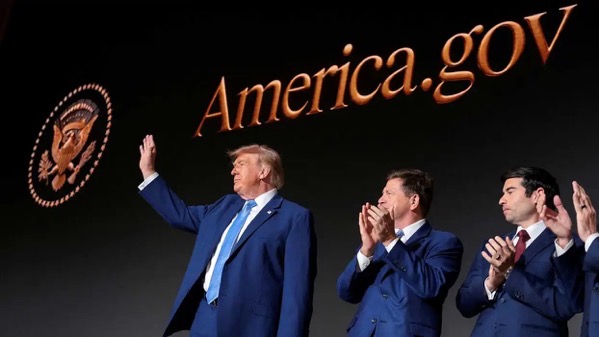
Us president donald trump attends national design studio launch event for america gov a new ai powered government website at t.jpg.

In an election year that sees American’s distaste for anything approaching the topic of AI growing like kudzu, the folks running the AI show keep rapidly alternating back and forth between requests that the government step in and stop them from destroying humanity and telling us that their products will create a new golden age of abundance.

If there’s a joke in the circle jerk of a game they’re playing, it’s that the president croaks that he got the assembled AI oligarchy to sign on to a “morally binding” agreement to self-police. You read that right. “Morally binding.” There’s lots of laughing about a group of technologists who built empires on stealing the work of others, who never met a law or a moral they wouldn’t spit on, signing such a document put forward by one of the most outrageous criminals the world has ever known. But that’s just the set up.

The joke is that these conmen are playing the decaying before our eyes president for all they can while he’s still breathing. He no longer understands what’s put before him. He doesn’t have a competent staff. A fact made abundantly clear by the misspelling of the United States under the president’s signature and the fact that his administration’s AI fueled new website spent the day disproving all the lies he’s foisted upon a population with an average reading age of a sixth grader. You’d think his flunkies would use AI to do some basic proofreading and fact-checking. But that’s above a sixth grader’s skill set. Apparently they’ve already “corrected” the website to spit out the lies again.

These tech bros are openly yanking the president’s chain, taking advantage of his infirmity, our divisiveness, our curiosity, and the greed of the markets. The rest of the world is doing it. Given their desires to run the planet, into the ground or elsewhere, they might as well get in on the act before the curtain comes down.

Couple all of that with the supposed name change in the order, rebranding Artificial Intelligence to Super Intelligence. On the one hand it’s good to know that if the technology kills us all there will be no shortage of superlatives to describe the end of times in the summaries all the robots, Muses, and Dots will spam each other with after we’re gone. It beats being wiped out by something branded as artificial, I guess. On the other, the name change is just super silly. Call me when OpenAI changes its name. I’m just surprised he didn’t name it American Intelligence. Or Trump Intelligence.

If there’s drama ahead in any of this, it’s that at some point it’s going to all go to shit. Mostly it has already. Those who dismiss every warning as merely marketing remind me of early climate change deniers. Those who take the warnings seriously remind me of every bandwagon jumper that’s ever leaped to a conclusion. As in most things, what truth that exists probably lies somewhere in the muddy middle, which is exactly where those who will profit over either their success or failure want it to stay.

Thanks for reading. You can subscribe to this blog if you care to. You can also find more of my writings on a variety of topics on Medium at this link, including in the publications Ellemeno and Rome. I can also be found on social media under my name as above. This site does not use affilate links.

 

Sunday Morning Reading

It’s all complicated. Until it’s not.

In some weird way another Sunday has rolled around and pulled into the station that signals the end of another week. I say weird because it’s one of those weeks where you lose track of where you are day by day, and have to keep reminding yourself which day that ends in “y” you’ve landed on. It’s complicated. In a way to avoid my momentary confusion, here’s some Sunday Morning Reading to share. If I’m sharing it, it must be Sunday, right?

Matthieu marseille JzmM3xTu2Xw unsplash.

Artificial Intelligence continues to complicate the news with more and more problems predictably arising daily out of that tempestuous soup we called technology. Ian Duncan has a more than interesting essay on the matter titled Sex, AI, And The Apocalypse that’s worth your time. Whether you’re buying what anyone, including Duncan, is selling, it’s worth examining the merchandise.

Aurra Kawanzaruwa reminds that’s it’s not the lie that’s told that matters as much as the doubt it creates in The Liar’s Dividend. Who Benefits From Your Doubt.

Meanwhile, David Todd McCarty takes a look at An Uncomplicated Life. Easier said than done. Better done than not.

JA Westenberg says Outrage Is Our Last Campfire. Any piece that begins with examining a bit of Anton Chekov is worth your time in my view. I’m not sure if outrage is the last or not, but it sure is consuming us more than keeping us warm.

I miss good sports writing. Chicago is a crazy sports town, and at the moment, with both major league baseball teams in the playoffs and the NFL season underway emotions are running rampant. The stakes are high, but the odds are fading with the Chicago Bear’s star quarterback and thus that team’s hopes injured.  Most of the hopes and baseball dreams will come to naught in my opinion, but it makes for an uncomplicated way to while away some time between commercial breaks for online betting. Matt Lombardo’s has a good piece of sports writing in The Official Quarterback Hell Travel Guide worth checking out if you’re into such things.

Sad to say, you can’t talk about sports today without talking about gambling. Alex Klavens, Walk Bogdanich and Jenny Vrentas investigate How Draftkings Uses A.I. To Target The Gamblers Likeliest To Lose. Bet you didn’t see that coming.

To close out, give a read to Timothy Snyder’s piece A Medidation On Train Stations. The things we know, and the things we just set aside to deal with so many other things are enough to complicate countless lifetimes.

(Image from Matthieu Marseille on Unsplash)

Thanks for reading. Feel free to subscribe if you want. It’s free. If you’re interested in just what the heck Sunday Morning Reading is all about you can read more about the origins of Sunday Morning Reading here. If you’d like more click on the Sunday Morning Reading link in the category column to check out what’s been shared on Sunday’s past. You can also find more of my writings on Medium at this link, including in the publications Ellemeno and Rome. This site does not use affilate links.

Sunday Morning Reading

Yes, and…or No, But?

It’s a Sunday. Yes, and it’s raining. Yes, and it was darker than I prefer when I sat down to write this edition of Sunday Morning Reading. The content feels darker too. Sign of the times? Or just a look inside what’s caught my attention? You read. You try to figure it out. I don’t think I can. Neither can anyone else it seems. Game on.

Michal vrba AJlaheUF IA unsplash. Boys playing chess

AI safety is all over the news, which means it has become practically a dead horse of a topic. Is it scam or a real threat? No one knows. Funny. I think that’s how the scammers prefer it. Especially if there’s a there there. Juliette Kayyem says Destroying Humanity Is Against The Law. Is it?

Anand Giridharadas repeats the obvious in The System Is Rigged. The Cavalry Is Not Coming. We’re On Our Own. Obvious as it may be, it’s worth your time.

Phillips Payson O’Brien says The American Age Is Over. Duh.

David Todd McCarty takes on The Abject Failure Of American Media. McCarty also sprinkles some wisdom on the Ed Sheeran controversy in Ed Sheeran Learns The Hard Way That Neutrality Is Not A Safe Space. There are parallels about more than just safe spaces if you’re of a mind to see them.

Anyone who didn’t think The Kennedy Center was going to be just another in a long list of casualties that would take a miraculous act of resurrection after Trump spoiled all the parties was deluding themselves. Everyone knew the lies going in. Janay Kingsberry reveals the financial ones for the few who pay attention in What The Kennedy Center’s Tax Returns Reveal.

I’m sure you’ve heard of the improv technique “Yes, and…” Dennis Hogan asks “What was Improv?” in his piece No, But. If you know, you know. If you read, you’ll find out.

Justin Neuman says we are most human when we play freely, imaginatively, and pointlessly. There’s wisdom there. There’s also wisdom in what he offers about this era when everything is gamified in More Nothing Now.

Neil Steinberg brightens the morning by suggesting that sometimes all we need is a kitten in Farm Kitten.

(Image from Michal Vrba on Unsplash)

Thanks for reading. Feel free to subscribe if you want. It’s free. If you’re interested in just what the heck Sunday Morning Reading is all about you can read more about the origins of Sunday Morning Reading here. If you’d like more click on the Sunday Morning Reading link in the category column to check out what’s been shared on Sunday’s past. You can also find more of my writings on Medium at this link, including in the publications Ellemeno and Rome. This site does not use affilate links.


Take AI Leaders At Their Word Or Call Their Bluff

Play the hand we’ve been dealt

Artificial Intelligence may or may not destroy human existence by 2030 or sometime in the next decade. Why waste the computing cycles and tokens when we’re doing a damn good job of beating it to the punch?

Museums of history new south wales VLFT8_H1tm8 unsplash.

After some dangerous confessions and warnings, along with continuing news of AI engines escaping their sandboxes, the leaders are calling out to slow things down, saying that they need to be regulated before what they are spending so much money on creating can become uncontrollable. Of course that spurs debate between those who love the technology and are making money off it, those who despise it—harbinger of doom it may or may not be, and now the millions who are stirring on the sidelines they usually sit on.

Some believe this is just another in a long line of overhyping the technology to improve bottom lines. Some see it as a timely move to try and influence the upcoming talks with the always-feared Chinese. Some, including those who have been working and studying the technology for quite some time, see AI as a real threat.

If we want to wipe the last two camps out of the memory banks and the debate, then either take them at their word or call the AI leaders’ bluff. Take them at their word that their brain children are too dangerous and put systems in place to regulate and slow things down. Or demand they pull the plug. They’ve exhausted the use of hyperbole in hyping the promises of their tech and most fell for it along the way. Why not take them at their word now?

Oh, wait. Whether the danger or is real or a bluff to be called there is a problem. The folks who would do the regulating belong to an institution that no longer exists called Congress. The president could do so, but then so could a dead fish for all it would matter. Funny, not funny that he joked about banning fishing just yesterday.

To think these ultra-competitive tech titans will slow themselves down in some selfless act of altruism to save the human race is folly. As much folly as hoping some governmental set of regulations or committees or dictates would. As much folly as pretending the conversation hasn’t been poisoned a million ways from Sunday to the point that no one knows what to believe.

At one point in our recent history the powers that be came to accept that the banks were too big to fail. We’ve sort of reached that point again with AI. It may not be too big to fail, but those who’ve created it, and those who have financed it, have already failed the rest of us. The rest of us who they need to pay for and feed their robots and robot-like artificial brains.

Call their bluff.

Thanks for reading. You can subscribe to this blog if you care to. You can also find more of my writings on a variety of topics on Medium at this link, including in the publications Ellemeno and Rome. I can also be found on social media under my name as above. This site does not use affilate links.

(Photo by Museums of History New South Wales on Unsplash)

If You’re Moving From 1Password to Apple Passwords Check Out These Resources

Making tech choices shouldn’t be this hard

This is a wacky era for many when it comes to computing, regardless of platform. The rapid pace of change is letting up, propelled by Artificial Intelligence and a cascading series of factors. Another is users’ distaste with some companies and/or their leaders’ decisions in the political and social climate meltdown we are all living through. Too often it feels like we’re choosing the least worst of bad options in the same way it often does in politics.

Sasun bughdaryan WUJmdr8pNwk unsplash. A computer keyboard with a combination lock resting on it

I’ve been reevaluating my use of 1Password for some time. The app has served me well across multiple devices and multiple platforms. When Apple first released its Apple Passwords app in 2022 I thought of switching, but held off to see how the app would evolve, and because the cross platform and other features were still of use. But I’ve felt the tug several times since 2022, and at the moment, now feels like the time.

I say at the moment for several reasons. In a couple of months it will be time to renew my 1Password subscription. Apple Passwords keeps improving, even though it still doesn’t match 1Password’s feature set. Lastly, the ownership of 1Password has made one of those political decisions that doesn’t sit right with me and many others.

I won’t get into the political parts of that in this post. The Verge has a good summary of the issue at this link.

What I will do though is link to two excellent articles for those who might be interested in switching from 1Password to Apple Passwords.

The first is from Ricky Mondello who actually works at Apple in the password management and app/website authentication spaces.

The second is from Glenn Fleishman on Six Colors, also on how to migrate from 1Password to Apple Passwords.

Ricky’s piece is more of a broad overview. Glenn’s piece is quite thorough and covers a number of do’s and don’ts.

For whatever reason you might be thinking of migrating from 1Password to Apple Passwords both are excellent resources that you might want to keep handy.

The good news is it is possible to make such a switch, even though changing horses in midstream might lead to some new challenges and habit changing.

The bad news that keeps accumulating more than I think most want is that too often it feels like we’re in a situation when we might be choosing between lesser evils.

I hate that.

(Image by Sasun Bughdaryan on Unsplash)

Thanks for reading. You can subscribe to this blog if you care to. You can also find more of my writings on a variety of topics on Medium at this link, including in the publications Ellemeno and Rome. I can also be found on social media under my name as above. This site does not use affilate links.

 

Sunday Morning Reading

Is reading, like writing, in danger?

Time for a little Sunday Morning Reading. But reader beware. Some think reading might be in danger. Read on. If you choose to.

Ben white 1MHU3zpTvro unsplash. A man sitting by a lake or river, reading a book.

Like a lot of folks who write I’ve been recently writing about writing in this AI age. But writing is only one side of the page writers want readers to turn. Readers don’t turn pages if they don’t like what they read. Bryan Cantrill thinks readers might be slowing their roll in his piece The Revolt of the Reader. I’d give it a read whether you write, or simply read the words of others.

Becky Ferreira takes a look at how The Remnants Of A Lost ‘Supercontinent’ Just Rewrote The History Of Life On Earth. Accepting that would require a global scale of editing and require quite a bit of new reading.

Roko’s Basilisk. Ever heard of it? Yes or no, you should check out Albert Buneko’s piece What If We Could Have A Future?

Perhaps you’ve heard that there’s a 10% chance AI will destroy humanity in the next decade? Over the weekend Anthropic’s Dario Amodei penned a large piece (or maybe he just had Claude generate it-who knows?) titled We Must Pace The Frontier. In the race he’s running he’s calling for things to slow down and governments to step in because there’s danger out there. It’s caused quite a stir. Fellow race participants, OpenAI’s Sam Altman and SpaceXAI’s Elon Musk, have quickly jumped in to agree. Either these guys are seeing the writing on the wall from folks who just aren’t buying their overhyped promises, or one of their AIs cracked into something we don’t know about yet. Or it could just be more hype. Or it could just be an attempt to push their agenda in upcoming talks the US is to have with China. Given that no one trusts anything they say, who knows? I’d say who cares, but there is that whole future thing that Albert Buneko was writing about.

Speaking of writing on the wall, apparently the gold rush for vibe coding apps isn’t what it looked like it might be. Paul Ford asks A.I. Was Supposed To Give Us Killer Apps. What Happened? The world only needs so many task management apps.

In the political realm folks are turning their attention to January 3, 2027 as a possible next January 6th coup. Michael Luttig lays it all out in The Final Battle For America’s Democracy. It’s a scary read. I think what he lays out is indeed possible. That said, if there is such a thing as a final battle, I think it was lost with the last presidential election.

With a hat tip to David Todd McCarty, I discovered Patrick Metzger’s piece What Canadians Won’t Admit About America. You should discover it as well.

And if you’re not going to be doing any reading this Sunday, perhaps go out and take a walk. Before you do, read David Todd McCarty’s Life On Goshen Landing Road.

Read well.

(Image from Ben White on Unsplash)

Thanks for reading. Feel free to subscribe if you want. It’s free. If you’re interested in just what the heck Sunday Morning Reading is all about you can read more about the origins of Sunday Morning Reading here. If you’d like more click on the Sunday Morning Reading link in the category column to check out what’s been shared on Sunday’s past. You can also find more of my writings on Medium at this link, including in the publications Ellemeno and Rome. This site does not use affilate links.


The Debate Over This Writing Thing

Words, words, words. Bits, bits, bits.

Several weeks ago there was quite a debate bouncing around about what writing is or might or might not become in this era of Artificial Intelligence. Quite a lot was written about the subject. I watched and read most of it beginning with John Gruber’s piece on Daring Fireball about Anthropic’s use of watermarks for AI-generated writing. Gruber called it a “perversion of writing.” Many others weighed in with words, words, words. And more words.

Shutterstock 2525907005. A hand writing with a quill an ink.

I particularly liked Dan Moren’s piece in response, primarily because it lines up with what I’ve learned and currently think about AI-writing. Here’s a quote:

That might be the case if AIs were writing. But they are not; they are simply generating text. Those two things are not the same. As per the premise of John’s piece, writing is about carefully picking the words and crafting the meaning of what you’re saying, things that AI do not—and patently cannot—do.

In case you’re wondering, I’m in the camp that says that AI isn’t capable of “writing.” If you know anything about the tech at all, you should be too. AI might be able to predict the next word, but that’s a mathematical equation not writing. If you insist otherwise, I hope the kool-aid tasted good on the way down.

Back in the days of my youth, one of the many rituals of sorting wheat from the chaff in childhood education was teaching us to to write mechanically, moving slowly but steadily up to writing things with meaning (remember book reports?) and once we moved into college there was Freshman Comp. Do they still teach Freshman Comp these days?

It wasn’t until later in college when I actually learned what I came to believe writing was all about. Dr. Ralph Cohen, an English professor who taught courses on Shakespeare, film as a narrative art, and surveys of literature, was one of the few professors who kicked my butt. He challenged me in ways others didn’t and I ended up taking most of the classes he offered.

In teaching Shakespeare, he laid out what the physical act and monetary cost of writing during the Bard’s time actually required. There was a real cost to committing an idea to the paper he made out of rags and old linens. Simply put, it meant the work of writing happened in the man’s brain and soul either before or as he was scribbling away with his quill and ink.

I was never good at writing with pen/pencil and paper. Nevertheless, I fought my mother tooth and nail when she insisted I take a typing class in high school. She won. I’m glad she did. Writing for me did become easier on a keyboard and a keyboard has been the primary medium of committing my thoughts to paper or digital bits ever since.

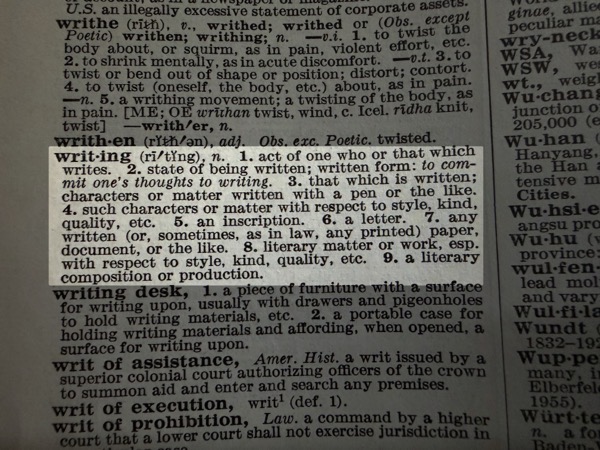
In thinking about this debate I pulled a dust covered dictionary off of one of my book shelves to look up the definition of writing. It’s The American College Dictionary published by Random House copyrighted in 1961. Here’s what that says below:

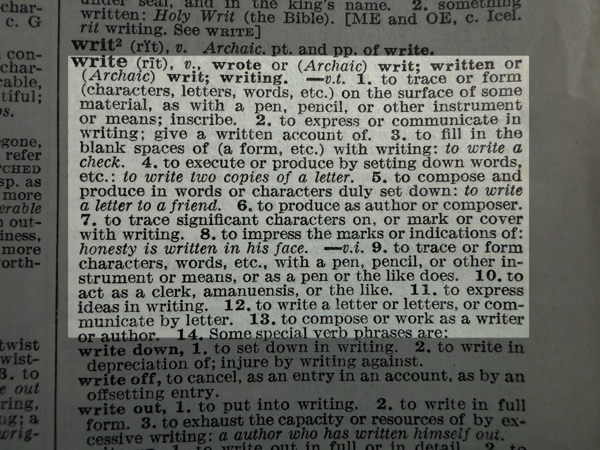
I also looked up the word “write.”

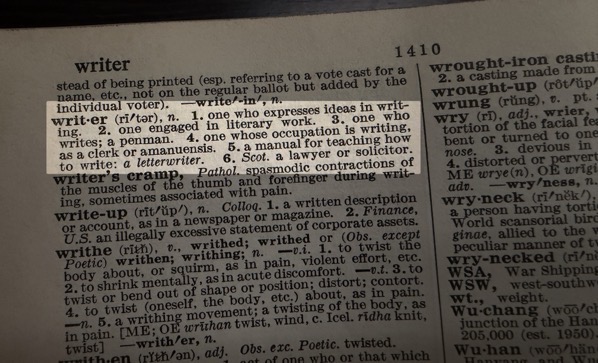
And the word “writer.”

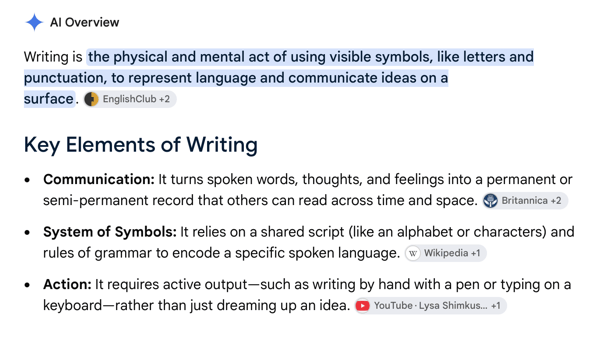
Google Gemini’s AI summary provides the following:

The highlights in that result are Google’s. Certainly there are many other dictionaries with differing and distinct definitions spelled out. I’d wager that most, like those above, focus on the mechanical. Perhaps that would steer the debate more towards those who think AI can “write.” Frankly, I find that devaluing when I think of the act, or dare I say the art of writing.

Having spent a life in the theatre, written a few plays and musicals along the way, and heard the chimes at midnight with many a playwright and composer searching for the right words or notes, I believe there’s an element that’s missing when most engage in this debate. I’d call it the soul.

Otherwise the infinite monkey theorem comes into play and renders all writing reductive to a fault. Or if The Simpsons is more your cup of tea, 1000 monkeys with a 1000 typewriters.

There are some that are trying to define parameters of this debate as being about process. But that’s any creator’s thing. Some want to frame the discussion about how the march of technological progress always presents change. So, why resist it?

If writing, or any other art form was supposed to be easy or easier that’s when the devaluing kicks in. The playing fields of creation have never be level. Why start doing so now?

That last link above is from a piece from Tim O’Reilly on the subject. I’m not sure if he wrote it or he coached an AI to do so. You’ll understand that if you do read the piece. Regardless, it’s worth your time if you have interest in the debate. Here’s a quote:

We’re in the early days, still shooting filmed stage plays. The masters of this instrument will uncover themselves. When they do, what they produce isn’t going to be slop. In the meantime, I don’t think we should be shooting down people who are trying to push AI’s limits in writing or art. Writers should be trying to figure out the medium, just as software developers are doing in coding.

We may indeed be in the early days. I translate that in our current moment to folks paying for and investing a lot of money to use beta software that promises much, doesn’t always work, and more often than not yields different responses to the same prompt. But that’s the slippery slope we’ve fallen down with most tech these days.

Early filmmakers may have indeed been constantly adapting and evolving the technology they used and the way they used it. Although to pick a nit, the early filmmakers analogy doesn’t really hold up, as most early films were shot outdoors until lighting technology caught up, allowing for better filming of interiors. That’s when filming stage plays really began. (Thanks, Dr. Cohen.)

The distinction is that those early filmmakers were pushing their technology envelopes to better tell a story in a new medium of motion pictures. Not mimic one that had existed since man first painted tales of the hunt on cave walls. That assumes you accept the pieces of the definitions of writing  that describe it as a method of using symbols, characters or words on some surface in order to communicate an idea.

But back to my thoughts on writing in opposition to those I disagree with. It’s safe to say that my bet is anything AI writes, no matter how well prompted, won’t endure for 400 or so years the way Shakespeare has. Or in later generations, Chekov, Ibsen, Miller, Mamet or Shepard. Not even the summaries. Of course, who knows what will endure 400 years into this wacky future we seem hell bent on creating? Or is that erasing?

I’ll end this with a quote from Mr. Shakespeare:

Write till your ink be dry, and with your tears
Moist it again, and frame some feeling line
That may discover such integrity.

Two Gentlemen From Verona, Act 3, Scene 2

A 1000 monkeys indeed.

(Images from KinoMasterskaya on Shutterstock. Dictionary photos by the author.)

Thanks for reading. You can subscribe to this blog if you care to. You can also find more of my writings on a variety of topics on Medium at this link, including in the publications Ellemeno and Rome. I can also be found on social media under my name as above. This site does not use affilate links.

Sunday Morning Reading

Reading and thinking on a rainy late-summer morning.

I have a love/hate relationship with late August in Chicago. Hints of Autumn, my favorite season, become stronger. The sun rises later, which I’m not a fan of. That’s where we are on this rainy Sunday morning in Chicago, so it’s time for a little Sunday Morning Reading. And thinking.

Ronit shaked  ENNtoNUxhU unsplash. Transparent umbrellas appear to float in the sky.

I like to think I keep an open mind. I also like to think that the life we’re living currently will one day be better. Bottom line, I like to think. Daryl Van Tongeren says that Everyone Wants To Think They’re Open-Minded. Here’s Why Most People Aren’t. My mind is increasingly closing to the possibility of things getting better in my lifetime.

Natasha MH explores egos and gatekeepers in The Structural Shift Beneath Our Feet. I’d argue the shift is in our minds.

David Todd McCarty says that Engagement Might Be The Problem, Not The Solution. To my way of thinking, it never was the solution. Unless you were running one of the engagement platforms.

Davi Ottenheimer sees a similarity between the tech bros and plantation owners. He’s not wrong. Check out “AI Own” And The Techbro Dream of Plantation Life.

Zoe Williams tells us How To Spot A Psychopath, saying ‘It’s like the difference between a domestic cat and a wild cat.” Given that most probably haven’t encountered the latter, perhaps it’s no surprise that the real deal is often so difficult to spot.

Neil Steinberg continues to delve into his archives, this time with a piece from 2015 called Face Fear. When you look and think beneath the surface, there’s no wonder what wonders you’ll discover.

I’ve attended a number of wakes, visitations, memorials, and celebrations of life recently. “Wake” is my favorite term of art for masking grief. It just feels more appropriate to my way of thinking. Timing is everything, so Natasha MH’s piece While The Dead Was Sleeping struck a chord this week.

Speaking of those departed, this week we lost one of the good ones, Dolly Parton. Lots of things written about her extraordinary life and legacy. I particularly enjoyed this piece from Heather Cox Richardson.

It’s a dreary day and some of the links above are also are a bit dreary. So, to close on a cheerier note, Mastodon friend Ian Robinson linked to this piece called How To Talk To Comedy Writer from Andy Reilly. If you’ve ever paid attention to comedy, I bet you’ll recognize some of what you’ve seen, if not why you laughed at it.

(Image from Ronit Shaked on Unsplash)

Thanks for reading. Feel free to subscribe if you want. It’s free. If you’re interested in just what the heck Sunday Morning Reading is all about you can read more about the origins of Sunday Morning Reading here. If you’d like more click on the Sunday Morning Reading link in the category column to check out what’s been shared on Sunday’s past. You can also find more of my writings on Medium at this link, including in the publications Ellemeno and Rome. This site does not use affilate links.
Leopards Don’t Change Their Spots

Neither will Meta and Zuckerberg

Maybe I’m just too old. Maybe I’m just too cynical. Maybe it’s a combination of both. After yesterday’s news that Meta settled its lawsuit with a bevy of state attorneys general, I find my eyebrow still raised in skepticism.

Bibake uppal 83uG2S0aT_I unsplash. A leopard standing on a tree branch

The bottom line of the settlement is Meta has to pay $18 billion (a pittance for Meta) over the course of 10 years and make some changes to its structure in an effort to better protect kids. On the surface that sounds like a good move to me. But there are some catches.

First, that payout is only if other companies like YouTube, TikTok and Snap do the same. Apparently Snap has said it will follow along. The others remain silent as of this writing.

Second, if the others follow along Meta has put itself in a position to write safety rules for everybody else. Can’t imagine that will go over well.

Third, I don’t trust anything coming from Meta. This seems like a shrewd PR move to take the heat off and set Meta apart. So far the media seems to be buying it.

Some of the feature changes might actually do some good. There’s no telling how that plays out. But again, I don’t trust Meta (or the others) when revenue and market share is the line. TechDirt has a good rundown of the feature changes.

Remember how Meta was born back in the day, initially called Facemash, to essentially evaluate the attractiveness of Harvard students. The company has gone on to fame and riches and is now giving the term “pervert” new life with the reaction to its Ray-Ban smart glasses, now derisively called “pervert glasses.”

Leopards don’t change their spots. Zuckerberg won’t either.

(Image from Bibake Uppal on Unsplash)

Thanks for reading. You can subscribe to this blog if you care to. You can also find more of my writings on a variety of topics on Medium at this link, including in the publications Ellemeno and Rome. I can also be found on social media under my name as above. This site does not use affilate links.