The Quest for the Unicorn AI Device

Hyping a tech war that won’t ever happen

Reporters love to declare war, crown winners and dismiss losers. Except of course when it comes to shooting wars and the rhetoric that often leads to them. But that’s not what this post is about. Tim Higgins of The Wall Street Journal, and his headline writers, are declaring that Mark Zuckerberg Just Declared War on the iPhone. 

I usually expect this kind of nonsense from the half-a-gazillion blogs and social media accounts out there that like to ginny up controversy to generate clicks. With AI glasses will clicks become blinks?

Now that I think about it, I’m wrong in my expectations because the WSJ, like most of the mainstream media is trying hard (too hard) to follow that pattern these days. It’s an easy game to play in the short term, but then so is the game of companies and governments making big announcements about the future. Remember the “pivot to video?” Remember “virtual reality?” The faux legs went out from underneath that pretty quick.

Higgins does and mentions those failures to capture marketshare beyond the initial hype and funding fevers. Nevertheless, he forgets a few simple things during his embedded tour on this march to the promise of “Personal Super Intelligence.” (That’s this fiscal quarter’s new label.) Zuckerberg might indeed be banging the war drums by propagandizing AI glasses as the latest form factor of mass destruction, but it’s too much hype without enough rhythm to marshall the troops. And to be fair, most of Higgins’ column is just regurgitating old news (AI summary?) that has been bouncing around in what passes for new news these days, tacking Zuckerberg’s recent announcement on as the headline war cry.

Bottom line in my opinion, we’re not going to see any new form factor take down iPhones, smartphones as a category, or computers, as the way we live, work and play in any near future. Folks have been waiting for all kinds of second comings for quite awhile now. I love how even the coming of advanced AI is now referred to as “near emergence.”

One day perhaps. Long after most of us interested in what this technological moment might eventually yield will have forgotten what Medicare and Medicaid were actually about. If and when that day arrives, the real clicks (blinks?)  will be in tutorials on how to turn off all of the notifications and other distractions and keep the tech from tracking you.

I’m old enough to remember when FourSquare came on the scene. The promise was you’d walk down the street and receive a notification from the coffee shop you just passed about the daily special. That never really materialized, but the tech was different then. Google and Waze later tried that and just annoyed any driver who stopped at stoplights looking for their next turn.

When the marketing survelllance mavens can figure out how not to send me ads for something I just bought I think there might actually be a chance for that kind of thing to work. A small chance, but a chance. But they’re not even close to that on the backend, let alone integrating them into some device that might pinch your nostrils after wearing them for too long.

Don’t get me wrong. I think it is indeed cool when companies create niche products that give some people joys and hobbies. Bits and pieces of that kind of innovation often creep into bigger things that do help our lives somewhere down the road. Even if they become creepy. Obviously I’d prefer they not become creepy, but that’s where the money is and the creeps always follow the money.

I’d much prefer to see the money and the hype meisters follow something like this that could probably actually help humanity. But even that kind of innovation can attract the creep factor.

Call me when a reporter can research, write, and submit for editing a column like this one I’m complaining about with a pair of AI glasses, an Alexa device, or a pendant, or any other smart device currently in the works.

Call me again, when the AI summary machines can actually deliver an accurate summarization of that article.

You can also find more of my writings on a variety of topics on Medium at this link, including in the publications Ellemeno and Rome. I can also be found on social media under my name as above. 

Sunday Morning Reading

Roads traveled too well

Some things defy understanding. Others appear less murky. Occasionally some hit the target. That’s why I read. That’s why I share. I’m still traveling and on the road for a bit, but there’s plenty to share in this week’s Sunday Morning Reading. Tomatoes and potatoes may be involved.

Shutterstock 1781559542.

Phillip Bump recently accepted a buyout from The Washington Post and hasn’t announced new plans yet. But he’s still writing. Glad he is. He has always been one of my favorite writers and chroniclers. Check out his latest piece Humans Didn’t Evolve To Understand Our World.

When you reach a certain age (certain is alwasy self-defined) you start looking back to the beginning and wonder what will mark the ending. Cris Andrei calls them Bookends. This piece hit the target given that I’m visiting some old haunts on this trip. Oh, and approaching a certain age (self-defined.)

Tuning out news, noise and distractions is never easy. NatashMH takes a look through the marking of Ozzy Osbourne’s passing and other recent cultural touchpoints in Fractals of Modern Life. If you don’t look too hard, all the news, noise and distractions don’t really touch or point towards much in the grand scheme of things. But are we entertained or just dulled into carrying on?

Sometimes writers write just for the fun of it. David Todd McCarty says that’s where this piece, Killing Time Waiting for Friend, came from. I need to find more of the fun of it. Anyway his piece, gave me a chuckle. I did not read it at Denny’s, although I visited one of my favorite locations of the past during my travels.

I’ve linked to and written about Cory Doctorow’s theory of enshittification quite a bit. I’m doing so again with this piece You Can’t Fight Enshittification. I don’t think it’s a question of not fighting, I think it’s a question of not knowing there was a fight to begin with.

Staying in the tech vein, I’ve been linking to Mathew Ingram and others who are talking about the demise of Google Search. Take a look at Pete Pachal’s piece, What Content Strategy Looks Like In The Age of AI. Look beyond the headline on this one.

Speaking of Mathew Ingram, you should read Social Media Didn’t Start The Fire, It Just Fanned The Flames. I agree. That said, if you drink acclerants through a firehose you’re bound to bust.

On the political beat, Jon Pavlovitz offers up Everyone Believes They’re Esssentially A Good Human Being.  Actors who play villains will always say that they look for what’s good in their evil character. It’s a form of coping. I happen to think this bunch of performance artists trying to burn down the country never bothered looking beyond the glee they take from their villainy. Apologies to real performance artists.

And to close things out on a competely different note, check out Will Dunham’s piece on the Evolutionary Origins of the Potato Revealed — and a Tomato Was Involved. Some things do defy understanding.

(Image from Mr. Abstract on Shutterstock.)

If you’re interested in just what the heck Sunday Morning Reading is all about you can read more about the origins of Sunday Morning Reading here. If you’d like more click on the Sunday Morning Reading link in the category column to check out what’s been shared on Sunday’s past. You can also find more of my writings on Medium at this link, including in the publications Ellemeno and Rome.

Mark Zuckerberg Says We All Need AI Glasses

The blind leading the blind-to-be

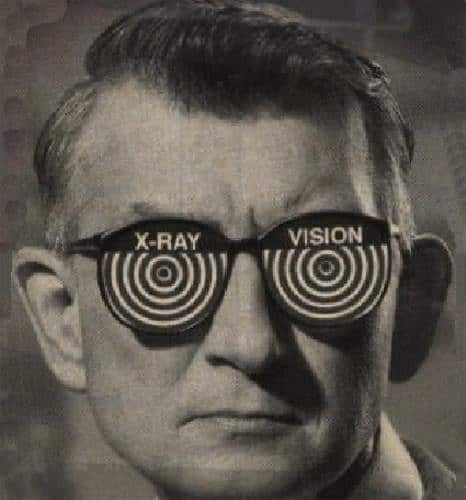
Mark Zuckerberg, trying to see his way clear to dominating the Artificial Intelligence race, is now saying that those of us who don’t use AI glasses will be at a disadvantage in the future. Reminds me of the X-Ray glasses hype from my childhood.

X ray man 1.

When you consider Zuckerberg’s checkered legend with starting what would eventually become Facebook, after running a college website called FaceSmash to rate girls, the comparison to the come on for X-Ray glasses does have a prurient parallel to many an adolescent boy’s fantasies.

I guess Zuckerberg needs to justify all of the money he’s spent building out AI infrastructure and wooing talent but it also is very reminiscent of the days he mucked up the media by declaring text was out and the pivot to video was in. In fact, much of this AI race feels very much like that. Sure, some of that stuck, but it mostly just made a mess and the legacy of that pivot left more than a few scars.

This entire AI race feels like that to me at the moment. I believe some of it is going to stick around and actually be useful. But mostly it’s just messing things up at the moment as everyone jumps into the deep end of a pool hoping to learn a new way to swim.

I’ve dealt with a few different companies of late trying to help some elder clients cut down on bills and solve some issues. Several of those companies have been switching much of their customer service to AI chatbots and the like. In those transitions they’ve more than made a mess of things for their customers and their employees who are left trying to clean up the mess.

I’m not completely down on Artificial Intelligence. I can see some benefits from the technology. At this point in the game it’s tough to sort out what that might be from the hype that seems to be authored by the folks who keep promising self-driving cars and those that promised X-Ray glasses.

You’d think by now someone would have developed an AI platform for investors and corporations that could see through the hype.

You can find more of my writings on a variety of topics on Medium at this link, including in the publications Ellemeno and Rome. I can also be found on social media under my name as above. 

Sunday Morning Reading

A bit of this, a bit of that. All good bits.

It’s the Dog Days of Summer and it’s been a hot one so far. We’re traveling again, but there’s still some interesting Sunday Morning Reading to share. Some of it hopeful, some elegiac. Some just geeky and fun. Enjoy.

Milen kolev zs9jdUCaP_4 unsplash.

Kicking things off is a piece in The Atlantic from Anna Deavere Smith called When You Don’t Look Like Anything. She’s a singular artist always worth paying attention to. Her story of her 50-year search for the American character is certainly more than worth your time. Damn good stuff.

A.R. Moxon popped up on my radar this week with a piece called Total Eclipses. It’s part 2 of a series, the first being Be Bolder, Not a Boulder. If you’re like me and looking for any light at the end of any tunnel these days, do give both pieces a read.

NatashaMH offers up An Ode To The Poetic Detours. It’s about writing and where she finds inspiration, but more broadly, it’s about observing, noticing, listening, seeing, and feeling between the lines we sometimes get trapped within.

Will Dunn asks Are Emoji’s Killing Language? I’ve been saying they are for quite some time. For the life of me I don’t understand why we seem intent on regressing back to an age of hieroglyphics instead using the complex beauty of words and language.

Mathew Ingram says The Google Link Economy Is Dying and It’s Not Coming Back. He’s not wrong. Actually, he’s very right.

Health is a big deal in tech these days, especially when it comes to adding features to improve monitoring what’s going on in our bodies. Frankly, as someone who uses medical devices for monitoring my diabetes, the promises to add that kind of monitoring to smart devices, along with blood pressure and other conditions, sound hollow, seeming as realistic to me as self-driving cars. We may get there one day, but for now it’s mostly a clever way to market something new to increase the bottom line. Victoria Song takes a look at Samsung’s recent effort to check out our level of antioxidants with their smartwatch in I ‘Fooled’ Samsung’s New Antioxidant Feature With a Cheez-It. 

Much has been made of Paramount’s caving to Donald Trump, leading to the firing of late not comedian Stephen Colbert. That was quickly followed up by the Trey Parker and Matt Stone’s skewering new season opener of South Park. Paramount paid up, got its merger, and in an Aristotelian, if not Mel Brooksian sense there’s some grand comedy in the entire thing. I’m a fan of Alexandra Petri’s piece examining the moment pre-South Park titled Are You Laughing Yet?

Sometimes we just need to laugh at what feels like no laughing matter.

(Image from Milen Kolev on Unsplash)

If you’re interested in just what the heck Sunday Morning Reading is all about you can read more about the origins of Sunday Morning Reading here. If you’d like more click on the Sunday Morning Reading link in the category column to check out what’s been shared on Sunday’s past. You can also find more of my writings on Medium at this link, including in the publications Ellemeno and Rome.

Hang On Commodore 64 Nostalgia Nerds. Legal Trouble Is Brewing

Jumping the gun?

It seems longer, but it was just a week ago that there was lots of excitement in tech nostalgia circles over an announcement that YouTuber Christian ‘Peri Fractic’ Simpson was taking pre-orders for a “new” Commodore 64. 

Cleanshot 2025 07 16 at 08.03.38402x.

As if we all don’t have enough to keep up with, the news generated quite a bit of buzz. No word on if it generated actual pre-orders.

Well, for those thinking about joining the Commodore 64 nostalgia parade, there might be some legal hurdles on the parade route ahead.

Commodore Industries, S.r.l, is out with a press release claiming they still own what’s own-able regarding the Commodore 64 and offering documents and evidence. After all of the hype surrounding Simpson’s announcement Commodore Industries claims it is now time to “intervene” to set the record straight.

Quoting from the press release:

Mr. Christian Simpson (alias ‘Peri Fractic’) recently made statements on his YouTube channel, at different times, which were picked up by numerous media outlets and various newspapers, aimed at undermining our position, claiming to have ‘bought Commodore’ and describing our use of the trademark as ‘illegitimate’.

None of the initiatives launched in the United States give Mr Simpson the right and/or power to cancel or revoke our legitimate rights to the above trademarks.

Such claims are not only legally unfounded, but also compromise the truth and unjustifiably discredit a business project that has invested time, resources and expertise in relaunching the Commodore brand in a modern and technologically advanced way.

In closing the press release states:

Our goal remains the same: to continue to create real value for the brand and for the entire Commodore ecosystem. For this reason, we are ready to dialogue and collaborate with anyone who demonstrates, through their actions, a constructive spirit and respect for both the rules and the community.

#WeAreCommodore

The hashtag and bold typeface concluded the press release.

Sounds like some lawyers are going to make some money. No one ever gets nostalgic over that happening.

You can find more of my writings on a variety of topics on Medium at this link, including in the publications Ellemeno and Rome. I can also be found on social media under my name as above. 

Through A Glass Darkly: Apple’s Liquid Glass Future Isn’t Clear

Continuing to watch Apple’s Betas from the sidelines.

Apple’s adventures with its new Liquid Glass design language reminds me of the title of a terrific, yet gloomy, Ingmar Bergman film, Through a Glass Darkly. Keep in mind that I’m not running the beta and living vicariously through the reactions of those whose opinions I trust. That said, based on some of those opinions of the recently released 4th developer beta, the future of Apple’s new design approach appears less than clear. 

Image from @davemark on Mastodon

From most accounts it’s a battle between legibility and the “coolness” of the design’s featured transparency that overlays content with the intent for the content below to bleed through. The challenge seems to be finding the right amount of bleed through that also allows users to easily read a notification or a control. 

In my view, the challenge with that challenge seems to be one of fighting things you can’t control. Holding liquid in your bare hands without spilling a drop might be easier. Every website and app designer has their own preference and approach. Even Apple apparently has difficulty as some of their own apps with background bleed through obscuring text. 

Image from @viticci on Mastodon

Since Apple announced Liquid Glass there have been three iterations of the approach. In a sort of Goldilocks and the Three Bears adventure with Apple dialing transparency features back and forth. Now in the 4th version of the developer beta reengaging more transparency. Searching for a “just right” solution doesn’t yet seem to be yielding any clear direction. But then, Apple’s ambitions, perhaps by design, have created a lose-lose short term future. The eventual product will never please everyone with this design change. But to be fair, that’s always the case with design changes and the folks at Apple knew that going in.

There are other usability issues as well, including things like making it easy to tell which tab or control is in focus, and having to tap multiple times to perform a function that used to be one tap to name a couple I see repeatedly mentioned.

But the clear focus of complaints (and some praise) is Liquid Glass. I would venture that for users it’s still too early to judge, but supposedly the Public Beta is due soon and the consensus is that what we see there will be pretty close to what we see in the Fall. Developers on the other hand are increasingly worried about Apple’s search for a “just right” solution while they try to find a path forward to have their own apps ready for the big release alongside or close to the release of this new wave of operating systems. 

CleanShot 2025-07-24 at 08.38.27@2x.

The problem becomes magnified when designing for the lowest common denominator with so many users. From my perspective of supporting clients and family members, most folks just want to pick up their devices and do what they want or need to do. They don’t want a new learning curve getting in the way. They certainly don’t want legibility issues to get in the way. There’s a real tension between what Apple needs to do to keep the cash registers ringing and the familiarity users want that I don’t think the folks in Cupertino understand given the annual pace they seem locked into. 

Image from @jsnell on Mastodon

The Bigger Picture

From where I sit on the sidelines, I think Apple has also created some real and perhaps less transparent problems beyond how Liquid Glass eventually rolls out.

Coming on the heels, and at least somewhat intended as a distraction from last year’s Apple Intelligence and Siri woes, Apple needs to create a clear narrative surrounding Liquid Glass in order to sell this year’s new crop of iPhones. (I imagine the commercials have already been scripted if not filmed.)

That already seemed like quite a challenge given that the only big hardware news this year is the rumored introduction of a smaller, lighter, apparently with less features iPhone Air. I don’t imagine that Apple’s traditional iPhone lineup is going to have new features to tout that makes those familiar device form factors must haves or must upgrades. 

If you’re counting on a flashy UI design change as the distraction that gets criticized as much as the issue you’re trying to distract from you’re magnifying your problems. Unless of course, you bank on criticism of the distraction further distracting from bigger issues.

Adding to that, the larger narrative has somewhat already passed by this year’s iPhones to what comes next year, with just about everyone assuming Apple’s version of folding iPhones will be the new focus. 

Sum all of that up and this is starting to feel potentially like a lost year for Apple. Sure, Apple will sell lots of iPhones, but if it can’t capture the imagination the way Apple usually does, much of the narrative will be wait ’til next year. Apple historically takes a long view. Time will tell if they have lost control of the visible horizon.

iPadOS 26

That said, somewhat under the radar, iPad beta users continue to trumpet the success of changes made in iPadOS 26. I’m looking forward to seeing that myself. That said, as much as those potential changes will be welcome, I can’t imagine that’s the tentpole Apple wants to rely on to create excitement this year.

CleanShot 2025-07-23 at 07.19.00@2x.

I mentioned the film Through A Glass Darkly in the opening of this post. The story of that classic film is about a family that gathers to try and heal after a member diagnosed with schizophrenia is released from an asylum. If you ask me, the challenges we’re seeing at Apple with design changes, Apple Intelligence and Siri among other things demonstrate that there are multiple personalities exhibiting control at various times within Apple, at a time when some turnover at the top is already underway, with quite a few calling for more.

As always, I recommend Michael Tsai’s Blog as a good source to keep track of how all of this continues to develop.

And with that, I’ll leave this update from the sidelines with this. 

CleanShot 2025-07-24 at 08.29.28@2x.

Update: The public betas for all of Apple’s new operating systems were released shortly after this post was originally published.

You can find more of my writings on a variety of topics on Medium at this link, including in the publications Ellemeno and Rome. I can also be found on social media under my name as above. 

The Bad Guys Love The Law When It Is On Their Side

You only think you own what you bought.

I once wrote a line in a play that I cribbed from my mother that always got applause, “Just because it’s legal, don’t make it right.” I’d like to assume that most folks who might read a thing or two here understand that far too many laws have been written not to protect everyone or make things right, but instead to often give cover for blatant acts against the little guy in favor of the big guns. 

Copyright laws when used as a weapon to further corporate interests and feather CEO nests have been one of the  favorite tools for the bad guys. That’s been an ever increasing problem paralleling the advance of technology as more and more companies reject the idea that if you bought it you own it, and still claim rights that too often are protected by laws that were never written to contemplate the world we find ourselves in. 

With a hat tip to Denny Henke, take a look at this video from Louis Rossmann about a recent example of this. 

You can find more of my writings on a variety of topics on Medium at this link, including in the publications Ellemeno and Rome. I can also be found on social media under my name as above. 

Scott Hanselman’s TEDx Talk On The Promises of Technology

Worth your time to give this a watch

Scott Hanselman is a someone I’ve followed for quite some time. I’ve always found his insights on technology and the intersection technology has with humanity to be valuable and that they make me think. Strange that I think of it has an intersection, given that technology wouldn’t exist without humans.

 I recently saw he that his TEDx talk titled Tech Promised Everything. Did It Deliver?

Scott breaks down the three promises of technology into Connection, Convenience, and Creativity. I won’t hint at where the talk goes, you should watch it for yourself.

As an intriguing side note given the subject matter I found in remarkably inconvenient that WordPress decided to do some sort of work on their backend as I went to publish this post. Technology is great when it delivers, right?

Regardless, what Scott has to share is excellent stuff and highly recommended. 

You can find more of my writings on a variety of topics on Medium at this link, including in the publications Ellemeno and Rome. I can also be found on social media under my name as above. 

Commodore 64 Nostalgia Nerds

Count me as a Commodore 64 nerd back in the day.

The older you get, nostalgic moments can be fun, even if fleeting. If nothing else they jog a few memories to the front of your brain for a bit. When they involve bits and bytes they also help you remember just how much things have changed. One of those fun memories for me is of my first computer, The Commodore 64.

CleanShot 2025-07-16 at 08.03.38@2x.

Recently, news hit that Christian ‘Peri Fractic’ Simpson, who has been trying to revive the Commodore 64 for some time now, has finally put enough of whatever he needs to start taking pre-orders for a “new” Commodore 64.

The announcement stirred a wave of nostalgia from those, like myself, who owned one of these early personal computers. And like many, those waves felt quite pleasant to surf in for a while. It also has churned up some of the rough waves from back in the day when “what computer is best” was a big part of the discussion.

I owned the Commodore 64, later moved to the Commodore 128 and then an Amiga, before eventually surrendering to the IBM PC/Windows world and later Apple. But I do indeed have fond memories of sprites dancing around on the small TV monitor I had connected to the 64, all of the peripherals I accumulated along the way, and some of the games. Archon and Lode Runner were two of my favorites, and the text adventure version of The Hitchhiker’s Guide to the Galaxy was my first exposure to Douglas Adams. I was also a fan of the GEOS operating system. And yes, I typed in many a computer program from computer magazines of the day, as well as quite a few words into PaperClip.

Drew Sauer has penned a nice  piece on this called The Commodore 64 Made A Difference, continuing the trip down memory lane and also surfacing some of those “what computer is best” feelings, apparently not too deeply buried in some memory banks. Apple bloggers John Gruber and Jason Snell have taken issue with some of Sauer’s comments and recollections.

Frankly, it’s all in good fun, (I hope), I don’t think it matters much for those who hope Simpson can deliver on his promises, and if he does, plop down their money to relive some of those memories. Nostalgia itself also comes in waves.

I’m also sure that memories can falter, become fuzzy, and take on a life of their own. Which is something the Commodore 64 could never do, unlike what so many want their computers to do today.

You can find more of my writings on a variety of topics on Medium at this link, including in the publications Ellemeno and Rome. I can also be found on social media under my name as above. 
Sunday Morning Reading

Notice the good things amidst the bad.

It’s been a week. But I repeat myself. These days it seems like that’s always the case. Superman’s back. (Again.) So too are this season’s butterflies. Everything circles back. Today’s Sunday Morning Reading is a potpourri of topics of interest that stroke a number of chords, some familiar, some not so, some good, some not so. Either way, enjoy.

Photo 1693722379283 fd3627e18cea.

In That Was Good, Merlin Mann says that smart people always find the best reasons for being very sad. I can relate. He suggests the cure for that might be noticing some good things. Even the small ones. Check it out. It’s a good thing.

This week featured the news revisiting the subject matter of several plays I’ve written or directed in the past. One of those, Inherit the Wind, the play by Jerome Lawrence and Robert Edwin Lee, is a semi-fictional retelling of the Scopes Monkey Trial in Dayton, Tennessee. This year marks the 100th year anniversary of that trial. Neil Steinberg has a terrific piece, both commemorating and commiserating. Given how short a distance we’ve traveled in this circle we keep walking in. Check out 100 Years Ago, The Scopes Trial Gripped The Nation, And Here We Go Again.

Twice a week on social media I post “This is your now weekly, and continuing reminder that we’re still fighting the Civil War.” Frankly, I don’t see it any other way for reasons I shouldn’t have to explain. I don’t often post interviews in this column, but I’m making an exception this week to post Amita Sharma’s interview with political scientist Barbara Walter who has helped forecast civil wars in other countries. Take a look at San Diego Political Expert Details Steps That Could Lead To US Civil War.

I blow hot and cold on Tom Nichols’ political commentary. I very much like his piece Damn You All To Hell! Find out his thoughts on how Hollywood taught a generation to fear nuclear catastrophe. It might have worked with that horror. Funny, yet sad, how it hasn’t worked with all of the goings on currently.

History is indeed always an incomplete picture that’s always evolving and struggling to take hold. In Texas Man’s Fight To Move A Lynching Marker Sparks New Battle For Truth, Christina Carrega pinpoints one of those moments of evolution.

Mathew Ingram says We Shouldn’t Blame AI For The Stupid Things That People Do. I agree. AI is the prime example.

Chris Castle takes on a piece of the Section 230 argument, thinking that a new theory of liability is emerging, grounded not in speech, but in conduct. Give a look at The Duty Comes From The Data: Rethinking Platform Liability In The Age of Algorithmic Harm. 

And to round out the circle this week, take a look at David SparksA Remarkable, Unremarkable Thing. Don’t let the small things go unnoticed.

(Image from Anya Chernik on Unsplash)

If you’re interested in just what the heck Sunday Morning Reading is all about you can read more about the origins of Sunday Morning Reading here. You can also find more of my writings on Medium at this link, including in the publications Ellemeno and Rome.