Joe Reddy for the Associated Press writes up a nice piece about Amazon’s AI on its Prime Video broadcasts of NFL Football games. While Reddy’s piece covers the what is, (that’s his job) it doesn’t talk about the what for.
Here’s the thing, the prevailing wisdom in sports coverage these days seems to be that the games themselves must not be enough to hold fans attentions long enough for them to watch the commercials, so we need to add distraction upon distraction before, during, and after the games to keep the fans interested. Certainly one can say that this season’s slate of NFL games wasn’t that terrific, at least the ones I watched. (I watched more than Chicago Bears games, because the Chicago Bears don’t play real football.)
Sports used to be a pastime. Watching a game was a luxury on TV or in person. And that was before the tremendous cost of attending a game in person went nuts. In many places, you could always catch the local games on TV, but that’s an age coming to an end sooner than we’d all like.
Certainly, these AI generated statistics do deliver an interesting factoid now and again. So this is not to say there’s not any value. It’s just not redeeming enough in my opinion.
Amazon isn’t alone, All of the networks are fumbling over each other to have the latest, greatest whiz bang graphics fill up our screens. They’re not mining data, they are mining dollars. The insertions of stat upon stat, mid-game interviews with coaches and players all come at a cost.
In my humble opinion it’s a cost that cheapens not enhances. But that’s the way we’re headed, because eventually we can tack even more sponsors and ad dollars on to each stat and distraction.I’m sure betting on what the AI will predict will soon follow.
You can find more of my writings on a variety of topics on Medium at this link, including in the publications Ellemeno and Rome.I can also be found on social media under my name as above.
A nod to Billy Joel, a little Faust, a little Shakespeare and the cycle of life keeps turning.
We may not have started the fire. In the words of Billy Joel, “it was always burning.” Still we can always try and fight it. I’m not sure how that’s working out but it does seem to be our lot. Sifting through smoke and ashes, here’s a little Sunday Morning Reading to share.
Kicking things off is David Todd McCarty’sLooking for God, Sitting in Hell. Summed up nicely, “we get so lost in semantics that we forget the important parts.” Indeed.
And while we’re on the literature beat Brian Klaas give us Faustian Capitalism. Again, there’s nothing new under the sun here as we watch this country’s wealthiest men bend their knees in supplication, but there’s some small comfort in knowing we’ve been this selfishly stupid before.
John Pavlovitz hits a nail on the head with The California Fires Are a Disaster. The American Cruelty Is A Tragedy. It may be beyond our capacity to comprehend devastation, but as the previous two entries show, it shouldn’t be beyond our ability to know we keep repeating the same mistakes. Or maybe that’s really just the hell we’re living?
This piece should scare you, but again, its subject is as old as humankind’s penchant for inhumanity. Stephanie McCrummen shines a bit of light as The Army Of God Comes Out Of The Shadows.
Derek Thompson takes a look at The Anti-Social Century and how our reality is changing as we spend so much of our time alone.
Perhaps one of the keys to being less alone and less anti-social is choosing your friends wisely. Natasha MH says that “To survive this life, it’s crucial to discern which friends are worth keeping and which aren’t. You are the guardian of your own peace of mind” as she lays out The Optimist’s Dilemma In A Pessimistic World.
And finally, Ian Dunt offers A Little Bit Of Hope After A Terrible Week, in what he calls a survival guide for the next four years. Ian says “History has no direction.” He’s correct. It’s a circle, a cycle, a carousel.
If you’re interested in just what the heck Sunday Morning Reading is all about you can read more about the origins of Sunday Morning Reading here. You can also find more of my writings on Medium at this link, including in the publications Ellemeno and Rome. You can also find me on social networks under my own name.
Mark Zuckerberg’s nakedly transparent sucking up to Donald Trump continues to unravel much of whatever fabric we thought social media might have knit together. I remember back in the day when some argued over whether or not it should be called a social graph. Those were naive days and that was naive math.
When Zuckerberg ditched human fact-checking it was only a matter of time before he ditched DEI initiatives as the next move. That happened today. In fact I’m surprised he didn’t do that first. All of this has left me, along with others, debating the wisdom of hanging around on Meta properties going forward. The ones I’ve used are Facebook, Instagram, and Threads. Of the latter two, Threads would be easy to leave, Instagram less so. Facebook is a dilemma of another sort.
This week’s horrific fires in Los Angeles illustrate my dilemma. I have many friends living in Los Angeles. Facebook was the one way I could keep up with their lives and careers and more immediately these recent horrible predicaments. I was able to find out who was safe and who was in danger. I know for several of them it was akin to a lifeline.
Perhaps our problem is how we got sucked or suckered into these social media maelstroms in the first place, but in the scope of human history it’s no different than how we follow any sort of trend, until we discover the downsides. It was an easy decision for me to abandon Twitter when Musk took over. This decision will be more difficult.
Not only does this week’s tragedy hit home differently, but Facebook has been a way, and I suggest the only way, I have had to stay connected to folks I went to high school and college with. The same, to a lesser extent is true about Instagram.
Sure I could have made phone calls, written letters, and Christmas cards, but being able to effortlessly see what’s happening in the lives of others I know was a decided benefit. Yes, I was feeding the beast each time I scrolled, liked or shared something, but the only difference between that and what we’ve done ever since the dawn of the age of marketing is scale, unless you’ve never shopped at a grocery store, used a bank, or bought insurance.
So, I’m struggling a bit with the decision I know I will inevitably make, and I know others are too. It will be a loss. Social media is a bit of a wilderness right now, and any wilderness is a dangerous place.
Sadly, and selfishly, my struggles are certainly less fraught than those of some of my friends and colleagues who know that there are those eager to exploit Meta’s dehumanizing new policies.
In an answer to the question “Do insults about mental illness and abnormality violate when targeting people on the basis of gender or sexual orientation?” Meta now answers “no.” It gave the following examples of posts that do not violate its policies:
Non-violating: “Boys are weird.”
Non-violating: “Trans people aren’t real. They’re mentally ill.”
Non-violating: “Gays are not normal.”
Non-violating: “Women are crazy.”
Non-violating: “Trans people are freaks.”
And in examples of posts that are now allowed on Facebook:
“There’s no such thing as trans children.”
“God created two genders, ‘transgender’ people are not a real thing.”
“This whole nonbinary thing is made up. Those people don’t exist, they’re just in need of some therapy.”
“A trans woman isn’t a woman, it’s a pathetic confused man.”
“A trans person isn’t a he or she, it’s an it.”
These tech bros used to con us (yes, we always knew it was a con) with promises of building a better world. I guess we can only be glad that their efforts are now more transparent, and their views, in my opinion twisted and wrong. Hopefully that knowledge of this moment will allow us to hopefully make wiser decisions going forward. I say hopefully, because in my view of the world, we haven’t proven we’re capable of that yet as a species.
You can find more of my writings on a variety of topics on Medium at this link, including in the publications Ellemeno and Rome.I can also be found on social media under my name as above.
What if the former office holders at Carter’s funeral, took the orange turd into a backroom and knocked him around a bit?
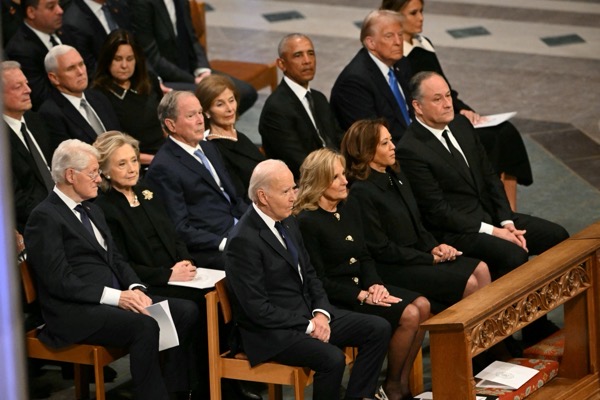
Watching a bit of former president Jimmy Carter’s funeral service today I couldn’t help buy fantasize a bit.
Watching the remaining former presidents, the current and outgoing president and vice president, along with a few former VPs my mind leapt into wild imaginings. I sort of wished that there would be a moment when, post ceremony, they all gathered together in a room with the incoming sad excuse of a human-soon to be president, looked him in the eye, and just said, “No, we are not going to let this happen again.”
Then I imagined they beat the shit out of him.
Of course they are collectively far too long in the tooth for that and decorum and dignity always seems to reign. Even when the incoming keepers of decorum and dignity are about to tear it to shreds. So, it’s just a fantasy.
But I liked the moment in my mind.
You can find more of my writings on a variety of topics on Medium at this link, including in the publications Ellemeno and Rome.I can also be found on social media under my name as above.
Has fact checking ever worked? Seriously. Has it ever? In my opinion if there was ever any real utility, it’s long since lost its pucker.
Mark Zuckerberg caused all sorts of consternation yesterday announcing he was going to dismantle Meta’s fact checking operation now that he realizes a million-dollar bribe probably wasn’t enough to keep him out of jail during the reign of the next administration. It was quite a public puckering up.
But let’s get real for a moment. Once any fact-less statement takes off it spreads faster than a wildfire in California and all the fact checkers in the world can’t snuff it out. For some facts do indeed matter. They occasionally do in our legal system, though not always. They used to in our legislative processes, but that’s long since become a relic of a time gone by. For most of its history, journalism wasn’t what so many bemoan the loss of today. Myths have fueled our religions and our histories since we first sought understanding.
And as for social media and the Internet in general? That’s a medium that has always allowed (and encouraged) the presence of fake personas. All bets there have always been off.
Prior to Zuckerberg’s recent sucking up, Meta had taken recent fire for allowing the creation of AI-generated chatbot personas to appear in feeds alongside regular users. Reaction to that led to a pull back that’s sure to be only temporary. I mean, think of the business model. Why do you need problematic real users when you can just create them and still con advertisers into paying for ads that most avoid or don’t see anyway? Programmatic users are certainly easier to control than problematic real ones—at least until the AI takes over.
Here’s a fact that doesn’t need checking. Facts matter if you think they do, but most of the rest of the world doesn’t care what you think if they can support their beliefs—or protect their business model—by making shit up and making it stick.
You can find more of my writings on a variety of topics on Medium at this link, including in the publications Ellemeno and Rome.I can also be found on social media under my name as above.
How many folks do you know who don’t trust iCloud? Or “The Cloud” in general? Quite a few, I would bet. When Apple rolled out iCloud in 2011, it offered, as all things do, a promise. Trying to move on from the problems associated with its previous troubled cloud service, MobileMe, it was a rebrand, a re-architecting, and a repeat of prior problems that missed the target and generated enough criticism to turn iCloud into a punch line for all jokes about “The Cloud.”
Apple has steadily improved iCloud (it still has issues), but not enough to remove that tarnish. The recent flap over summaries generated by Apple Intelligence threatens to do the same to that new brand, and quite frankly to the concept of Artificial Intelligence in general. Some might see that as a good thing, but that’s another issue for another day.
The issues with Apple Intelligence are compounding, largely due to mistakes of Apple’s own making in its rush to correct its way-too-late entry into a game it is losing. Overhyping the beta release as if it were a finished product certainly didn’t help. That investment in dollars essentially removed the excuse that mistakes can happen in betas. The “New Siri” remains delayed. And, like every AI release I’ve seen from other makers, once the initial shine wears off, the rough edges begin to show and cracks are revealed. I can’t count the number of users who claimed they’ve turned off most of Apple Intelligence features.
This latest flap deals with Apple Intelligence summaries. There have been legions of screenshots posted of humorous and not-so-humorous, inaccurate, confusing, and downright misleading summaries. The BBC has now twice called out Apple for misleading and inaccurate summaries. The most recent one named a darts player the winner of a competition before the match had even been played.
Apple has now responded, reminding everyone about the beta status and that a future update will further clarify when the text being displayed is summarized by Apple Intelligence. In essence, a warning label.
Quite a few big dogs in the Apple influencer game have already barked, weighing in with possible suggestions and warnings. (See these links from John Gruber and Jason Snell.) There’s somewhat of a debate as to who should have ultimate control over whether or not users see summaries. Should developers be able to opt out of having notifications summarized from their apps, or should users have control by opting out of the feature? Either way, in my opinion, it points to essentially a defeat and also a larger problem.
First impressions matter. Screwing the pooch in a first impression typically leaves a mark.
Given what we already knew about AI hallucinations, mistakes, and problems before Apple belatedly and hurriedly entered the game, I don’t think anyone thought Apple would have solved that problem. Thus, the shield of announcing it as a beta. But the dollars spent on promoting it certainly didn’t offer enough prominent caveats to cut through the glitzy messaging. Apple Intelligence, beta or not, was the tentpole marketing feature. Heck, Apple’s announcements moved markets as if gold had been discovered.
Summaries are just one of many features that AI offers, Apple’s version and others. Arguments can be made that summaries are a good thing in a busy world, and also that they are completely unnecessary given that there is a level of mistrust that already existed pre-Apple Intelligence, that requires, almost demands, users to check the work generated by the AI before relying on it.
However Apple chooses to work its way out of this latest problem of its own making, its misplaced marketing miscues have called enough attention to Artificial Intelligence to make it a problem for that entire segment of the tech industry. What was a key selling feature is quickly becoming the butt of another joke.
If this was a game of darts, Apple’s shot would have not only missed the target but also missed the board.
You can find more of my writings on a variety of topics on Medium at this link, including in the publications Ellemeno and Rome.I can also be found on social media under my name as above.
Crime has a new and devalued meaning in this new world, but the criminal who started this will be in charge soon. Never forget that he and his worshippers did what they did to this country on January 6th. To make a buck. They may legally be let off the hook, itself another crime that mocks our legal system into irrelevance. They most certainly will try and erase history and this story. We have a history of that sort of whitewashing in this country. It’s something we do all too well.
Bad things are going to happen to this country and its people beginning in a few weeks. This most recent spark may have been lit on an escalator in 2015, but it burst into all-consuming flames on January 6th, 2021, after smoldering with occasional flare-ups since the American Civil War, itself an conflagration smoldering since this country’s founding.
I recommend reading this article in The Atlantic from Jacob Glick, “ What I Saw on the January 6th Committee.” It has an interesting and worthy perspective on the surrounding investigations. But let’s set investigations aside. They mean little these days when they can be both derailed or manufactured from whole cloth.
The Big Lie won. The Big Liar won. Those who worship at his feet, along with those of us who see what is actually happening and about to happen, lost. There’s this sense of trying to find a sense of normalcy, a sense of balance to manage the treacherous path ahead. There will be none. We’re off-axis, and gravity is behaving in mysterious ways.
We are living in a moment when the history of this world will change. Not under our feet, but in front of our faces. There’s no rug to be pulled out from under us, only a mirror we avoid like a vampire.
We really don’t know how or what those changes will bring. The times they are a-changing, but it’s not the same song. We are breathing rare air right now, and in our lungs, it feels mysterious and wrong. January 6th will be the moment remembered. Never forget it.
Never forget it in the ways we have forgotten the other moments that allowed it to take place.
You can find more of my writings on a variety of topics on Medium at this link, including in the publications Ellemeno and Rome.I can also be found on social media under my name as above.
Looking back, while heading forward, with a nod to Beckett wandering through a lot of good questions.
This is the first edition of Sunday Morning Reading in the New Year, 2025. A new year certainly has meaning astronomically. From a human perspective it is a way of looking back in remembrance, even as we continue to evolve and move forward. Often these days, the evolving part seems more and more in question, even as humans make strides and advances in their various fields of endeavors. Some improve our lives, even as it appears so many of us remain stuck in the habits of the past and feel good about celebrating that choice to turn the clock back.
This week’s edition, in a way, marks that always thin dividing line between one year and the next, when what was old carries over into the new.
Natasha MH kicks things off with a lovely remembrance of her grandfather, It Begins With A Grain Of Salt. There’s a lovely quote:
Human intuition is not always reliable. Our perceptions can be distorted by biases and the limitations of our senses, which capture only a small fraction of the world’s phenomena.”
The Next Big Idea Club shares some insights from Greg Epstein’s new book Tech Agnostic: How Technology Became the World’s Most Powerful Religion, and Why It Desperately Needs a Reformation, in The Weird Worship of Tech That Demands Serious Questioning. Epstein is the Humanist Chaplin at Harvard and at MIT, where he advises students, faculty and staff on ethical and existential concerns from a humanist perspective.
One thing is certain as we head into the new year, Artificial Intelligence will continue to dominate discourse. Jennifer Ouellette examines what happened at the Journal of Human Evolution when all but one member of the editorial board resigned. Some of the issues predate the current AI moment, but that seems to have been a breaking point as she explains in Evolution Journal Editors Resign En Masse.
Simon Willison takes a look at Things We Learned About LLMs in 2024. It’s an excellent look back and worth hanging onto as we plunge ahead, willingly or no.
Edward Zitron believes that generative AI has no killer apps, nor can it justify its valuations. Here’s him quoting himself from March 2024:
What if what we’re seeing today isn’t a glimpse of the future, but the new terms of the present? What if artificial intelligence isn’t actually capable of doing much more than what we’re seeing today, and what if there’s no clear timeline when it’ll be able to do more? What if this entire hype cycle has been built, goosed by a compliant media ready and willing to take career-embellishers at their word?
Strip out the reference to AI and apply it anywhere along the timeline of human evolution and innovation and the questions resonant in a very Beckett-like way. Check out his piece Godot Isn’t Making It.
Judges in the U.S. Sixth Circuit drove a stake through the heart of Net Neutrality as the new year dawned. Brian Barrett says it’s crushing blow not just for how we live our lives on the Internet but consumer protections in general in The Death Of Net Neutrality Is A Bad Omen. He’s correct.
And finally this week, an incredible piece of reporting from Joshua Kaplan at ProPublica. The Militia And The Mole is at once terrifying and also confirming when it comes to the fears those paying attention harbor heading into whatever this next year is going to bring.
If you’re interested in just what the heck Sunday Morning Reading is all about you can read more about the origins of Sunday Morning Reading here. You can also find more of my writings on Medium at this link, including in the publications Ellemeno and Rome. You can also find me on social networks under my own name.
Terrific early work by famous authors among this year’s entries into the public domain.
In addition to being the first day of the New Year, January 1 is also known as Public Domain Day, when titles previously under copyright enter the public domain in many countries, including the U.S.
This year’s titles include a host of good books by some authors you might have heard of including William Faulkner, Earnest Hemingway, John Steinbeck, Dashiell Hammett, Thomas Wolfe, Sinclair Lewis, Edith Wharton and Mahatma Gandhi among others.
These book titles, were first published in 1929. I won’t get into the length of copyrights and all the issues surrounding that, but instead say this is an interesting collection of works, some early or first works by some of the authors listed above.
Keep in mind that on Public Domain Day a number of titles in other media also entered the public domain. Duke University publishes a more extensive, but not complete list that includes titles of plays, movies, characters, music compositions, art, and sound recordings. The date for sound recordings is 1924 and includes Rhapsody In Blue by George Gershwin.
You can find more of my writings on a variety of topics on Medium at this link, including in the publications Ellemeno and Rome.I can also be found on social media under my name as above.
Everyone has rituals they follow around the turning of the New Year. For some it’s making resolutions. For some it’s breaking them. Among other household chores and family obligations, those chores include doing some tech cleanup, archiving, and discarding some of the digital detritus that has accumulated over the last year.
I’ll be paying closer attention to cleaning things up during this year’s ritual as I anticipate moving from the M1 iMac 24 I currently own to the M4 version sometime in the first quarter. My iMac is the center of my computing tasks. External storage that I use throughout the year hangs off of that, it’s the one device I use where I don’t Optimize Photo Storage, and I download some, not all, of my music there as well. I can easily fill up 750GB of 1TB of SSD disk space throughout the course of a year, sometimes more.
That external storage contains ongoing archives and backups, as well as ripped (legally) videos I maintain that I can access on other devices, such as the Apple TV at or iPad via the app Infuse. I’m still old fashioned enough in my work habits that if I’m working on a project I keep its files local, even though I may routinely back them up to the cloud so I have access to them if I’m on the road.
Below are some things I do in the week following the turn of the new year.
Clean Up Photos
I take a lot of photos throughout the year, mostly just for fun. Typically I’ll take multiples of the same shot, especially of my grandkids. That means there are a lot of duplicates. I’ll get rid of most of those via manual examination. That happens on my iMac. I don’t quite trust Apple’s deduping process, but I may give that a go this year.
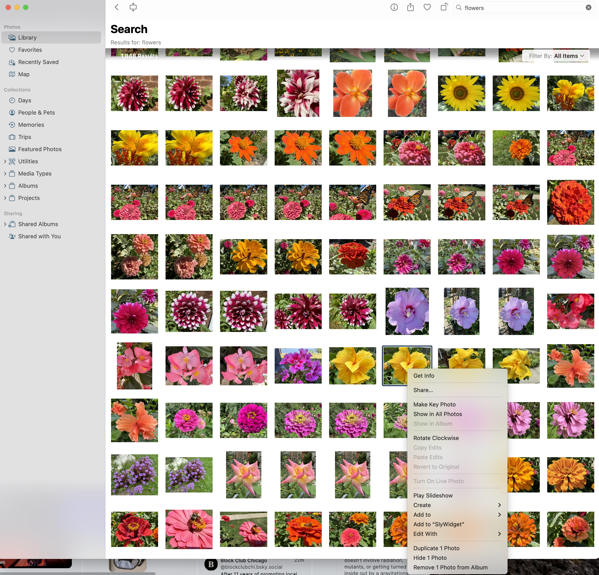
This year Apple vastly improved its search capability in Photos and I find it works quite well. Unfortunately though it delivers the results to what I assume is a “smart album.” Regardless, the problem with that is that you can’t delete a photo or series of photos from that result unless you first enlarge each photo and delete each one directly. You can remove one or multiple photos from the album created, but I would think that possibly changes whatever algorithm Apple is using to group these photos.
As you can see in the image below I take lots of pictures of flowers.
While there are direct duplicates, there are others when I vary the shot slightly enough that it’s not an exact duplicate so any dedupe tool won’t work. Being able to delete those I don’t want from that search result would be a terrific time saver.
Clean Up Videos
With two young grandkids we take a lot of videos. Most of the family uses iPhones so much of what’s taken and shared gets stored in Photos. I’ll go through the videos accumulated there throughout the year and put them on external storage that stays attached to my iMac so as to somewhat reduce the size of my Photo library before it inevitably expands again during the next year. That also allows me to store them alongside the videos from non iPhone family members of nieces and nephews. You never know when you’ll need one of those childhood videos to embarrass a younger relative in front of their significant other in the future.
Change Passwords
Passwords are necessities in our digital lives, though there’s hope that Passkeys will take a firmer hold going forward. That hasn’t happened with many of the websites I use routinely yet and I wish it would. I do change passwords at the beginning of every year as a routine, one I’d love to not have to do. Of course I change various passwords throughout the year as well, which leads to me deleting some that have accumulated throughout the year.
Since I still rely on far too many passwords, I continue to use One Password for password storage, but I am increasingly transitioning to Apple’s new Passwords app. Of course that means I’ve increased my task load of changing passwords this year to make sure what’s stored is properly reconciled between the two apps.
Archive Files
Each year there are always projects I complete and don’t need to have immediate access for those files and assets. I’ll clean up my day-to-day working environment by archiving those files both in the cloud and on local external storage media.
For local storage it’s a multi-year process. I’ll archive files to attached external storage so I can easily retrieve things if the need arises during the next year or so. Once a series of project files have aged two-years I’ll move them to local storage on a drive that is then archived and stored away separately. At some point I’ll have to think about getting rid of some of those older archives on older drives, but I haven’t felt the need (or discovered the patience) to reexamine and accomplish that chore.
For digital archiving I primarily use Dropbox, but I won’t sync those archived files and folders to my desktop going forward. I can always go and fetch them if needed. I’m a little more rigorous with that digital archive in that I examine it for files I can delete every year, and typically delete a good portion of those remaining digital archives two years after a project is completed.
Delete Apps I’m No Longer Using
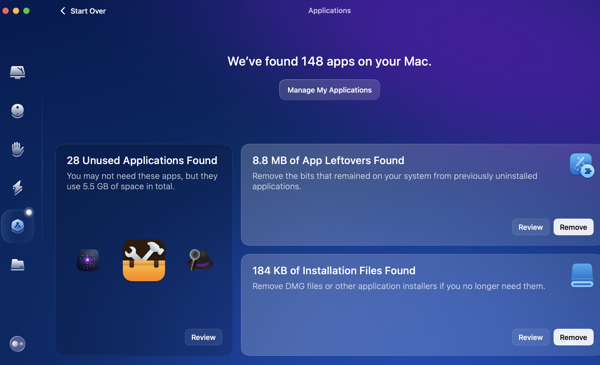
My pace of downloading apps has slowed down quite a bit, primarily because I seem to think I have most of the tools I need already. That doesn’t mean I won’t try out a new apps each year. A few will stick, but most don’t. I’ll delete those during this digital housekeeping phase. I use Clean My Mac and it provides a good utility for telling me how long it’s been since I’ve used an app, along with the other tools it includes in its suite of utilities.
In App Archiving
I use several apps to collect webpages and articles to read later. The two I primarily use are Goodlinks and Instapaper. I used to use Pocket quite a bit for this, but its owner, Mozilla, has essentially ruined that app for me. I’ll go through and delete any articles or links that I’m not interested in keeping and archive those I do want to keep. Instapaper provides a handy archive function. I use tags in Goodlinks to organize what I want to hang on to and a folder structure in Instapaper for things I want to keep quicker access to.
Cancel Subscriptions
Typically I’m pretty on top of things throughout the year regarding the subscriptions I use for apps and services. Even so, I still take an inventory at the beginning of each year. While that rarely leads to a cancellation at that point, it does put me on notice to see if I think a subscription will be worth continuing as the year goes on. I’ll set reminders 10 days before a subscription is due to be renewed and if it hasn’t provided value since the beginning of the year I’ll make sure to cancel or not renew at that point.
Clean Up Contacts
I have to admit I’ve gotten lazy here. I blame Auto-Complete in email and messaging clients, even though they are not always 100% accurate. I’ll still do a quick once through, but I’m afraid my reliance on Auto-Complete in this area has not only made me lazy, but might make me recoil at what I see if I ever had to get serious about this again.
Clean Up Cables
I don’t routinely change cables for the sake of changing them and I am not one of those in a rush to replace the few devices requiring Lightning connectors with newer USB versions. It’ll happen when it happens. But I do check out what I’ve got plugged in and cabled to to make sure everything looks in good working order and to take an inventory on whether or not I need to keep an eye out for deals on any cables I think might need replacing throughout the year. Throughout the last two years I’ve eliminated a lot of cable clutter around my desk by using MagSafe chargers.
Check UPS Status
I review the warranties for the Uninterruptible Power Supplies (UPS) that I use to gauge if any look like they might need to be replaced during the coming year.
Printer Check
We use an Epson ET-2760 EcoTank printer and have for a couple of years now. Our printing needs continue to diminish, but they do come in spurts, and we haven’t ordered ink since we bought the thing. Once a month I’ll check the ink supply and print a few things to make sure everything stays in good working order, but I’ll do a through maintenance check using the printer’s on device tools at the beginning of each year regardless.
Roomba Maintenance
This is a relatively new one. We use a Roomba and it’s now become a part of our Christmas ritual that I give my wife a parts replacement kit that contains filters and brushes as a gift. Not sexy I know, but we both have routine gifts we exchange in a similar fashion.
You can find more of my writings on a variety of topics on Medium at this link, including in the publications Ellemeno and Rome.I can also be found on social media under my name as above.



 When Zuckerberg
  Watching the remaining former presidents, the current and outgoing president and vice president, along with a few former VPs my mind leapt into wild imaginings. I sort of wished that there would be a moment when, post ceremony, they all gathered together in a room with the incoming sad excuse of a human-soon to be president, looked him in the eye, and just said, “No, we are not going to let this happen again.”


 Life on the Wicked Stage: Act 3