-
A Little Halloween Fun
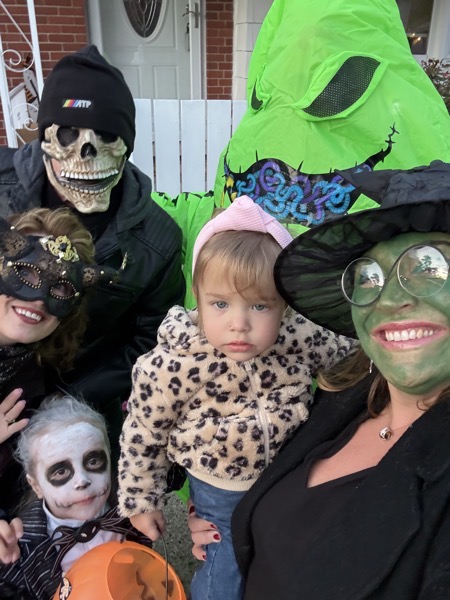
Trick or treating with the grandkids. Better than a sugar rush.
-
Late Arriving Fall Color in Chicago
Two things everyone in our circles are talking about. ICE raids and a late arriving Fall. As far as the usual colors we get every Fall, this year most of our leaves haven’t turned yet. We’re about to turn the calendar from October to November and most of the foliage is still quite green.

Many of the early turning golden leaves are gone and filling the gutters, and there’s the occasional burst of red among the green. But all feels late. It will be interesting to see how this season progresses.

-
DeValuing The Myth of Anything Super
Super.
It used to mean bigger, better, bolder, somehow special. At least when it referred to humans, as in superheroes.
Now that we’re busy replacing humans with Artificial Intelligence, the rush to brand AI innovations as somehow superior or “super” is doing more to devalue the concept of anything “super” since the comic books and their movie spinoffs started examining all the collateral damage their superheroes caused in their efforts to save worlds, galaxies, universes and multi-verses.
Long time proofreading service Grammarly acquired the AI-native email app Superhuman this past summer and has now announced a sort of unusually reversed rebranding that rolls out these bundled services under the subsumed Superhuman brand.
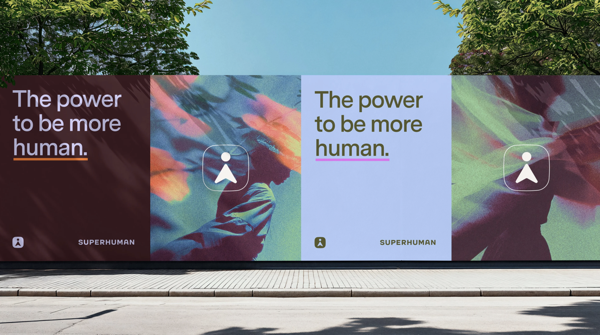
You have to laugh at the decidedly and very human super-ego sized slug line that claim the new effort gives you “the power to be more human.”
The newly christened Superhuman certainly isn’t alone as Artificial Intelligence purveyors have been defining pursuing super intelligence as their goal for quite some time, which has always had an ironic appeal, even if chatbots and the like don’t understand irony.
In my opinion the entire thing is all very silly, far too easily unmasked as unhealthy hubris, yet also very dangerous. The promises continue to fall short, yet the hype continues to feed economic fires that will eventually burn out, even as AI invades everything associated with technology and business.
Super may have a definition that sets anything following the prefix as special and somehow superior to the ordinary. But it is also slang for supernumerary, which in show biz traditions means extra, unwanted, or unimportant.
You can also find more of my writings on a variety of topics on Medium at this link, including in the publications Ellemeno and Rome. I can also be found on social media under my name as above.
-
New Friends
Someone thinks they’ve found a friend.

-
Review: A House of Dynamite
When you live in Chicago, a city under siege by ICE, I’m not sure, but I guess it a strong bent of masochism to watch a movie where your city gets nuked by an unknown enemy. That’s sorta how I felt when my wife and I cued up the excellent Kathryn Bigelow film, A House of Dynamite over the weekend. We debated back and forth, and decided to give it a go. I’m glad we did.
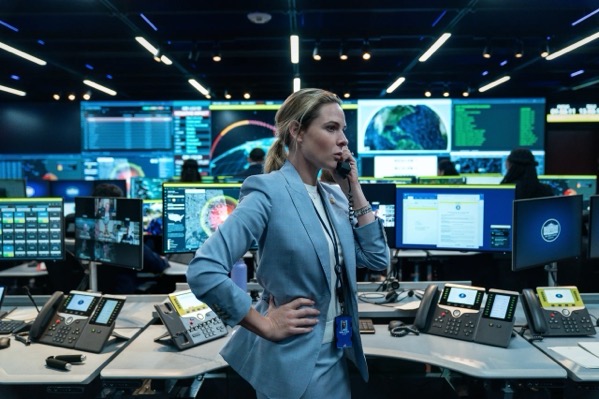
It’s certainly not an easy movie to watch, regardless of where you live. Yes, a city gets nuked. But that’s not the strength or the point of this movie. Nor should it be a spoiler at this point. The strength lies in watching otherwise steely individuals wither when their shields of confidence dissolve into vulnerable realizations as a horrible what-if scenario becomes all too real to contemplate, yet alone live through, even though they’ve contemplated them over and over again in training.
We don’t get the disaster movie special effects explosions and carnage. They aren’t necessary for this film to work. What we do get is far more terrifying. We get holes ripped through the souls of the characters we’re allowed to meet as they do their jobs. We get belief in systems and protocols developed by smart people shattered, leaving us all wondering if any of it was worth it in the end. It’s a parable of the moment.
It’s certainly not a Halloween movie, but I can’t think of a scarier film to watch as it strips away every possible security blanket and myth we might have become just too comfortable imagining, and realize just how much we’re in the hands of human beings just like us when horrible things unfold.
That’s more than frighteningly true with an utterly incompetent administration running the U.S at the moment. Noah Oppenheim’s script subtly, deceptively, and brilliantly lays that out as it carries us deeper into unfolding and inevitable danger that may be too horrible to watch, but is certainly more terrifying not to.
Bigelow and Oppenheim’s characters all seem more than capable of the sensitive jobs they hold. The filmmakers dispense with the tropes typical of these kind of disaster flicks that feature the usual array of martinets, incompetent and insufferable fools, and even heroes, sung or unsung. Sure, we see some of the personal traumas and trivia some may be dealing with as they come to work on the morning in question. But we initially watch each of these men and women of strong character knuckle down to perform when the unthinkable moment presents itself.
We then watch as they ultimately come face to face with that horrible moment of realization that there is nothing they can do to stop the inevitable. We watch as the enormous personal toll alters their breathing as they have no choice but to carry on with psychic wounds bigger than any smoldering crater before the missile even hits. Bigelow’s camera work and the cast’s strong acting gives us searing glimpses into those moments of horror and devastation as she catches her characters when each crushing realization occurs.
In three parts and an epilogue, the movie repeats the same horrible 18 minutes or so from missile detection to impact, presenting the scenarios in different government locales and viewpoints. We see a missile interception station in Alaska communicating with the White House Situation Room, the STRATCOM headquarters in Nebraska, FEMA headquarters as they have to pull out the plans for the inevitable, and the president who is attending a basketball camp event and then whisked away, while his aides work to inform him from the White House.
Those parts overlap using much of the same dialogue presented from these different points of view via video or audio conferences as the government tries to formulate its response. The repetition of dialogue serves as a better tension builder and reminder of the time before impact than any of the countdown clocks we might see on the screen. As does the sudden departures of those who need to be taken to secure locations as events unfold.
Bigelow’s cast includes some big name actors in a cast headed by Idris Elba and Rebecca Ferguson, that also includes Anthony Ramos, Gabriel Basso, Jared Harris, Jason Clarke, Greta Lee, and Tracy Letts among a host of others. Some of that host provides some of the most telling reactions on the periphery of the action as they watch their bosses try to handle the situation.
To my mind, nothing procedural happens that we haven’t seen or read about in countless Cold War thrillers of the past. With one exception. I was left with the same sort of existential dread after viewing A House of Dynamite as I was when I first read Tom Clancy’s Sum of All Fears and realized the weapon was going to explode. The only difference is that there was a hero in the Clancy novel to pick up the pieces and help us move beyond the horror.
In A House of Dynamite there are no heroes. Only humans. Trying to do their best. Not failing. But having to face the reality that sometimes your best is simply not enough in the face of madness.
You can also find more of my writings on a variety of topics on Medium at this link, including in the publications Ellemeno and Rome. I can also be found on social media under my name as above.
-
Sunday Morning Reading
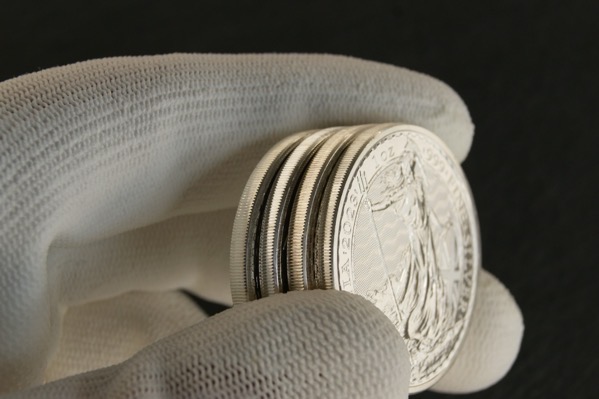
Regardless of the many problems with the Internet, there’s no denying its benefits. One of those is the pleasure of reading stuff I probably would never be aware of without it. In many ways that’s what this Sunday Morning Reading column is about (as well as my life in general on the Internet.) When you read and live life enough, you discover that the trick is always balancing on the edge of the coin that separates the two sides.
There’s comfort perhaps landing on one side or the other, but life is actually in the fragile middle of the muddle somewhere, even if it’s a fine, and increasingly thinner line, often hard to discern.
First up this Sunday is a piece by Josh Marshall of Talking Points Memo called Fear, Greed, Civic Virtue and the Fall of the Elites. Pay attention to that word “virtue.” As Marshall points out it originally meant “manliness.” The word’s evolution is as tricky as the concept itself.
Follow that up with Ian Betteridge’s The Politics of the Missing Middle.
Ian Betteridge’s law of headlines that says any headline that ends in a question mark can be answered with the word “no.” Steven Levy falls into Betteridge’s trap in his piece, Can AI Avoid The Enshittification Trap? Cory Doctorow’s theory of Enshittification has been a popular topic in this column and Betteridge’s law certainly applies here. For those looking for a primer on enshittification Greg Rosalsky has a a quick primer on the topic in A Theory Why The Internet Is Going Down The Toilet.
While technically not falling under the umbrella of enshittification, some of the ways folks are using AI sure sound shitty. Check out Alexandra Jones’s I Realized I’d Been ChatGPT-ed Into Bed: ‘Chatfishing’ Made Finding Love On Dating Apps Even Weirder.
Things are getting weird indeed. Adi Robertson tells us that The Next Legal Frontier Is Your Face and AI.
Several pieces on the arts and creativity stood out to me this week. David Sparks’ The Inherent Value Of The Creative Act reflects on his creative life and his resistance to using AI for the work of creating, but it helps with his administrative tasks. There’s that edge of the coin again.
Authoritarians always target art and artists first. You don’t need an Internet to discover that history, or perhaps we might if the current forces in charge have their way. Andrew Weinstein discusses Trump’s Campaign To Defund The Arts—and Rewrite History.
Speaking of creativity or rather the other side of that coin, Joe Rosenthal takes on Creative Neglect: What About The Apps In Apple? I mentioned some of this in a piece I wrote this past week.
Speaking of that edge and to close out this week, here’s an image of a Mastodon post by friend David Todd McCarty from this morning.
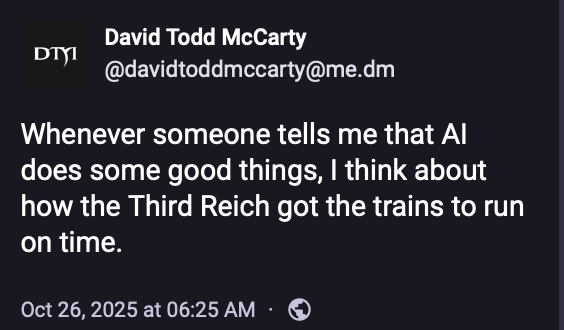
(Coin Image above from ABARONS on Shutterstock)
If you’re interested in just what the heck Sunday Morning Reading is all about you can read more about the origins of Sunday Morning Reading here. If you’d like more click on the Sunday Morning Reading link in the category column to check out what’s been shared on Sunday’s past. You can also find more of my writings on Medium at this link, including in the publications Ellemeno and Rome.
-
Some Fall Photos
Sharing some photos of interesting moments I’ve seen this Fall.





-
Apple’s Changes To The Phone App Are Helpful and Confusing
When the iPhone was first announced Steve Jobs uttered the now famous words about three products that would be combined into one:
Well, today we’re introducing three revolutionary products of this class. The first one is a widescreen iPod with touch controls. The second is a revolutionary mobile phone. And the third is a breakthrough Internet communications device.
The app for that “revolutionary mobile phone” has undergone few changes through the years since 2007, but nothing really to call home about. It can be argued that of those original three products, the phone has become perhaps the least important as users relied more and more on other methods of communication. This year with iOS 26, the Phone app got some significant changes. Some of which, at the moment, are proving quite helpful even if a bit confusing.
Let’s talk about the confusion first.
Apple introduced a new Unified View in the Phone app that consolidates Favorites, Recents, and Voicemails all under a single Calls tab. It sounds good to try and combine these features into one hub as a concept, but I find it confusing and some of the folks I support do as well. Apple also knew it could be confusing, providing users with a way to switch back to the prior Classic View with the familiar separate tabs for Favorites, Recents and Voicemail. Those folks I support are choosing to stick with the Classic View rather than learning something new. I’m swinging back and forth.

Like anything else new this Unified View breaks muscle memory. That sort of change isn’t necessarily a bad thing, but coming after years of users trained on the same interface, it’s about as confusing as flipping the mouthpiece and the earpiece on an old landline phone would be.
If you choose the Unified View and designate enough contacts as Favorites, it’s also a damn ugly interface to look at. Your Favorites are arrayed at the top with recent calls below.. If you tap on Show All, (the catch all bucket if you have more than seven Favorites) you’re taken back to the same list view from the older UI of the Classic View. (The Unified View is on the left and the Classic View is on the right in the image below.)

I’m also confused at times about the differences between what’s a Missed Call and What’s an Unknown Caller as notifications sometimes, not all the time, appear in both places. Sometimes a call record will show up in three places if it’s also identified as a Spam call.
New and Newish Features
Hold Assist Detection sounds like a winner of a feature. In some cases it is. In some not. It makes me think that the designers of this feature have never used the Phone app to call a pharmacy or a doctor’s office where the person answering the phone is so busy that when they answer they speak so fast that you can’t understand what they’re saying. In my experiences attempting to use this feature in cases like those, the person on the other end just hangs up and I have to make the call again. I’ve yet to have a successful attempt at using this feature as designed other than testing it with friends.

As an intriguing side note, the same thing happened with a call to Apple Support.
Screen Unknown Callers is another new feature that works well in some cases yet not in others. It has certainly reduced the number of unwanted calls I’ve received since turning it on. The call screening happens before your phone rings, which apparently is enough to bring an end to a number of those calls. Sometimes those calls appear in the Missed Calls list, sometimes not. What I don’t understand is that some of these calls also show up as Priority Notifications while others do not.
There are three options for screening unknown callers. The first is Never, which means you aren’t screening and all calls come through. The second is Ask Reason for Calling, which queries the caller. The third is Silence which silences any unsaved numbers and sends them to voicemail, placing the log of the call in the Recents List.
I’ve been using the Ask Reason for Calling option and, as I said, it has cut down on the number of unknown calls I receive in a day. My wife and I received our current phone numbers when we lived in another state and area code, so we essentially reject any calls with that area code as unwanted. I do wonder if this will become a whack-a-mole game with spam callers in the future as they look for ways to get around this feature.
Call Filtering silences missed calls and voicemail from unknown numbers. Those calls end up in the Unknown Callers List. Sometimes in other lists.
Spam Calls, as identified by your carrier, are silenced, sent to voicemail and moved to the Spam List. Yet, sometimes are flagged as Priority notifications.
Live Voice Mail has been around since iOS 17 and is supposed to show you a live transcription of a voice mail so you can pick up if the call is important. I tried this a couple of times during the iOS 17 era but never used it regularly to gauge how well it worked. I’ve tried it a few times in iOS 26 and have not been able to see the live transcription until after the caller ended things on their end. So I’m guessing Apple has some work to do there.
The good news about all of this is that Apple in the last couple of years is working to make your iPhone less of a nuisance when it comes to dealing with unwanted calls.
The not-so-good news comes in two buckets. The new user interface will require quite an adjustment. Kudos to Apple for providing an option to switch back easily. The other bucket is that phone makers have to rely on carriers for reducing Spam. Spam lists are the province of the carriers. That push and pull is reflected somewhat in the design of the Phone app interface when it comes to blocking unwanted calls.
In order to Block or Block and Report a phone number as Spam there are two options. If you swipe left on the record of an unknown phone call a small orange icon with a white hand appears that reveals the blocking actions.

You can also open up a Contact card by hitting the Info button on the right of a Contact card, scroll all the way down to the bottom of the card and choose to Block the number from there.
Either method described above is more cumbersome than it needs to be in my opinion and it would be much simpler if Apple could design an incoming call screen that had a prominent Block button on it.
These new features Apple has added to the Phone app in my opinion demand better curation of contacts by a user to work effectively. At least in my case they do. Numbers you may use once in a while need to be in your contacts in order for these new phone features to identify them appropriately. By the same token, numbers you never want to hear from again need to be blocked or blocked and reported as spam.
All methods of communication eventually devolve into this kind of tedium and you’d think by now there would be money enough to find better technological methods to relieve us of it.
My other concern is one that I have about how Apple handles its apps in general. With a few exceptions, (Notes and Reminders) Apple tends to release new features for an app and then let them go years without continuing to improve them. I hope that’s not the case with these new features in the Phone app. Apple made a good, certainly overdue, next step with these changes. They can’t just leave us all on hold until they take the next one. We could all use a little more sanity and perhaps a bit more revolution from the “revolutionary mobile phone.”
Who knows? Maybe one day Apple will even turn its attention to the long neglected Contacts app.
You can also find more of my writings on a variety of topics on Medium at this link, including in the publications Ellemeno and Rome. I can also be found on social media under my name as above.
-
Shocked, Shocked To See A Gambling Scandal Involving Professional Sports
This week’s easily awarded Claude Rains Award goes to the federal government for busting up sports gambling in the NBA that’s intertwined with the Mafia.

In case you’re not up to snuff, Claude Rains played the character in the movie Casablanca who was “shocked” to discover gambling going on at that movie’s famous nightclub. If you’re not up on that film, then I guess you’d might be shocked that there is illegal gambling in sports involving players.
Several NBA big names are involved. According to news reports so far current Miami Heat player Terry Rozier apparently was involved in a what amounts to a points shaving scheme letting sources know that he would take himself out of a game early so bettors could bet the under on the points he would score. Portland Trail Blazers coach Chauncey Billups is accused of being involved in rigged poker games, serving as a “celebrity” piece of bait to lure others to the underground games. Some of those games used some impressive technology, including an X-Ray table to cheat the suckers.
I’ve survived several vices in my life. Gambling was one I never got hooked on. Not because I’ve always known that illegal gambling was synonymous with most sports, but because I was never good at it. If I’m surprised by any of this it’s that there is actually a bust of such a wide ranging gambling operation in this current environment. Folks in the know, know. And they’ve known long before legalized sports gambling became as ubiquitous as hot dog and beer vendors at baseball games in stadiums that now house sports books on site.
As an example of that, take a look at Mike Florio’s book Big Shield, about sports gambling, mostly in the NFL, but also touching on the NBA. (FYI I don’t do affiliate links.) Parts of what we know about this current bust sounds like they are lifted right from the plot of the book.
It will be interesting to see how the NBA handles this because I’m betting the two names unveiled this morning aren’t the only athletes involved. It will also be interesting to see how the other pro and college leagues responds. There’s big money to be made on sports gambling, especially if you’re inside the scam.
You can also find more of my writings on a variety of topics on Medium at this link, including in the publications Ellemeno and Rome. I can also be found on social media under my name as above.
-
Woolly Bears and Colder Weather
A bit envious of this woolly bear caterpillar’s coat given that the temperatures have dropped here in the Midwest. But then the woolly bears were always a harbinger of the Winter to come.

Skip to content

Life on the Wicked Stage: Act 3
Musings on life, the theatre, technology, culture and the occasional emu sighting
 Life on the Wicked Stage: Act 3