Sunday Morning Reading

With aging comes awareness. Or at least it should.

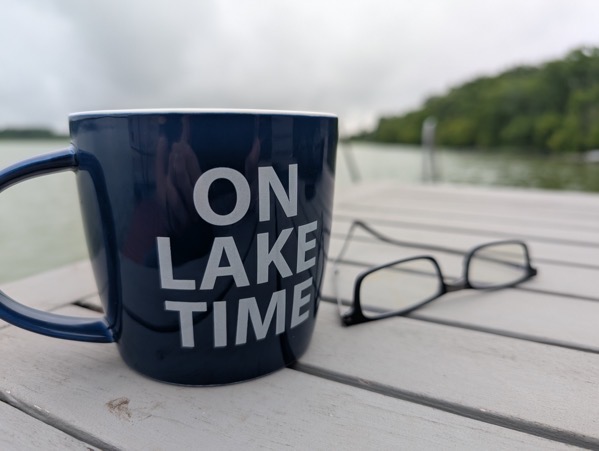
We’re on Lake Time this weekend, but there’s still time to share some Sunday Morning Reading. 

PXL 20250706 141021103.

Two weeks ago I shared a piece from youngster David Todd McCarty titled When I Was Old. I’m resharing it this week since I celebrated a birthday on Friday, getting one year closer to marking seven decades on this rock. Also sharing another great piece from David, called I Was Told There’d Be More.

“Scented memories.” I like those two words put together by NatashaMH in her piece, The Fragile Geometry of Becoming. 

I’ve been an Elmore Leonard fan for as long as I can remember. Anthony Lane’s Elmore Leonard’s Perfect Pitch may not be perfect, but it is damned close enough.

David Struett delivers a terrific ode to Chicago bike messengers, their culture and their jobs in Meet Chicago’s Last Bike Messengers. Here’s How They Survive.

You might notice a touch of sentimentality and reminiscing in the pieces above. Comes with the thoughts during a birthday weekend. Fair warning though that most of the links shared below are a bit darker, and yes, more political than those above. With aging comes awareness. Or at least it should.

Mathew Ingram wonders What Do We Do When The Facts Don’t Matter? I think we’re not liking what we’re finding out.

Mike Masnick’s piece Facism for First Time Founders offers the next generation a clue or two, assuming the current generation doesn’t crash it all before they get a chance to discover them.

I’ve written about the concept of enshittification in tech quite a bit. Mostly as regards the Internet. Henry Farrell and Abraham L. Newman take a look at The Enshittifcation of American Power. 

Another big contributor to enshittification is the media who increasingly seem more and more clueless and devoid of any self awareness. Charlotte Kim takes a look Inside The Media’s Traffic Apocalypse.

Speaking of things toxic and shitty, Adam Aleksic explores How Incel Language Infected The Mainstream Internet — and Brought It’s Toxicity With It. I’ve spent almost 70 years on this planet. I have no idea why guys turned into such misanthropic, self-loathing idiots.

In a world seemingly more and more intent on criminality, there are very few surprises, but there are legacies. Jessica Winter’s What I Inherited From My Criminal Great-Grandparents. Great story.

To conclude this week I’m sharing a film review by Sonny Bunch. This one of the new film Eddington. I haven’t seen the film. I plan to. Rarely does a review encourage or discourage me from seeing a film. If it’s anything like Bunch describes one way or the other I’m sure it will be worth it as it sounds like a fun, yet conflicted, summary of lots of things we’ve all been living through since 2020, and continue to do so. I’ll leave it with this quote:

The feed never stops, the algorithm never tires. There’s always more. It never ends. Just a few more videos. You can sleep later. You can never sleep, if that’s what you’d prefer. Who knows what you’ll miss when you’re asleep?

And we wonder why everyone has gone a little nuts.

If you’re interested in just what the heck Sunday Morning Reading is all about you can read more about the origins of Sunday Morning Reading here. If you’d like more click on the Sunday Morning Reading link in the category column to check out what’s been shared on Sunday’s past. You can also find more of my writings on Medium at this link, including in the publications Ellemeno and Rome.

Commodore 64 Nostalgia Nerds

Count me as a Commodore 64 nerd back in the day.

The older you get, nostalgic moments can be fun, even if fleeting. If nothing else they jog a few memories to the front of your brain for a bit. When they involve bits and bytes they also help you remember just how much things have changed. One of those fun memories for me is of my first computer, The Commodore 64.

CleanShot 2025-07-16 at 08.03.38@2x.

Recently, news hit that Christian ‘Peri Fractic’ Simpson, who has been trying to revive the Commodore 64 for some time now, has finally put enough of whatever he needs to start taking pre-orders for a “new” Commodore 64.

The announcement stirred a wave of nostalgia from those, like myself, who owned one of these early personal computers. And like many, those waves felt quite pleasant to surf in for a while. It also has churned up some of the rough waves from back in the day when “what computer is best” was a big part of the discussion.

I owned the Commodore 64, later moved to the Commodore 128 and then an Amiga, before eventually surrendering to the IBM PC/Windows world and later Apple. But I do indeed have fond memories of sprites dancing around on the small TV monitor I had connected to the 64, all of the peripherals I accumulated along the way, and some of the games. Archon and Lode Runner were two of my favorites, and the text adventure version of The Hitchhiker’s Guide to the Galaxy was my first exposure to Douglas Adams. I was also a fan of the GEOS operating system. And yes, I typed in many a computer program from computer magazines of the day, as well as quite a few words into PaperClip.

Drew Sauer has penned a nice  piece on this called The Commodore 64 Made A Difference, continuing the trip down memory lane and also surfacing some of those “what computer is best” feelings, apparently not too deeply buried in some memory banks. Apple bloggers John Gruber and Jason Snell have taken issue with some of Sauer’s comments and recollections.

Frankly, it’s all in good fun, (I hope), I don’t think it matters much for those who hope Simpson can deliver on his promises, and if he does, plop down their money to relive some of those memories. Nostalgia itself also comes in waves.

I’m also sure that memories can falter, become fuzzy, and take on a life of their own. Which is something the Commodore 64 could never do, unlike what so many want their computers to do today.

You can find more of my writings on a variety of topics on Medium at this link, including in the publications Ellemeno and Rome. I can also be found on social media under my name as above. 

Sunday Morning Reading

Notice the good things amidst the bad.

It’s been a week. But I repeat myself. These days it seems like that’s always the case. Superman’s back. (Again.) So too are this season’s butterflies. Everything circles back. Today’s Sunday Morning Reading is a potpourri of topics of interest that stroke a number of chords, some familiar, some not so, some good, some not so. Either way, enjoy.

Photo 1693722379283 fd3627e18cea.

In That Was Good, Merlin Mann says that smart people always find the best reasons for being very sad. I can relate. He suggests the cure for that might be noticing some good things. Even the small ones. Check it out. It’s a good thing.

This week featured the news revisiting the subject matter of several plays I’ve written or directed in the past. One of those, Inherit the Wind, the play by Jerome Lawrence and Robert Edwin Lee, is a semi-fictional retelling of the Scopes Monkey Trial in Dayton, Tennessee. This year marks the 100th year anniversary of that trial. Neil Steinberg has a terrific piece, both commemorating and commiserating. Given how short a distance we’ve traveled in this circle we keep walking in. Check out 100 Years Ago, The Scopes Trial Gripped The Nation, And Here We Go Again.

Twice a week on social media I post “This is your now weekly, and continuing reminder that we’re still fighting the Civil War.” Frankly, I don’t see it any other way for reasons I shouldn’t have to explain. I don’t often post interviews in this column, but I’m making an exception this week to post Amita Sharma’s interview with political scientist Barbara Walter who has helped forecast civil wars in other countries. Take a look at San Diego Political Expert Details Steps That Could Lead To US Civil War.

I blow hot and cold on Tom Nichols’ political commentary. I very much like his piece Damn You All To Hell! Find out his thoughts on how Hollywood taught a generation to fear nuclear catastrophe. It might have worked with that horror. Funny, yet sad, how it hasn’t worked with all of the goings on currently.

History is indeed always an incomplete picture that’s always evolving and struggling to take hold. In Texas Man’s Fight To Move A Lynching Marker Sparks New Battle For Truth, Christina Carrega pinpoints one of those moments of evolution.

Mathew Ingram says We Shouldn’t Blame AI For The Stupid Things That People Do. I agree. AI is the prime example.

Chris Castle takes on a piece of the Section 230 argument, thinking that a new theory of liability is emerging, grounded not in speech, but in conduct. Give a look at The Duty Comes From The Data: Rethinking Platform Liability In The Age of Algorithmic Harm. 

And to round out the circle this week, take a look at David SparksA Remarkable, Unremarkable Thing. Don’t let the small things go unnoticed.

(Image from Anya Chernik on Unsplash)

If you’re interested in just what the heck Sunday Morning Reading is all about you can read more about the origins of Sunday Morning Reading here. You can also find more of my writings on Medium at this link, including in the publications Ellemeno and Rome.

Sunday Morning Reading

Mixed feelings and mixed emotions on a Summer Sunday by the lake.

The 4th of July weekend is wrapping up in the U.S. and many are having mixed feelings this year. Today’s edition of Sunday Morning Reading will feature some excellent writing on some of those mixed feelings in addition to some interesting reads on familiar topics from familiar writers, and some not so familiar. Enjoy.

Giuseppe argenziano J04GmVkKSLQ unsplash.

First up, let’s take a look at Elizabeth Lopatto’s view on the state of things in the states in her post The American System of Democracy Has Crashed. Excellent. Should be required reading.

Neil Steinberg also has thoughts well worth your time in He’s baaaaaaack.

Jack Hopkins gives us The 4th of July: What We Were Meant to Celebrate — and How We’re Failing It. Again, worth a read as we close out the long holiday weekend and this section of today’s Sunday Morning Reading.

Now for some catching up on some links I’ve delayed too long in sharing.

First up is The Chosen Few and the Cost of Global Silence from NatashaMH. History repeats. All the damn time. As she also demonstrates in this piece The Cruelty of Indifference.

Relative youngster, David Todd McCarty writes about aging in When I Am Old.

Writers are having trouble finding the right fit when it comes to how to make a living. Matthew Ingram tells us Why Substack Shouldn’t Be The Future of Online Publishing. We

Chuck Wendig argues about and bemoans the loss of downtime in his writing process given all that’s happening around us in A Small But Vital Thing, Taken.

While writers search for new ways and new homes, Joshua Rothman wonders What’s Happening To Reading?

Never Forgive Them is a piece from Edward Zitron from December 2024 that seems relevant again in more ways than it was intended then.

Composer and poet Stan Stewart recently had his computer die on him. He writes about what he lost and found in Of Dead Computers and Really Living.

Matteo Wong says The Entire Internet Is Reverting to Beta. Sure everything is a janky work in progress, certainly in the janky days of AI. But I think that’s how those who think they run the joint like running the joint.

And to close out this week, take a good look at this wonderful long read from Eric Konigsberg from all the way back in 2001, entitled My Uncle The Hit Man.

Image from Giuseppe Argenziano on Unsplash.

If you’re interested in just what the heck Sunday Morning Reading is all about you can read more about the origins of Sunday Morning Reading here. You can also find more of my writings on Medium at this link, including in the publications Ellemeno and Rome.

Sunday Morning Reading

Intelligence or compassion? They both caught my eye this week.

It’s interesting how topics surface throughout a week. I’m not sure if it’s follow-the-leader or hive mind thinking, but from the sources I follow this week it seemed like everyone was thinking and writing, in one way or another, about Artificial Intelligence. Or maybe just about intelligence.

Certainly there was plenty on other topics because there were certainly plenty of other big things happening. Some intelligent, some not so. Some showing the capacity for compassion right along side our capacity for cruelty. I’m sure there will be plenty written in the days ahead about all of those things. These are the posts that stuck with me for this week’s Sunday Morning Reading.

Kicking things off is a short post by Gene Weingarten called A Cat Named Grandpa. It’s about compassion.

Mathew Ingram wonders Is AI Smarter Than We Are or Stupider Than We Are? Read the piece. If you’ve read any of the things I’ve written on AI you’ll know I agree with Mathew’s conclusions.

David Todd McCarty thinks the lack of originality in human consciousness is both appalling and comforting in I Gotta Be Me.

Natasha MH was Seeking God In A Machine.

For those who need to think about end of life issues, this might be a timely, yet frightening from Ashley Belanger. Check out How To Draft A Will To Avoid Becoming an AI Ghost. Apparently, it’s not easy.

Matteo Wong writes about The Newspaper That Hired ChatGPT. It’s mostly an interview, but one worth reading.

Folks can become addicted to and troubled by just about anything, and AI is no different. We’re starting to hear more and more about this, which is somewhat surprising on a number of fronts given how short a time generative AI has been with us. Kashmir Hill writes about a young man whose reality became so distorted it almost killed him in They Asked ChatGPT Questions. The Answers Sent Them Spiraling.

While not about AI in specific, this tech story speaks volumes about the decisions tech bosses make that influence the technology we use to work and play with. Check out Phil McKinney’s I Convinced HP’s Board To Buy Palm for $1.2B. Then I Watched Them Kill It In 49 Days.

And Happy Father’s Day to all. Miss you Dad.

(Image from Rey Seven on Unsplash.)

If you’re interested in just what the heck Sunday Morning Reading is all about you can read more about the origins of Sunday Morning Reading here. You can also find more of my writings on Medium at this link, including in the publications Ellemeno and Rome.

Sunday Morning Reading

When caring becomes a commodity, should we care more or less?

Lots to care about. On all the usual fronts. But in the grand scope of the universe does much of it really matter? Some interesting links to share in this week’s Sunday Morning Reading.

Dan Sinker, taking a look at The Chicago Sun-Times AI flaps calls it The Who Cares Era. His theory is that along the way, nobody cared. I’d venture they cared about the wrong things.

Apple’s annual developer conference WWWDC is a week away and given the many issues the company is confronting lots of folks care and are curious about how Apple begins to address them. Some don’t see Apple changing how it deals with developers, like Aaron Vegh in his post, They’re Not Going to Change.

Some, like John Siracusa, are rooting for Apple and even offering advice. Siracusa’s piece Apple Turnaround is a companion to his recent previous post Apple Turnover. All worth a read, regardless of how you feel about the predicaments Apple finds itself in.

The tech bros who seem to be in the pole position running to rule the world may be making bank, but they’re not winning any friends in the process. They most likely don’t care given that they think they’re on their way to conquering the universe. John Kaag is offering up A Reality Check For Tech Oligarchs. Frankly, I don’t think they live in anything close to reality.

Meanwhile, down here on planet reality, some are looking for ways to survive and perhaps beat the odds seemingly stacked against us. A.M. Hickman lays out a vision for How To Live on $432 a Month In America.

Much of what’s going on around us might seem profane and vulgar, leading to quite a few expletives coming out of our mouths as we cope. David Todd McCarty takes us on an exploration of his love of four-letter words in Frequently Profane But Never Vulgar. For what it’s worth, all words have value in my opinion. Hiding from them is fucking stupid.

Natasha MH is Reclaiming the Joy of Struggle in an AI-Driven World. Better grab that joy while we can, because that struggle is only going to become more intense.

Just when you thought we might have begun to figure out the new landscape of insanity we’re currently struggling through, comes along Ross Anderson who informs us about The Nobel Prize Winner Who Thinks We Have The Universe All Wrong. It may someday stop expanding the way we thought and might just remain stagnant for longer than originally theorized, allowing intelligent life to continue longer than we thought. One may ask, should we care?

(Photo from Vincent Nicolas on UnSplash.)

If you’re interested in just what the heck Sunday Morning Reading is all about you can read more about the origins of Sunday Morning Reading here. You can also find more of my writings on Medium at this link, including in the publications Ellemeno and Rome.

Review: Apple In China by Patrick McGee

An excellent read about Apple and America’s acquiescence to China.

Timing is everything. As I began to write this short review of Patrick McGee’s new book Apple in China, this article, Auto Shangai 2025 Wasn’t Just a Car Show. It Was a Warning to the West, popped up on my radar. Let’s just say, they are nice companion pieces, given what I think the real message of McGee’s book is all about.

Cover page for Patrick McGee's Apple in China

I highly recommend McGee’s Apple in China. It not only provides some rich history and context to much of the hurly burly news we follow about Apple and its relationship with China, but beneath that surface it provides a deeper warning about the failures of capitalism — Apple and American style — in general.

Not only does it hit that crucially important overlay of the story, it provides some fascinating, and at times frightening detail in many of the design, engineering, corporate, and political maneuverings far beneath the surface of all the machinations we read about on our iPhones.

In my opinion, that’s where the real magic is in the story. Given the amount of detail, McGee had access to some excellent sources. He’s an excellent writer. Portions of the story read with the pace, suspense, and scope of an adventure novel.

The focus of the book — and any of the praise and criticism of it — is obviously Apple. The gist is that Apple essentially trained up China to such a point, that with the pull of a plug, China can cut it off, and take what it has learned to dominate the world’s manufacturing sectors. His arguments are persuasive, and since Apple is — and has been — such a crucial focus since the dawn of the iPhone age, that focus makes sense. But lurking beneath those headlines, are other American companies, occasionally mentioned, who might not have gained the same notoriety, but essentially followed the same path. Check out the article I linked to earlier about the Shanghai Auto Show.

If there’s a villain in the story, it’s China. If there’s a useful idiot, it’s Apple, along with other shareholder valuing and profit loving American companies. Think of the parable of The Scorpion and the Frog.

Certainly Tim Cook plays a central role in all of this, but I have to say outside of some of the details, his obsequious compromises and acquiescence throughout comes as no more of surprise revelation as does his knee-bending to the Trump regime’s recent bullying. That’s all been on transparent display for anyone who has paid the slightest bit of attention, which makes any and all of it seem nothing short of a foolish farce, albeit a lucrative one.

In fact, I think you learn more about Foxconn’s Terry Gou than you do about Tim Cook.

If there is one big surprise that I think pierces the Apple aura, it’s just how little central control and understanding of what was happening on the ground in China in the helter-skelter days of early iPhone growth. What on the surface may have seemed like, and been adopted almost as mantra-like by the tech press, a giant corporation with a vision pushing buttons in Monday morning executive meetings, often feels like a company reacting to forces beyond its control that it brought into the tent.

The fact that Apple was as completely overwhelmed by early iPhone sales volume in China is quite frankly astounding, given what most have believed was a generally good central command of inventory control and marketing predictions. Certainly no one can predict everything, but it seems Apple wasn’t even close to understanding, much less predicting, what might happen in that market. Even as it was unfolding.

Obviously Apple won most of those skirmishes and battles. The question the book raises is will Apple have what it takes to win the larger war that it helped set the battlefield for.

(I don’t do affiliate links to products mentioned in any article.)

You can find more of my writings on a variety of topics on Medium at this link, including in the publications Ellemeno and Rome. I can also be found on social media under my name as above. 

Sunday Morning Reading

Paying attention for the next generation.

Good morning. Visiting the grandkids this weekend, so this will be a short stack of links to share. Fair warning ahead most are on the darker side of the ledger. The links. Not the grandchildren. They are the light. The grandchildren are why I pay attention.

First up is a piece on despair from Dean Pritchard titled Despair, What Is It Good For. He calls it a hopeless call to action. I’m not sure it’s hopeless at all. Just another step in finding what may or may not turn out to be answers. As long as we keep stepping.

NatashaMH says that social media addiction isn’t just about us, it’s about the people around us in Unread, Unavailable and Unbothered. I’ve never been one to buy into the social media addiction theory. It’s too damn easy to put down the damn phone. But I take her points because it’s too damn easy to keep hoping to find new ways to avoid despair.

Lauren Goode takes on Deepfakes, Scams, and the Age of Paranoia. Somebody needs to.

Tom Schaller and Paul Waldman say that Trump is betraying the voters who elected him in The White Rural Reckoning. They are correct. But we knew that would happen. Scum likes to remove itself from other scum once it’s done scumming around.

Joan Westenberg compares the comeuppance moment Apple is enduring to Martin Luther’s reformation moment in Apple’s Diet of Worms. Given the abundance of fanatics there’s more than a little truth here.

Playwright Sara Ruhl is one of my favorites. Charles McNulty takes a look at what she has to say in her new book In ‘Lessons From My Teachers,’ Playwright Sarah Ruhl Finds Wisdom In Art, Motherhood, Even Grief.

And as for weathering despair, check out Lost At Sea by Alec Frdyman. Excellent reading about a scary adventure.

And to close out this weekend I’ll leave you with this uncredited thought that pops up every now and then on social media.

And just remember who the tax breaks are targeted for.

Peace.

If you’re interested in just what the heck Sunday Morning Reading is all about you can read more about the origins of Sunday Morning Reading here.  You can also find more of my writings on Medium at this link, including in the publications Ellemeno and Rome.

CNN Will Air George Clooney’s ‘Good Night and Good Luck’ Live From Broadway on June 7

This paradox should be a must watch.

I’d mark your calendar for this one. CNN will be airing George Clooney’s production of the play Good Night, and Good Luck, live on June 7th from the Winter Garden Theatre on Broadway. It will be the first time that a live play performance has been televised.

GNGL GNGL 111064 020792 TodayTix 1600x1200.

The play is adaptation of the 2005 movie of the same name that Clooney co-wrote, directed, and starred in, based on CBS journalist’s Edward R. Murrow’s work to expose Joe McCarthy during the Red Scare in the 1950s. In the movie Clooney played Fred Friendly, Murrow’s producer. On the stage he plays Murrow.

The Broadway production has met with critical acclaim and just recently announced that it had recouped its initial investment during its run that began in March of 2025.

I’m a big fan of the movie (I wrote a little about it here) and imagine I will also be of the stage version. I’m sure the story’s central message of standing up to bullies and demagogues translates just as well in a live version as it does on film.

I’m looking very much forward to watching this and would encourage you to as well. I know there are some who see Clooney as one of the villains in our recent political turmoil. And some see CNN has a willing accomplice to the madness we face. Even with what may seem like all of that irony, I would urge you to set that aside and give Good Night, and Good Luck a watch. As I said then

This isn’t some moment of nostalgia for a time gone by. It is a recognition that where we are now is a place we’ve been before. This time around those that control the media and messaging have, for the moment, much more control than they did in Murrow’s day. Make no mistake, they had some control then, but now it’s more pervasive and the Murrow’s, Friendly’s and Paley’s are fewer in number.

Setting aside the historical significance of this broadcast of a live play, and the paradox between the message and the messengers, I can’t think of a better reason to watch given where we are and will continue to be for some time.

You can find more of my writings on a variety of topics on Medium at this link, including in the publications Ellemeno and Rome. I can also be found on social media under my name as above. 

Sunday Morning Reading

Happy Mother’s Day reading.

Time for some Sunday Morning Reading on this Mother’s Day, with a short stack of culture, some tech, some politics, and the Ziegfeld Follies tossed in for good measure.

First up is a good long read from Spencer Kornhaber wondering if we’ve entered a cultural dark age. Provocative in parts, predictable in others, it’s worth your time for the journey it takes. Check out Is This The Worst-Ever Era of American Pop Culture?

Kaitlyn Tiffany says We’re Back to the Actually Internet. It’s about fact checking, the need for fact checking, and actually about how fact checking doesn’t really matter.

We may have beat the term fascism to death long before the real beating actually begins, and it’s the Bible thumpers who seem far too eager for the end times with their wishes for some sort of Armageddon beat down. Naomi Klein and Astra Taylor take a look at The Rise of End Times Fascism.

The Apple enthusiast world is still going through some things and will continue to for the foreseeable future. Denny Henke at Beardy Guy Musings is chronicling his thoughts about his move away from using Apple products. His latest, Are Apple Enthusiasts Miserable? takes a look at some of the angst and tensions he sees.

Indie app Developer Thomas Ricourad, the developer of the app Ice Cubes for Mastodon, among other apps, is searching. He’s not alone. Check out Having A Clear Vision In A Blurred World.

Matthew Gurewitsch takes a quick look The Story of a Rose, an upcoming look at an almost forgotten era in A Ziegfeld Girl Recalls The Forgotten War.

Happy Mother’s Day to all.

(image from Aga Putra on Unsplash)

If you’re interested in just what the heck Sunday Morning Reading is all about you can read more about the origins of Sunday Morning Reading here.  You can also find more of my writings on Medium at this link, including in the publications Ellemeno and Rome.