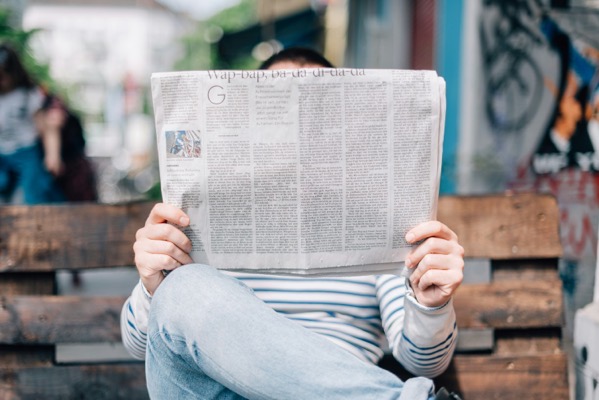
Sunday Morning Reading

Intelligence or compassion? They both caught my eye this week.

It’s interesting how topics surface throughout a week. I’m not sure if it’s follow-the-leader or hive mind thinking, but from the sources I follow this week it seemed like everyone was thinking and writing, in one way or another, about Artificial Intelligence. Or maybe just about intelligence.

Certainly there was plenty on other topics because there were certainly plenty of other big things happening. Some intelligent, some not so. Some showing the capacity for compassion right along side our capacity for cruelty. I’m sure there will be plenty written in the days ahead about all of those things. These are the posts that stuck with me for this week’s Sunday Morning Reading.

Kicking things off is a short post by Gene Weingarten called A Cat Named Grandpa. It’s about compassion.

Mathew Ingram wonders Is AI Smarter Than We Are or Stupider Than We Are? Read the piece. If you’ve read any of the things I’ve written on AI you’ll know I agree with Mathew’s conclusions.

David Todd McCarty thinks the lack of originality in human consciousness is both appalling and comforting in I Gotta Be Me.

Natasha MH was Seeking God In A Machine.

For those who need to think about end of life issues, this might be a timely, yet frightening from Ashley Belanger. Check out How To Draft A Will To Avoid Becoming an AI Ghost. Apparently, it’s not easy.

Matteo Wong writes about The Newspaper That Hired ChatGPT. It’s mostly an interview, but one worth reading.

Folks can become addicted to and troubled by just about anything, and AI is no different. We’re starting to hear more and more about this, which is somewhat surprising on a number of fronts given how short a time generative AI has been with us. Kashmir Hill writes about a young man whose reality became so distorted it almost killed him in They Asked ChatGPT Questions. The Answers Sent Them Spiraling.

While not about AI in specific, this tech story speaks volumes about the decisions tech bosses make that influence the technology we use to work and play with. Check out Phil McKinney’s I Convinced HP’s Board To Buy Palm for $1.2B. Then I Watched Them Kill It In 49 Days.

And Happy Father’s Day to all. Miss you Dad.

(Image from Rey Seven on Unsplash.)

If you’re interested in just what the heck Sunday Morning Reading is all about you can read more about the origins of Sunday Morning Reading here. You can also find more of my writings on Medium at this link, including in the publications Ellemeno and Rome.

Sunday Morning Reading

There’s a creeping inevitability to much of what’s happening around us.

Some Sunday’s when I sit down to collect what I find interesting enough to share it seems like things around us are just bad. Or going from bad to worse. It feels inevitable. This is one of those Sundays. Nevertheless, there’s some good writing and good thinking in the articles linked below that I believe are worthy of your attention. But paying attention is not one of our strong suits. Cue up a little Crosby, Stills, Nash and Young, pay attention, and read away.

‘Tin Soldiers and Nixon’s Coming’ is an excellent look back as we stare at this moment we’re in from Robert Cohen and Michael Konciewicz on the 2020 50th anniversary of Kent State and Jackson State.

You’re Not Ready, is an excellent, yet somewhat frightening compilation of articles by various authors at Wired, comprising info on AI hacker attacks, grid attacks, or a GPS blackout. I say “somewhat” simply because many of us have had inklings about this. Or at least those who pay attention.

Josh Marshal of Talking Points Memo has an excellent piece on Artificial Intelligence and The Posture of Skepticism.

Mathew Ingram’s fascinating piece, How Marc Andreessen and I (and you) Created The Web is informative and entertaining history and context that’s worth your time about the time we’re in.

Paul M. Sutter tells us that A New Theory Says Time Has Three Dimensions. It ‘Really Messes Up’ What We Know About the Cosmos, Scientists Say. We seem to be doing a good job of that at the moment given our current understanding of time, so why not go ahead and mess things up.

Timothy Snyder wonders what happens with The Next Terrorist Attack. It’s far deeper than the headline suggests.

Michael Podhorzer writes about something I’ve been thinking and saying for a while: The Courts Will Not Save Us. It’s a long read but more than worth your time. Read this instead of watching TV lawyers.

Most of the articles I’ve already linked to this Sunday morning in one way or another deal with trust. That trust gap is widening these days. It doesn’t help when we do find out things that break trust, but the finding out at least helps us understand the gap better. Take a look at Aruna Viswanatha’s piece The Pentagon Disinformation That Fueled America’s UFO Mythology.

Tomorrow, June 9th, Apple kicks off its annual World Wide Developer Conference. There are trust issues there as well. These next few links contain some interesting thoughts heading into WWDC, beginning with Sebastiann De With’s Physicality: the new age of UI, which anticipates the coming design changes rumored for all of Apple’s operating systems. A fresh coat of paint may not hurt. I’m not sure it’ll help.

As I said, Apple faces a number of problems, some legal and regulatory. Jérôme Marin explains how A Simple Comma is going to cost Apple Billions in Europe. Commas can indeed cause all sorts of chaos. Just ask US constitutional scholars about a comma and the 2nd Amendment.

And to close things out, one of my favorite developers _DavidSmith talks about his optimism heading into WWDC in Let’s Get Started. I admire the optimism and the reality check approach _DavidSmith brings to this.

If you’re interested in just what the heck Sunday Morning Reading is all about you can read more about the origins of Sunday Morning Reading here. You can also find more of my writings on Medium at this link, including in the publications Ellemeno and Rome.

Thoughts and Prayers Heading into WWDC 2025

A new coat of paint won’t fix the cracks in the wall.

In a week Apple will unveil what it has in store for us during its annual World Wide Developer’s Conference (WWDC). Beginning June 9, the microscope will be focused more intently and with a greater scrutiny given the myriad of issues Apple is facing. That scrutiny might just overwhelm any message Apple has planned for the year ahead depending on how Apple handles it.

WWDC 2025 Apple Logo

The reason I titled this post “Thoughts and Prayers Heading into WWDC 2025” isn’t that I’m offering up good vibes for Apple as they try to work out of the messes they’ve mostly created for themselves. I’m actually hoping — most likely against hope — that Apple will finally clean up some of the annoyances they’ve neglected over several generations of iOS and macOS.

I’m not going to discuss the bigger picture issues Apple is facing here. I’ve written about some already, as have many others. Instead I’m going to focus on the smaller software reliability annoyances that add up to make me think Apple just doesn’t care.

It’s become almost a running joke that Apple allows some of these flaws to continue year over year. But I don’t find it funny. You can put new wallpaper over a water damaged section of a wall, but if you don’t fix the leak then the problem isn’t the stain on the wall, it’s you not caring. Or maybe you don’t have the money to get it fixed. Apple certainly has the money. As John Siracusa says in an excellent post called Apple Turnaround:

It’s been 15 years since Apple’s leadership last demonstrated that it’s willing to emphasize software reliability at the cost of new features. Since then, bugs in major features have been allowed to fester, unfixed, for years on end.

I’ll quibble with John on one point. If you allow a reliable, yet ignored “bug” to remain through several operating systems, it essentially becomes a feature the longer it’s not addressed.

I’m a stubborn old coot in my life as a theatre director. Deeply ingrained in my way of directing is something a mentor laid on me year’s ago. “If it’s on the stage it’s yours. If it fails or distracts, it’s your failure.”

Here’s a short list of bugs and annoyances that have existed over several versions of the operating systems and several versions of Apple’s hardware that I encounter routinely. That’s based on how I work and play with Apple hardware and software. I’m sure there are many more depending on how others use their devices.

Focus

I know there are folks who swear by the Focus feature, but to me it’s one of those features that works and then randomly doesn’t. I’d call it unfocused. I keep trying to use it, but abandoning it because I already have enough random failures in my life.

Shared Reminders Notifications

I’ve written about this previously. Shared Reminders are terrific for grocery lists and other things, especially of a checklist nature. But when you complete a Reminder, the notification needs to disappear for all of the users who are sharing the Reminder. I’ve had Shared Reminders hang around for hours after I’ve checked it off of a list.

Syncing Photos

This one just gets more and more puzzling and has become the butt of so many jokes, it’s almost become a part of the Apple brand. You take a photo on your iPhone and whenever it syncs to iCloud and subsquently to other devices is a wild guess. I get that if you’re running low on battery you may want to delay syncing. But if my iPhone is plugged in telling me that it won’t sync so that it can optimize battery it is a little silly. Also telling me syncing is paused for “optimizing the system” makes me wonder just what system is being optimized. Apple’s or mine?

Bluetooth Connectivity and AirPods 

I’m a big fan of AirPods. I’m also a big fan of AirPods and the way they are designed to work within Apple’s ecosystem. When they work as designed it’s magic. When not, it is frustrating. Again, random failures to disconnect, which always seem to come at just that moment when you need to quickly plop them in your ears for a phone call are never fun. Neither is it a good time when one of your devices you might have previously been connected to refuses to let go of the connection.

Deleting Media from Messages

I support a few family members who keep their Messages set to retain their Messages forever. That’s all well and good, except this can quickly fill up storage on an iPhone. Apple needs to make it possible for users to select and bulk delete media on an iPhone the same way you can in Mail. The UI looks like you can swipe down the list of circles, but you can’t. The fact that you can only view these attachments sorted by size also makes it a more difficult chore to remove unwanted media attachments.

Shortcuts

I have a love/hate relationship with Shortcuts. Love it when they work. Hate it when something changes and a Shortcut I’ve relied on suddenly stops working or stops appearing in Spotlight. This happens more frequently in beta season even though I don’t run betas.

Beta Badness

Again, I don’t run betas on any of my devices. That said, I’ve been told by Apple Support personnel that changes are always happening behind the scenes on the backend during beta season that can sometimes affect all users. That stands to reason, given how much of what you do on an Apple device is tied into Apple’s servers and iCloud. I suspect this may only become more prevalent with Apple Intelligence as Apple tries to remain competitive with other AI providers that seem to constantly be updating their software. Perhaps there needs to be a way to create a wall or silo off users running betas from those who do not.

App Store 

With M-series chips we’re able to get great performance and fast loading times from apps. With one notable exception being Apple’s own App Stores. For the life of me I don’t understand why they can’t improve performance on their own point-of-sale outlets. It’s like not cleaning the glass on the front of your storefront.

Settings and Permissions

I get that there are a large number of Settings. I don’t get that there’s such a haphazard way of addressing the problem of making them discoverable. I’m sure it’s a challenge, but the only way to address a challenge is to set it as a priority. The same is true with Permissions. Certainly there’s a way to force developers (including Apple) to send us to the correct Permissions screen to choose to make a selection.

Rules in Mail

I’ve set up a number of Rules in Mail in macOS over the years. Currently they all seem to be non-functioning, or randomly functioning. I have a suspicion this may have something to do with Apple’s tinkering with Apple Intelligence based mail categories (a feature I tried but turned off). Having to manually choose to Apply Rules is not the same as having a Rule that runs automatically. It defeats the purpose. Let’s face it, no company has found a way to win the cat and mouse game of spam filtering. I doubt they ever will even with AI. The Rules feature wasn’t perfect, but when it worked it was a help in weeding out some of the spam.

Consistency between iOS and macOS

Speaking of Mail, I’d like to see consistency across the board regarding features between the macOS and iOS versions. In fact, I’d like to see consistency across the board in all of Apple’s native apps. This is especially true given that there is a rumor that Apple is redesigning most of its operating system user interfaces to try and unify the look and feel between different device categories. Carry that through with how you treat app functionality between platforms. Other examples include Shortcuts and Apple News+. I enjoy being able to open an article via the Share Menu from Apple News in Safari on a Mac. I should have the same option on iOS and iPadOS.

As I said, these are mostly annoyances. But I’m annoyed that no one at Apple seems to be annoyed enough to take care of them.

You can find more of my writings on a variety of topics on Medium at this link, including in the publications Ellemeno and Rome. I can also be found on social media under my name as above. 

Sunday Morning Reading

When caring becomes a commodity, should we care more or less?

Lots to care about. On all the usual fronts. But in the grand scope of the universe does much of it really matter? Some interesting links to share in this week’s Sunday Morning Reading.

Dan Sinker, taking a look at The Chicago Sun-Times AI flaps calls it The Who Cares Era. His theory is that along the way, nobody cared. I’d venture they cared about the wrong things.

Apple’s annual developer conference WWWDC is a week away and given the many issues the company is confronting lots of folks care and are curious about how Apple begins to address them. Some don’t see Apple changing how it deals with developers, like Aaron Vegh in his post, They’re Not Going to Change.

Some, like John Siracusa, are rooting for Apple and even offering advice. Siracusa’s piece Apple Turnaround is a companion to his recent previous post Apple Turnover. All worth a read, regardless of how you feel about the predicaments Apple finds itself in.

The tech bros who seem to be in the pole position running to rule the world may be making bank, but they’re not winning any friends in the process. They most likely don’t care given that they think they’re on their way to conquering the universe. John Kaag is offering up A Reality Check For Tech Oligarchs. Frankly, I don’t think they live in anything close to reality.

Meanwhile, down here on planet reality, some are looking for ways to survive and perhaps beat the odds seemingly stacked against us. A.M. Hickman lays out a vision for How To Live on $432 a Month In America.

Much of what’s going on around us might seem profane and vulgar, leading to quite a few expletives coming out of our mouths as we cope. David Todd McCarty takes us on an exploration of his love of four-letter words in Frequently Profane But Never Vulgar. For what it’s worth, all words have value in my opinion. Hiding from them is fucking stupid.

Natasha MH is Reclaiming the Joy of Struggle in an AI-Driven World. Better grab that joy while we can, because that struggle is only going to become more intense.

Just when you thought we might have begun to figure out the new landscape of insanity we’re currently struggling through, comes along Ross Anderson who informs us about The Nobel Prize Winner Who Thinks We Have The Universe All Wrong. It may someday stop expanding the way we thought and might just remain stagnant for longer than originally theorized, allowing intelligent life to continue longer than we thought. One may ask, should we care?

(Photo from Vincent Nicolas on UnSplash.)

If you’re interested in just what the heck Sunday Morning Reading is all about you can read more about the origins of Sunday Morning Reading here. You can also find more of my writings on Medium at this link, including in the publications Ellemeno and Rome.

Yes, There’s More on The Chicago Sun-Times AI Flap

Content is no longer king. Revenue generation is the boss.

You probably remember last week’s adventure in AI and The Chicago Sun-Times. A special section featuring summer activities called The Heat Index included a traditional list of fifteen books for summer reading. Ten of the books didn’t exist, even though they are listed as being written by actual authors. Yes, AI was the culprit. But so too were the humans.

Well, it turns out there’s more to the story. Other parts of The Heat Index also included things like quotes from folks who claim they never made them and in the case of one chef was never solicited for an interview. The Sun-Times began checking the Heat Index and discovered 10 stories they checked all had similar erroneous sources, some phony, and multiple errors and information that couldn’t be verified.

The digging also unveiled that similar errors existed in past special supplements put together by King Features, a division of Hearts Corp, the newspaper published. The Sun-Times typically does about 10 such special supplements a year.

Here are some examples from the latest article describing the scenario:

One of the first stories in the summer section, touted as “a look at the hammock boom,” quoted several people who may not exist, or at least are not who Buscaglia said they were.

For example, a Ryan Leidecker was described as a product line manager at Eagles Nest Outfitters. The company said Leidecker is not an employee nor ever has been.

Buscaglia also cited a Dr. Jennifer Campos as professor of leisure studies at the University of Colorado. The university says it has no record of an employee named Jennifer Campos.

The story quoted Campos as saying a “hammock has become this generation’s equivalent of the Frisbee on the quad,” from her “2023 research paper published in the Journal of Contemporary Ethnography.” A search of her name in the journal yielded nothing.

In the same story, Mark Ellison is identified as an employee at Great Smoky Mountains National Park and warns about the damage that “improper hammock hanging techniques” can do to trees, with Buscaglia noting the information appeared on the park’s website.

Ellison posted on Facebook that he was not an employee of the park and said no such thing. The national park confirmed to the Sun-Times that Ellison does not work there and that there is no such information about hammocks on its website.

Also cited in the DIY article was a 2024 Wired magazine story by a tech writer named Brian Kahn, about setting up an outdoor movie area in your backyard. Wired told the Sun-Times that Kahn has not written for the publication and the quote was inaccurate.

The author of the content, Mark Buscaglia, did come clean about using AI and his failure to fact check. The Sun-Times has also come clean and said that no Sun-Times employees proofed the content before publishing it under its own banner.

What’s interesting, though not surprising, is The Sun-Times reasoning for how it got into this mess. Using King Features and not Sun-Times staff to prepare the supplements was, as you would expect, a cost-saving move according to Chicago Public Media’s CEO Melissa Bell, who also called the episode a series of “human mistakes.

Here’s another quote:

Bell said the decision to buy special sections from King Features — which predated her arrival at CPM last year — was a “creative solution to keep hitting revenue goals while we transition from print to digital revenue.” She said she had no objection: “I didn’t deeply investigate the editions, and quickly approved the team to continue the practice in place. My reasoning: let’s not sacrifice any revenue.”

As a side note to this story, and pointing to the bigger picture human mistakes I think all of these AI companies have made, it seems to me that a lot of these kind of error prone mistakes or hallucinations — too easily overlooked by most humans — could easily be rectified if the AI output included some sort of watermark or other identifier to say that it was generated by machines. That technology certainly should be easy to implement. At least given the promises of what AI is supposed to offer. But then that lets the air out of the balloon.

When it comes to scraping nickels off the pavement or bigger bucks from investors, and appearing that you’re something you’re not, we humans are far too accomplished at those skills. It’s no wonder Artificial Intelligence spits it back in our faces from time to time.

You can find more of my writings on a variety of topics on Medium at this link, including in the publications Ellemeno and Rome. I can also be found on social media under my name as above. 

You Will Be Assimilated as OpenAI Seeks Single Sign On Capabilities

Resistance to Single Sign On is not futile

News on so many fronts is fast and furious these days and this little Artificial Intelligence nugget seemed to skirt around quite a few radars. OpenAI, the purveyors of ChatGPT is working on a Sign In with ChatGPT feature. 

OpenAI logo

As I said on social media when this news broke, we’ve seen this movie before. It’s a complex plot, that never seems to work out in the end. Signing in with Beginning what seems like a generation ago, Facebook, Twitter, Google, and the like proliferated and many users joined the parade out of convenience. Apple has its own Sign in with Apple feature, and swears up and down that it doesn’t share your data. That may be true, but we now know different about most, if not all of the others.

Like what happens with most new technology, we jump into the pool without really knowing what lurks beneath, and once it became more apparent how single sign in allowed companies to track you across most online activities folks began changing their habits. Swimming with sharks is never fun.

The tracking is the key. So is the passage of time. There’s an entire new generation of users who have embraced Artificial Intelligence, OpenAI’s ChatGPT in particular. TechCrunch cites that there are 600 million monthly active users of ChatGPT. I’d wager that a large number of those users were too young to experience the last generation of the single sign in revolution years ago.

As I said, we’ve seen this movie before, and by and large it never ends well. Data is tracked, traded — and now with AI used for training — in ways that should cause greater care when it comes to the tradeoff for convenience when consenting to those user agreements no one ever reads.

As the TechCrunch article points out the intent here is to use that data for commercial purposes supposedly to “help people with a wide range of online services.” That’s the pitch. But it’s a knuckle ball that is difficult to control, much less swing at. It’s always about the money and data is money.

OpenAI may be the first of the AI companies vying to sign you in, it won’t be the last. In my opinion the safest bet in the big data casino is to always create a separate sign in for each online service you use. Don’t let the convenience factor outweigh what little control you do have over how your data is used and abused.

You can find more of my writings on a variety of topics on Medium at this link, including in the publications Ellemeno and Rome. I can also be found on social media under my name as above. 

Sunday Morning Reading

So what is this future we’re heading into anyway?

If you’re observing Memorial Day weekend in the U.S. I hope you have had a pleasant one. Even if the weather isn’t cooperating, seemingly echoing the threats of seeing that tradition, like so many others, diminished. We’re on the road again for a dear friend’s memorial service, but there’s still time for a little Sunday Morning Reading. Mostly tech related this week, some politics, and of course some cultural happenings. If you’re paying attention, it’s all intertwining. Listening to a lot of Bruce Springsteen. Enjoy.

Adding to what’s becoming a recurring theme in this column, Ian Dunt is looking for ways to get the most out of our digital lives while taking back a bit of control from the tech god wanna-be’s. Check out Taking Back Control of Our Digital Life.

Matthew Ingram wonders If AI Helps To Kill The Open Web What Will Replace It? Excellent piece and excellent topic, because like it or not, it’s the current and next movement we on the ground are going to have to contend with. Pay attention.

Neil Steinberg, one of my favorite of a dying breed of Chicago journalists, gives his take on the recent Chicago Sun-Times AI flap in The AI Genie Is Out of The Bottle, and the Granted Wish Often Brings Trouble.

Lucy Bannerman takes on the AI’s abuse of copyright and artists rights in Nick Clegg: Artists’ Demand Over Copyright Are Unworkable. They aren’t. Those demands just cost more than folks counting the beans want to pay.

Lynette Bye’s Misaligned AI Is No Longer Just Theory raises up that specter that haunts this entire episode of our life across all spectrums that seems easy to fall prey to or dismiss, depending on which side of the coin you’re on. Frankly, if you don’t think the future of this can be manipulated, you’re not paying attention.

Jason Snell’s take on the recent announcement that OpenAI has bought Jony Ive’s company to produce new hardware for AI I think is the correct one. Check out Sam and Jony and Skepticism.

Chloe Rabinowitz fills us in on the outgoing president of the Kennedy Center’s response to the bullshit coming out of the White House. in Deborah Rutter Releases Statement In Response to Trump Kennedy Center Allegations.

The real boss, Bruce Springsteen, continues to piss off the orange buffoon in the White House and I’m glad to see it. So is Eric Alterman in a guest essay in The New York Times proclaiming Bruce Springsteen Will Never Surrender to Donald Trump. We need more of this.

And to wrap up this week, here’s NatashaMH wondering Do We Really Need To Have This Discussion? No hints. No clues. Just good stuff for you to read.

If you’re interested in just what the heck Sunday Morning Reading is all about you can read more about the origins of Sunday Morning Reading here. You can also find more of my writings on Medium at this link, including in the publications Ellemeno and Rome.

We’re Losing The Battle Over What’s Real and What’s Not

The Chicago Sun-Times publishes AI generated fiction as fact

The Chicago Sun-Times is going to go through some things. Is AI the culprit? Business model? Lack of editorial oversight? The answer doesn’t really matter in the grand scheme of things when it comes to the struggle to understand what’s real and what’s not.

CleanShot 2025-05-20 at 09.26.11@2x.

The paper published a summer activities guide called the Chicago Sun-Times Heat Index that contained a reading list of books that included real authors, but some of the titles were entirely fictional. As in not real titles at all. Just made up. Five of the titles actually exist. Ten do not.

This episode lead most to immediately speculate that the article was generated by Artificial Intelligence and that there was no editorial oversight of what actually made it into print. I don’t know about you, but I’d call those assumptions more than an early warning sign.

According to 404 Media the Heat Index was published by King Features which is owned by Hearst Newspapers. The guide was licensed by the Sun-Times apparently for the Sunday print and online editions.

The Sun-Times issued an early statement saying they are looking into the matter as referenced below, promising more info to be released soon.

CleanShot 2025-05-20 at 09.32.34@2x.

To their credit they did. VP of marketing and communications for Chicago Public Media, which owns the Sun-Times stated to 404 Media that no one at Chicago Public Media reviewed the section, which follows a pattern used with similar such inserts saying that “historically, we don’t have editorial review…because it comes from a newspaper.” That statement of course includes the promise of a change in policy going forward and an investigation to see if there is other inaccurate information. You can read the full Chicago Sun-Times statement released later here.

The Sun-Times was not the only paper to license and publish the paper according to NPR.

That NPR report also says that writer Marco Buscaglia claimed responsibility for the guide and did acknowledge that it was partly generated by Artificial Intelligence.

Ah, well. All of those worst case assumptions were not a mass hallucination, I guess.

There were years that I bought both the Chicago Sun-Times and the Chicago Tribune every morning and got to work early enough to read them both. Those days are long gone, mostly thanks to the Internet and the changes that wrought on the newspaper publishing industry. We’ve all seen this next chapter coming. I guess it’s here.

Here’s the thing. The cold hard fact that most leapt to the assumption that this is some form of AI generated content proves the battle, and perhaps the war has already been lost, regardless of how this did or didn’t happen. It will happen again.

We’ve been heading into the land of make believe where facts don’t matter for some time now. It’s sad that what once were venerated media sources have been helping to lead the charge, especially in an era when governments feel free to make up things as they go along.

You can find more of my writings on a variety of topics on Medium at this link, including in the publications Ellemeno and Rome. I can also be found on social media under my name as above. 

Sunday Morning Reading

Paying attention for the next generation.

Good morning. Visiting the grandkids this weekend, so this will be a short stack of links to share. Fair warning ahead most are on the darker side of the ledger. The links. Not the grandchildren. They are the light. The grandchildren are why I pay attention.

First up is a piece on despair from Dean Pritchard titled Despair, What Is It Good For. He calls it a hopeless call to action. I’m not sure it’s hopeless at all. Just another step in finding what may or may not turn out to be answers. As long as we keep stepping.

NatashaMH says that social media addiction isn’t just about us, it’s about the people around us in Unread, Unavailable and Unbothered. I’ve never been one to buy into the social media addiction theory. It’s too damn easy to put down the damn phone. But I take her points because it’s too damn easy to keep hoping to find new ways to avoid despair.

Lauren Goode takes on Deepfakes, Scams, and the Age of Paranoia. Somebody needs to.

Tom Schaller and Paul Waldman say that Trump is betraying the voters who elected him in The White Rural Reckoning. They are correct. But we knew that would happen. Scum likes to remove itself from other scum once it’s done scumming around.

Joan Westenberg compares the comeuppance moment Apple is enduring to Martin Luther’s reformation moment in Apple’s Diet of Worms. Given the abundance of fanatics there’s more than a little truth here.

Playwright Sara Ruhl is one of my favorites. Charles McNulty takes a look at what she has to say in her new book In ‘Lessons From My Teachers,’ Playwright Sarah Ruhl Finds Wisdom In Art, Motherhood, Even Grief.

And as for weathering despair, check out Lost At Sea by Alec Frdyman. Excellent reading about a scary adventure.

And to close out this weekend I’ll leave you with this uncredited thought that pops up every now and then on social media.

And just remember who the tax breaks are targeted for.

Peace.

If you’re interested in just what the heck Sunday Morning Reading is all about you can read more about the origins of Sunday Morning Reading here.  You can also find more of my writings on Medium at this link, including in the publications Ellemeno and Rome.

Sunday Morning Reading

Happy Mother’s Day reading.

Time for some Sunday Morning Reading on this Mother’s Day, with a short stack of culture, some tech, some politics, and the Ziegfeld Follies tossed in for good measure.

First up is a good long read from Spencer Kornhaber wondering if we’ve entered a cultural dark age. Provocative in parts, predictable in others, it’s worth your time for the journey it takes. Check out Is This The Worst-Ever Era of American Pop Culture?

Kaitlyn Tiffany says We’re Back to the Actually Internet. It’s about fact checking, the need for fact checking, and actually about how fact checking doesn’t really matter.

We may have beat the term fascism to death long before the real beating actually begins, and it’s the Bible thumpers who seem far too eager for the end times with their wishes for some sort of Armageddon beat down. Naomi Klein and Astra Taylor take a look at The Rise of End Times Fascism.

The Apple enthusiast world is still going through some things and will continue to for the foreseeable future. Denny Henke at Beardy Guy Musings is chronicling his thoughts about his move away from using Apple products. His latest, Are Apple Enthusiasts Miserable? takes a look at some of the angst and tensions he sees.

Indie app Developer Thomas Ricourad, the developer of the app Ice Cubes for Mastodon, among other apps, is searching. He’s not alone. Check out Having A Clear Vision In A Blurred World.

Matthew Gurewitsch takes a quick look The Story of a Rose, an upcoming look at an almost forgotten era in A Ziegfeld Girl Recalls The Forgotten War.

Happy Mother’s Day to all.

(image from Aga Putra on Unsplash)

If you’re interested in just what the heck Sunday Morning Reading is all about you can read more about the origins of Sunday Morning Reading here.  You can also find more of my writings on Medium at this link, including in the publications Ellemeno and Rome.