The legendary Apple 1984 commercial turns 41 today.
The commercial, directed by Ridley Scott, has become as iconic as the computer and the company it advertised. Given everything going on in the world currently as we watch Tim Cook and other so-called leaders of the tech industry fall into lockstep with the new U.S. administration, the message has a much deeper and darker resonance than it did when it was just advertising a new computer.
You can find more of my writings on a variety of topics on Medium at this link, including in the publications Ellemeno and Rome.I can also be found on social media under my name as above.
History has its layers and facts might be damned, but that’s what myths are made of.
Tick. Tock. Or is that TikTok? Regardless, it’s the last Sunday Morning Reading column before things take a drastic turn here in the United States. Plenty to be concerned about, but Sunday Morning Reading will sill keep chugging along until they turn out the lights. That said, quite a bit of today’s chugging focuses on that messy intersection of tech and politics, because, well, you know, that muddled mess of things is what attracts my attention. They are no small things.
Speaking of small things, David Todd McCarty suggests that when we get too overwhelmed perhaps it’s time to get small. Check out Let’s Get Small.
There’s A Reason Why It Feels Like The Internet Has Gone Bad is actually a short interview with Cory Doctorow by Allison Morrow about a term Doctorow coined that I think fits much (and not just on the Internet) of what we’re already living through and what we’re in for: enshittification.
George Dillard wonders why modern business tycoons are like their forbears in Nerds, Curdled.
John Gruber highlights and expands on an article by Kyle Wiggins at TechCrunch that hit amidst the growing chaos this week when Google announced that’s its ever declining search product would now require JavaScript in order to use Google Search. Check out Google Search, More Machine Now Than Man, Begins Requiring JavaScript.
We love stories, but we love our myths more. Neil Steinberg takes on The Myths of Telephone History. The lies we agree upon might just be the most pungent of them all.
To close things out, NatashaMH reminds us in Chestnut Roasting On An Open Fire that some say that “the strength of a superhero is determined by the strength of his villain—the greater the adversary, the mightier the hero.” We’re about to find out if that’s true or not.
If you’re interested in just what the heck Sunday Morning Reading is all about you can read more about the origins of Sunday Morning Reading here. You can also find more of my writings on Medium at this link, including in the publications Ellemeno and Rome. You can also find me on social networks under my own name.
A nod to Billy Joel, a little Faust, a little Shakespeare and the cycle of life keeps turning.
We may not have started the fire. In the words of Billy Joel, “it was always burning.” Still we can always try and fight it. I’m not sure how that’s working out but it does seem to be our lot. Sifting through smoke and ashes, here’s a little Sunday Morning Reading to share.
Kicking things off is David Todd McCarty’sLooking for God, Sitting in Hell. Summed up nicely, “we get so lost in semantics that we forget the important parts.” Indeed.
And while we’re on the literature beat Brian Klaas give us Faustian Capitalism. Again, there’s nothing new under the sun here as we watch this country’s wealthiest men bend their knees in supplication, but there’s some small comfort in knowing we’ve been this selfishly stupid before.
John Pavlovitz hits a nail on the head with The California Fires Are a Disaster. The American Cruelty Is A Tragedy. It may be beyond our capacity to comprehend devastation, but as the previous two entries show, it shouldn’t be beyond our ability to know we keep repeating the same mistakes. Or maybe that’s really just the hell we’re living?
This piece should scare you, but again, its subject is as old as humankind’s penchant for inhumanity. Stephanie McCrummen shines a bit of light as The Army Of God Comes Out Of The Shadows.
Derek Thompson takes a look at The Anti-Social Century and how our reality is changing as we spend so much of our time alone.
Perhaps one of the keys to being less alone and less anti-social is choosing your friends wisely. Natasha MH says that “To survive this life, it’s crucial to discern which friends are worth keeping and which aren’t. You are the guardian of your own peace of mind” as she lays out The Optimist’s Dilemma In A Pessimistic World.
And finally, Ian Dunt offers A Little Bit Of Hope After A Terrible Week, in what he calls a survival guide for the next four years. Ian says “History has no direction.” He’s correct. It’s a circle, a cycle, a carousel.
If you’re interested in just what the heck Sunday Morning Reading is all about you can read more about the origins of Sunday Morning Reading here. You can also find more of my writings on Medium at this link, including in the publications Ellemeno and Rome. You can also find me on social networks under my own name.
Looking back, while heading forward, with a nod to Beckett wandering through a lot of good questions.
This is the first edition of Sunday Morning Reading in the New Year, 2025. A new year certainly has meaning astronomically. From a human perspective it is a way of looking back in remembrance, even as we continue to evolve and move forward. Often these days, the evolving part seems more and more in question, even as humans make strides and advances in their various fields of endeavors. Some improve our lives, even as it appears so many of us remain stuck in the habits of the past and feel good about celebrating that choice to turn the clock back.
This week’s edition, in a way, marks that always thin dividing line between one year and the next, when what was old carries over into the new.
Natasha MH kicks things off with a lovely remembrance of her grandfather, It Begins With A Grain Of Salt. There’s a lovely quote:
Human intuition is not always reliable. Our perceptions can be distorted by biases and the limitations of our senses, which capture only a small fraction of the world’s phenomena.”
The Next Big Idea Club shares some insights from Greg Epstein’s new book Tech Agnostic: How Technology Became the World’s Most Powerful Religion, and Why It Desperately Needs a Reformation, in The Weird Worship of Tech That Demands Serious Questioning. Epstein is the Humanist Chaplin at Harvard and at MIT, where he advises students, faculty and staff on ethical and existential concerns from a humanist perspective.
One thing is certain as we head into the new year, Artificial Intelligence will continue to dominate discourse. Jennifer Ouellette examines what happened at the Journal of Human Evolution when all but one member of the editorial board resigned. Some of the issues predate the current AI moment, but that seems to have been a breaking point as she explains in Evolution Journal Editors Resign En Masse.
Simon Willison takes a look at Things We Learned About LLMs in 2024. It’s an excellent look back and worth hanging onto as we plunge ahead, willingly or no.
Edward Zitron believes that generative AI has no killer apps, nor can it justify its valuations. Here’s him quoting himself from March 2024:
What if what we’re seeing today isn’t a glimpse of the future, but the new terms of the present? What if artificial intelligence isn’t actually capable of doing much more than what we’re seeing today, and what if there’s no clear timeline when it’ll be able to do more? What if this entire hype cycle has been built, goosed by a compliant media ready and willing to take career-embellishers at their word?
Strip out the reference to AI and apply it anywhere along the timeline of human evolution and innovation and the questions resonant in a very Beckett-like way. Check out his piece Godot Isn’t Making It.
Judges in the U.S. Sixth Circuit drove a stake through the heart of Net Neutrality as the new year dawned. Brian Barrett says it’s crushing blow not just for how we live our lives on the Internet but consumer protections in general in The Death Of Net Neutrality Is A Bad Omen. He’s correct.
And finally this week, an incredible piece of reporting from Joshua Kaplan at ProPublica. The Militia And The Mole is at once terrifying and also confirming when it comes to the fears those paying attention harbor heading into whatever this next year is going to bring.
If you’re interested in just what the heck Sunday Morning Reading is all about you can read more about the origins of Sunday Morning Reading here. You can also find more of my writings on Medium at this link, including in the publications Ellemeno and Rome. You can also find me on social networks under my own name.
Everyone has rituals they follow around the turning of the New Year. For some it’s making resolutions. For some it’s breaking them. Among other household chores and family obligations, those chores include doing some tech cleanup, archiving, and discarding some of the digital detritus that has accumulated over the last year.
I’ll be paying closer attention to cleaning things up during this year’s ritual as I anticipate moving from the M1 iMac 24 I currently own to the M4 version sometime in the first quarter. My iMac is the center of my computing tasks. External storage that I use throughout the year hangs off of that, it’s the one device I use where I don’t Optimize Photo Storage, and I download some, not all, of my music there as well. I can easily fill up 750GB of 1TB of SSD disk space throughout the course of a year, sometimes more.
That external storage contains ongoing archives and backups, as well as ripped (legally) videos I maintain that I can access on other devices, such as the Apple TV at or iPad via the app Infuse. I’m still old fashioned enough in my work habits that if I’m working on a project I keep its files local, even though I may routinely back them up to the cloud so I have access to them if I’m on the road.
Below are some things I do in the week following the turn of the new year.
Clean Up Photos
I take a lot of photos throughout the year, mostly just for fun. Typically I’ll take multiples of the same shot, especially of my grandkids. That means there are a lot of duplicates. I’ll get rid of most of those via manual examination. That happens on my iMac. I don’t quite trust Apple’s deduping process, but I may give that a go this year.
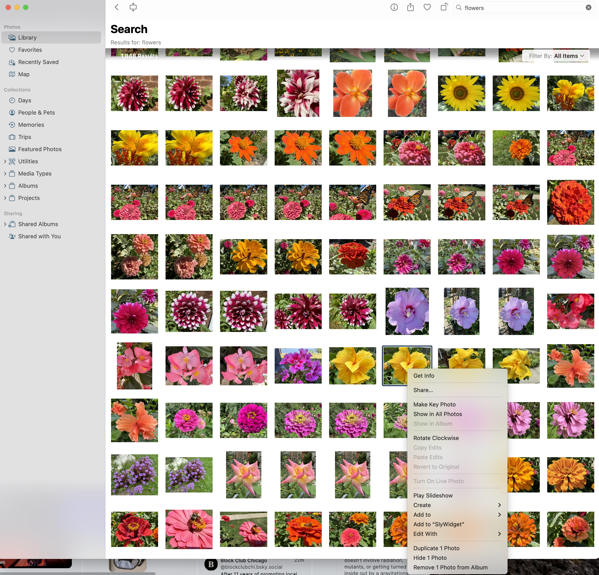
This year Apple vastly improved its search capability in Photos and I find it works quite well. Unfortunately though it delivers the results to what I assume is a “smart album.” Regardless, the problem with that is that you can’t delete a photo or series of photos from that result unless you first enlarge each photo and delete each one directly. You can remove one or multiple photos from the album created, but I would think that possibly changes whatever algorithm Apple is using to group these photos.
As you can see in the image below I take lots of pictures of flowers.
While there are direct duplicates, there are others when I vary the shot slightly enough that it’s not an exact duplicate so any dedupe tool won’t work. Being able to delete those I don’t want from that search result would be a terrific time saver.
Clean Up Videos
With two young grandkids we take a lot of videos. Most of the family uses iPhones so much of what’s taken and shared gets stored in Photos. I’ll go through the videos accumulated there throughout the year and put them on external storage that stays attached to my iMac so as to somewhat reduce the size of my Photo library before it inevitably expands again during the next year. That also allows me to store them alongside the videos from non iPhone family members of nieces and nephews. You never know when you’ll need one of those childhood videos to embarrass a younger relative in front of their significant other in the future.
Change Passwords
Passwords are necessities in our digital lives, though there’s hope that Passkeys will take a firmer hold going forward. That hasn’t happened with many of the websites I use routinely yet and I wish it would. I do change passwords at the beginning of every year as a routine, one I’d love to not have to do. Of course I change various passwords throughout the year as well, which leads to me deleting some that have accumulated throughout the year.
Since I still rely on far too many passwords, I continue to use One Password for password storage, but I am increasingly transitioning to Apple’s new Passwords app. Of course that means I’ve increased my task load of changing passwords this year to make sure what’s stored is properly reconciled between the two apps.
Archive Files
Each year there are always projects I complete and don’t need to have immediate access for those files and assets. I’ll clean up my day-to-day working environment by archiving those files both in the cloud and on local external storage media.
For local storage it’s a multi-year process. I’ll archive files to attached external storage so I can easily retrieve things if the need arises during the next year or so. Once a series of project files have aged two-years I’ll move them to local storage on a drive that is then archived and stored away separately. At some point I’ll have to think about getting rid of some of those older archives on older drives, but I haven’t felt the need (or discovered the patience) to reexamine and accomplish that chore.
For digital archiving I primarily use Dropbox, but I won’t sync those archived files and folders to my desktop going forward. I can always go and fetch them if needed. I’m a little more rigorous with that digital archive in that I examine it for files I can delete every year, and typically delete a good portion of those remaining digital archives two years after a project is completed.
Delete Apps I’m No Longer Using
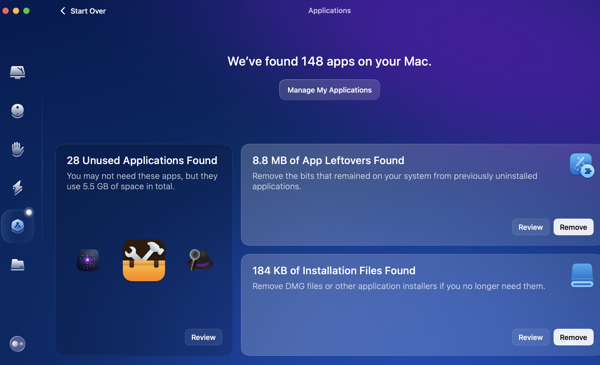
My pace of downloading apps has slowed down quite a bit, primarily because I seem to think I have most of the tools I need already. That doesn’t mean I won’t try out a new apps each year. A few will stick, but most don’t. I’ll delete those during this digital housekeeping phase. I use Clean My Mac and it provides a good utility for telling me how long it’s been since I’ve used an app, along with the other tools it includes in its suite of utilities.
In App Archiving
I use several apps to collect webpages and articles to read later. The two I primarily use are Goodlinks and Instapaper. I used to use Pocket quite a bit for this, but its owner, Mozilla, has essentially ruined that app for me. I’ll go through and delete any articles or links that I’m not interested in keeping and archive those I do want to keep. Instapaper provides a handy archive function. I use tags in Goodlinks to organize what I want to hang on to and a folder structure in Instapaper for things I want to keep quicker access to.
Cancel Subscriptions
Typically I’m pretty on top of things throughout the year regarding the subscriptions I use for apps and services. Even so, I still take an inventory at the beginning of each year. While that rarely leads to a cancellation at that point, it does put me on notice to see if I think a subscription will be worth continuing as the year goes on. I’ll set reminders 10 days before a subscription is due to be renewed and if it hasn’t provided value since the beginning of the year I’ll make sure to cancel or not renew at that point.
Clean Up Contacts
I have to admit I’ve gotten lazy here. I blame Auto-Complete in email and messaging clients, even though they are not always 100% accurate. I’ll still do a quick once through, but I’m afraid my reliance on Auto-Complete in this area has not only made me lazy, but might make me recoil at what I see if I ever had to get serious about this again.
Clean Up Cables
I don’t routinely change cables for the sake of changing them and I am not one of those in a rush to replace the few devices requiring Lightning connectors with newer USB versions. It’ll happen when it happens. But I do check out what I’ve got plugged in and cabled to to make sure everything looks in good working order and to take an inventory on whether or not I need to keep an eye out for deals on any cables I think might need replacing throughout the year. Throughout the last two years I’ve eliminated a lot of cable clutter around my desk by using MagSafe chargers.
Check UPS Status
I review the warranties for the Uninterruptible Power Supplies (UPS) that I use to gauge if any look like they might need to be replaced during the coming year.
Printer Check
We use an Epson ET-2760 EcoTank printer and have for a couple of years now. Our printing needs continue to diminish, but they do come in spurts, and we haven’t ordered ink since we bought the thing. Once a month I’ll check the ink supply and print a few things to make sure everything stays in good working order, but I’ll do a through maintenance check using the printer’s on device tools at the beginning of each year regardless.
Roomba Maintenance
This is a relatively new one. We use a Roomba and it’s now become a part of our Christmas ritual that I give my wife a parts replacement kit that contains filters and brushes as a gift. Not sexy I know, but we both have routine gifts we exchange in a similar fashion.
You can find more of my writings on a variety of topics on Medium at this link, including in the publications Ellemeno and Rome.I can also be found on social media under my name as above.
Clever and touching ad from Apple deserves a listen.
Apple hasn’t had the best of luck with commercials this year, but they pushed out one that carries an emotional punch heading into the holidays. Called HeartStrings it highlights new hearing health features users with AirPods Pro 2 can take advantage of to use them as hearing aids.
Users can run a hearing test that according to Apple provides “scientifically validated results within minutes and the ability to activate a clinical-grade Hearing Aid Feature on your AirPods Pro 2.” I took the test and my hearing rated just fine, but if you’d like to read how one user tested this out, I recommend checking out What It’s Like to Hear Better with AirPods Pro 2 by John Voorhees on MacStories.
The commercial certainly belongs in the warm and fuzzy holiday genre and in my opinion is quite well done. It certainly is a better approach than crushing up some musical instruments.
You can find more of my writings on a variety of topics on Medium at this link, including in the publications Ellemeno and Rome.I can also be found on social media under my name as above.
Delusions abound in this week’s Sunday Morning Reading.
If it’s Sunday, it is time for Sunday Morning Reading with interesting writing on a variety of topics, that without intending to all seem to involve delusions in one way or another. There’s also a little Procol Harum on the side. Enjoy reading, while you skip the light fandango.
It’s no delusion that Artificial Intelligence remains in the news (before it eventually subsumes the news). Harry McCracken takes us a bit into the deep mind behind Google’s DeepMind in The Future According to Google DeepMind CEO Demis Hassabis. That first link takes you to the web version, this one takes you to the Apple News version of the article since the piece is a premium article for Fast Company readers.
We’re all complaining about a lot of things, the continued enshittification of the Internet being a familiar and well deserved target. (It’s interesting that I use that term enshittification so frequently and yet spell check or any other type of check hasn’t picked it up yet.) Dave Winer is fighting the good fight on a lot of fronts and he looks at a new kind of enshittification in Billionaire-proof?
David Todd McCarty takes on the platitude “the meek shall inherit the earth” in The Children of Pacifists.
And to round things out this week, Ulf Wolf spools out an essay on the mostly forgotten Keith Reid of Procol Harum in The Shadow Member of Procol Harum. Not going to lie, I did spin up a copy of Whiter Shade of Pale while writing this week’s column. The Salty Dog album is cued up next.
If you’re interested in just what the heck Sunday Morning Reading is all about you can read more about the origins of Sunday Morning Reading here. You can also find more of my writings on Medium at this link, including in the publications Ellemeno and Rome. You can also find me on social networks, including Bluesky, under my own name.
Tough reading for tough times in today’s Sunday Morning Reading.
It’s a Sunday. I’ve been reading. As usual I’ll share some of that with you in today’s Sunday Morning Reading.
I started out the week thinking I’d try to avoid politics. That didn’t work. Sort of like getting a cancer diagnosis and not wanting to know anything about the disease taking over your body. So, apologies if there isn’t much “light” reading today.
I’ll start of with an anonymous piece published in The Guardian. We all knew misogyny was a feature of the incoming frat party that will be the new administration. I don’t think anyone thought it would filter down so quickly to high schools. The Boys In Our Liberal School Are Different Now That Trump Has Won, tells that story. Woe be onto us and our children.
Sherrilyn Ifill calls her piece The Truth. It is. And it’s hard.
Joan Westenberg says the way to destroy a generation is to make them think the word runs on feelings and then use those feelings against them. Check out How To Destroy a Generation.
Life may feel too short to worry about some things. But it’s all a matter of perspective. Check out Natasha MH in Life’s Too Short for Matching Socks.
And to close things out, BlueSky is the latest social network to experience a burst of new users. This time the the burst is due largely in reaction against Musk’s rape of Twitter/X, and dissatisfaction with Zuckerberg’s Threads, which had been the darling for awhile. Mike Issac takes a look in Bluesky Is Growing Up. Maybe Too Fast.
If you’re interested in just what the heck Sunday Morning Reading is all about you can read more about the origins of Sunday Morning Reading here. You can also find more of my writings on Medium at this link, including in the publications Ellemeno and Rome. You can also find me on social networks, including Bluesky, under my own name.
Jokers to the left and right, but things feel increasingly unfunny.
Time for some Sunday Morning Reading as we continue treading water until the election on November 5th and prepare for the aftermath here in the U.S. There’s more tech and culture in this week’s edition than politics, but that’s here too. Hard to avoid it.
Take a look at We Are Willing Lord, But What, If Anything, Is Needed?, by David Todd McCarty. It’s a fascinating, very human discourse on attempting to find a way through the madness we’re mired in. And it’s not just about politics.
There was a big kerfuffle when the LA Times owner chose not to make an endorsement in this year’s election. There was a much larger one when Amazon mogul Jeff Bezos did the same with the Washington Post. Cowardly moves by both men who got where they are by not being cowards. Funny how money can change a guy. Many of those working for the papers are upset, some have quit, some are making their views known, including Alexandra Petri, the humor columnist for the Post. Check out It’s Fallen To Me, The Humor Columnist, To Endorse Harris For President.
If you’re interested in just what the heck Sunday Morning Reading is all about you can read more about the origins of Sunday Morning Reading here. You can also find more of my writings on Medium at this link, including in the publications Ellemeno and Rome. You can also find me on social networks under my own name.
The days are getting longer and things are getting scarier in this week’s Sunday Morning Reading.
We’re getting closer to Halloween, Dia De Los Muertos, and perhaps the more frightening of the days ahead, Election Day in the U.S. With just three editions of Sunday Morning Reading to go before whatever tricks, treats, and horrors might befall us on or after the votes are tallied, enjoy the somewhat frightening reading ahead.
Approaching Dia De Los Muertos, David Todd McCarty remarks on turning his father’s passing into a celebration in We Called Him Papa.
Artificial Intelligence continues to be the dominant ghost story in tech with ups, downs, and promises everywhere. So far, most tech promises make good hype, but not necessarily good products. Matteo Wong thinks delivering on promised deadlines for superintelligence might be the truly scary part in The AI Boom Has an Expiration Date.
Perhaps the scariest story linked in this week’s edition is Franklin Foer’s What Elon Musk Really Wants. There’s no trick, and there’s certainly no treat in what this madman aims to do.
Paolo Bacigalupi takes us on a little science-fiction journey into what a future shaped by climate change might look like in Azalea: A Science-Fiction Story. A great piece. I’m just not so sure we can call what we’re living through science-fiction anymore.
If you’re interested in just what the heck Sunday Morning Reading is all about you can read more about the origins of Sunday Morning Reading here. You can also find more of my writings on Medium at this link, including in the publications Ellemeno and Rome. You can also find me on social networks under my own name.








 Life on the Wicked Stage: Act 3