Random Thoughts and Links Looking Ahead to an Apple Beta Summer

A summer of viewing betas from the sidelines.

We’re already several weeks deep in Apple’s beta season for all of its operating systems. As of this writing the second developer betas have been released. We’re due to see the first public beta this month and that’s when things will really heat up. I’m not a developer and I no longer run betas on any of my Apple hardware, choosing to live vicariously until the official releases this fall.

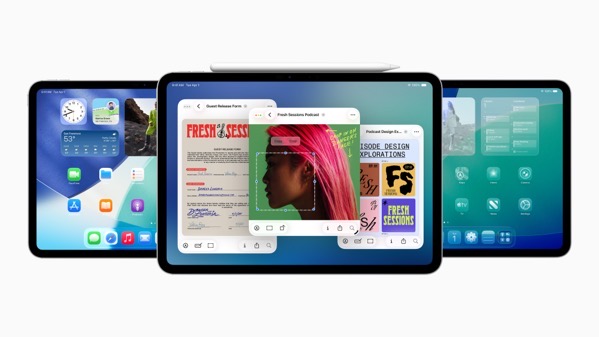
Apple WWDC25 iPadOS 26 hero 250609.

I have to admit though that I was tempted to pick up another iPad given the changes to iPadOS 26 and the general early positive reactions to it. But I stuck to my guns and will look forward to what some trusted sources have to say over the course of the summer.

Speaking of, if you’re interested in following how the new operating systems develop and evolve over the summer, I’m going to list several links to sources you might want to follow, if you don’t already. That list will come at the end of this post.

As to my random thoughts I have three.

First, it looks like Apple’s big Liquid Glass design change will indeed garner most of the focus this year. That was certainly the intent, and from what I’ve seen Apple is on the way to pulling it off, certainly on the iPhone and the iPad. The jury is still out for the Mac at this early juncture in the beta season. Even so, it appears Apple has managed to add a shiny new coat of paint that won’t confuse most users when it comes to familiar functionality of their devices.

Second, as I said previously I’m excited to see the changes in iPadOS 26. Depending on the job at hand, and whether or not I’m home or away, I jump between Macs and iPads frequently. I’m looking forward to what these changes mean when I’m primarily working on an iPad away from home.

Third, the deeper integration of Shortcuts with Apple Intelligence (whatever that may come to mean) and also with Spotlight has me intrigued. I don’t use a ton of shortcuts and currently rely on Raycast as a launcher for those I do use. If I had two wishes on this I would hope that this plays out the way it proposes to do, and I would hope Apple could finally find a way to keep what happens behind the scenes with Shortcuts from constantly breaking. Giving app developers access to the App Intent Framework and the Foundation Models Framework promises good things, if Apple can avoid the infrastructure hiccups of the past. Although I’m sure that will usher in a different sort of hiccups going forward.

Good Apple, Bad Apple

On another note, I, like many this year, have had a hard time reconciling my views about what I consider wrong moves from Apple the corporation with my preference for Apple hardware and software. I’ve thought long and hard about it and at the bottom of that deep well of thought the decision to stick with my current Apple tool set comes from the fact that I support a lot of friends, family members, and a few small businesses that use Apple products. I have no desire to abandon that part of my life personally, even if Apple’s actions pisses me off to the point where I’m occasionally ready to chuck gear into the trash. Convincing those I support to shift gears would mean saying goodbye to that part of the relationship for the most part (I’ve explored this) and neither they nor I am ready for that.

Is that a trap? Perhaps, depending on your point of view and I won’t argue against that. Am I talking out of both sides of my mouth? Also, perhaps. But I think using and enjoying products of a company gives you a bigger license to criticize.

So, I’m sticking with things for the moment, but I will say that I’m paying close attention to folks like Denny Henke who’ve made different choices than mine. I admire their approach and am always learning. I’m also paying close attention to how Apple handles things going forward. I despise this dilemma.

Links

I’m going to link to a few specific articles from which you should be able to get back to the homepages of the various sources, some are just the homepage links.

Michael Tsai’s Blog always contains an excellent collection of links to various sources worth following. In fact, it may be the one stop source for quite a bit of Apple News.

Six Colors is an excellent source for information and reviews. This is one source to look to when the first public betas drop for good reviews of what we will know at that time. Jason Snell, Dan Moren, and now with Glenn Fleishman as a contributor, always provide excellent coverage.

Speaking of reviews, MacStories is another go to site when reviews of software drop. While they cover a range of gadget topics beyond Apple, the coverage there is quite good, even if it sometimes is aimed more at advanced users.

Parker Ortolani has recently started blogging and his thoughts are always worth a look.

If you’re looking for a developer’s perspective check out Craig Hockenberry’s furbo.org. Craig is a founder of the iconfactory, which is responsible for a number of apps including, Tapestry, Wallaroo, Linea Sketch, Tot, and more including the original Twitterrific for Macs and iPhones.

Craig Grannell’s blog, Stuff, is also a good source to add to your reading list or RSS reader.

Myke Hurly has also started blogging in addition to his many podcasting chores. Check out his blog, The Enthusiast.

Louie Mantia, Jr. is an artist and designer who lends that perspective to his writings about Apple and its designs.

John Gruber’s Daring Fireball is always a must read.

There are certainly more that are worth your time, but the ones I’ve linked to here continue to provide me with not only good information, but some good and deeper thoughts beyond the surface news. It’s going to be an interesting beta season viewing it from the sidelines.

You can find more of my writings on a variety of topics on Medium at this link, including in the publications Ellemeno and Rome. I can also be found on social media under my name as above. 

Apple Beta Season Is Upon Us and iPad Debates Are Around the Corner

Changes look promising. Wait and See is the operative condition.

Apple announced what it has in store for the next versions of all of its operating systems during it’s annual World Wide Developers Conference this week. Or rather Apple put out a pretty nice commercial for some of what it has in store. But that’s the way of these things whether pre-taped or live. The beta testers and pundits are off and running looking into every nook and cranny of the code, celebrating, criticizing, and screenshotting. That will go on deep into the summer.

Apple WWDC25 iPadOS 26 hero 250609_big.jpg.large_2x.

The biggest, most observable change is the new design language, Liquid Glass, that is intended to bring all of Apple’s operating systems into a more unified look and feel, sorta, kinda based on the Vision Pro. Who knew that headset would provide new Vistas ahead?

They also unified the current OS numbering system, ditching the previous version numbers. Now each operating system will increase by the last two digits of each year ahead, as in iOS 26, watchOS 26, etc… We’re going to get to iOS 50 sooner than we thought.

I no longer play the beta game with my devices so I haven’t seen anything first hand, beyond the reactions of others that range from it’s terrible to the best thing since sliced bread. Keep in mind that any reactions you see following the release of the first developer beta should always include the caveat that what you see now will probably evolve over the course of the summer. Wait and see is the operative condition that needs to be set.

As far as I’m concerned the big news was about the iPad and what iPadOS 26 is promised to offer. There has been lots of back and forth about trying to define the iPad ever since there have been iPads. But certainly since Apple, in the pre-M1 chip era, put out the What’s a Computer campaign in 2018. There were quite a few loud voices always wanting more than Apple delivered in terms of making the iPad more like a Mac. And in recent conversations many of those loud voices were putting down their megaphones and were moving on from those iPad as their main computer dreams.

But this year Apple seems to be promising most of the changes those users have been clamoring for. They include a multiple windowing UI, much more similar to MacOS than any of the previous multi-tasking attempts. There’s even a menu bar, the inclusion of a new Preview app and more Finder-like functionality in the Files app. Better background processing and enhancements to the audio system are sure to make podcasters happy. There are a host of other new tidbits as well. There are also casualties. Many are already mourning the loss of Slide Over.

To give you an idea of how big a deal this change is, noted Windows advocate, Paul Thurrott ended his first look piece with “I may need to get a Smart Cover. Or whatever it’s called. This changes everything.”

The cynic in me has to say that the depth and breadth of these new iPad features makes me suspicious as to why Apple didn’t take this path earlier. It seems obvious that it had been thought through. The hardware has certainly been capable. Regardless of those suspicions, Apple has set up another new iPad story to keep us chattering.

So, iPads are being dusted off again. Soon, and more importantly deeper into the summer, we’ll hear how successful these features may be in fulfilling the desires of those who want the iPad to be more like a Mac. What we won’t have to wait for is the debates around the iPad to heat up.

I’ve never been one that felt disappointed by the iPad’s less than Mac-like features. For my work it has always served me well and gotten better in doing so over its evolution. Stage Manager was never my thing, but Slide Over worked well for my usage as my primary multi-tasking metaphor. Will I miss it? I’m sure I will. But I’ll wait and see what this new multi-tasking UI offers before rendering judgment.

But that’s me and I’m not everybody. So, as I look forward to living vicariously through the summer as others poke around these new changes, let me close with this. Regardless of whatever differences exist between the iPad and the Mac they always had one great similar strength that these new changes appear poised to make stronger still. Different users with different needs can use an iPad or a Mac for just about anything they want and need to do.

You can find more of my writings on a variety of topics on Medium at this link, including in the publications Ellemeno and Rome. I can also be found on social media under my name as above. 

Thoughts and Prayers Heading into WWDC 2025

A new coat of paint won’t fix the cracks in the wall.

In a week Apple will unveil what it has in store for us during its annual World Wide Developer’s Conference (WWDC). Beginning June 9, the microscope will be focused more intently and with a greater scrutiny given the myriad of issues Apple is facing. That scrutiny might just overwhelm any message Apple has planned for the year ahead depending on how Apple handles it.
WWDC 2025 Apple Logo

The reason I titled this post “Thoughts and Prayers Heading into WWDC 2025” isn’t that I’m offering up good vibes for Apple as they try to work out of the messes they’ve mostly created for themselves. I’m actually hoping — most likely against hope — that Apple will finally clean up some of the annoyances they’ve neglected over several generations of iOS and macOS.

I’m not going to discuss the bigger picture issues Apple is facing here. I’ve written about some already, as have many others. Instead I’m going to focus on the smaller software reliability annoyances that add up to make me think Apple just doesn’t care.

It’s become almost a running joke that Apple allows some of these flaws to continue year over year. But I don’t find it funny. You can put new wallpaper over a water damaged section of a wall, but if you don’t fix the leak then the problem isn’t the stain on the wall, it’s you not caring. Or maybe you don’t have the money to get it fixed. Apple certainly has the money. As John Siracusa says in an excellent post called Apple Turnaround:

It’s been 15 years since Apple’s leadership last demonstrated that it’s willing to emphasize software reliability at the cost of new features. Since then, bugs in major features have been allowed to fester, unfixed, for years on end.

I’ll quibble with John on one point. If you allow a reliable, yet ignored “bug” to remain through several operating systems, it essentially becomes a feature the longer it’s not addressed.

I’m a stubborn old coot in my life as a theatre director. Deeply ingrained in my way of directing is something a mentor laid on me year’s ago. “If it’s on the stage it’s yours. If it fails or distracts, it’s your failure.”

Here’s a short list of bugs and annoyances that have existed over several versions of the operating systems and several versions of Apple’s hardware that I encounter routinely. That’s based on how I work and play with Apple hardware and software. I’m sure there are many more depending on how others use their devices.

Focus

I know there are folks who swear by the Focus feature, but to me it’s one of those features that works and then randomly doesn’t. I’d call it unfocused. I keep trying to use it, but abandoning it because I already have enough random failures in my life.

Shared Reminders Notifications

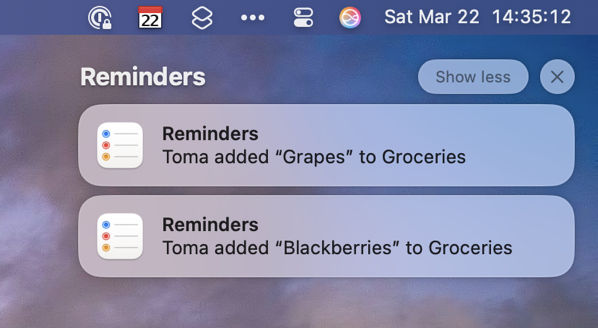
I’ve written about this previously. Shared Reminders are terrific for grocery lists and other things, especially of a checklist nature. But when you complete a Reminder, the notification needs to disappear for all of the users who are sharing the Reminder. I’ve had Shared Reminders hang around for hours after I’ve checked it off of a list.

Syncing Photos

This one just gets more and more puzzling and has become the butt of so many jokes, it’s almost become a part of the Apple brand. You take a photo on your iPhone and whenever it syncs to iCloud and subsquently to other devices is a wild guess. I get that if you’re running low on battery you may want to delay syncing. But if my iPhone is plugged in telling me that it won’t sync so that it can optimize battery it is a little silly. Also telling me syncing is paused for “optimizing the system” makes me wonder just what system is being optimized. Apple’s or mine?

Bluetooth Connectivity and AirPods 

I’m a big fan of AirPods. I’m also a big fan of AirPods and the way they are designed to work within Apple’s ecosystem. When they work as designed it’s magic. When not, it is frustrating. Again, random failures to disconnect, which always seem to come at just that moment when you need to quickly plop them in your ears for a phone call are never fun. Neither is it a good time when one of your devices you might have previously been connected to refuses to let go of the connection.

Deleting Media from Messages

I support a few family members who keep their Messages set to retain their Messages forever. That’s all well and good, except this can quickly fill up storage on an iPhone. Apple needs to make it possible for users to select and bulk delete media on an iPhone the same way you can in Mail. The UI looks like you can swipe down the list of circles, but you can’t. The fact that you can only view these attachments sorted by size also makes it a more difficult chore to remove unwanted media attachments.

Shortcuts

I have a love/hate relationship with Shortcuts. Love it when they work. Hate it when something changes and a Shortcut I’ve relied on suddenly stops working or stops appearing in Spotlight. This happens more frequently in beta season even though I don’t run betas.

Beta Badness

Again, I don’t run betas on any of my devices. That said, I’ve been told by Apple Support personnel that changes are always happening behind the scenes on the backend during beta season that can sometimes affect all users. That stands to reason, given how much of what you do on an Apple device is tied into Apple’s servers and iCloud. I suspect this may only become more prevalent with Apple Intelligence as Apple tries to remain competitive with other AI providers that seem to constantly be updating their software. Perhaps there needs to be a way to create a wall or silo off users running betas from those who do not.

App Store 

With M-series chips we’re able to get great performance and fast loading times from apps. With one notable exception being Apple’s own App Stores. For the life of me I don’t understand why they can’t improve performance on their own point-of-sale outlets. It’s like not cleaning the glass on the front of your storefront.

Settings and Permissions

I get that there are a large number of Settings. I don’t get that there’s such a haphazard way of addressing the problem of making them discoverable. I’m sure it’s a challenge, but the only way to address a challenge is to set it as a priority. The same is true with Permissions. Certainly there’s a way to force developers (including Apple) to send us to the correct Permissions screen to choose to make a selection.

Rules in Mail

I’ve set up a number of Rules in Mail in macOS over the years. Currently they all seem to be non-functioning, or randomly functioning. I have a suspicion this may have something to do with Apple’s tinkering with Apple Intelligence based mail categories (a feature I tried but turned off). Having to manually choose to Apply Rules is not the same as having a Rule that runs automatically. It defeats the purpose. Let’s face it, no company has found a way to win the cat and mouse game of spam filtering. I doubt they ever will even with AI. The Rules feature wasn’t perfect, but when it worked it was a help in weeding out some of the spam.

Consistency between iOS and macOS

Speaking of Mail, I’d like to see consistency across the board regarding features between the macOS and iOS versions. In fact, I’d like to see consistency across the board in all of Apple’s native apps. This is especially true given that there is a rumor that Apple is redesigning most of its operating system user interfaces to try and unify the look and feel between different device categories. Carry that through with how you treat app functionality between platforms. Other examples include Shortcuts and Apple News+. I enjoy being able to open an article via the Share Menu from Apple News in Safari on a Mac. I should have the same option on iOS and iPadOS.

As I said, these are mostly annoyances. But I’m annoyed that no one at Apple seems to be annoyed enough to take care of them.

You can find more of my writings on a variety of topics on Medium at this link, including in the publications Ellemeno and Rome. I can also be found on social media under my name as above. 

Apple’s Long Term Challenges Complicate The Short Term

It’s not easy to sell a waiting game.

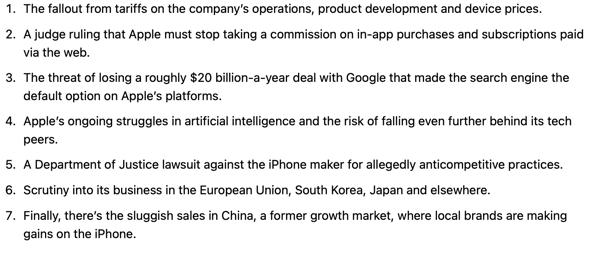
Mark Gurman offers up a relatively thorough summary of the number of challenges Apple is facing going forward in his weekly Power On column. Things always go forward. The question is always how.

The original link above is paywalled, but here’s a web archive link to the story.

And here’s the summary:

CleanShot 2025-05-05 at 09.41.06@2x.

Gurman calls this point in Apple’s history a “critical juncture.” I would agree. The many moving parts, both surrounding Apple, and of its own making, have put Cook and company squarely in that critical juncture. This comes as Apple and those that make their living talking about Apple are gearing up for this year’s World Wide Developer’s Conference (WWDC) next month.

Gurman delivers the punchline well below the headline that neatly summarizes why WWDC is not going to be able to address all of these challenges, but also why the turmoil is going to continue.

Speaking specifically about Apple’s race to catch up in the AI realm he says:

it’s going to be a while before we can tell if Apple is heading in the right direction

Perhaps that should have been the lede. He could have easily said the same about each of these challenges he enumerates.

But there’s also a larger, more encompassing challenge that makes surmounting each even more difficult. The tech world is moving at a pace that Apple is unaccustomed to. Apple’s historic long view has served it well over the years, but the window on that long view is increasingly narrowing its aperture.

Apple may spend its June introducing and setting the table for what’s coming later this year, but already most of the smart players who follow and promote Apple are shifting their focus to the bigger, and more critical, table stakes coming long after this year’s summer and fall hype cycles end. The now familiar “coming later this year” now means much less when the real issues may only begin to be addressed further down the road.

Waiting “a while” is not an easy sell. Especially these days.

You can find more of my writings on a variety of topics on Medium at this link, including in the publications Ellemeno and Rome. I can also be found on social media under my name as above. 

Dan Moren Questions What It Means To Be An Apple Fan These Days

Core questions for Apple users

The headline of Dan Moren’s final column for MacWorld says it all: I’m An Apple Fan In 2025. What Does That Even Mean?

Apple fanboy.

Moren has been writing for MacWorld and been a sensible voice inside the Apple community for close to 20 years. He’s signing off his regular column gig for MacWorld, but he’ll still be around on the likes of Six Colors, podcasts, and I’m sure other places. Which is good, because his voice is an important and reliable one.

In his farewell, he raises the question many are asking of themselves, and the questions many are asking of Apple in its current state and our own state of affairs. As he puts it in a nutshell of a statement:

As Apple started becoming more and more successful, I’ve become increasingly skeptical that one should ever really consider oneself a “fan”of a company.

It’s a well thought out and well reasoned post and one that I think should be read by anyone considering themselves a fan, or a no longer fan, or even someone who just doesn’t care for Apple or its products.

A big part of the self-examination I know quite a few folks are going through in assessing their current relationship with Apple deals with issues bigger than just the products. For lack of a better description call them corporate issues. Even using that label — corporate — feels dirty to type in ways that seem damning in more dangerous ways these days. But that’s a fungible feeling and thinking that’s becoming increasingly tangible.

Here’s the thing. Technology advances. Humans advance. Nothing that feels foundational or allegiance adhering, or even worth being infatuated about is going to ever stay the same. Nor are our feelings about what we first might have fallen in love with, regardless of how the object of that affection itself grows and changes. Change is constant.

Microsoft had my allegiance back in the Tablet PC days because they won it when those much maligned devices provided a better, more productive way to do my work. Microsoft changed. I did too. iPads replaced what Tablet PCs were for me in my work and my play, and those are the tools I still use today. Do I think that will be forever? Not a chance. I mourned the loss of Tablet PCs. I’m sure if Apple stopped making iPads, I’d go through a similar grieving process. But again, that’s change. That’s life.

That’s also growth. But growth on the human side of the ledger rarely equals growth on the corporate side. In my brief time on this planet the two have never added up to successful equation that yields anything other than diverging results. That’s one thing I don’t ever expect to change.

Kudos to Dan on a job and career well done, (and still going) and kudos for a lovely farewell column in MacWorld.

You can find more of my writings on a variety of topics on Medium at this link, including in the publications Ellemeno and Rome. I can also be found on social media under my name as above. 
Resurrecting Trust Is A Tall Order

You can fool some of the people all of the time…or maybe not.

It might be easier to resurrect the dead than it is to restore trust. One way or the other, we move on from death, but moving on from any relationship once trust is busted is a tough slog for those still among the living. I’m not just talking about politics. I’m referring to the relationships we have in most of the spheres of life we interact with each and every day.

Certainly that’s true in politics and governing. Those currently in charge of sinking the ship of state want you to think the water inching over your shoe tops isn’t a problem. And if we go under, well that’s the last guy’s fault. So is the fact that we don’t have enough lifeboats. Sorry. Hope you can swim.

The same is true in technology, entertainment, business, religion, and the list goes on and on. Superhero comic book creators would call this world of competing realities a multi-verse, but even that concept doesn’t really hold enough water to drink, fantasy that it may be.

If you feel like you’re wading through swamps of bullshit trying to find morsels of truth it is because you are. The powers that be have realized (again) they can get away with calling day night if they say it often and loud enough with enough assists from a cowering media that loves its microphones more than its freedom to exist. And when some bit of truth pokes its head above the surface it’s quickly washed over and submerged by another pounding wave of new stories or new product updates. Think waterboarding with quicksand.

This distortion swamp is full of mirages reflected back into our eyeballs like a thousand suns reflecting off an endless body of water. There’s nothing to anchor to.

Set the politics aside and focus for the moment on the ongoing saga about Apple’s delaying of Apple Intelligence features it unveiled almost a year ago at WWDC. A recent NY Times column by Tripp Mickle dropped two new grains of salt into the still open wounds of that debate. First up, Mickle seems to want to lay the blame on former Apple CFO Luca Maestri for changing up a plan to increase Apple’s budget for purchasing the chips apparently needed to ramp up for the Apple Intelligence push.

Here’s the quote:

Mr. Cook approved a plan to double the team’s chip budget, but Apple’s finance chief, Luca Maestri, reduced the increase to less than half that, the people said. Mr. Maestri encouraged the team to make the chips they had more efficient.

The lack of GPUs meant the team developing A.I. systems had to negotiate for data center computing power from its providers like Google and Amazon, two of the people said. The leading chips made by Nvidia were in such demand that Apple used alternative chips made by Google for some of its A.I. development.

The next grain of sand has launched a thousand blog posts (including this one) by saying that the previously delayed Apple Intelligence features will now launch this fall.  Mickel says that’s according to three sources. Regardless of the quantity of sources, that report has generated more use of the words “may” and “possibly” in following headlines than I’ve seen in some time.

The tech press has either caught on and is choosing to not grant Apple the usual slack after feeling more than a bit betrayed. Or it’s pretending to hide beyond an endless streak of optimism. Either way Apple is currently mired in a trust swamp of its own making. Tangentially, and for what’s it’s worth, the same could be said of The NY Times.

My point here, isn’t to debate the sourcing, the reporting, or even the timing of when Apple may or may not launch new features. The long preamble to get to this Apple “news” should have been your first clue to that. My point is that once any authority fractures trust whether it be a company, a government, an official, a teacher, a parent, or a news organization, all sides lose. You can work to regain trust over time, but the stain will always remain and there’s very little anyone can do to remove it. You can learn to live with it, but you can’t erase it. 

Or as Lady Gaga says, “Trust is like a mirror, you can fix it if it’s broken, but you can still see the crack in that mother fucker’s reflection.”

There’s an entire industry full of PR professionals and crisis managers lurking, just waiting to make bank on these kind of mistakes, anxious to be called in to try and resurrect a brand or a reputation. But they are really just good makeup artists capable of masking scars. If the art of “spin” was ever a currency, it is has more than lost any value it may have once had.

In an attempt to steer this full circle, if there’s a silver lining in all of this, the raging egos we’ve put in charge of things bigger than consumer electronics can’t keep their mouths shut to their own detriment and perhaps the benefit of those of us on the ground. Their continual yapping and yipping is exposing not just their own ineptitude in governing, but the entire rigged game that everyone in these industries of make believe rely on, whether it be politics, iPhones or punditry.

I’m beginning to hope the immediate damage from these flapping maws will have more impact than any tariff upheaval, leading us all to a healthier and more skeptical view of the world we live in. The world they are tearing to shreds is beginning to feel like one that might not deserve to be saved any longer.

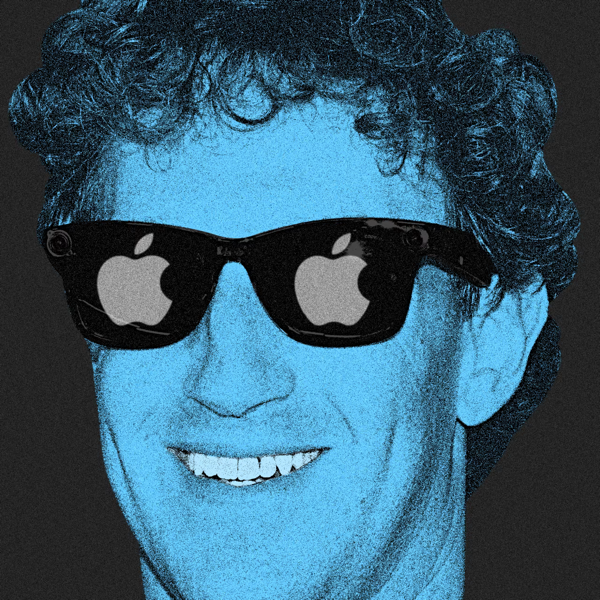
(Image from ChiccoDodiFC on Shutterstock)

You can find more of my writings on a variety of topics on Medium at this link, including in the publications Ellemeno and Rome. I can also be found on social media under my name as above. 


Shared Apple Reminders That Never Disappear

A bug in Apple’s Reminders app.

Maybe one day Apple will find time to fix this bug with shared Reminders. Maybe not, given all that it keeps piling on its seemingly overflowing plate these days.

Here’s the thing. Apple has a nifty feature to share lists and Reminders in the Reminders app. It allows you to create a list and share it among family, friends, or perhaps even National Security officials but I haven’t heard of it being used that way. Yet.

It works as advertised when it comes to actually sharing a Reminder. My wife and I use it for grocery and other shopping lists. If she’s doing an inventory through the cabinets prior to a grocery run, I’ll get notifications of the Reminders she adds to the list.

The problem pokes its head up after those Reminders are completed.  Those notifications don’t disappear the way non-shared Reminders do. They hang around. Seemingly forever. At least in my case, sometimes for hours.

The two Reminders in the image above are from my iMac. My wife added them after I had already headed to the store on a day of errands. They were still there hours after I had checked them off in the Shared Reminders list on my iPhone. The notifications still remained on my iPhone as well.

You have to manually get rid of these Shared Reminder notifications, which seems like a silly bug to me. It’s been around since Shared Reminders was introduced in iOS 13. It’s a shame it’s been around so long because Apple has done a good job over the years evolving the Reminders app into something that’s really useful.

Perhaps Apple Intelligence will figure out a way to fix this somewhere down the line. I won’t set a shared Reminder to check on that though.

You can find more of my writings on a variety of topics on Medium at this link, including in the publications Ellemeno and Rome. I can also be found on social media under my name as above. 

Apple Intelligently Delays New Siri

Apple says stay tuned. The question is: For what?

It has been inevitable for some time that Apple was going to delay launching whatever the new personalized Siri with Apple Intelligence was supposed to be. To expect otherwise was as foolish as hoping the new American government wasn’t going to wreak havoc on its own citizenry and the rest of the world after the most recent election.

Now Apple has owned up to the inevitable. In a statement to Daring Fireball’s John Gruber announced the delay and a new set of expectations:

“Siri helps our users find what they need and get things done quickly, and in just the past six months, we’ve made Siri more conversational, introduced new features like type to Siri and product knowledge, and added an integration with ChatGPT. We’ve also been working on a more personalized Siri, giving it more awareness of your personal context, as well as the ability to take action for you within and across your apps. It’s going to take us longer than we thought to deliver on these features and we anticipate rolling them out in the coming year.”

Note that last sentence includes “we anticipate.” I anticipate dying at some point. I also anticipate warmer days this summer, rain occasionally, and eating pizza on some day in the future. So, the message is stay tuned.

I have several thoughts on this and I’ll lay them out below, along with links to some interesting hot takes following the announcement, some of which have already cooled off a bit.

First, I think Apple was smart to make this announcement even if everyone paying attention already knew this was going to be the case. This delay wasn’t and isn’t news. That said, the announcement comes after Apple, generally perceived as rushing to catch up in the push for Artificial Intelligence, has made what can only be called a poor first impression. Sure, you can call Apple Intelligence a beta if you want. Apple does. But advertising a flawed beta as the tent pole to push new iPhones can’t be called anything but a marketing misfire, if not malpractice.

First impressions of shipping products matter more than clever shiny announcements of things yet to come.

Apple should know this because they are no strangers to bad first impressions. MobileMe left a bad stain that iCloud still has difficulty erasing. The VisionPro continues struggling with poor perception and reception. Yes, Apple also does have a history of turning some poorly received rollouts around. The best examples of that are Apple Maps and the Apple Watch. Even so, once a product launched becomes a product laughed at, it’s difficult to erase the echos of that laughter.

But perhaps the product ridiculed crucially here is the one that Apple married to this all out AI effort: Siri. Purchased, proudly launched, and then allowed to wallow — like too many other of Apple’s efforts (*cough* iPadOS *cough*), Siri has become not just a joke, but one that keeps on giving. Some say it has improved. I’ll agree with that to a point but that depends on the day.

Siri has never fulfilled Apple’s bold promises with any consistent value beyond setting a timer or adding a reminder. Even that fails enough of the time to earn users’ distrust and provide late night comedians with jokes so easy to make that the shrewder jokesters have moved on.

The debate following this recent Apple announcement in pundit circles seems to be on whether or not Apple should jettison Siri and start from scratch. I’m sure that debate has gone round and round in the circular halls of the Apple campus. I doubt that happens, given that the marketing mavens in Cupertino seem to be erratically driving the bus these days. There’s been a huge investment in Siri branding, problematic as it has always been. Unfortunately salvaging a brand is also expensive.

Apple’s Long Game Mindset Might Just Be Short Sighted

The success of the iPhone has given Apple the benefit of playing a long game, plotting product and growth strategy with a large enough cushion to weather the occasional storm. It’s certainly easier to sail through rough seas in a large ship, but the bigger the boat, the more maintenance is required to keep the hull from rusting and the engines running smoothly. The nuts and bolts matter.

Artificial Intelligence, regardless of what company is pushing it, is nuts and bolts, bits and bytes, ones and zeros. Everyone scanning the horizon thinks this is the future we’re sailing towards, full steam ahead. But nothing that’s been released or demonstrated yet has really proven that anyone can chart a correct course. The current moment resembles that scene in Jaws when all the ships set out in an armada to chase a bounty, not knowing really what they’re up against.

Don’t get me wrong. I think Artificial Intelligence may indeed prove useful. Someday. On an enterprise level. I’m just not so sure if it will ever be as big a deal on the consumer front as the marketers want us to believe it is or will be.

I also doubt Apple Intelligence will end up being another Butterfly Keyboard, MobileMe, or Siri, but at the moment there’s as good a shot of it joining the ranks of those jokes in Apple lore as there is for it becoming a success, much less useful.

Ian Betteridge in this piece, lays out what I think the AI true believer vision is in this excerpt:

But AI presents a fundamentally different challenge. This isn’t merely a new product category to be perfected – it’s a paradigm shift in how humans interact with technology. Unlike hardware innovations where Apple could polish existing concepts, AI is redefining the entire computing experience, from point-click or touch-tap to conversations. The interface layer between humans and devices is transforming in ways that might render Apple’s traditional advantages increasingly irrelevant.

He also captures the key context that reveals the tension between the long and short game as Apple has historically played it in this excerpt from earlier in that post:

Apple has long been characterised as a “fast follower” rather than a pioneering innovator. It wasn’t the first to make an MP3 player, smartphone, or even a personal computer. This strategy served Apple brilliantly in the past – observing others’ mistakes, then delivering exquisitely refined products with unmatched attention to design, usability, and integration. The first iPhone wasn’t novel in concept, but revolutionary in execution because it had a unique interface: multitouch. In fact, I would argue this was the last time Apple’s user interfaces went in a bold direction.

What is obvious in this frenzied sea of Artificial Intelligence is that Apple did a quick course correction and tried to “fast follow” before the mistakes of others could be identified well enough to refine and/or correct the way Apple has historically been successful in the past. In the case of Siri, the fact that Apple has let it languish for so long more than hints that it just doesn’t see enough value in the voice assistant proposition.

Were those bad moves? Who can really say at present. It is true that Apple had to react. OpenAI’s release of ChatGPT upset a lot of apple carts and not just those in Cupertino. But Apple’s quick course correction, coupled with a less than enthusiastic response in the same year of its other attempt at a computer interaction paradigm shift–spatial computing with the Vision Pro–has cut down the chances for any short term smooth sailing.

Some are positioning this moment Apple has created for itself as a necessary gamble Apple had to make. Here’s an excerpt from Jason Snell at Six Colors:

And if you asked those same Apple executives if they were aware that the cost of underdelivering those features in the spring of 2025 would be getting beaten up in the press a little bit for delaying features, perhaps even back to iOS 19? I’m pretty sure they’d say that a little bit of negative press today, when the world isn’t really paying that close attention to Apple and AI, would totally be worth it.

That may indeed be true in and of itself. I have no way of knowing. What I do know is that this gamble might have had better odds if Siri, prior to all of this, hadn’t been such a historical and neglected mess for far too long.

Security and Privacy

This delay announcement has also opened wider the door for criticism that might shatter another of Apple’s tent pole marketing strengths: security and privacy. Here’s a post from Simon Willison, who has a hunch that the delay might be related to those issues. It’s also worth taking a look at Willison’s earlier post on prompt injection. John Gruber of Daring Fireball takes Willison’s point further in this post. Here’s the key excerpt:

Prompt injection seems to be a problem that LLM providers can mitigate, but cannot completely solve. They can tighten the lid, but they can’t completely seal it. But with your private information, the lid needs to be provably sealed — an airtight seal, not a “well, don’t turn it upside down or shake it” seal. So a pessimistic way to look at this personalized Siri imbroglio is that Apple cannot afford to get this wrong, but the nature of LLMs’ susceptibility to prompt injection might mean it’s impossible to ever get right. And if it is possible, it will require groundbreaking achievements. It’s not enough for Apple to “catch up”. They have to solve a vexing problem — as yet unsolved by OpenAI, Google, or any other leading AI lab — to deliver what they’ve already promised.

Ay there’s the rub,” as Hamlet would say. No one has those solutions, yet it’s full speed ahead as the selling and hype continues. There may be a dream in there somewhere, but as for now, whether sleeping, sleepwalking, or blindly chasing bounties, all the consumer is left with at the moment is “stay tuned.”

For better or worse, we are not going to return to our regularly scheduled programming.

(I note that I was putting the final touches on this piece Bloomberg is reporting that Apple plans the biggest user interface design overhaul in quite some time with this year’s new operating system releases that will be unveiled at WWDC. Apple is under pressure from not only this Apple Intelligence, but other issues that concern developers as well. Shiny distractions generally win when it comes to taking the heat off of failures and problems.)

 You can find more of my writings on a variety of topics on Medium at this link, including in the publications Ellemeno and Rome. I can also be found on social media under my name as above. 

Picking Your Tech Poison

It’s not easy loving tech these days.

There are no good options when it comes to choosing your tech these days. Let me rephrase that slightly, if you’re hesitant or resistant to AI taking over your tech there are no good options these days. Whether it be mobile devices, laptops, or desktop rigs, the makers of the major operating systems have all jumped on the Artificial Intelligence band wagon and are doing really poor Harold Hill impersonations trying to sell us on it. Sure there are different flavors, but they’ve become or are becoming intrusively the default. We all know where this appears to be heading. Computing devices without AI will be the flip phones of tomorrow, If they are even available. Apple has turned on Apple Intelligence by default, (even though it is still in beta). Microsoft is forcing Copilot into Office 365 and its operating system and charging you more for it, wanted or not. (There are ways to ditch it.) Google is doing the same thing with Android. Even if you don’t use an Android device, but use Google services, Google’s AI now accompanies anything you do with those services. Of course other smartphone users that rely on Android are following along, but there’s really no choice. If Artificial Intelligence was a virus, we’ve all been infected and there’s no vaccine to argue over, nor will wearing a mask help, because it extends beyond our own computing lives to the interactions we have with our doctors, banks, any form of customer service, and other affiliations of our daily lives. Yes, there are still refuges where you can attempt to avoid AI, but that’s not the real world of daily commerce and daily personal interaction. Now, it sounds like I’m 100% in the anti-AI camp. I’m not. I think there are legitimate uses. Some are even quite good. Some offer promise. I actually experiment with some of that. But I also think that there’s too much that isn’t useful, too much that just doesn’t work as advertised (beta or not), and too much that’s more than potentially harmful, especially in greedy hands. I can get excited about the technology, especially on some of the exciting hardware we now see. I just consider it a shame that all of that computing power is going to be put to the uses it appears we’re in for. We’ve been here before with new technology. First it’s a curious trickle then it becomes a tidal wave that sweeps us along in its path.  It’s tough to live daily life without a smartphone these days. That’s a more recent fact than many want to acknowledge. There’s another factor. Part of the hesitancy and resistance I know I’m feeling is that I don’t feel like I can trust the likes of Apple, Google, and Microsoft, much less the social networks and other applications that run on their hardware. I’ve always been skeptical, but that trust level took a knock with the recent knee-bending by these companies, trading cash for favors from the evil regime now in place in the U.S. I’m not sure how much more capitulation will be required, but I’m betting the folks trying stay in the game will find themselves laying prostrate before this is all over. I’ve used Apple products and have been a fan for quite some time. I imagine I will continue to be a user of those products going forward, given the investment I have in that ecosystem. But I also use Microsoft and Google products and support a coterie of folks who do as well. I also use services on my Apple devices by both Google and Microsoft. In order to support the folks I do, I keep up to speed with this increasing and haphazard pace we’re all forced into. The questions I deal with lately focus on how to remove or prevent these AI features more than they do about how to guide them through new features. When every day users are asking those questions there’s obviously a problem. As for me, tasting the poison in order to understand the which antidote is needed feels unhealthy, a bit dangerous, and just plain dirty. So, I’m starting to check out other hardware to become even more familiar, but also to look at my own options. Again, there’s no easy choice. I picked up a Pixel Pro 9 recently and am checking that out. Does that mean I’m thinking of changing horses in this stream we’re in? Probably not. As I said, there are no good choices. It really is a pick your poison era we’re in. I’m not happy about it. I’ve always been tech curious, it’s just sad my current curiosity is bred from such distaste, distrust, and disgust. You can find more of my writings on a variety of topics on Medium at this link, including in the publications Ellemeno and Rome. I can also be found on social media under my name as above. 

Apple’s 2025 Black Unity Collection Announced Amidst An Age Of Disunity

Timing is everything in this political circus Apple fans find themselves in.

What a planet we’ve landed on. It’s certainly a different one than a few months ago. Or is it? Apple Watch Black Unity Collection hero_big.jpg.large_2x. Today Apple announced its 2025 Black Unity collection including a new Apple Watch Band and watch face in addition to wallpapers to honor Black History Month. This has become an annual Apple tradition since 2021, and is typically met with some, but not large, fanfare given that it can be classified as an appeal to a specific segment of the market. That said, it has historically been one of Apple’s signature signals about where it’s cultural (some say woke) heart lies. But that landscape has changed a bit with the election of the new oligarchic, nakedly racist regime in the United States, and with Tim Cook’s decision to donate $1 million dollars to the inauguration and attend that knee bending ceremony. Cook’s decisions will cast shadows on any Apple announcements going forward, certainly those that historically Apple has painted as a part of its civic and human consciousness. Many Apple fans, I count myself among them, are asking tough questions of themselves and Apple. The questions are tough, everyone is touchy, and feelings are raw. As an example, The MacRumors article announcing Apple’s announcement this morning illustrates just how touchy an issue is. Take a look at the footnote to their article below. CleanShot 2025-01-27 at 08.19.33@2x.I’m not judging anyone for what had to be a tough editorial decision, but the decision to move the discussion thread to the Political News section of the MacRumors forum speaks to the moment. Timing is everything in life, with or without punch lines. Black History Month  is always in February and for those counting the bruises on Apple, unfortunately February follows an ugly inauguration month. In order for there to be a punch line though, you first need to have a joke, and sadly, we’re not in joking territory as we muddle our way through this. You can find more of my writings on a variety of topics on Medium at this link, including in the publications Ellemeno and Rome. I can also be found on social media under my name as above.