
Distrust-By-Default

Donning a new armor for protection

In a typically thorough article on Ars Technica about Microsoft preparing to reintroduce the Recall feature to Windows 11, Andrew Cunningham sums up his, and I think many of our, queasy feelings about these kind of feature and marketing failures we’ve recently seen from the likes of Microsoft, Apple and others, using the phrase distrust-by-default.

 Here’s the quote in context:

This was a problem that Microsoft made exponentially worse by screwing up the Recall rollout so badly in the first place. Recall made the kind of ugly first impression that it’s hard to dig out from under, no matter how thoroughly you fix the underlying problems. It’s Windows Vista. It’s Apple Maps. It’s the Android tablet.

And in doing that kind of damage to Recall (and possibly also to the broader Copilot+ branding project), Microsoft has practically guaranteed that many users will refuse to turn it on or uninstall it entirely, no matter how it actually works or how well the initial problems have been addressed.

Unfortunately, those people probably have it right. I can see no signs that Recall data is as easily accessed or compromised as before or that Microsoft is sending any Recall data from my PC to anywhere else. But today’s Microsoft has earned itself distrust-by-default from many users, thanks not just to the sloppy Recall rollout but also to the endless ads and aggressive cross-promotion of its own products that dominate modern Windows versions. That’s the kind of problem you can’t patch your way out of.

Briefly, Recall is the Windows 11 feature that was built to capture and recall almost all of what you do on your PC via snapshots, making it available for recall later. After substantial promotion, Microsoft pulled and delayed the rollout last year after security concerns were raised. Skepticism was high even before the security issues were raised that caused the delay. Cunningham’s article provides an excellent rundown on that and I encourage you to read the full thing.

I think Andrew is spot on calling the uneasy feeling many of us have distrust-by-default. Certainly when it comes to this specific Microsoft moment and other tech companies. Zooming out, I think it also describes well the armor we’re all adopting on any number of issues in these moments of mistrust we seem to be facing on so many fronts in our lives.

(Image from Atmospher1 on Shutterstock)

You can find more of my writings on a variety of topics on Medium at this link, including in the publications Ellemeno and Rome. I can also be found on social media under my name as above. 

Picking Your Tech Poison

It’s not easy loving tech these days.

There are no good options when it comes to choosing your tech these days. Let me rephrase that slightly, if you’re hesitant or resistant to AI taking over your tech there are no good options these days. Whether it be mobile devices, laptops, or desktop rigs, the makers of the major operating systems have all jumped on the Artificial Intelligence band wagon and are doing really poor Harold Hill impersonations trying to sell us on it. Sure there are different flavors, but they’ve become or are becoming intrusively the default. We all know where this appears to be heading. Computing devices without AI will be the flip phones of tomorrow, If they are even available. Apple has turned on Apple Intelligence by default, (even though it is still in beta). Microsoft is forcing Copilot into Office 365 and its operating system and charging you more for it, wanted or not. (There are ways to ditch it.) Google is doing the same thing with Android. Even if you don’t use an Android device, but use Google services, Google’s AI now accompanies anything you do with those services. Of course other smartphone users that rely on Android are following along, but there’s really no choice. If Artificial Intelligence was a virus, we’ve all been infected and there’s no vaccine to argue over, nor will wearing a mask help, because it extends beyond our own computing lives to the interactions we have with our doctors, banks, any form of customer service, and other affiliations of our daily lives. Yes, there are still refuges where you can attempt to avoid AI, but that’s not the real world of daily commerce and daily personal interaction. Now, it sounds like I’m 100% in the anti-AI camp. I’m not. I think there are legitimate uses. Some are even quite good. Some offer promise. I actually experiment with some of that. But I also think that there’s too much that isn’t useful, too much that just doesn’t work as advertised (beta or not), and too much that’s more than potentially harmful, especially in greedy hands. I can get excited about the technology, especially on some of the exciting hardware we now see. I just consider it a shame that all of that computing power is going to be put to the uses it appears we’re in for. We’ve been here before with new technology. First it’s a curious trickle then it becomes a tidal wave that sweeps us along in its path.  It’s tough to live daily life without a smartphone these days. That’s a more recent fact than many want to acknowledge. There’s another factor. Part of the hesitancy and resistance I know I’m feeling is that I don’t feel like I can trust the likes of Apple, Google, and Microsoft, much less the social networks and other applications that run on their hardware. I’ve always been skeptical, but that trust level took a knock with the recent knee-bending by these companies, trading cash for favors from the evil regime now in place in the U.S. I’m not sure how much more capitulation will be required, but I’m betting the folks trying stay in the game will find themselves laying prostrate before this is all over. I’ve used Apple products and have been a fan for quite some time. I imagine I will continue to be a user of those products going forward, given the investment I have in that ecosystem. But I also use Microsoft and Google products and support a coterie of folks who do as well. I also use services on my Apple devices by both Google and Microsoft. In order to support the folks I do, I keep up to speed with this increasing and haphazard pace we’re all forced into. The questions I deal with lately focus on how to remove or prevent these AI features more than they do about how to guide them through new features. When every day users are asking those questions there’s obviously a problem. As for me, tasting the poison in order to understand the which antidote is needed feels unhealthy, a bit dangerous, and just plain dirty. So, I’m starting to check out other hardware to become even more familiar, but also to look at my own options. Again, there’s no easy choice. I picked up a Pixel Pro 9 recently and am checking that out. Does that mean I’m thinking of changing horses in this stream we’re in? Probably not. As I said, there are no good choices. It really is a pick your poison era we’re in. I’m not happy about it. I’ve always been tech curious, it’s just sad my current curiosity is bred from such distaste, distrust, and disgust. You can find more of my writings on a variety of topics on Medium at this link, including in the publications Ellemeno and Rome. I can also be found on social media under my name as above. 
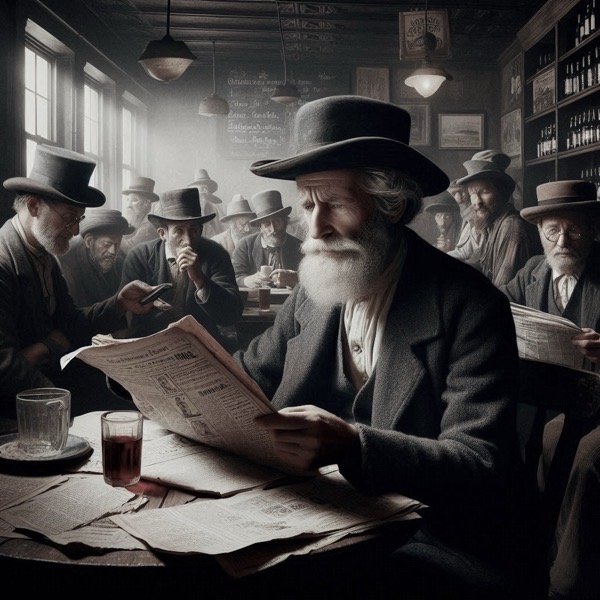
Sunday Morning Reading

It’s a cold late Fall morning, with some crisp and cold writing for you in this week’s Sunday Morning Reading.

Sunday, it’s a Sunday. The Sunday after Thanksgiving and Black Friday, although every Sunday these days feels like it’s the Sunday after yet another Black Friday. Even so, it’s time for some Sunday Morning Reading. This week’s edition contains some somber writing, fitting for the onset of a winter of discontent and reflection, along with some thinking on the tech scene and vaccines. For good measure, there’s a history of dive bars at the end. Enjoy.

Leading off, David Todd McCarty’s piece I Was F*cking Wendy Under The Stars, The Night Elvis Died, reflects on the risks we take, and perhaps don’t take, in building a life.

Promises and Scars by Kelly Gawitt is an excellent piece of writing on second chances. We all need them.

Joan Westenberg says We’re Dying. Here’s How to Make Better Decisions. Joan’s Mortality Matrix is something to see.

Sam Roberts gives us a look back at a real heroine in Madeline Riffaud, ‘The Girl Who Saved Paris,’ Dies at 100. I’m thinking we might need some Madeline’s going forward.

Patrick Fealey offers a harrowing and personal inside look at homelessness in America in The Invisible Man.

Tim Berners-Lee, who conceived the World Wide Web is taking a crack at a new way our digital lives are stored online with a new venture called Solid. Harry McCracken takes a crack at explaining it all in The Man Who Gave Us The Web Is Building A Better Digital Wallet. Hope it works.

Christopher Mims says that Googling Is For Old People. That’s A Problem For Google. The lede is fantastic:

If Google were a ship, it would be the Titanic in the hours before it struck an iceberg—riding high, supposedly unsinkable, and about to encounter a force of nature that could make its name synonymous with catastrophe.

Vaccines. Who in their right mind thought we’d ever be debating anything about the miracle of vaccines? Donald G. McNeil Jr. says that Vaccines Will Have To Prove Themselves Again. The Hard Way. Warning: the “hard way” isn’t a pretty way.

And after all of that if you need a drink or two or three, check out Linze Rice’s piece on The History of Chicago’s Dive Bars, Once Called ‘The Vilest Holes In The City.’ Bottoms up.

If you’re interested in just what the heck Sunday Morning Reading is all about you can read more about the origins of Sunday Morning Reading here.  You can also find more of my writings on Medium at this link, including in the publications Ellemeno and Rome. You can also find me on social networks under my own name.

Google is A Monopoly So Says the Judge

Judge drops the anti-trust hammer on Google

I’m guessing things are about to change. Federal Judge Amit Mehta has declared Google to be a monopolist as relates to its search and advertising business.

The ruling comes after a 10-week trial and is sure to shake things up in the tech landscape with other big tech companies like Apple, Amazon, and Meta also facing legal challenges regarding their potential status as monopolies. So far no remedies have been proposed yet, so we will have to see how it all plays out.

Here’s the money quote from the verdict:

After having carefully considered and weighed the witness testimony and evidence, the court reaches the following conclusion: Google is a monopolist, and it has acted as one to maintain its monopoly…it has violated Section 2 of the Sherman Act.

Google also faces another fight with the Justice Department again this fall challenging its advertising technology business.

You can read the entire lengthy verdict at this link. Or you could just Google it.

You can find more of my writings on a variety of topics on Medium at this link, including in the publications Ellemeno and Rome. I can also be found on social media under my name as above. 

Sunday Morning Reading

Some serious stuff in our world this week, but we must dance on. Here’s some Sunday Morning Reading to share.

The world is a very serious and uncomfortable place based on what I’ve been reading this past week, so the topics for this edition of Sunday Morning Reading will lean that way. Good writing all around that meets the seriousness we’re all dancing around.

The United States Supreme Court is about to alter the world we’ve all thought we’ve lived in. Rick Wilson of Everything Trump Touches Dies fame writes:

The Supreme Court will delay Trump’s case and then make the most cataclysmic legal mistake in American history.

We’re not talking Dred Scott bad, Plessy bad, and Korematsu bad.

We’re talking about previously unimagined levels of bad.”

He’s correct. Check out The Red Court Strikes Again.

Bryan Tannehill says The Court Just Sealed Everyone’s Fate, Including It’s Own. Again, correct.

While this may be a bit less current than most articles inlcuded this week, Brian Gopnik reminds us that it takes more than one man to turn the world upside down in The Forgotten History of Hitler’s Establishment Enablers.

Wars, protests and political shenanigans about those wars abound. Mo Husseni has laid out his thoughts about what’s happening in the Middle East and our reactions to it on Threads and published them as an essay on Medium. Well worth your time to read his piece titled Hmmm… do I need a title?  

A few topics on the tech front, the mechanism that one way or the other bring us all this news and writing about that news, Edward Zitron tells us about The Man Who Killed Google Search.

Craig Grannell tells us to Just Say No: Not Every Piece of Tech Needs Subscriptons and AI. He’s correct and he nails the reason why this is becoming pervasive.

I don’t agree with everything Allison Johnson says in The Walls of Apple’s Garden Are Tumbling Down, but she makes good points and provides a piece of the necessary frame around this unfolding story.

Changing the subject, it is tough to laugh given all that is swirling around us. But laugher is crucial. Always. As unprovoked a release of emotion it is, laughter does take on different forms and come from different places. Christie Nicholson takes on The Humor Gap between men and women. Hat tip to David Todd McCarty for this excellent piece.

A Summer Place by Natasha MH reminds us that whatever we’re mired in, we should always dance on and quoting Neil Gaiman we should

Face Your life

It’s pain,

It’s pleasure,

Leave no path untaken.

If you’re interested in just what the heck Sunday Morning Reading is all about you can read more about the origins of Sunday Morning Reading here.  You can also find more of my writings on Medium at this link, including in the publications Ellemeno and Rome.

Sunday Morning Reading

It’s a Sunday morning of a somewhat lost, yet restorative weekend. Simultaneous with spring daffodils starting to bloom, the cast from my recent gig, The Lehman Trilogy, made a suprise trip from Memphis to Chicago to visit for the weekend. Made we think and feel deeply. Made me laugh. It was glorious. Bonds don’t get any deeper. I needed that. That said, and still recovering, here’s some Sunday Morning Reading to share.

First up David Todd McCarty is searching for the answers on why we do the things we do in Frittering Away What’s Left of Eternity. Terrific piece with no frittering. Resonated with me when it was published earlier this week. After this weekend it resonates with stronger vibrations.

Radley Balko delves into The War On the Woke in an excellent piece The War on the Woke Trumps the Truth for Heterodox Thinkers. 

Sarah Jones takes a look at The Exvangelicals Searching for Political Change. I think she coined “Exvangelical.” Regardless of the label credit, its meaning sticks.

Jim Sciutto sees current global tensions as a 1939 Moment in his new book The Return of The Great Powers. Russia, China and the Next World War. I’m looking forward to reading it. You should too. In the meantime, David Smith talks about Sciutto’s book in ‘A 1939 Moment’: Jim Sciutto On Russia, China and the Threat of War.

Once a teacher always a teacher. I grew up in a family of teachers. NatahsMH in The Blind Leading the Blind recounts her experiences of teaching young ones what it’s like to experience being disabled for only an hour. I’m not talking comedy, but here’s the punch line: “And you experienced being disabled for one hour. Imagine a lifetime. Now go design the world a better, smarter place.” 

It’s been 10 years? On the anniversary David Pierce wonders Who Killed Google Reader? I remember that death. The internet remains, but there’s a hole left by it.

If you’re interested in just what the heck Sunday Morning Reading is all about you can read more about the origins of Sunday Morning Reading here.  You can also find more of my writings on Medium at this link, including in the publications Ellemeno and Rome.