Living in the Past with Apple Music Replay

Musical time warps

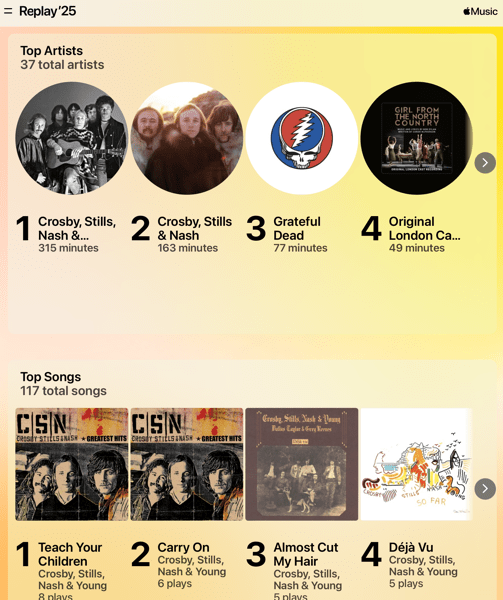
I listen to music but I’m not a voracious listener like some are. Fact is, I spend most of my listening time with podcasts and audio books. Nevertheless, it is interesting to see what music I did spend my time listening to. Apple Music, like other music services, offers a feature to summarize what tunes you’ve tuned into over the year called Apple Music Replay.

CleanShot 2025-12-02 at 08.48.09@2x.

Given all that’s going on in the U.S currently I shouldn’t find it surprising that I spent most of my time reliving parts of my youth that were just as tumultuous as our present, revisiting a lot of Crosby, Stills, Nash and Young and The Grateful Dead as well as the musical Girl From the North Country that features the music of Bob Dylan. (I spent considerably more time with that selection last year.)

It’s also interesting to me that when I do listen to music I do so through a couple of very eclectic playlists that range over quite a few genres. I never see that reflected in these generated mixes, only artists or albums I’ve selected specifically, which tells me these lists are mostly made up from selections you’re searching for. Perhaps that explains why when I ask Siri to cue up a playlist it fails as much as it succeeds. But then again, most of those playlists contain mostly music from my past, more than contemporary selections.

Seems to me, we could all do with a little more music these days that is speaking directly to these days.

You can also find more of my writings on a variety of topics on Medium at this link, including in the publications Ellemeno and Rome. I can also be found on social media under my name as above.

Sunday Morning Reading

Winter is coming. Or is it already here?

It’s a snowy Sunday after the Thanksgiving holiday here in Chicago. The Chicago Bears have already played this week’s game, beating the Philadelphia Eagles on Friday, sending the town into a tizzy before it got covered in a Saturday snowfall. So it feels like the perfect day to settle in and do a little Sunday Morning Reading after the shoveling and snow blowing move stuff around. Bitch of it is, the stuff still has to melt. Let’s take a look.

PXL 20250320 115712285.

Humorist Emily Bressler has a frighteningly funny piece of satire that I think sums up the chilling undercurrents in so much of what we’re living through at the moment in I Work For An Evil Company, But Outside Work, I’m Actually A Really Good Person.

Winter may be a few weeks away officially, but in Chicago, it feels like it’s here already this weekend. Actually the metaphor feels like it’s been too close for comfort for quite some time. The U.S. might be sinking ships in warmer waters threatening an invasion of Venezuela, but the Danes haven’t forgotten threats in colder climes and have been preparing. Miranda Bryant spells it out in Denmark Sets Up ‘Night Watch’ To Monitor Trump After Greenland Row. 

Theaters and other arts organizations are feeling quite a chill in this inhospitable political climate these days. Adam Harrington is Taking The Temperature Of Theater In Chicago: Distress As Venues Fall, But Optimism Driving By A Vibrant Community. 

Speaking of theater, Mathew Ingram takes a look at the ritualized charades that happen after a tech company gets called on the carpet for being evil in What Did Mark Zuckerberg Know And When Did He Know It? These performance art pieces happen all too frequently, regardless of venue. The audience never buys it. So why do these unfunny farces continue?

If we survive the Artificial Intelligence tsunami the next big thing that’s been the next big thing for quite some time will be when quantum computing actually turns into something. I imagine it’ll all be lumped in together as all of these waves crash ashore with the same promises. The Swinburne University of Technology asks the question If Quantum Computing Is Solving ‘Impossible’ Questions, How Do We Know They’re Right?

Josh Marshall takes a look at The Surreal Madness Of The AI Boom. I’m not sure I’d call it surreal, but it’s certainly something other than real. Otherwise, why would folks like Laura J. Nelson be chronicling how Tech Titans Amass Multimillion-Dollar War Chests To Fight AI Regulation. (Hint, when you have to play that kind of expensive defensive game, you’re trying to hide the ball, not advance it.)

NatashaMH provides a quilted farewell in a touching remembrance of a friend who passed too soon. Her closing line of My Best Friend Wrapped In Peace, “be safe in winter till summer arrives again,” chills and thaws in the same breath.

To close out this snowy holiday weekend, Neil Steinburg gives us a short piece titled simply, Home. Read it. Whether you’re home, on your way there, or returning to it.

If you’re interested in just what the heck Sunday Morning Reading is all about you can read more about the origins of Sunday Morning Reading here. If you’d like more click on the Sunday Morning Reading link in the category column to check out what’s been shared on Sunday’s past. You can also find more of my writings on Medium at this link, including in the publications Ellemeno and Rome.

Sunday Morning Reading

No tricks. No treats. Just thoughts and reading worth sharing.

The frights of Halloween have passed us by, but real life horrors remain and expand. Never had more gut wrenching emotions this weekend than spending it with my grandkids costumed in their bountiful innocence, avoiding what’s out there in a life they’ll one day have to face, but in the present doesn’t exist beyond the edges of any joyful moment of wonder and exuberance they can conjure. This week’s Sunday Morning Reading won’t touch on too much of that, but then again, I think it just did.

David Todd McCarty thinks amidst it all We Can Be Heroes. Making my grandkids laugh uncontrollably makes me feels damn close.

Adam Gropnik visits the home of the poet Wislawa Szymborska and returns with How To Endure Authoritarianism.

Will Bunch says It Didn’t take A Reichstag Fire To Burn Down Congress. He’s correct. It didn’t even take a match.

Some interesting writing on Artificial Intelligence and the Internet this week that’s worth your while, first up Cory Doctorow tackles When AI Prophecy Fails.

Will Douglas Heaven explains How AGI Became The Most Consequential Theory Of Our Time.

Tim Chinenov wonders Who’s Creating The Rage Bait That’s Radicalizing You?

Decidedly not on the Internet Friday night while trick-or-treating with my grandkids, though not in my besieged town of Chicago, I witnessed not only kids howling with fun, but adults who joined in on the fun with their own costumes and decorated homes, some elaborate, some not so, all with love and honoring a tradition I’ve never seen in the communities I’ve lived in. Many families set up in their driveways, some with small fire pits, some with tents, tables full of food (and candy), welcoming all comers to their Halloween semi-tall gating front yards. I also noticed the adults who just sat in their cars and slowly followed their children down the block. The entire experience reminded me of this piece from the summer in which Joan Westenberg says every creator pays a tax while the rest stay spectators in The Unbearable Lightness of Cringe. Pay the tax.

And closing out this week, kudos to both the Los Angeles Dodgers and the Toronto Blue Jays for an excellent World Series, which the Dodgers won. Both teams played a splendid series and provided an incredible Game 7 finish to one of those contests you never want to see end, but know it must. Grown men over compensated for incredible talent, playing a kid’s game like kids, thrilling and heart breaking in the same breath. Too bad we don’t have any great, or even good, baseball writers to chronicle the moment these days.

If you’re interested in just what the heck Sunday Morning Reading is all about you can read more about the origins of Sunday Morning Reading here. If you’d like more click on the Sunday Morning Reading link in the category column to check out what’s been shared on Sunday’s past. You can also find more of my writings on Medium at this link, including in the publications Ellemeno and Rome.

What’s Next After No Kings Day? How About Blackout Black Friday

Blackout Black Friday

By most accounts No Kings Day 2 was a success in gathering large crowds. Around 7 million seems to be the accepted estimate. Did it have an impact? Sure. What kind of impact? Who the hell really knows.

If you’ve followed the thoughts I’ve been jotting down here you’ll know that I strongly believe that until we extend the energy from events like No Kings Day out of a weekend and into a work week, or have a general strike, we’re not going to see the level of impact that might actually change things. I stress the word “might.”

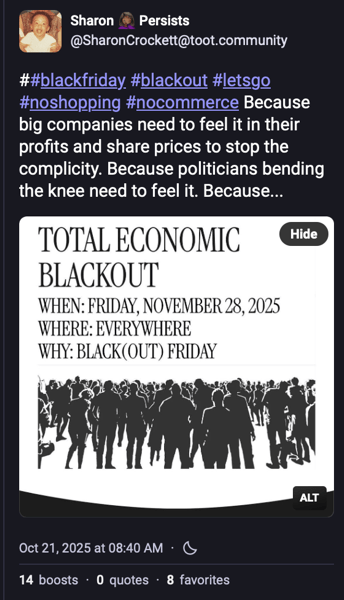
In the aftermath of No Kings Day 2 I was searching within the recesses of my brain for something, anything that could possibly move the needle. I came up with the idea of a Blackout on Black Friday. Don’t shop. Skip Prime Day and all of its variants. Don’t watch the sports. Don’t go to the movies. Stay off the Internet. Even a 10% drop in shopping and viewing metrics would have an impact. Even the threat of such an action would probably have an impact. 

Then this morning on Mastodon I see this post from SharonPersists. 

CleanShot 2025-10-21 at 09.23.08@2x.

I’m glad my brain isn’t the only one where these kind of thoughts are rattling around.

I’m sure there would be all sorts of friction given that this would be over a holiday weekend geared towards family and giving thanks. But I can’t think of a better time to turn it all off, spend time with family and friends, and possibly build on the momentum of other protests.

One way or the other this situation is going to require sacrifice before it comes to whatever end it will eventually come to. The only real choice we have is to make that sacrifice willingly, or have it continue to be thrust upon us.

I think of all of the Thanksgiving Day holidays in which I was producing and directing Charles Dickens’ A Christmas Carol. After each performance I watched families leave filled with the Christmas Spirit, only to have that merely be a passing moment in time when the message didn’t stick. We need to find some way that sticks.

I’ll be emailing organizers about this idea. I hope you might do the same.

You can also find more of my writings on a variety of topics on Medium at this link, including in the publications Ellemeno and Rome. I can also be found on social media under my name as above.
Sunday Morning Reading

Reading for the morning after the No Kings rallies and beyond.

Good Sunday morning. This edition will be slightly different than most. Yes, there will be a collection of links I find worth sharing (and hope you’ll read). That said, most of the links in this week’s Sunday Morning Reading come from an excellent series in The Atlantic’s November 2025 issue from a collection of authors called The Unfinished Revolution.

Yes, that’s behind a paywall. Sorry, not sorry. But this is the Internet and if you’re not already paying for excellent content like The Atlantic, there are a million ways to skirt that restriction. The issue is one worth paying for, if for no other reason to keep it as an archive for future generations. That may prove important one day. I plan on picking up a hard copy soon enough.

The issue is also timely as this country approaches it’s 250th anniversary, and finds itself being torn apart by forces that, suffice it to say, don’t represent what many believe this country stands for, or at least the promise of what it should stand for, even with it’s historical problems and faults.

It’s also timely because we’ve just seen the second and larger No Kings rallies across the country. Given that the founding of this country was indeed the original No Kings protest that kicked off a revolution against rule by a monarch, the timing also feels apropos.

I won’t highlight all of the articles in the series, you should go and check them out yourself. The ones I do link to are ones I found particularly interesting. And yes, there will be other links in today’s Sunday Morning Reading as well.

Before I get to The Atlantic’s links, this article by Garrett Graff,  Three Reasons I Still Have Hope For America, is more than worth your time. I agree that there is strength in numbers, but I don’t think the inevitable passing of a leader this time around will have the affect the world has seen historically.

The title of Anne Applebaum’s Atlantic piece, The Beacon of Democracy Goes Dark, certainly tells you where the piece is going. Even so, it is more than worth reading and contemplating. One way or the other we are living through and participating in moments that will change the world. We just don’t know how.

We’re dealing with our own Mad King wannabe, so Rick Atkinson’s The Myth of Mad King George draws some interesting parallels beyond their affinity for makeup that I suggest could be similarly drawn behind most of the troubled men who’ve plagued the world throughout its history.

Political and social schisms divide not only countries, but often families as well. Stacy Schiff asks Why Did Benjamin Franklin’s Son Remain Loyal To The British?

Jeffrey Rosen says that insurrection has marred the American constitutional order since its founding. He’s correct. Check out The Insurrection Problem. If you’re not an American history buff, I bet you’ll be surprised.

George Packer thinks we do need patriotism in his piece I Don’t Want To Stop Believing In America’s Decency. I concur with his sympathies, but when the meaning of words like patriotism and decency can get so easily mangled it becomes trying to cling to those beliefs.

Fintan O’Toole asks What The Founders Would Say Now. We’ve imagined, conjured, twisted, and appropriated who and what they and their words are so often, that in my view I think they’d tell us all to either grow up or go to hell.

As most of this week’s Sunday Morning Reading and my own thinking has focused on the issues facing America as a whole, I found former NY Times drama critic Frank Rich’s piece on Zohran Mamdani and the New York mayor’s race fascinating. Not just for his at times surprising commentary on that race. But for those paying attention, Why Powerbrokers Got Everything Wrong About Zohran Mamdani incisively dissects the deeper fissures subsuming the bigger political picture as well.

And to close out this week, here’s a piece from 404 Media about the amphibian symbol that has become associated with our current protests against the administration, Matthew Gault’s The Surreal Practicality Of Protesting As An Inflatable Frog.

If you’re interested in just what the heck Sunday Morning Reading is all about you can read more about the origins of Sunday Morning Reading here. If you’d like more click on the Sunday Morning Reading link in the category column to check out what’s been shared on Sunday’s past. You can also find more of my writings on Medium at this link, including in the publications Ellemeno and Rome.

We Have To Do Better. At What Exactly?

The time is out of joint

We’re burning up the words and phrases we use for comfort faster than out-of-control wildfires. We’re drowning meaning under flash floods of ravaging frequency. We’re dancing around sensitivities like so many angels on the head of a pin, ignoring that the pin has been smashed into smithereens by a sledge hammer. We keep looking for better angels of our nature to appear but they seem to have given up the ghost trying to reign things in. The time is out of joint.

PXL 20250913 090506555.

The meaningless phrase of the moment this morning that has gotten my goat is “we have to do better.”

What the hell does that even mean?

We pretend that everyone cares about the outrage of political violence. Not everyone does. There are those that care only enough to use it to their own advantage and want to see more of it. Yes, it’s about power. But it’s increasingly  become about the money, because you can make boatloads of it preaching hate and division. You know, free speech and all of that.

We have to do better.

There’s no “better” to do when it comes to language, because language only expresses what is felt inside. About self. About others. About domination. About fear. And when the “better” is about better profits… well, that’s the world we live in and at the moment it’s what’s making the world spin faster.

Step away from politics for a second.

When a sports team loses and coaches and players say “we have to do better” or “we have to play better” it means nothing. Of course they do. They lost.

When a business doesn’t meet its sales targets, they always say “we have to do better.” Unless of course they’re spinning losses into wins hoping no one pays attention.

Shift back to political world.

The spinning happens there as well, with a speed that can burn through the surface it’s spinning on. Yet, it’s a bit late to want to do better after the bullet has struck a target so broadly painted.

We can no longer expect appeals to better angels or doing better to work. It’s a naive call to a different past that in many respects never existed, even though on the surface it seemed to. We should no longer be afraid of phrases like civil war, because in case you haven’t noticed, we’re in one. People are being killed in their homes, at rallies, in schools, just about in any place. Sad fact of history, what we want to believe is random violence by extremists always happens before someone declares that a war is on. But hey, we’ve got a deranged lunatic of a leader who wants to meme one into being, while we spend so much time trying to figure out what we know is the why of it.

You can argue that the extremists aren’t the ones with the guns, but the ones with the big mouths and the AI bots at their command. No one is going to clamp down on the rhetoric any more than they are going to clamp down on guns, and it has already bubbled over into a toxic stew. How are you going to “do better” when all sides claim their way is the better way? I don’t have an answer for that question, because I’m afraid I actually know the answer and there’s nothing “better” about it.

The only thing we have to “do better” at is recognizing the horrors of the moment we’re in and facing it for the reality that it is. You and I certainly don’t want to see and hear what we’re seeing and hearing. But we’re too far down that road to not acknowledge we’ve arrived at a terrible place.

Hamlet says:

‘The time is out of joint: O cursed spite,
That ever I was born to set it right!’

I feel like we’re all caught in Hamlet’s dilemma. Wanting to fix it, but afraid to the point of cursing what will eventually need to be done.

You can also find more of my writings on a variety of topics on Medium at this link, including in the publications Ellemeno and Rome. I can also be found on social media under my name as above.

Sunday Morning Reading

Back home from travels. Still sharing stuff that warrants attention.

Back home after a couple of weeks on the road. Good times. Crazy times. Nevertheless, it’s Sunday and there’s Sunday Morning Reading to share.

Shutterstock 1626610513.

“Life isn’t just about knowing what you should do, or having the resources to do it, it’s about following through.” So says, John Burn-Murdoch in his piece The Troubling Decline In Conscientiousness. I agree there’s a decline. I’m not so sure the remedy is as simple as it sounds.

The AI race is continuing whether we want it to or not. Apparently there’s now a way to create your own TV show if you want to keep diving deeper into your own delusions. Nina Metz has a great piece on this intrusion into the entertainment industry saying After A Long Day, The Last Thing I Want Is To Tell GenAI To Create a TV Show For Me To Watch.

In Notes From The Circus, Mike Brock takes a look at The Faux Intellectuals of Silicon Valley. “When oligarchs treat human civilization as thought experiments while sophisticated courtiers provide intellectual cover, democratic discourse itself becomes impossible.” Nailed it.

I don’t know about you, but my handwriting went downhill mere minutes after I was no longer graded on it. So it has always sucked. So, I’m not sure if NatashaMH’s latest applies in my case, but she is taking a look at what happens When The Handwriting Changes, suggesting that the body keeps score and so does the pen. Damn, if I’d know there was score keeping…

Mathew Ingram takes a look at age gating, the move afoot to protect kids from the perils of the Internet in The UK’s Well-Meaning Online Safety Law Is A Dumpster Fire. American dumpsters won’t be far behind, because we like to hide from the things we think are bad, pretending we’ve solved the problem, instead of addressing the problem.

Matthew Wolfe tells a great story about Chicago and America’s first black detective, who had a few secrets of his own in The Talented Mr. Bruseaux.

The turmoil among Apple users continues to roil for lots of reasons. Certainly this week’s obsequious bending of the knee by Tim Cook has added more to it. I wrote a bit about that here. I like John Gruber’s take on the issue in Gold, Frankincense, and Silicon. 

(Image from OlegRi on Shutterstock)

If you’re interested in just what the heck Sunday Morning Reading is all about you can read more about the origins of Sunday Morning Reading here. If you’d like more click on the Sunday Morning Reading link in the category column to check out what’s been shared on Sunday’s past. You can also find more of my writings on Medium at this link, including in the publications Ellemeno and Rome.

Sunday Morning Reading

A bit of this, a bit of that. All good bits.

It’s the Dog Days of Summer and it’s been a hot one so far. We’re traveling again, but there’s still some interesting Sunday Morning Reading to share. Some of it hopeful, some elegiac. Some just geeky and fun. Enjoy.

Milen kolev zs9jdUCaP_4 unsplash.

Kicking things off is a piece in The Atlantic from Anna Deavere Smith called When You Don’t Look Like Anything. She’s a singular artist always worth paying attention to. Her story of her 50-year search for the American character is certainly more than worth your time. Damn good stuff.

A.R. Moxon popped up on my radar this week with a piece called Total Eclipses. It’s part 2 of a series, the first being Be Bolder, Not a Boulder. If you’re like me and looking for any light at the end of any tunnel these days, do give both pieces a read.

NatashaMH offers up An Ode To The Poetic Detours. It’s about writing and where she finds inspiration, but more broadly, it’s about observing, noticing, listening, seeing, and feeling between the lines we sometimes get trapped within.

Will Dunn asks Are Emoji’s Killing Language? I’ve been saying they are for quite some time. For the life of me I don’t understand why we seem intent on regressing back to an age of hieroglyphics instead using the complex beauty of words and language.

Mathew Ingram says The Google Link Economy Is Dying and It’s Not Coming Back. He’s not wrong. Actually, he’s very right.

Health is a big deal in tech these days, especially when it comes to adding features to improve monitoring what’s going on in our bodies. Frankly, as someone who uses medical devices for monitoring my diabetes, the promises to add that kind of monitoring to smart devices, along with blood pressure and other conditions, sound hollow, seeming as realistic to me as self-driving cars. We may get there one day, but for now it’s mostly a clever way to market something new to increase the bottom line. Victoria Song takes a look at Samsung’s recent effort to check out our level of antioxidants with their smartwatch in I ‘Fooled’ Samsung’s New Antioxidant Feature With a Cheez-It. 

Much has been made of Paramount’s caving to Donald Trump, leading to the firing of late not comedian Stephen Colbert. That was quickly followed up by the Trey Parker and Matt Stone’s skewering new season opener of South Park. Paramount paid up, got its merger, and in an Aristotelian, if not Mel Brooksian sense there’s some grand comedy in the entire thing. I’m a fan of Alexandra Petri’s piece examining the moment pre-South Park titled Are You Laughing Yet?

Sometimes we just need to laugh at what feels like no laughing matter.

(Image from Milen Kolev on Unsplash)

If you’re interested in just what the heck Sunday Morning Reading is all about you can read more about the origins of Sunday Morning Reading here. If you’d like more click on the Sunday Morning Reading link in the category column to check out what’s been shared on Sunday’s past. You can also find more of my writings on Medium at this link, including in the publications Ellemeno and Rome.

Sunday Morning Reading

Mixed feelings and mixed emotions on a Summer Sunday by the lake.

The 4th of July weekend is wrapping up in the U.S. and many are having mixed feelings this year. Today’s edition of Sunday Morning Reading will feature some excellent writing on some of those mixed feelings in addition to some interesting reads on familiar topics from familiar writers, and some not so familiar. Enjoy.

Giuseppe argenziano J04GmVkKSLQ unsplash.

First up, let’s take a look at Elizabeth Lopatto’s view on the state of things in the states in her post The American System of Democracy Has Crashed. Excellent. Should be required reading.

Neil Steinberg also has thoughts well worth your time in He’s baaaaaaack.

Jack Hopkins gives us The 4th of July: What We Were Meant to Celebrate — and How We’re Failing It. Again, worth a read as we close out the long holiday weekend and this section of today’s Sunday Morning Reading.

Now for some catching up on some links I’ve delayed too long in sharing.

First up is The Chosen Few and the Cost of Global Silence from NatashaMH. History repeats. All the damn time. As she also demonstrates in this piece The Cruelty of Indifference.

Relative youngster, David Todd McCarty writes about aging in When I Am Old.

Writers are having trouble finding the right fit when it comes to how to make a living. Matthew Ingram tells us Why Substack Shouldn’t Be The Future of Online Publishing. We

Chuck Wendig argues about and bemoans the loss of downtime in his writing process given all that’s happening around us in A Small But Vital Thing, Taken.

While writers search for new ways and new homes, Joshua Rothman wonders What’s Happening To Reading?

Never Forgive Them is a piece from Edward Zitron from December 2024 that seems relevant again in more ways than it was intended then.

Composer and poet Stan Stewart recently had his computer die on him. He writes about what he lost and found in Of Dead Computers and Really Living.

Matteo Wong says The Entire Internet Is Reverting to Beta. Sure everything is a janky work in progress, certainly in the janky days of AI. But I think that’s how those who think they run the joint like running the joint.

And to close out this week, take a good look at this wonderful long read from Eric Konigsberg from all the way back in 2001, entitled My Uncle The Hit Man.

Image from Giuseppe Argenziano on Unsplash.

If you’re interested in just what the heck Sunday Morning Reading is all about you can read more about the origins of Sunday Morning Reading here. You can also find more of my writings on Medium at this link, including in the publications Ellemeno and Rome.

Sunday Morning Reading

When caring becomes a commodity, should we care more or less?

Lots to care about. On all the usual fronts. But in the grand scope of the universe does much of it really matter? Some interesting links to share in this week’s Sunday Morning Reading.

Dan Sinker, taking a look at The Chicago Sun-Times AI flaps calls it The Who Cares Era. His theory is that along the way, nobody cared. I’d venture they cared about the wrong things.

Apple’s annual developer conference WWWDC is a week away and given the many issues the company is confronting lots of folks care and are curious about how Apple begins to address them. Some don’t see Apple changing how it deals with developers, like Aaron Vegh in his post, They’re Not Going to Change.

Some, like John Siracusa, are rooting for Apple and even offering advice. Siracusa’s piece Apple Turnaround is a companion to his recent previous post Apple Turnover. All worth a read, regardless of how you feel about the predicaments Apple finds itself in.

The tech bros who seem to be in the pole position running to rule the world may be making bank, but they’re not winning any friends in the process. They most likely don’t care given that they think they’re on their way to conquering the universe. John Kaag is offering up A Reality Check For Tech Oligarchs. Frankly, I don’t think they live in anything close to reality.

Meanwhile, down here on planet reality, some are looking for ways to survive and perhaps beat the odds seemingly stacked against us. A.M. Hickman lays out a vision for How To Live on $432 a Month In America.

Much of what’s going on around us might seem profane and vulgar, leading to quite a few expletives coming out of our mouths as we cope. David Todd McCarty takes us on an exploration of his love of four-letter words in Frequently Profane But Never Vulgar. For what it’s worth, all words have value in my opinion. Hiding from them is fucking stupid.

Natasha MH is Reclaiming the Joy of Struggle in an AI-Driven World. Better grab that joy while we can, because that struggle is only going to become more intense.

Just when you thought we might have begun to figure out the new landscape of insanity we’re currently struggling through, comes along Ross Anderson who informs us about The Nobel Prize Winner Who Thinks We Have The Universe All Wrong. It may someday stop expanding the way we thought and might just remain stagnant for longer than originally theorized, allowing intelligent life to continue longer than we thought. One may ask, should we care?

(Photo from Vincent Nicolas on UnSplash.)

If you’re interested in just what the heck Sunday Morning Reading is all about you can read more about the origins of Sunday Morning Reading here. You can also find more of my writings on Medium at this link, including in the publications Ellemeno and Rome.