Death By Lightning: A Mini-Review for a Mini-Success

Music, fighting, sausages

Candace Millard’s excellent non-fiction book Destiny of the Republic: A Tale of Madness, Medicine and the Murder of the President is often overlooked, though it was well received well when it debuted in 2011. I’m hoping that the new Netflix adaptation titled Death By Lightning will give Millard, her book, and the period of American history it chronicles more well deserved and appropriate notoriety.

Death by lightning.

Yes, this is one of those many cases where the original source material far outshines the film/TV version. That said, Death By Lightning is worth a watch, if nothing else for an entertaining opportunity to dip your toes into the historical waters that are still affecting much of what we’re wading through today in an age when those in control are so eager to pour cold water on the pieces of history they don’t like.

More to the point, Death By Lightning touches on a piece of history from a tumultuous time that seems largely forgotten, that we perhaps might have learned better from, even before we got into this current mess. A poignant, late scene sets this up wonderfully.

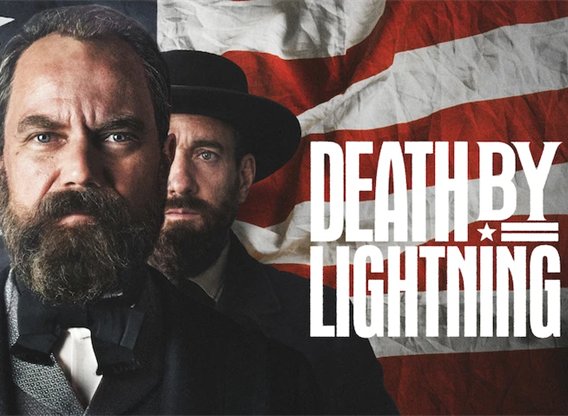
Created by Mike Makowsy and directed by Matt Ross, Death By Lightning is a limited Netflix series, that chronicles the unlikely rise of James Garfield to the presidency and his assassination by Charles Guiteau. (If you think anything in this brief review is a spoiler it proves my earlier point.)

There are four episodes and in the end that’s part of what weakens the series as it doesn’t allow much time for much of the depth of Millard’s book. Towards the end it feels like it’s rushing to a conclusion, leaving me wondering how much got left on the cutting room floor or chucked away in the C-suite.

An excellent cast largely rises to the occasion featuring Michael Shannon as Garfield and Matthew MacFadyen as an over the top Guiteau. That said, Guiteau was apparently quite over the top in real life according to many accounts, so much so that there are so many accounts. They are well supported by Betty Gilpin, Shea Whigham, Bradley Whitford, and especially Nick Offerman in a scenery and sausage chewing turn as Chester Arthur, who succeeded Garfield.

One of the wonders of Millard’s book is that it featured an intersection of so much of American life at the time following the Civil War, from politics to science and medicine. The battle between the politics of the spoils system and a desire for a less corrupt civil service system is well chronicled in both the book and the series and adds interesting context to our current tariff tangles that I’m guessing most will find surprising.

If you’re frustrated by recent happenings in our current day Congress and politics both the book and the series will add some historical (and often entertaining) context to the mess we’re in.

Less featured in the series are the conflicts in medicine with many American physicians of the day rejecting what had become largely accepted in Europe as a new approach to germs and sanitary surgical practices.  Not really a spoiler, Garfield was shot, but it wasn’t the bullet that killed him. He died from sepsis caused by infection due to unsanitary practices in the aftermath.  If you’re detecting hints of the medical madness we’ve been living through since the pandemic, you’re not wrong.

Alexander Graham Bell also makes an appearance with a new invention that could possibly detect the bullet lodged in Garfield’s gut, but the fuller story about his scientific advances and entrepreneurship, which runs on an almost parallel path to Garfield and Guiteau’s in the book, is mostly left as a footnote in the Netflix series.

Again, it’s by no means a perfect piece of streaming entertainment. I highly recommend the book on which it is based and I would mildly rate it better than most of the mundanity that fill our screens instead of the lists we curate. The cast and the exposure to a forgotten moment in American history that I’m certain many have no clue about makes it a good candidate for your watch list.

Besides just getting a chance to see Nick Offerman toss out the line, “Music, fighting, and sausages” is worth the time spent.

You can also find more of my writings on a variety of topics on Medium at this link, including in the publications Ellemeno and Rome. I can also be found on social media under my name as above.

Sunday Morning Reading

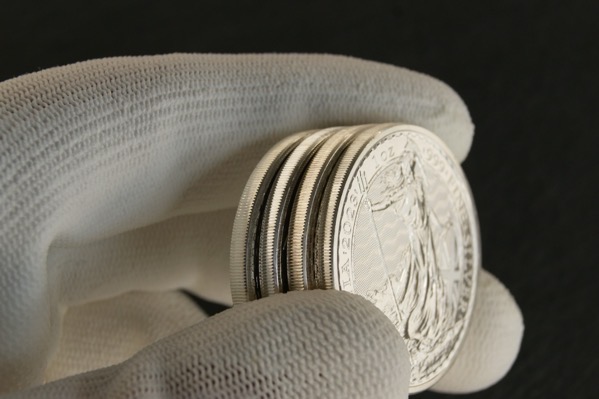
Balancing on the edge of a coin

Regardless of the many problems with the Internet, there’s no denying its benefits. One of those is the pleasure of reading stuff I probably would never be aware of without it. In many ways that’s what this Sunday Morning Reading column is about (as well as my life in general on the Internet.) When you read and live life enough, you discover that the trick is always balancing on the edge of the coin that separates the two sides.

There’s comfort perhaps landing on one side or the other, but life is actually in the fragile middle of the muddle somewhere, even if it’s a fine, and increasingly thinner line, often hard to discern.

Shutterstock 2408853287.

First up this Sunday is a piece by Josh Marshall of Talking Points Memo called Fear, Greed, Civic Virtue and the Fall of the Elites. Pay attention to that word “virtue.” As Marshall points out it originally meant “manliness.” The word’s evolution is as tricky as the concept itself.

Follow that up with Ian Betteridge’s The Politics of the Missing Middle.

Ian Betteridge’s law of headlines that says any headline that ends in a question mark can be answered with the word “no.” Steven Levy falls into Betteridge’s trap in his piece, Can AI Avoid The Enshittification Trap? Cory Doctorow’s theory of Enshittification has been a popular topic in this column and Betteridge’s law certainly applies here. For those looking for a primer on enshittification Greg Rosalsky has a a quick primer on the topic in A Theory Why The Internet Is Going Down The Toilet. 

While technically not falling under the umbrella of enshittification, some of the ways folks are using AI sure sound shitty. Check out Alexandra Jones’s I Realized I’d Been ChatGPT-ed Into Bed: ‘Chatfishing’ Made Finding Love On Dating Apps Even Weirder. 

Things are getting weird indeed. Adi Robertson tells us that The Next Legal Frontier Is Your Face and AI. 

Several pieces on the arts and creativity stood out to me this week. David Sparks’ The Inherent Value Of The Creative Act reflects on his creative life and his resistance to using AI for the work of creating, but it helps with his administrative tasks. There’s that edge of the coin again.

Authoritarians always target art and artists first. You don’t need an Internet to discover that history, or perhaps we might if the current forces in charge have their way.  Andrew Weinstein discusses Trump’s Campaign To Defund The Arts—and Rewrite History.

Speaking of creativity or rather the other side of that coin, Joe Rosenthal takes on Creative Neglect: What About The Apps In Apple? I mentioned some of this in a piece I wrote this past week.

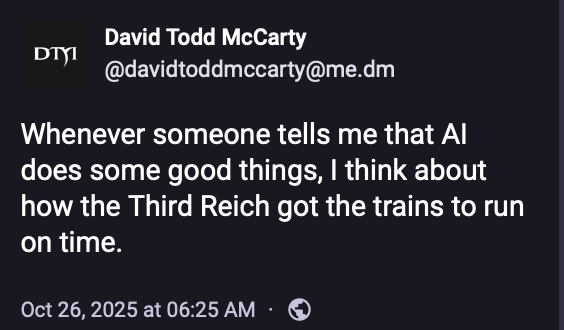
Speaking of that edge and to close out this week, here’s an image of a Mastodon post by friend David Todd McCarty from this morning.

CleanShot 2025-10-26 at 07.29.46@2x.

(Coin Image above from ABARONS on Shutterstock)

If you’re interested in just what the heck Sunday Morning Reading is all about you can read more about the origins of Sunday Morning Reading here. If you’d like more click on the Sunday Morning Reading link in the category column to check out what’s been shared on Sunday’s past. You can also find more of my writings on Medium at this link, including in the publications Ellemeno and Rome.

What’s Next After No Kings Day? How About Blackout Black Friday

Blackout Black Friday

By most accounts No Kings Day 2 was a success in gathering large crowds. Around 7 million seems to be the accepted estimate. Did it have an impact? Sure. What kind of impact? Who the hell really knows.

If you’ve followed the thoughts I’ve been jotting down here you’ll know that I strongly believe that until we extend the energy from events like No Kings Day out of a weekend and into a work week, or have a general strike, we’re not going to see the level of impact that might actually change things. I stress the word “might.”

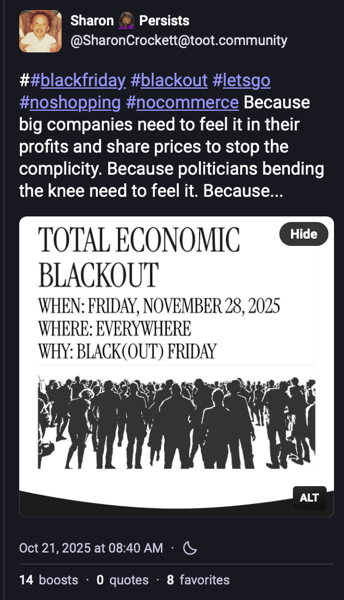
In the aftermath of No Kings Day 2 I was searching within the recesses of my brain for something, anything that could possibly move the needle. I came up with the idea of a Blackout on Black Friday. Don’t shop. Skip Prime Day and all of its variants. Don’t watch the sports. Don’t go to the movies. Stay off the Internet. Even a 10% drop in shopping and viewing metrics would have an impact. Even the threat of such an action would probably have an impact. 

Then this morning on Mastodon I see this post from SharonPersists. 

CleanShot 2025-10-21 at 09.23.08@2x.

I’m glad my brain isn’t the only one where these kind of thoughts are rattling around.

I’m sure there would be all sorts of friction given that this would be over a holiday weekend geared towards family and giving thanks. But I can’t think of a better time to turn it all off, spend time with family and friends, and possibly build on the momentum of other protests.

One way or the other this situation is going to require sacrifice before it comes to whatever end it will eventually come to. The only real choice we have is to make that sacrifice willingly, or have it continue to be thrust upon us.

I think of all of the Thanksgiving Day holidays in which I was producing and directing Charles Dickens’ A Christmas Carol. After each performance I watched families leave filled with the Christmas Spirit, only to have that merely be a passing moment in time when the message didn’t stick. We need to find some way that sticks.

I’ll be emailing organizers about this idea. I hope you might do the same.

You can also find more of my writings on a variety of topics on Medium at this link, including in the publications Ellemeno and Rome. I can also be found on social media under my name as above.

Artists Unite for Fall Of Freedom Campaign

Art matters. Artists are a threat to American fascism.

Much of the current focus building out of the simmering outrage at the actions of the Trump regime is centered on the October 18 NoKings rallies being planned across the country. From the sound of it the crowds will be large and widespread across the country. That’s all a good thing. 

 That said, I still wish and hope for and believe that more sustained efforts are going to be required before enough pressure might actually lead to progress. 

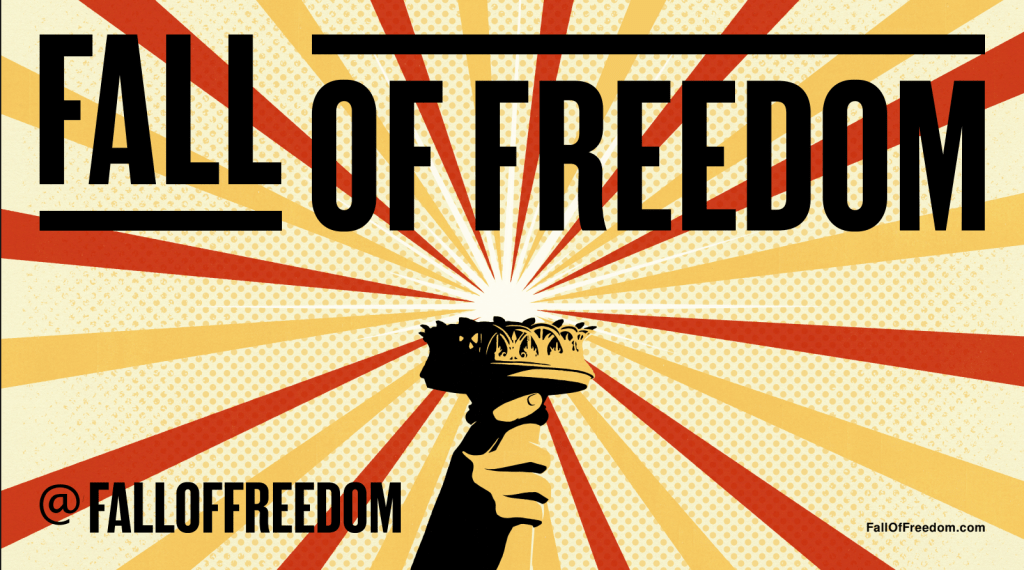
One effort that might help, if given proper support and media coverage, is an national call to action by artists called Fall Of Freedom. You should certainly check out the website and how to get involved. Here’s an excerpt from the website:

Fall of Freedom is an urgent call to the arts community to unite in defiance of authoritarian forces sweeping the nation. Our Democracy is under attack. Threats to free expression are rising. Dissent is being criminalized. Institutions and media have been recast as mouthpieces of propaganda.

This Fall, we are activating a nationwide wave of creative resistance. Beginning November 21–22, 2025, galleries, museums, libraries, comedy clubs, theaters, and concert halls across the country will host exhibitions, performances, and public events that channel the urgency of this moment. Fall of Freedom is an open invitation to artists, creators, and communities to take part—and to celebrate the experiences, cultures, and identities that shape the fabric of our nation.

Art matters. Artists are a threat to American fascism.

I do happen to believe in that last statement. Art does matter, and artists are a threat to American fascism, or fascism wherever it raises its ugly head.

From an article in American Theatre magazine, here are some of the theatre artists and organizations already involved:

Playwrights David Henry Hwang, Dominique Morisseau, and Sarah Ruhl; director/organizer Annie Dorsen; and Julia Jordan of the Lillys. Theatre organizations involved include the August Wilson Center, National Black Theatre, the Public Theater, Broadway Advocacy Coalition, Woolly Mammoth, New York Theatre Workshop, Ensemble Studio Theatre, En Garde Arts, Crossroads Theater Company, IndieSpace, and more.

There’s a longer and growing list at this link.

I urge you to check out the website that includes ways to get involved and a toolkit for this national call to action.


Hollywood Stars Relaunch The Committee For The First Amendment

History once again repeating itself

In the tumult that is the debate over freedom of speech and the First Amendment, a large group of Hollywood celebrities, led in this effort by Jane Fonda, have relaunched The Committee for the First Amendment. I’m glad to see it.

Committee for the First Amendment.

First created during the McCarthy ‘Red Scare’ era after government repression of American citizens for their political beliefs, the original Committee for the First Amendment was also a group of Hollywood actors, producers, directors, writers and more attempting to fight the repression led by Joe McCarthy’s efforts to purge communists from all walks of life. That repression led to black lists, the end of careers, and a black stain on the freedoms American’s cherish. Sadly, we’re back there again.

Some in today’s world of complicit media like to call this current mess a debate over freedom of speech. That’s bullshit in my opinion. There’s no debate in the attempts to label what speech, what entertainment, what ideas are allowed or not, certainly to when you have many Hollywood and media executives willing to bend the knee to the fascist regime we now have in place.

Here’s an excerpt from the webpage:

The federal government is once again engaged in a coordinated campaign to silence critics in the government, the media, the judiciary, academia, and the entertainment industry.

We refuse to stand by and let that happen. Free speech and free expression are the inalienable rights of every American of all backgrounds and political beliefs – no matter how liberal or conservative you may be. The ability to criticize, question, protest, and even mock those in power is foundational to what America has always aspired to be.

We understand that this is a frightening and confusing moment for many people. We recognize that we represent just one group of many who are under threat right now. Across classrooms, libraries, factories, companies and workplaces of all kinds, Americans of every walk of life are facing intimidation and censorship too — and we stand with them.

We know there is power in solidarity and strength in numbers. We will stand together—fiercely united—to defend free speech and expression from this assault. This is not a partisan issue. That is why we urge every American who cares about the First Amendment—the cornerstone of our democracy—and every artist around the globe who looks to the United States as a beacon of freedom to join us.

The list of those signing on is long. Here’s hoping we see more join in for what appears at the moment to be a long fight. And not just from Hollywood. It’s going to take this kind of action in all sectors of our society.

You can also find more of my writings on a variety of topics on Medium at this link, including in the publications Ellemeno and Rome. I can also be found on social media under my name as above.

A Constitution Day Like No Other

Not easy to celebrate this year.

Today, September 17 in the U.S. is Constitution and Citizenship Day in the U.S. It marks the observance of the day that delegates to the Constitutional Convention signed the document, revered for almost two and half centuries, and now, in my opinion, seriously in danger of being stripped of its meaning by those only adhering to its principles when its convenient and shredding them when it’s not.

CONSTITUTION_iStock 923052552_2500 1200x630.

Tumultuous times today, but there were also tumultuous in the run up to reaching the moment that saw the Constitution adopted. That’s well known and also conveniently forgotten. Until a piece of it needs cherry picking to beat a point home.

It was never a perfect document. It was never intended to be. That’s why there’s an amendment clause in Article V. But amendments to the document require enormous amounts of toil and compromise, are hard to come by, and frankly that process can’t work when you live in a world without principle.

I may not have agreed with some of the things left out of the original document or its later amendments, and perhaps I’m naive, but I do happen to believe that those who argued over what our governing document should be at the time at least had principles that they believed in as opposed to those today who only seem to believe in what’s best for themselves and not the entire body politic.

We talk all the time about the founders who built this thing. It’s a damn shame we’re consumed with talking about a real estate developer who is overseeing its destruction.

You can also find more of my writings on a variety of topics on Medium at this link, including in the publications Ellemeno and Rome. I can also be found on social media under my name as above.

We Have To Do Better. At What Exactly?

The time is out of joint

We’re burning up the words and phrases we use for comfort faster than out-of-control wildfires. We’re drowning meaning under flash floods of ravaging frequency. We’re dancing around sensitivities like so many angels on the head of a pin, ignoring that the pin has been smashed into smithereens by a sledge hammer. We keep looking for better angels of our nature to appear but they seem to have given up the ghost trying to reign things in. The time is out of joint.

PXL 20250913 090506555.

The meaningless phrase of the moment this morning that has gotten my goat is “we have to do better.”

What the hell does that even mean?

We pretend that everyone cares about the outrage of political violence. Not everyone does. There are those that care only enough to use it to their own advantage and want to see more of it. Yes, it’s about power. But it’s increasingly  become about the money, because you can make boatloads of it preaching hate and division. You know, free speech and all of that.

We have to do better.

There’s no “better” to do when it comes to language, because language only expresses what is felt inside. About self. About others. About domination. About fear. And when the “better” is about better profits… well, that’s the world we live in and at the moment it’s what’s making the world spin faster.

Step away from politics for a second.

When a sports team loses and coaches and players say “we have to do better” or “we have to play better” it means nothing. Of course they do. They lost.

When a business doesn’t meet its sales targets, they always say “we have to do better.” Unless of course they’re spinning losses into wins hoping no one pays attention.

Shift back to political world.

The spinning happens there as well, with a speed that can burn through the surface it’s spinning on. Yet, it’s a bit late to want to do better after the bullet has struck a target so broadly painted.

We can no longer expect appeals to better angels or doing better to work. It’s a naive call to a different past that in many respects never existed, even though on the surface it seemed to. We should no longer be afraid of phrases like civil war, because in case you haven’t noticed, we’re in one. People are being killed in their homes, at rallies, in schools, just about in any place. Sad fact of history, what we want to believe is random violence by extremists always happens before someone declares that a war is on. But hey, we’ve got a deranged lunatic of a leader who wants to meme one into being, while we spend so much time trying to figure out what we know is the why of it.

You can argue that the extremists aren’t the ones with the guns, but the ones with the big mouths and the AI bots at their command. No one is going to clamp down on the rhetoric any more than they are going to clamp down on guns, and it has already bubbled over into a toxic stew. How are you going to “do better” when all sides claim their way is the better way? I don’t have an answer for that question, because I’m afraid I actually know the answer and there’s nothing “better” about it.

The only thing we have to “do better” at is recognizing the horrors of the moment we’re in and facing it for the reality that it is. You and I certainly don’t want to see and hear what we’re seeing and hearing. But we’re too far down that road to not acknowledge we’ve arrived at a terrible place.

Hamlet says:

‘The time is out of joint: O cursed spite,
That ever I was born to set it right!’

I feel like we’re all caught in Hamlet’s dilemma. Wanting to fix it, but afraid to the point of cursing what will eventually need to be done.

You can also find more of my writings on a variety of topics on Medium at this link, including in the publications Ellemeno and Rome. I can also be found on social media under my name as above.

Sunday Morning Reading

The ant hill of humanity

Crazy travel rhythms this summer. Spending time at the lake this weekend. The good thing about lake time is there’s time to do some reading. Here’s some good stuff I stumbled onto, worth sharing for this week’s edition of Sunday Morning Reading.  Quite a bit revolving around Artificial Intelligence and other mind games. There’s also ants.

For some inexplicable reason defining what it means to be an American has actually become a chore these days. It shouldn’t be. Kieran Healy has written a piece simply titled American that recounts his thoughts and feelings on becoming an American citizen. Well worth your time, espeically in these crazy times.

“Memory isn’t linear; it’s relational.” That’s the thought NatashaMH leaves us with in her piece The Mind’s Mischief. The mind is indeed a curious thing.

Matteo Wong says the AI Doomers Are Getting Doomier. I don’t know about you, but if we’re all doomed at the hands of AI (does AI have hands?) human intelligence never really advanced as far as I thought it did. Or maybe we just hit the ceiling.

Speaking of AI doom, Charlie Warzel wonders why one of the impacts of AI it to make us feel like we’re losing it in  AI Is A Mass-Delusion Event. I get the points and they’re well made. Referring back to my comment from the previous entry, if we’re such easy marks for this kind of delusion… well…we are such easy marks.

David Todd McCarty argues why we should resist AI with ecclesiastical fervor, especially those who create for a living. Check out The Moral Failure Of Using AI In Your Art.

Reece Rogers is marking yet another change brought about by AI. Take a look at The AI-Powered PDF Marks The End of An Era.

Barry Betchesky tells us that It Took Many Years And Billions of Dollars, But Microsoft Finally Invented A Calculator That Is Wrong Sometimes. You read that right. The money quote is:

“But now we have Microsoft apparently determining that ‘unpredictability’ was something that some number of its customers wanted in their calculators.”

Rounding out this collection of links on AI, is another article by NatashaMH where she says instead of Fearing the Machinery, Interrogate The Mindset. Excellent piece. The underlying current is something I’ve been thinking about a lot. We’re creating these machines in our own images. Or at least the images we imagine of ourselves. Humans are far too human, even when we look past or try to accelerate beyond our humanity.

One of the joys of spending time in the great outdoors is that it reminds you we’re not the only intelligent species on the planet. Although as the theme of this week’s reading has emerged, we might want to reevaluate that, just not with Microsoft’s math tools. On another front, in politics it’s certainly easy to argue for a reevaluation. Kate Knibbs takes a swipe at it in a look at how Government Staff Cuts Have Fueled An Ant-Smuggling Boom.

I told you there’d be ants.

If you’re interested in just what the heck Sunday Morning Reading is all about you can read more about the origins of Sunday Morning Reading here. If you’d like more click on the Sunday Morning Reading link in the category column to check out what’s been shared on Sunday’s past. You can also find more of my writings on Medium at this link, including in the publications Ellemeno and Rome.
Who Controls History If AI Is In The Mix

Time in a bottle of bits

One of the scariest things about this insane period we’re living through is the attempt by those in power to rewrite, alter, or just get rid of history they don’t like. Whether it’s banning books, changing curriculums, forcing the closures of libraries, or what museums can display, I find it a cowardly, yet effective way to hide heads in the sand, bury the sins of the past, and admit we’re actually ashamed of ourselves.

Peter herrmann 9_FK2Tp kLA unsplash.

I know this because I have lived this. My early education certainly tilted the American narrative towards the mythology of the Old South. It wasn’t until I left home, and got involved in the theatre that I discovered just how much I hadn’t learned, how much more I needed to, and how the future depends on the past, no matter how complicated it was.

Fortunately the information was there. It was up to me to do the work.

What happens when it’s not there? Or it’s wrong?

I find It hard to imagine that large chunks of the world’s history can be erased, growing up in an era when my access to it seemed to expand exponentially. But it’s been tried before. It’s succeeded with entire generations of populations. Now we’re facing the very real possibility of it happening again in this digital age with the aid of Artifical Intelligence.

There’s an interesting piece by Benji Edwards in Ars Technica about a college student who trained a small AI model that he called TimeCapsuleLLM on Victorian texts. During his experiments his time capsule spit out some actual history he didn’t know about real protests during the era. He checked into the info and the LLM was indeed accurate.

At first glance, that feels like a very positive AI story. Discovering lost history is a good thing. However, with the way I understand AI training it all depends on what data it’s trained on. That leaves things up to who controls the training data. Leave out, change or bias the historical record and…

Well, you can see the problem.

Elon Musk has already hinted at this kind of manipulation. I’m sure there are others thinking the same. They say history repeats itself. Actually history doesn’t. Humans do. History is just the record of the repetition. Humans just use newer and different tools to mold the past into something more comfortable. I may be mistaken, but I think history, in the long run, also proves that never really works out.

Correcting and rewriting history is not for the faint of heart. But when there is no heart, there’s a problem.

Time machines and time travel have always been fraught with danger in the history of science fiction. So has Artificial Intelligence. I’m reasonably sure we’re not smart enough to walk whatever fine lines might exist in a future when the past can be more easily manipulated. We haven’t been in the past when the erasing was harder. But I am dead certain we’re going to be facing this unreal reality.

Again.

Just with newer methods.

Without anything resembling Artficial Intelligence, we’ve managed to forget, alter, or set aside many of the horrible lessons of human history. Why should any new tool we create be any different? I’m sure these AI geeks think they can strip ego and emotion out of these robots they are building.

I doubt they will ever remove hubris.

(Image from Peter Herrman on Unsplash.)

You can also find more of my writings on a variety of topics on Medium at this link, including in the publications Ellemeno and Rome. I can also be found on social media under my name as above. 
The Reason Trump Won’t Declare Martial Law

Follow the money

Drip, drip, drip. The daily dilly dallying on the margins that the Trump administration keeps doling out continues. Horror after horror is revealed on this fascist march into demolishing the world’s oldest democracy. But the money keeps rolling in.

Freddie collins uXWPg9uMwt8 unsplash.

The ongoing debate as to whether or not these despicable actions are distractions is in and of itself a meaningless distraction. We’re essentially living under a dictatorship already, and yet the putzes with power can’t really go there. Doing so would cut their mother’s milk off at the teat.

There’s a reason for the pace of things. There’s a reason why Trump hasn’t just declared a full national emergency and implemented martial law and shut the place down. That reason is political fundraising. That’s where the money is. That’s where the suckers are.

Without elections the con men and women can’t shake down the public, corporations, and foreign countries for political donations. Cut off that cash flow and you cut the power, quicker than flipping a switch. It’s not just money for candidates and causes. It’s money for consultants, think tanks, and the advertising dependent media. Declare martial law and the spinning wheel stops.

In order to keep the money flowing there needs to be an opposition. Without one it would be all about selling meme coins, fake gold phones, and silly shoes. The shake downs would still continue, just on a different levels. Gifts, grifts and gunpoint.

Of course the silver lining is all of those fundraising emails would stop.

(Image from Freddie Colins on Unsplash)

You can also find more of my writings on a variety of topics on Medium at this link, including in the publications Ellemeno and Rome. I can also be found on social media under my name as above.