Time Names Architects of AI As 2025 Person of the Year

Hype masters of the Year

There was a time when I used to buy Time Magazine’s rationale for naming someone Person of the Year. The rationale always was the person or persons chosen had the most impact during the year, whether for good or ill. I’ve changed my perspective on that, long before this year’s choice.

ArchitectsCover web 01.

This year Time Magazine named The Architects of AI as the 2025 Person of the Year.

As Time puts it:

This is the story of how AI changed our world in 2025, in new and exciting and sometimes frightening ways. It is the story of how Huang and other tech titans grabbed the wheel of history, developing technology and making decisions that are reshaping the information landscape, the climate, and our livelihoods. Racing both beside and against each other, they placed multibillion-dollar bets on one of the biggest physical infrastructure projects of all time. They reoriented government policy, altered geopolitical rivalries, and brought robots into homes. AI emerged as arguably the most consequential tool in great-power competition since the advent of nuclear weapons.

There’s no denying the individuals Time lists have had an impact. In my opinion, the list leans decidedly into the “for ill” column. You can’t argue that these folk have certainly created a new economy with all of the yet to be fulfilled promises. But, at some point there needs to be something real underneath the hype. For better or worse, and however these promises may or may not be fulfilled, I’d love to be around a few decades from now to see how the ledger balance that describes what good may have come from AI versus what bad things it left in its wake totals up.

But if any or all of the promises come true, I doubt the AI accountants will ever show us that math.

Perhaps it’s the advent of the holiday season. Perhaps it’s that I’m just not that keen on Artificial Intelligence. But I’d rather see a focus on folks who have actually done tangible good for the world rather than folks who, to this point, have only made bundles of money promising a future that may in the end turn out to be what I suspect will be just another unfulfilled promise.

While I get the intention, I also find it darkly portentous that Time includes a “Ask me anything” chatbot that follows you along the webpage as you scroll through to read the article.

CleanShot 2025-12-11 at 08.46.57@2x.

To be fair, Time does point out some of the bad things already associated with Artificial Intelligence in the article. There are a growing number of those these days, but eventually eyeballs will pass them by in the same way folks eventually look past the ever present news of gun violence. Those sitting on that girder in the photograph are counting on that.

I’m guessing future Person of the Year selections will most likely be chosen by AI, and will whitewash most of that out of the accompanying articles.

You can also find more of my writings on a variety of topics on Medium at this link, including in the publications Ellemeno and Rome. I can also be found on social media under my name as above.

DeValuing The Myth of Anything Super

Grammarly rebrands as Superhuman

Super.

It used to mean bigger, better, bolder, somehow special. At least when it referred to humans, as in superheroes.

Now that we’re busy replacing humans with Artificial Intelligence, the rush to brand AI innovations as somehow superior or “super” is doing more to devalue the concept of anything “super” since the comic books and their movie spinoffs started examining all the collateral damage their superheroes caused in their efforts to save worlds, galaxies, universes and multi-verses.

Long time proofreading service Grammarly acquired the AI-native email app Superhuman this past summer and has now announced a sort of unusually reversed rebranding that rolls out these bundled services under the subsumed Superhuman brand.

CleanShot 2025-10-29 at 08.37.52@2x.

You have to laugh at the decidedly and very human super-ego sized slug line that claim the new effort gives you “the power to be more human.”

The newly christened Superhuman certainly isn’t alone as Artificial Intelligence purveyors have been defining pursuing super intelligence as their goal for quite some time, which has always had an ironic appeal, even if chatbots and the like don’t understand irony.

In my opinion the entire thing is all very silly, far too easily unmasked as unhealthy hubris, yet also very dangerous. The promises continue to fall short, yet the hype continues to feed economic fires that will eventually burn out, even as AI invades everything associated with technology and business.

Super may have a definition that sets anything following the prefix as special and somehow superior to the ordinary. But it is also slang for supernumerary, which in show biz traditions means extra, unwanted, or unimportant.

You can also find more of my writings on a variety of topics on Medium at this link, including in the publications Ellemeno and Rome. I can also be found on social media under my name as above.

EmptyWheel on Artificial Intelligence

Worth your time

I highlighted the excellent 4-part series What We Talk About When We Talk About AI by EmptyWheel in the most recent Sunday Morning Reading column. I’m linking to it again, because it is not only excellent in scope and content, but also depth and context that will be worth referring to as we continue to plunge, or be plunged, into a world increasingly confounded and defined by AI.

Peter herrmann 9_fk2tp kla unsplash.

As I said, it’s a four part series. Here are links to each piece:

A NORMAL PERSON’S EXPLAINER ON WHAT GENERATIVE AI IS AND DOES

THE OTHER HALF OF THE AI RELATIONSHIP

PROTEINS, FACTORIES, AND WICKED SOLUTIONS

LLMS ARE LEAD

Repeating for my own emphasis something I’m saying lately, the pendulum of opinion about AI is swinging widely of late. The more ubiquitous it becomes the more we seeing opinions shift. Sometimes away from using it, but also seeing some who have been negative about using AI, reevaluating it as well.

That all seems natural to me given where we are with this new technology. Essentially in its infancy. A well funded infancy perhaps, but still teething, and shitting the bed on occasion.

Bookmark this series or save it where you will. I have a feeling it will be essential context in the short and long terms of this era we’re in.

(Image from Peter Herrman on Unsplash.)

You can also find more of my writings on a variety of topics on Medium at this link, including in the publications Ellemeno and Rome. I can also be found on social media under my name as above. 

Sunday Morning Reading

Things AI can’t summarize: Nostalgia and what’s worth not forgetting.

A brief breather at home before travels resume, so there’s a full plate for this week’s Sunday Morning Reading including some nostalgia that shouldn’t be, some very interesting reading on AI, a defiant Chicago, and even a bit on gambling and baseball. Enjoy.

Roman kraft _Zua2hyvTBk unsplash 1.

Chicago is under threat from a madman and you can feel the tension in the crisp fall air. Dan Sinker has written an excellent Benediction for Chicago On the Eve of Occupation. You don’t hear thoughts and prayers in the check out lines at the grocery store,  just a growing sense of defiant preparation.

The pendulum seems to be swinging wildly in the opinion wars about Artificial Intelligence now that some are actually able to sift through the hype bubbles and see what’s what. EmptyWheel has an excellent 4-part series that is more than worth your time. It begins with A Normal Person’s Explainer On What Generative AI Is And Does and continues with The Other Half Of The AI Relationship, Proteins, Factories, And Wicked Solutions, and concludes with LLMs Are Lead.

Follow that excellent series with The Tech Industry Has a Dirty Secret: The More People Learn About AI, The Less They Trust it by Victor Tangermann. For what it’s worth, I’m also seeing AI naysayers riding the pendulum back the other way as they find ways to make some of the tools of this tool work for them. No AI could ever sort this out with a summary.

The Power We Use and The Power We Give is a brilliant piece by Philip Bump. As he transitions from his former job with The Washington Post he’s talking about where choosing to land next and why making the right choice about where to exercise what power the words you use live. This is a complicated moment in history on so many levels, well illustrated in this one man’s piece.

Also, here’s an excellent piece from Bump on the goings on in Chicago called Trump Wants To Make War On Chicago. He Picked The Wrong Fight.

Speaking of complexity, David Todd McCarty wonders why so many men find themselves alone later in life in Boys Don’t Cry, Men Don’t Bond.

Chris Armitage says It’s Time For Americans To Start Talking About “Soft Secession.” I take the point about the term and the concept. I’m not criticizing either or Armitage’s piece when I say this, but hell, when the president of the country mockingly riles up everyone with a threat to declare war on a city, I’m not sure there’s anything “soft” about anything anymore.

NatashaMH tackles political amnesia is what I think is a timely piece worth revisiting more than once. Our capacity to forget or set aside so much, so often, is astounding. Check out Inside The Fortress, Outside The Fire. Here’s the money quote:

As often as I can, I remind them how history is a reminder of the lives we lost and of how stupid we really are. “Senseless to the core. And once we’re done with the bloodshed, we write poetry.”

To clear the palette a bit, check out Tim Newcomb’s piece about how A Remarkable Discovery of A Document Shatters One of Shakespeare’s Biggest Mysteries. 

Fact checking may be a dying art, given that most of the world has decided we can each have our own facts. Zach Helfand as a wonderful long piece on The History Of The New Yorker’s Vaunted Fact-Check Department. Too damn bad we have to file this under nostalgia.

Speaking of nostalgia, check out Bettor Up by J.R. Moehringer about gambling and baseball. Yes, it’s about gambling and baseball, but it’s the closest thing I’ve seen to the good sports writing (especially about baseball) that I grew up with.

(Image from Roman Kraft on Unsplash.)

If you’re interested in just what the heck Sunday Morning Reading is all about you can read more about the origins of Sunday Morning Reading here. If you’d like more click on the Sunday Morning Reading link in the category column to check out what’s been shared on Sunday’s past. You can also find more of my writings on Medium at this link, including in the publications Ellemeno and Rome.

Sunday Morning Reading

The ant hill of humanity

Crazy travel rhythms this summer. Spending time at the lake this weekend. The good thing about lake time is there’s time to do some reading. Here’s some good stuff I stumbled onto, worth sharing for this week’s edition of Sunday Morning Reading.  Quite a bit revolving around Artificial Intelligence and other mind games. There’s also ants.

For some inexplicable reason defining what it means to be an American has actually become a chore these days. It shouldn’t be. Kieran Healy has written a piece simply titled American that recounts his thoughts and feelings on becoming an American citizen. Well worth your time, espeically in these crazy times.

“Memory isn’t linear; it’s relational.” That’s the thought NatashaMH leaves us with in her piece The Mind’s Mischief. The mind is indeed a curious thing.

Matteo Wong says the AI Doomers Are Getting Doomier. I don’t know about you, but if we’re all doomed at the hands of AI (does AI have hands?) human intelligence never really advanced as far as I thought it did. Or maybe we just hit the ceiling.

Speaking of AI doom, Charlie Warzel wonders why one of the impacts of AI it to make us feel like we’re losing it in  AI Is A Mass-Delusion Event. I get the points and they’re well made. Referring back to my comment from the previous entry, if we’re such easy marks for this kind of delusion… well…we are such easy marks.

David Todd McCarty argues why we should resist AI with ecclesiastical fervor, especially those who create for a living. Check out The Moral Failure Of Using AI In Your Art.

Reece Rogers is marking yet another change brought about by AI. Take a look at The AI-Powered PDF Marks The End of An Era.

Barry Betchesky tells us that It Took Many Years And Billions of Dollars, But Microsoft Finally Invented A Calculator That Is Wrong Sometimes. You read that right. The money quote is:

“But now we have Microsoft apparently determining that ‘unpredictability’ was something that some number of its customers wanted in their calculators.”

Rounding out this collection of links on AI, is another article by NatashaMH where she says instead of Fearing the Machinery, Interrogate The Mindset. Excellent piece. The underlying current is something I’ve been thinking about a lot. We’re creating these machines in our own images. Or at least the images we imagine of ourselves. Humans are far too human, even when we look past or try to accelerate beyond our humanity.

One of the joys of spending time in the great outdoors is that it reminds you we’re not the only intelligent species on the planet. Although as the theme of this week’s reading has emerged, we might want to reevaluate that, just not with Microsoft’s math tools. On another front, in politics it’s certainly easy to argue for a reevaluation. Kate Knibbs takes a swipe at it in a look at how Government Staff Cuts Have Fueled An Ant-Smuggling Boom.

I told you there’d be ants.

If you’re interested in just what the heck Sunday Morning Reading is all about you can read more about the origins of Sunday Morning Reading here. If you’d like more click on the Sunday Morning Reading link in the category column to check out what’s been shared on Sunday’s past. You can also find more of my writings on Medium at this link, including in the publications Ellemeno and Rome.


Who Controls History If AI Is In The Mix

Time in a bottle of bits

One of the scariest things about this insane period we’re living through is the attempt by those in power to rewrite, alter, or just get rid of history they don’t like. Whether it’s banning books, changing curriculums, forcing the closures of libraries, or what museums can display, I find it a cowardly, yet effective way to hide heads in the sand, bury the sins of the past, and admit we’re actually ashamed of ourselves.

Peter herrmann 9_FK2Tp kLA unsplash.

I know this because I have lived this. My early education certainly tilted the American narrative towards the mythology of the Old South. It wasn’t until I left home, and got involved in the theatre that I discovered just how much I hadn’t learned, how much more I needed to, and how the future depends on the past, no matter how complicated it was.

Fortunately the information was there. It was up to me to do the work.

What happens when it’s not there? Or it’s wrong?

I find It hard to imagine that large chunks of the world’s history can be erased, growing up in an era when my access to it seemed to expand exponentially. But it’s been tried before. It’s succeeded with entire generations of populations. Now we’re facing the very real possibility of it happening again in this digital age with the aid of Artifical Intelligence.

There’s an interesting piece by Benji Edwards in Ars Technica about a college student who trained a small AI model that he called TimeCapsuleLLM on Victorian texts. During his experiments his time capsule spit out some actual history he didn’t know about real protests during the era. He checked into the info and the LLM was indeed accurate.

At first glance, that feels like a very positive AI story. Discovering lost history is a good thing. However, with the way I understand AI training it all depends on what data it’s trained on. That leaves things up to who controls the training data. Leave out, change or bias the historical record and…

Well, you can see the problem.

Elon Musk has already hinted at this kind of manipulation. I’m sure there are others thinking the same. They say history repeats itself. Actually history doesn’t. Humans do. History is just the record of the repetition. Humans just use newer and different tools to mold the past into something more comfortable. I may be mistaken, but I think history, in the long run, also proves that never really works out.

Correcting and rewriting history is not for the faint of heart. But when there is no heart, there’s a problem.

Time machines and time travel have always been fraught with danger in the history of science fiction. So has Artificial Intelligence. I’m reasonably sure we’re not smart enough to walk whatever fine lines might exist in a future when the past can be more easily manipulated. We haven’t been in the past when the erasing was harder. But I am dead certain we’re going to be facing this unreal reality.

Again.

Just with newer methods.

Without anything resembling Artficial Intelligence, we’ve managed to forget, alter, or set aside many of the horrible lessons of human history. Why should any new tool we create be any different? I’m sure these AI geeks think they can strip ego and emotion out of these robots they are building.

I doubt they will ever remove hubris.

(Image from Peter Herrman on Unsplash.)

You can also find more of my writings on a variety of topics on Medium at this link, including in the publications Ellemeno and Rome. I can also be found on social media under my name as above. 

Change Is Hard

Why hasn’t AI figured this out yet?

Change may be inevitable but change is hard. Change becomes harder when those making the change, for whatever reasons, don’t remember change is hard. The only thing that doesn’t change is how easily we forget that change is hard.

Linus nylund Q5QspluNZmM unsplash.

OpenAI met with some real friction after announcing its big changes last week. Apple is going to meet some when it doles out its new operating systems with Liquid Glass next month. HBO changes its name so often it can’t even get it right in press releases. The list is as long as history. Every company faces this. Some do it well. Others not so.

As  M.G. Siegler points out in this column if you’ve been around long enough you learn to recognize the patterns. You have to be willfully blind or consumed by ego not to. In fact, the problems with instituting change are so predictable it makes one wonder why these AI engines, endlessly regurgitating whatever human wisdom they can scrape and scrounge, don’t caution against it. I’m sure somewhere in all the words and wisdom created by humans “change is hard” has been said before.

If we’re marching towards an advanced AGI with PhD level knowledge that can reason better than humans, I think the masters of the AI universe need to solve that problem before anyone can make a claim that we might someday get there.

Call me when that happens.

It’s like watching a new edition to the Alien franchise hoping one actually turns out to be more than a repeat. Or watching an American football team with a bad offensive line try to run the ball up the middle over and over again. Or thinking that once inflation retreats that prices will come down. Or thinking humans will one day be smart enough not to fall for obvious con games.

The unsolvable riddle about change involves the variables and vagaries of human nature. That’s a constant that will never change.

You can also find more of my writings on a variety of topics on Medium at this link, including in the publications Ellemeno and Rome. I can also be found on social media under my name as above. 

(Image from Linus Nylund on Unsplash)

AI Customer Support Devalues Customers And The Company That Adopts It

AI customer support isn’t all that intelligent or supporting

I noticed an article on MacRumors that Apple is getting ready to roll out it’s “AI-powered Support Assistant.” Apparently Apple’s only willing to take the risk with tech support and not customer support. That’s where money might exchange bank accounts.

Shutterstock 2482823939.

This is the way the world is spinning at the moment. My prediction is that companies will ratchet back these cost saving moves but not until the realize what it costs in customer loyalty. We have to go through the suck, before we get to the less suck.

I base that prediciton on my experiences spending the better part of this Summer and past Spring helping clients and a few relatives, some elderly, work to cut back on expenses and take care of some warranty repairs for appliances. (Hint: Ditiching warranty services is one way to cut montly costs.)

Timing is everything. My efforts coincided with several of these companies caught in the process of switching to AI solutions for customer and tech support. To be direct, it was a mess. For me, the customer, and also for the employees left holding the bag on the other end of these crazy corporate strategies.

No one would argue that most customer and technical support systems were in good shape previous to these kind of moves. They were indeed ripe for re-inventing and they have always been easy marks for the bean counters to cut corners.

Chatbots had already begun to proliferate, descended from automated phone trees like some form of inverted evolution that only a sadist could love. No one would ever conclude that they had been intelligently designed. My previous experiences were always hit and miss, but at least I understood that if I followed the steps I could eventually reach someone on a phone or live chat. During these transitons that became nigh on near impossible.

Prior to one of the companies I worked making the switch, it had become obvious that they had abandoned call centers and let their agents work from home. I kid you not, I spent one phone call with a barking dog in the background of whatever small quarters this rep was in, and another with two small children fighting with each other in the background of another call.

Let me give you one example from my recent experience with one company undergoing a transiton to AI tech and customer support.

Sears Home Services

Sears Home Services has been a popular home warranty service for many throughout the years. It’s been apparent for a while that services like these have lost their luster and some have devolved into scams. But for folks of certain generations they were always in the monthly budget. In my experience with one of my clients, prior to their switchover, it worked about as well as it was advertised to work. You made a call, talked with an agent, set up an appointment, a technician arrived to check things out, ordered parts if necessary, rescheduled the appointment, and then came back to effect the repair or replacement.

The first repair I assisted with happened just like I described above. The entire process from first call to final signoff on the repair took 10 days.

The second call not so much.

I guessed things were in trouble when the phone number prominently displayed on the webpage would not yield a method of speaking with an agent, but kept pushing me to their chatbot. The chatbot had limited options that you could select. It did not have a way to enter any request beyond those options. My guess is the company didn’t want customers speaking to an agent.

Undaunted, I did the usual online searching for phone numbers and finally stumbled on to a Reddit thread where users experiencing the same problems were reporting phone numbers that worked. Until they didn’t. It was a cat and mouse game of dialing a phone number before it was changed or taken out of service. That lasted about a week.

Finally I succumbed and scheduled an appointment via the chatbot. That chatbot sure was happy. I was told the support technician would contact me the night before to schedule a more specific appointment window. Things were looking up. That call never came. The morning of the appointment I got a text telling me the appointment was scheduled between 8 and 5pm. In my previous experiences these appointments were scheduled in four hour windows.

On the afternoon of the repair, at 5:30pm I got a phone call from a support person saying he would be their in a half-hour. He showed up 45 minutes later. He diagnosed the issue, said he would order parts and they would be shipped directly to me. This was a change I’ll describe later. He then said he needed to go sit in his truck and work with the system to get the parts ordered and that would take a half-hour or so becuase the system was constantly kicking him out mid-order and he would have to start over.

When he came back to finalize everything for that appointment he reiterated that this new system was screwed up. I told him I wasn’t a fan either. We had a good conversation.

Previously, according to him, each night technicians like him would get a list of their appointments for the next day. They would go to a drop ship pickup location for any parts for that day’s appointments, head out and do the work. Now the system sent parts directly to the address of the repair and required the customer to reschedule the next appointment once the parts arrived. Because customers were not receiving notifications of these part shipments, the parts would just show up, often get returned, delaying the inevitable service.

Most striking in his telling was the fact that he no longer received the next day’s list of appointment the night before. Only the first one for the day. Once that was completed he would receive his next appointment. Again, according to him, the previous system in place for dispatching personnel was pretty good at scheduling the next day’s appointments with minimal travel time between appointments. Now with the new system, he would find himself traveling between appointments, often located far apart, more than he would working the repairs.

To begin to bring this ancedote about this repair to a close, suffice it to say that the entire episode from first call to eventual repair has not yet been completed. It begin on May 20. Once it was determined that the appliance needed to be replaced, not repaired (that took two appointments,) a new one was ordered. Then canceled by Sears Home Repair’s system. Then re-ordered.

On the night before the scheduled delivery I got a call that it would be delivered the next day. That morning I got a call saying the delivery would take place that morning. Ten minutes later I got a call saying that the appliance had not been delivered to the delivery driver. (It was too large for a home delivery.) This necessitated canceling the order, re-ordering and a repeat of the process.

Somewhere in the middle of the process phone calls with agents became possible again. Progress? Not quite.

After several discussions with several agents I discovered that they were as challenged as their customers were by the new system. I’m sure you’ve played the escalation game to get to a supervisor and I played that game here as well. At last count I’m waiting on approximately 7 phone calls from supervisors that never came in.

Eventually the appliance was delivered to the delivery person. But there was no record in the system of an appointment to install the new one and remove the old one as per the warranty.

It took a month and two more canceled appointments for installation before Sears finally gave up and said a check would be forthcoming to cover the installation costs. That check has yet to arrive. (That’s why I consider the transaction not completed.) We did get the appliance installed on our own.

But of course, we did receive the usual survey request asking us to rate how well Sears Home Repair Services performed. Once the check arrives and clears the bank, my client will be cancelling that warranty. That will be our response.

Xfinity

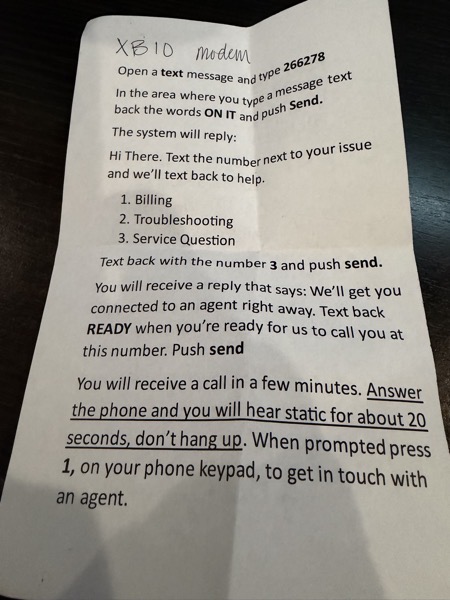
One bill I was working on reducing for another client was Xfinity. I probably don’t need to say more if you’ve ever dealt with that company. But I will. I simply wanted to call and discuss plan options for reducing the bill.

No where was I able to get through to a live person. I was sent links to chatbots that would promise a live person, if I followed along, but those calls never connected.

I eventually took a trip to an Xfinity store and got the info and made adjustments to my client’s bill in person. The staff member at that store told me that they were seeing more foot traffic because the online and phone systems were such a mess.

Back to Apple

Now, I began this post mentioning Apple’s move to a generative AI based technical support system. I find this greatly disappointing. In general, because I believe this type of cost cutting move represents a decline in how I value a company because it represents a decline in how these companies view their customers.  And in Apple’s case, I have typically found Apple’s tech support to be better than most companies. Not perfect. Still flawed. But better than most.

I’ve had to work through some tricky issues over the years with Apple’s technical support. Some easily resolved. Some not so. One of those issues required several months worth of conversations, eventually reaching up the chain to Craig Federeghi, before getting the issue resovled. I can’t imagine any tech support system being able to measure up to what Apple has currently, even with flaws and failures that require steadfast persistence and often negotiation.

In my attempts to aid my clients I’ve tried some of the AI chatbots that aren’t part of the specific company I’m working with. Typically they spit out much of what I imagine is in the documentation most phone bank customer service reps use to begin a diagnostic process. (Yes, the device or appliance is plugged in.)

I imagine that Apple will use this new system to handle those rudimentary requests that come in that I’m sure fill up the tech support queues and can be resolved easily. I can only hope Apple then passes more difficult issues to an actual human being who can do the type of intervention necessary to reach a resolution. Heaven help us all, and Apple, if they ever automate the degree of support that requires screen sharing over to a robot.

I have yet to meet anyone in the real world that thinks AI on any level is going to fulfill anything close to the promises made by those pushing it. Folks have already seen and felt the results of these early efforts and have turned sour on the entire concept. I think of this like I imagine the last century’s transition to the automobile. Regardless of how some felt upon seeing the first automobiles on the same streets as pedestrian and horse traffic, everyone knew, for better or worse, it was a future they would have to adapt to.

I have encountered a few business owners who think AI will help them create efficiency and reduce costs, but their discussions about what is possible demonstrate a real hype-fed ignorance and hoped for way of cutting costs. I have one client who is smitten with the promise, but is constantly getting bitten by the results.

I’m betting Apple’s move will take a bite out of its customer satisfacton numbers as well.

(Image from Munthia on Shutterstock)

You can also find more of my writings on a variety of topics on Medium at this link, including in the publications Ellemeno and Rome. I can also be found on social media under my name as above. 

The Quest for the Unicorn AI Device

Hyping a tech war that won’t ever happen

Reporters love to declare war, crown winners and dismiss losers. Except of course when it comes to shooting wars and the rhetoric that often leads to them. But that’s not what this post is about. Tim Higgins of The Wall Street Journal, and his headline writers, are declaring that Mark Zuckerberg Just Declared War on the iPhone. 

I usually expect this kind of nonsense from the half-a-gazillion blogs and social media accounts out there that like to ginny up controversy to generate clicks. With AI glasses will clicks become blinks?

Now that I think about it, I’m wrong in my expectations because the WSJ, like most of the mainstream media is trying hard (too hard) to follow that pattern these days. It’s an easy game to play in the short term, but then so is the game of companies and governments making big announcements about the future. Remember the “pivot to video?” Remember “virtual reality?” The faux legs went out from underneath that pretty quick.

Higgins does and mentions those failures to capture marketshare beyond the initial hype and funding fevers. Nevertheless, he forgets a few simple things during his embedded tour on this march to the promise of “Personal Super Intelligence.” (That’s this fiscal quarter’s new label.) Zuckerberg might indeed be banging the war drums by propagandizing AI glasses as the latest form factor of mass destruction, but it’s too much hype without enough rhythm to marshall the troops. And to be fair, most of Higgins’ column is just regurgitating old news (AI summary?) that has been bouncing around in what passes for new news these days, tacking Zuckerberg’s recent announcement on as the headline war cry.

Bottom line in my opinion, we’re not going to see any new form factor take down iPhones, smartphones as a category, or computers, as the way we live, work and play in any near future. Folks have been waiting for all kinds of second comings for quite awhile now. I love how even the coming of advanced AI is now referred to as “near emergence.”

One day perhaps. Long after most of us interested in what this technological moment might eventually yield will have forgotten what Medicare and Medicaid were actually about. If and when that day arrives, the real clicks (blinks?)  will be in tutorials on how to turn off all of the notifications and other distractions and keep the tech from tracking you.

I’m old enough to remember when FourSquare came on the scene. The promise was you’d walk down the street and receive a notification from the coffee shop you just passed about the daily special. That never really materialized, but the tech was different then. Google and Waze later tried that and just annoyed any driver who stopped at stoplights looking for their next turn.

When the marketing survelllance mavens can figure out how not to send me ads for something I just bought I think there might actually be a chance for that kind of thing to work. A small chance, but a chance. But they’re not even close to that on the backend, let alone integrating them into some device that might pinch your nostrils after wearing them for too long.

Don’t get me wrong. I think it is indeed cool when companies create niche products that give some people joys and hobbies. Bits and pieces of that kind of innovation often creep into bigger things that do help our lives somewhere down the road. Even if they become creepy. Obviously I’d prefer they not become creepy, but that’s where the money is and the creeps always follow the money.

I’d much prefer to see the money and the hype meisters follow something like this that could probably actually help humanity. But even that kind of innovation can attract the creep factor.

Call me when a reporter can research, write, and submit for editing a column like this one I’m complaining about with a pair of AI glasses, an Alexa device, or a pendant, or any other smart device currently in the works.

Call me again, when the AI summary machines can actually deliver an accurate summarization of that article.

You can also find more of my writings on a variety of topics on Medium at this link, including in the publications Ellemeno and Rome. I can also be found on social media under my name as above. 

Mark Zuckerberg Says We All Need AI Glasses

The blind leading the blind-to-be

Mark Zuckerberg, trying to see his way clear to dominating the Artificial Intelligence race, is now saying that those of us who don’t use AI glasses will be at a disadvantage in the future. Reminds me of the X-Ray glasses hype from my childhood.

X ray man 1.

When you consider Zuckerberg’s checkered legend with starting what would eventually become Facebook, after running a college website called FaceSmash to rate girls, the comparison to the come on for X-Ray glasses does have a prurient parallel to many an adolescent boy’s fantasies.

I guess Zuckerberg needs to justify all of the money he’s spent building out AI infrastructure and wooing talent but it also is very reminiscent of the days he mucked up the media by declaring text was out and the pivot to video was in. In fact, much of this AI race feels very much like that. Sure, some of that stuck, but it mostly just made a mess and the legacy of that pivot left more than a few scars.

This entire AI race feels like that to me at the moment. I believe some of it is going to stick around and actually be useful. But mostly it’s just messing things up at the moment as everyone jumps into the deep end of a pool hoping to learn a new way to swim.

I’ve dealt with a few different companies of late trying to help some elder clients cut down on bills and solve some issues. Several of those companies have been switching much of their customer service to AI chatbots and the like. In those transitions they’ve more than made a mess of things for their customers and their employees who are left trying to clean up the mess.

I’m not completely down on Artificial Intelligence. I can see some benefits from the technology. At this point in the game it’s tough to sort out what that might be from the hype that seems to be authored by the folks who keep promising self-driving cars and those that promised X-Ray glasses.

You’d think by now someone would have developed an AI platform for investors and corporations that could see through the hype.

You can find more of my writings on a variety of topics on Medium at this link, including in the publications Ellemeno and Rome. I can also be found on social media under my name as above.