Sunday Morning Reading

History has its layers and facts might be damned, but that’s what myths are made of.

Tick. Tock. Or is that TikTok? Regardless, it’s the last Sunday Morning Reading column before things take a drastic turn here in the United States. Plenty to be concerned about, but Sunday Morning Reading will sill keep chugging along until they turn out the lights. That said, quite a bit of today’s chugging focuses on that messy intersection of tech and politics, because, well, you know, that muddled mess of things is what attracts my attention. They are no small things.

Speaking of small things, David Todd McCarty suggests that when we get too overwhelmed perhaps it’s time to get small. Check out Let’s Get Small.

There’s A Reason Why It Feels Like The Internet Has Gone Bad is actually a short interview with Cory Doctorow by Allison Morrow about a term Doctorow coined that I think fits much (and not just on the Internet) of what we’re already living through and what we’re in for: enshittification.

George Dillard wonders why modern business tycoons are like their forbears in Nerds, Curdled.

Jared Yates Sexton has some thoughts on dealing with what’s coming in Back Into The Breach: Thoughts On The Second Trump Presidency. Good read.

The toadstools salivating to use government to dismantle government no longer grow in shadowy, dank places. Joan Westenberg takes on Silicon Valleys’s Secret Love Affair With The State.

John Gruber highlights and expands on an article by Kyle Wiggins at TechCrunch that hit amidst the growing chaos this week when Google announced that’s its ever declining search product would now require JavaScript in order to use Google Search. Check out Google Search, More Machine Now Than Man, Begins Requiring JavaScript.

Joseph Finder takes a look at The Russian Roots Of American Crime Fiction—And The O.G. It’s not that the characters created by Dostoevsky and Gogol were Russian. They were merely human.

We love stories, but we love our myths more. Neil Steinberg takes on The Myths of Telephone History. The lies we agree upon might just be the most pungent of them all.

To close things out, NatashaMH reminds us in Chestnut Roasting On An Open Fire that some say that “the strength of a superhero is determined by the strength of his villain—the greater the adversary, the mightier the hero.”  We’re about to find out if that’s true or not.

If you’re interested in just what the heck Sunday Morning Reading is all about you can read more about the origins of Sunday Morning Reading here.  You can also find more of my writings on Medium at this link, including in the publications Ellemeno and Rome. You can also find me on social networks under my own name.

Sunday Morning Reading

A nod to Billy Joel, a little Faust, a little Shakespeare and the cycle of life keeps turning.

We may not have started the fire. In the words of Billy Joel, “it was always burning.” Still we can always try and fight it. I’m not sure how that’s working out but it does seem to be our lot. Sifting through smoke and ashes, here’s a little Sunday Morning Reading to share.

Kicking things off is David Todd McCarty’s Looking for God, Sitting in Hell. Summed up nicely, “we get so lost in semantics that we forget the important parts.” Indeed.

David Sterling Brown tells us What Shakespeare Revealed About the Chaotic Reign of Richard III – And Why The Play Still Resonates In The Age of Donald Trump. The only thing I question is the word “still” in the headline. There’s not a moment of being human that isn’t contained in the stories and characters of Shakespeare. We haven’t invented a new way of being good, bad or indifferent in quite some time.

And while we’re on the literature beat Brian Klaas give us Faustian Capitalism. Again, there’s nothing new under the sun here as we watch this country’s wealthiest men bend their knees in supplication, but there’s some small comfort in knowing we’ve been this selfishly stupid before.

John Pavlovitz hits a nail on the head with The California Fires Are a Disaster. The American Cruelty Is A Tragedy. It may be beyond our capacity to comprehend devastation, but as the previous two entries show, it shouldn’t be beyond our ability to know we keep repeating the same mistakes.  Or maybe that’s really just the hell we’re living?

Speaking of Faustian bargains, Mike Masnick lays out The Good, The Bad, And The Stupid In Meta’s New Content Policies.

This piece should scare you, but again, its subject is as old as humankind’s penchant for inhumanity. Stephanie McCrummen shines a bit of light as The Army Of God Comes Out Of The Shadows.

Derek Thompson takes a look at The Anti-Social Century and how our reality is changing as we spend so much of our time alone.

Perhaps one of the keys to being less alone and less anti-social is choosing your friends wisely. Natasha MH says that “To survive this life, it’s crucial to discern which friends are worth keeping and which aren’t. You are the guardian of your own peace of mind” as she lays out The Optimist’s Dilemma In A Pessimistic World.

And finally, Ian Dunt offers A Little Bit Of Hope After A Terrible Week, in what he calls a survival guide for the next four years. Ian says “History has no direction.” He’s correct. It’s a circle, a cycle, a carousel.

If you’re interested in just what the heck Sunday Morning Reading is all about you can read more about the origins of Sunday Morning Reading here.  You can also find more of my writings on Medium at this link, including in the publications Ellemeno and Rome. You can also find me on social networks under my own name.

Sunday Morning Reading

Looking back, while heading forward, with a nod to Beckett wandering through a lot of good questions.

This is the first edition of Sunday Morning Reading in the New Year, 2025. A new year certainly has meaning astronomically. From a human perspective it is a way of looking back in remembrance, even as we continue to evolve and move forward. Often these days, the evolving part seems more and more in question, even as humans make strides and advances in their various fields of endeavors. Some improve our lives, even as it appears so many of us remain stuck in the habits of the past and feel good about celebrating that choice to turn the clock back.

This week’s edition, in a way, marks that always thin dividing line between one year and the next, when what was old carries over into the new.

Natasha MH kicks things off with a lovely remembrance of her grandfather, It Begins With A Grain Of Salt. There’s a lovely quote:

Human intuition is not always reliable. Our perceptions can be distorted by biases and the limitations of our senses, which capture only a small fraction of the world’s phenomena.”

Christopher Luu offers a terrific look at one who made choices in ‘She Believed You Have To Take Sides’: How Audrey Hepburn Became A Secret Spy During World War Two.

Om Malik has a lovely piece about his “re-birthday” after surviving a heart attack in The Story of The Stent.

James Thomson, the developer of PCalc and other Apple software, looks back on the last 25 years in I Live My Life A Quarter Century At A Time.

The Next Big Idea Club shares some insights from Greg Epstein’s new book Tech Agnostic: How Technology Became the World’s Most Powerful Religion, and Why It Desperately Needs a Reformation, in The Weird Worship of Tech That Demands Serious Questioning. Epstein is the Humanist Chaplin at Harvard and at MIT, where he advises students, faculty and staff on ethical and existential concerns from a humanist perspective.

One thing is certain as we head into the new year, Artificial Intelligence will continue to dominate discourse. Jennifer Ouellette examines what happened at the Journal of Human Evolution when all but one member of the editorial board resigned. Some of the issues predate the current AI moment, but that seems to have been a breaking point as she explains in Evolution Journal Editors Resign En Masse.

Simon Willison takes a look at Things We Learned About LLMs in 2024. It’s an excellent look back and worth hanging onto as we plunge ahead, willingly or no.

Edward Zitron believes that generative AI has no killer apps, nor can it justify its valuations. Here’s him quoting himself from March 2024:

What if what we’re seeing today isn’t a glimpse of the future, but the new terms of the present? What if artificial intelligence isn’t actually capable of doing much more than what we’re seeing today, and what if there’s no clear timeline when it’ll be able to do more? What if this entire hype cycle has been built, goosed by a compliant media ready and willing to take career-embellishers at their word?

Strip out the reference to AI and apply it anywhere along the timeline of human evolution and innovation and the questions resonant in a very Beckett-like way. Check out his piece Godot Isn’t Making It. 

Judges in the U.S. Sixth Circuit drove a stake through the heart of Net Neutrality as the new year dawned. Brian Barrett says it’s crushing blow not just for how we live our lives on the Internet but consumer protections in general in The Death Of Net Neutrality Is A Bad Omen. He’s correct.

And finally this week, an incredible piece of reporting from Joshua Kaplan at ProPublica. The Militia And The Mole is at once terrifying and also confirming when it comes to the fears those paying attention harbor heading into whatever this next year is going to bring.

If you’re interested in just what the heck Sunday Morning Reading is all about you can read more about the origins of Sunday Morning Reading here.  You can also find more of my writings on Medium at this link, including in the publications Ellemeno and Rome. You can also find me on social networks under my own name.

Sunday Morning Reading

What do ugly Christmas sweaters, physics, the post office and pernicketies have in common? Check out this week’s Sunday Morning Reading.

Here we are with the last edition Sunday Morning Reading for 2024. As usual there’s links to subjects and writing I’ve found particularly interesting. I hope you do as well. Enjoy this week’s edition and see you next year.

 Christmas has come and gone, and it’s time for the decorations to come down and the ugly Christmas sweaters to be put away. Jennifer Ouellette takes a look at The Physics of Ugly Christmas Sweaters. You may want to consider how you fold yours up for seasonal storage after reading this.

I’ve laid off politics during most of this year’s holiday season, but I’ve been peripherally aware that apparently a Civil War has broken out between the tech bros and the MAGAts over immigration. Not to worry, Heather Cox Richardson has a running account of the blows and counter blows in her Letters From An American for December 27. 

One of the numerous things many are worried we might actually lose during the next administration is the troubled U.S. Postal Service. Steve Herman gives a nice rundown of some history, context, and what we might lose in Going Postal. As the son of a former post master, I appreciate Steve’s efforts here.

Thinking about how big projects get started, Joan Westenberg takes on The Ego-Legacy Complex: On Ancient Monuments and Modern Malaise. 

ProPublica writers Asia Fields, Nicole Santa Cruz, Ruth Talbot, and Maya Miller conducted a series of interviews with homeless individuals. A feature of the article is the re-printing of the notecards some of the interviewees wrote describing their losses. Check out I Have Lost Everything to see what they have lost.

Most folks have a love/hate relationship with services they subscribe to and of course that includes streaming video services like Netflix. If you subscribe to Netflix and you’ve ever wondered why Netflix gets on your nerves, check out Will Tavlin’s Casual Viewing. You’ll never stream it the same way again.

You have to love the title, but you’ll also love the article. Check out Pet Peeves and Other Pernicketies from NatashaMH.

Have a Happy New Year! 

If you’re interested in just what the heck Sunday Morning Reading is all about you can read more about the origins of Sunday Morning Reading here.  You can also find more of my writings on Medium at this link, including in the publications Ellemeno and Rome. You can also find me on social networks under my own name.

Sunday Morning Reading

Some festive fare, and some not quite so for this week’s Sunday Morning Reading.

Christmas and Hanukkah are almost upon us. There’s that traditional feeling of magic in the air, but it’s tempered a bit by apprehension about what may come in the New Year. But it’s Sunday and it’s before all of that, so it’s time to share some Sunday Morning Reading.

First up are a couple of Christmas gifts that seem appropriate both for their historical holiday context and in today’s current one. Shannon Cudd takes on The Surprisingly Corporate Retail Origin Story Behind ‘Rudolph the Red-Nosed Reindeer.’ Feels appropriate in this approaching age of oligarchy even if that age seemed a bit more innocent.

Follow that up with Olivia Jordan’s A Christmas Carol in Context: Dickens’ Beloved Festive Fable. Having directed many a production of ‘The Carol,’ I’m always amazed that its story of goodwill and redemption is at once so popular, yet always so quickly forgotten. It’s a puzzler. But then the great messages told around Christmas typically lose their resonance once we move away from the season.

Speaking of puzzlers, Generative AI is still on everyone’s mind and Gary Marcus thinks Generative AI Still Needs To Prove It’s Usefulness. Yes, he means beyond the hype it’s generated that has made some fabulously wealthy.

Journalism is having a moment and not a good one in today’s political climate. Most of that is of its own making and a good deal of it is by the owners. Podcaster and tech journalist Kara Swisher might be fed up enough to try and do something about it. She is seeking to round up investors to fund a bid to buy The Washington Post, after Jeff Bezo’s weak capitulation to the incoming Trump regime. I hope she succeeds. Meanwhile, John Gruber has written a terrific piece on this titled Journalism Requires Owners Committed To The Cause. He’s spot on.

Meanwhile Om Malik takes a look at the just how dark things may be for traditional media in these dark days in Musings On Media In The Age of AI. Here’s a quote:

None of the media business models will work in the future — neither advertising nor paywalls. Today’s content deals, like the one The Atlantic signed with OpenAI, are akin to the sugar high you get from soda. The sugar high is followed by the inevitable crash.

Jennifer Berry Hawes, Nat Lash, and Mollie Simon for ProPublica take a look at The Story Of One Mississippi County Shows How Private Schools Are Exacerbating Segregation. Good reporting on a story that somehow feels more than a little Dickensian.

Folks seek validation in many ways. Climbing mountains and overcoming obstacles can be a part of that game. So too is recognizing that “not everything in life needs to be conquered.” Check out Ain’t No Mountain High Enough from NatashaMH.

And to close out this week’s Sunday Morning Reading with a bit of grace, check out The Laundromat On Sixth Avenue by Grace 🎶 @notesofgrace

May whatever holiday you celebrate this time of the year bring you some peace and perhaps some joy. Here’s hoping we all can find that comfort surrounded by the company of family and good friends.

If you’re interested in just what the heck Sunday Morning Reading is all about you can read more about the origins of Sunday Morning Reading here.  You can also find more of my writings on Medium at this link, including in the publications Ellemeno and Rome. You can also find me on social networks under my own name.

Sunday Morning Reading

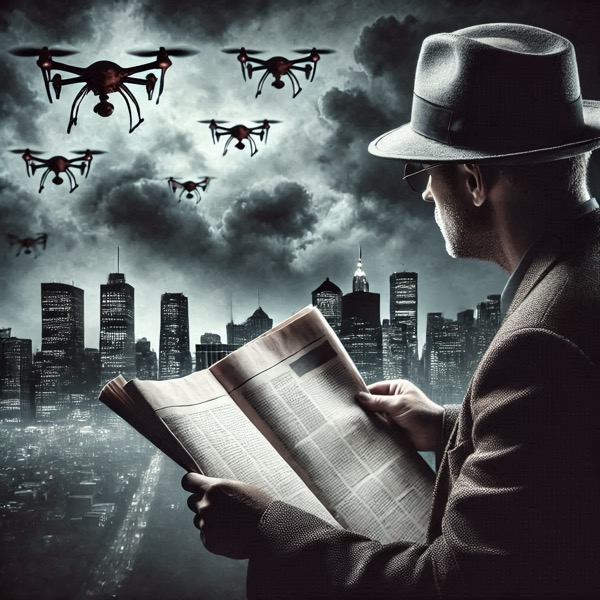
Drones may be circling and society may be circling the drain, but there’s always time for Sunday Morning Reading.

Drones may (or may not) be circling the skies overhead, but that doesn’t mean we shouldn’t keep our eyes peeled for some good writing and good reading. This week’s Sunday Morning Reading features a usual mix of writing on tech, Artificial Intelligence, politics, and culture. Buckle up and enjoy.

A man reading a newspaper on a porch with a sky full of drones and a cityscape background. AI generated

Speaking of Artificial Intelligence, Arvino Narayanan and Sayash Kapoor tell us that Human Misuse Will Make Artificial Intelligence More Dangerous. I’ve been saying that for a while and so have any number of science fiction writers. Still, this short piece is worth a read.

Matthew Ingram asks and answers the question Are AI Chatbots Good or Bad For Mental Health? Yes. Good read.

Reed Albergotti chronicles an interview with Google’s Sundar Pichai on Google going all in on AI and the next move,  Agentic AI. Check out Why Sundar Pichai Never Panicked.

Rounding out this group of links on AI, take a look at this intelligent and very human piece from NatashaMH. In No Society Left Behind she posits that AI will still leave us with uneven playing fields across the different strata of society.

John Gruber has an interesting piece On The Accountability of Unnamed Public Relations Spokespeople. It’s politics specific but it also speaks more broadly about the, in my opinion, decline of PR as an effective tool.

We still haven’t come to grips with the shooting of the United Health Care executive and the reaction to it. Adrienne LaFrance takes that as a cue for Decivilization May Already Be Under Way. I would argue it’s been under way for quite some time now. Itt’s just accelerating.

David Todd McCarty says We’re All Going to Need To Hunker Down For A Long-Ass Storm. I concur, although I fear it’s going to be looked back on as a major climate shift.

Dave Troy in the Washington Spectator gives us The Wide Angle: “Project Russia,” Unknown In The West, Reveals Putin’s Playbook. It will never ceae to amaze me how we let this one slip by us.

Looking back a bit in history take a look at this piece from the Atlantic’s 1940 issue called The Passive Barbarian by Lewis Mumford. With the exception of a few references in the article and the publication date, I bet you would think it had been written in this current moment.

And finally, with the holiday drone buzzing around us David Todd McCarty offers up Struggling To Find Peace In The Midst of Exuberant Joy.

If you’re interested in just what the heck Sunday Morning Reading is all about you can read more about the origins of Sunday Morning Reading here.  You can also find more of my writings on Medium at this link, including in the publications Ellemeno and Rome. You can also find me on social networks under my own name.

Sunday Morning Reading

Sunday Morning Reading is on the road but there’s still plenty to share.

We’re on the road this weekend to get the Christmas holidays started with the grandkids, but there’s still time to share a little Sunday Morning Reading. Enjoy.

First up is a piece by Margaret Dean called An Afternoon In My Strawberry Fields. You’ll enjoy wandering there.

I don’t think the sun sets anywhere on the planet that there isn’t a current political crisis. Artists and storytellers keep doing their thing regardless. This story from Tom Phillips and Etienne Cóte-Paluck tells of a Haitian theatre troupe still carrying on in the face of that island’s chaos. Check out ‘An Act of Rebellion: Haitian Theatre Persists Amid Political Crisis and Violence.

No crime story has quite captured public attention and exposed how insufficient American media is at reporting out what’s behind the headlines as the murder of United HealthCare’s CEO Brian Thompson. The act is shocking, the reaction to it is shocking as well, yet not surprising. Some of the best reporting I’ve seen so far comes from the BBC from Mike Wendling and Madeline Halpert in Killing of Insurance CEO Reveals Simmering Anger At US Health System.

If you’re wondering about that “simmering” and why I don’t think we should be surprised by what this event reveals, check out this guest essay in the New York Times from Dr. Helen Ouyang entitled What Doctors Like Myself Know About Americans’ Health Care Anger.

Casey Newton delivers one of the best pieces I’ve seen on Artificial Intelligence with The Phony Comfrots of AI Skepticism. You might want to hang on to this one for future reference.

Mark Jacob wonders Can Journalism Survive Billionaires? My short answer is not with this current crop.

If you think repealing women’s right to vote in America isn’t on the agenda of some in the world of MAGA misogyny check out Emma Cieslik’s piece Christian Nationalism’s First Item On The Agenda: Repeal The Women’s Right To Vote. 

Brian Krebs is a name most on the Internet have run across as a top-notch security researcher and reporter. Robert McMillian and Vipal Monga have gone behind the curtain to reveal some of the lengths Krebs has to go through to keep himself secure. And not just on the Internet. Check out He Investigates The Internet’s Most Vicious Hackers-From A Secret Location.

If you’re interested in just what the heck Sunday Morning Reading is all about you can read more about the origins of Sunday Morning Reading here.  You can also find more of my writings on Medium at this link, including in the publications Ellemeno and Rome. You can also find me on social networks under my own name.

Sunday Morning Reading

It’s a cold late Fall morning, with some crisp and cold writing for you in this week’s Sunday Morning Reading.

Sunday, it’s a Sunday. The Sunday after Thanksgiving and Black Friday, although every Sunday these days feels like it’s the Sunday after yet another Black Friday. Even so, it’s time for some Sunday Morning Reading. This week’s edition contains some somber writing, fitting for the onset of a winter of discontent and reflection, along with some thinking on the tech scene and vaccines. For good measure, there’s a history of dive bars at the end. Enjoy.

Leading off, David Todd McCarty’s piece I Was F*cking Wendy Under The Stars, The Night Elvis Died, reflects on the risks we take, and perhaps don’t take, in building a life.

Promises and Scars by Kelly Gawitt is an excellent piece of writing on second chances. We all need them.

Joan Westenberg says We’re Dying. Here’s How to Make Better Decisions. Joan’s Mortality Matrix is something to see.

Sam Roberts gives us a look back at a real heroine in Madeline Riffaud, ‘The Girl Who Saved Paris,’ Dies at 100. I’m thinking we might need some Madeline’s going forward.

Patrick Fealey offers a harrowing and personal inside look at homelessness in America in The Invisible Man.

Tim Berners-Lee, who conceived the World Wide Web is taking a crack at a new way our digital lives are stored online with a new venture called Solid. Harry McCracken takes a crack at explaining it all in The Man Who Gave Us The Web Is Building A Better Digital Wallet. Hope it works.

Christopher Mims says that Googling Is For Old People. That’s A Problem For Google. The lede is fantastic:

If Google were a ship, it would be the Titanic in the hours before it struck an iceberg—riding high, supposedly unsinkable, and about to encounter a force of nature that could make its name synonymous with catastrophe.

Vaccines. Who in their right mind thought we’d ever be debating anything about the miracle of vaccines? Donald G. McNeil Jr. says that Vaccines Will Have To Prove Themselves Again. The Hard Way. Warning: the “hard way” isn’t a pretty way.

And after all of that if you need a drink or two or three, check out Linze Rice’s piece on The History of Chicago’s Dive Bars, Once Called ‘The Vilest Holes In The City.’ Bottoms up.

If you’re interested in just what the heck Sunday Morning Reading is all about you can read more about the origins of Sunday Morning Reading here.  You can also find more of my writings on Medium at this link, including in the publications Ellemeno and Rome. You can also find me on social networks under my own name.

Sunday Morning Reading

Delusions abound in this week’s Sunday Morning Reading.

If it’s Sunday, it is time for Sunday Morning Reading with interesting writing on a variety of topics, that without intending to all seem to involve delusions in one way or another. There’s also a little Procol Harum on the side. Enjoy reading, while you skip the light fandango.

Speaking of delusions, check out a piece by Michael Connors and Peter Halligan exploring What Delusions Can Tell Us About the Cognitive Nature of Belief. 

It’s no delusion that Artificial Intelligence remains in the news (before it eventually subsumes the news). Harry McCracken takes us a bit into the deep mind behind Google’s DeepMind in The Future According to Google DeepMind CEO Demis Hassabis. That first link takes you to the web version, this one takes you to the Apple News version of the article since the piece is a premium article for Fast Company readers.

Joan Westenberg has caught my eye of late (if you follow Sunday Morning Reading you should know that) and here are a couple of recently published dynamic pieces: Don’t Confuse Volume with Truth and Rebel Optimism: How We Thrive in a Broken World. Both worth your time.

We’re all complaining about a lot of things, the continued enshittification of the Internet being a familiar and well deserved  target. (It’s interesting that I use that term enshittification so frequently and yet spell check or any other type of check hasn’t picked it up yet.) Dave Winer is fighting the good fight on a lot of fronts and he looks at a new kind of enshittification in Billionaire-proof?

David Todd McCarty takes on the platitude “the meek shall inherit the earth” in The Children of Pacifists.

Ronan Farrow takes a look at The Technology The Trump Administration Could Use To Hack Your Phone. You know it’s going to happen. You know it most likely already has.

And to round things out this week, Ulf Wolf spools out an essay on the mostly forgotten Keith Reid of Procol Harum in The Shadow Member of Procol Harum. Not going to lie, I did spin up a copy of Whiter Shade of Pale while writing this week’s column. The Salty Dog album is cued up next.

If you’re interested in just what the heck Sunday Morning Reading is all about you can read more about the origins of Sunday Morning Reading here.  You can also find more of my writings on Medium at this link, including in the publications Ellemeno and Rome. You can also find me on social networks, including Bluesky, under my own name.

Sunday Morning Reading

Tough reading for tough times in today’s Sunday Morning Reading.

It’s a Sunday. I’ve been reading. As usual I’ll share some of that with you in today’s Sunday Morning Reading.

I started out the week thinking I’d try to avoid politics. That didn’t work. Sort of like getting a cancer diagnosis and not wanting to know anything about the disease taking over your body. So, apologies if there isn’t much “light” reading today.

I’ll start of with an anonymous piece published in The Guardian. We all knew misogyny was a feature of the incoming frat party that will be the new administration. I don’t think anyone thought it would filter down so quickly to high schools. The Boys In Our Liberal School Are Different Now That Trump Has Won, tells that story. Woe be onto us and our children.

David Todd McCarty is working out how to get through the day these days. Check out We’re All Just Killing Time.

Sherrilyn Ifill calls her piece The Truth. It is. And it’s hard.

Joan Westenberg says the way to destroy a generation is to make them think the word runs on feelings and then use those feelings against them. Check out How To Destroy a Generation.

David French thinks Donald Trump Is Already Starting to Fail. Great. Too bad he’s going to take the rest of us down with him.

Norman Solomon is optimistic about Hope In A Time of Fascism.

Margaret Sullivan tries to debunk some of the lies rolling around this history changing moment in As Trump Plans Become Clearer, Reject These Four Dangerous Lies.

Life may feel too short to worry about some things. But it’s all a matter of perspective. Check out Natasha MH in Life’s Too Short for Matching Socks.

And to close things out, BlueSky is the latest social network to experience a burst of new users. This time the the burst is due largely in reaction against Musk’s rape of Twitter/X, and dissatisfaction with Zuckerberg’s Threads, which had been the darling for awhile. Mike Issac takes a look in Bluesky Is Growing Up. Maybe Too Fast.

If you’re interested in just what the heck Sunday Morning Reading is all about you can read more about the origins of Sunday Morning Reading here.  You can also find more of my writings on Medium at this link, including in the publications Ellemeno and Rome. You can also find me on social networks, including Bluesky, under my own name.