
Sunday Morning Reading

There’s a creeping inevitability to much of what’s happening around us.

Some Sunday’s when I sit down to collect what I find interesting enough to share it seems like things around us are just bad. Or going from bad to worse. It feels inevitable. This is one of those Sundays. Nevertheless, there’s some good writing and good thinking in the articles linked below that I believe are worthy of your attention. But paying attention is not one of our strong suits. Cue up a little Crosby, Stills, Nash and Young, pay attention, and read away.

‘Tin Soldiers and Nixon’s Coming’ is an excellent look back as we stare at this moment we’re in from Robert Cohen and Michael Konciewicz on the 2020 50th anniversary of Kent State and Jackson State.

You’re Not Ready, is an excellent, yet somewhat frightening compilation of articles by various authors at Wired, comprising info on AI hacker attacks, grid attacks, or a GPS blackout. I say “somewhat” simply because many of us have had inklings about this. Or at least those who pay attention.

Josh Marshal of Talking Points Memo has an excellent piece on Artificial Intelligence and The Posture of Skepticism.

Mathew Ingram’s fascinating piece, How Marc Andreessen and I (and you) Created The Web is informative and entertaining history and context that’s worth your time about the time we’re in.

Paul M. Sutter tells us that A New Theory Says Time Has Three Dimensions. It ‘Really Messes Up’ What We Know About the Cosmos, Scientists Say. We seem to be doing a good job of that at the moment given our current understanding of time, so why not go ahead and mess things up.

Timothy Snyder wonders what happens with The Next Terrorist Attack. It’s far deeper than the headline suggests.

Michael Podhorzer writes about something I’ve been thinking and saying for a while: The Courts Will Not Save Us. It’s a long read but more than worth your time. Read this instead of watching TV lawyers.

Most of the articles I’ve already linked to this Sunday morning in one way or another deal with trust. That trust gap is widening these days. It doesn’t help when we do find out things that break trust, but the finding out at least helps us understand the gap better. Take a look at Aruna Viswanatha’s piece The Pentagon Disinformation That Fueled America’s UFO Mythology.

Tomorrow, June 9th, Apple kicks off its annual World Wide Developer Conference. There are trust issues there as well. These next few links contain some interesting thoughts heading into WWDC, beginning with Sebastiann De With’s Physicality: the new age of UI, which anticipates the coming design changes rumored for all of Apple’s operating systems. A fresh coat of paint may not hurt. I’m not sure it’ll help.

As I said, Apple faces a number of problems, some legal and regulatory. Jérôme Marin explains how A Simple Comma is going to cost Apple Billions in Europe. Commas can indeed cause all sorts of chaos. Just ask US constitutional scholars about a comma and the 2nd Amendment.

And to close things out, one of my favorite developers _DavidSmith talks about his optimism heading into WWDC in Let’s Get Started. I admire the optimism and the reality check approach _DavidSmith brings to this.

If you’re interested in just what the heck Sunday Morning Reading is all about you can read more about the origins of Sunday Morning Reading here. You can also find more of my writings on Medium at this link, including in the publications Ellemeno and Rome.

Sunday Morning Reading

When caring becomes a commodity, should we care more or less?

Lots to care about. On all the usual fronts. But in the grand scope of the universe does much of it really matter? Some interesting links to share in this week’s Sunday Morning Reading.

Dan Sinker, taking a look at The Chicago Sun-Times AI flaps calls it The Who Cares Era. His theory is that along the way, nobody cared. I’d venture they cared about the wrong things.

Apple’s annual developer conference WWWDC is a week away and given the many issues the company is confronting lots of folks care and are curious about how Apple begins to address them. Some don’t see Apple changing how it deals with developers, like Aaron Vegh in his post, They’re Not Going to Change.

Some, like John Siracusa, are rooting for Apple and even offering advice. Siracusa’s piece Apple Turnaround is a companion to his recent previous post Apple Turnover. All worth a read, regardless of how you feel about the predicaments Apple finds itself in.

The tech bros who seem to be in the pole position running to rule the world may be making bank, but they’re not winning any friends in the process. They most likely don’t care given that they think they’re on their way to conquering the universe. John Kaag is offering up A Reality Check For Tech Oligarchs. Frankly, I don’t think they live in anything close to reality.

Meanwhile, down here on planet reality, some are looking for ways to survive and perhaps beat the odds seemingly stacked against us. A.M. Hickman lays out a vision for How To Live on $432 a Month In America.

Much of what’s going on around us might seem profane and vulgar, leading to quite a few expletives coming out of our mouths as we cope. David Todd McCarty takes us on an exploration of his love of four-letter words in Frequently Profane But Never Vulgar. For what it’s worth, all words have value in my opinion. Hiding from them is fucking stupid.

Natasha MH is Reclaiming the Joy of Struggle in an AI-Driven World. Better grab that joy while we can, because that struggle is only going to become more intense.

Just when you thought we might have begun to figure out the new landscape of insanity we’re currently struggling through, comes along Ross Anderson who informs us about The Nobel Prize Winner Who Thinks We Have The Universe All Wrong. It may someday stop expanding the way we thought and might just remain stagnant for longer than originally theorized, allowing intelligent life to continue longer than we thought. One may ask, should we care?

(Photo from Vincent Nicolas on UnSplash.)

If you’re interested in just what the heck Sunday Morning Reading is all about you can read more about the origins of Sunday Morning Reading here. You can also find more of my writings on Medium at this link, including in the publications Ellemeno and Rome.

Sunday Morning Reading

So what is this future we’re heading into anyway?

If you’re observing Memorial Day weekend in the U.S. I hope you have had a pleasant one. Even if the weather isn’t cooperating, seemingly echoing the threats of seeing that tradition, like so many others, diminished. We’re on the road again for a dear friend’s memorial service, but there’s still time for a little Sunday Morning Reading. Mostly tech related this week, some politics, and of course some cultural happenings. If you’re paying attention, it’s all intertwining. Listening to a lot of Bruce Springsteen. Enjoy.

Adding to what’s becoming a recurring theme in this column, Ian Dunt is looking for ways to get the most out of our digital lives while taking back a bit of control from the tech god wanna-be’s. Check out Taking Back Control of Our Digital Life.

Matthew Ingram wonders If AI Helps To Kill The Open Web What Will Replace It? Excellent piece and excellent topic, because like it or not, it’s the current and next movement we on the ground are going to have to contend with. Pay attention.

Neil Steinberg, one of my favorite of a dying breed of Chicago journalists, gives his take on the recent Chicago Sun-Times AI flap in The AI Genie Is Out of The Bottle, and the Granted Wish Often Brings Trouble.

Lucy Bannerman takes on the AI’s abuse of copyright and artists rights in Nick Clegg: Artists’ Demand Over Copyright Are Unworkable. They aren’t. Those demands just cost more than folks counting the beans want to pay.

Lynette Bye’s Misaligned AI Is No Longer Just Theory raises up that specter that haunts this entire episode of our life across all spectrums that seems easy to fall prey to or dismiss, depending on which side of the coin you’re on. Frankly, if you don’t think the future of this can be manipulated, you’re not paying attention.

Jason Snell’s take on the recent announcement that OpenAI has bought Jony Ive’s company to produce new hardware for AI I think is the correct one. Check out Sam and Jony and Skepticism.

Chloe Rabinowitz fills us in on the outgoing president of the Kennedy Center’s response to the bullshit coming out of the White House. in Deborah Rutter Releases Statement In Response to Trump Kennedy Center Allegations.

The real boss, Bruce Springsteen, continues to piss off the orange buffoon in the White House and I’m glad to see it. So is Eric Alterman in a guest essay in The New York Times proclaiming Bruce Springsteen Will Never Surrender to Donald Trump. We need more of this.

And to wrap up this week, here’s NatashaMH wondering Do We Really Need To Have This Discussion? No hints. No clues. Just good stuff for you to read.

If you’re interested in just what the heck Sunday Morning Reading is all about you can read more about the origins of Sunday Morning Reading here. You can also find more of my writings on Medium at this link, including in the publications Ellemeno and Rome.

Sunday Morning Reading

Paying attention for the next generation.

Good morning. Visiting the grandkids this weekend, so this will be a short stack of links to share. Fair warning ahead most are on the darker side of the ledger. The links. Not the grandchildren. They are the light. The grandchildren are why I pay attention.

First up is a piece on despair from Dean Pritchard titled Despair, What Is It Good For. He calls it a hopeless call to action. I’m not sure it’s hopeless at all. Just another step in finding what may or may not turn out to be answers. As long as we keep stepping.

NatashaMH says that social media addiction isn’t just about us, it’s about the people around us in Unread, Unavailable and Unbothered. I’ve never been one to buy into the social media addiction theory. It’s too damn easy to put down the damn phone. But I take her points because it’s too damn easy to keep hoping to find new ways to avoid despair.

Lauren Goode takes on Deepfakes, Scams, and the Age of Paranoia. Somebody needs to.

Tom Schaller and Paul Waldman say that Trump is betraying the voters who elected him in The White Rural Reckoning. They are correct. But we knew that would happen. Scum likes to remove itself from other scum once it’s done scumming around.

Joan Westenberg compares the comeuppance moment Apple is enduring to Martin Luther’s reformation moment in Apple’s Diet of Worms. Given the abundance of fanatics there’s more than a little truth here.

Playwright Sara Ruhl is one of my favorites. Charles McNulty takes a look at what she has to say in her new book In ‘Lessons From My Teachers,’ Playwright Sarah Ruhl Finds Wisdom In Art, Motherhood, Even Grief.

And as for weathering despair, check out Lost At Sea by Alec Frdyman. Excellent reading about a scary adventure.

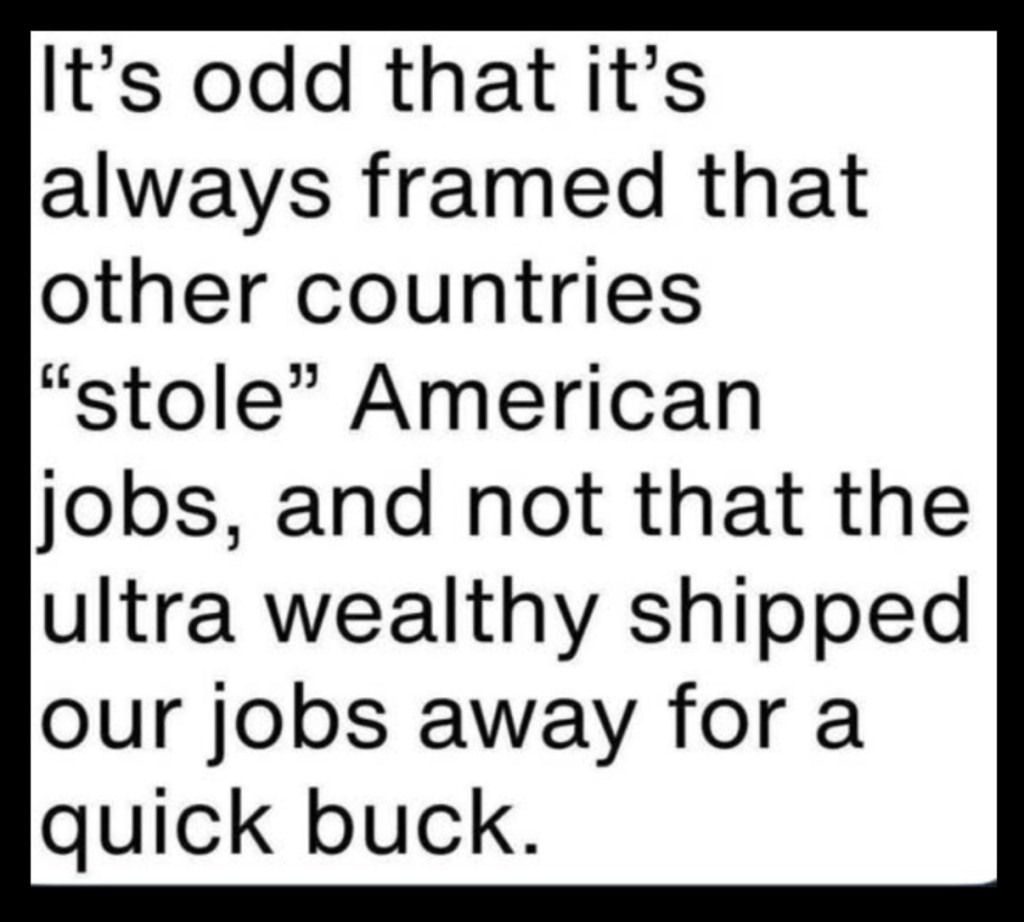
And to close out this weekend I’ll leave you with this uncredited thought that pops up every now and then on social media.

And just remember who the tax breaks are targeted for.

Peace.

If you’re interested in just what the heck Sunday Morning Reading is all about you can read more about the origins of Sunday Morning Reading here.  You can also find more of my writings on Medium at this link, including in the publications Ellemeno and Rome.
Sunday Morning Reading

Happy Mother’s Day reading.

Time for some Sunday Morning Reading on this Mother’s Day, with a short stack of culture, some tech, some politics, and the Ziegfeld Follies tossed in for good measure.

First up is a good long read from Spencer Kornhaber wondering if we’ve entered a cultural dark age. Provocative in parts, predictable in others, it’s worth your time for the journey it takes. Check out Is This The Worst-Ever Era of American Pop Culture?

Kaitlyn Tiffany says We’re Back to the Actually Internet. It’s about fact checking, the need for fact checking, and actually about how fact checking doesn’t really matter.

We may have beat the term fascism to death long before the real beating actually begins, and it’s the Bible thumpers who seem far too eager for the end times with their wishes for some sort of Armageddon beat down. Naomi Klein and Astra Taylor take a look at The Rise of End Times Fascism.

The Apple enthusiast world is still going through some things and will continue to for the foreseeable future. Denny Henke at Beardy Guy Musings is chronicling his thoughts about his move away from using Apple products. His latest, Are Apple Enthusiasts Miserable? takes a look at some of the angst and tensions he sees.

Indie app Developer Thomas Ricourad, the developer of the app Ice Cubes for Mastodon, among other apps, is searching. He’s not alone. Check out Having A Clear Vision In A Blurred World.

Matthew Gurewitsch takes a quick look The Story of a Rose, an upcoming look at an almost forgotten era in A Ziegfeld Girl Recalls The Forgotten War.

Happy Mother’s Day to all.

(image from Aga Putra on Unsplash)

If you’re interested in just what the heck Sunday Morning Reading is all about you can read more about the origins of Sunday Morning Reading here.  You can also find more of my writings on Medium at this link, including in the publications Ellemeno and Rome.

Sunday Morning Reading

Choose to pay attention before you don’t have a choice.

So much is broken these days as we watch more things break. Of course the choice is to watch or not. I prefer watching. I prefer paying attention. That’s why I share these links in Sunday Morning Reading and throughout the week.

Kicking off this week is an excellent essay from Jia Tolentino called My Brain Finally Broke. It’s one of the more powerful pieces I have read on all that’s breaking. The above is the original link. This one is to the web archive of the piece. Obviously I encourage you to read all I like to in Sunday Morning Reading, but this is one you shouldn’t miss.

NatashaMH takes on The Paradox of Choice. If you ask me, we too often enjoy choosing the paradox.

Joan Westenberg takes a look at what happens when one chooses conventional wisdom and the systems and ways things have always worked. Until those ways become a weakness and a downfall in The Cannae Problem. We’re watching this happen in real time folks.

This past week Amazon’s ass-kissing founder Jeff Bezos looked like he might have tired of the stink. In the wake of Trump’s tariffs word got out that Amazon would show customers the amount of a price increase that was due to the Trump tax. That quickly changed. Some say with a phone call from the bumbling boss. Harry McCracken suggests, (I did too), that merchants should let us know who’s screwing who in this broken mess. Check out Of Course We Deserve To Know The True Costs of Tariffs.

What Should We Do If An AI Becomes Conscious? I’m not sure. But then again, look what we as conscious beings are already doing. Mathew Ingram takes a look.

Yanis Varoufakis takes a look at Trump And The Trump Of The Technolords. It’s not a pretty look at the reasoning behind what seems to be happening without reason.

There’s not much new news in Matthew Cunningham-Cook’s piece titled Elon Musk And His DOGE Bro Have Cashed In On American’s Retirement Savings, but it’s a good summary of what has happened for those who choose to pay attention. A better one for those who choose otherwise.

To end this week with an article about hope, take a look at Lessons From A Physician About Hope by Leif Hass. Yes, hope is important. Here’s hoping you always choose wisely.

(Image from Roman Kraft on Unsplash.)

If you’re interested in just what the heck Sunday Morning Reading is all about you can read more about the origins of Sunday Morning Reading here.  You can also find more of my writings on Medium at this link, including in the publications Ellemeno and Rome.

Sunday Morning Reading

We’re always chasing bubbles.

Back from a brief hiatus, there’s plenty to read and share. It feels like it’s becoming increasingly important, and perhaps more urgent to do both. I promise there’s some happiness amidst all of the Strum and Drang down the page.

First up, Canadian Stephen Marche is singing the Red, White and Blues. It’s easy to look from the outside in, or even from within and be dismayed at what’s going on in this country. Because it’s so damn easy to see. Unless of course you’re still in shock, or choosing to ignore it. Marche’s tune doesn’t hit a false note as he says America was a “country of bubbles.”

David Todd McCarty is back Poking The Bear. It’s good seeing him write about politics again.

Drik de Klein of History of Sorts wrote Evil, I Think, Is The Absence of Empathy back in 2019, using Captain G.M. Gilbert’s quote from the Nuremberg trials as the headline. I remember reading it a while ago and it resurfaced this week, proving, as always, just how short our attention spans are. Or perhaps our comprehension and retention capabilities.

NatashaMH says, “I can’t stand people being ignorant bastards” in her excellent piece Our Modern Discontents. Again, a viewpoint from outside the red, white, and blue bubble that feels like it’s ready to pop.

Jacob Silverman’s Welcome To The Slop World: How The Hostile Internet Is Driving Us Crazy is an invitation to a party that turned into something nobody was expecting.

Speaking of bubbles, big tech is in hot water of its own boiling these days. Google is facing anti-trust charges and a possible breakup that probably won’t happen. Wendy Grossman takes a look at Three Times A Monopolist.

Who’d a thunk it? Bot Farms Invade Social Media To Hijack Popular Sentiment. Eric Schwartzman does some digging in those all too fertile fields.

This past week we celebrated William Shakespeare’s birthday. As usual lots of words were written about the writer who used them better than anyone else to describe the human condition. One of the accepted parts of the Bard’s legacy is that he was an absent husband that left his family behind to pursue his calling. But a discovery of a letter might just change that. Check out what Ephrat Livini has to say about the possibility in an Overlooked Letter Rewrites History of Shakespeare’s Bad Marriage.

And for that happiness I promised, I’ll stick with Shakespeare and Cora Fox with ‘I Were Happy But Little Happy, If I Could Say How Much’; Shakespeare’s Insights On Happiness Have Held Up For More Than 400 Years. We often focus on his tragedies, but he reveled in the joys of life as well. Keep those happy bubbles afloat as long as you can. Pop the bad ones.

(Image from Rey Seven on Unsplash)

If you’re interested in just what the heck Sunday Morning Reading is all about you can read more about the origins of Sunday Morning Reading here.  You can also find more of my writings on Medium at this link, including in the publications Ellemeno and Rome.
Sunday Morning Reading

Sunday Morning Reading is on hiatus this week for family time. For those who celebrate Easter, and for those who don’t, may you find warmth, joy, and laughter in the company of family and good friends. A little peace would be nice also.

If you’re interested in just what the heck Sunday Morning Reading is all about you can read more about the origins of Sunday Morning Reading here.  You can also find more of my writings on Medium at this link, including in the publications Ellemeno and Rome.

Sunday Morning Reading

More than the bare minimum

It’s another Sunday. At a bare minimum it’s time for a little Sunday Morning Reading. There’s more politics than I’d like to shake any sticks at dominating my reading these days, so apologies if that turns you off. I just don’t think we can turn off or tune out to what’s happening. Like it or not (I don’t) we’re living through an epochal moment in world history demonstrating how little we regard human history. I emphasize “living through” because while we’re bearing witness, it is happening to us and whatever it evolves or devolves into will affect all who come after.

I happen to be one who believes that Trump is the ugly face of the chaos descending around us, propped up by bigger, deeper and darker forces using him as the fool too many fools easily fall for. Jonathan Mahler has an excellent piece that delves a bit into this called How The G.O.P. Fell In Love With Putin’s Russia. Excellent context that should not be ignored.

We’re living in a world daily facing formalist delusions. Benjamin Wittes uses the Abrego Garcia case as one example of that in The Situation: Formalist Delusions Confront Lawless Realities.

Speaking of formalist delusions, who knew some tech bros could declare you dead and wipe you off the books, or at least the books that matter when it comes to navigating life in today’s world. Hannah Natanson, Lisa Rein, and Meryl Kornfield take a look at how the Trump Administration Overrode Social Security Staff To List Immigrants As Dead.

Joan Westenberg calls us America, The Isolated. I can’t argue with her points. Though I will refer you back to Jonathan Mahler’s piece above for wider aperture. The deeper context is that the lens we’ve viewed the world, contained and restrained by borders, has never been the view for the forces now moving so rapidly.

In the growing category of erasing history, John Ismay takes a look at Who’s In and Who’s Out At The Naval Academy’s Library?

Mathew Ingram has penned two terrific posts that address what will certainly become a part of our digital lives as we move forward. Be Careful What You Post On Social Media. They Are Listening is the first post. He’s expanded that with Part 2 as the pace of social media monitoring is sure to be picking up.

Perhaps all of this feels too big or too overwhelming to contemplate in the helter-skelter of our daily lives. But it is beginning to have impacts, big and small. Take a look at Scott McNulty’s very funny run-in with a construction worker at his CVS. While CVS – Construction Versus Scott is about his adventures at his local pharmacy under renovation, there’s a comedy nugget in there that demonstrates how those paying attention are actually paying attention.

My initial reaction to any illness in our children is immediate quarantine and a call to the WHO (I deleted the CDC’s number from my address book because suddenly they just kept telling me to get more vitamin A).

To close out this week, take a look at My Open Letter to Gen Z from NatashaMH. At “a bare minimum,” it’s worth a read to remind us that what we remember and hang on to from “back in the day” is now in a daily collision with what comes tomorrow. Easier to avoid the damage from those collisions perhaps if you acknowledge the maps are constantly changing.

Image from Mega Stolberg on Unsplash.

If you’re interested in just what the heck Sunday Morning Reading is all about you can read more about the origins of Sunday Morning Reading here.  You can also find more of my writings on Medium at this link, including in the publications Ellemeno and Rome.

Sunday Morning Reading

A bit of politics, a bit of tech, and a bit of hope and coping. All tariff free.

This week’s Sunday Morning Reading is tariff free. As usual, even in unusual times there’s some politics, some tech, and things pulled from the cultural file. Enjoy.

Apparently folks in the tech industry can’t stand to look at themselves in the mirror. Issie Lapowsky isn’t. Take a look at ‘The Terror Is Real’: An Appalled Tech Industry Is Scared To Criticize Elon Musk.

For some good context that gets lost in all of what’s washing over us, Jill Lapore takes a look at The Failed Ideas That Drive Elon Musk. Everything old is new again is the saying, even bad things.

Trying to pin down any real coherent details or point of view about what’s happening in the economy is a fool’s game played by the foolish at this point. But context does help. Hamilton Nolan thinks the recent foolish moves will eventually make the rich poorer. I agree. Take a look at what he calls “a deep, dark ocean of harm” in Divergence From The Interests of Capital.

Like the political world, the tech world is seeing its myths and myth makers exposed for the frauds they often are with new layers of the onion peeled back daily. Joanna Stern in the Wall Street Journal takes a look the erosion of trust in her piece, Apple and Amazon Promised Us Revolutionary AI. We’re Still Waiting. It’s a soft headline. Here closing line hits harder, “Where’s the trust?”

Andrew Lanxon wonders Is Technology Actually Terrible Or Am I Just A Grumpy Old Man? He’s not the only one who’s grumpy.

But perhaps, all is not lost. Yet. Nate Anderson takes a look at Unshittification: 3 Tech Companies That Recently Made My Life…Better.

Flipping back to politics a bit for another positive note, Tiffany Stanley tells the tale of how A Historic Black Church Took The Proud Boys To Court. Now It Controls Their Trademark. Take victories when we can.

Lest we forget that our culture and society is one weird, yet overly predictable wrestling match over how to, or not to control our animal impulses, comes word that Hooters is filing for bankruptcy. Annie Joy Williams takes a look at The End of Hooters.

We’re all staring at everything we’re facing hoping, perhaps against hope, that none of it will lead to any permanent damage, yet teetering on the verge of grief because we recognize our personal impermanence means it might be permanent enough in our short respective lifetimes. That strikes home when someone brave talks about a moment of personal grief. Check out Death Comes Gently Into The Night by NatashaMH.

Image from Michael Constantine on Unsplash

If you’re interested in just what the heck Sunday Morning Reading is all about you can read more about the origins of Sunday Morning Reading here.  You can also find more of my writings on Medium at this link, including in the publications Ellemeno and Rome.