Finding Her Voice with an iPad

A great story about how technology can help give voice to the voiceless.

This is a terrific story. Jordyn Zimmerman is autistic and nonspeaking. She uses an iPad and Apple’s Assistive Touch and Live Speech accessibilty features to give voice to her thoughts.

CleanShot 2024-05-08 at 09.47.11@2x.

She’s accomplished quite a bit since she began using the technology. It’s an amazing story and one you should watch. Here’s the video.

 Hat tip to my friend Sumocat for alerting me to this. 

You can find more of my writings on a variety of topics on Medium at this link, including in the publications Ellemeno and Rome.

Treasures You Discover When Packing to Move

Buried Treasure? My wife discovered her iPod Nano and iPod touch while packing to move.

When you’re packing to move you discover all sorts of things when you start rummaging through closets and under beds. Last night, my wife dug up these treasures.

An iPod Nano and an iPod Touch, her first forays into Apple devices. We no longer even have a charger in the house anymore to plug in the iPod Nano. Unless we uncover more treasures. Memories.

You can find more of my writings on a variety of topics on Medium at this link, including in the publications Ellemeno and Rome.

Things We Know

Life sucks when there are things we know and can’t change.

Things we know and it doesn’t appear we can do anything about. 

WEB article WHY dont we .

Judge Cannon is on the take. 

Our judicial system has been exposed as corrupt beyond repair, much like our political systems. Neither is going to save us from a deranged orange tinged rapist who is willing to blow anything and everything up. Regardless of how the election turns out. 

Destroying musical instruments for advertising purposes is apparently a sin against nature. 

 There are bears in the woods. 

There are no answers for the problems in the Middle East. Too many prayers. Not enough thoughts.

Streaming entertainment consolidation continues. Prices will go up, and we’ll see more of the same ads because there’s not enough advertising to go around. 

At times Social Media can be anything but.

Moving sucks.

You can find more of my writings on a variety of topics on Medium at this link, including in the publications Ellemeno and Rome.

Thoughts on Thoughts About New iPad Pros

Let iPads be iPads. Trying to be all things to all people doesn’t work in life, and I don’t think it works in tech.

Years ago when I was a Microsoft MVP for Tablet PCs I attended an MVP Summit in Redmond. It was an exciting and stresssful moment for Tablet PC advocates, of which I was one. The winds of change were kicking up and hinting that Microsoft would favor Touch over pen based Tablet PCs in the future. For broader context, the PC Pundit industry had already declared the Tablet PC a largely failed niche device. 

Then Microsoft CEO Steve Ballmer was to give the keynote and take questions from the audience. As I lined up to ask a question I noticed that he was taking notes on a piece of legal paper. I never got a chance to ask my question which is probably a good thing because I changed what I had prepared to ask. Had I gotten the chance I was going to ask why he wasn’t using a Tablet PC to take notes. It certainly would have made a big statement if he had done so. It certainly did make one that he didn’t. 

Preparing to watch Apple’s recent Let Loose announcement about new iPads I was reminded of that moment in watching the usual, now almost cliché, iPad criticism flow through my social media timelines. There are two routinely rhetorical responses about the iPad:

  • The iPad lineup is confusing. 
  • The iPad Pro needs to be more Mac like and/or run macOS. 

Each of the above is true. Clichés are rooted in variants of truth. Yes, there is confusion, but on the first point I think Apple largely let loose the air out of a that balloon.

There’s now an easy roadmap to follow if you’re interested in a full-sized iPad. $349 will get you an iPad without many of the bells and whistles, perfect for a child or a mother-in-law. You can spend upwards of $3000 for the fully kitted out iPad Pro. Or you can settle in the middle for a $700 starting point for the iPad Air that now includes most of the technology previously only seen in the iPad Pro lineup. That all makes good sense to me. Oh, and the iPad mini is still around and I’m guessing we’ll see an update of that later this fall.

Apple is largely to blame for the second confusion point, due to a rare misfire in its marketing years ago. Before we had Apple Silicon in MacBooks things weren’t looking great for the MacBook. There was lots of talk about the iPad being the future and what it would take to make it so.  Apple even launched a What’s a Computer? campaign in 2017 promoting iPads that helped confused the issue. 

Tech pundits took their cue. They pushed the envelope on their devices and pushed Apple to keep on keeping on and the iPad Pro (introduced in 2015) kept getting more powerful and more capable right along side the “The iPad is the only computer I need but it needs more” stories. But hardware is only part of the story.

Things continued to get confusing when Apple split the iOS operating system into two and birthed iPadOS in 2019. Certainly that hinted at more to come from the software. Even so, the software narrative continued to feel incomplete while the parallel story of the immediate success of Apple Silicon Macs intensified the dissatisfaction. 

Now, let me be clear. I’m not one of those who feels the iPad needs to be more Mac like or run macOS. Could there be advancements to iOS? Yes. I’d love the File system to work more intuitively. Quite frankly, I’m fine with how iPads sort of multi-task now, Stage Manager being the exception.

I use an iPad Pro with a keyboard at times, but I mostly use it as a tablet in landscape mode for work with an Apple Pencil. I’m a use the right tool for the job kind of guy when it comes to tech. Since both Microsoft and I abandoned Tablet PCS, an iPad has always been the right tool for most of my work in the theatre, alongside a Mac for portions of that and other work. I don’t see that changing, given that I’ve tried most of the other tablet options out there. Let iPads be iPads and Macs be Macs. Trying to be all things to all people doesn’t work in life, and I don’t think it works in tech.

In my view, the “iPadOS isn’t complete until it can be a Mac software” story has created a myth like reverse branding similar to the negative one of Microsoft’s Tablet PC. So much so at this point, I don’t think Apple will ever be able to counteract it, even if it did create an iPadOS that runs macOS or some version of it. And that’s a damn shame.

I made this comment prior to the Let Loose event, yesterday.


I could very easily be wrong, but I don’t think we’ll ever see that mythical iPad that some wish for. Personally I don’t think it’s necessary and I’d be more than happy if we just let iPads be iPads and Macs be Macs. We’ll see how and if the story changes at WWDC in a few weeks. I’m guessing it won’t and I’m just fine with that.

You can find more of my writings on a variety of topics on Medium at this link, including in the publications Ellemeno and Rome.

Time for Apple To Come Clean About iCloud: Part 2

It’s been a week and Apple needs to tell users what happened on April 27 when so many had to change their passwords causing confusion

Last week, beginning on Friday April 27, quite a few Apple users experienced a disturbance in the force when all of sudden they were prompted to relog into their Apple ID on their devices. On attempting to do so many discovered their accounts were locked for “security reasons” and needed to change their passwords in order to get back in.  Eventually the situation righted itself as everyone eventually was allowed to change their passwords (there’s more to that part of the story later). It’s been a week and Apple has yet to publicly comment on what caused the issue. That’s a problem.

Apple and other companies spend enormous resources to keep users and systems safe, guarding against privacy attacks and security hacks. Apple also spends mountains of marketing money touting its approach to security and privacy as a key selling point. All that’s well and good. We live in an age of online paranoia when every security alert, every email, every text, every phone call, every link we are prompted to click on is suspect. Apple Security Notifications are now in that list.

When folks started receiving prompts on their Apple devices to change their passwords and then discovering that they were locked out of their devices, that paranoia rippled across the Internet as social networks, forums, and support networks burbled with users wondering if this was a hack, a glitch on Apple’s end, or just another run of the mill online inconvenience. Depending on which Apple Support rep you got on the phone you were told there wasn’t a problem or helped to relog back in. The event was blamed on all sorts of culprits from foreign countries to AT&T after its recently revealed compromise. There was no messaging from Apple. There’s been none since.

There are some signs that it might have been a system update on Apple’s end. Gone wrong or right no one knows. Was Apple hacked and did it pull a maneuver to protect users? Was Apple attempting to update or perform system maintanence? No one knows. No one knows still.

John Gruber on Daring Fireball pointed to Apple’s Developer System Status dashboard that showed maintenance scheduled for that Friday evening and another scheduled for the next day under “Account.” So that may be a possibility. Without any communication from Apple users are left in the dark.

In my opinion most likely this incident may have been related to a backend maintainence issue. Yes, that’s a speculative opinion, but it’s based on my long (too long) experience trying to sort out ongoing iCloud failures with Apple Support. My personal conclusion is that Apple has problems with its backend operations that it either can’t figure out or is unwlling to devote enough resources to fix in a timely manner before it cycles into finishing up the next OS release.

Before I get to that, and what I experienced on April 27, let me just say that Apple (hell all companies because every company is online and subject to hacks) owe users open communication at the very least. Equally as important, Apple owes its own tech support personnel open and better communication on these problems. That’s the reason for the Part 2 in the title of this post. Apple not only refuses to give users accurate information, but does the same with its own tech support personnel. It’s been an ongoing issue and in the wake of this latest situation apparently extends far beyond the typically convenient and meaningless excuse that only “a small percentage of users were affected.” The events of April 27 may not have affected all users, but this time there was more than a “small percentage.

Selfishly, as the evening unfolded and things started to feel very familiar, I actually hoped that the larger number of users reporting complaints might actually lead to some communication that could possibly help resolve my ongoing issues. But so far that’s not the case.

Friday Night’s Apple ID Fracas

My wife and I were watching an episode of Palm Royale on Apple TV+ via an Apple TV. A message popped up on the screen saying I needed to update my Apple ID password. I thought this was strange as I never recall having to enter my Apple ID password on an Apple TV before. Typically with my iPhone nearby signing in just “magically” happened.

I grabbed my iPhone and noticed the same message there and then the Apple ID Locked message appeared. My first thought, like so many others, was that I had been hacked or there was an issue on Apple’s end. I went to my iMac and fired up social media apps and also headed to Apple’s System Status webpage. Nothing helpful there, which isn’t surprising. But on social media I started seeing the typical “Is this happening to anyone else or is it just me?” posts start to scroll through my feeds. Chance Miller at 9to5 Mac was the first publication to report on the issue.

I then got the same notification on my iMac which cascaded to my other Apple devices. As the event unfolded I experienced a very similar series of events as told by Michael Tasi in his excellent blog post Janky Apple ID Security. There were some differences. Bottom line: I just couldn’t log back in after several attempts to change my password on my iPhone.

Logging in with a new password would fail, spinners would spin, and prompts would overlay causing a guessing game as to which button to push. At one point I got the following screen on my iMac.

It’s curious. The date I’m publishing this post is May 3 and as you can see above there’s supposedly a new device on my account that can’t be used to edit my information until May 3, 2024. Which device? Who knows? I’ve had use of all of my devices since I successfully relogged them back in with the new password on April 27 and I’ve since edited account details from the iMac, which I assume is the device in question since that’s were the notification popped up. But who knows?

At one point while attempting to change the password on my MacBook Air I was asked to enter the device password for my iPad mini. Again that’s curious. I had not yet attempted to change the password on that device or even attempted to wake it up.

After successfully changing my iCloud password and relogging back in to my iPhone, iPads and Macs, I was still unable to do so with my Apple TV and Apple Watch until I manually entered the new password on each device. Again, I’ve never previously had to enter an iCloud password on either device. Also curious, as of this writing I no longer am able to control my Apple TV with my iPhone or Apple Watch. Is that the mysterious “until May 3” device? So far that hasn’t resolved if it is.

The “Not” Fun and Games Didn’t Stop on Friday Night

After feeling relatively confident that my passwords on each device had been changed succesfully we finished watching the episode for Palm Royale and retired for the night. Note that my wife’s iPhone and iPad did not experience any of these issues. Neither did other family members I support.

The next morning I discovered that I had more to do in order to bring my devices back up to full speed. First, I had to relog in to Messages on each of my devices. I also discovered that all my App Speciifc Passwords had been deleted, which of course required creating new ones. To be honest, I’m not sure I’ve done so with all of the apps that require them yet because all of the passwords were erased. I can’t remember which apps required them and which ones didn’t. Those I use frequently, such as Fantastical, let me know right away. I assume I’ll hear from the others as they rotate back into usage.

After searching social media and other sites I began to notice that users who had fallen prey to whatever this was experienced a range of issues, but not all of the same issues I did. Some experienced more and different ones. Those running HomeKit and HomePods (I don’t) had their own set of different issues. Folks were confused and waiting for an answer.

One of the confusing discoveries is how Stolen Device Protection is supposed to work. Supposedly if you’re in a “Familiar Location” you don’t have to endure the waiting period unless you set up the system to require it at all times. But others, searching Settings for “Familiar” or “Significant” Locations, (Settings/Privacy&Security/Location Services/System Services/Significant Locations) discovered that their “Familiar” home or work locations were recorded outside of the radius for it to be “trusted” leading to the one hour delay.

Tying This Incident to Ongoing Issues 

I won’t go into a blow by blow account with my iCloud Migraine issues. You can find those specifics in blog posts here, here, here, and here. That said, having to re-log into Messages after this event leads me to continue to believe that Apple has deeply rooted issues with iCloud. I’ve been fighting these issues (and Apple) for well over a year. Within the last five months or so a workaround that Dwight Silverman clued me into has been a way to get the ship righted in most instances when they reoccur.

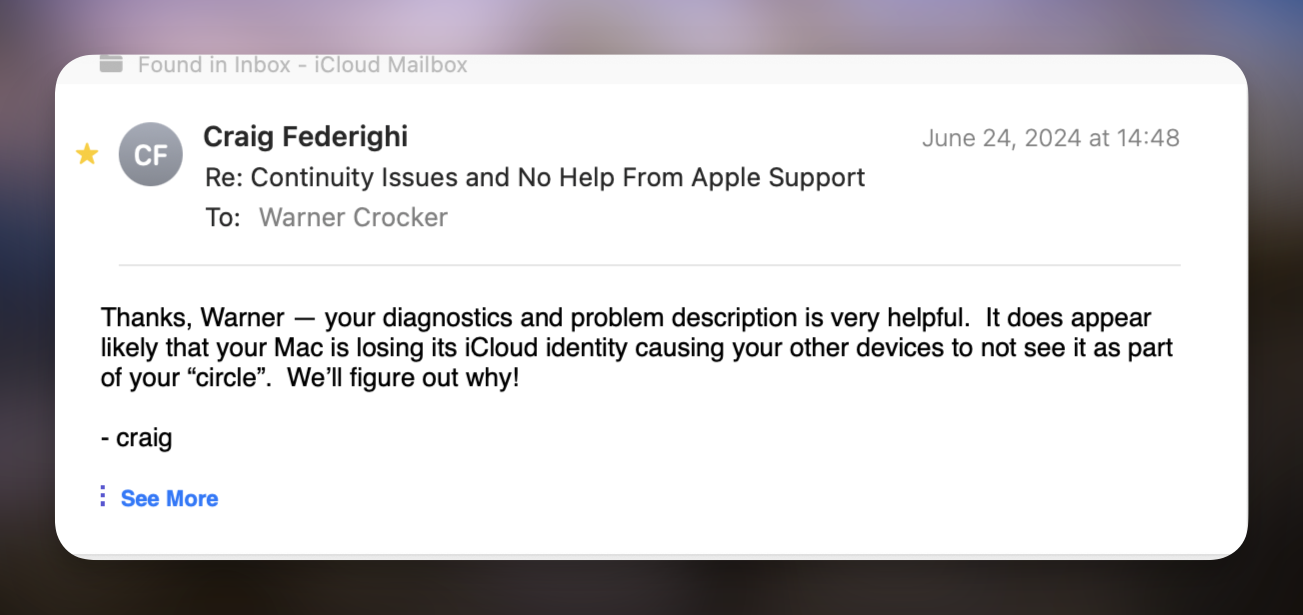
Briefly, when I lose Universal Control, Sign in with Apple Watch, Handoff, Copy and Paste between devices, the fix is to sign out of Messages in iCloud and to sign back in. When these fuctions disappear from my Macs they are still available on iOS devices. I know it’s iCloud related from my conversations with Apple Support and because I always receive a notification that says I have to sign my Apple Watch into iCloud via my iPhone.

Note that there is no option to do so in the Apple Watch settings on the iPhone. An Apple Watch is signed in to iCloud when it is paired to an iPhone.

Dwight’s fix has worked most of the time. Often it will work right away. Other times I won’t be able to sign back in immediately, resulting in an endless spinner that eventaully times out.

One of the other odd things about this workaround is that often executing it on one of my Macs will fix the situation on both. Sometimes it will require me to execute the fix on each Mac. Occasionally it will fix things on one Mac and not on the other even when executed on both. There seems to be no rhyme nor reason to this riddle.

I’ll know the workaround works when I get a notification that tells me WiFi calling is now an available option on my Macs follwed by notifications on my iOS devices that a new Mac is now available in iCloud. Which is strange given that a check of Settings always reveals both Macs being available on the account before, during and after the event.

When this doesn’t work I’ll perform a dance of the devices, turning them off and on in various sequences. Sometimes that works. Sometimes not. Sometimes I just need to wait things out and eventually things will right themselves.

That waiting corresponds with what I and other users have been cryptically (often very cryptically) told by Apple Support. Here’s a quote from Dan Moren’s experience:

. . . after perhaps 20 minutes on the phone, he seemed to hit on something. I heard him laugh and say something along the lines of “that explains it” and then, with my consent, put me on hold. When he came back, he said—and I’m not exactly quoting, but close enough: “I’m sorry, I can’t tell you any more than this, but all your services should be back up pretty much exactly 12 hours after they went down.”

I and others have also been told to wait 24 hours. Regardless of the length of the waiting period the “I can’t tell you any more than this” is always consistent.

Some Theories

I can’t offer any conclusion about the events of April 27 beyond what I’ve previously stated as speculation. What I can offer is that whatever caused that issue and how it was rectified by Apple has many similarities with these ongoing iCloud issues.

What is consistent is that they resurface each time Apple issues a beta update for iOS and macOS or a full release of same. What’s inconsistent is that sometimes the issues surface the morning of a release, sometimes the day after, sometimes the day before. NOTE: I do not run Betas on any of my devices.

What this tells me is that concurrent with those device operating system updates, beta or otherwise, Apple is issuing corresponding updates on the iCloud backend. That’s only logical, and it points up a flaw in the process. If you’re a beta tester you can and should expect issues. That’s what betas are for: to find issues. However, If you’re NOT a beta tester you should not be subjected to issues related to betas. 

When I’ve raised this timing issue with Apple Support I’ve gotten tacit agreement that it is an issue, but no definitive answer. My support dialogues through much of 2024 have consisted of me sending sysdiag files to Apple each and every time an OS update is released.

However, while I still religiously collect sysdiags to send each time the issues occur, the requests to send them stopped in March. That followed a period of time when I was asked to wait until after the next point release before submitting any further updates.

There was also a moment last fall when I was told that Apple engineers had recently put the issue back under investigation after the officlal release of Sonoma. I was told they thought they had solved it with Sonoma but realized shortly after they had not.

My theory of the moment, which I’ve expressed to Apple Support and gotten no official response to, is that with WWDC quickly approaching Apple has once again has put this on the back burner for current users in order to possibly address it in the next OS release. If my theory holds we might see the issue disappear at some point in this summer’s beta cycle or it will continue as it has since the days of Monterey.

Another theory I have, and that may tie in with the events of April 27, is that this somehow relates to when a user first set up an Apple ID. My initial Apple ID was a mac.com address and that’s followed me through the MobileMe era into the iCloud era. A number of users who experienced the problems on April 27 had mac.com addresses. I can’t speak to whether or not that was always the case with every user, but in trying to find solutions to my ongoing problems, many I’ve spoken with also acquired their first Apple IDs in the mac.com era.

Note that my wife and the family members I support all began their relationship with Apple in the iCloud generation. None of them experienced issues on April 27. None of them have experienced any of these issues that continue to plague me. That’s a small sample, but it fits within this theory of mine. I’ve also heard from some others who did not experience this April 27 issue that some have mac.com addresses at the root and some do not. So again, who knows?

Bottom Line: Fix and Communicate

Apple needs to solve whatever this long running problem with iCloud and Apple needs to communicate with its users and support personnel better. Certainly they need to do so when there are more acute failures such as that which occured on April 27, whether they be security related or just attempts to find a better solution. A week is much too long to wait for some sort of statement. We may all be At The Mercy of The Backend, but we don’t need to be at the mercy of poor communication. That’s a choice by a company. Contrary to what some might think or fear, saying there’s an issue and we can’t yet pin it down is a less bad PR move than going silent.

I use Apple products and follow Apple news throughout the evolutions of beta cycles into full blown releases. I like to follow that news. I don’t like and choose not to live and work through them. Each time Apple tries to improve things or add new features I know I’m going to experience failures before I can actually use the products and ecosystem as designed and advertised. And even after the situation may be fixed, worked around or righted, so far there’s no solution that has been able to solve the problems. To me that’s unacceptable.

It reminds me of days from my youth when I’d go out to start my old beater of a car and hold my breath wondering if it would actually turn over and start. Always a relief when it did. Always a pain in the ass when it didn’t and I’d have to lug out the jumper cables. Apple doesn’t make or sell beaters. But these issues sure are beating me down.

You can find more of my writings on a variety of topics on Medium at this link, including in the publications Ellemeno and Rome.

Sunday Morning Reading

Some serious stuff in our world this week, but we must dance on. Here’s some Sunday Morning Reading to share.

The world is a very serious and uncomfortable place based on what I’ve been reading this past week, so the topics for this edition of Sunday Morning Reading will lean that way. Good writing all around that meets the seriousness we’re all dancing around.

The United States Supreme Court is about to alter the world we’ve all thought we’ve lived in. Rick Wilson of Everything Trump Touches Dies fame writes:

The Supreme Court will delay Trump’s case and then make the most cataclysmic legal mistake in American history.

We’re not talking Dred Scott bad, Plessy bad, and Korematsu bad.

We’re talking about previously unimagined levels of bad.”

He’s correct. Check out The Red Court Strikes Again.

Bryan Tannehill says The Court Just Sealed Everyone’s Fate, Including It’s Own. Again, correct.

While this may be a bit less current than most articles inlcuded this week, Brian Gopnik reminds us that it takes more than one man to turn the world upside down in The Forgotten History of Hitler’s Establishment Enablers.

Wars, protests and political shenanigans about those wars abound. Mo Husseni has laid out his thoughts about what’s happening in the Middle East and our reactions to it on Threads and published them as an essay on Medium. Well worth your time to read his piece titled Hmmm… do I need a title?  

A few topics on the tech front, the mechanism that one way or the other bring us all this news and writing about that news, Edward Zitron tells us about The Man Who Killed Google Search.

Craig Grannell tells us to Just Say No: Not Every Piece of Tech Needs Subscriptons and AI. He’s correct and he nails the reason why this is becoming pervasive.

I don’t agree with everything Allison Johnson says in The Walls of Apple’s Garden Are Tumbling Down, but she makes good points and provides a piece of the necessary frame around this unfolding story.

Changing the subject, it is tough to laugh given all that is swirling around us. But laugher is crucial. Always. As unprovoked a release of emotion it is, laughter does take on different forms and come from different places. Christie Nicholson takes on The Humor Gap between men and women. Hat tip to David Todd McCarty for this excellent piece.

A Summer Place by Natasha MH reminds us that whatever we’re mired in, we should always dance on and quoting Neil Gaiman we should

Face Your life

It’s pain,

It’s pleasure,

Leave no path untaken.

If you’re interested in just what the heck Sunday Morning Reading is all about you can read more about the origins of Sunday Morning Reading here.  You can also find more of my writings on Medium at this link, including in the publications Ellemeno and Rome.

Apple and the DOJ: You Can Do Anything You Want As Long As You Don’t Get Caught

You can do anything you want in the land of the free and the home of the brave. As long as you don’t get caught. Or as long as you have enough cash in the bank to hire the right legal beagles. That’s the American way. Always has been. The bigger you are the more you can toss around your weight. That works more times than it doesn’t. In the case of the United States vs. Apple, Inc, not so much. Thus far.

The Department of Justice swooped in on Apple charging that the iPhone is the crown jewel of an illegal monopoly. You can read the lawsuit here. I’m not going to get in to all of the legal issues. Not really my game. As to that lawsuit I’ll take the liberty of saying the following:

  • I don’t understand the equation that led to the monopoly designation. It seems odd given similar such cases in history. The fact that different percentages for different types of valuations is being tossed around in all of the first reactions I think bears that out.
  • I’m in deep in the Apple ecosystem. I use the hardware and software. I enjoy the tech (when it is working as designed), and I hope they’ll continue to make the high quality products and software they do. Having used hardware and software from other makers, I find Apple’s superior and better for my needs. When and if that changes so will I. 
  • For the most part I buy Apple’s pitch about security and privacy. There are times I think the marketing around security and privacy leans too much towards myth-making, but in my experience the myth seems to have some foundation.
  • I’ve listened to the complaints from developers and other users through the years and find most of those I understand justified. Apple may have indeed created problems by creating and running the App Store the way it has. I personally don’t feel victimized by that, but I understand the issues presented by those that see it differently. 

Bigger picture I will say the following. Apple, like some other familiar tech giants of note (Microsoft, Google, and Amazon), largely brought this on itself with a too big for its bank account britches attitude. 

Arrogance and swagger isn’t just a feature of big tech companies. It’s a bug that infects any company or anyone who gets too greedy for their own good. I’ve seen it happen too many times.

History is full of these stories and many American myths are built on that foundation. You work hard, you make your pile, and you do it your way. The world beats a path to your door and you think you own the path and the world. You made your own rules along the way and bent some existing ones to your will. Perhaps broke a few.

That mythical song of good old American capitalism has been sung so often everyone knows the tune and the lyrics. When it comes to Apple’s stanza, you add in a chorus about Apple’s rise from an almost near-death experience and it becomes a siren song with a powerful resonance.  

In my view, limited as it may be, Apple could have easily made some adjustments along the way and possibly avoided this current mess. But the powers that be obviously thought different. They also thought they could swagger their way through and beyond this. That may well prove out in the years to come. And it will take years. 

Meanwhile, here’s some good early inning commentary on this story so far. I’m sure there will be much more ahead.

John Gruber on Daring Fireball

Jason Snell on Six Colors

M.G. Siegler on Spyglass.org

Stephen Robles on Beard.fm

You can find more of my writings on a variety of topics on Medium at this link, including in the publications Ellemeno and Rome.

Things We Know

Magicians have a hard job. Everyone is looking for the trick. Politicians have it easy. No one looks for the trick. Everyone already knows it. They’re not marks. They’re part of the act.

Donald Trump is a degenerate criminal, a rapist, an insurrectionist, a scumbag, a loser, a lousy liar, and more beyond redemption than most of the evil people in recorded history. And he’s the Republican nominee for President of the United States. If you’re voting for him I feel sorry for your grandkids’ future. 

Judge Aileen Cannon is on the take. 

Apple is screwing the pooch when it comes to PR and policy of late. Unusual. 

Even if Putin died tomorrow he wins. We’ve already given him the win. Regardless of how the war in Ukraine or the 2024 US presidential election turn out, he’s overseen the decline of the West he and his predeccesors always wanted. So much damage from falling out of a first floor window.

The Main Stream Media will blame its continued demise on everyone and everything except themsleves. 

Boeing has become synonymous with the Ford Pinto.

The vast majority of Internet issues (spam, bots, etc…) could be eliminated if the companies that control communication technoloy and social media apps would forego profit from that behavior. And that’s never going to happen. 

photo via sergio1972 on Shutterstock

At The Mercy of The Backend

Part of the Information Super Highway traveled some rough road this morning. Meta experienced an outage in all of its services today that took down Facebook, Threads, Instagram, Messenger, and I imagine everything else in the Metaverse. A source told the Daily Mail that the company’s internal systems were also down. Boomshakalaka, another day on the Internet.

We’re somewhat accustomed to Internet outages. In much the same way we’re sadly becoming accustomed to extreme weather events. Some are caused by malicious hacks, some by incompetence, some by rodents chewing through cables. Internet connectivity has made so much of our current world more convenient and convenience always comes with a cost. It’s a cost that those who own the servers, the services, and the connections, sometimes don’t want to pay for, leaving users stranded at times. It’s apparently tough to value an ounce of prevention on the Internet.

We hear about these outages when big ones hit. That’s sensational news. But far too often there are “backend” issues that happen that we never hear about. Those are the ones that only affect “a small percentage of users” or companies that don’t command the public’s day in day out appetite for connectivity.

Intriguingly enough, those charged with communicating with users when problems do arise sometimes never hear about them either, or if they do are they are told not to talk about them. Again, nothing surprising.

The corporate PR pros may or may not issue lawyered up responses, but rarely do users get any nuts and bolts answers as to what went wrong. Vague apologies, promises to do better, free credit monitoring when user info is hacked, etc… We’ll’ hear the now-clichéd “small percentage of users” modifier trotted out whenever things get righted. It’s funny/not funny how we all just move on.

Earlier this morning I was chatting with some folks on Threads who were seeing issues with Apple’s Weather app not updating as designed on their Apple Watches. I casually replied that it was probably an issue with iCloud’s backend and how it was associated with the provider Apple uses to offer up weather info. These issues with Apple always seem to manifest as they are rolling out new operating system updates, so my guess is more than a guess. (Apple rolled out iOS updates today.)

I’ve been going round and round with Apple for almost two years now trying to solve what is apparent to me, after much effort and investigation, an iCloud related issue. It’s not just apparent to me, there are several other users experiencing the same issues I’m having, as well as other users with other iCloud related issues in similar but different veins.

When I talk to Apple Support (a regular occurrence) we’ve developed this coded, often unspoken, acknowledgment that the issues are iCloud related. But as I said in this post, Apple needs to allow its support personnel to acknowledge directly what the problems are. And in my case, and those of others, so far that continues to not happen.

(Side note for those who might read the links above or are familiar with the situation: I’ve discovered a workaround to sometimes get things back to normal thanks to Dwight Silverman. Signing out of Messages and then back in works about 8 times out of 10. Otherwise I just have to wait it out.)

The problem is bigger than a social media network going down, or a streaming service buffering out during the big game for lack of bandwidth. Those may be frustrating but in the grand scheme of things merely inconveniences. But the more connected our daily lives become to our banks, our medical institutions, our governments, etc… the more reliant we become on services being well run, well maintained, and frankly just available and working as advertised.

I think of it as I think of streets and roads. We’re reliant on them and need them well maintained. The big difference is we see the potholes and understand the inconvenience we’re about to experience when the construction barriers go up.

When Apple, Microsoft, or Google releases a software update, they are not just updating the bits and bytes on your device. Corresponding updates happen on the backend as well. When your favorite app updates the same thing occurs. If that app provides a service, whether it be a social network, streaming media, or checking your bank balance something’s cooking on the backend.

And that’s just the backend updates we’re at least peripherally aware of. Perhaps we need better signage on the Information Super Highway.

You can find more of my writings on a variety of topics on Medium at this link, including in the publications Ellemeno and Rome

Sunday Morning Reading

Here’s some Sunday Morning Reading to share on a day when the political world is fixated on diatribes about age, infirmity, and a tottering judicial system that’s too long in the tooth and already rotted out with decay. Meanwhile a majority of eyeballs are getting ready to tune all of that out and watch some talented young athletes bash each other’s brains out on a playing field, hoping for a moment of glory. But hey, you can always do some reading.

First up, Clare Malone wonders Is The Media Prepared for An Extinction Level Event? The short answer is no. But read the article. It’s good.

And speaking of bordering on extinction, David Brooks in The New York Times pens an interesting piece titled Trump Came for Their Party But Took Over Their Souls.A bit like that old axiom about shutting barn doors after the horses have galloped away, but worth a read.

Smart Is Not Always Wise, says David Todd McCarty. He’s right. I may have linked to this already, but it’s worth you catching up to if you haven’t yet. Also check out The Scale of Evil Things. Smart and wise.

One of the mysteries of our time is how so many got suckered into so much bullshit thinking about things that used to feel like touchstones in our lives. In this piece, Reed Galen is talking about religion. The scary thing is how spot on the title is: Hiding in Plain Sight.

NatashaMH thinks she needs to be fucked up in order to be creative in her piece The Fucked Up Creative. Here’s to being fucked up if that’s the case. 

Back on the politics beat, but also the fucked up beat, Ronald Brownstein talks about the non-secret plans the decaying orange turd has if he gets elected again in Trump’s ‘Knock on the Door’. We can’t say we didn’t see it coming this time around.

The Apple Vision Pro continues to dominate tech talk and here are a couple of interesting takes from this second week of that beta project’s life in the wild. Apple Vision Pro Review: Eyes on the Future by Jason Snell of Six Colors and  Christopher Mim’s analysis that Apple’s New Face Computer Is For Work. 

And finally to close out the morning here’s a look at How Steinbeck Used The Diary as a Tool of Discipline, A Hedge Against Self Doubt, and a Pacemaker for the Heartbeat of Creative Work by Maria Popova. No AI or fancy tech required.

If you’re interested in just what the heck Sunday Morning Reading is all about you can read more about the origins of Sunday Morning Reading here.  You can also find more of my writings on Medium at this link, including in the publications Ellemeno and Rome.