Sunday Morning Reading

“The life of a man is of no greater importance to the universe than that of an oyster.” -David Hume

On the weekend when some parts of the world think they can alter time by simply changing the clocks, I’m reminded of the biggest lesson most learn in life: we’re each not the center of the universe. Most learn it. Some never do, or if they do, they continue to operate under that delusion. We pretty good at setting up systems and structures that reinforce and rely on that delusional thinking. Somehow that seems to be the theme running through the articles and writing I collected this week for this edition of Sunday Morning Reading. 

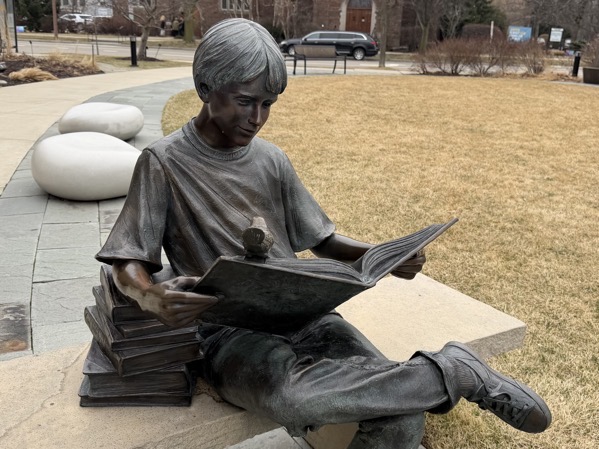
Bronze statue of a child sitting on an outdoor stone bench with legs crossed, reading an open book that rests on their lap, a small bird perched on the top edge of the book, and a stack of books beside them, with a paved walkway, grass lawn, and buildings in the background.Kicking things off is the story of how Humanity Altered an Asteroid’s Orbit Around The Sun by Becky Ferreira. The article links to the ScienceAdvances abstract on the nudge that might be as good as a wink.

Last week the war in the Middle East had just kicked off as I was publishing this column. This week it continues. And, yes, it’s a war, regardless of the stupid debate. Jonathan Taplin looks at The Terrifying New Era of American Imperialism, and Jay Caspian Kang examines The No-Explanation War.

“Society grows great when old men plant trees who shade they’ll never sit under” and the opposite of that wisdom is how Scott Galloway kicks off his piece on Role Models.

Ali Breland takes a looks at those yearning for a return to McCarthyism in ‘We Need To Do McCarthyism to the Tenth Power.’ Turning back time only works as a song lyric.

JA Westenberg offers up a A Soft-Landing Manual For The Return To The Second Gilded Age. It’s tough to avoid the usual hard crashes.

The Dodgy Code examines The Great AI Arbitrage: Making A Killing Before Your Client Wises Up. The inevitable turnaround on this is going to be something to see.

Before we get to that turnaround, Mathew Ingram says The Danger Posed By AI Just Got A Lot More Real All Of A Sudden. Going to be interesting to watch AI bots fighting each other to be the center of the universe. If we’re around to see it.

David Todd McCarty is Searching For Originality In A Sea of Slop. Even on dry land that’s tough.

I’ve been revisiting a lot of Shakespeare of late, so this piece by Alice Cunningham caught my eye. Check out Author To Revive Shakespeare Club After 300 Years. We could all do with revisiting the his works.

And to conclude this week, James Verini brings us the wild tale of The Man Who Broke Into Jail.

(Photo taken by the author.)

If you’re interested in just what the heck Sunday Morning Reading is all about you can read more about the origins of Sunday Morning Reading here. If you’d like more click on the Sunday Morning Reading link in the category column to check out what’s been shared on Sunday’s past. You can also find more of my writings on Medium at this link, including in the publications Ellemeno and Rome.


Hollow Crowns, Hollow Honor, Hollow Men

There’s nothing new under the sun

My wife and I spent the weekend watching two pieces of history. One unfolding, one already folded into folios more times than creases might allow. Separated as they are by hundreds of years, one a streaming dramatic retelling, the other a dramatic reality, they share more similarities than those distances impart.

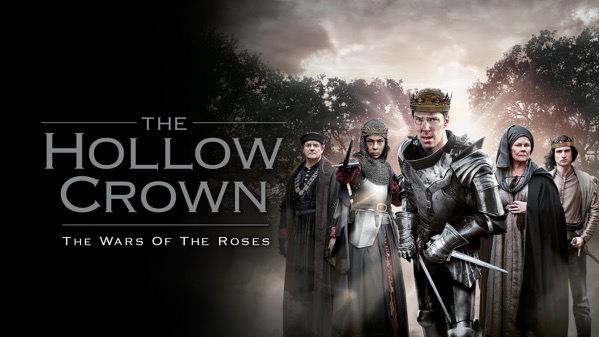
Promotional poster for the TV series “The Hollow Crown: The Wars of the Roses,” showing the title in large white text on a dark background at left while, on the right, a group of medieval characters in armor and period clothing stand in front of misty trees and a bright, cloudy sky, with a crowned knight in full plate armor holding a sword at the front of the group.

That reality I speak of is of course the war that the United States and Israel have launched against Iran for any of the hollow rationales the administration keeps trying to fill in. The retelling is the two-season BBC series encompassing William Shakespeare’s history plays spanning the reigns of Richard II, through a collection Henrys, an Edward, and ending with Richard III called The Hollow Crown. 

The title of the series is taken from a soliloquy from Richard II that always felt apt as preamble for what was to come through the period of history those plays encompass, as it has throughout human history, both before and after that bloody era.

From Richard II

…for within the hollow crown
That rounds the mortal temples of a king
Keeps Death his court and there the antic sits,
Scoffing his state and grinning at his pomp,
Allowing him a breath, a little scene,
To monarchize, be fear’d and kill with looks,
Infusing him with self and vain conceit,
As if this flesh which walls about our life,
Were brass impregnable, and humor’d thus
Comes at the last and with a little pin
Bores through his castle wall, and farewell king!

The plays and our current Middle East maelstrom demonstrate the folly of humans in what we call war, civil and otherwise, and the allegiances we are taught to assign to countries, kings, and presidents. They also demonstrate the collective capacity to forget that these humans we bow down to, willingly or no, are no more or less flawed than those they govern. Even as some become monsters or others reveal that they always have been.

Shakespeare had the benefit of over 100 years distance from the events he was dramatizing before he embarked on writing the first tetralogy, (Henry VI, Parts I, II, and III, and Richard the Third,) and a few years later completing the second (Richard II, Henry IV parts 1 and 2 and Henry V.) Although taken as two parts of a whole in terms of history, the two tetralogies were written out of historical sequence with the latter years chronicled before the former.

Obviously, today we don’t have the benefit of perspective that distance and the passage of time can lend as current news swoops in like flocks of drones. In truth, we really shouldn’t need it. The only thing that really changes are the players and history’s progression of weaponry and technology that they wield. Even the rhetoric doesn’t change much.

From Henry V

Take pity of your town and of your people
Whiles yet my soldiers are in my command,
Whiles yet the cool and temperate wind of grace
O’erblows the filthy and contagious clouds
Of heady murder, spoil, and villainy.
If not, why, in a moment look to see
The blind and bloody soldier with foul hand
Desire the locks of your shrill-shrieking daughters,
Your fathers taken by the silver beards
And their most reverend heads dashed to the walls,
Your naked infants spitted upon pikes
Whiles the mad mothers with their howls confused
Do break the clouds

These are the things men say when they choose to go to war, whether they may have good reason or not. If reason itself does exist in those moments. Once you descend down that path, it becomes an increasingly greater challenge to swallow the bluster and reverse course. Honor demands, they always say, and more than not leaves its corpse on the field.

Although you have to admit, Shakespeare’s poetry, even for those not used to scanning Shakespeare, is easier on the ear than anything spewing out of the mouths of Trump, Hegseth or any of the other current day blowhards and courtiers.

Regardless of whether the war councils happen in throne rooms, camp tents, or a makeshift Mar-A-Lago SCIF, it doesn’t take much imagining to see the similarities between modern day cabinet members, and long dead peers and archbishops. The costumes may be different, but the egos, hubris and fear remain the same. The fear isn’t always as much of the opponent, but of the leader’s capricious power against those who think differently and raise their heads to speak their minds. Civilization may have advanced to the point in most regions that we don’t cut off heads at a whim, but legs and livelihoods can swiftly be cut off with a Twitter/Truth Social post.

One of the things that struck me most about the production of The Hollow Crown, was the intimacy that filming allows. The series features a cast of superstars including Patrick Stewart, Judi Dench, Benedict Cumberbatch, Tom Hiddleston, Jeremy Irons, Simon Russell Beale, Ben Whishaw, David Suchet, Hugh Bonneville, Michelle Dockery, and Sophie Okonedo among a host of others it would be tough to assemble to speak those speeches on a stage. They do so with intimacy and nuance than larger, more open venues allow without amplification.

I’ve seen each of these plays live on stage multiple times. In fact, one of the signature live theatre viewing experiences of my life was attending the English Shakespeare Company’s The Wars of the Roses at the Chicago International Theatre Festival in 1988 that presented all of the plays over the course of three days.

Both that live version and this made for TV version made cuts in the text for various reasons including length. The three parts of Henry VI are condensed into two, with the TV version omitting Jack Cade’s rebellion, and Henry V bypassing the slaying of the children managing the baggage train are examples. But both gave you the essentials of the same story.

The live stage version certainly brought grandeur and spectacle to the event. The parade of the various reigns of kings proceeded through history adorned in Renaissance costumes with weapons of the period for Richard II evolving to more contemporary clothing and weapons for Richard III, before quickly devolving to the final battle between that Richard and Richmond in full battle armor, then flashing forward again, presenting Richmond’s final speech as a press conference broadcast on TV.

The TV version suffers a bit compared to current day streaming spectacles given the obvious budget and technology constraints of the time of its filming in 2012 through 2016. Amazing how 10-15 years can make more of a difference in our storytelling techniques than hundreds of years does in how we continue to rerun the actions of those stories in real life.

But the streaming version does hold up extraordinarily well and offers new insights, due to the intimacy that the camera allows. Using the camera to focus on Shakespeare’s moments of inner thoughts in soliloquies dissects those character kings and queens in ways modern day lickspittle journalists only wish they could access. Even though Shakespeare’s words describing those thoughts are his, they have the ring of more truth than the many we hear and see through these days, certainly in moments of chaos.

And there’s the rub. In moments that strain the hearts and souls of nations, we yearn for anything approaching a morsel of truth amongst all the banquets of rhetoric we’re served. Shakespeare’s fictionalized histories, though not accurate in detail or some necessary facts, reveal the more important and enduring truths, doubts, and fears that all men and women harbor beneath the armor they don for battle as they command us to follow.

Whether watching The Bishop of Canterbury recite the litany of lineage that gives King Henry V the right to invade France, or Secretary of State Marco Rubio breathlessly trying to spin together the strands of stories this administration has spewed out as justification for our current war, the comparisons favor neither, yet reveal the time worn folly of both. And you can’t walk away from comparing the falsehoods, conniving, and deteriorating health of Falstaff to those of Donald Trump.

History catalogs facts and the myths manufactured around them. Drama reveals the humanity of those behind the history. I have said more times than I can count that Shakespeare is the greatest chronicler of the human condition and the ways we relate one to another. There isn’t a human to human interaction that he doesn’t reveal in his characters, even those who have no character.

We like to ignore, or conveniently forget that it’s all been written before. Watching our current myth makers trying to rewrite history as it happens moment to moment, it’s no wonder we yearn for any small slice of humanity to help us make sense of it all.

I’m guessing the dramatists who will reveal that to us haven’t been born yet.

You can also find more of my writings on a variety of topics on Medium at this link, including in the publications Ellemeno and Rome. I can also be found on social media under my name as above.


Ian McKellen, Thomas More, Shakespeare, and The Strangers’ Case

Watch this

There really is nothing new under the sun. Man’s “mountainous inhumanity” is something that’s always been with us. We constantly need to remind ourselves of that when it comes to our current moment, especially as relates to our current ICE capades.

Ian McKellen appeared recently on The Late Night With Stephen Colbert for an extended interview in which he recited a 400-year-old monologue from the play Sir Thomas Moore, that speaks to directly to the plight of immigrants. 

You can watch the clip below. It should be cued to the monologue. In case it’s not, the monologue begins at roughly 22:16 in the 26 minutes interview. Naturally I’d recommend watching the entire thing.

For an intriguing bit of context, the play largely thought to have been originally written by Anthony Munday and Henry Chettle, but contains pages attributed to Shakespeare and others in what was largely a collaborative effort over time as it passed from troupe to troupe. Which is when Shakespeare would have entered the picture. Of course, Shakespeare’s authorship has been debated as it always is. If interested, you can check out a Wikipedia entry on the play and its history that will give you some idea.

McKellen stepped into the play for the first time in 1964 after the original actor left the production due to artistic differences. 

Setting aside authorship debates, the 400-year-old speech certainly speaks to our current moment as it has through generations, even if the play has been rarely performed live in its 400-year-old history.

You can also find more of my writings on a variety of topics on Medium at this link, including in the publications Ellemeno and Rome. I can also be found on social media under my name as above.


Sunday Morning Reading

Traveling through the crazy paying attention along the way

It’s been a fortnight since I’ve published one of these columns due to travel. So much has happened. The travel adventures to London and Memphis were great. The way the world continues to pull itself apart continues to not be, as witnessed by protests and a madman’s threats of troops in the streets followed me from Chicago to London to Memphis. You can shut off and shut down to enjoy new places and visit dear friends, but the insanity keeps getting more insane. So, Sunday Morning Reading is back at it this week, with a mix of politics, culture and a bit of tech. (Oh, yeah, Apple released new iPhones during all of that.) If you can’t feel the currents flowing together, you’re not paying attention.

On my travels my wife and I caught some theatre. Two plays by Shakespeare and the contemporary play Stereophonic. The two Shakespeares were one of his worst, Merry Wives of Windsor, and one of the best, Hamlet. We’re theatre rats and know the importance of the medium and certainly recognize the role writers in all mediums play in our lives, history, and culture. So too does a favorite writer of mine, David Todd McCarty. Check out his important piece The Reason You Need To Be Making Art Right Now. And if I may be so bold, the other Sunday Morning Reading links below demonstrate that to a tee.

NatashaMH reflects on free speech, punk rebellion and British satire in When Satire Was Safe. Great piece. I dare say, satire has never been safe even when tolerated. Plenty of fools can attest to that. Ask Yorick.

I mentioned there’d be politics and here’s a few links to some excellent context on just how damn familiar all of what we’re living through is. For those who bother to pay attention. First up is Mark Hertling’s Beware Today’s ‘Fire-Eaters’. If you don’t know that term, read the piece. You’ll recognize today’s fire-eaters in a second.

On a broader scale, take a look at Nikki McCann Ramirez’s interview with Mike Duncan in Are We Witnessing The Fall Of The American Empire? My short answer is yes. Here’s the money quote that should terrify us all:

So if we go this route, we’re going to have congresses, we’re going to have Supreme Courts, we’re going to have a President of the United States, there will be governors, there will be elections, it’s just what’s happening underneath that facade. The facade is never going to go away, it’s how tissue-thin the facade is.

Follow that up with George Packer’s America’s Zombie Democracy.

For a bit of recent history and context, check out The Story of DOGE, As Told By Federal Workers from a team of Wired writers led by Zoe Schiffer.

As I mentioned Apple released new iPhones last week. Om Malik seems quite taken with the new iPhone Air, although he has some concerns in Go Out & Get Some Air.

In this column and other posts I’ve been following Denny Henke’s journey to de-Apple himself in his tech life with a keen interest. I greatly admire his drive and his sharing of his efforts. Check out My Ongoing Effort To de-Apple the iPad.

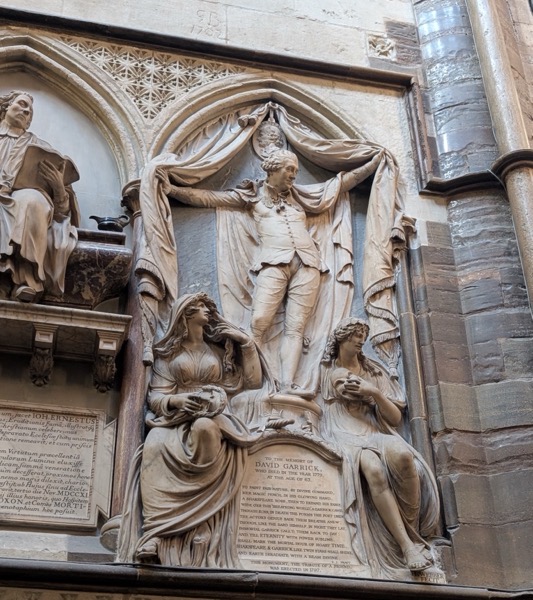
And to bring this all back around, take a look at Neely’s Tucker’s sharing of a guest post by Patrick Hastings,  Nobody Would Edit Shakespeare, Right? Right? They have and they do. David Garrick wasn’t the first or the last. Throughout history we always look for the ways to make it easier to swallow tragic moments and unhappy endings. In the theatre and on the stages of our lives.

(The image above is of David Garrick’s monument in Westminster Abbey, taken by me on my recent travels.

If you’re interested in just what the heck Sunday Morning Reading is all about you can read more about the origins of Sunday Morning Reading here. If you’d like more click on the Sunday Morning Reading link in the category column to check out what’s been shared on Sunday’s past. You can also find more of my writings on Medium at this link, including in the publications Ellemeno and Rome.

Sunday Morning Reading

We’re always chasing bubbles.

Back from a brief hiatus, there’s plenty to read and share. It feels like it’s becoming increasingly important, and perhaps more urgent to do both. I promise there’s some happiness amidst all of the Strum and Drang down the page.

First up, Canadian Stephen Marche is singing the Red, White and Blues. It’s easy to look from the outside in, or even from within and be dismayed at what’s going on in this country. Because it’s so damn easy to see. Unless of course you’re still in shock, or choosing to ignore it. Marche’s tune doesn’t hit a false note as he says America was a “country of bubbles.”

David Todd McCarty is back Poking The Bear. It’s good seeing him write about politics again.

Drik de Klein of History of Sorts wrote Evil, I Think, Is The Absence of Empathy back in 2019, using Captain G.M. Gilbert’s quote from the Nuremberg trials as the headline. I remember reading it a while ago and it resurfaced this week, proving, as always, just how short our attention spans are. Or perhaps our comprehension and retention capabilities.

NatashaMH says, “I can’t stand people being ignorant bastards” in her excellent piece Our Modern Discontents. Again, a viewpoint from outside the red, white, and blue bubble that feels like it’s ready to pop.

Jacob Silverman’s Welcome To The Slop World: How The Hostile Internet Is Driving Us Crazy is an invitation to a party that turned into something nobody was expecting.

Speaking of bubbles, big tech is in hot water of its own boiling these days. Google is facing anti-trust charges and a possible breakup that probably won’t happen. Wendy Grossman takes a look at Three Times A Monopolist.

Who’d a thunk it? Bot Farms Invade Social Media To Hijack Popular Sentiment. Eric Schwartzman does some digging in those all too fertile fields.

This past week we celebrated William Shakespeare’s birthday. As usual lots of words were written about the writer who used them better than anyone else to describe the human condition. One of the accepted parts of the Bard’s legacy is that he was an absent husband that left his family behind to pursue his calling. But a discovery of a letter might just change that. Check out what Ephrat Livini has to say about the possibility in an Overlooked Letter Rewrites History of Shakespeare’s Bad Marriage.

And for that happiness I promised, I’ll stick with Shakespeare and Cora Fox with ‘I Were Happy But Little Happy, If I Could Say How Much’; Shakespeare’s Insights On Happiness Have Held Up For More Than 400 Years. We often focus on his tragedies, but he reveled in the joys of life as well. Keep those happy bubbles afloat as long as you can. Pop the bad ones.

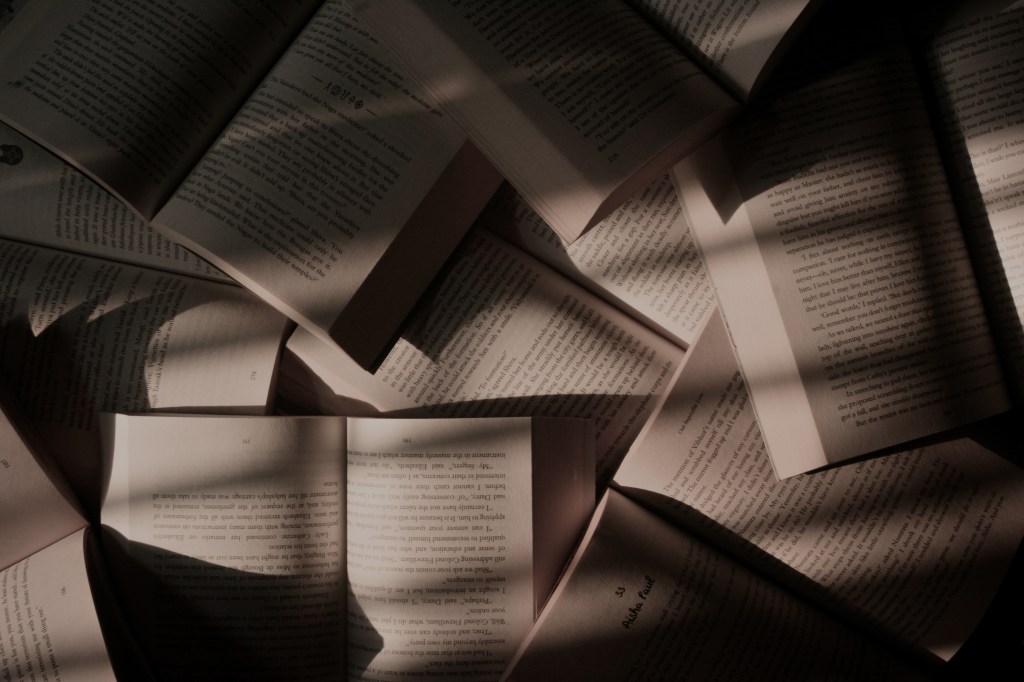
(Image from Rey Seven on Unsplash)

If you’re interested in just what the heck Sunday Morning Reading is all about you can read more about the origins of Sunday Morning Reading here.  You can also find more of my writings on Medium at this link, including in the publications Ellemeno and Rome.

All The World’s His Stage. Happy Birthday (We Think) to William Shakespeare

We’re merely players.

William Shakespeare is the playwright and poet that described us all. He did so with intelligence and wit. Today, April 23, is the day most mark as his birthday. The record of his baptism is April 26th, so it’s a decent bet the date is close enough.

Shakespeare William _ banner.

There really is nothing new in human behavior under the sun. In his plays and poems I don’t think he missed much in describing every thing good, bad, noble, and foolish about how we operate with each other and within the world. In my view, it’s a shame more of us don’t pay enough attention to his cataloging of humanity. But then he predicted that as well.

Here’s an intriguing side note on this very intelligent man’s celebrated birth date. I asked several AI engines on what day was he born. Gemini, ChatGPT, Perplexity, and DeepSeek returned April 23rd as the likely date with the typical (and mostly accepted) disclaimers that we celebrate that day, but there’s no definitive proof it was the actual date. I asked Siri and Alexa, both returned April 23 as the definitive date. Intriguing that Siri didn’t try to pass that off to ChatGPT. I’m sure Amazon will now offer me all kind of suggestions to purchase anything Shakespeare.

So, I’ll amend slightly my statement about the Bard describing us all and there being nothing new under the sun. He’s correct in that we’re both smart and too often not smart enough to understand what we do and do not know, but he might have missed the mark when it comes to artificial intelligence. Or did he did he?

I’m reasonably certain his works have been fed into AI engines and Chatbot training given that they are long in the public domain. I’m also reasonably certain they ignore his nothing new under the sun descriptions of human interactions in the same way those of us still walking around do.

“Lord, what fools we mortals be!”

You can find more of my writings on a variety of topics on Medium at this link, including in the publications Ellemeno and Rome. I can also be found on social media under my name as above. 

Sunday Morning Reading

A nod to Billy Joel, a little Faust, a little Shakespeare and the cycle of life keeps turning.

We may not have started the fire. In the words of Billy Joel, “it was always burning.” Still we can always try and fight it. I’m not sure how that’s working out but it does seem to be our lot. Sifting through smoke and ashes, here’s a little Sunday Morning Reading to share.

Kicking things off is David Todd McCarty’s Looking for God, Sitting in Hell. Summed up nicely, “we get so lost in semantics that we forget the important parts.” Indeed.

David Sterling Brown tells us What Shakespeare Revealed About the Chaotic Reign of Richard III – And Why The Play Still Resonates In The Age of Donald Trump. The only thing I question is the word “still” in the headline. There’s not a moment of being human that isn’t contained in the stories and characters of Shakespeare. We haven’t invented a new way of being good, bad or indifferent in quite some time.

And while we’re on the literature beat Brian Klaas give us Faustian Capitalism. Again, there’s nothing new under the sun here as we watch this country’s wealthiest men bend their knees in supplication, but there’s some small comfort in knowing we’ve been this selfishly stupid before.

John Pavlovitz hits a nail on the head with The California Fires Are a Disaster. The American Cruelty Is A Tragedy. It may be beyond our capacity to comprehend devastation, but as the previous two entries show, it shouldn’t be beyond our ability to know we keep repeating the same mistakes.  Or maybe that’s really just the hell we’re living?

Speaking of Faustian bargains, Mike Masnick lays out The Good, The Bad, And The Stupid In Meta’s New Content Policies.

This piece should scare you, but again, its subject is as old as humankind’s penchant for inhumanity. Stephanie McCrummen shines a bit of light as The Army Of God Comes Out Of The Shadows.

Derek Thompson takes a look at The Anti-Social Century and how our reality is changing as we spend so much of our time alone.

Perhaps one of the keys to being less alone and less anti-social is choosing your friends wisely. Natasha MH says that “To survive this life, it’s crucial to discern which friends are worth keeping and which aren’t. You are the guardian of your own peace of mind” as she lays out The Optimist’s Dilemma In A Pessimistic World.

And finally, Ian Dunt offers A Little Bit Of Hope After A Terrible Week, in what he calls a survival guide for the next four years. Ian says “History has no direction.” He’s correct. It’s a circle, a cycle, a carousel.

If you’re interested in just what the heck Sunday Morning Reading is all about you can read more about the origins of Sunday Morning Reading here.  You can also find more of my writings on Medium at this link, including in the publications Ellemeno and Rome. You can also find me on social networks under my own name.

Robert LePage’s Hamlet without Words, Words, Words

Told through dance, LePage’s Hamlet is a thrill.

What a treat. Last night a group of us celebrated a friend’s birthday by attending the Robert LePage production of Hamlet. Billed as a Hamlet without words Le LePage collaborated with choreographer Guillaume Côté, who also danced the title role, to deliver a piece almost entirely as a ballet performed by a company of nine. It was an exquisite theatrical adventure. 

Hamlet 4 photo by Stephane Bourgeois.

With the exception of a few supertitles announcing character entrances for identification, the story unfolds and unfurls through dance, and Côté’s choreography was excellent throughout. Although, I felt the vocabulary he established for himself in the title role was not as strong or consistently surprising as it was for the rest of the ensemble. In and of itself surprising, because the entire story revolves around Hamlet’s surprising reactions to the events enfolding him. 

The true standout in the company was Carleen Zouboules as Ophelia. Her descent into madness, her drowning, and the graveyard scene were the highlights among many in the production. The entire ensemble were excellent and each had standout moments of their own.

LePage always surprises and Chicago audience were lucky to have this US premiere here. Thrilled I got to see it. There’s a trailer linked below, although it seems to have a larger ensemble than the nine person version we saw last night.

You can find more of my writings on a variety of topics on Medium at this link, including in the publications Ellemeno and Rome. I can also be found on social media under my name as above. 


Sunday Morning Reading

AI, politics, culture and a bit of history in some Sunday Morning lake time reading to share.

We’re on lake time this weekend, but there’s always some Sunday Morning Reading to share. Especially when you get to share it from a lovely morning looking over the lake. Lots of AI, some polticis, some culture, and some just fun this Sunday. Enjoy.

It’s Father’s Day weekend, which prompts delving back into memories for me and also comes at a time when the debates around Artificial Intelligence touch a bit on how we collect, save, and share what may have once been memories but might be hallucinations. While this piece from Natasha MH isn’t aimed specifically in either of those directions, it struck some of those chords when I read it. Check out No Proof of Existence.

Speaking of AI, Miles Klee thinks Brands Are Beginning to Turn Away From AI. 

Holy moly. Even the Pope is getting into the AI discussion. Antony Faiola, Cat Zakrzewski and Stefano Pirelli take a quick look at How Pope Francis Became the AI Ethicist for World Leaders and Tech Titans. The AP also has a larger report here.

I’ve compiled a large reading list on Apple’s move into AI that it has now branded as Apple Intelligence. It’s way too early in this game to understand or predict the technology and financial games ahead, but as the previous link suggests perhaps not the ethical. Check out Eshu Marneedi’s Why Apple intelligence is the Future of Apple Platforms.

Fascinating piece by Renée DiResta on how online conspiracy theorists turned her into “CIA Renee.” Check out My Encounter with the Fantasy Industrial Complex.

Joan Westenberg does some comparing of our political life between the 1850’s and now in A Republic, If You Can Keep It: How 2024 Rhymes with the 1850’s. The parallels are black and white. The ability for too many to see where this will all lead not so much, as evidenced by this piece from Gregory S. Schneider and Karina Elwood: A School Board Reinstated Confederate Names. It Split The Community Again.

Anna Spiegel reports for Axios on The Folger Shakespeare Library’s Reimagining. This institution is a treasure and worth a visit. I’m looking forward to seeing it again after the new reopening.

If you’re interested in just what the heck Sunday Morning Reading is all about you can read more about the origins of Sunday Morning Reading here.  You can also find more of my writings on Medium at this link, including in the publications Ellemeno and Rome.
Sunday Morning Reading

We just commemorated the anniversary of the history altering events of January 6th. So some of thse links in this weeks’ edition of Sunday Morning Reading will reflect that. Not all. But some. If that turns you off, apologies in advance. Not to you. Because of you.

Kicking it off is David Todd McCarty’s Who’s Teaching You a Lesson? Read it damnit.

Driftglass offers up The Art of Persuasion is Over. Short. Sweet. Persuasive.

David French offers up The Case of Disqualifying Trump is Strong. I agree. Too bad the judges it will be argued in front of are not.

David Graham tells us How Trump Taught America to Tolerate Brazen Corruption. We’ve always tolereated corruption. Most of us just don’t want it flaunted openly in our face by a bunch of bragadocius buffoons.

Changing the tune, check out To Own The Future, Read Shakespeare. Not what you think. It’s about tech and the liberal arts. Great read.

NatashMH wonders how the plot got lost regarding feminism in We Were Once Dragons and Phoenices. Another great read.

And then for something completely different, check out Dana Milbank’s I Killed A Deer From My Bathroom.

If you’re interested in just what the heck Sunday Morning Reading is all about you can read more about the origins of Sunday Morning Reading here.  You can also find more of my writings on Medium at this link, including in the publications Ellemeno and Rome.