Apple’s Long Term Challenges Complicate The Short Term

It’s not easy to sell a waiting game.

Mark Gurman offers up a relatively thorough summary of the number of challenges Apple is facing going forward in his weekly Power On column. Things always go forward. The question is always how.

The original link above is paywalled, but here’s a web archive link to the story.

And here’s the summary:
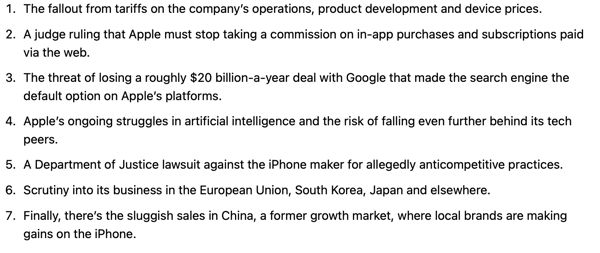
CleanShot 2025-05-05 at 09.41.06@2x.

Gurman calls this point in Apple’s history a “critical juncture.” I would agree. The many moving parts, both surrounding Apple, and of its own making, have put Cook and company squarely in that critical juncture. This comes as Apple and those that make their living talking about Apple are gearing up for this year’s World Wide Developer’s Conference (WWDC) next month.

Gurman delivers the punchline well below the headline that neatly summarizes why WWDC is not going to be able to address all of these challenges, but also why the turmoil is going to continue.

Speaking specifically about Apple’s race to catch up in the AI realm he says:

it’s going to be a while before we can tell if Apple is heading in the right direction

Perhaps that should have been the lede. He could have easily said the same about each of these challenges he enumerates.

But there’s also a larger, more encompassing challenge that makes surmounting each even more difficult. The tech world is moving at a pace that Apple is unaccustomed to. Apple’s historic long view has served it well over the years, but the window on that long view is increasingly narrowing its aperture.

Apple may spend its June introducing and setting the table for what’s coming later this year, but already most of the smart players who follow and promote Apple are shifting their focus to the bigger, and more critical, table stakes coming long after this year’s summer and fall hype cycles end. The now familiar “coming later this year” now means much less when the real issues may only begin to be addressed further down the road.

Waiting “a while” is not an easy sell. Especially these days.

You can find more of my writings on a variety of topics on Medium at this link, including in the publications Ellemeno and Rome. I can also be found on social media under my name as above. 

Sunday Morning Reading

Lots to think about in this helter-skelter moment we’re living through.

Back at it after a couple of weeks of traveling and dealing with a case of pneumonia. (All is well.) Certainly there’s a lot going on and most of it is happening in a such a rush that I’m not sure anyone has enough space to accurately write or think about all that’s happening. But there is some good stuff to recommend.

Leading off this week are some articles from folks who are concerned, distressed, pissed off, and searching for tech solutions that don’t rely on America’s big tech oligarchies.

First up is I’m Tired of Pretending Tech is Making the World Better by Joan Westenberg. Follow that up with Joan’s article on How I’m Building a Trump-Proof Tech Stack Without Big Tech. Good suggestions there.

Matt Keil has also published a list of non-U.S. tech apps and services for those looking to move things offshore called Migrating Away from US Apps and Services.

With all going that’s going on, Denny Henke at Beardy Star Stuff takes a look at Apple, big tech, lock-in and the corporate colonization of life experience.

If you’re one of those searching for different tech solutions, remember no matter how long a service may have been around or how big the company behind it is, it’s all impermanent. As an example, Om Malik takes a look at Microsoft ending the run of Skype this week in Skype Is Dead. What Happened? It might take awhile, but everything eventually dies.

Moving off of the tech beat, this story by Joshua St. Clair is tough emotional read, but well worth your time. The title tells you what you’re in for: What Do You Do After You Accidentally Kill A Child?

There’s lots of rethinking of lots of things these days. David Todd McCarty is Rethinking Pride.

Adam Serwer asks the question most are asking when it comes to the words behind the ugly acronym, MAGA: Just when was America great, exactly, and for whom? Check out The Great Resegregation.

We’ve yet to feel any real impact on the economy given all of what’s happening. At some point we will. Umair at the issue takes a look at what happens if capital flight occurs in How an America the World Can’t Trust Goes from Collapse to Implosion.

Tonight is Hollywood’s big night with the Oscars. In an article from 2013, Seth Abramovitch takes us on a look inside a moment when an Oscar opening number went horribly wrong in “I Was Rob Lowe’s Snow White”: The Untold Story Of A Nightmare Opening. Show biz is hard.

And to close things out, NatashaMH takes a look at simple acts of kindness in Of Munchkins and Manners. Do be kind.

If you’re interested in just what the heck Sunday Morning Reading is all about you can read more about the origins of Sunday Morning Reading here.  You can also find more of my writings on Medium at this link, including in the publications Ellemeno and Rome.

(image from Roman Kraft on Unsplash.)

EU Charges Apple with Violating DMA Rules

The EU charges Apple with violations of the DMA

The friction between Apple and the European Union just took another turn. The EU has charged Apple with DMA rules violations dropping the dubious distinction on Apple of being the first “gatekeeper” company to be so charged. It’s a preliminary ruling and Apple has until March 2025 to respond to this preliminary ruling.

If the charges stick, the potential remedy is for Apple to be fined up to 10 percent of its annual global revenue. quite a bite of the Apple.

This comes on the heels of last week’s pot-stirring announcement that Apple’s new, but yet unreleased and untested, Apple Intelligence features won’t be rolling out in the EU (and other markets) until next year. As I said then, this is all going to be one big negotiation with legal and political shots fired by both sides.

At the root of the charges is “steering,” which the EU sees as key to a competitive market. Bottom line, the EU wants gatekeeper companies to allow software developers to be able to “steer” potential customers to their products free from closed App Store and other gatekeeper restrictions. Apple joins Alphabet, Amazon, ByteDance, Meta and Microsoft in the EU”s list of gatekeepers.

The EU is also challenging Apple’s moves to come into compliance by charging a Core Technology Fee that most complain violates the intention to allow side loading of apps.

This will bounce back and forth over the next nine months and will probably become even more contentious given quotes like this from Thierry Breton, the EU internal market commissioner: “Apple’s new slogan should be ‘act different.

Apple has released the following statement:

“Throughout the past several months, Apple has made a number of changes to comply with the DMA in response to feedback from developers and the European Commission. We are confident our plan complies with the law, and estimate more than 99% of developers would pay the same or less in fees to Apple under the new business terms we created. All developers doing business in the EU on the App Store have the opportunity to utilize the capabilities that we have introduced, including the ability to direct app users to the web to complete purchases at a very competitive rate. As we have done routinely, we will continue to listen and engage with the European Commission.”

The Financial Times seems to be the front lines where both the EU and Apple are waging this battle. The Verge also has a writeup on the news. I’m sure there will be more. Intelligent or not.

You can find more of my writings on a variety of topics on Medium at this link, including in the publications Ellemeno and Rome. I can also be found on social media under my name as above. 

Apple Intelligence Crawling Under the Skin for Some

Apple Intelligence is the latest AI effort upsetting web publishers.

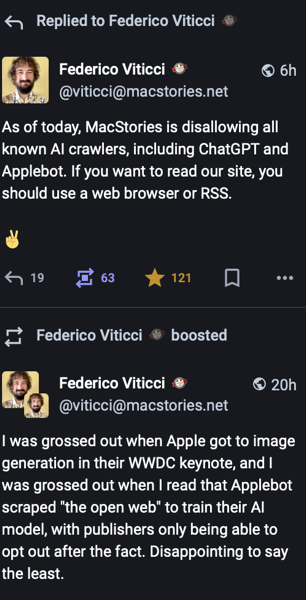
As we learn more about Apple Intelligence how Apple is training its AI efforts is crawling under the skin of some web publishers. Apple has been reasonably transparent about how it’s crawling the open web and using data it can grab for its efforts. Even so that’s not sitting well with everybody. But that’s been an uneasy road we’ve all been on with AI in a general sense since those gates were thrown open by OpenAI in 2022.

Screenshot%202024 06 10%20at%2011.36.33%E2%80%AFAM.This is a sticky wicket. Web publishers justifiably don’t feel great about having their content grabbed, regurgitated and spit back out without some consent or control. The other side of that coin is that the info is on the open web and by and large folks can access it through a variety of methods. There’s also the reality that the horse is already far from the barn because most of these AI models have been doing the same thing Apple is doing. AI has a been both a cash grab and a content grab from the get go, because without the content there’s diminishing returns on the cash.

There are methods to exclude a website from being crawled. Dan Moren at Six Colors has posted a good piece on how to do so and what that could mean here. Keep in mind any method used for this only excludes content and data going forward. Federico Viticci at MacStories has already stated that he’ll be excluding his website going forward.

Also keep in mind that this isn’t the only way Apple will be putting Apple Intelligence to work. Regardless, this is going to be an issue to follow as we continue to learn more about Apple Intelligence, which is just the latest in these Artificial Intelligence efforts that we all need to pay attention to. Like it or not it’s here and a fact of life. AND this isn’t the only issue getting under some folk’s skin since Apple made its announcement.

As a side note, my reading list on Apple Intelligence continues to grow with both punditry and technical info that I discover along the way. I imagine that list will just keep growing.

You can find more of my writings on a variety of topics on Medium at this link, including in the publications Ellemeno and Rome. I can also be found on social media under my name as above. 

Apple and the DOJ: You Can Do Anything You Want As Long As You Don’t Get Caught

You can do anything you want in the land of the free and the home of the brave. As long as you don’t get caught. Or as long as you have enough cash in the bank to hire the right legal beagles. That’s the American way. Always has been. The bigger you are the more you can toss around your weight. That works more times than it doesn’t. In the case of the United States vs. Apple, Inc, not so much. Thus far.

The Department of Justice swooped in on Apple charging that the iPhone is the crown jewel of an illegal monopoly. You can read the lawsuit here. I’m not going to get in to all of the legal issues. Not really my game. As to that lawsuit I’ll take the liberty of saying the following:

  • I don’t understand the equation that led to the monopoly designation. It seems odd given similar such cases in history. The fact that different percentages for different types of valuations is being tossed around in all of the first reactions I think bears that out.
  • I’m in deep in the Apple ecosystem. I use the hardware and software. I enjoy the tech (when it is working as designed), and I hope they’ll continue to make the high quality products and software they do. Having used hardware and software from other makers, I find Apple’s superior and better for my needs. When and if that changes so will I. 
  • For the most part I buy Apple’s pitch about security and privacy. There are times I think the marketing around security and privacy leans too much towards myth-making, but in my experience the myth seems to have some foundation.
  • I’ve listened to the complaints from developers and other users through the years and find most of those I understand justified. Apple may have indeed created problems by creating and running the App Store the way it has. I personally don’t feel victimized by that, but I understand the issues presented by those that see it differently. 

Bigger picture I will say the following. Apple, like some other familiar tech giants of note (Microsoft, Google, and Amazon), largely brought this on itself with a too big for its bank account britches attitude. 

Arrogance and swagger isn’t just a feature of big tech companies. It’s a bug that infects any company or anyone who gets too greedy for their own good. I’ve seen it happen too many times.

History is full of these stories and many American myths are built on that foundation. You work hard, you make your pile, and you do it your way. The world beats a path to your door and you think you own the path and the world. You made your own rules along the way and bent some existing ones to your will. Perhaps broke a few.

That mythical song of good old American capitalism has been sung so often everyone knows the tune and the lyrics. When it comes to Apple’s stanza, you add in a chorus about Apple’s rise from an almost near-death experience and it becomes a siren song with a powerful resonance.  

In my view, limited as it may be, Apple could have easily made some adjustments along the way and possibly avoided this current mess. But the powers that be obviously thought different. They also thought they could swagger their way through and beyond this. That may well prove out in the years to come. And it will take years. 

Meanwhile, here’s some good early inning commentary on this story so far. I’m sure there will be much more ahead.

John Gruber on Daring Fireball

Jason Snell on Six Colors

M.G. Siegler on Spyglass.org

Stephen Robles on Beard.fm

You can find more of my writings on a variety of topics on Medium at this link, including in the publications Ellemeno and Rome.