What’s Next After No Kings Day? How About Blackout Black Friday

Blackout Black Friday

By most accounts No Kings Day 2 was a success in gathering large crowds. Around 7 million seems to be the accepted estimate. Did it have an impact? Sure. What kind of impact? Who the hell really knows.

If you’ve followed the thoughts I’ve been jotting down here you’ll know that I strongly believe that until we extend the energy from events like No Kings Day out of a weekend and into a work week, or have a general strike, we’re not going to see the level of impact that might actually change things. I stress the word “might.”

In the aftermath of No Kings Day 2 I was searching within the recesses of my brain for something, anything that could possibly move the needle. I came up with the idea of a Blackout on Black Friday. Don’t shop. Skip Prime Day and all of its variants. Don’t watch the sports. Don’t go to the movies. Stay off the Internet. Even a 10% drop in shopping and viewing metrics would have an impact. Even the threat of such an action would probably have an impact. 

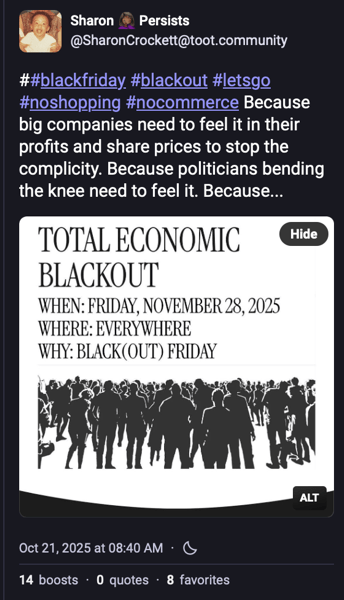
Then this morning on Mastodon I see this post from SharonPersists. 

CleanShot 2025-10-21 at 09.23.08@2x.

I’m glad my brain isn’t the only one where these kind of thoughts are rattling around.

I’m sure there would be all sorts of friction given that this would be over a holiday weekend geared towards family and giving thanks. But I can’t think of a better time to turn it all off, spend time with family and friends, and possibly build on the momentum of other protests.

One way or the other this situation is going to require sacrifice before it comes to whatever end it will eventually come to. The only real choice we have is to make that sacrifice willingly, or have it continue to be thrust upon us.

I think of all of the Thanksgiving Day holidays in which I was producing and directing Charles Dickens’ A Christmas Carol. After each performance I watched families leave filled with the Christmas Spirit, only to have that merely be a passing moment in time when the message didn’t stick. We need to find some way that sticks.

I’ll be emailing organizers about this idea. I hope you might do the same.

You can also find more of my writings on a variety of topics on Medium at this link, including in the publications Ellemeno and Rome. I can also be found on social media under my name as above.

Social Media Stewing in the Stewpot

Social media, like everything else, is in a state of flux.

Social Media is having another moment. Social Media has many of those. This one is in the wake of the historic U.S. election and a largely a delayed reaction to Elon Musk’s raping of what used to be Twitter, pro-Trump propagandizing, and general infantile behavior. That last comment was not intended to insult infants. They know no better.

Shutterstock 2454780715.

Certainly it cuts deeper than that. But not by too much. Since Musk’s takeover of Twitter it has largely become a stinkier cesspool than it already was pre-Musk. Now, it’s overrun by frat boys, tech bros, and Nazis, all far too eager to rape and pillage as Twitter/X barrels down a path to becoming State Sponsored Social Media. That would be ironic if irony applied to anything on the Internet and in politics these days.

Since the takeover, there have been at least three massive migrations of Twitter/X refugees that would make a human trafficker lust with envy for the business. The first came in the days leading up to and after Musk’s takeover. Most of those folks headed to Mastodon at the time. But, for quite a few Mastodon offered too many hurdles, too much policing, and too little inclusiveness to overcome their quest for Social Media solace. But quite a few stuck.

Then there was Threads, the Mark Zuckerberg empire’s attempt to swipe back at Musk. That too pulled in a rush of users, at least initially because you could import your entire Instagram graph. That could and should have been an early warning sign.

What was funny to watch in that migration was how conveniently many who had been pounding Zuckerberg as an Internet devil in the Meta hellscape, quickly developed amnesia and jumped on board. But Threads began to lose luster, when it became apparent that producing, sharing, and viewing desired content (most of it political and news) became secondary to Meta’s commercial needs. Again, that should not have been a surprise.

And in this latest chapter there is yet another shift to yet another social network, this time BlueSky.

This last migration to bluer skies is both yet another reaction against Twiiter/X and also the increasing dissatisfaction with Threads. There are reports that Mastodon is also seeing a smaller wave of newcomers or returnees. Regardless of platform, returnees is a key. When a new service, in this case a social network, is launched, there are quite a few who sign up simply to reserve their name or handle on that service, assuming that at some point their followers will, well… follow them there. Some try it out and stick, some move on, perhaps to return at a later date.

To be clear, I’m on Mastodon, Threads, and Bluesky. (Yes, those are links to my profiles on each of those services.) I stopped participating on Twitter during the first big migration, though I kept my account active for a period of time before finally deactivating it. I am one of those who will grab my name, (I always use my real name), when a new platform debuts and it is littered around more Internet services than I can remember.

If I had to choose one social media platform today I’d choose Mastodon. I’m comfortable there, and that will probably be my downfall. So I continue to actively explore because I don’t think there’s anyway to predict how any of this will evolve. Ask anyone who proudly proclaimed with each new app that they were replacing the Twitter icon on their home screen with Mastodon, then Threads, now Bluesky. Always a good laugh. Infatuations are always infinite entertainment.

Know this. For one reason or the other all of these services will end up disappointing users at some point in the future.

Here’s the thing. The story we’re living through has been repeated many times on Internet platforms other than social media and in social spheres other than the Internet. Folks find an app or a service they like. The business of that app or service changes hands when the original owners cash out (nothing wrong with that), or choose to pivot in different directions. Customers show their dissatisfaction and move on. Nothing is forever in life. The distance between now and forever is even shorter in Internet time.

Why is social media so attractive an addiction?

Being on social media is largely a performative gesture. If you’re going to participate, as opposed to just lurking and following, you’re choosing to share what you think or feel, in and of itself, quite a bit like performing. Some do it as themselves, some adopt personas.

If you rub digital elbows with celebrities, sports heroes, and other favorites, you get to bask in their spotlight while pretending that you are actually communicating with those larger than life folks with large followings. Think of it has having a backstage pass. You’re part of the entourage, part of the show. At least in your mind. And like all performers that’s where the juice is juiciest. In the little theatre or grand stages of their own minds.

But, the minute you step on any stage you also open yourself up, and become vulnerable to judgment, criticism, and yes, ridicule and possible abuse. Willing to share, many recoil at the responses that can come flying back their way, yet some thrive and build lucrative lifestyles from it. To say you need a thick skin and not care oversimplifies and understates the paradox. Protestations aside, (“I don’t read reviews”), all performers care. Even stating you don’t care is an act that shows how much you actually care.

Reacting to Reactions

Everyone wants whatever new social network pond they are swimming in to be either what TwitterX was before Musk, or anti-what TwitterX became. Everyone also wants their pond to be just the right temperature and free from scum. Except of course the scum. There will always be scum no matter how many ways of blocking or muting a network can provide.

Variety may be the spice of life, but there’s also a healthy clamoring for all of these new networks to work together. Protocol debates are heating up and some interesting solutions for cross pollination are buzzing about. Quite honestly I hope whatever we end up with will be something different with distinctions with differences among them.

I don’t expect any of these social networks will find ways to escape, or be free from whatever you, I, or someone might consider bad or wrong behavior. You would have to get rid of humans to do that. (Maybe we’re heading that way faster than we think. *Cough* AI *Cough*). There are new features in all of these newer networks that are reactions to how things sunk so low on Twitter/X. Call them reactions.  Every action may have an equal and opposite reaction, but that’s a  cycle that never ends.

Why we should have an expectation of a safe and conflict free “social” network when we live in an age when we can’t expect that at a sporting event, a church, or a family holiday gathering is beyond me. I’ve always viewed social media no differently than I view any other social interaction, there’s just a safer illusion of freedom when you’re behind a keyboard and not face to face. Remember, TwitterX had its bad actors even when it was in its prime.

Real Time

Bad actors notwithstanding, there will never be another Twitter/X-like social network that resembles what it was in that heyday. Those days and that utility are gone. In my feeds I could get real-time local news, as well as real-time news from around the planet. I could communicate with companies I did business with, promote my own, and receive technical support, (remember ComcastCares and Frank Eliason?) There was also great fun to be had reacting online in real-time to sporting or current events.

The key to all of that was the real-time or near real-time utility of Twitter. Currently none of the newer networks comes close to that. I doubt they ever will.

Bluesky looks like it might have the best chance of achieving some semblance of that real-time utility, but it’s early and it has a ways to go before any determination can be made. What is obvious is that Bluesky has put up enough of a threat to Threads, which seems to have no interest in anything approaching real time, that Meta is making rapid changes signaling they are feeling the pressure. All that means is we’re going to see some bursts of activity and change as competition, perceived or real, heats up. In real time.

What was Twitter/X wasn’t built in a day and just like everything else happening in the world we’re in a period of transition without knowing, but perhaps fearing, what we’re transitioning to. So, it is wise to be skeptical.

Far be it from me to tell anyone where to consume  or perform on social media. I’ll continue to explore what’s out there, because one way or another we’re heading somewhere different, perhaps faster than we could have imagined a short time ago.

Pick your poison.

You can find more of my writings on a variety of topics on Medium at this link, including in the publications Ellemeno and Rome. I can also be found on social media under my name as above. 

Croissant is a Treat for Social Media Cross-Posting

Croissant is a sweet and simple app for social media cross-posters.

With the social media world still very much atwitter and scattered among various platforms in the wake of Twitter’s destruction at the hands of Elon Musk, some users like myself traverse across the multiple platforms seeking to replace it. That’s all well and good as far as it goes, but it presents a first world problem of having to post separately for those who do.

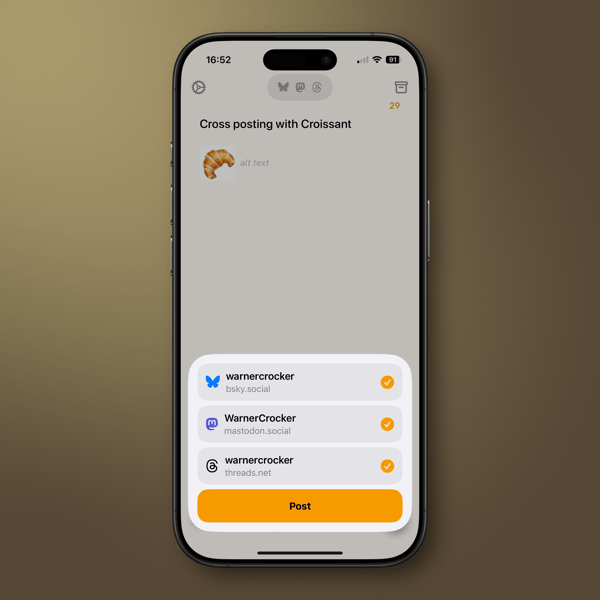
To the rescue comes Croissant. A lovely little app from indie developers Ben McCarthy and Aaron Vegh that simplifies cross-posting to Mastodon, Threads, and Bluesky. While there are promises a plenty of interactivity via ActivityPub, that’s still by and large a waiting game. I also don’t think buying into a protocol will be the simple answer most think it will be for differing complex platform agendas. Meanwhile Croissant serves up a tasty treat for cross-posters.

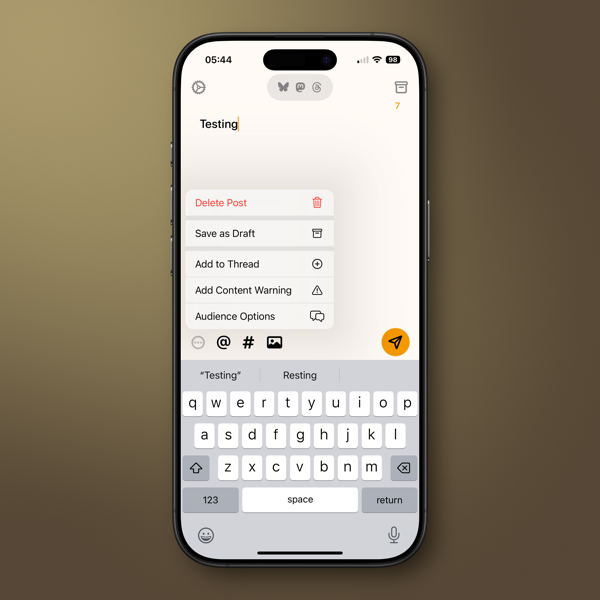
In this first version the action is sweet and simple as is the design. Feed in your account credentials and cross-post away. You can add photos, hashtags, and you can tag someone in your post assuming you know their handle and it’s the same across multiple platforms. Swipe right to delete a post, swipe left to create a thread.

You can choose to spill out your toots, threads, and posts to all three, or pick and choose where each pearl of wisdom drops. You can also save drafts and create threaded posts. For those who manage multiple accounts on any of the platforms it provides a one-stop solution. Croissant also delivers the now table stakes of different color schemes and your choice of icons.

I’d like to add more to this quick review, but there’s no need. In its first iteration Croissant does what it does simply enough and that is its elegance and its utility. The developers have a road map for adding new features in the future, but I hope hanging on to the “buttery smooth” simplicity remains a priority.

You can find more of my writings on a variety of topics on Medium at this link, including in the publications Ellemeno and Rome. I can also be found on social media under my name as above. 
.

Sunday Morning Reading

Happy Christmas Eve! Sitting here away from and missing home, waiting for the clock to run out on my COVID quarantine (so far a very mild case). Life hits. You take the punch. You move on. So moving on, here’s some Christmas Eve Sunday Morning Reading to share.

Kicking off with a couple of pieces from one of my favorite writers, David Todd McCarty. First up for those into the holiday gift giving thing he offers The Ol’ Bowling Ball Bag Gift. 

Following that with another holiday themed piece about how small moments with a family can turn into life long touchstones in We’re All Tired, Dear.

Keeping in the holiday vein, Megan Angelo gives us My Selfish Christmas Tradition—And How You Can Do It Too.

Christmas is a time for new smartphones. NatashaMH takes on what happens if you lose your new precious in A Slave to The Machine.

Stepping away from the holidays for a bit, David Pierce has an excellent piece on The Fediverse entitled 2023 in Social Media: The Case for the Fediverse.

And just to keep things real amidst the holiday hoopla, Rogé Karma takes on Private Equity, one of the several unseen dangers lurking in our midst in The Secretive Industry Devouring the U.S. Economy. 

To close out back to the holidays spotllighting an Icelandic folk tale of Jólakötturinn, The Yule Cat that eats children who don’t wear the new clothes they received on Christmas. Guess you better don those new socks tomorrow morning.

Merry Christmas and Happy Holidays!

If you’re interested in just what the heck Sunday Morning Reading is all about you can read more about the origins of Sunday Morning Reading here.  You can also find more of my writings on Medium at this link, including in the publications Ellemeno and Rome.

Why and How I Use Mastodon

We’ve just marked the anniversary of Elon Musk purchasing Twitter. You could call it the beginning of the end. Many see it as a dark day. I’m just the opposite. Musk buying Twitter and then selfishly and sadistically delighting in destroying it will probably go down in history as one of the best things that could have happened to and on the Internet. And perhaps civilization. Maybe not. Regardless, Musk jolted folks out of complacency and into a self-reexamination that in my opinion tilts the scale of humanity to the better side.

We’re a year into whatever this moment is or will be and it’s been a bumpy ride. Like many of those who saw what was coming I began looking for a new social media home. I’ve tried out most of the social media alternatives that have sprung up. Currently I’m on Mastodon, Bluesky and Threads. You can also find me on Facebook, Instagram and a few other places. Regardless of the digs, my shingle is my real name. But where I feel the most comfortable, most informed, most entertained, and most aligned is Mastodon.

Mastodon 499561363 5a033703845b34003865fec8

Welcome to the land where Mastodons roam. Here’s why and here’s how I use Mastodon.

Of the many things I’m interested in I like to keep current with events. I like to discover new things. News, yes, but not just news. Every day I learn something new is a good day is not only my mantra but it’s why my two great passions in life, making theatre and playing with technology, keep me going. I also love to share discoveries. I’m a theatre director. I share stories that others write. I write the occasional one myself. So, yes I’m a storyteller but also a story sharer. Combine all of that into a mix and I think that’s why the Internet should exist. And for me, that’s why social media as a construct works. Here’s the bio I use on social media websites:

Gadfly. Flying through life as a gadget geek and theatre artist…commenting along the way. Every day I learn something new is a good day. Boosts offered without endorsement. Comments on the other hand…

When it comes to comments and opinions I’m an opinionated SOB. I’ve got enough mileage on me to not give a damn if you disagree with mine, but to respect that you have one. Even if you’re wrong. I find humor and sadness to be two sides of the same coin. Pain and joy the same. I wish we lived on the edge of those coins more than we’re able or comfortable with. Because the highs and lows of life really are on the edges. Not on flat surfaces lying on flat surfaces held down by gravity.

Mastodon was and is a reaction to the evolution and destruction of Twitter. I first opened a Mastodon account long before Musk mucked up his new joint. But I didn’t really start using it until I was a part of the first big wave of Twitter refugees looking for a new place to do the things social media does for me. Mastodon, a year into regular usage does that.

Now let me be clear. In my view the success or lack thereof of any congregation depends on the users and those who own or control it working in tandem. Users are like having employees. The minute you have one employee you have an employee problem. Given Mastodon’s place in the larger Fediverse and the large number of federated servers, many with different rules of the road, I’m amazed things seem to have settled in they way they feel to me. There have been some hiccups, and moments of angst, but the folks I’m following and who follow me seem to be the sort of characters I’d like to hang out with in a bar. I’m constantly exposed to new thoughts, new things, new people and I feel like what I share is generally welcomed, agreed with or not. There are very few days when I feel I haven’t learned something new.

Is it a place just for like-minds? Maybe. Time will tell. But I think not exclusively. Witness the discussions currently as the world is experiecing the trauma in the Middle East. There’s tension. And it’s real. There’s divergent views. How could there not be? If there’s common ground it’s one that feels grounded somewhat in respect. I could be wrong, that could change, but that’s how I feel it at the moment.

Do I think that will last forever? Not on your life. As far as Internet gathering places, and I’ve gathered at a bunch from BBS’s to forums to chatrooms to where we are today, they always end up changing. Typically for the worse. Users and waves of users come and go. Things change. Such is life.

So that’s the WHY. Here’s the HOW.

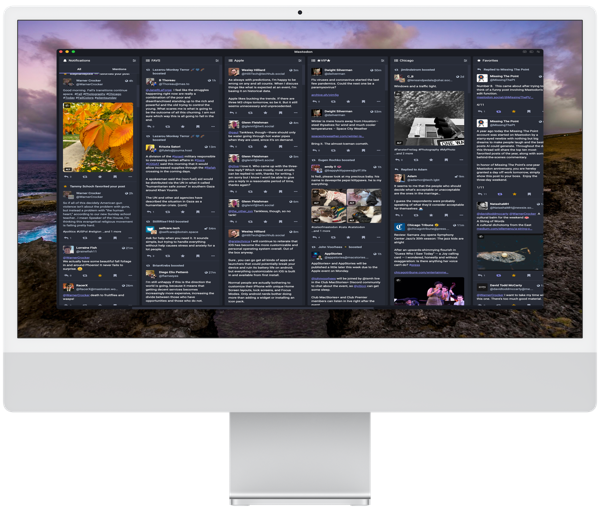
  • The key for me is Lists. I follow a ton of folks and interests. Trying to keep up in my Home feed is almost, but not quite impossible so I rely on separating areas of interests into Lists. I break my key Lists down this way:
  • Favorites: People and interests I want to keep up with in general
  • VIP: Folks I want to see every thing they toot.
  • Apple: Apple (and other) tech journalists, geeks, and developers I want to keep an eye on what they’re working or reporting on.
  • Chicago: Folks and topics from where I live.
  • Old People of Mastodon: Folks like myself that have accumulated some mileage. That list is generated via a hashtag.
  • Lisa Melton: This prolific booster has her own list and it’s through her generous sharing I discover so many new folks and ideas. I can’t imagine Mastodon without her.
  • Laffy: The best person to follow for up to date poltiical news, especially during our current lifetime of legal linguini. If I need a quck catch up on the day I can without fail catch up by viewing this List of her toots.

I also have lists for Science, Photography, Theatre, and the Arts. These I follow as hashtags. I create others as I discover things of interest I want to follow.

Within that VIP List I have a select few folks I’ve set up Notifications for. Meaning if they toot I’m going to see it on my iPhone or my Apple Watch.

On the Mac via the web I use the Advanced Web Interface mostly because it constantly updates the number of columns I’ve chosen. Occasionally I’ll use Ivory. I’d use it more if it updated continuosly. (Can you tell I miss Tweetdeck?)

IFrameScreenshot  10 29 23 12 30

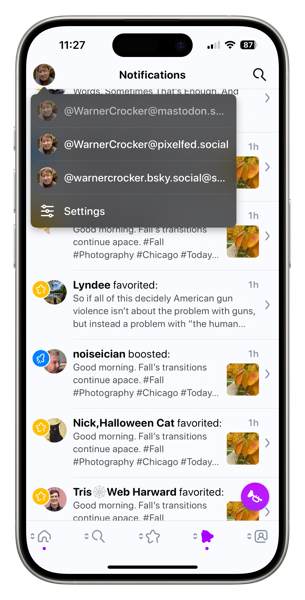
On iPhones and iPads I’m using a combination of the apps Ivory, IceCubes and Mona. I like to vary things up a bit. Ivory is my go to on the iPhone but there are things I like about IceCubes and Mona as well. Mona is my go to on the iPad. I like its handling of columns the best on that device.  With Ivory on any of those devices I can also keep track of and post to my acounts on Bluesky and Pixelfed.

IFrameScreenshot  10 29 23 12 39

I have an older Android phone for testing some things out and I use the app Trunks on that device.

On my Apple Watch I use the excellent app Stomp. I don’t spend much time with it (or any app for that matter) on the Apple Watch, but if I’m out and about and I get a notification from someone on my VIP list, it’s a handy way to quickly glance at what they’re tooting about.

StompAppleWatch

I use Hashtags a lot and find them handy if I need to search for something. Being able to follow a Hashtag and pin it to a column in the Advanced Web Interface is a real plus. I also use Favorites and Bookmarks to keep track of toots I may want to refer back to. Favorites is also a great way to acknowledge someone else’s toot. I try to do a toot each week sharing new folks I stumble across.

And yes I refer to what people put on Mastodon as a “toot.” I understand some despise the use of “toot.” Get over yourselves and welcome some whimsy into your life. (Told you I was opinionated.)

So there it is. The Why and How of why I enjoy Mastodon and spend the overwhelmingly majority of my social media life on that website. As I said, I’m also on Bluesky  and Threads. I’m not sure Bluesky knows what it wants to be any longer, which is probably why I can’t figure it out either. I’ve still got some invites for Bluesky if you want to try and figure it out. And Threads is having a bit of of a social media moment, currently gaining traction among a new wave of refugees from Musk’s mayhem. What’s funny to have witnessed on both sites is the exact same series of new user reactions as I witnessed on Mastodon.

Here’s the script:

This place feels so much nicer. 

There’s no nazis here.

Where is this feature?

I’m having a hard time getting my followers to move here.

I miss my “whatever number of followers” from Twitter but the engagement is better here.

Block liberally. We don’t want this here. 

I’ve replaced Twitter with this app on my Home Screen.

I’m not contributing on Twitter any more except to tell my followers I’m here.

I’m not contributing on Twitter any more except to check in now and then. Boy has it gotten worse.

I’m not contributing to Twitter any more and I’m thinking of deleting my acount. 

This is why I deleted my account on Twitter. 

Which in the end points out that the only thing that separates social media interaction from the local bar or diner, the church recreation hall, or any place humans gather is use of the Internet. To each his/her own. At the moment I feel like Mastodon is the place I want to hang out for a few drinks and enjoy some fellowship. I’ll continue to visit others and participate there as well. Because you never know when someone’s going to come in and wreck the joint.

Oh, and you can find me at Mastodon here. 

Sunday Morning Reading

A few loose threads in this edition of Sunday Morning Reading. Yes, that’s a bad attempt at headlining what’s going on in the social media universe after the release of Threads by Meta. But hey, if you’re interested there’s also pieces on our inevitable extinction driven by our pursuits of pleasure along with a piece of how we can possibly slow down aging.

Threads

We seem to want everything to replace everything else when something new happens. Watts Martin takes on Threads vs Mastodon in You’re So Vain, You Probably Think This App Is About You: On Meta and Mastodon. 

Scott Galloway also takes on the Threads thing in Threadzilla. Good read for context and what’s going on in the moment.

And while not exactly Threads related but certainly Threads adjacent, David French has an excellent piece about how Twitter Shows, Again, the Failure of the New Right’s Theory of Power.

And to move away from Threads, did you know The Pursuit of Pleasure Could Doom All Intelligent Life To A Bllissful Extinction?

But not to worry about extinction. Go ahead and pursue pleasure. Madeline Fitzgerald tells us that Harvard Researchers Claim They’ve Found the Chemical Cocktail That Reverses Aging.

And back on the Artificial Intelligence beat, here’s a bit from Benji Edwards on Why AI Detectors Think The US Constitution Was Written By AI.

If you’re interseted in just what the heck Sunday Morning Reading is all about you can read more about the origins of Sunday Morning Reading here.

Sunday Morning Reading

It’s been a week. But they usually are. I don’t think there’s a theme to this week’s Sunday Morning Reading other than that things continue along the same path of craziness that for some reason we just continue to accept as somehow normal. So perhaps it is.

Unknown 2

Kicking things off is a great piece by M.G. Siegler about the Elon Musk and Mark Zuckerberg let’s have a cage mage nonsense called These Used To Be Serious People. I think that title could be applied to just about any field of human endeavor in this current moment.

Moral Panic? Mabye. But then maybe you’re just in a moral panic about moral panics. Interesting read from Pamela Paul.

Annalee Newitz says Ben Franklin Would Have Loved Bluesky as Twitter and Facebook lose ground to federated platforms. She says we’re in a social media era of chaos that sociologists woujld call a “legitmation crisis.” While the title uses Bluesky and Ben Franklin for attention grabbers she burrows down a bit into how the decentralization desires for some in social media, government and life tend to get thwarted by money. She goes deeper than that in a worthy read.

And speaking of money making the world go around Emma Roth says the FTC wants to put a ban on fake reviews on Amazon. Pick your favorite metaphor for being late to the party and good luck with that one.

A couple of interesting reads on so-called Artificial Intelligence. First up is The Age of AI: Everything You Need To Know About Artificial Intelligence by Devin Coldewey. Good explainer. I’m not sure if an AI bot could have done it better or not.

And Casey Newton says The AI Is Eating Itself. I’m very much in line with his thinking here.

Did you know that Samuel Beckett and Buster Keation collaborated on a film? They did. Thomas Leatham tells us about it in The Film Created by Samuel. Beckett and Buster Keaton. You can check out a small clip of it in the article.

And to wrap things up this week here’s a bit of fun and curiosity. Jisha Joseph highlights an interesting bit of Victorian news and comedy commentary from Tit-Bits Magazine:

a competition that offered a reward to unmarried women who could provide the best answer as to why they were yet to find themselves a husband. The page-full of responses published on April 27, 1889, made one thing abundantly clear: Women in Victorian England had a badass sense of humor.

If you’re interseted in just what the heck Sunday Morning Reading is all about you can read more about the origins of Sunday Morning Reading here.

Apple’s Design Trap

There’s an excellent discussion about design vs practicality going on currently within the Apple community that gathers around the Mastodon water cooler. It was kicked off by Matt Birchler responding to a post from Daring Fireball’s John Gruber commenting on how far ahead third party iOS apps for Mastodon were than those on the Android platform. Birchler filled out his thoughts in a post called The Shocking Stage of Enthusiast Apps on Android.

John Gruber continued the thread on Daring Fireball with an excellent post called Making Our Hearts Sing. That in turn prompted Frederico Viticci to pen a post on MacStories called The Practicality of Art in Software. I’d highly recommend you read Matt, John, and Viticci’s posts.

Beyond a brief summary let me just say that I’m in profound agreement with each of the posts. There are differences in the arguments, but they all aim at the same larger point about Apple.

Yes, in my view Android apps for Mastodon pale in comparison to iOS apps. As backed up by my own experiences, I do feel the general design of Android apps also lack what Gruber calls “the artistic value in software and interface design” that he sees in iOS apps. AND, as Viticci says “As a computer maker or app developer, you have to strike that balance between the aspirational and the practical, the artistic and the functional.”

The two cents I’m about to add to the discussion isn’t in contrast to what these three have laid out. Like I said I’m in agreement with the points in each argument. Think of this as tangential to the discussion.

51199 101165 Stage Manager small windows xl

So here’s the tangent.

Design is key to any endeavor that’s creating a product. We can talk form following function, or practicality, or art for art’s sake. Doesn’t matter where you enter the discussion. It’s key. And the posts I’ve mentioned above do an excellent job of hitting those points.

Apple has captured, captivated, seduced and perhaps suckered many of us with its approach to the design of its products. In my opinion I think they’ve largely succeeded. If you “think different” then I won’t question your taste, but I’ll just acknowledge that we sail on two different oceans. That said, Apple is also masterful in the design of the marketing and rollout of products. In many ways the product and the marketing of the product are inseparable.

But I think Apple has designed itself into a predicament in the same way many tastemakers do. Once you embody an asthetic and it becomes not only your brand but your essence you create almost impossible semiotic expectations. You’re no longer designing just your next creation, you’re designing to meet the expectations you’ve created. It can be a trap when you follow that path OR if you deviate from it.

And that’s where the trap gets tricky. Be real with me here. When you see amazing and beautiful screenshots of a new app I’m sure you’re often as tempted as I am to push the Buy button before you even read and understand the description of what the app offers. Especially if the App is from a developer you’ve had good experiences with in the past. It’s no different than following any other artist in any other medium. Favorite singer, buy the next album. Favorite author, buy the next book.

Don’t get me wrong I’m not saying all app developers, Apple, or other artists are trying to pull one over on us. (I’m sure some are but that’s another topic for another day.) Using a combined appeal to our senses and our reservoir of good feelings from past experiences is what designing products is all about. The successful designers know just how to reach us and build a following. Some would call it maniuplation. They’re correct. The intent of most art is to maniuplate a response.

Take Weather apps for example. Goodness knows how many of those I tried just because those radar displays looked gorgeous in screenshots. The well worn cliché of not buying a book by its cover certainly applies to App marketing and we all know how clichés get started.

And then there are the artists and designers that break the mold. Try something new. Take a different, sometimes radical approach. That may work in the long view once a more full body of work can be viewed from a distance. But it’s risky in the immediate market of expectations, which is why its viewed as a departure. But strike gold and the risk can pay off.

Play to our attactions to the pretty. The shiny. The well designed. The well packaged. Play to our desires for something familiar while yearning for something new. Create tension with those competing desires and debut that “departure” inside a wrapping of the familiar and you get a double bang for the buck. And here’s where Frederico Viticci’s long, and well documented struggle with Stage Manager works so well as the prime example in this tangent.

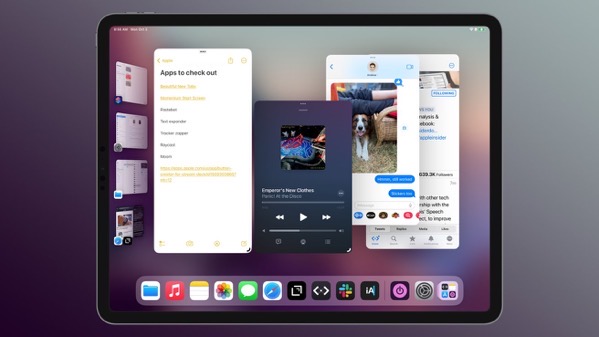
Stage Manager is Apple’s attempt at a windowing solution for iPads and Macs. iPad users have been yearning for a windowing or multi-tasking solution for awhile. What they’ve been yearning for is something most are already familiar with from experiences with laptops and desktops. Surely this would be beautiful in a “think different” sort of way. But not too “think different” in the practical mechanics.

If you’re an iPad user I am reasonably sure you were awed by the demo of Stage Manager when you first saw it. It looked magical. It looked magical in that Apple way. It looked like the solution many iPad users have all been waiting for. I know it did for me. And it was rolled out in all the ways we’ve all become accustomed to.

But the practicality of Stage Manager on the iPad largely failed to live up to the promise of those expectations once users got their hands on it. Frankly, I find it more than a dissapointment. But the design from demo to packaging of the idea was certainly alluring and seductive enough to get us (me) in the door.

I won’t go into the ways and wherefores of that beyond linking to Viticci’s excellent chronicling of his experiences. His feelings and thoughts are shared by me and many others.

So to wrap this up and get back to the points about design asthetics, practicality vs pretty, and Mastodon Apps on competing platforms let me say this. I’ve downloaded and followed the development of many of the iOS Apps for Mastodon. I’m genuinely excited by what I see and feel.  Although there are differences, some are starting to morph a bit into the same look and feel but the feature sets (currently) set them apart.

After giving a spin to some of the Android Mastodon apps I’ve been dissappointed in the smaller selection available and also the lack of strong design statements in those that do exist. And again, features sets give them distinction. I’m sure others feel differently and vive la differénce.

This difference though cements my thinking that the expectations and semiotic differences between Apple and Android design philosophies are  baked in at this point in the game. Apple has created such a deeper dependency on design prowess. Android’s “come as you are” approach leaves more room for less when it comes to the art of visual design. Fundamentally there’s nothing wrong with ether approach from a user perspective. Choose what you’re attracted to and have fun with your choice.

The larger and more precarious point with this tangent is that Apple’s rich design expectations, as powerful as they are, are also Apple’s Achilles heel. Great artists aren’t afraid to fail. Great product makers who use great art as a selling point need to tred more carefully to avoid the level of disappointment that can turn a legacy into a burden.

Tech Predictions for 2023

I thought I’d jot down a few tech predictions for 2023. So here we go.

There will be tech news in 2023. There will be grand promises and grander failures. It will be entertaining, a bit crazy, and ultimately meh as the latest in a round of bad bets come due or come closer to being so.

Apple will make a ton of money in 2023 even though some governments want to design products for them. Apple won’t have as easy a time of it as it has in recent years for a number of reasons including some self-inflicted wounds.

Artificial Intelligence will continue to be a dominant story until chat bots start writing most of the tech stories.

The Metaverse will further try to wriggle out of the pond with or without legs. With other companies jumping into the “let’s put an expensive, goofy-looking, headache inducing gizmo on your head” it will be one of the comic tech highlights of the next few years before this whole thing ends where it was always destined to: an enterprise play.

Cyrpto will continue to falter as the denizens of the latest refuge of scammers discover that they’ve sucked all the money they can from the available suckers. There certainly won’t be any Super Bowl commercials.

Streaming Entertainment will continue to figure out that they haven’t figured it out yet. Consolidation will begin in earnest, hopefully before the streamers cancel all of the shows.

Twitter. Who the hell knows. It’s owner sure doesn’t.

Mastodon and federated social networking will continue growing pains as it continues to grow and becomes less of a pain for new users to gain entry.

Humans. Humans will be the biggest tech story behind the stories that capture the headlines. The humans who create tech will continue to be in some form of tension with the humans who use it. Humans who do use tech will continue to look less and less for tech to solve their problems, understanding before tech creators that all tech solutions aren’t necessarily going to change the world.  At least until the tech creators understand that they need humans to talk to humans to help them solve the problems with the products they create. Or until the robots show up.

Where the Mastodons Roam

So I’m hanging out on Mastodon these days. It’s the social networking site that quite a few folks have found to continue their social networking addiction, thanks to Elon Musk’s behavior as the new owner of Twitter. So far I’m liking it quite a bit. Scratch that. I’m liking it a lot. So do many of the folks I’m hanging out with.

If you’ve come to this blog post from Mastodon you’ll recognize most of the things folks are saying in my thoughts. Yes, it’s more civil. Yes, the Mastodonians are working hard to keep it that way in reacton to the Musk melon’s mucking up the joint. Yes, it’s not Twitter. Yes, the engagement is richer. And yes, it’s fun.

I’m here to tell you that I haven’t had as much fun with an Internet thingie since, well… since Twitter first came along.

While Mastodon has existed for awhile (I first staked out a piece of turf in May of last year), it picked up a fast blossoming head of steam once Musk’s purchase of Twitter went through. That momentum seems to be continuing. And those who’ve set up shop in these recent waves of refugees seem to be enjoying themselves as much as I am.

In addition to hanging out there it led to this blog. I stopped blogging and writing on the Internet primarily due to Twitter’s existence. I’m not alone in that. But as Mastodon is gaining in popularity, there appears to be a parallel resurgence in personal blogging. That urge hit me as well and here we are.

Twitter may have turned into the place of “owning” someone with a witty response, but “being owned” accelerated into a whole new nasty meaning in the last few months. So, Mastodon or no, it was time for a change.

For those who don’t know, Mastodon is set up as a decentralized network where no one person has control or ownership. It exists in a place(?) called the Fediverse. There are many Instances (or servers) where folks can find a home, and those Instances are interconnected through the Internet. If you’re not paying attention to that structural distinction Mastodon feels like a similar experience to Twitter. I’m reasonably certain that Mastodon will run into some issues down the road given its structure and philosophy. But that’s for another day.

There are other types of services in the Fediverse as well. Pixelfed is an Instagram-like service Yes, I’ve staked out a spot there as well, though I’m not that active currently. And if you’re starting to sense that these services on the Fediverse sound reactionary, then you’re correct. I’ll probably spew out some words on that in the future.

But for the moment I’m enjoying that fun I referred to earlier. Not only is the service new (we all like new things and self-validate our new choices) but the energy in the eco-system surrounding Mastodon feels very much like the days when mobile tech exploded after the launch of the iPhone. I’ve tried out more new apps in recent months than I have in the last couple of years. I’m re-discovering folks who I followed but somehow lost sight of on Twitter while discovering new folks in abundance.

So, if you choose to visit this blog you’ll be hearing more about Mastodon in the future. If you choose to find your way there you can check me out at this link.