Death By Lightning: A Mini-Review for a Mini-Success

Music, fighting, sausages

Candace Millard’s excellent non-fiction book Destiny of the Republic: A Tale of Madness, Medicine and the Murder of the President is often overlooked, though it was well received well when it debuted in 2011. I’m hoping that the new Netflix adaptation titled Death By Lightning will give Millard, her book, and the period of American history it chronicles more well deserved and appropriate notoriety.

Death by lightning.

Yes, this is one of those many cases where the original source material far outshines the film/TV version. That said, Death By Lightning is worth a watch, if nothing else for an entertaining opportunity to dip your toes into the historical waters that are still affecting much of what we’re wading through today in an age when those in control are so eager to pour cold water on the pieces of history they don’t like.

More to the point, Death By Lightning touches on a piece of history from a tumultuous time that seems largely forgotten, that we perhaps might have learned better from, even before we got into this current mess. A poignant, late scene sets this up wonderfully.

Created by Mike Makowsy and directed by Matt Ross, Death By Lightning is a limited Netflix series, that chronicles the unlikely rise of James Garfield to the presidency and his assassination by Charles Guiteau. (If you think anything in this brief review is a spoiler it proves my earlier point.)

There are four episodes and in the end that’s part of what weakens the series as it doesn’t allow much time for much of the depth of Millard’s book. Towards the end it feels like it’s rushing to a conclusion, leaving me wondering how much got left on the cutting room floor or chucked away in the C-suite.

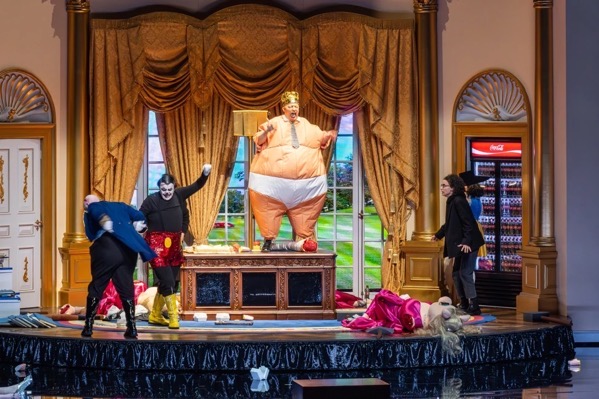
An excellent cast largely rises to the occasion featuring Michael Shannon as Garfield and Matthew MacFadyen as an over the top Guiteau. That said, Guiteau was apparently quite over the top in real life according to many accounts, so much so that there are so many accounts. They are well supported by Betty Gilpin, Shea Whigham, Bradley Whitford, and especially Nick Offerman in a scenery and sausage chewing turn as Chester Arthur, who succeeded Garfield.

One of the wonders of Millard’s book is that it featured an intersection of so much of American life at the time following the Civil War, from politics to science and medicine. The battle between the politics of the spoils system and a desire for a less corrupt civil service system is well chronicled in both the book and the series and adds interesting context to our current tariff tangles that I’m guessing most will find surprising.

If you’re frustrated by recent happenings in our current day Congress and politics both the book and the series will add some historical (and often entertaining) context to the mess we’re in.

Less featured in the series are the conflicts in medicine with many American physicians of the day rejecting what had become largely accepted in Europe as a new approach to germs and sanitary surgical practices.  Not really a spoiler, Garfield was shot, but it wasn’t the bullet that killed him. He died from sepsis caused by infection due to unsanitary practices in the aftermath.  If you’re detecting hints of the medical madness we’ve been living through since the pandemic, you’re not wrong.

Alexander Graham Bell also makes an appearance with a new invention that could possibly detect the bullet lodged in Garfield’s gut, but the fuller story about his scientific advances and entrepreneurship, which runs on an almost parallel path to Garfield and Guiteau’s in the book, is mostly left as a footnote in the Netflix series.

Again, it’s by no means a perfect piece of streaming entertainment. I highly recommend the book on which it is based and I would mildly rate it better than most of the mundanity that fill our screens instead of the lists we curate. The cast and the exposure to a forgotten moment in American history that I’m certain many have no clue about makes it a good candidate for your watch list.

Besides just getting a chance to see Nick Offerman toss out the line, “Music, fighting, and sausages” is worth the time spent.

You can also find more of my writings on a variety of topics on Medium at this link, including in the publications Ellemeno and Rome. I can also be found on social media under my name as above.

Sunday Morning Reading

Politics, the arts, a little snow, and the end of an era

It’s a Sunday and Fall is homing in on Winter as the first snow of the season hits Chicago this morning. Perfect time for a little Sunday Morning Reading featuring some interesting stories about the arts, AI, and home.

As the first flakes of this winter of discontent fall, two interesting reads highlight some of the chaos the art-less U.S administration is inflicting on the American arts scene, specifically The Kennedy Center. Shawn McCreesh takes a look at the damage being done in The Kennedy Center Crackup.

Meanwhile, Charlotte Higgins reports that the Washington National Opera May Move Out Of The Kennedy Center Due to Trump ‘Takeover.’ I’m here to tell you that while what’s happening on the banks of the Potomac may feel very inside the beltway, the repercussions are being felt in the boardrooms of arts organizations across the country.

The above, like most of our news of late, is certainly not something to laugh at. That doesn’t mean we shouldn’t find ways to laugh at the incompetent, ignorant and dangerous players wreaking havoc in their wake. Laughter gets under their all too thin skins, no matter how made up or stretched too tight by surgery. Mike Monteiro offers up How To Point At Fascists And Laugh.

NatashaMH, far too young to worry about being old, takes a look at creating art as she nears the mid-century mark in I Don’t Paint For Your Sofa. Youngsters these days.

Art and politics might be an unholy mix in dangerous times like these, but there’s another foul concoction brewing. Adam Willems points to An ex-Intel CEO’s Mission To Build A Christian AI: ‘Hasten The Coming of Christ’s Return.’ If you ask me these folks wishing for these kind of end times have really missed the points. All of them.

Continuing on the AI front there seems to be a bit of weakening in the walls of what most concede is an economic bubble. The cliché is that bubbles pop. Those that don’t, just disappear as they float away. Ben Thompson takes a look at what happens in either case in The Benefits of Bubbles. 

Home is where hearts are and often places you can’t return back to. I’ve lived both. Chris Andrei is Searching For The Elusive Feeling Of Home.

With the weather changing and snowflakes falling out my window, there’s a passage of time marker about to be set. The Farmers’ Almanac is about to shut down. Growing up in rural America there were only two publications that everyone I knew received in the mail. It was always a big deal in our house when my dad, who was the postmaster, brought those home. The Sears Catalog and The Farmer’s Almanac. The Sears Catalog is long gone. The 2026 edition of the latter will be its last. Grace Snelling takes a look back and ahead in After More Than 200 Years, The Farmers’ Almanac Is Shutting Down For Good. 

Returning to where this week’s column began, the arts, Jack Rodolico’s The Blue Book Burglar examines how New York’s once vaunted Social Register, was not only a destination that social climbers desired to be included in, but was also a hit list for the country’s hardest working art thief. I just don’t understand how the current thieves doing today’s pillaging have it so damn easy.

If you’re interested in just what the heck Sunday Morning Reading is all about you can read more about the origins of Sunday Morning Reading here. If you’d like more click on the Sunday Morning Reading link in the category column to check out what’s been shared on Sunday’s past. You can also find more of my writings on Medium at this link, including in the publications Ellemeno and Rome.
Sunday Morning Reading

Balancing on the edge of a coin

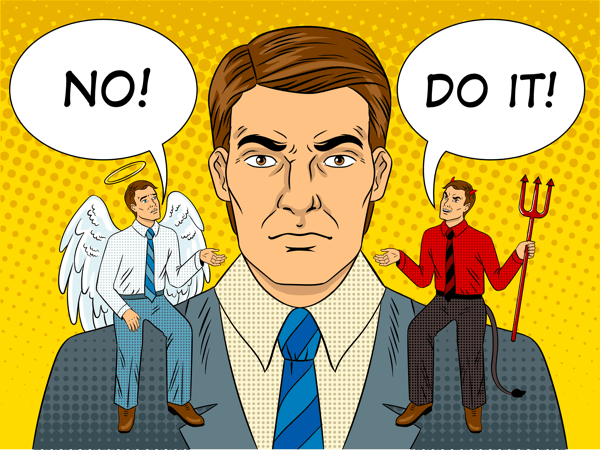
Regardless of the many problems with the Internet, there’s no denying its benefits. One of those is the pleasure of reading stuff I probably would never be aware of without it. In many ways that’s what this Sunday Morning Reading column is about (as well as my life in general on the Internet.) When you read and live life enough, you discover that the trick is always balancing on the edge of the coin that separates the two sides.

There’s comfort perhaps landing on one side or the other, but life is actually in the fragile middle of the muddle somewhere, even if it’s a fine, and increasingly thinner line, often hard to discern.

Shutterstock 2408853287.

First up this Sunday is a piece by Josh Marshall of Talking Points Memo called Fear, Greed, Civic Virtue and the Fall of the Elites. Pay attention to that word “virtue.” As Marshall points out it originally meant “manliness.” The word’s evolution is as tricky as the concept itself.

Follow that up with Ian Betteridge’s The Politics of the Missing Middle.

Ian Betteridge’s law of headlines that says any headline that ends in a question mark can be answered with the word “no.” Steven Levy falls into Betteridge’s trap in his piece, Can AI Avoid The Enshittification Trap? Cory Doctorow’s theory of Enshittification has been a popular topic in this column and Betteridge’s law certainly applies here. For those looking for a primer on enshittification Greg Rosalsky has a a quick primer on the topic in A Theory Why The Internet Is Going Down The Toilet. 

While technically not falling under the umbrella of enshittification, some of the ways folks are using AI sure sound shitty. Check out Alexandra Jones’s I Realized I’d Been ChatGPT-ed Into Bed: ‘Chatfishing’ Made Finding Love On Dating Apps Even Weirder. 

Things are getting weird indeed. Adi Robertson tells us that The Next Legal Frontier Is Your Face and AI. 

Several pieces on the arts and creativity stood out to me this week. David Sparks’ The Inherent Value Of The Creative Act reflects on his creative life and his resistance to using AI for the work of creating, but it helps with his administrative tasks. There’s that edge of the coin again.

Authoritarians always target art and artists first. You don’t need an Internet to discover that history, or perhaps we might if the current forces in charge have their way.  Andrew Weinstein discusses Trump’s Campaign To Defund The Arts—and Rewrite History.

Speaking of creativity or rather the other side of that coin, Joe Rosenthal takes on Creative Neglect: What About The Apps In Apple? I mentioned some of this in a piece I wrote this past week.

Speaking of that edge and to close out this week, here’s an image of a Mastodon post by friend David Todd McCarty from this morning.

CleanShot 2025-10-26 at 07.29.46@2x.

(Coin Image above from ABARONS on Shutterstock)

If you’re interested in just what the heck Sunday Morning Reading is all about you can read more about the origins of Sunday Morning Reading here. If you’d like more click on the Sunday Morning Reading link in the category column to check out what’s been shared on Sunday’s past. You can also find more of my writings on Medium at this link, including in the publications Ellemeno and Rome.
Sunday Morning Reading

Reading for the morning after the No Kings rallies and beyond.

Good Sunday morning. This edition will be slightly different than most. Yes, there will be a collection of links I find worth sharing (and hope you’ll read). That said, most of the links in this week’s Sunday Morning Reading come from an excellent series in The Atlantic’s November 2025 issue from a collection of authors called The Unfinished Revolution.

Yes, that’s behind a paywall. Sorry, not sorry. But this is the Internet and if you’re not already paying for excellent content like The Atlantic, there are a million ways to skirt that restriction. The issue is one worth paying for, if for no other reason to keep it as an archive for future generations. That may prove important one day. I plan on picking up a hard copy soon enough.

The issue is also timely as this country approaches it’s 250th anniversary, and finds itself being torn apart by forces that, suffice it to say, don’t represent what many believe this country stands for, or at least the promise of what it should stand for, even with it’s historical problems and faults.

It’s also timely because we’ve just seen the second and larger No Kings rallies across the country. Given that the founding of this country was indeed the original No Kings protest that kicked off a revolution against rule by a monarch, the timing also feels apropos.

I won’t highlight all of the articles in the series, you should go and check them out yourself. The ones I do link to are ones I found particularly interesting. And yes, there will be other links in today’s Sunday Morning Reading as well.

Before I get to The Atlantic’s links, this article by Garrett Graff,  Three Reasons I Still Have Hope For America, is more than worth your time. I agree that there is strength in numbers, but I don’t think the inevitable passing of a leader this time around will have the affect the world has seen historically.

The title of Anne Applebaum’s Atlantic piece, The Beacon of Democracy Goes Dark, certainly tells you where the piece is going. Even so, it is more than worth reading and contemplating. One way or the other we are living through and participating in moments that will change the world. We just don’t know how.

We’re dealing with our own Mad King wannabe, so Rick Atkinson’s The Myth of Mad King George draws some interesting parallels beyond their affinity for makeup that I suggest could be similarly drawn behind most of the troubled men who’ve plagued the world throughout its history.

Political and social schisms divide not only countries, but often families as well. Stacy Schiff asks Why Did Benjamin Franklin’s Son Remain Loyal To The British?

Jeffrey Rosen says that insurrection has marred the American constitutional order since its founding. He’s correct. Check out The Insurrection Problem. If you’re not an American history buff, I bet you’ll be surprised.

George Packer thinks we do need patriotism in his piece I Don’t Want To Stop Believing In America’s Decency. I concur with his sympathies, but when the meaning of words like patriotism and decency can get so easily mangled it becomes trying to cling to those beliefs.

Fintan O’Toole asks What The Founders Would Say Now. We’ve imagined, conjured, twisted, and appropriated who and what they and their words are so often, that in my view I think they’d tell us all to either grow up or go to hell.

As most of this week’s Sunday Morning Reading and my own thinking has focused on the issues facing America as a whole, I found former NY Times drama critic Frank Rich’s piece on Zohran Mamdani and the New York mayor’s race fascinating. Not just for his at times surprising commentary on that race. But for those paying attention, Why Powerbrokers Got Everything Wrong About Zohran Mamdani incisively dissects the deeper fissures subsuming the bigger political picture as well.

And to close out this week, here’s a piece from 404 Media about the amphibian symbol that has become associated with our current protests against the administration, Matthew Gault’s The Surreal Practicality Of Protesting As An Inflatable Frog.

If you’re interested in just what the heck Sunday Morning Reading is all about you can read more about the origins of Sunday Morning Reading here. If you’d like more click on the Sunday Morning Reading link in the category column to check out what’s been shared on Sunday’s past. You can also find more of my writings on Medium at this link, including in the publications Ellemeno and Rome.

Sunday Morning Reading

Everything you can imagine is different, yet it’s the same.

It’s a Sunday. It’s a Sunday in Chicago. The Cubs lost. (Not surprising.) The Trump regime continues its horrendous snatch and grab policies all over the city (Increasingly not surprising but still terrifying.) Leaves are falling, but somehow they feel dirtier and without the bursts of color we’re used to seeing beforehand. And the world marches on. Time for a little Sunday Morning Reading. 

Neil Steinberg wrote a terrific piece about Chicago amidst all that’s going on called What A Lovely Day in Chicago. It’s a love letter. It’s an homage. It’s a snapshot. As he puts it “We need to remember that this is oppression for oppression’s sake, a practice built on lies. The city is fine.” That’s the odd thing. The city is fine. It’s the oppression that’s not.

Timothy Burke’s The News: Reign of Error expands on a piece by Henry Farrell that says that institutions and communities need to coordinate their resistance to Trump. As Burke puts it one of the obstacles is that “the closer that institutions get to one another in character and mission, and the less necessary it is to be competitive, the more that they are overwhelmed by the narcissism of small differences.” It’s an excellent dissection that reveals why some in higher places of different sectors might be holding their tongues while their mouths are agape at what’s going on around us.

Empywheel thinks The Nativists Are Getting Restless: How The Comey Prosecution May Backfire. I’m not sure it matters in the end if the point is do damage as loudly as possible.

David Todd McCarty asks the question Is Your Imagination Robbing You of Real Experiences? Cogito, ergo sum?

I wrote a play years ago about John Brown and Harpers Ferry, one of those moments in American history that we seem to want to forget, yet never goes away. Robert S. Levine tells us Why Donald Trump Wants To Erase John Brown’s Fiery Abolitionist Legacy (and Why He Will Fail.)

There was so much craziness about the Nobel Peace Prize this year given, well you know why. So much so that many of the other awards were overlooked. The Nobel Prize for Literature went to Hungarian author Lázló Krasznahorkai. I have several acquaintances who adore his work and were tremendously excited. I did some reading on Krasznahorkai and stumbled up on this 2011 piece by James Wood called Madness and Civilization about the author. Worth your while.

On the Artificial Intelligence beat, Sora is the latest thing everyone has an immediate love/hate relationship with. But this isn’t about that. Sarah Perez says It’s Not Too Late For Apple To Get AI Right. Frankly, I think it’s too late for any of these companies to get it right, unless “right” is about winning the con game.

Resting my case on that last statement, Alexandra Jones looks into the connections folks can’t make in real life and are turning to AI for in ‘I Realized I’d Been ChatGPT-ed Into Bed’: How ‘Chatfishing Made Finding Love On Dating Apps Even Weirder.”

And as Autumn continues its march, New Englanders Are Fed Up With Leaf-Peeping Tourists Ruining Their Fall, so says Jared Mitovitch.

(Image is a photo I took last Fall)

If you’re interested in just what the heck Sunday Morning Reading is all about you can read more about the origins of Sunday Morning Reading here. If you’d like more click on the Sunday Morning Reading link in the category column to check out what’s been shared on Sunday’s past. You can also find more of my writings on Medium at this link, including in the publications Ellemeno and Rome.

Hollywood Stars Relaunch The Committee For The First Amendment

History once again repeating itself

In the tumult that is the debate over freedom of speech and the First Amendment, a large group of Hollywood celebrities, led in this effort by Jane Fonda, have relaunched The Committee for the First Amendment. I’m glad to see it.

Committee for the First Amendment.

First created during the McCarthy ‘Red Scare’ era after government repression of American citizens for their political beliefs, the original Committee for the First Amendment was also a group of Hollywood actors, producers, directors, writers and more attempting to fight the repression led by Joe McCarthy’s efforts to purge communists from all walks of life. That repression led to black lists, the end of careers, and a black stain on the freedoms American’s cherish. Sadly, we’re back there again.

Some in today’s world of complicit media like to call this current mess a debate over freedom of speech. That’s bullshit in my opinion. There’s no debate in the attempts to label what speech, what entertainment, what ideas are allowed or not, certainly to when you have many Hollywood and media executives willing to bend the knee to the fascist regime we now have in place.

Here’s an excerpt from the webpage:

The federal government is once again engaged in a coordinated campaign to silence critics in the government, the media, the judiciary, academia, and the entertainment industry.

We refuse to stand by and let that happen. Free speech and free expression are the inalienable rights of every American of all backgrounds and political beliefs – no matter how liberal or conservative you may be. The ability to criticize, question, protest, and even mock those in power is foundational to what America has always aspired to be.

We understand that this is a frightening and confusing moment for many people. We recognize that we represent just one group of many who are under threat right now. Across classrooms, libraries, factories, companies and workplaces of all kinds, Americans of every walk of life are facing intimidation and censorship too — and we stand with them.

We know there is power in solidarity and strength in numbers. We will stand together—fiercely united—to defend free speech and expression from this assault. This is not a partisan issue. That is why we urge every American who cares about the First Amendment—the cornerstone of our democracy—and every artist around the globe who looks to the United States as a beacon of freedom to join us.

The list of those signing on is long. Here’s hoping we see more join in for what appears at the moment to be a long fight. And not just from Hollywood. It’s going to take this kind of action in all sectors of our society.

You can also find more of my writings on a variety of topics on Medium at this link, including in the publications Ellemeno and Rome. I can also be found on social media under my name as above.

Sunday Morning Reading

Traveling through the crazy paying attention along the way

It’s been a fortnight since I’ve published one of these columns due to travel. So much has happened. The travel adventures to London and Memphis were great. The way the world continues to pull itself apart continues to not be, as witnessed by protests and a madman’s threats of troops in the streets followed me from Chicago to London to Memphis. You can shut off and shut down to enjoy new places and visit dear friends, but the insanity keeps getting more insane. So, Sunday Morning Reading is back at it this week, with a mix of politics, culture and a bit of tech. (Oh, yeah, Apple released new iPhones during all of that.) If you can’t feel the currents flowing together, you’re not paying attention.

On my travels my wife and I caught some theatre. Two plays by Shakespeare and the contemporary play Stereophonic. The two Shakespeares were one of his worst, Merry Wives of Windsor, and one of the best, Hamlet. We’re theatre rats and know the importance of the medium and certainly recognize the role writers in all mediums play in our lives, history, and culture. So too does a favorite writer of mine, David Todd McCarty. Check out his important piece The Reason You Need To Be Making Art Right Now. And if I may be so bold, the other Sunday Morning Reading links below demonstrate that to a tee.

NatashaMH reflects on free speech, punk rebellion and British satire in When Satire Was Safe. Great piece. I dare say, satire has never been safe even when tolerated. Plenty of fools can attest to that. Ask Yorick.

I mentioned there’d be politics and here’s a few links to some excellent context on just how damn familiar all of what we’re living through is. For those who bother to pay attention. First up is Mark Hertling’s Beware Today’s ‘Fire-Eaters’. If you don’t know that term, read the piece. You’ll recognize today’s fire-eaters in a second.

On a broader scale, take a look at Nikki McCann Ramirez’s interview with Mike Duncan in Are We Witnessing The Fall Of The American Empire? My short answer is yes. Here’s the money quote that should terrify us all:

So if we go this route, we’re going to have congresses, we’re going to have Supreme Courts, we’re going to have a President of the United States, there will be governors, there will be elections, it’s just what’s happening underneath that facade. The facade is never going to go away, it’s how tissue-thin the facade is.

Follow that up with George Packer’s America’s Zombie Democracy.

For a bit of recent history and context, check out The Story of DOGE, As Told By Federal Workers from a team of Wired writers led by Zoe Schiffer.

As I mentioned Apple released new iPhones last week. Om Malik seems quite taken with the new iPhone Air, although he has some concerns in Go Out & Get Some Air.

In this column and other posts I’ve been following Denny Henke’s journey to de-Apple himself in his tech life with a keen interest. I greatly admire his drive and his sharing of his efforts. Check out My Ongoing Effort To de-Apple the iPad.

And to bring this all back around, take a look at Neely’s Tucker’s sharing of a guest post by Patrick Hastings,  Nobody Would Edit Shakespeare, Right? Right? They have and they do. David Garrick wasn’t the first or the last. Throughout history we always look for the ways to make it easier to swallow tragic moments and unhappy endings. In the theatre and on the stages of our lives.

(The image above is of David Garrick’s monument in Westminster Abbey, taken by me on my recent travels.

If you’re interested in just what the heck Sunday Morning Reading is all about you can read more about the origins of Sunday Morning Reading here. If you’d like more click on the Sunday Morning Reading link in the category column to check out what’s been shared on Sunday’s past. You can also find more of my writings on Medium at this link, including in the publications Ellemeno and Rome.

Jimmy Kimmel’s Return: Grace and Strength

Perhaps a spark

Jimmy Kimmel returned to the air in some places last night. In my opinion, he did so with grace and with strength. 

He certainly didn’t give any ground as a comedian, continuing to needle the Trump administration and the two-faced chair of the FCC, Brendan Carr. But he also showed a great deal of grace given the moments he and we have all been through since this episode of life under a crazy emperor with no clothes. 

I’m linking to the video above with his opening monologue, because one way on the other the moment is a piece of broadcast and cultural history. The optimist in me hopes it will prove to be bigger than that, perhaps a turning point. The realist in me thinks we’re due for some sequels. 

Here’s hoping people and the cowardly CEOs have learned a lesson or two before the next sequel is given a green light. I’m not holding my breath on the latter. I have more hope for the former.

You can also find more of my writings on a variety of topics on Medium at this link, including in the publications Ellemeno and Rome. I can also be found on social media under my name as above.
The Cowards and Greedy Captains of Industry

If you can’t take a joke…

Once upon a time things like free speech, freedom of expression, freedom of the press were considered hallmarks of what America stood for. That feels more and more like a fairy tale. The folks in control of the government keep ripping their claws into social and political fabric and turning America into some weird fascist and cultish state that worships a convicted felon and child rapist.

2021 11 08 smothers brothers alamy.

The latest outrageous move of the Trump administration is threatening ABC to take late night comedy host Jimmy Kimmel off of the air “indefinitely.” It’s a political move and a business move. It’s also a mob move.

Disney, the pseudo-family corporate parent of ABC, Disney made the move after one of the ABC affiliates, Nexstar Media said it was so offended by Kimmel’s comments about the recent shooting of Charlie Kirk that it would pre-empt the show on its stations.

Here’s the fun part. Nexstar is trying to expand its stable of channels and that requires FCC approval. You don’t need a crayon to draw your own conclusions because the thugs in charge are so transparent with their thuggery.

Day by day we’re watching what used to be called the Captains of Industry, academia, and the media drive their boats into what they presume is the safe harbor under Trump’s protection. That harbor is getting so crowded that no one is going to be able to sail out again. Forget the ship of state, the ships of commerce are running themselves aground. This will continue because once ground is given, the bully keeps taking. It’s a tale told too well.

This feels like a yet another power move and of course it requires power to pull off. But it’s actually the move of cowards who realize they are despised and have skin so thin that they can’t take a punch line from a so-so comic. It also requires what we once thought of strong business leaders to show their true colors as cowards. Captains of Cowardice fits more today than the former sobriquet of Captains of Industry.

Another president in another time, Lyndon Johnson, once said about the comedic and satiric criticism tossed at him by the Smothers Brothers.

“It is part of the price of leadership of this great and free nation to be the target of clever satirists. You have given the gift of laughter to our people. May we never grow so somber or self-important that we fail to appreciate the humor in our lives.”

Don’t get me wrong. LBJ was pissed. But he was man enough to rise above it, at least publicly. Those were tumultuous times then as well. These times are becoming not only tumultuous, but tortuous because of the daily drip of news like this.

You can also find more of my writings on a variety of topics on Medium at this link, including in the publications Ellemeno and Rome. I can also be found on social media under my name as above.
A Constitution Day Like No Other

Not easy to celebrate this year.

Today, September 17 in the U.S. is Constitution and Citizenship Day in the U.S. It marks the observance of the day that delegates to the Constitutional Convention signed the document, revered for almost two and half centuries, and now, in my opinion, seriously in danger of being stripped of its meaning by those only adhering to its principles when its convenient and shredding them when it’s not.

CONSTITUTION_iStock 923052552_2500 1200x630.

Tumultuous times today, but there were also tumultuous in the run up to reaching the moment that saw the Constitution adopted. That’s well known and also conveniently forgotten. Until a piece of it needs cherry picking to beat a point home.

It was never a perfect document. It was never intended to be. That’s why there’s an amendment clause in Article V. But amendments to the document require enormous amounts of toil and compromise, are hard to come by, and frankly that process can’t work when you live in a world without principle.

I may not have agreed with some of the things left out of the original document or its later amendments, and perhaps I’m naive, but I do happen to believe that those who argued over what our governing document should be at the time at least had principles that they believed in as opposed to those today who only seem to believe in what’s best for themselves and not the entire body politic.

We talk all the time about the founders who built this thing. It’s a damn shame we’re consumed with talking about a real estate developer who is overseeing its destruction.

You can also find more of my writings on a variety of topics on Medium at this link, including in the publications Ellemeno and Rome. I can also be found on social media under my name as above.