
Sunday Morning Reading

Hands on with playwrights, movies, smart toilets, and a discomforting rooster

Another Sunday. More snow overnight. More shoveling later. The holidays creep closer or perhaps they’re already here, given that grandpa mode has kicked into high gear. Started writing a new play out of the blue yesterday. I have no idea why, but it just tumbled out of my brain on to the screen via the keyboard. Time to share some Sunday Morning Reading. Read as you will, even if it’s on a smart toilet.

I often save the softer pieces for later in this column, but I’ll lead today with David Todd McCarty’s Christmas Means Comfort. Tell that to the rooster.

The world lost a treasure this week with the passing of architect Frank Gehry. Lee Bray writes a nice obituary and tribute. Check out Architect Frank Gehry Who Designed Millennium Park’s Pritzker Pavillion and Foot Bridge Dies at 96.

Samuel Beckett’s Hands is a terrific piece by Rob Tomlinson about, well it’s about Samuel Beckett’s hands and how Dupuytren’s contracture may have influenced not just how, but what he wrote, given that Beckett always begin his writing with pen and paper.

While I’m sharing stories about playwrights, the movie Hamnet is garnering lots of attention and accolades. (I haven’t seen it yet.) Based on Maggie O’Farrell’s excellent novel of the same name, Hamnet mostly follows accepted scholarship that William Shakespeare wrote Hamlet while grieving the death of his son, Hamnet. (At the time, the two names were practically interchangeable.) As with most things Shakespeare, there’s generally accepted knowledge and there are always those who challenge it. James Shapiro takes a look at The Long History of the Hamnet Myth.

And while I’m sharing stories about movies, take a look at Susan Morrison’s piece on How Noah Baumbach Fell (Back) In Love With The Movies.

I linked earlier this week to a piece by Phillip Bump called There Are Limits to the Hitler-Trump Comparison. Just Ask These Historians. I don’t disagree with the thesis. I just think it stops short in the way most history usually does.

Rory Rowan and Tristan Sturm write that Peter Thiel’s Apocalyptic Worldview Is A Dangerous Fantasy. Here’s hoping this first draft of our current history proves lasting.

There’s been much talk about all things military recently given how the current administration is tossing away most of what we believe the military stands for as easy as my grandson tosses away toy soldiers. Carrie Lee says The Soldier In The Illiberal State Is A Professional Dead End. I concur. Sadly.

In the wake of the cataclysm that was Twitter, social media is essentially a messy muddle these days with users continuing to migrate from one platform to another seeking some sort of place that feels comfortable enough to share and often discomfort others. Ian Dunt writes what he calls a love letter to one platform with Thank God for Bluesky.

Smart toilets were in the news this week. I actually got to see and use one at a Christmas party last night. All I could think about while doing my business was this piece by Victoria Song called Welcome To The Wellness Surveillance State. 

And to conclude this week, Amogh Dimri informs us that the Oxford University Press has chosen Rage Bait as 2025’s Word of the Year. Dimiri thinks it’s a brilliant choice. I guess it begs the question, if we’re angry enough to rage, is it really baiting?

If you’re interested in just what the heck Sunday Morning Reading is all about you can read more about the origins of Sunday Morning Reading here. If you’d like more click on the Sunday Morning Reading link in the category column to check out what’s been shared on Sunday’s past. You can also find more of my writings on Medium at this link, including in the publications Ellemeno and Rome.
Blood Glucose Monitoring on the Apple Watch Is Probably A Long Way Off

The annual hope and hype cycle

Every year as we near Apple’s iPhone and Apple Watch announcements rumors circulate and recirculate about Apple including a blood glucose monitor for the Apple Watch. It would be great if that happens someday. In my view it’s probably a lot further off than most of those hoping it happens want it to be. Here’s why I think that.

I’m a Type 2 diabetic. Checking my blood sugars has been a part of my life for 14 years or so. I’m painfully familiar with the prick your finger method and relied on it until a new endocrinologist prescribed a Dexcom G6 sensor. I’m now using a Dexcom G7 sensor. I don’t use an automatic insulin pump, just the sensors for monitoring via my iPhone and Apple Watch. I treat my condition with injected medication, both insulin and GLP-1.

The Dexcom sensors (both generations) were indeed a plus in my life as they provided a better way of monitoring, allowing me to better gauge diet and exercise, which will always be the biggest part of any diabetic’s regime.

But neither Dexcom model was a fire and forget it solution. There are times when I have to check my blood sugar with a finger prick because there are so many variables that can affect your glucose levels. The Dexcom system does provide a method to calibrate and recalibrate based on actual readings from a finger prick. I experience periods when I don’t need to recalibrate often and periods when I do.

If I’m traveling for a more than a day or so I have to pack my kit for finger pricks, because travel can be one of those variables. An inadvertent bump of the sensor on my arm can throw readings off for the remaining life of that sensor. (You have to change to a new sensor every 10 days.) AND to be frank, the tech is still far from perfect. Sensors fail occasionally and, as is the case with all tech that fails, it happens at the most inappropriate time.

Dexcom’s sensors are classified as a minimally invasive medical device. The device inserts a small filament under the skin, and yes it feels like a small needle insertion. That filament takes its reading from the interstitial fluid between cells. It does not read directly from the bloodstream. The device is held on by an adhesive patch.

When Dexcom introduced its Apple Watch app it was a decided monitoring improvement over the iPhone App which I viewed via a widget on my iPhone Home Screen. The iPhone widget far too frequently needed a touch of the screen which opened the app to update the reading.

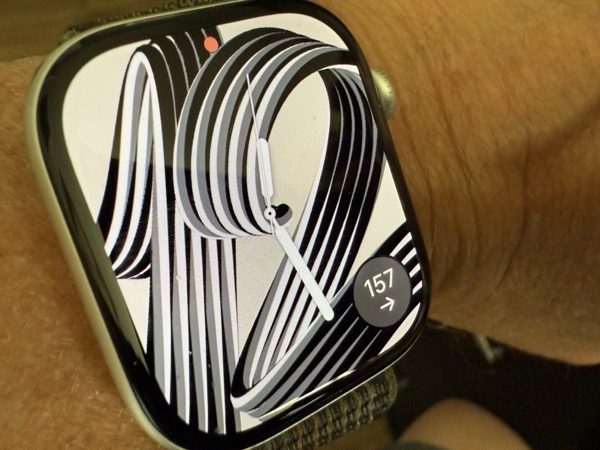
The Apple Watch app offers a complication that displays data more consistently, needing less frequent touches to refresh the readings. (The complication is visible in the photo above showing a reading of 157.) That said, the Apple Watch tends to disconnect too easily from the sensor, defaulting back to displaying readings from the iPhone when that occurs.

I also find that the Apple Watch app reading is more current than what the iPhone is showing, but you do still need the iPhone app to communicate readings with your endocrinologist.

In some instances I’ll need to reboot both devices to reconnect things up on both my iPhone and Apple Watch. Dexcom technicians have told me these disconnections have to do with Bluetooth connection issues and are subject to the same vagaries and variables that exist with many other Bluetooth connections. I also need to be aware of which arm I have the sensor attached. I wear my Apple Watch on my left arm and if the sensor is on my right arm there will be more frequent disconnections. I don’t sleep with my Apple Watch on, so waking in the morning requires a waiting period for the watch app to reconnect.

The goal behind the push to include blood glucose monitoring on an Apple Watch (or any other smart device) is obviously to cut down on the need for finger pricks and possibly the use of minimal invasive medical devices. But also, in theory an on device sensor communicating directly with watchOS should show readings more consistently and be much less subject to the vagaries of Bluetooth connectivity.

I certainly can’t prejudge any new system or technology that hasn’t surfaced yet. Certainly I’m one who hopes Apple or some other company can eventually tackle this issue and provide a workable solution. That said, convenient as this annual rumor always seems to be, I believe blood glucose monitoring on the Apple Watch is a lot further off than most hope or think it might be. I’m also reasonably sure that finger pricks will still be needed if for no other reason than to calibrate sensor readings with actual blood glucose levels.

You can also find more of my writings on a variety of topics on Medium at this link, including in the publications Ellemeno and Rome. I can also be found on social media under my name as above.