I’m looking forward to the release of Guillermo del Toro’s Frankenstein on Netflix perhaps more than any other film to be released this fall. The movie hits theaters on October 7 and streams on Netflix beginning November 7th. The official trailer has now been released.
Mary Shelly’s tale of the monster who created a monster has been so twisted around in so many different incarnations it’s hard to separate the takes from the original fiction. That’s not a complaint, it’s just what it is. I can imagine this one will offer up a unique twist or two given Guillermo del Toro’s previous films.
I’m really looking forward to this and hope it lives up to its promise.
You can also find more of my writings on a variety of topics on Medium at this link, including in the publications Ellemeno and Rome.I can also be found on social media under my name as above.

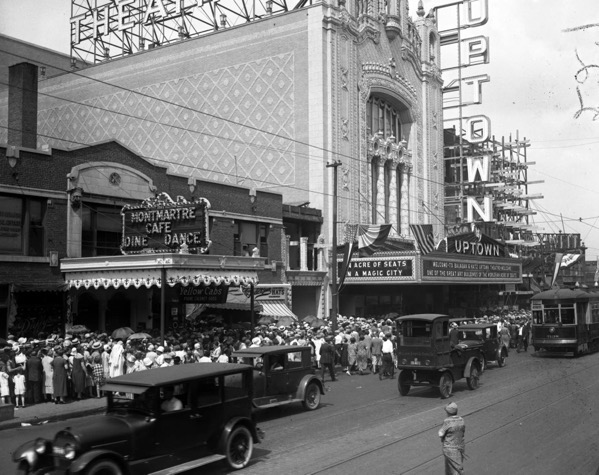
They certainly don’t make movie theatres like they used to. That’s not surprising or new, and long ago signaled a passing of a time when building special places for people to gather became less of a priority than so many other concerns. Chicago’s Uptown Theatre was one of those special places back in the day. It’s been decaying and shuttered since 1981 and every now and then efforts surface to try and bring it back to life.
The Uptown celebrates its 100th birthday on August 18. Built as a grand show palace by Balaban & Katz and the architectural firm Rapp & Rapp, it was hailed as spectacular, and a “splendiferous palace of a place.” The Uptown sat 4,320 in what was called “an acre of seats.”
Offering movies and live entertainment it was billed as a “shrine to democracy where there are no privileged patrons. The wealthy rub elbows with the poor — and are better for this contact.” It also had air conditioning.
Obviously a lot changed throughout the years, talkies took over from silent films, the Great Depression, and the advent of TV changed the dynamic. The Uptown part of town itself fell on hard times and saw big changes, and during much of my time in Chicago was the last section of the lakefront resisting redevelopment. The final act on the Uptown stage was a concert by the J. Geils Band in 1981.
Robert Loerzel has a terrific piece looking back at the Uptown Theatre in the Chicago Tribune that’s more than worth a read as we approach the show palace’s centennial. There’s also an excellent gallery of photos, which the photo above is from. The link should be a gift link, although I don’t know how long that lasts. Loerzel has also authored a new book, The Uptown: Chicago’s Endangered Movie Palace
When I first moved to Chicago in 1999 there were still a few of these show palaces in operation around the city, but the Uptown had long since shuttered. I got to take a tour of the place in the early 1990’s and the scale of what it once offered was impressive to see, only dwarfed by the decay and disrepair.
There are still efforts to try and find funding to restore the Uptown, but I’m sad to say I think priorities have shifted in such a way that we won’t see that happen.
You can also find more of my writings on a variety of topics on Medium at this link, including in the publications Ellemeno and Rome.I can also be found on social media under my name as above.
I saw Ryan Coogler’s Sinners in a movie theatre when it was released in April. I rarely go to movie theaters these days, but in this one instance I was certainly glad I did. Now that Sinners has reached streaming on the 4th of July, I hope anyone who didn’t have a chance to see it on the big screen will take time to view the fireworks it provides at home. I’m looking forward to a second watch. It is excellent. It’s not perfect. But it is sublime in its imperfections.
Ryan Coogler knows how to tell stories. He knows how to tell stories in big ways. He knows how to tell stories that entertain and unsettle. He knows how to weave the various strands of history, culture, and popular story tropes together in ways that spin out a fresh new cinematic delight that redefines the old and refreshes the tired. He may get a bit carried away here and there, but in the end he delivers as a filmmaker of note.
In Sinners he ties Southern-gothic, vampire horror, and depression era gangster styles together along with a musical storyline that literally burns down the house. Working with his familiar actor collaborator, Michael B. Jordan, playing a set of twins, Coogler creates something brand new, dangerous and in the end just damn dandy. I fully expect Sinners to be quite popular in the Best Picture categories when awards season rolls around. Even with its imperfections, it’s at the top of my list for best films of the year.
Jordan and all of the actors are superb. The music is red hot. The vampire gore is plenty gory. There’s a raw, violent, sexual tension throughout that’s heightened by the rawness of the blues music that infuses the storyline. The sequence when the fateful evening’s dancers are intermingled with ghosts of African and African-American pasts and premonitions of musical genres of a future yet to be is a highlight, even if it is a bit too precious.
Coogler also plays with some larger themes among the music, horror, and history. Questioning why Blacks cleave to Christianity (“Blues wasn’t forced on us like that religion,” and who counts as Black when everyone doesn’t have the same black skin or heritage, cut through many of the myths so easily consumed and assumed about the Black South.
As to the flaws, perhaps the biggest is also its biggest strength. Coogler stretches out a wide canvas to paint this story on. Perhaps too wide, and even so he often paints outside the bounds of that canvas. And once the delicious and setup is accomplished, the violent confrontation we all know is coming at times feels more rushed than we want it to, certainly when it consumes characters we’ve invested in.
Even with those flaws, Sinners yields a bounty that often borders on the rapturous. It is more than worth your time.
You can find more of my writings on a variety of topics on Medium at this link, including in the publications Ellemeno and Rome.I can also be found on social media under my name as above.
As if Apple needed another kerfuffle, it appears that one of its marketing efforts for the movie F1 has raised the hackles on the necks of some. You almost have to be tuned out completely to have missed the plethora of marketing methods Apple has already been pushing around the racetrack to get this movie to the starting line. But there’s always more.
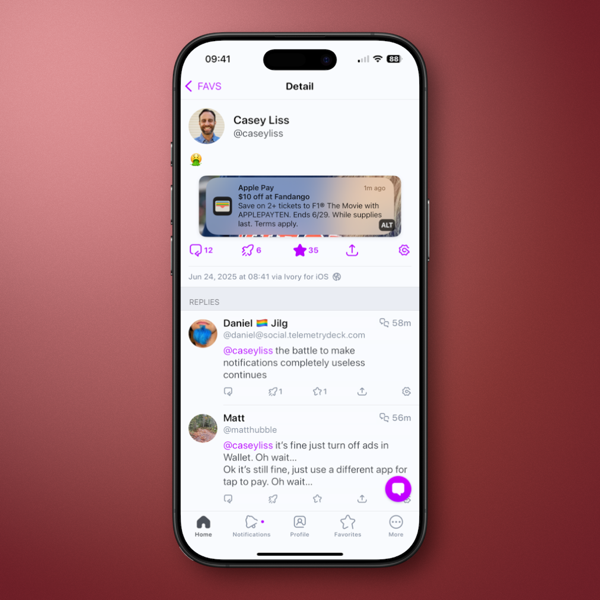
Apple started pushing out Apple Wallet notifications to users of that service announcing that they could receive a discount for movie theater tickets via Fandango by purchasing those tickets with, yep, you guessed it, Apple Pay.
I saw the notification late last night and just swiped it away the way I do the majority of these mosquito-like pests. Too bad I didn’t take a screenshot.
But Casey Liss, of The Accidental Tech Podcast trio grabbed one and posted about it on Mastodon, accompanied by a vomiting emoji.
Those who felt as ill about the promotion as Casey did quickly jumped in, condemning it and pulling out the enshittification label that we’ve all become familiar with since it was coined by Cory Doctorow in 2022.
Yes, it is advertising, but I’m not sure it was enshittification. Perhaps we’re reaching the point of shitting all over that label and diminishing, yet revealing its power in sort of a weird turning in on itself way that proves the original meaning behind the original term even while mucking it up by using it too frequently.
Granted there aren’t too many who lust for the ever increasing onslaught of advertising and marketing pitches we’re bombarded with hourly. I’m certainly not one who does. But advertising and marketing, as overused and overwrought as it has become, in and of itself isn’t enshittification, no matter how fast it grows like weeds rapidly enveloping every corner of our Internet usage.
My grandfather used to say that “a weed is anything that grows where you don’t want it to.” Most of today’s advertising certainly feels weed like. And it keeps getting worse, especially when pushed at us from sources we don’t expect it from. Amazon we expect this from. Apple not so much. Though there is a history there.
In my view of things, Apple advertising this promotion is really not that much different than a podcast advertising its latest merch to its audience or promoting a fundraiser. Don’t get me wrong, I’m not shitting on The Accidental Tech Podcast, which does both of those things. I actually pay for a subscription and occasionally buy their merch and donate when they fundraise. Captive audience marketing is an age old technique and it works. I’ve used it myself. Even so, it can grow old and tip over into enshittification.
But there’s a larger point.
Eventually most users tune out. I used to deliver a curtain speech pitching the next play or special offer before every performance at a theatre I ran. Initially they were wildly successful. Eventually returns diminished. That may be anecdotal, but I believe the more ads increase the more they become the blandest of white noise or even a turn off to the product. Again, anecdotally I had initial interest in the F1 movie, but after the inundation of advertising I’ve already decided my interest has waned. So I’m certainly not going to be contributing to Apple’s goal of finally putting butts in theater seats for one of its movies. I’ll catch it sometime down the line on streaming.
Overhyping, as a facet of enshittification can too easily create diminishing returns, gradually enshittifying the very business models of the enshittifiers. Mosquitos can’t feed when everyone within their range packs up and goes indoors and they eventually move on or die out.
We just haven’t reached that tipping point in this bloodsucking business model we’re trapped in currently. In his original post outlining the enshittification of early social media platforms Doctorow says “the same forces that drove rapid growth drove rapid collapse.”
I doubt we’ll reach that tipping point in advertising. Because there’s a whole new frontier that the enshittifiers are just waiting to exploit and that’s AI. Google’s moving away from search faster than its search rankings are dropping and there’s no secret on the path it’s choosing.
I’ve often imagined that perhaps AI could be one of our salvations in the advertising scheme of things, figuring out better than humans seem capable of doing when enough is enough. But those driving that racetrack see the possibility of too many dollar signs to make that more than just a wild imagining no matter how much sense it might make.
You can find more of my writings on a variety of topics on Medium at this link, including in the publications Ellemeno and Rome.I can also be found on social media under my name as above.
Just posting this here because in the midst of all of the shit going down around us, it surfaced and made me laugh. And I needed that for just a minute.
Mel Brooks announced a sequel to his wacky sci-fi comedy, Spaceballs. It’s been awhile and he takes full advantage of that in this brilliant trailer.
You can find more of my writings on a variety of topics on Medium at this link, including in the publications Ellemeno and Rome.I can also be found on social media under my name as above.
The play is adaptation of the 2005 movie of the same name that Clooney co-wrote, directed, and starred in, based on CBS journalist’s Edward R. Murrow’s work to expose Joe McCarthy during the Red Scare in the 1950s. In the movie Clooney played Fred Friendly, Murrow’s producer. On the stage he plays Murrow.
The Broadway production has met with critical acclaim and just recently announced that it had recouped its initial investment during its run that began in March of 2025.
I’m a big fan of the movie (I wrote a little about it here) and imagine I will also be of the stage version. I’m sure the story’s central message of standing up to bullies and demagogues translates just as well in a live version as it does on film.
I’m looking very much forward to watching this and would encourage you to as well. I know there are some who see Clooney as one of the villains in our recent political turmoil. And some see CNN has a willing accomplice to the madness we face. Even with what may seem like all of that irony, I would urge you to set that aside and give Good Night, and Good Luck a watch. As I said then
This isn’t some moment of nostalgia for a time gone by. It is a recognition that where we are now is a place we’ve been before. This time around those that control the media and messaging have, for the moment, much more control than they did in Murrow’s day. Make no mistake, they had some control then, but now it’s more pervasive and the Murrow’s, Friendly’s and Paley’s are fewer in number.
Setting aside the historical significance of this broadcast of a live play, and the paradox between the message and the messengers, I can’t think of a better reason to watch given where we are and will continue to be for some time.
You can find more of my writings on a variety of topics on Medium at this link, including in the publications Ellemeno and Rome.I can also be found on social media under my name as above.
Apple Store takes center stage in this hostage drama.
I’m guessing iHostage is a flick you’ll never see on Apple TV+ even though it features the Amsterdam Apple Store as a prominent character in the story. iHostage, directed by Bobby Boerman is currently streaming on Netflix and is based on an actual hostage situation that took place at the Apple Store in Leidseplein in 2022.
As far as hostage films go it isn’t bad nor is it great. These things typically only end one way, and of course if you have any familiarity (I did not) with the actual events you already know how things turn out in this case. But as to the entertainment value there’s good fun to be had as the director and his cameras look for every conceivable angle to shoot within and without the Apple Store. AirPods play an important role early on. Also interesting is watching some of the hostages use an Apple Watch to check whether or not another was having a heart attack. (For the record, an Apple Watch can’t detect underlying causes of a heart attack, but it can detect irregular rhythms.)
The acting, visuals, and direction are generally good, keeping the tension going as we cut back and forth between the hostage taker and his primary hostage, and those on the police side trying to bring about an end to the event. But again, these stories have a formula about them that to some extent just requires a plug-and-play approach with all the necessary elements of filmmaking. I’d say everyone pulls their job off well with the sort of cleanliness you’d expect in an Apple Store. In the end it’s all a bit too clean.
You can read about the true story behind the movie here and watch the trailer below. I’d say it’s a fun watch if this kind of story is your kind of thing, or you just want to tour an Apple Store in Amsterdam.
You can find more of my writings on a variety of topics on Medium at this link, including in the publications Ellemeno and Rome.I can also be found on social media under my name as above.
I’m not sure about how you’re viewing all the things swirling around us these days and maybe it’s just the prism I’m seeing the world through, but most of the writing that attracts me all seems to relate. The common denominator is human arrogance, (perhaps it’s arrogant for me to say that). On the other hand is the push back against it, whether it be in global or national affairs, technology, or simply finding a new way to connect in what seems like old ways. Anyway, that’s a thread running through my mind as I share this week’s Sunday Morning Reading.
Freedom of Speech and Disinformation are two sides of the same worn coin that I’m afraid is on the verge of losing any of the value it once represented. Ian Dunt says that Progressives Are Rediscovering Freedom of Speech after the populists essentially used it as a cleaver to butcher it.
Timothy Snyder has one of the best pieces I’ve seen on SignalGate called SignalGate: Violating National Security. It doesn’t get more simple than that title, and yet, we’re in a world where we let it get stupid, silly, and so much more complicated than it needed to be.
On the technology front, Artificial Intelligence keeps dominating most discussions. Steven Levy takes a look inside Anthropic and its version with Anthropic’s Claude Is Good At Poetry-And Bullshitting. Here’s the thing that always makes me laugh about AI fluffing and fulminating. We keep playing circular games with these things, creating them, we’re told, to be better than our falliable selves at reasoning and to be more efficient to free our minds from drudgery. We are good at the creating part yet seemingly not smart enough to recognize the fallibility in all of our arrogant bullshitting. We’re obviously not smart enough to recognize that, so what makes anyone think anything artificial we create will do any better?
Apple continues stewing in juices of its own making as it heads into its next cycle of OS releases, leaving many aching for the days of Snow Leopard, a release which supposedly was aimed at bug fixes more than new features. Matt Birchler reminds us that this was one of those bullshit marketing myths too many fell for in The Snow Leopard We’ve Built Up In Our Heads and links to a terrific rundown of why that was indeed a myth from Jeff Johnson in The Myth And Reality of Mac OS X Snow Leopard.
As for the pushing back part of today’s introduction, take a look back, or listen back in cultural history at this piece in OpenCulture. Turns out after World War II, as the KKK was once again gaining some momentum, Superman stepped in to help slow things down. Check out Superman Vs. The KKK: Hear The 1946 Superman Radio Show That Weakened The Klan.
Watering holes are great places for connecting with other humans whether it be for refreshment, survival, or merely just a human connection. David Todd McCarty publishing on LinkedIn takes a look at The Return of The Speakeasy, reminding us that nothing was or is easy.
If you’re interested in just what the heck Sunday Morning Reading is all about you can read more about the origins of Sunday Morning Reading here. You can also find more of my writings on Medium at this link, including in the publications Ellemeno and Rome.
I’d like that to be all that I write about this sensational limited streaming series on Netflix, but there’s more I want to say.
You’ve probably heard of Adolescence. It’s become a well deserved hot topic of conversation because it’s an excellently done piece of storytelling that cuts through what seems like an impenetrable zeitgeist like a hot knife through melted butter. I’m glad to see that the hype tour surrounding its recent release ramp up after the series took off because something this good needs to be ballyhooed, bravoed, and brandished with flying banners.
For me, the bottom line, beyond just saying “see it” is that the producers and artists involved captured something we all know in our gut and make us face it. Captured it in a challenging way that they didn’t need to, but by accepting that challenge opened up those gut instincts with a rawness that touches nerves we may have all let somehow deaden. The painful intimacy of one family’s story opens up a chasm full of realizations that speak far beyond the specific issues so well portrayed.
In brief, a young boy is accused of stabbing a young girl and through the investigation we delve into a world of young boys and men influenced by Incel culture and bullying. A world not understood in this instance by the young boy’s family, or any one of the parents’ generation that we meet in the story. Watching the investigating detective’s son educate his father is a remarkable scene.
We follow the story through the boy’s arrest, booking and indictment, examination with a therapist, and the devastating conclusion as the family deals with the aftermath. Every moment is powerful. His arrest in the first episode is only the beginning of story that digs into every emotion there is when confronted with horrible moments that one would hope no family would ever have to endure. I can’t imagine any parent of young children, especially boys, watching this without wanting to take the doors off of their child’s bedroom doors and disconnect them from the Internet. It is tough to watch and it’s impossible to look away.
Toxic masculinity, patriarchy, bullying, isolation, fear, self-loathing, and the perils of social media become bigger monsters by the moment than any knife wielding attacker.
Director Philip Barantini, known for filming his stories in one take, uses that device to exquisite effect. He didn’t need to, but he and his team did and the payoff is exquisite. Each episode unfolds like a one-act play, filmed in one amazing traveling take. In later interviews it’s been revealed that they only did two full takes after a weekend’s rehearsal for each of the four episodes. The one take keeps you riveted as it ratchets up the tension, never letting you catch a visual breather from the story. How they filmed the second episode which takes place in and around a school is almost beyond imagining.
The cast is superb, especially 13-year old Owen Cooper as the young boy. In his acting debut he delivers a performance that is so outstanding that it takes your breath away. He’s not only a natural, his performance borders on the supernatural. Stephen Graham, who also co-authored the story with Jack Thorne, plays the boy’s father and strikes true in every millisecond he is on the screen. Well known for playing in-your-face tough guys, Graham’s journey through this story is like watching a rock face that has been the feature of a cliff, let go and crash into a million pieces. The rest of the cast is equally up to the task of matching these amazing performances.
The back story is that Graham, hearing about crimes featuring young boys stabbing young girls, felt that questions needed to be asked, the obvious one being “why is this happening?’ As is the case with all good drama and story telling Adolescence raises as many questions as it answers others. Certainly I imagine parents who see this, and they all should, will be asking the same questions the mother and father in the series do themselves.
On a larger scale, as we daily face an adult and supposedly mature world that seems stuck in adolescent, if not prepubescent misbehavior, celebrating toxic masculinity, bullying, and the perils of social media, this amazingly told story might at least give us a glimpse into how we looked away too often, when we knew we shouldn’t, ignoring so much at the cost of even more.
You can’t look away from this.
You can find more of my writings on a variety of topics on Medium at this link, including in the publications Ellemeno and Rome.I can also be found on social media under my name as above.
The events of the 1972 Munich Olympics hostage crisis changed the world in so many ways, ushering in the age of terrorism foremost among them. But behind the scenes of the terror and the politics were the sports television broadcasters who found themselves in the middle of an unexpected crisis and they were totally unprepared for. The movie September 5 tells that side of the story and tells it well.
Two things stand out beyond the excellent acting and well crafted script that make the film worth a watch. Director Tim Fehlbaum does a great job of capturing the chaos and the tension in the ABC control room and its environs as his cast hustles and bustles from moment to moment and emotion to emotion. Fehlbaum also skillfully weaves historical ABC footage of the coverage into the action he’s filming in his current day mise-en-scene. That choice alone was an excellent one and sets the filmmaking apart.
The film is also a terrific nostalgic view on what seems like the now ancient technology that television broadcasts used in that era. Watching how logos and titles are created to superimpose over images is quite a treat.
Certainly audiences of my generation will be familiar with how big a moment this was, but I’m sure there are younger generations experiencing the story for the first time. They couldn’t have a better primer than this film.
The end of the tragedy is well known, but the telling of it in this newsroom procedural gives it an entirely new life as we see producers and directors making choices in the moment, realizing how their actions are breaking new ground, potentially fraught with peril, and how their audiences will witness the event they are covering and what it means going forward.
September 5 is currently streaming on Paramount+ and available via video on demand from most services.
You can watch the trailer below.
You can find more of my writings on a variety of topics on Medium at this link, including in the publications Ellemeno and Rome.I can also be found on social media under my name as above.