Meta Muddle, Wildfires, and the Social Media Wilderness

I’m hating that Meta is getting hateful.

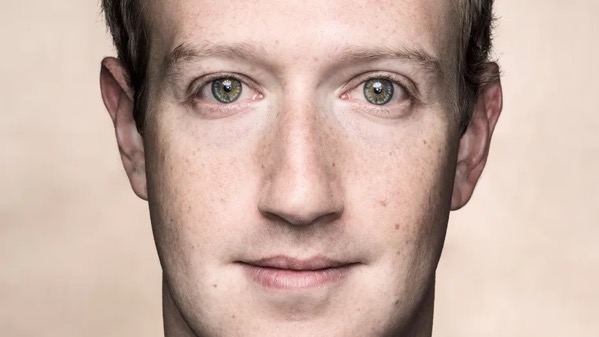
Mark Zuckerberg’s nakedly transparent sucking up to Donald Trump continues to unravel much of whatever fabric we thought social media might have knit together. I remember back in the day when some argued over whether or not it should be called a social graph. Those were naive days and that was naive math.

When Zuckerberg ditched human fact-checking it was only a matter of time before he ditched DEI initiatives as the next move. That happened today. In fact I’m surprised he didn’t do that first. All of this has left me, along with others, debating the wisdom of hanging around on Meta properties going forward. The ones I’ve used are Facebook, Instagram, and Threads. Of the latter two, Threads would be easy to leave, Instagram less so. Facebook is a dilemma of another sort.

This week’s horrific fires in Los Angeles illustrate my dilemma. I have many friends living in Los Angeles. Facebook was the one way I could keep up with their lives and careers and more immediately these recent horrible predicaments. I was able to find out who was safe and who was in danger. I know for several of them it was akin to a lifeline.

Perhaps our problem is how we got sucked or suckered into these social media maelstroms in the first place, but in the scope of human history it’s no different than how we follow any sort of trend, until we discover the downsides. It was an easy decision for me to abandon Twitter when Musk took over. This decision will be more difficult.

Not only does this week’s tragedy hit home differently, but Facebook has been a way, and I suggest the only way, I have had to stay connected to folks I went to high school and college with. The same, to a lesser extent is true about Instagram.

Sure I could have made phone calls, written letters, and Christmas cards, but being able to effortlessly see what’s happening in the lives of others I know was a decided benefit. Yes, I was feeding the beast each time I scrolled, liked or shared something, but the only difference between that and what we’ve done ever since the dawn of the age of marketing is scale, unless you’ve never shopped at a grocery store, used a bank, or bought insurance.

So, I’m struggling a bit with the decision I know I will inevitably make, and I know others are too. It will be a loss. Social media is a bit of a wilderness right now, and any wilderness is a dangerous place.

Sadly, and selfishly, my struggles are certainly less fraught than those of some of my friends and colleagues who know that there are those eager to exploit Meta’s dehumanizing new policies.

Casey Newton in Platformer reported some of the hateful guidelines. Here’s an excerpt:

In an answer to the question “Do insults about mental illness and abnormality violate when targeting people on the basis of gender or sexual orientation?” Meta now answers “no.” It gave the following examples of posts that do not violate its policies:

Non-violating: “Boys are weird.”

Non-violating: “Trans people aren’t real. They’re mentally ill.”

Non-violating: “Gays are not normal.”

Non-violating: “Women are crazy.”

Non-violating: “Trans people are freaks.”

And in examples of posts that are now allowed on Facebook:

“There’s no such thing as trans children.”

“God created two genders, ‘transgender’ people are not a real thing.”

“This whole nonbinary thing is made up. Those people don’t exist, they’re just in need of some therapy.”

“A trans woman isn’t a woman, it’s a pathetic confused man.”

“A trans person isn’t a he or she, it’s an it.”

These tech bros used to con us (yes, we always knew it was a con) with promises of building a better world. I guess we can only be glad that their efforts are now more transparent, and their views, in my opinion twisted and wrong. Hopefully that knowledge of this moment will allow us to hopefully make wiser decisions going forward. I say hopefully, because in my view of the world, we haven’t proven we’re capable of that yet as a species.

You can find more of my writings on a variety of topics on Medium at this link, including in the publications Ellemeno and Rome. I can also be found on social media under my name as above. 

Has Fact Checking Ever Worked?

Facts and the factless.

Has fact checking ever worked? Seriously. Has it ever? In my opinion if there was ever any real utility, it’s long since lost its pucker.

Mark Zuckerberg caused all sorts of consternation yesterday announcing he was going to dismantle Meta’s fact checking operation now that he realizes a million-dollar bribe probably wasn’t enough to keep him out of jail during the reign of the next administration. It was quite a public puckering up.

But let’s get real for a moment. Once any fact-less statement takes off it spreads faster than a wildfire in California and all the fact checkers in the world can’t snuff it out. For some facts do indeed matter. They occasionally do in our legal system, though not always. They used to in our legislative processes, but that’s long since become a relic of a time gone by. For most of its history, journalism wasn’t what so many bemoan the loss of today. Myths have fueled our religions and our histories since we first sought understanding.

And as for social media and the Internet in general? That’s a medium that has always allowed (and encouraged) the presence of fake personas. All bets there have always been off. 

Prior to Zuckerberg’s recent sucking up, Meta had taken recent fire for allowing the creation of AI-generated chatbot personas to appear in feeds alongside regular users. Reaction to that led to a pull back that’s sure to be only temporary. I mean, think of the business model. Why do you need problematic real users when you can just create them and still con advertisers into paying for ads that most avoid or don’t see anyway? Programmatic users are certainly easier to control than problematic real ones—at least until the AI takes over.

Here’s a fact that doesn’t need checking. Facts matter if you think they do, but most of the rest of the world doesn’t care what you think if they can support their beliefs—or protect their business model—by making shit up and making it stick.

You can find more of my writings on a variety of topics on Medium at this link, including in the publications Ellemeno and Rome. I can also be found on social media under my name as above. 
Croissant is a Treat for Social Media Cross-Posting

Croissant is a sweet and simple app for social media cross-posters.

With the social media world still very much atwitter and scattered among various platforms in the wake of Twitter’s destruction at the hands of Elon Musk, some users like myself traverse across the multiple platforms seeking to replace it. That’s all well and good as far as it goes, but it presents a first world problem of having to post separately for those who do.

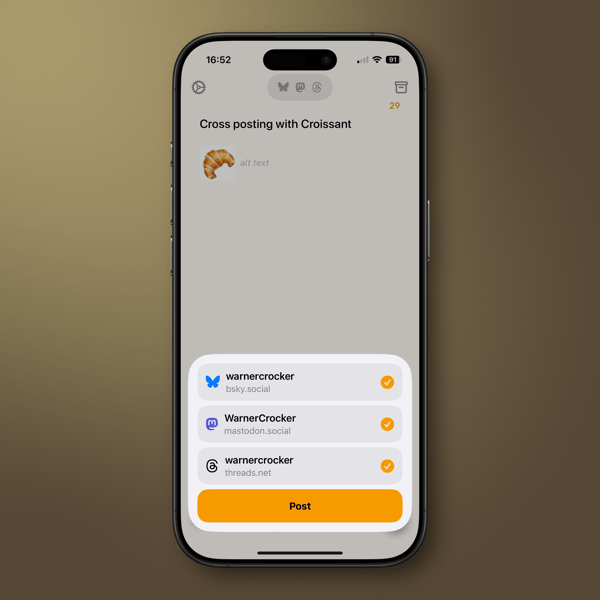
To the rescue comes Croissant. A lovely little app from indie developers Ben McCarthy and Aaron Vegh that simplifies cross-posting to Mastodon, Threads, and Bluesky. While there are promises a plenty of interactivity via ActivityPub, that’s still by and large a waiting game. I also don’t think buying into a protocol will be the simple answer most think it will be for differing complex platform agendas. Meanwhile Croissant serves up a tasty treat for cross-posters.

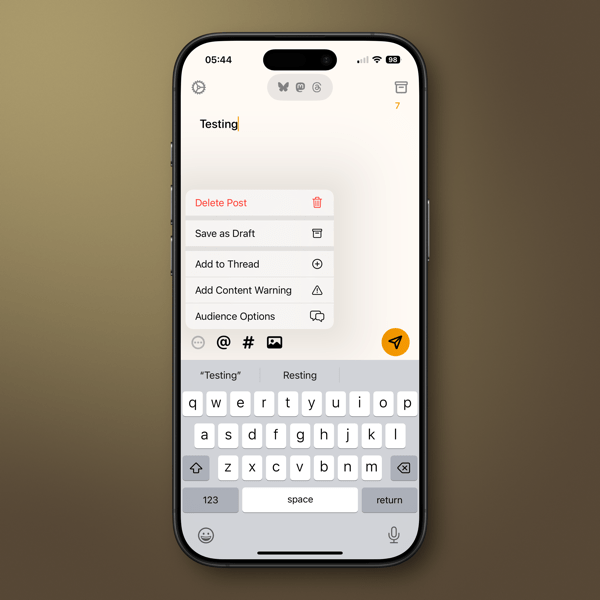
In this first version the action is sweet and simple as is the design. Feed in your account credentials and cross-post away. You can add photos, hashtags, and you can tag someone in your post assuming you know their handle and it’s the same across multiple platforms. Swipe right to delete a post, swipe left to create a thread.

You can choose to spill out your toots, threads, and posts to all three, or pick and choose where each pearl of wisdom drops. You can also save drafts and create threaded posts. For those who manage multiple accounts on any of the platforms it provides a one-stop solution. Croissant also delivers the now table stakes of different color schemes and your choice of icons.

I’d like to add more to this quick review, but there’s no need. In its first iteration Croissant does what it does simply enough and that is its elegance and its utility. The developers have a road map for adding new features in the future, but I hope hanging on to the “buttery smooth” simplicity remains a priority.

You can find more of my writings on a variety of topics on Medium at this link, including in the publications Ellemeno and Rome. I can also be found on social media under my name as above. 

.

At The Mercy of The Backend

Part of the Information Super Highway traveled some rough road this morning. Meta experienced an outage in all of its services today that took down Facebook, Threads, Instagram, Messenger, and I imagine everything else in the Metaverse. A source told the Daily Mail that the company’s internal systems were also down. Boomshakalaka, another day on the Internet.

We’re somewhat accustomed to Internet outages. In much the same way we’re sadly becoming accustomed to extreme weather events. Some are caused by malicious hacks, some by incompetence, some by rodents chewing through cables. Internet connectivity has made so much of our current world more convenient and convenience always comes with a cost. It’s a cost that those who own the servers, the services, and the connections, sometimes don’t want to pay for, leaving users stranded at times. It’s apparently tough to value an ounce of prevention on the Internet.

We hear about these outages when big ones hit. That’s sensational news. But far too often there are “backend” issues that happen that we never hear about. Those are the ones that only affect “a small percentage of users” or companies that don’t command the public’s day in day out appetite for connectivity.

Intriguingly enough, those charged with communicating with users when problems do arise sometimes never hear about them either, or if they do are they are told not to talk about them. Again, nothing surprising.

The corporate PR pros may or may not issue lawyered up responses, but rarely do users get any nuts and bolts answers as to what went wrong. Vague apologies, promises to do better, free credit monitoring when user info is hacked, etc… We’ll’ hear the now-clichéd “small percentage of users” modifier trotted out whenever things get righted. It’s funny/not funny how we all just move on.

Earlier this morning I was chatting with some folks on Threads who were seeing issues with Apple’s Weather app not updating as designed on their Apple Watches. I casually replied that it was probably an issue with iCloud’s backend and how it was associated with the provider Apple uses to offer up weather info. These issues with Apple always seem to manifest as they are rolling out new operating system updates, so my guess is more than a guess. (Apple rolled out iOS updates today.)

I’ve been going round and round with Apple for almost two years now trying to solve what is apparent to me, after much effort and investigation, an iCloud related issue. It’s not just apparent to me, there are several other users experiencing the same issues I’m having, as well as other users with other iCloud related issues in similar but different veins.

When I talk to Apple Support (a regular occurrence) we’ve developed this coded, often unspoken, acknowledgment that the issues are iCloud related. But as I said in this post, Apple needs to allow its support personnel to acknowledge directly what the problems are. And in my case, and those of others, so far that continues to not happen.

(Side note for those who might read the links above or are familiar with the situation: I’ve discovered a workaround to sometimes get things back to normal thanks to Dwight Silverman. Signing out of Messages and then back in works about 8 times out of 10. Otherwise I just have to wait it out.)

The problem is bigger than a social media network going down, or a streaming service buffering out during the big game for lack of bandwidth. Those may be frustrating but in the grand scheme of things merely inconveniences. But the more connected our daily lives become to our banks, our medical institutions, our governments, etc… the more reliant we become on services being well run, well maintained, and frankly just available and working as advertised.

I think of it as I think of streets and roads. We’re reliant on them and need them well maintained. The big difference is we see the potholes and understand the inconvenience we’re about to experience when the construction barriers go up.

When Apple, Microsoft, or Google releases a software update, they are not just updating the bits and bytes on your device. Corresponding updates happen on the backend as well. When your favorite app updates the same thing occurs. If that app provides a service, whether it be a social network, streaming media, or checking your bank balance something’s cooking on the backend.

And that’s just the backend updates we’re at least peripherally aware of. Perhaps we need better signage on the Information Super Highway.

You can find more of my writings on a variety of topics on Medium at this link, including in the publications Ellemeno and Rome