We Have To Do Better. At What Exactly?

The time is out of joint

We’re burning up the words and phrases we use for comfort faster than out-of-control wildfires. We’re drowning meaning under flash floods of ravaging frequency. We’re dancing around sensitivities like so many angels on the head of a pin, ignoring that the pin has been smashed into smithereens by a sledge hammer. We keep looking for better angels of our nature to appear but they seem to have given up the ghost trying to reign things in. The time is out of joint.

PXL 20250913 090506555.

The meaningless phrase of the moment this morning that has gotten my goat is “we have to do better.”

What the hell does that even mean?

We pretend that everyone cares about the outrage of political violence. Not everyone does. There are those that care only enough to use it to their own advantage and want to see more of it. Yes, it’s about power. But it’s increasingly  become about the money, because you can make boatloads of it preaching hate and division. You know, free speech and all of that.

We have to do better.

There’s no “better” to do when it comes to language, because language only expresses what is felt inside. About self. About others. About domination. About fear. And when the “better” is about better profits… well, that’s the world we live in and at the moment it’s what’s making the world spin faster.

Step away from politics for a second.

When a sports team loses and coaches and players say “we have to do better” or “we have to play better” it means nothing. Of course they do. They lost.

When a business doesn’t meet its sales targets, they always say “we have to do better.” Unless of course they’re spinning losses into wins hoping no one pays attention.

Shift back to political world.

The spinning happens there as well, with a speed that can burn through the surface it’s spinning on. Yet, it’s a bit late to want to do better after the bullet has struck a target so broadly painted.

We can no longer expect appeals to better angels or doing better to work. It’s a naive call to a different past that in many respects never existed, even though on the surface it seemed to. We should no longer be afraid of phrases like civil war, because in case you haven’t noticed, we’re in one. People are being killed in their homes, at rallies, in schools, just about in any place. Sad fact of history, what we want to believe is random violence by extremists always happens before someone declares that a war is on. But hey, we’ve got a deranged lunatic of a leader who wants to meme one into being, while we spend so much time trying to figure out what we know is the why of it.

You can argue that the extremists aren’t the ones with the guns, but the ones with the big mouths and the AI bots at their command. No one is going to clamp down on the rhetoric any more than they are going to clamp down on guns, and it has already bubbled over into a toxic stew. How are you going to “do better” when all sides claim their way is the better way? I don’t have an answer for that question, because I’m afraid I actually know the answer and there’s nothing “better” about it.

The only thing we have to “do better” at is recognizing the horrors of the moment we’re in and facing it for the reality that it is. You and I certainly don’t want to see and hear what we’re seeing and hearing. But we’re too far down that road to not acknowledge we’ve arrived at a terrible place.

Hamlet says:

‘The time is out of joint: O cursed spite,
That ever I was born to set it right!’

I feel like we’re all caught in Hamlet’s dilemma. Wanting to fix it, but afraid to the point of cursing what will eventually need to be done.

You can also find more of my writings on a variety of topics on Medium at this link, including in the publications Ellemeno and Rome. I can also be found on social media under my name as above.


Sunday Morning Reading

A bit of this, a bit of that. All good bits.

It’s the Dog Days of Summer and it’s been a hot one so far. We’re traveling again, but there’s still some interesting Sunday Morning Reading to share. Some of it hopeful, some elegiac. Some just geeky and fun. Enjoy.

Milen kolev zs9jdUCaP_4 unsplash.

Kicking things off is a piece in The Atlantic from Anna Deavere Smith called When You Don’t Look Like Anything. She’s a singular artist always worth paying attention to. Her story of her 50-year search for the American character is certainly more than worth your time. Damn good stuff.

A.R. Moxon popped up on my radar this week with a piece called Total Eclipses. It’s part 2 of a series, the first being Be Bolder, Not a Boulder. If you’re like me and looking for any light at the end of any tunnel these days, do give both pieces a read.

NatashaMH offers up An Ode To The Poetic Detours. It’s about writing and where she finds inspiration, but more broadly, it’s about observing, noticing, listening, seeing, and feeling between the lines we sometimes get trapped within.

Will Dunn asks Are Emoji’s Killing Language? I’ve been saying they are for quite some time. For the life of me I don’t understand why we seem intent on regressing back to an age of hieroglyphics instead using the complex beauty of words and language.

Mathew Ingram says The Google Link Economy Is Dying and It’s Not Coming Back. He’s not wrong. Actually, he’s very right.

Health is a big deal in tech these days, especially when it comes to adding features to improve monitoring what’s going on in our bodies. Frankly, as someone who uses medical devices for monitoring my diabetes, the promises to add that kind of monitoring to smart devices, along with blood pressure and other conditions, sound hollow, seeming as realistic to me as self-driving cars. We may get there one day, but for now it’s mostly a clever way to market something new to increase the bottom line. Victoria Song takes a look at Samsung’s recent effort to check out our level of antioxidants with their smartwatch in I ‘Fooled’ Samsung’s New Antioxidant Feature With a Cheez-It. 

Much has been made of Paramount’s caving to Donald Trump, leading to the firing of late not comedian Stephen Colbert. That was quickly followed up by the Trey Parker and Matt Stone’s skewering new season opener of South Park. Paramount paid up, got its merger, and in an Aristotelian, if not Mel Brooksian sense there’s some grand comedy in the entire thing. I’m a fan of Alexandra Petri’s piece examining the moment pre-South Park titled Are You Laughing Yet?

Sometimes we just need to laugh at what feels like no laughing matter.

(Image from Milen Kolev on Unsplash)

If you’re interested in just what the heck Sunday Morning Reading is all about you can read more about the origins of Sunday Morning Reading here. If you’d like more click on the Sunday Morning Reading link in the category column to check out what’s been shared on Sunday’s past. You can also find more of my writings on Medium at this link, including in the publications Ellemeno and Rome.

Sunday Morning Reading

When caring becomes a commodity, should we care more or less?

Lots to care about. On all the usual fronts. But in the grand scope of the universe does much of it really matter? Some interesting links to share in this week’s Sunday Morning Reading.

Dan Sinker, taking a look at The Chicago Sun-Times AI flaps calls it The Who Cares Era. His theory is that along the way, nobody cared. I’d venture they cared about the wrong things.

Apple’s annual developer conference WWWDC is a week away and given the many issues the company is confronting lots of folks care and are curious about how Apple begins to address them. Some don’t see Apple changing how it deals with developers, like Aaron Vegh in his post, They’re Not Going to Change.

Some, like John Siracusa, are rooting for Apple and even offering advice. Siracusa’s piece Apple Turnaround is a companion to his recent previous post Apple Turnover. All worth a read, regardless of how you feel about the predicaments Apple finds itself in.

The tech bros who seem to be in the pole position running to rule the world may be making bank, but they’re not winning any friends in the process. They most likely don’t care given that they think they’re on their way to conquering the universe. John Kaag is offering up A Reality Check For Tech Oligarchs. Frankly, I don’t think they live in anything close to reality.

Meanwhile, down here on planet reality, some are looking for ways to survive and perhaps beat the odds seemingly stacked against us. A.M. Hickman lays out a vision for How To Live on $432 a Month In America.

Much of what’s going on around us might seem profane and vulgar, leading to quite a few expletives coming out of our mouths as we cope. David Todd McCarty takes us on an exploration of his love of four-letter words in Frequently Profane But Never Vulgar. For what it’s worth, all words have value in my opinion. Hiding from them is fucking stupid.

Natasha MH is Reclaiming the Joy of Struggle in an AI-Driven World. Better grab that joy while we can, because that struggle is only going to become more intense.

Just when you thought we might have begun to figure out the new landscape of insanity we’re currently struggling through, comes along Ross Anderson who informs us about The Nobel Prize Winner Who Thinks We Have The Universe All Wrong. It may someday stop expanding the way we thought and might just remain stagnant for longer than originally theorized, allowing intelligent life to continue longer than we thought. One may ask, should we care?

(Photo from Vincent Nicolas on UnSplash.)

If you’re interested in just what the heck Sunday Morning Reading is all about you can read more about the origins of Sunday Morning Reading here. You can also find more of my writings on Medium at this link, including in the publications Ellemeno and Rome.

Sunday Morning Reading

Paying attention for the next generation.

Good morning. Visiting the grandkids this weekend, so this will be a short stack of links to share. Fair warning ahead most are on the darker side of the ledger. The links. Not the grandchildren. They are the light. The grandchildren are why I pay attention.

First up is a piece on despair from Dean Pritchard titled Despair, What Is It Good For. He calls it a hopeless call to action. I’m not sure it’s hopeless at all. Just another step in finding what may or may not turn out to be answers. As long as we keep stepping.

NatashaMH says that social media addiction isn’t just about us, it’s about the people around us in Unread, Unavailable and Unbothered. I’ve never been one to buy into the social media addiction theory. It’s too damn easy to put down the damn phone. But I take her points because it’s too damn easy to keep hoping to find new ways to avoid despair.

Lauren Goode takes on Deepfakes, Scams, and the Age of Paranoia. Somebody needs to.

Tom Schaller and Paul Waldman say that Trump is betraying the voters who elected him in The White Rural Reckoning. They are correct. But we knew that would happen. Scum likes to remove itself from other scum once it’s done scumming around.

Joan Westenberg compares the comeuppance moment Apple is enduring to Martin Luther’s reformation moment in Apple’s Diet of Worms. Given the abundance of fanatics there’s more than a little truth here.

Playwright Sara Ruhl is one of my favorites. Charles McNulty takes a look at what she has to say in her new book In ‘Lessons From My Teachers,’ Playwright Sarah Ruhl Finds Wisdom In Art, Motherhood, Even Grief.

And as for weathering despair, check out Lost At Sea by Alec Frdyman. Excellent reading about a scary adventure.

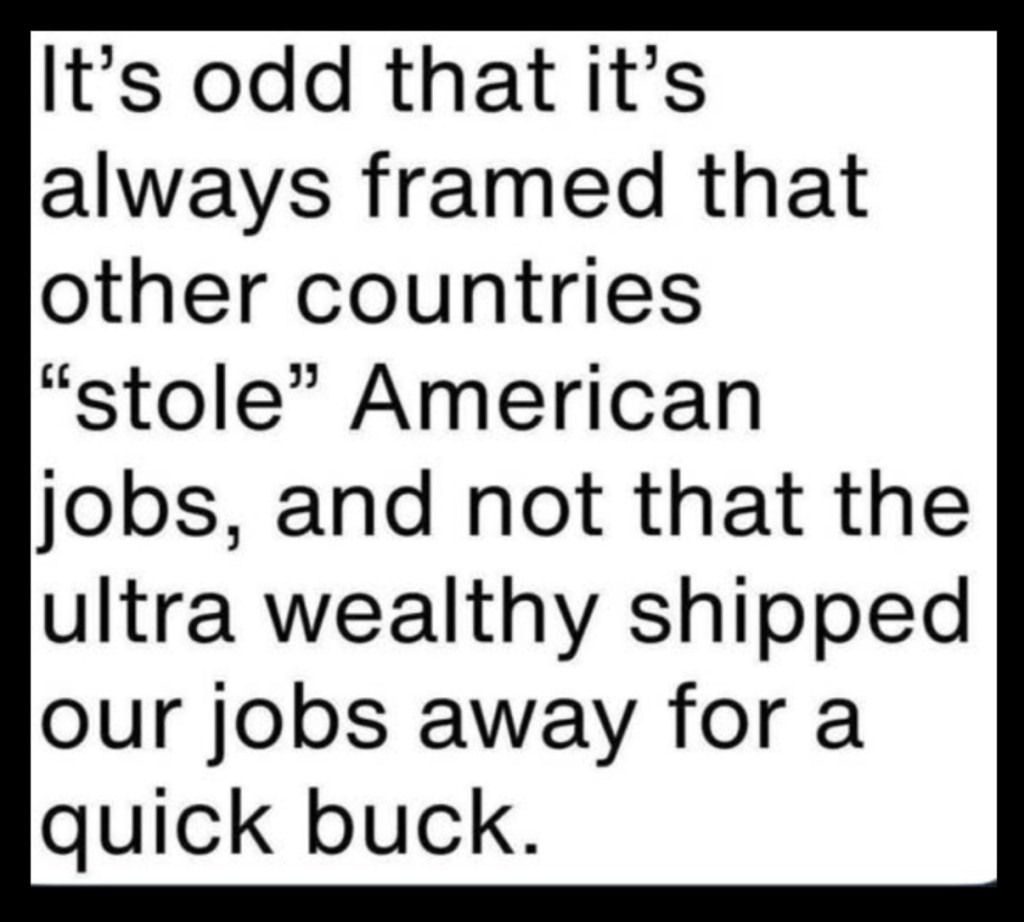
And to close out this weekend I’ll leave you with this uncredited thought that pops up every now and then on social media.

And just remember who the tax breaks are targeted for.

Peace.

If you’re interested in just what the heck Sunday Morning Reading is all about you can read more about the origins of Sunday Morning Reading here.  You can also find more of my writings on Medium at this link, including in the publications Ellemeno and Rome.

Maybe “We’re All Afraid.” We Need To Stop Saying So.

Candid cowardice breed bullies

It’s often a risky thing to be candid. Even more so about your fears. I get that. Been there myself in some moments that I felt the stakes were high. Thankfully those stakes didn’t involve the fate of the United States and perhaps the free world. 

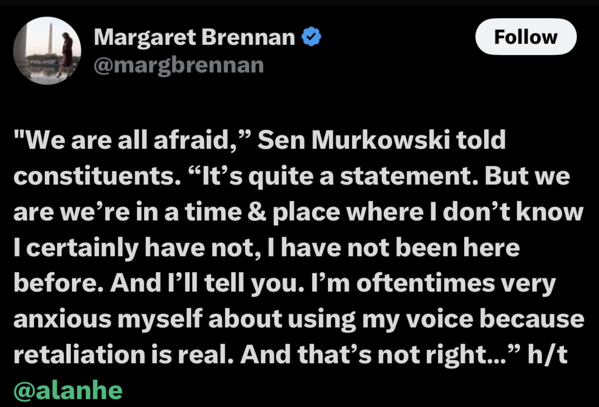
Lisa Murkowski's statment on being afraid of Trump

Senator Lisa Murkowski’s statement as quoted in the screenshot above is indeed admirable for its candor. Yet I would call it cowardly, given her office. If you’re one of 100 people elected to the senate of the United States, you’re chosen to overcome your fears in the face of danger.

I don’t doubt that there are threats of retaliation. Yes, that’s scary and as she says “that’s not right.” But admitting you are susceptible to succumbing to fear only feeds the fever that breeds more of what you fear. And we’re already tossing too much chum into these turbulent waters.

I’m reasonably sure when the signatories of the Declaration of Independence put their names to that document there was fear in their minds and hearts. History is replete with leaders who have taken courageous stands and I’m also reasonably sure most did so while facing fears. We need to see and hear more that. Strongly worded letters and sound bites just aren’t strong enough this time around the history cycle.

I’ll give the Senator credit for saying she’s going to continue to use her voice which she says might appear confrontational at times. She used it well in an early decision point in this administration by voting against the nomination of Pete Hegseth for Secretary of Defense. Others weren’t so brave. My issue with her candid language here is once you admit you’re on the defensive, the other side knows it has the advantage and feels free to press harder. The only thing that’s going to turn the tide and pop the buffoon’s balloon are those who don’t cower and candidly concede he’s made you afraid, no matter how fearful you are.

You can watch more of the Senator’s remarks in the video below for a fuller context.

You can find more of my writings on a variety of topics on Medium at this link, including in the publications Ellemeno and Rome. I can also be found on social media under my name as above. 

Sunday Morning Reading

Delusions abound in this week’s Sunday Morning Reading.

If it’s Sunday, it is time for Sunday Morning Reading with interesting writing on a variety of topics, that without intending to all seem to involve delusions in one way or another. There’s also a little Procol Harum on the side. Enjoy reading, while you skip the light fandango.

Speaking of delusions, check out a piece by Michael Connors and Peter Halligan exploring What Delusions Can Tell Us About the Cognitive Nature of Belief. 

It’s no delusion that Artificial Intelligence remains in the news (before it eventually subsumes the news). Harry McCracken takes us a bit into the deep mind behind Google’s DeepMind in The Future According to Google DeepMind CEO Demis Hassabis. That first link takes you to the web version, this one takes you to the Apple News version of the article since the piece is a premium article for Fast Company readers.

Joan Westenberg has caught my eye of late (if you follow Sunday Morning Reading you should know that) and here are a couple of recently published dynamic pieces: Don’t Confuse Volume with Truth and Rebel Optimism: How We Thrive in a Broken World. Both worth your time.

We’re all complaining about a lot of things, the continued enshittification of the Internet being a familiar and well deserved  target. (It’s interesting that I use that term enshittification so frequently and yet spell check or any other type of check hasn’t picked it up yet.) Dave Winer is fighting the good fight on a lot of fronts and he looks at a new kind of enshittification in Billionaire-proof?

David Todd McCarty takes on the platitude “the meek shall inherit the earth” in The Children of Pacifists.

Ronan Farrow takes a look at The Technology The Trump Administration Could Use To Hack Your Phone. You know it’s going to happen. You know it most likely already has.

And to round things out this week, Ulf Wolf spools out an essay on the mostly forgotten Keith Reid of Procol Harum in The Shadow Member of Procol Harum. Not going to lie, I did spin up a copy of Whiter Shade of Pale while writing this week’s column. The Salty Dog album is cued up next.

If you’re interested in just what the heck Sunday Morning Reading is all about you can read more about the origins of Sunday Morning Reading here.  You can also find more of my writings on Medium at this link, including in the publications Ellemeno and Rome. You can also find me on social networks, including Bluesky, under my own name.