At Last: A Cure for Apple iCloud Migraines Thanks to Craig Federighi

Finally, a solution to those Apple iCloud Migraines thanks to Craig Federighi

Relief. At last. All it took was the right doctor.

We’ve all been there with health situations. You lay out your symptoms and whatever checklist your medical professional follows leads to a course of treatment that might or might not work. Perhaps after repeated tests and possible cures you might finally get the attention of someone who actually listens, goes beyond the symptom check list, and you get treatment that works to solve your problem.

If your situation and symptoms don’t fit those of the majority of patients it can be an exhausting, frustrating, and dehumanizing experience.

The same is sadly true with technical support. You have a problem. You call or chat (hopefully with a human). Lay out your symptoms and you get served up solutions from a playbook that don’t solve your problem. Striking out on your own you search the Internet for solutions, (increasingly a frustrating and useless experience), only to discover others facing the same issues.

At least you find comfort in knowing you’re not alone. Even so, there’s not enough strength in numbers if you and your compatriots fall into that ever popular yet corporately dismissed category of a “small minority of users.”

Like with your medical condition, if your technical issue falls outside of the range that most experience, then you better hope that you are talking to someone who actually listens and isn’t just a part of a solution mill that rewards quick dispensing of the call the way restaurants hope for quick table turnovers.


The Diagnosis

Perhaps you’ve read my previous chronicles discussing the Apple iCloud Migraines. I’ve been suffering with these headaches for a number of years and through a tourist guide map of California named macOS operating systems. I won’t go into detail, but you can find links to them here, here, here, here, and here. I will offer a brief summary (non AI generated) of the problem :

At each point that Apple released an operating system update, whether beta or final release, my Macs would mysteriously lose all Continuity based or related features. Continuity is the system Apple uses to connect its devices allowing users to copy and paste between them, sign in to Macs with an Apple Watch, display iPhone widgets on a Mac Screen, and connect Macs and iPads together via Universal Control. Your iCloud account is a key to Continuity.

Note that I haven’t been on a beta since owning any of my current devices. So, in theory, none of these beta updates should have affected me. However, I might as well have been downloading betas like a beta junkie, given the return of these migraines with each beta release and subsequent full releases.

Communications over the years with Apple Support yielded nothing that would help until Dan Moren of Six Colors posted about a similar issue he was facing and the responses he got from Apple Support.

That second agent proved quite capable, not only agreeing that the situation was strange, but also looking into issues on Apple’s side. Which led to the somewhat bizarre conclusion of this story: after perhaps 20 minutes on the phone, he seemed to hit on something. I heard him laugh and say something along the lines of “that explains it” and then, with my consent, put me on hold. When he came back, he said—and I’m not exactly quoting, but close enough: “I’m sorry, I can’t tell you any more than this, but all your services should be back up pretty much exactly 12 hours after they went down.”

Now, in my initial forays on social media, I had gotten a reply from someone on Mastodon mentioning that Apple’s iCloud servers were sometimes put in maintenance mode for 12 hours—but upon going back and looking for that specific reply, it was nowhere to be found.

It did, however, support the theory that something had gone wrong with the particular iCloud server on which my account was located.

There was, according to this support agent, nothing to do but sit back and wait, then call back if service hadn’t returned by the 12-hour mark and reference my case number. He was again apologetic for not being able to give me any more information, but reiterated his confidence that everything would be resolved.

After Dan’s post turned the heat up a bit on the issue my calls with Apple Support changed in tone and substance. I got moved a couple of rungs up the ladder to an advanced support level. (Draw your own conclusions). Initially that seemed promising. I also got the “just wait it out” response as Dan.

Suffice it to say that eventually yielded no real solution and there were two periods of time when things just seemed to stall. The first being prior to the Apple Vision Pro release and the second in the run-up to WWDC 2024. I chalked those up to resource allocations.


Reaching the Right Doctor

Following WWDC I decided on one frustrating evening to drop an email to Craig Federighi, Apple’s honcho on all things software. I didn’t expect any response. My previous emails to Tim Cook were met with a brush off.

In the context of my email I appealed to Craig quite explicitly that I was very interested in the new iPhone Mirroring feature coming in Sequoia that relied on Continuity and how he had discussed Continuity during the WWDC presentation. I also expressed that I imagined this feature would be at best a hit and miss for me given the ongoing migraines.

Lo and behold, I got a response from Federighi requesting I share diagnostic files with him. Note I don’t know if I was actually communicating with him directly or one of his staff, but after submitting another round of diagnostic files I received the emails below:
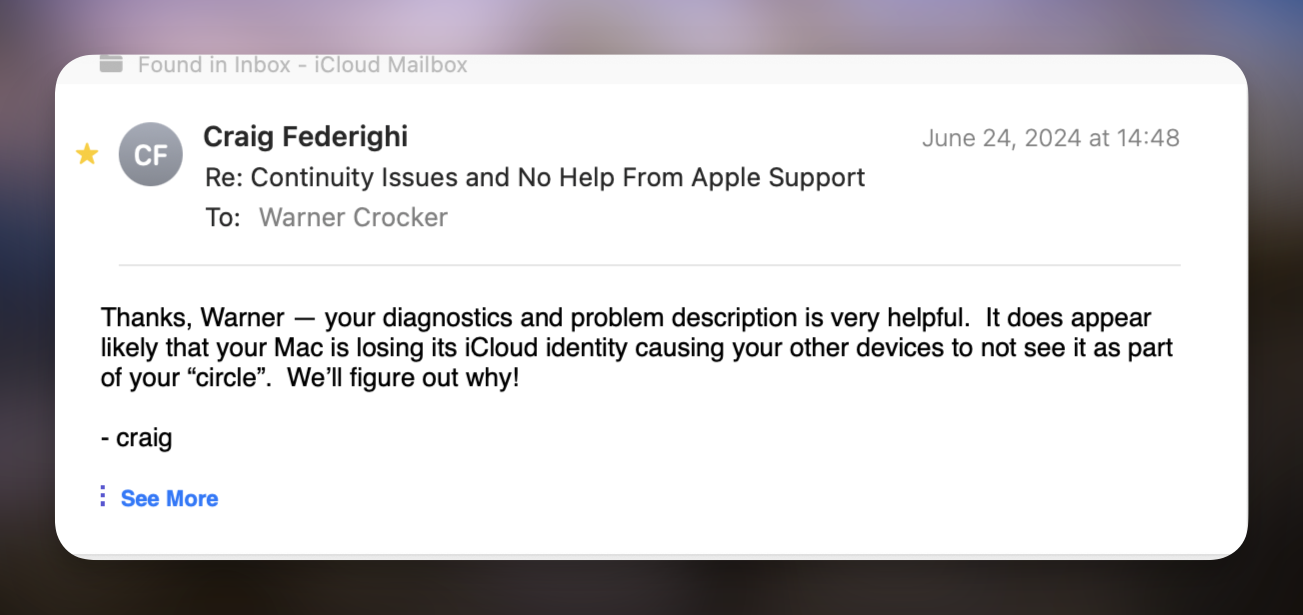
And then I received the following:

Once macOS Sonoma 14.6 and iOS 17.6 were released the problem did indeed appear to be solved, but I knew I would have to wait through the next few beta releases and also the release of Sequoia to determine if the fix would indeed hold.

The good news is that I can report the fix did indeed hold through the remainder of the beta cycle and also through the final releases of macOS Sequoia 15 and iOS 18. As of today it has held through developer betas and also public release of the betas for 15.1 and 18.1 since installing the final versions of macOS 15 and iOS 18 the day of their release. It has also held through upgrading my iPhone and Apple Watch.

I’m glad this seems to be resolved but I’m going to remain skeptical until we see the .ox and .x releases of Sequoia and iOS 18 roll out. To be honest, it feels like I’m waiting for any sign of a possible reoccurrence of a medical symptom.


Wrapping Up

I’ve always tied my migraines to problems somehow related to my iCloud account and it appears those suspicions were by and large correct. I don’t have a definitive answer but given that only a “small percentage of users” experienced this issue combined with comments from support personnel and a few clues from Dan Moren’s post, that is what logically makes the most sense to me and a few others I’ve consulted, social network buddy Dwight Silverman among them. By the way Dwight led me to a workaround involving signing out and back in to Messages in iCloud.

I’m certainly appreciative of Craig Federighi or his office pushing this forward to a resolution. I’m reasonably convinced it helped that iPhone Mirroring, which relies on Continuity, is one of the sexy tent pole features of this year’s new releases finally probably brought quicker attention to the issue. That and a stroke of good luck with my timing.

Unfortunately, for whatever reason, users in situations that don’t have a large podcast or online audience and can’t stir up a major hullabaloo in the tech press are left to piece these clues together. Unless on a rare occasion they catch the attention of a higher up at Apple to find a resolution. That shouldn’t be the case.

Certainly the bigger a company becomes it’s easier for all sorts of issues for a “small minority of users” to fall through the cracks and for priorities to shift. That’s just a reality. And it shouldn’t take the luck of good timing in sending an email to a top executive, certainly busy with many other tasks, to suss out an issue.

As I’ve said all along, Apple needs to find a way to come clean with both users and its front line support personnel when these issue present themselves. Listening should be the key because sometimes the patient/user has all the clues you need to help them.

You can find more of my writings on a variety of topics on Medium at this link, including in the publications Ellemeno and Rome. I can also be found on social media under my name as above. 

WWDC 2024: Things I’d Like To See

Bring in the new and shiny, but fix the old and buggy too.

The Internet is filled with wish lists of things Apple fans would like to see announced next week at WWDC. New things. New capabilities. New all round. The majority of those wishes are the same and focus ahead. Nothing wrong with that. We’re always advancing. Or so we’re told.

Perhaps I’m stuck in the past, but I’d rather see Apple devote time to correcting some longstanding issues that bug me. Many of these issues are part of the glue that holds Apple’s ecosystem together, or what Apple calls iCloud and I call the unnamed operating system, iCloudOS. So, I’ve compiled a list of things I’d like Apple to fix, repair, or at least pay some real attention to.

Chances are better than good that you won’t hear much about any of this next week or in the weeks that follow. Many of these issues have existed for a few years now and seem to be such a low priority that Apple must be content to let them exist. Quite a bit of this could be considered small in comparison to the bigger challenges brought on by adding new features that bring new complexity. But one of the reasons so many prefer Apple’s way of doing things is the attention to detail in both design and practical matters. When it’s good it’s great and often magical. When Apple loses focus and doesn’t pay attention it can be like watching a magician pull a dead rabbit out of a hat.

For me these issues are rough enough and present enough inconsistency to diminish that attention to detail. The longer they are ignored or put off the more they point to glaring weaknesses in Apple’s process and I think we get farther away from that “magical” or “it just works” lore.

It’s apparent that not enough others feel the same or have the same experiences to pressure Apple into devoting the resources necessary to address these annoyances. That’s not a surprise. New always takes precedence in a market driven by delivering something new each year. And AI is the big new thing this year and Apple has assigned all hands on deck to ready what most expect to be the newly christened Apple Intelligence ship to sail.

Yes, we’ll hear quite a bit about AI. I’m also sure we’ll hear about things like emoji, flashy Messages and other novelties that show well in demos. Many of those I consider trivial or “meh” features that will be forgotten shortly after all of the reviews are written. Though the money I spend on Apple products is a small drop in Apple’s buckets of cash, I’d much rather see it spent putting resources into fixes for these annoyances. The list below certainly isn’t a complete one, but these are the things I’d love to see Apple address.


Continue reading “WWDC 2024: Things I’d Like To See”

WWDC 2024: Apple Needs To Do Some Serious Work With iCloud

iCloud OS: Apple’s Unnamed Operating System. The second in a series heading into Apple’s WWDC 2024.

WWDC is designed to highlight future directions for Apple’s increasing number of operating systems and how they work together. The OS list is long and getting longer, but there’s actually one that Apple has never mentioned as an operating system, yet it’s the one that glues every other piece of the ecosystem together. I call it iCloudOS. Like any glue it can fasten and bind, but apply it without care and you can end up with a sticky mess. iCloudOS is a bit of both.

If you use multiple Apple devices iCloud ties them all together creating a supposedly fluid connection between devices and services. That’s the attraction of the ecosystem. When it works as designed it can feel magical. Copy and paste between devices, universal control, handoff, shared Notes and Reminders and others all make Apple computing life more productive and often more fun.

When things don’t work it reminds every parent of raising a child. There are moments of sheer wonder and joy, but you know at some point the kid is going to shit the bed. There’s too much of the latter to ignore.

I’ve written extensively about my iCloud woes (here, here, here, here, and here). I’ve had numerous conversations with Apple tech support personnel. What I’ve discovered is that there are ongoing iCloud backend issues that Apple hasn’t been able to solve. They keep trying, but they keep getting put on the back burner once Apple gears up to roll out its next big new thing, as is the case with this year’s now well predicted AI announcement. Things reach a point when a “wait until next year” mandate takes hold that would test even a Chicago Cubs fan’s patience.

In my most recent adventures into the backend of iCloudOS it has been acknowledged that all of the work we were doing to pin down the issues I and others have been seeing has been put on hold until after whatever is coming next in the various operating systems due to be announced next week. All well and good, I suppose, but here’s the problem with that. That approach essentially makes all users of the ecosystem beta testers. I do not run betas on my devices but I’ll suffer through the numerous summer releases and whatever changes Apple makes on the backend during the summer beta season. That will continue with each point release throughout the year. Keep in mind, we’re all, always at the mercy of the backend. 

I’ve already seen this begin to happen and the betas don’t roll out for a week or so yet. One of the early warning signs(and there are quite a few) that things are happening in iCloudOS is when notifications for Apple’s Reminders app get out of sync between my macOS devices and iOS devices.


Continue reading “WWDC 2024: Apple Needs To Do Some Serious Work With iCloud”

WWDC 2024: iCloudy Forecasts Ahead Amidst Dampening Expectations

iCloudy Forecast Ahead for Apple at WWDC

Here it comes. Apple is heading into its annual World Wide Developer’s Conference (WWDC) with announcements of its next big things beginning June 10th. By all accounts, this year those next big things will center on AI which is short for Artificial Intelligence. There won’t be any shortage of AI in a tech world that has grown both AI crazy and AI fearful, putting Apple is in the unusual position of playing follow the leader in more obvious ways than in the past.

CleanShot 2024-06-04 at 08.54.35@2x.

There will be other new features announced for iPhones, Macs, Apple Watches, perhaps even the Vision Pro, but as always the focus will be on what’s new. Even though a goodly portion of what’s new and exciting each year often ends up being a bit “meh” in the end. Either “meh” or rolled out and forgotten as Apple shifts its attention to what next year’s next big things will be. That seems to be what’s happening this year as Apple has turned most of its focus to AI.

Apple is also unfortunately positioned to have to work harder in making its splashy announcements splashy and dodging seemingly already diminished expectations on a number of fronts. Most anticipate Apple’s AI announcements to be less than sexy and the iPad faithful/hopeful seemed to be poised to continue piling on the criticism (some necessary, some not) that greeted newer iPads less than a month ago.

So, on two big fronts, AI and iPadOS, Apple has some tougher challenges ahead than it usually does this time of year. And bad timing is at the root of both.

The iPad Issue Is Touchy

On the iPad front, for whatever reason Apple went more than a year before releasing new iPads. When they did debut them last month they surprised everyone by including new M4 chips in the new Pro lineup, upsetting every pundit’s attempts at trying to assign a predictable timetable to the continued Apple Silicon evolution. Coming just weeks ahead of WWDC, and without any new operating system software to accompany it, Apple opened up a slew of doors for the salivating pundit class to rush through, cranking up the complaints about iPadOS not taking advantage of very powerful and much loved hardware. And, as always, the married at the hip debates about being able to run macOS on an iPad or adding a touch screen to the Mac tagged along as noisy bridesmaids.

It’s a bit frustrating for a regular and religious iPad user. While the issues are genuine, they negatively dominate the conversation given that they come from the influential voices that helped turn the iPad into a success in the first place. I know the issues are long simmering, well intentioned, and come from the heart of those who love the device, but the recent sudden crescendo was deafening enough to fire up a Loud Environment warning on an Apple Watch. With WWDC just around the corner everyone knew the new devices alone were not going to offer anything remotely close to a new and different iPad experience. It just seemed premature to me. If they were meant as a warning to Apple, then I would call it not only premature, but a misfire given the timing.

Those debates and complaints probably aren’t going to end in the foreseeable future as entertaining and exhausting as they can be. Between manifestos, and well thought through lists of what some desire on iPads, there was some general vitriolic piling on. It heralds a tough year ahead for Apple and its iPad lineup.

My prediction is that no one is going to be remotely satisfied with this year’s iPadOS release. Most rumors say not much of consequence will be announced. It’s certainly going to be interesting to follow the commentariat class as they wrestle with how many different ways they can say the iPads are great devices but Apple keeps holding them back for another year.

Perhaps this year changes things, but typically big OS changes come to the iPhone first with iPads and Macs bringing up the rear in the year or years that follow. Given Apple’s push into AI as this year’s big iPhone tent pole, if the iPad doesn’t get included it will add even more to those complaints and increase the volume.

Continue reading “WWDC 2024: iCloudy Forecasts Ahead Amidst Dampening Expectations”

Time for Apple To Come Clean About iCloud: Part 2

It’s been a week and Apple needs to tell users what happened on April 27 when so many had to change their passwords causing confusion

Last week, beginning on Friday April 27, quite a few Apple users experienced a disturbance in the force when all of sudden they were prompted to relog into their Apple ID on their devices. On attempting to do so many discovered their accounts were locked for “security reasons” and needed to change their passwords in order to get back in.  Eventually the situation righted itself as everyone eventually was allowed to change their passwords (there’s more to that part of the story later). It’s been a week and Apple has yet to publicly comment on what caused the issue. That’s a problem.

Apple and other companies spend enormous resources to keep users and systems safe, guarding against privacy attacks and security hacks. Apple also spends mountains of marketing money touting its approach to security and privacy as a key selling point. All that’s well and good. We live in an age of online paranoia when every security alert, every email, every text, every phone call, every link we are prompted to click on is suspect. Apple Security Notifications are now in that list.

When folks started receiving prompts on their Apple devices to change their passwords and then discovering that they were locked out of their devices, that paranoia rippled across the Internet as social networks, forums, and support networks burbled with users wondering if this was a hack, a glitch on Apple’s end, or just another run of the mill online inconvenience. Depending on which Apple Support rep you got on the phone you were told there wasn’t a problem or helped to relog back in. The event was blamed on all sorts of culprits from foreign countries to AT&T after its recently revealed compromise. There was no messaging from Apple. There’s been none since.

There are some signs that it might have been a system update on Apple’s end. Gone wrong or right no one knows. Was Apple hacked and did it pull a maneuver to protect users? Was Apple attempting to update or perform system maintanence? No one knows. No one knows still.

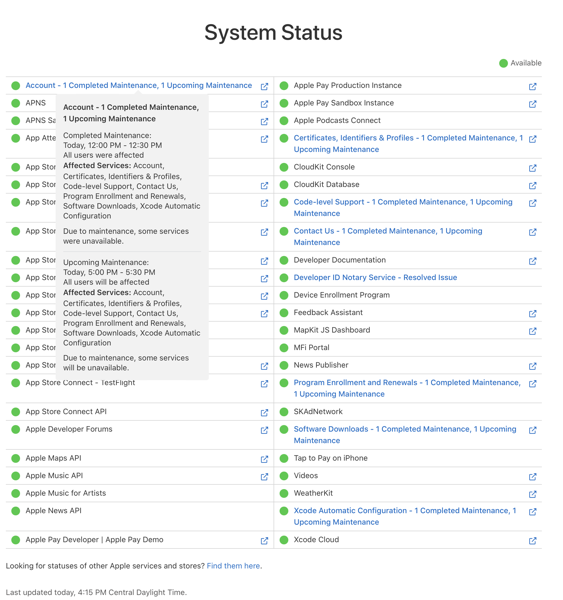
John Gruber on Daring Fireball pointed to Apple’s Developer System Status dashboard that showed maintenance scheduled for that Friday evening and another scheduled for the next day under “Account.” So that may be a possibility. Without any communication from Apple users are left in the dark.

In my opinion most likely this incident may have been related to a backend maintainence issue. Yes, that’s a speculative opinion, but it’s based on my long (too long) experience trying to sort out ongoing iCloud failures with Apple Support. My personal conclusion is that Apple has problems with its backend operations that it either can’t figure out or is unwlling to devote enough resources to fix in a timely manner before it cycles into finishing up the next OS release.

Before I get to that, and what I experienced on April 27, let me just say that Apple (hell all companies because every company is online and subject to hacks) owe users open communication at the very least. Equally as important, Apple owes its own tech support personnel open and better communication on these problems. That’s the reason for the Part 2 in the title of this post. Apple not only refuses to give users accurate information, but does the same with its own tech support personnel. It’s been an ongoing issue and in the wake of this latest situation apparently extends far beyond the typically convenient and meaningless excuse that only “a small percentage of users were affected.” The events of April 27 may not have affected all users, but this time there was more than a “small percentage.

Selfishly, as the evening unfolded and things started to feel very familiar, I actually hoped that the larger number of users reporting complaints might actually lead to some communication that could possibly help resolve my ongoing issues. But so far that’s not the case.

Friday Night’s Apple ID Fracas

My wife and I were watching an episode of Palm Royale on Apple TV+ via an Apple TV. A message popped up on the screen saying I needed to update my Apple ID password. I thought this was strange as I never recall having to enter my Apple ID password on an Apple TV before. Typically with my iPhone nearby signing in just “magically” happened.

I grabbed my iPhone and noticed the same message there and then the Apple ID Locked message appeared. My first thought, like so many others, was that I had been hacked or there was an issue on Apple’s end. I went to my iMac and fired up social media apps and also headed to Apple’s System Status webpage. Nothing helpful there, which isn’t surprising. But on social media I started seeing the typical “Is this happening to anyone else or is it just me?” posts start to scroll through my feeds. Chance Miller at 9to5 Mac was the first publication to report on the issue.

I then got the same notification on my iMac which cascaded to my other Apple devices. As the event unfolded I experienced a very similar series of events as told by Michael Tasi in his excellent blog post Janky Apple ID Security. There were some differences. Bottom line: I just couldn’t log back in after several attempts to change my password on my iPhone.

Logging in with a new password would fail, spinners would spin, and prompts would overlay causing a guessing game as to which button to push. At one point I got the following screen on my iMac.

It’s curious. The date I’m publishing this post is May 3 and as you can see above there’s supposedly a new device on my account that can’t be used to edit my information until May 3, 2024. Which device? Who knows? I’ve had use of all of my devices since I successfully relogged them back in with the new password on April 27 and I’ve since edited account details from the iMac, which I assume is the device in question since that’s were the notification popped up. But who knows?

At one point while attempting to change the password on my MacBook Air I was asked to enter the device password for my iPad mini. Again that’s curious. I had not yet attempted to change the password on that device or even attempted to wake it up.

After successfully changing my iCloud password and relogging back in to my iPhone, iPads and Macs, I was still unable to do so with my Apple TV and Apple Watch until I manually entered the new password on each device. Again, I’ve never previously had to enter an iCloud password on either device. Also curious, as of this writing I no longer am able to control my Apple TV with my iPhone or Apple Watch. Is that the mysterious “until May 3” device? So far that hasn’t resolved if it is.

The “Not” Fun and Games Didn’t Stop on Friday Night

After feeling relatively confident that my passwords on each device had been changed succesfully we finished watching the episode for Palm Royale and retired for the night. Note that my wife’s iPhone and iPad did not experience any of these issues. Neither did other family members I support.

The next morning I discovered that I had more to do in order to bring my devices back up to full speed. First, I had to relog in to Messages on each of my devices. I also discovered that all my App Speciifc Passwords had been deleted, which of course required creating new ones. To be honest, I’m not sure I’ve done so with all of the apps that require them yet because all of the passwords were erased. I can’t remember which apps required them and which ones didn’t. Those I use frequently, such as Fantastical, let me know right away. I assume I’ll hear from the others as they rotate back into usage.

After searching social media and other sites I began to notice that users who had fallen prey to whatever this was experienced a range of issues, but not all of the same issues I did. Some experienced more and different ones. Those running HomeKit and HomePods (I don’t) had their own set of different issues. Folks were confused and waiting for an answer.

One of the confusing discoveries is how Stolen Device Protection is supposed to work. Supposedly if you’re in a “Familiar Location” you don’t have to endure the waiting period unless you set up the system to require it at all times. But others, searching Settings for “Familiar” or “Significant” Locations, (Settings/Privacy&Security/Location Services/System Services/Significant Locations) discovered that their “Familiar” home or work locations were recorded outside of the radius for it to be “trusted” leading to the one hour delay.

Tying This Incident to Ongoing Issues 

I won’t go into a blow by blow account with my iCloud Migraine issues. You can find those specifics in blog posts here, here, here, and here. That said, having to re-log into Messages after this event leads me to continue to believe that Apple has deeply rooted issues with iCloud. I’ve been fighting these issues (and Apple) for well over a year. Within the last five months or so a workaround that Dwight Silverman clued me into has been a way to get the ship righted in most instances when they reoccur.

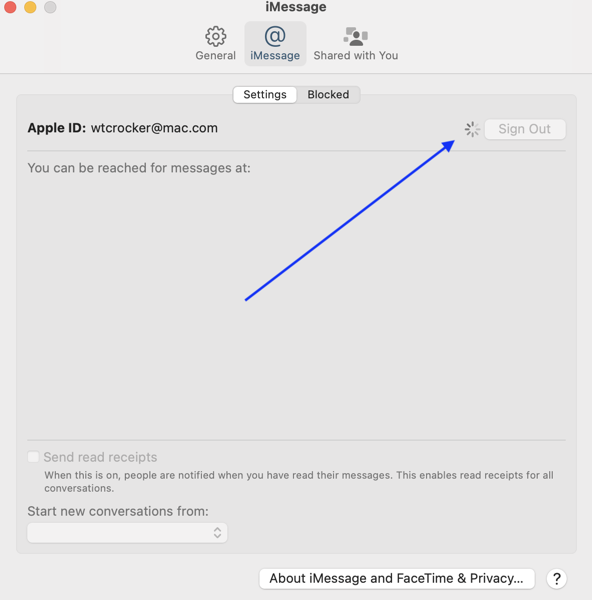
Briefly, when I lose Universal Control, Sign in with Apple Watch, Handoff, Copy and Paste between devices, the fix is to sign out of Messages in iCloud and to sign back in. When these fuctions disappear from my Macs they are still available on iOS devices. I know it’s iCloud related from my conversations with Apple Support and because I always receive a notification that says I have to sign my Apple Watch into iCloud via my iPhone.

Note that there is no option to do so in the Apple Watch settings on the iPhone. An Apple Watch is signed in to iCloud when it is paired to an iPhone.

Dwight’s fix has worked most of the time. Often it will work right away. Other times I won’t be able to sign back in immediately, resulting in an endless spinner that eventaully times out.

One of the other odd things about this workaround is that often executing it on one of my Macs will fix the situation on both. Sometimes it will require me to execute the fix on each Mac. Occasionally it will fix things on one Mac and not on the other even when executed on both. There seems to be no rhyme nor reason to this riddle.

I’ll know the workaround works when I get a notification that tells me WiFi calling is now an available option on my Macs follwed by notifications on my iOS devices that a new Mac is now available in iCloud. Which is strange given that a check of Settings always reveals both Macs being available on the account before, during and after the event.

When this doesn’t work I’ll perform a dance of the devices, turning them off and on in various sequences. Sometimes that works. Sometimes not. Sometimes I just need to wait things out and eventually things will right themselves.

That waiting corresponds with what I and other users have been cryptically (often very cryptically) told by Apple Support. Here’s a quote from Dan Moren’s experience:

. . . after perhaps 20 minutes on the phone, he seemed to hit on something. I heard him laugh and say something along the lines of “that explains it” and then, with my consent, put me on hold. When he came back, he said—and I’m not exactly quoting, but close enough: “I’m sorry, I can’t tell you any more than this, but all your services should be back up pretty much exactly 12 hours after they went down.”

I and others have also been told to wait 24 hours. Regardless of the length of the waiting period the “I can’t tell you any more than this” is always consistent.

Some Theories

I can’t offer any conclusion about the events of April 27 beyond what I’ve previously stated as speculation. What I can offer is that whatever caused that issue and how it was rectified by Apple has many similarities with these ongoing iCloud issues.

What is consistent is that they resurface each time Apple issues a beta update for iOS and macOS or a full release of same. What’s inconsistent is that sometimes the issues surface the morning of a release, sometimes the day after, sometimes the day before. NOTE: I do not run Betas on any of my devices.

What this tells me is that concurrent with those device operating system updates, beta or otherwise, Apple is issuing corresponding updates on the iCloud backend. That’s only logical, and it points up a flaw in the process. If you’re a beta tester you can and should expect issues. That’s what betas are for: to find issues. However, If you’re NOT a beta tester you should not be subjected to issues related to betas. 

When I’ve raised this timing issue with Apple Support I’ve gotten tacit agreement that it is an issue, but no definitive answer. My support dialogues through much of 2024 have consisted of me sending sysdiag files to Apple each and every time an OS update is released.

However, while I still religiously collect sysdiags to send each time the issues occur, the requests to send them stopped in March. That followed a period of time when I was asked to wait until after the next point release before submitting any further updates.

There was also a moment last fall when I was told that Apple engineers had recently put the issue back under investigation after the officlal release of Sonoma. I was told they thought they had solved it with Sonoma but realized shortly after they had not.

My theory of the moment, which I’ve expressed to Apple Support and gotten no official response to, is that with WWDC quickly approaching Apple has once again has put this on the back burner for current users in order to possibly address it in the next OS release. If my theory holds we might see the issue disappear at some point in this summer’s beta cycle or it will continue as it has since the days of Monterey.

Another theory I have, and that may tie in with the events of April 27, is that this somehow relates to when a user first set up an Apple ID. My initial Apple ID was a mac.com address and that’s followed me through the MobileMe era into the iCloud era. A number of users who experienced the problems on April 27 had mac.com addresses. I can’t speak to whether or not that was always the case with every user, but in trying to find solutions to my ongoing problems, many I’ve spoken with also acquired their first Apple IDs in the mac.com era.

Note that my wife and the family members I support all began their relationship with Apple in the iCloud generation. None of them experienced issues on April 27. None of them have experienced any of these issues that continue to plague me. That’s a small sample, but it fits within this theory of mine. I’ve also heard from some others who did not experience this April 27 issue that some have mac.com addresses at the root and some do not. So again, who knows?

Bottom Line: Fix and Communicate

Apple needs to solve whatever this long running problem with iCloud and Apple needs to communicate with its users and support personnel better. Certainly they need to do so when there are more acute failures such as that which occured on April 27, whether they be security related or just attempts to find a better solution. A week is much too long to wait for some sort of statement. We may all be At The Mercy of The Backend, but we don’t need to be at the mercy of poor communication. That’s a choice by a company. Contrary to what some might think or fear, saying there’s an issue and we can’t yet pin it down is a less bad PR move than going silent.

I use Apple products and follow Apple news throughout the evolutions of beta cycles into full blown releases. I like to follow that news. I don’t like and choose not to live and work through them. Each time Apple tries to improve things or add new features I know I’m going to experience failures before I can actually use the products and ecosystem as designed and advertised. And even after the situation may be fixed, worked around or righted, so far there’s no solution that has been able to solve the problems. To me that’s unacceptable.

It reminds me of days from my youth when I’d go out to start my old beater of a car and hold my breath wondering if it would actually turn over and start. Always a relief when it did. Always a pain in the ass when it didn’t and I’d have to lug out the jumper cables. Apple doesn’t make or sell beaters. But these issues sure are beating me down.

You can find more of my writings on a variety of topics on Medium at this link, including in the publications Ellemeno and Rome.

An Apple Christmas Wish List for 2023

Dear Santa Tim Cook,

I’m writing you to let you know what I would like from Apple for this Christmas. It’s not new hardware. The amount of Apple gear I own is more than enough and I’m quite happy with it. So thank you for that, and thanks ahead of time because I’m sure Apple’s vision is to keep cranking out new hardware in the future.

This is a wish list about a number of nagging things that I think you and your elves need to pay more attention to in your operating systems and software. Let’s call them fixes. Most of these nagging issues have been around for a while and oft-reported so it’s surprising you’d allow them to hang around for the users who love your products. I, and many others, have been reminding you of them quite frequently and for quite a while.

I know your elves are busy, but if they could find some time to address these things it would be one of those gifts that gives all year long, and for years to come.

So, here’s my wish list for iOS and macOS.

iCloud

This is the big ticket item on my wish list. You’ve tied so many services and functionality to iCloud and a user’s AppleID. That makes good sense for the eco-system and when it works it’s great. When it doesn’t it causes problems for users, your support personnel, and completely diminishes much of the good it intends to provide. I’ve been on the hunt for solutions to my iCloud woes for quite some time now. I won’t go into detail here, but you can follow the links in this article that chronicle my journey.

But just so you know, the issues aren’t resolved, aren’t closed to being resolved, and tend to pop up with some sort of Santa-like omniscience, knowing when we users can least afford a problem.

Your elves I’ve spoken with thought this had been resolved with Sonoma and were quite disappointed to find out that wasn’t the case. So they’re as perplexed as your users.

These iCloud issues affect features like Handoff/Continuity and Sign in with Apple Watch not working. They also include Photos not syncing, Shortcuts not syncing, Mail not syncing, Reminders not syncing, iMessages not syncing, and the list goes on. To be fair, Photos, Shortcuts, Mail, Reminders and iMessages eventually do sync and catch up. But when they randomly don’t and you’re counting on them it’s like receiving a hastily scribbled note in your Christmas stocking telling you the gift you were expecting will be arriving later. Certainly survivable, but disappointing and certainly not magical.

While, at times, the reoccurrence of these issues seems random, there seems to be some predictability about it. They far too often (not always) crop up just before or just after an update is released whether it be the next official OS release or the beta for the next version. My hunch, after months of observation, and talking with other users and your elves, is that each time you issue a software update for devices (beta or official), whatever accompanies that on the back end keeps stacking problems on top of unsolved problems.

To be quite honest it feels more and more like regardless of if we run OS betas or not, (I do not), non-beta users are subject to the same vagaries that any beta can bring and/or fall prey to back end operations that are required by these updates.

Mac Notifications in General

Please, oh, please. We all know notifications are tricky. We all know they are a mess. But please, oh, please give Mac users a way to bail out and dismiss all notifications with one button the way we can on iOS devices. Or at least time them out.

Reminder Notifications

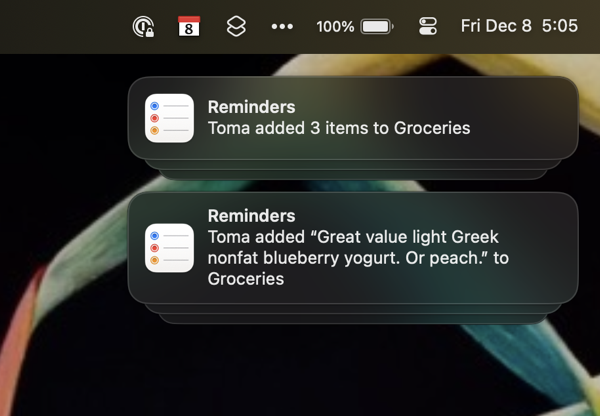
I’m very pleased with the continual progress in the Reminders app. I like using Reminders for shared lists with my wife. But the notifications when adding a shared Reminder to a list need to at least follow the same rule as other Reminder notifications do and disappear after a short time, waiting to be recalled. I used to find it humorous that my wife could add a Reminder to our shared grocery list while I was on the way to the store. But not so funny after I picked up the item and cleared the item in the Reminders app, had returned home and placed the item in the fridge only to find the shared Reminder still showed up on my devices. I let some of these linger for a day once. And they never disappeared until I manually removed the notification.

Stand By

This is a nice new feature that I like quite a bit. Please fix it so the widgets I choose to show stay on the screen and don’t change randomly after I’ve set up my preferences. This feature either needs to be less smart or much more intelligent.

Apple Mail

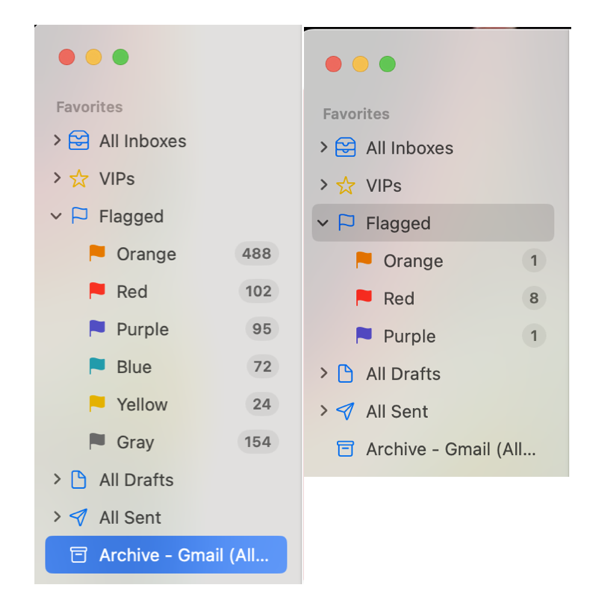
I use Flags and Rules in Apple mail to help me manage my Mail workflow between projects. Different projects have different colored Flags. That works well most of the time switching between Macs. But not always. In fact currently the counts are so drastically off between my two Macs that it’s a little ridiculous. And it’s always changing.

I watch over a course of days how those numbers can change trying to sync up. When the counts get off so drastically, it tells me something is happening server side on the back end. That doesn’t help when I am attempting to use this organization structure to accomplish a task. By the way the differences in numbers is more often than not off between Mac and OS devices also.

I’d also like to be able to more easily track via color distinction those same Flags in iOS by having another menu drop down allowing access to the different color categories instead of just a list of emails with all of the different colored Flags.

When I’m triaging email I’d like to be able to choose a colored Flag after using the swipe gesture to Flag an email instead of having to go back and choose the correct color later.

Consistency Across Platforms

I know things are different between macOS and iOS. And yet, it seems like you keep trying to bring them into more and more into sync. (“Sync” might be a poor word choice there, given all the syncing issues you have. Or maybe it’s just too darn appropriate.) In trying to sync some things up you’ve created some cognitive dissonance and user frustration. These issues cut across Apps and Services like Shortcuts, the Share Sheet, Mail, Notes, Reminders, even Apple Music, Apple TV+ and Apple News. Features are almost the same, but not quite the same enough.

There are times when using a feature on one platform is just a small enough degree different than on the other that it creates a logjam in getting things done and makes me think I’ve lost track of how to perform the task. At times it makes me wish things were more separate and not less. But I know that’s not the goal much less the desire.

Wrapping Up

So that’s it. With the exception of the issues related to iCloud, I think it’s  a manageable list. Here’s hoping Apple’s vision for the future includes cleaning up these longstanding nagging issues before adding new ones on top of the old.

Merry Christmas!

Sunday Morning Reading

Time for another edition of Sunday Morning Reading. Today’s collection is a scattered selection of topics some of which might feel a bit dark. But it is a dark time scattering many of us into our corners or maybe to have an extra drink or two.

Readinginabar

For reasons, other than stupidity, we’re steal dealing with forces that want to ban books in America. This sadly isn’t a new thing, and Chris Klimek gives us A Brief History of Banned Books in America in this podcast transcript from the Smithsonian magazine podcast “There’s More To That.”

What’s happening and about to happen in the Middle East has the world on edge. Technology brings these moments to us in moments. Joanna Stern in the Wall St. Journal gives us a look in When Our Smartphones Became Windows to a War.

Continuing with that news of the moment Anne Applebaum in the Atlantic gives us There Are No Rules. As she describes it, our norms and values define how the world ought to work. We continually learn that’s not the reality.

Here’s a pallet cleanser with the first of a couple of tech topics. Jared Newman in Fast Company takes a look at the note-taking app Obsidian in The Cult of Obsidian: Why People Are Obssesed With The Note-Taking App. 

If you’ve paid attention to my tech writings here you’ll know I’m having some challenges with Apple’s iCloud failings and flailings. I’m not the only one and my challenge isn’t the only iCloud issue. In TidBits Glenn Fleishman describes his in Cloudy With A Chance of Insanity: Unsticking iCloud Drive.

And back on the politics and follies of mankind beat, this piece by Michael Tomasky, I Never Thought I’d Live to See Democracy Die. But Now I Wonder is worth a look. He’s not alone in his wondering if Democracy is just a phase.

And after all of that, if you think you might need a drink, here’s a look at The Bad Law That Made Good Bars, from Peter Suderman on The Raines Law. Never heard of it? Pour yourself a beverage of choice and take a read.

If you’re interested in just what the heck Sunday Morning Reading is all about you can read more about the origins of Sunday Morning Reading here

Time for Apple To Come Clean About iCloud

Dan Moren of Six Colors might have found a hint that might help unlock  the Apple Migraine Mystery I have slowly been piecing  together clue by clue in my ongoing Apple iCloud woes. He recently ran into his own iCloud issues (thought different than mine) and blogged about what he suspects might be one of the root causes. Again, his situation is different than mine, but if his conclusions are correct it comes closer to confirming my suspicions that iCloud is the culprit.

Here’s an excerpt from his post Bitten by the black box of iCloud.

. . . after perhaps 20 minutes on the phone, he seemed to hit on something. I heard him laugh and say something along the lines of “that explains it” and then, with my consent, put me on hold. When he came back, he said—and I’m not exactly quoting, but close enough: “I’m sorry, I can’t tell you any more than this, but all your services should be back up pretty much exactly 12 hours after they went down.”

“I’m sorry, I can’t tell you any more than this, but all your services should be back up pretty much exactly 12 hours after they went down.” It’s a tantalizing clue for what I think might be behind this migraine mystery. Spoiler alert, Moren saw things begin to return to almost normal after waiting the requisite 12 hours.

OIG  1

Backstory

Here’s a brief recap of what I’ve been tracking with my iCloud migraines. All features relating to Continuity/Handoff/Sign in with Watch would just switch off. No warning. No nothing. Just working one minute. Then not the next. Intriguingly I began to notice this would happen on the morning of each new OS update (iOS, watchOS, and Mac). This has been going on for almost a year since the fall of 2022. This includes beta releases since WWDC 2023, even though I ran no betas on any of these devices. The pattern that I began associating with OS releases became apparent to me in late spring of this year. Things flipped off the mornings of iOS (and sibling) releases from 16.4.1 last April and has continued each morning through the release of 17.0.3.

I would try to fix the issues with a series of reboots that for a time seemed to rectify things, but then that eventually failed as a solution. And then I noticed that within a day or so, often the next morning, things would magically come back, with zero intervention from me. Since this fall’s releases of iOS 17 and its siblings this has also occurred with through 17.0.3 which was released on Wednesday of this week.

Add this to the clues.

When this situation first surfaced last Fall I spoke with Apple Support. After jumping through the usual hoops and getting to a higher tier of support we would eventually step through possible fixes until we reached the dreaded “log out of iCloud” solution. I say “dreaded” because if you ever need to do that there’s never any degree of certainity that everything will come back to “normal.”

And then…

I was literally on a support call in July when we had reached the moment I knew was coming. I said to the rep that I was going to have to sign out of iCloud. And the answer was “no, we don’t suggest you do that.” I was floored. This was the first time I had gotten that type of response.  Of course my response was to ask what I should do. I was placed on hold and then the response came “our engineers are aware of this and we suggest waiting until they reach a solution. We’re working on it.” The next morning things were working again.

That sounds somewhat similar to what Dan experienced although there was no mention of a 12-hour timeline. I’ve gotten this “please wait” suggestion on this issue three times now. The third one was a most interesting reiteration of the first two. I’ll recount that below after some more backstory.

Backstory continued

I’ve had two previous show stopping issues with Apple products. Both times I’d reached the point when I was ready to toss in the towel. The first was with the original Apple Watch. The second was with Notes.

Both times I was getting zero satisfaction from Apple Support. So, I decided to write Tim Cook. I explained my dissatisfaction with the lack of solutions. Within a couple of days I got a response from someone obviously higher up in the chain saying they would work to make sure I was satisified. They were always very nice, very thorough and followed up as if their job depended on it.

The first time resulted in me receiving a new Apple Watch after returning the malfunctioning one. The second resulted in me getting connected to an engineer. That experience led to them essentially taking Notes on my account offline after I saved them all locally. They rebuilt my Notes database on their end. Called me back. I logged in and almost everything came back. (The original problem is that Notes would not sync at all and some data was getting lost as I may work situation was I was switching back and forth between devices.)

In both instances in follow up, I was asked not to write about these interactions. Until today I haven’t. So given that after Apple’s latest round of OS updates didn’t solve anything I thought I would reach out to Mr. Cook once again. That third time I referred to earlier was not the charm. Here’s the response I got back:

Hello Warner, 

Thank you for your recent correspondence to Apple. We apologize for the delay in our response.

The parties with whom you have previously communicated are empowered by Apple to address concerns such as yours. In each of your communications you have been provided with the same answer from Apple. According to your case number 102054684817: Apple is still investigating the issue and we won’t be able to provide an exact ETA on when it will be resolved. There is no further escalation point that will deal with this matter differently. 

We regret that you are not satisfied with this response, because Apple strives for customer satisfaction. It is our sincere hope that this situation will not diminish your enjoyment of the products and services that we provide. 

You can also provide feedback to Apple by visiting Product Feedback – Apple.

We apologize for any inconvenience or frustration. 

Kind regards, 

Apple

Back to the plot

For quite some time based on the clues I’d assembled prior to Dan Moren’s post I have thought this issue I was dealing with was tied to iCloud. I’ve gotten no firm confirmation of that from Apple Support. And given that others I’ve talked to about this suffer from different sets of iCloud issues it has literally been a slog to try and piece it all together.

Apple has quite a few services, features, and devices tied into each user’s AppleID. Scratch that. All of them are tied in. You literally can’t go anywhere within the Apple ecosystem without it. Frankly, it’s one of the attractions. But it’s becoming less so. Comments from support personnel and engineers have indicated, but not directly pointed the finger at iCloud as the potential culprit.

And some of Moren’s comments make sense to me along this line of thinking. For example.

Now, in my initial forays on social media, I had gotten a reply from someone on Mastodon mentioning that Apple’s iCloud servers were sometimes put in maintenance mode for 12 hours—but upon going back and looking for that specific reply, it was nowhere to be found.

It did, however, support the theory that something had gone wrong with the particular iCloud server on which my account was located.

In one of my calls I pressed the support person who warned against signing out of iCloud as to why. It was quite telling that I couldn’t get a response other than tacit agreement with my statement that it was problematic that things never came completely back from signing out and signing back in. That didn’t used to be the case. I can’t begin to remember how many times I’ve signed out and back into iCloud at Apple’s suggestion.

Moren did see things “flip” back on 12 hours later. After I read his post I made a note to check things out when I returned home after rehearsal in the evening to see if my devices had seen any such flipping. (My devices flipped off around 8am CDT). I checked about 11:15pm CDT and sure enough everything was working.  I normally don’t wake up my Macs until morning and that’s typically when I would discover things had flipped back on.

So I’m feeling my suspicions firm up.  This is all tied into how Apple’s iCloud services work behind the scenes. Apple doesn’t want to talk about that.  I’m in violent agreement with this statement from Dan Moren:

Moreover, if this was some kind of scheduled procedure, why not warn affected users ahead of time? The idea that my email—which I rely upon for work—and a slew of other services might be interrupted for essentially an entire workday with no notice whatsoever is technological malpractice. My cable company tells me when it’s doing work in my area and there might be service hiccups, and you can bet that the hosting provider I use for my website communicates whenever there might be something that affects my service.

And this:

The thing is Apple fundamentally doesn’t want you to think they’re like “other” service companies. They’re not going to send you emails about upcoming outages, or a digest of all the spam that silently got blocked from your account so you can find the ones that should have gotten through, because it flies in the face of the image that Apple wants to put forth, that their magical system “just works.” But the problem with a black box is that once you’re inside, you have no idea what’s going on—and it’s even harder to get out.

Look. I get it. There’s no easy or ideal time if there’s work of some kind going on in the backend that might lead to a service disruption. But Apple should at least empower its support personnel to communicate to users who call with an issue if that is the case. Even if that won’t solve the problem until some engineer somewhere flips things back on, it would at least remove some frustration and wasted time in the support conversations.

I’m beginning to think that Apple keeps this as another one of its secrets from not only users but user facing personnel as well. If so, it’s a self-destructive policy that gives lie to Apple’s image-making. Even if “a small minority of users” are facing this issue at any one time. If true, it certainly speaks to how Apple values what it perceives as its reputation over the cash value of paying Apple support personnel to sit on lengthy support calls that can’t offer answers.

I encourage you to read Moren’s post in full. In the meantime maybe I’ll find and configure a 12-hour timer as one of the fancy new interactive widgets that I can activate the next time Apple flips the switch.