
Too Many Frankensteins

There’s a reason they call it science FICTION.

Why does no one ever read the end of the story? Or if they do, why don’t they pay attention?
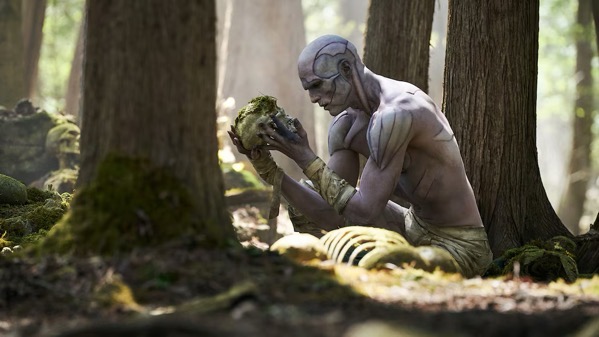
A publicity still from Guillermo del Toro's Frankenstein featuring a sunlit forest surrounded by tall tree trunks, a pale, muscular humanoid creature with light purple skin and ridge-like markings on its head and shoulders crouches on the ground. The figure wears cloth wraps around its forearms and waist, and holds a mossy human skull close to its face with a somber expression. Partial human skeletal remains, including a rib cage, rest on the mossy forest floor in front of it.

Ever since Mary Shelley gave us Frankenstein, laying out a moral of a story proving that just because you can, doesn’t mean you should, there seems to be a preponderance of ignorance running alongside the obvious capabilities our current day Dr. Frankensteins possess. It feels like the story is playing on an endless Youtube Short or TikTok or Reel without ever reaching the end and the story’s point. The only thing coming close to the volume of ignorance is the overdose of hubris that someone must be selling somewhere on some street corner. Or maybe it’s testosterone injections.

Whatever it is, whether in tech and AI, politics, sports, media, or fill in the blank for any field that can issue a press release and attract attention like flies to rotting flesh, it’s past the epidemic stage and has spread like a plague.

The fever stokes flames on Wall Street, which seems content to fuel them further until it all melts down. As long as they make their fees. Makes one wonder how the prediction markets on any number of popping bubbles are doing?

Between AI companies climbing over each other to fight over which model can cause more damage when they break free, companies creating horror movie-like robots to do damage control in dangerous circumstances, companies working to create AI powered glasses that will be used for mass surveillance — much less trouble making privacy violations, the tech sector seems to be outrunning the rest when it comes to the mad scientist wannabe game.

Politicians aren’t far behind, lagging only by their inability to keep up with and understand the changes happening around them as they count the cash being stuffed in their pockets. Sports teams intent on winning today don’t seem to care that they may be permanently damaging their game.

And there’s a media that doesn’t actually care who wins and who loses as long as they have access to the story of the rise and the story of the fall. Imagine if today’s media had covered Dr. Frankenstein’s efforts the way they cover Musk, Altman, Zuckerberg, or any of the others.

It’s too broad a generalization to say these stories never end well, even though many fail whether the consequences are intended or not. But in a world seemingly being driven by a bunch of geeks who profess a love for science fiction, and those who can’t help but take their money to drive their own ambitions, you’d think someone along the way would understand that they don’t get to write the end.

But that would require more than reading a summary.

Thanks for reading. You can subscribe to this blog if you care to. You can also find more of my writings on a variety of topics on Medium at this link, including in the publications Ellemeno and Rome. I can also be found on social media under my name as above. This site does not use affilate links.


Andor, Or We Are The Heroes We Need

Echoing Tina Turner

The ever expanding universe of the Star Wars franchise is one that often leaves me colder than I imagine I’d feel if I were floating alone in space. That’s the same with most of these run the IP into the ground franchises. When something comes out of those factories that’s actually decent, it’s a surprise. One of the surprising beacons of warmth has been the Andor series, which is currently streaming in its second season. I’m also a fan of the movie Rogue One for which Andor is a prequel.

P22265604 b h8 aa-e1673489907972-900x561.

Yes, the story is about the rebel rebellion against the Empire, but there’s something different about Andor. Recently I read a piece from Derek Pharr on Nerdist, Hope Without The Force: How Andor Rewrites Rebellion. It helped me put my finger on why the show feels different and surprisingly current beyond the scope of small screen entertainment.

Here’s a quote:

Andor makes the quiet argument that the Jedi weren’t just irrelevant to the uprising against the Empire. They were liabilities and detached from everyday suffering. The Jedi were fixated with balance and prophecy, and wildly ineffective at stopping fascism when it counted. The Jedi Order had their shot. They blew it. Meanwhile, on Ferrix and Narkina 5, regular people are building the rebellion through sweat, sacrifice, and solidarity. Not the Force.

Whether you are a fan of the series or not, I encourage you to read the entire piece. Pharr’s thesis is indeed a good one about the series. But for me it spins off into many of the challenging moments we face today in the wake of our own evolving evil empire. One that’s certainly not intelligently designed, much less preordained.

Bottom line, it’s going to come down to those of us on the ground.

I think we need to eternalize and begin acting on that instead of waiting around and looking for heroes among congress critters, political parties, media mouthpieces, TV lawyers and those at the bar, or even judges to come to the rescue. We know what’s ahead is going to continue to get uglier. We’re probably going to have to meet ugly with a little ugly ourselves. Cue Tina Turner’s We Don’t Need Another Hero.

As Pharr puts it,

The Jedi were legends. The rebellion was real.

No elegant solutions from a more civilized age. Just people. Flawed, desperate, courageous people, who decide enough is enough.

He also argues that noble as they were, the Jedi were spectacularly bad at saving things in their attempts to reclaim balance. I don’t know about you, but that sounds frighteningly familiar.

Read Pharr’s piece if and when you watch Andor. If you don’t watch the show, read the piece anyway.

Pie in the sky? Perhaps. But I’ll take a serving and ask for seconds.

You can find more of my writings on a variety of topics on Medium at this link, including in the publications Ellemeno and Rome. I can also be found on social media under my name as above. 

Problematic 3 Body Problem

I both enjoyed and was ultimately left frustrated by 3 Body Problem, the Netflix adaptation of Liu Cixin’s sci-fi novel The Three-Body Problem. Thanks to fellow Mastodonian @RickiTarr I was finally able to put my finger on the source of my frustration.

I both enjoyed and was ultimately left frustrated by 3 Body Problem, the Netflix adaptation of Liu Cixin’s sci-fi novel The Three-Body Problem. Thanks to fellow Mastodonian Ricki Tarr I was finally able to put my finger on the source of my frustration.

Set aside the twists and turns through physics, politics, battles with cancer, romance, and everything else this story throws at you. The fundamental fight focuses on  humans who understand that an alien race is coming in 400 years to wipe out our civilization.  The aliens are doing so to save their own.

Given that we’re a species that can’t deal with more immediate threats currently facing us in far closer futures it’s hard to imagine trying to marshall the solidarity and resources to try and stave off a threat 400 years in the future. And that’s not even the problem in the title.

There’s not too much discussion of that in the show. Which is probably a good thing for how the storytellers want to unfold their story. But it puts us at a remove that left me and my wife joking throughout the series that Netflix has 400 years to unravel this tale.

Once the alien threat is revealed to all there are the usual sci-fi tropes about how those under threat deal with all such threats, but things quickly focus back on the main characters and their attempts to try and change what’s coming. As far as this adaptation is concerned everyone panics, reacts and then essentially shrugs and leaves it to a group of smart guys and gals to figure out.

I kept waiting for the 3 Body Problem metaphor to manifest in main character chaotic orbits as their arcs developed, but their orbital paths were all too damn predictable to cause the sort of friction that might have ignited the story, much less take hold with any metaphorical meaning.

As I said in the beginning I took some enjoyment from the experience. Some of the individual threads were captivating in and of themselves, but ultimately not enough to recommend the whole.

You can find more of my writings on a variety of topics on Medium at this link, including in the publications Ellemeno and Rome.