Well now. I wish I could say I’m surprised. But I can’t. After reading and watching reviews of Apple Vison Pro there weren’t many suprises in the many lists of pros anc cons. Well, maybe one. I’ll still be looking forward to real users trying it out and posting their reactions, along with the tech press that didn’t get in on the review cycle. But by and large everything I’ve seen confirms what I’d already imagined..
It’s a terrific piece of tech by all accounts, albeit a bit heavy. Yes, there’s some intriguing tech and quite a few innovations. Yet it is still a very version 1.0 device that I’m perfectly happy to let others discover the ins and outs of as Apple continues to advance this new platform. $3500-$4000 is a steep price for beta hardware and a software eco-system, no matter how much of a new paradigm it seeks to introduce. The interesting thing to watch will be how many developers work to create for the device.
The other interesting theme that runs through these early reviews is that while Apple Vision Pro might open up new worlds it only does so for the wearer. It’s a solitary device. There’s no escaping that this is a device for isolating yourself in those worlds separate from the one around you.
The one surprise I mentioned is that Apple marketing apparently goofed big time when they rolled out the device regarding the EyeSight feature. You know the one when someone can see your eyes, or rather a digital representation of your eyes. Those pictures were everywhere, and apparently the reality is most of the reviews indicate that the feature doesn’t match the hype. No wonder there have been rumors that the EyeSight feature might not survive into future versions.
As for me, I’ll journey to an Apple Store and try it out at some point. Meanwhile I’m stting this one out for who knows how long. I still find the spatial computing concept intriguing and promising. I imagine that might be the way long after I’m gone. In the meantgime I hope it actually turns into something useful beyond just watching entertainment. But maybe that will be enough.
That said, here are some links to some of the reviews and articles, (one featuring Tim Cook wearing the thing), that I found worthwhile. There are plenty more out there. There’s a combination of writing and video, so pick your poison. The first two links really offer comprehensive coverage. Or as comprehensive as you can get this early in the game. The real story will be told down the line.
You can find more of my writings on a variety of topics on Medium at this link, including in the publications Ellemeno and Rome and check out The Lehman Trilogy Diarieshere.
Apple started taking pre-orders for the Apple Vision Pro this morning and the excitement from those jumping into the pond for this first generation new device is running hot. It’s fun to see. I’m glad to see it. I’m not jumping in. I’ll be anxious to see how real users report their experiences as opposed to all the very clever and promotional marketing Apple has released.
Apple released a couple of videos about the experience that I’ll share below. Slick stuff. But I’m more interested in the real world impressions and wondering just how those are going to be conveyed on the web. Since those who pre-ordered will start seeing deliveries in February it’s going to make that an interesting month to follow the news on this device.
This next one is a “Making Of.”
Don’t get me wrong, I’m not doubting that this is a cool new thing, but just like with the first gen iPhone I’m not gonna early adopt (especially at these prices) until we’ve got some real world feedback. Or is that virtual world?
I use Apple products. Have for awhile. Computer and mobile tech is a hobby of mine It’s a hobby I care profoundly about for a myriad of reasons. I feed that hobby with Apple’s stuff because quite simply I prefer those products to others currently on the market. When friends tell me it’s an expensive hobby I often reply with questions about their golfing habit and course fees. (I have a lot of friends who play golf.) So, in my mind it all equals out. But yes, it’s expensive. I don’t chase tiny balls around a golf course. I do chase technology for all the fun, foibles and foolishness it can sometimes provide. I also use it for work.
Now, do I think Apple is the be all and end all? Absolutely not. Apple pisses me off almost as much as it delights me with some of its products. (Here’s looking at you iCloud.) Apple also pisses me off at how it hides behind its “majority of users are satisfied” and “small minority of users” PR lines. That does nobody any good if there’s an issue affecting them but not the majority of users. I also have come to believe that Apple’s luxury of taking the long view is starting to hurt a bit when it comes to issues with current products on the market. Lately, I also think their design acumen is not up to the standards they’ve previously set and that they’re caught in a trap of their own making. If we pay for the train ticket we’re entitled to complain about the ride.
I’ve written a bit about all of that here and in other places. I’ll continue to do so. But everything in life is a trade off, and in my view there are less of them with Apple’s products than with others.
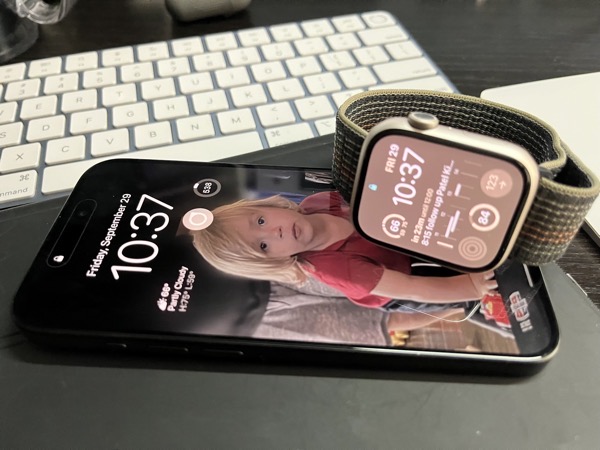
All of that out of the way, yes, I buy a new iPhone each year. I sometimes do the same thing with the Apple Watch. I typically hang on to iPads and Macs through as many cycles as I can. This year I’ve purchased an iPhone 15 Pro and an Apple Watch Series 9. The iPhone is a year over year upgrade. So is the Apple Watch. Below are my initial thoughts on each. I’ll also link to other helpful sources of information and some reviews along the way that provide more than just the impressions I’m jotting down here.
As I’ve said before we’re in a wait and see game with most Apple products. We’re waiting to see what happens with the Vision Pro and spatial computing. In that context, everything is pointing towards that future with this year’s crop of Apple hardware and operating system releases yielding what feels like moderate, not wow inducing updates. Nothing wrong with that. The iPhone is a stable and staple product. Each year’s model deserves and demands something new. There will be plenty of folks in the market for new or upgraded devices between now and “early next year.” These products certainly look to fill the bill. As for the Apple Watch, there is also a major redesign with the user experience that I’m not sure actually works for current users looking to upgrade. Again, I think it’s pointing towards the future.
iPhone 15 Pro
I’ve had the iPhone 15 Pro for a week now so that’s what these impressions are based on. First impression: Nice. I could leave these impressions with that one word. Nice. Maybe I’ll add a second word. Nice Action.
Upgrading an iPhone year over year you don’t see great leaps, especially in the 3-4 year cycle Apple relies on for each design. Obviously there are many reasons for that from costs to the fact that most iPhone users don’t upgrade every year. But as someone who’s owned every iPhone since the 3GS, I’ve been pleased with each device’s design change. The big exception for me was the leap from the iPhone 4/4S to the iPhone 5.
Design
The first thing right out of the box I immediately noticed and liked about the iPhone 15 Pro is it feels lighter in the hand and the slightly rounded edges do make a difference. Tangibly so. The weight and small shape differences are very noticeable in my hand, my pocket, and when attached to the ESR Magnetic Wireless charger in my car driving over the very bumpy backroad to my in-law’s lake house. With the iPhone 14 Pro I’d have to take it off of the charger to keep it from tipping down or falling off. With the 15 Pro it held its orientation.
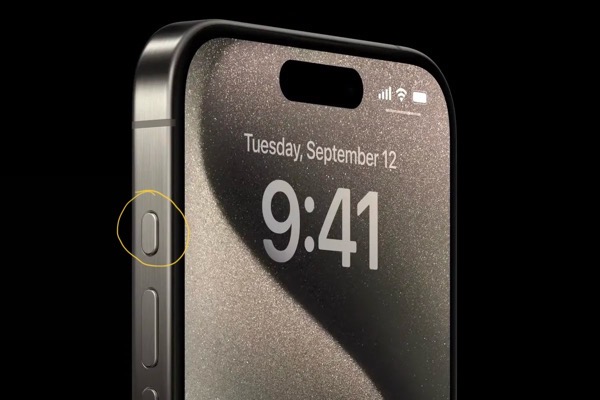
Next up is the Action Button. Great addition. I like it a lot.
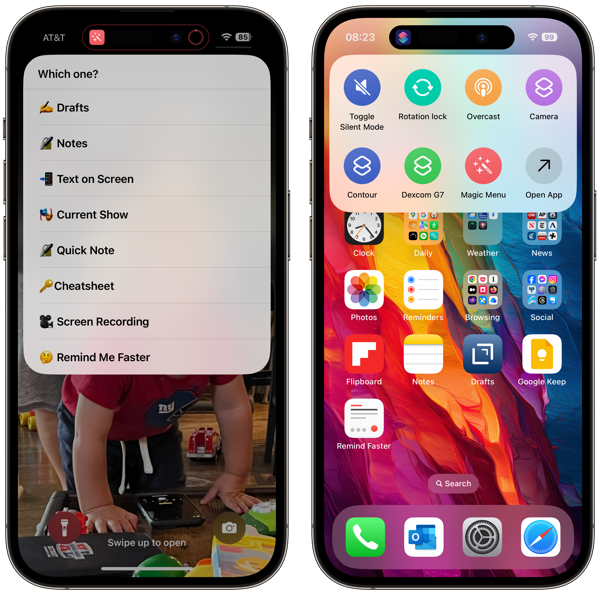
The Action Button replaces the switch to mute the phone. You can still mute the phone with the Action Button or in Control Center. You can also use it for other purposes you can configure in Settings. I’ve already configured it to use Shortcuts so that it’s more than a single use thing. And that’s why I think the Action Button is a more than significant change.
Unlike last year’s big shiny new feature the Dynamic Island, the Action Button is something users can take advantage of to make their iPhones much more personal. The Dynamic Island required developers to add features in their apps. To be honest I’m disappointed in the lack of apps I use that take advantage of it. But the Action Button, combined with Shortcuts gives users so much more to work and play with. For those not afraid to dip into Shortcuts it’s a real way to personalize an iPhone. I’ll be putting up a separate post about some of my experiments with the Action Button shortly after this one.
I do have one complaint about it though. Its placement on the device just above the volume ringers is odd. I have not yet developed enough muscle memory to consistently find it instead of the Volume Up button. To my mind, and my reach, it would have been better placed below the volume buttons. But as far as I’m concerned the Action Button is this year’s biggest, best, and winning new feature.
As for the big push to Titanium, well ok. It does improve the weight so that’s a plus. I wasn’t enamored enough of the look and feel of the devices in the Apple Store on release day to say it is that big a deal cosmetically. If going caseless is your thing, perhaps it makes a difference for you. But with this year’s color choices I don’t see it or feel it, beyond the weight difference. And perhaps that’s enough. Regarding colors the same goes for the iPhone15 non-Pro. If you ask me Apple’s color design team more than lost a step this year. Color me not impressed.
Camera
Every year Apple promises and delivers camera upgrades. This year the big upgrade came to the bigger iPhone 15 Pro Max only. Apple didn’t leave out the smaller 15 Pro however. The iPhone 15 Pro uses the sensor, machine learning algorithms and the number of pixels in different ways. That gets into more numbers, math and wizardry than I want to explain so I’m linking to this PetaPixel article by Chris Niccolls on the camera improvements in the iPhone 15 lineup if you’re looking for more details.
One big change that I think will be widely used is the new Smart Portrait mode. You no longer have to set the camera to take a shot in portrait mode. You can do that after the fact while editing in the same way Apple introduced this for video last year. This is a real win.
In my experience with the new camera I do see improvements. I’m still very impressed with what we can do with smartphone cameras. I like taking photos with them. It’s a hobby within my hobby. Below are a few images I’ve taken in various places.
One thing of note about the video capability. Pointing to the Vision Pro and spatial computing future the iPhone 15 Pro lineup has moved the lens arrangement on the back of the iPhone to better align them for spatial video. This is so that when the Vision Pro devices are released “early next year” there is an iPhone on the market that can shoot spatial video needed for that tent pole feature promised for new headset. I’m not surprised by this. Apple needed iPhones capable of shooting spatial video when the headset rolls out. They weren’t going to wait until next fall. But the spatial video feature for this year’s crop of iPhone Pros is promised for a future iOS 17 update. Pointing towards the future is a recurring them with this year’s Apple devices.
USB-C
Another big change is Apple replacing the charging port to USB-C from Lightning. A lot of folks tried to make this into a “users will be upset and this is just a cash grab from Apple” thing. The good news is I don’t think it took. From my impressions no one is that aroused with new plugs for new holes. I’m happy to see the USB-C port and everything it brings. Some have had quite a bit of fun connecting all sorts of things up to an iPhone. Check out this video from Stephen Robles. I imagine we’ll see much more of that. I also imagine we’re going to see Lightning cables still in use for other Apple accessories and earlier model iPhones for awhile to come. Evolution is a slow process even when intelligently designed or prodded along by the European Union.
Processor
The iPhone Pro lineup features a new chip in a new size. Apple reduced the chip size from 5 nanometers to 3. And this year’s version is called the A17 Pro. The size difference in the chipset is supposed to yield reduced power consumption and increased performance. The GPU (graphics) got most of the bump and Apple is making a play for the gaming market. Here’s a subtle hint from Apple on that.
The only notable difference I have seen since the release of iOS 17, a few days ahead of the iPhone 15 Pro release, is faster responsiveness with Look Ahead typing and autocorrect than on the iPhone 14 Pro. Time will tell. But really we’re reaching a point that these improvements in Apple Silicon year over year don’t yield big notable jumps that the average eye is going to notice.
There’s been some concern about these models getting warmer than some feel comfortable with. Early thoughts focused on the new chip. Noted Apple analyst Ming-Chi Kuo has cast some doubt on that. That story continues to heat up and I imagine we’re going to hear more about this in the days and weeks to come.
On that front I’ve had two experiences when I noticed warmer temperatures than I expected. I shot a little slow motion video (about 2 minutes each for several clips) and noticed the iPhone got really warm.
This morning as I was proofing this article with my iPhone sitting on my desk, not charging, and not being used for easily 40 minutes or so, I noticed when I did pick it up that it was quite warm, more so than usual. That’s almost a full week after setting up the device so I would think that all of the new phone indexing and stuff behind the scenes would have already settled down.
That’s it for initial impressions of the iPhone 15 Pro after a week of using the device. I’m pleased with it. There are some issues and some big wins. The Action Button is terrific. Smart Portrait mode is a win. The lighter weight and better feel are a win. And there’s lots of wait and see’s. Even so I’m glad I indulged my hobby again this year and I’m sure I’ll have more impressions down the line. Not being one to use these devices without a case there’s a story about that as well.
FineWoven Cases
If there’s a controversy or a -gate with this year’s products it’s with Apple’s FineWoven iPhone cases. Meant to replace Apple’s leather cases as a big nod to saving the environment, Apple’s FineWoven cases (and Apple Watch bands) were touted as a very green replacement for the leather products. I think everyone, including the powers that be, assumed Apple would get this right. That’s not the case.
I ordered one. I’ve returned it. It certainly did not feel as nice in the hand as the leather case or worth the same price. From many accounts it doesn’t hold up or age as well in normal usage. There were stories of deep scratches and unremovable stains. There were also photos of scarred cases on Apple displays in stores forcing employees to continually swap them out. That all surfaced before I received mine, so I was extra careful trying it out. But the point of using a case is to not have to be extra careful. While I didn’t object to the new feel of the case, I could easily tell it would not stand up over time.
Someone(s) at Apple goofed big time here. The leather cases certainly showed wear and tear, but that developled over time as is always happens with leather. Not just with one day’s usage. And the properties of leather vs fabric, fine woven or not, make that an entirely different and actually desired experience.
In addtion to the look, feel and durability of the cases, Apple apparently goofed on the cutout surrounding the USB C enclosure. There are reports that the cutout is misaligned so that you can’t plug in a USB cable. I don’t think that’s universal, but that actually makes the problem a bigger one. That might not be surprising in a cheap 3rd-party case. But for Apple that’s just sloppy and out of character.
Bigger pictiure, Apple not only goofed with the design and manufacture of the cases but they’ve busted a branding attempt that I’m sure cost a lot of time and money to create. Whatever happens going forward I doubt we’ll see FineWoven Apple products except as the butt of jokes and memes that rival some of Apple’s other failures.
Apple Watch Series 9
As pleased as I am with the iPhone 15 Pro year over year I’m almost the opposite with the Apple Watch Series 9. Almost. My disappointment isn’t with the hardware. How could it be? By and large it’s the same hardware as the previous two versions with a brighter screen, more memory and a faster processor. All good things. And hey, it’s Apple’s first fully carbon neutral product. So, no issues with the hardware.
I have do have irritations with the UI changes Apple has introduced. Some of these may be less irritating as I get used to them. I’d like to charge this off to something new and different that needs a period of adjustment, but I don’t think that’s going to prove out. Apple makes the whole widget, hardware and software. Usually that benefits users and the company. Apple also calls the Apple Watch it’s “most personal product.” This feels like a case when the new design and “whole widget” philosophies went too far for a device that I indeed feel very personally attached to.
Apple changed which buttons do what on the Apple Watch. Apple also introduced Widgets in what feels like a move to make them the primary interface. Swiping left to right to change watch faces is also gone. There’s logic to these changes. But I am admittedly flustered by them.
Previously, primary interactions with apps were through Complications that you could set for watch faces. Some watch faces could have more. Some could have very few, if any. I actually had different watch faces with different sets of complications for different facets of my work and play. Now, regardless of which watch face you choose you can swipe up from the bottom of the screen or scroll the Digital Crown to access the widgets you choose to place in what Apple calls the Smart Stack. Think of it as a vertically scrolling half-carousel. It doesn’t go all the way around. The logic is sound here.
While this new metaphor makes more sense for user interaction on more watch faces, you also can’t swipe back and forth to change watch faces without first long pressing on the screen. So it feels like a win that is also a loss.
The other biggest loss is that I can no longer call up a list of my favorite apps. Previously you called them up by pressing the Side Button. That interaction is now gone and replaced by using the Side Button to access the Control Center. You can also no longer set Favorite Apps. I don’t use many apps on my Apple Watch, but the few I do use I do so regularly.
I’ve added the widgets for those apps into the Smart Stack. The “smart” in that stack of widgets is supposed to show you the widget you need when you need it, or when Apple thinks you might need it. So far in my case that hasn’t proven to be anywhere close to being true. Perhaps it’s too early to make that judgment. But things just feel wrong with the constant lineup of the Smart Stack changing as Apple feels it should I have to constantly scroll back and forth to find the app I’m looking for.
Here’s another example. The photo below is of a completed timer. That big circle in the middle is begging to be tapped to close the timer. But to actually close it, you need to hit the smaller X in the lower left. This interface shows up in several instances in several of Apple’s native apps. It just seems confusing.
So it feels like Apple goofed here. There may be a longer term vision here, but the luxury Apple has of looking far ahead seems to have confused the moment for this year’s Apple Watches.
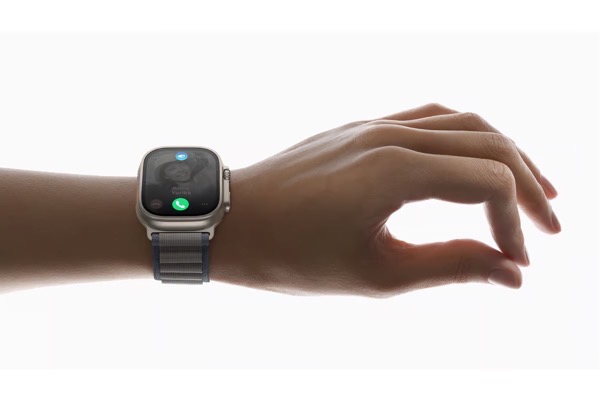
Speaking of looking ahead, there’s also the Double Tap gesture. The feature allows you control the watch by double tapping your thumb and finger together. It’s a way to interact with the watch that is right out of the Vision Pro vision. The feature has sorta, kinda existed as an accessibility option previously but is now a part of the operating system. Or soon will be. It’s due to come later this year, even though it was ballyhooed quite a bit when it was unveiled. It’s somewhat surprising it wasn’t ready at launch. Indications are it will show up in watchOS 10.1, but it wasn’t included in the first release of that beta for developers. So we’ll see.
Siri does feel a bit faster and more accurate. That’s because some of what Siri does happens on device. Some requests still do roundtrip to the Internet, but by and large you can feel a positive change. I use Siri on my Apple Watch more than on other devices and always to mixed success. Siri is one of those features that seems to suffer through good and bad periods for no discernible reason so let’s hope there’s more consistency with some of its functionality happening on device.
One other thing that surprises me is transitions from Notifications back to the Watch Face. The animations feel janky. I noticed this after installing watchOS 10 on the previous Series 8. I thought perhaps that was just an issue that would be rectified with the new performance on the Series 9. I was wrong. Those transitions are still not smooth and still quite janky. Not optimal. Here’s a short video of what I mean.
So that’s it. Initial impressions on the iPhone 15 Pro, the Apple Watch Series 9, the FineWoven cases and some other things tossed in the mix. I’d rate this Fall’s Apple product releases as a B-. The iPhone I’d give an A-. The Apple Watch Series 9 a C. The FineWoven case is just a failure.
I’m going to list some resources here for you to find out more details and also some fun. These folks have provided good coverage since the release of the new iPhones and operating systems, but also in some cases during this past summer’s beta process. I hope you enjoy and get benefit from their stuff as I do.
Apple has announced new iPhones and Apple Watches for 2023. They look nice. They always do. Apple by and large held prices at the same level. There are improved cameras in the iPhones. There’s Titanium on the Pro models. The Apple Watches get a new chip set, more memory and brighter screens. There’s a new 3 nanometer chip in the Pro iPhones and Apple is working hard to save the environment and tell you about saving lives.
And it all sorta, kinda feels obligatory.
Even coverage of the event and the devices feels a bit underwhelming. (Except for the derision being tossed around over Apple’s environmental efforts video featuring Octavia Spencer.) I’m betting the reviews will feel lackluster too. There’s a reason for that. Until at least “early next year” Apple’s vision for the Vision Pro and spatial computing is sucking up all the space, time and energy. What we’re seeing with this fall’s release of new iPhones and Apple Watches, and anything else that might come later, is merely marking time to keep the money machine churning until Apple flips the switch on its new paradigm.
Don’t get me wrong. The new iPhones and Apple Watches look like very nice devices. For those ready to upgrade or jump on the Apple bus for the first time I’m confident they will feel good about the devices they choose. We’re certainly not in any post-iPhone period. As I’ve said here and other places this is a mature product line and we’re seeing more iteration than innovation. It’s tough to make big splashes with iteration. And it seems like even Apple’s design folks responsible for colors are putting their focus elsewhere. For the most part, this is not going to change until after “early next year.” And maybe not even for awhile after.
But Apple did drop a few clues and if you’re paying attention it’s not hard to piece them together to suss out where things are headed.
We’ve become accustomed to the iPhone being the center of Apple’s universe. That will continue for quite some time to come. But in Apple’s universe the future belongs to spatial computing. No one knows when and exactly how that future will arrive, but Tim Cook is taking steps to make it possible. And we saw some of those steps and clues at this iPhone and Apple Watch event.
The first clue was lifting and refining the Double Tap gesture for the Apple Watch out of the Accessibiility options, where it has already been available, and making it a full-fledged feature of watchOS. The Double Tap got tent pole time at the event. And if you’ve been paying any attention at all to Vision Pro and spatial computing you immediately recognized that gesture from what Apple has revealed one of the ways users will interact in that new world.
Another big clue was the announcement that the new iPhone 15 Pro models will be able to record spatial video. That only makes sense. Spatial video from what everyone who has demoed the headsets says is pretty amazing to view in those devices. If Apple meets its target and releases Vision Pro devices “early next year” with spatial video as one of the signature features it doesn’t want to wait until next fall to have an iPhone that can record it. Yes, you can use the Vision Pro headset to record spatial video, but just about everyone agreed that poor dad at the birthday party looked pretty darned creepy.
iCloud storage capacity levels are getting a bump up to 6TB and 12TB (at a price). I’m guessing those spatial videos will take up quite a bit of room.
Apple told us up front in the event that the focus would only be on new iPhones and Apple Watches. The pre-event rumor mill had pretty much quieted down talk about new iPads and Macs, much less anything about Apple TVs and other gear. So this annual fall event happened in essentially routine fashion. No big surprises, no “one more thing.”
There are folks that think we may see another event this fall regarding Macs and iPads. But I don’t think so. We’re not going to see new Macs until after we see the Vision Pro released. The reason I think that is one of the signature features of the Vision Pro and spatial computing: the ability to see and work spatially with the apps on your Mac.
I may be completely off base, but “early next year” sure seems like the perfect marketing one-two timing punch to sell newer Macs. I’m not sure how the iPad fits into that picture though. Which, as an iPad user is slightly concerning.
Spatial computing is the vision for the future. For better or worse Apple is taking us there. Until “early next year” things are going to feel a bit obligatory and routine when it comes to the current product lineup and maybe next year’s as well given that we probably aren’t going to see mass consumer take up of the Vision Pro in year one.
There’s nothing wrong with that. If Apple’s spatial computing bet on the future pays off then, at the moment, it feels like Tim Cook has timed this transition well. There are certainly enough iPhone users out there who will need and want to upgrade and there’s going to be a new iPhone every year going forward for quite awhile. But the vision is shifting and so too should our expectations.
Apple is about to unleash its annual storm of iPhone news next week when it unveils the 2023 edition of the computer that changed everything. There will be a flood of impressions initially, good and less than good, and we’ll be wading through high water right into the holiday season.
So why is it raining thoughts about iPads?
Probably because it doesn’t look there will be much in the way of iPad news at this event. And from what we know of iPadOS the big news seems to be correcting the goofy mistakes made last year with Stage Manager. I also think that since this year’s iPhones and Apple Watches are rumored to be more interative than innovative, and much of the pent up energy is focused ahead to next year’s release of Apple’s Vision Pro, AND the predominant iPad rumor is that the 2024 iPad will feature big design changes, there’s room to kvetch a bit.
Don’t get me wrong about the iPhone. I don’t think iterative is a bad thing. The iPhone is mature platform. In and of itself that’s a great thing. But that doesn’t set the tech pundit heartbeats a-fluttering as much as the potential for bigger innovations.
Nature abhors a vacuum and so does the Internet. So why not talk about everyone’s favorite Apple mystery: iPad.
Why a mystery? No one seems to know exactly how to define this device. Including Apple.
Before moving on let me say this. I’m an iPad fan. I’ve owned most of them, currently the latest versions of the 11-inch iPad Pro and iPad mini. I use them both daily (along with Macs) for both work and play. I’m typing this currently on the iPad Pro while visiting family. There hasn’t been one too far from my reach since the first version. It’s my favorite work device and my favorite stall surfing device.
Here’s a quick summary of what some are saying:
Jason Snell of Six Colors kicked off this current wave by saying he’s Giving up the iPad-Only Travel Dream. He’d like to see the iPad capable of more functionality with Apple opening the platform up for developers and users to more easily extend it to their heart’s content.
John Gruber picked up and extended that argument on Daring Fireball.
Much of the mystery isn’t really mysterious. It’s that there seems to be no Goldilocks answer. The pro-users want more and the extremes in that camp won’t be content until the Mac and the iPad are one and the same. In the middle, the iPad Air line offers most users much of what the Pro offers but holds back a bit. The iPad without a modifer offers even less, but compensates with a price point that makes it popular for those who just want to stream entertainment, do some browsing, FaceTime, or shut their kids up by letting them stream CoComelon.
And the iPad mini is caught somewhere in the middle. In my view the iPad mini is the most hindered by Apple’s attempts at segregating the lineup beyond size. Goldilocks might have called it “just right.” It’s the device I pick up the most.
Unless you measure success merely by sales charts, there’s nothing wrong with there being some confusing segmentation. On the other, what we currently know (and use) in all computing categories is constantly changing around and underneath our finger tips. Apple Silcon changed everything, including, I think, Apple’s plans. All you had to do was watch the “What’s a computer” commercials in the last decade to see where things seemed to be headed.
And if you think that spatial computing, the concept behind Apple’s Vision Pro, wasn’t in the works when those commericals were approved and aired, you’re mistaken. Whatever spatial computing is going to be it is going to profoundly change things.
It’s hard for the pundits when Apple’s cues aren’t easily decipherable. In my view it’s less, but still so for consumers. I’ve yet to read a review of any product in any category that calls it perfect without calling for more. Goodness knows how confusing things will be in the future if spatial computing’s future offers a lineup of products resembling anything close to current speculation, from contact lenses to powerhouse gaming headsets.
So I say enjoy the ride while the riding’s good. There’s no Goldilocks iPad for all. There’s no Goldilocks computing platform for all. There probably shouldn’t be and I hope that always remains the case. Niches can be nice. And besides, we’d all be bored and begging for more anyway if the game just stopped. Just look at the lack of excitement about this year’s iPhones and Apple Watches.
















 iCloud storage capacity levels are getting a bump up to 6TB and 12TB (at a price). I’m guessing those spatial videos will take up quite a bit of room.

 Life on the Wicked Stage: Act 3