
Souring On Artificial Intelligence

The new butt of family holiday jokes

There’s an interesting article in the New York Times called Why Do Americans Hate A.I.? The article goes through the litany of some of the bugaboos just about anyone can recite from memory these days: jobs, trust, and agency. As fast as Artificial Intelligence has dominated the conversation, warnings about the pitfalls have run side by side in what I think resembles a barefooted three-legged sack race over broken glass.
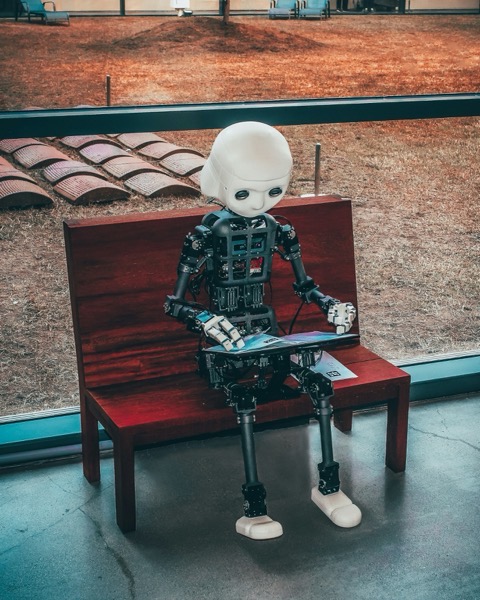
Andrea de santis zwd435 ewb4 unsplash.

Over the holidays at what seemed like an infinite number of family gatherings I picked up on some interesting themes that I mentioned in my end of year post about all things Apple that I think is worth calling out here again. Everyday Janes and Joes are souring on artificial intelligence, not for any of the now almost clichéd anti-AI reasons, but after everyday unsatisfactory encounters with their doctors, banks, and any number of the other institutions and business that they deal with.

As I said in that post about Apple, 

I also think Apple and the other tech companies need to pay attention to the warning signs that are starting to bubble up about Artificial Intelligence. I think most of the growing distaste of AI comes not from what these tech companies are offering on computing platforms, but from the day to day encounters people are experiencing in their daily lives as more and more non-tech companies roll out versions of AI support. The way I’m hearing and feeling it, jokes and complaints about AI at holiday gatherings this year are starting to compete in numbers with ones about government and politics.

Because money rules the roost, most of the conversations we hear about Artificial Intelligence center on how much money is being spent propping up and expanding the bubble that is keeping a sagging economy afloat like a hot balloon on a cloudy day. There’s only so much liquefied propane in any tank once things lift off.

Here’s the thing about holiday family gatherings. I can’t remember one when conversations didn’t at some point offer up a “you’ve got to try this” recommendation or some sort of eye-grabbing new thing  or trend that captured attention along with the usual complaints and grievances. But AI-negative conversations seemed to take precedence on the grievance side of the ledger this year.

Everyday folks don’t care about who wins the AI technology race or who has the best on device AI or how many tokens a system offers. They care about getting results in less time and more so, getting it done with a human they can talk to, not a robot in a chat window. So far based on the jokes, swearing and condescending attitudes I’m hearing (anecdotally, I admit) everyday folks aren’t buying the pitch, but they’re getting closer to picking up the tar.

We can talk about data centers, job efficiencies and job losses, chatbots, AI slop, and scientific advancements all day long, but when everyday folks on the ground develop a distaste for what you’re selling and turn your efforts into the butt of a joke, eventually you need to discount or clear out the inventory no matter how many data center servers you pop up.

Even so, perhaps that’s the aim of the A.I. purveyors. If they salt the fields with enough of their product to the point that everyone condescendingly abides it the way they do government, it may not matter if it doesn’t offer any harvest that yields nutrition, just that it yields a ubiquitous tolerance.

(Image from Andres De Santis on Unsplash)

You can also find more of my writings on a variety of topics on Medium at this link, including in the publications Ellemeno and Rome. I can also be found on social media under my name as above.

Change Is Hard

Why hasn’t AI figured this out yet?

Change may be inevitable but change is hard. Change becomes harder when those making the change, for whatever reasons, don’t remember change is hard. The only thing that doesn’t change is how easily we forget that change is hard.

Linus nylund Q5QspluNZmM unsplash.

OpenAI met with some real friction after announcing its big changes last week. Apple is going to meet some when it doles out its new operating systems with Liquid Glass next month. HBO changes its name so often it can’t even get it right in press releases. The list is as long as history. Every company faces this. Some do it well. Others not so.

As  M.G. Siegler points out in this column if you’ve been around long enough you learn to recognize the patterns. You have to be willfully blind or consumed by ego not to. In fact, the problems with instituting change are so predictable it makes one wonder why these AI engines, endlessly regurgitating whatever human wisdom they can scrape and scrounge, don’t caution against it. I’m sure somewhere in all the words and wisdom created by humans “change is hard” has been said before.

If we’re marching towards an advanced AGI with PhD level knowledge that can reason better than humans, I think the masters of the AI universe need to solve that problem before anyone can make a claim that we might someday get there.

Call me when that happens.

It’s like watching a new edition to the Alien franchise hoping one actually turns out to be more than a repeat. Or watching an American football team with a bad offensive line try to run the ball up the middle over and over again. Or thinking that once inflation retreats that prices will come down. Or thinking humans will one day be smart enough not to fall for obvious con games.

The unsolvable riddle about change involves the variables and vagaries of human nature. That’s a constant that will never change.

You can also find more of my writings on a variety of topics on Medium at this link, including in the publications Ellemeno and Rome. I can also be found on social media under my name as above. 

(Image from Linus Nylund on Unsplash)

You Will Be Assimilated as OpenAI Seeks Single Sign On Capabilities

Resistance to Single Sign On is not futile

News on so many fronts is fast and furious these days and this little Artificial Intelligence nugget seemed to skirt around quite a few radars. OpenAI, the purveyors of ChatGPT is working on a Sign In with ChatGPT feature. 

OpenAI logo

As I said on social media when this news broke, we’ve seen this movie before. It’s a complex plot, that never seems to work out in the end. Signing in with Beginning what seems like a generation ago, Facebook, Twitter, Google, and the like proliferated and many users joined the parade out of convenience. Apple has its own Sign in with Apple feature, and swears up and down that it doesn’t share your data. That may be true, but we now know different about most, if not all of the others.

Like what happens with most new technology, we jump into the pool without really knowing what lurks beneath, and once it became more apparent how single sign in allowed companies to track you across most online activities folks began changing their habits. Swimming with sharks is never fun.

The tracking is the key. So is the passage of time. There’s an entire new generation of users who have embraced Artificial Intelligence, OpenAI’s ChatGPT in particular. TechCrunch cites that there are 600 million monthly active users of ChatGPT. I’d wager that a large number of those users were too young to experience the last generation of the single sign in revolution years ago.

As I said, we’ve seen this movie before, and by and large it never ends well. Data is tracked, traded — and now with AI used for training — in ways that should cause greater care when it comes to the tradeoff for convenience when consenting to those user agreements no one ever reads.

As the TechCrunch article points out the intent here is to use that data for commercial purposes supposedly to “help people with a wide range of online services.” That’s the pitch. But it’s a knuckle ball that is difficult to control, much less swing at. It’s always about the money and data is money.

OpenAI may be the first of the AI companies vying to sign you in, it won’t be the last. In my opinion the safest bet in the big data casino is to always create a separate sign in for each online service you use. Don’t let the convenience factor outweigh what little control you do have over how your data is used and abused.

You can find more of my writings on a variety of topics on Medium at this link, including in the publications Ellemeno and Rome. I can also be found on social media under my name as above. 

Apple Intelligence Crawling Under the Skin for Some

Apple Intelligence is the latest AI effort upsetting web publishers.

As we learn more about Apple Intelligence how Apple is training its AI efforts is crawling under the skin of some web publishers. Apple has been reasonably transparent about how it’s crawling the open web and using data it can grab for its efforts. Even so that’s not sitting well with everybody. But that’s been an uneasy road we’ve all been on with AI in a general sense since those gates were thrown open by OpenAI in 2022.

Screenshot%202024 06 10%20at%2011.36.33%E2%80%AFAM.This is a sticky wicket. Web publishers justifiably don’t feel great about having their content grabbed, regurgitated and spit back out without some consent or control. The other side of that coin is that the info is on the open web and by and large folks can access it through a variety of methods. There’s also the reality that the horse is already far from the barn because most of these AI models have been doing the same thing Apple is doing. AI has a been both a cash grab and a content grab from the get go, because without the content there’s diminishing returns on the cash.
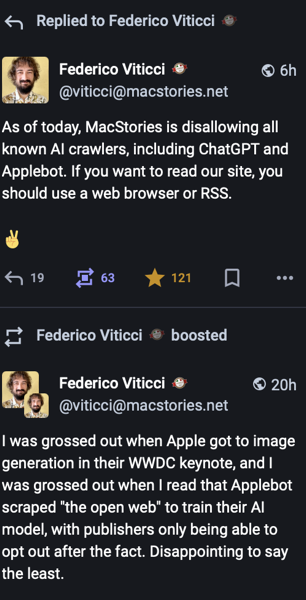
There are methods to exclude a website from being crawled. Dan Moren at Six Colors has posted a good piece on how to do so and what that could mean here. Keep in mind any method used for this only excludes content and data going forward. Federico Viticci at MacStories has already stated that he’ll be excluding his website going forward.

Also keep in mind that this isn’t the only way Apple will be putting Apple Intelligence to work. Regardless, this is going to be an issue to follow as we continue to learn more about Apple Intelligence, which is just the latest in these Artificial Intelligence efforts that we all need to pay attention to. Like it or not it’s here and a fact of life. AND this isn’t the only issue getting under some folk’s skin since Apple made its announcement.

As a side note, my reading list on Apple Intelligence continues to grow with both punditry and technical info that I discover along the way. I imagine that list will just keep growing.

You can find more of my writings on a variety of topics on Medium at this link, including in the publications Ellemeno and Rome. I can also be found on social media under my name as above. 

Artificial Intelligence is No Match for Human Goofiness

Everyone’s intelligence is being challenged given the decidely human drama going on over OpenAI’s adventures in whatever it is adventuring in. The story’s not over by any stretch of the imagination (or hallucinating) but from what we know it only proves that anything humans touch, humans can screw up.

Shutterstock 2245159551

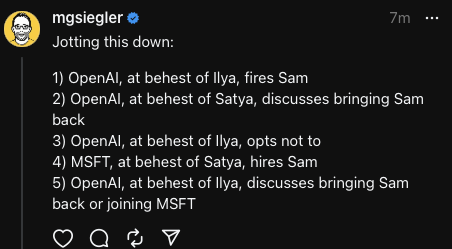
Here’s a link to a story on TechCrunch about what, at the time of its publishing, was the latest news that Microsoft. CEO Satya Nadella,  exercising the muscles Microsoft built up with its 10 billion dollar investment in the company, hired Altman and the company president Greg Brockman after a weekend of boards, CEOs, directors, and investors doing what they typically do. Employees of OpenAI have signed a letter saying they’ll leave unless Altman is brought back. Even the guy who suggested outing Altman has signed on to do so. Goofy? You bet.

CleanShot 2023 11 20 at 08 46 39

But I’m thinking all the horses are out of the barn into more Azure pastures.

All of this is about AI, a powerful and world changing technology, fraught with possibly as much potential harm as promise. That genie is out of the bottle, never to be put back in with a future no human or AI model can really predict. This story will continue to unfold, as will the technology. What won’t change is what I said in the opening paragraph: Anything humans touch, humans can screw up.

Sunday Morning Reading

Chili was on the menu last night and it’s a chlly Autumn Sunday morning. So it’s time to share some Sunday Morning Reading featuring a little poetry, some politics, some not so intelligent moves in the Artificial Intelligence world (is it a world?) and just some damn good writing worth your time.

Fallreading

Let’s start with the poetry. One of my favorite new writing discoveries is NatashaMH on Medium. She popped out a piece of poetry, Pereginations, the other day on Ellemeno and this morning she’s got a terrific piece called The Day I Learned Poetry. Good stuff. Good times. Good fun. Nothing artifcial about the intelligence happening there.

Speaking of AI, it was and still is quite a weekend on that front. OpenAI’s board surprisingly fired poster boy CEO Sam Altman, now he may come back after lots of hueing and crying.  Or he may not. Who knows. Om Malik has a great piece called Foundational Risks of OpenAI looking at the story but rightly hitting the bullseye that this is more than about corporate chaos and investment returns. I’m not sure AI, or its champions, is built for looking back with a long view.

Our politics here in the U.S is still a mess with no foreseable correction in the cards. Dan Balz, Clara Ence Morse and Nick Mourtoupalas take a look at some of the foundational biases in the U.S. Senate that, in my belief, need to change before any next card can be revealed. Check out The Hidden Biases at Play in the U.S. Senate.

Sometimes an outside view is needed for perspective. In this case not so much. Even so, The Economist weighing in with Donald Trump Poses The Biggest Danger to the World in 2024 offers good context in its global round up.

Like it or not, much of our life on the Internet is changing. Social Media is a crazy free-for-all and so is the world of entertainment. In How Social Media Is Turning Into Old-Fashioned Broadcast Media, Christopher Mims takes a look at the stew that’s stewing.

And where would we be without critics? Probably better off, but that’s not necessarily the point of Siskel, Ebert, and the Secret of Criticism by Richard Brody. Here’s a quote:

Criticism is a fraught profession because it’s parasitical. It depends on the work of artists, without which criticism couldn’t exist. A critic who acknowledges and accepts the fact of this dependence is trying to salvage the dignity of the activity; critics who don’t are just trying to salvage their own dignity.

David Todd McCarty is starting a daily column entitled A Bit Dodgy. I recommend subscribing, following, but most of all reading. I’m sure it will be quite a ride.

And in case you’re wondering, worried, or concerned about all of the insanity happening in the world that makes it feel like we’re approaching the End Times, Jeannie Ortega Law tells us that Left Behind author, Jerry Jenkins thinks that all of those End Times prophecies have been fulfilled. So check that off your list.

If you’re interested in just what the heck Sunday Morning Reading is all about you can read more about the origins of Sunday Morning Reading here