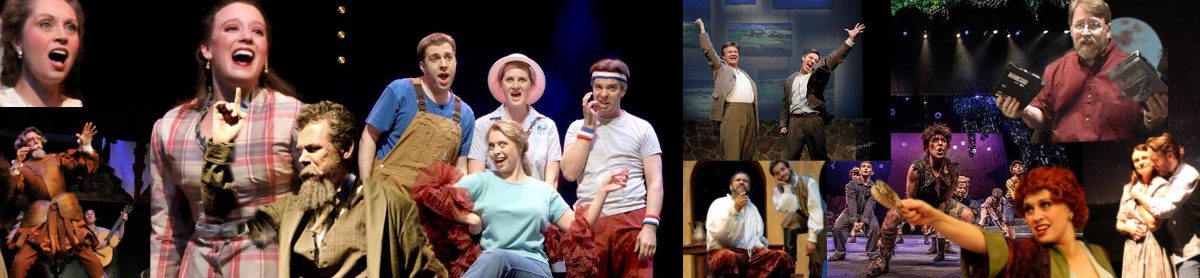
What Goes Around Is Always Coming Back Around

Life can be painful. Live theatre can be as well.

Now that we’re into rehearsals for the stage reading of Puta Wijaya’s play OH, it’s both gratifying and terrifying to discover that my initial thoughts about the piece being timely and universal are correct.
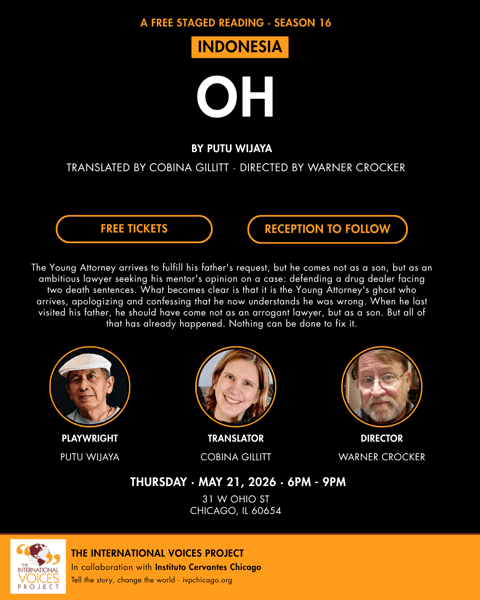
An event poster with a black background and orange and white accents, advertising a free staged reading of a play from Indonesia titled "OH".
At the top, orange text reads "A FREE STAGED READING · SEASON 16". Below it, the word "INDONESIA" is boxed in orange, sitting just above the large, white, bold title, "OH".
The credits below the title read "BY PUTU WIJAYA", followed by "TRANSLATED BY COBINA GILLITT · DIRECTED BY WARNER CROCKER" in slightly smaller white text. Two orange-outlined buttons below read "FREE TICKETS" and "RECEPTION TO FOLLOW".
A central paragraph provides a synopsis of the play:
"The Young Attorney arrives to fulfill his father's request, but he comes not as a son, but as an ambitious lawyer seeking his mentor's opinion on a case: defending a drug dealer facing two death sentences. What becomes clear is that it is the Young Attorney's ghost who arrives, apologizing and confessing that he now understands he was wrong. When he last visited his father, he should have come not as an arrogant lawyer, but as a son. But all of that has already happened. Nothing can be done to fix it."

That of course what’s makes a good play, a good story. It also makes for a constant reminder of how little attention we pay to the stories we tell and repeat.

Wijaya’s work began as a short story that was originally published in 2003, and was then adapted by him in 2018 into what he calls a monodrama, meaning a one character monologue. It’s set in Indonesia. But the words spilling out his thoughts could easily have been written about the U.S lately.

Here’s an example:

I’m stepping into the struggle for justice in this impotent toothless tiger of a country which, instead of using what’s left of its strength to fight, lazes around enjoying itself. Oh! This is insanely embarrassing. It just doesn’t make sense. But this is reality. Our reality! The older generation slacks off, the younger generation jacks off. People are racing to dig their own graves.

And another:

Not like those other lawyers these days who are mostly about making deals, or those elites and intellectuals who shine when they are powerless, but who, from their new seats of power, become more…(Louder) violent, greedy, materialistic, merciless, and despicable once they get the opportunity to trample on justice and truth they once idolized.

Working with IVP is one of the gigs I return to eagerly. Working with plays from far away places and different cultures, always, in the end, proves over and over again that at the core, we’re all the same. Though our life experiences may differ, they really aren’t.

I used the word terrifying in the opening of this post because you’d never know that this play wasn’t written about what we in the U.S. are living through currently. I also say that because regardless of where we’re from, or the horrors we endure, we never seem to learn how the wheel always turns and comes round again.

Life can be painful. Live theatre can be as well.

You can also find more of my writings on a variety of topics on Medium at this link, including in the publications Ellemeno and Rome. I can also be found on social media under my name as above. This site does not use affilate links. 
 

Gearing Up For Another Journey With The International Voices Project

The plays may be from far away, but the stories feel closer to home

It’s that time again. A time to journey into parts unknown with writers new to me. That means it’s time for The International Voices Project festival.

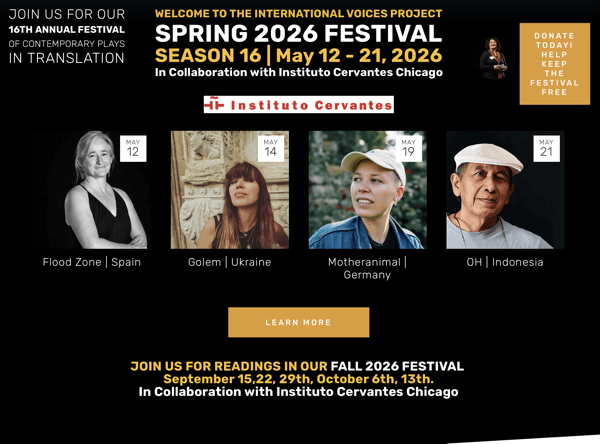
This promotional banner for the International Voices Project Spring 2026 Festival (Season 16) is set against a black background with white, yellow, and tan accents.
At the top, the text invites viewers to the "16th Annual Festival of Contemporary Plays in Translation," running from May 12 – 21, 2026, in collaboration with Instituto Cervantes Chicago. A tan box in the upper right encourages donations to keep the festival free.
The center of the banner features four square portraits representing scheduled readings, each with a date tag in the corner:
•	May 12: "Flood Zone | Spain" – A black and white portrait of a woman in a dark sleeveless top.
•	May 14: "Golem | Ukraine" – A woman with long hair and bangs leaning against a stone wall.
•	May 19: "Motheranimal | Germany" – A person wearing a tan baseball cap and a denim jacket, looking off to the side.
•	May 21: "OH | Indonesia" – A man wearing a white flat cap and glasses around his neck.

This is a gig I participate in once or twice a year. IVP gives me a chance to explore writers, different cultures, and a larger world. The mission of IVP is to bring international works translated into English to Chicago audiences. They are presented in a staged reading format. That simply means actors are carrying scripts and the production isn’t fully realized. The emphasis is on the text and the story.

This year I’m headed to Indonesia and the play, OH, by Puta Wijaya. The story features a young attorney who arrives at his father’s hospital bedside to fulfill his father’s request, but he comes not as a son, but as an ambitious lawyer seeking his mentor’s opinion on a case: defending a drug dealer facing two death sentences. Wijaya himself adapted the piece into a play from an original short story of his, called The People’s Justice.

The one thing I always learn from these plays from other countries is not how different we are, but just how much we are the same. That’s more than true with this piece, as much of what the main character thinks could be ripped out of today’s US headlines or from social media.

Looking forward to spending the next week rehearsing and hearing the staged reading of OH, next week.

You can also find more of my writings on a variety of topics on Medium at this link, including in the publications Ellemeno and Rome. I can also be found on social media under my name as above. This site does not use affilate links. 
 

The Little Prince Meets Artificial Intelligence

A melange of technology and fantasy

Every year, sometimes twice a year,  I return to one of my favorite theatre gigs, directing a staged reading for The International Voices Project. IVP is a Chicago company that produces staged readings of plays translated from other countries and cultures. Throughout the years the plays I’ve directed have taken me on journeys with writers from Syria, Lebanon, Ireland, Germany, Norway, Ukraine, El Salvador, and now Romania.

The reason I return each year is one of the reasons I have pursued and enjoyed my life making theatre. I get to touch and explore worlds, cultures, and ideas I would never have had the chance to experience otherwise. It’s always an adventure into something new.
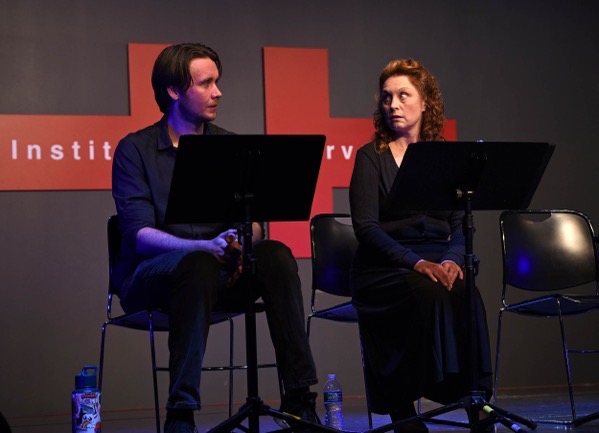
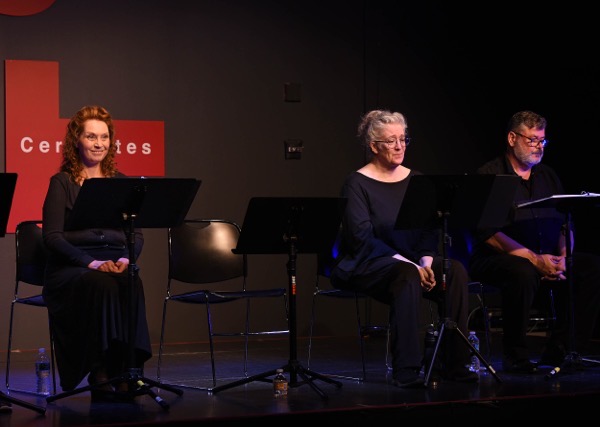
My most recent gig with IVP certainly scratched all of those itches. The play is called Veronica’s Little Prince by Romanian playwright Dr. Catalina Florina Florescu. Yes, Antonie de Saint-Exupéry’s character of The Little Prince plays an important role.

The piece centers on Veronica, a former principal ballerina who has literally had her legs taken out from under her in a mysterious accident, leaving her in an institution, unable to move without the aid of a wheelchair and unable to speak. Unhappy with her fate Veronica is suspected of wanting to kill herself. Even before the mysterious accident she’s lived a life of self-destructive behavior.

The Little Prince arrives to help her examine and uncover the truth within her actions.

There’s another twist. I mentioned that Veronica can’t speak. In a technological twist she communicates via an AI robot by typing on her body. Via an implant those signals transmit to the robot who speaks her words and thoughts.

The play weaves in and out of Veronica’s mind and thoughts, her past and present, reality and fantasy, technology and humanity in very theatrical ways.

Creating an even more mysterious melange of tech and fantasy, the most frightening line to me is when Veronica’s Little Prince answers Veronica’s question about who told her to come by saying:

You see, they have programmed me to pop up whenever I hear certain words.

That may delight AI enthusiasts and those who keep suggesting we’re living in some sort of simulation, but given the rush to push us all deeper into a world run by Artificial Intelligence, it more than tweaks a nerve for those, like me, who may see benefits to AI in some forms, but think the pitfalls are more dangerous. Frankly, I prefer the characters in fantasy to spring from the minds of humans, not lines of code.

Given the sound and visual representations that give the script its many layers it was quite a challenge to present in a staged reading format without the benefit of theatre technology. But we managed to pull it off, letting the words weave their magic.

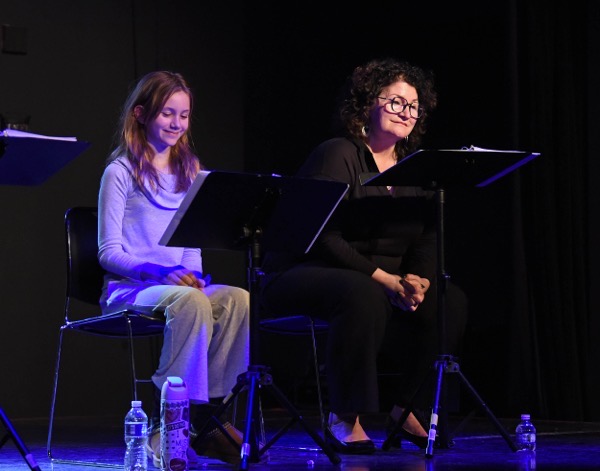
My thanks and kudos to the cast for doing such great work and especially to young Olive Popio who played our Little Prince.

(Photo by Scott Dray for The International Voices Project)

You can also find more of my writings on a variety of topics on Medium at this link, including in the publications Ellemeno and Rome. I can also be found on social media under my name as above.

A Dream Cast Delivers a Dreamy Dream of Autumn by Jon Fosse

Exceptional performances highlight a magical evening with a magical play.

Fantastic! That’s the first, but not the last compliment I’ll issue to the remarkable cast of our staged reading of Jon Fosse’s play Dream of Autumn last night. Matt Keely, Thomasin Savaiano, Gabrielle Brite, Amy Stricker, and Kevin Grubb were each, and as an ensemble, gloriously fantastic. They deserve all the praise that came flying their way after the reading. Producers should hire them.

Dream of Autumn was presented as a part of this year’s International Voices Project festival. Each piece is given a one-night only reading after a limited rehearsal period (more on that later).

For those unfamiliar, the actors read from their scripts, but are expected to bring full life to the text. This group sure did. Dream is a tricky play, dwelling in the realm of magical realism, with time shifts, and in this story character shifts, that can turn on the edge of dime. In a full production there would be production elements to help the audience follow those shifts. In this very barebones reading style, with the actors sitting in chairs and reading from their scripts from behind music stands, those shifts were handled via the reading of stage directions and the acting choices made by each member of the cast. According to the audience during our post-performance talk back, every one followed each twist and turn.

We only had about six hours of rehearsal to prepare, and the cast took the direction that was given and ran with it, culminating in a very “in the moment” experience for themselves as well as the audience. This was the first time this cast had read the play start to finish, together, without stopping. It was also the first time I had heard it. You could feel the entire room caught in the moments of the play and the moments of performance, breathing as one.

Having directed a number of these staged readings I’ve seen similar quite a few times, but rarely as well and as thrilling as last night’s effort. I often maintain that one of the true tests of an actor’s mettle is watching them carry the day with little preparation, trusting their skill and instincts. This team certainly carried this play last night further than most.

My hat’s off to each of them. Job exceptionally well done.

All photos by Scott Dray.

You can find more of my writings on a variety of topics on Medium at this link, including in the publications Ellemeno and Rome. I can also be found on social media under my name as above. Check out the categories for this blog to read more about my theatre work. 

Next Up: Dream of Autumn by Jon Fosse

My next gig onstage: Dream of Autumn by Jon Fosse

Monday night, November 18 at the International Voices Project we unveil a staged reading of Jon Fosse’s Dream of Autumn. Fosse won the Nobel Prize for Literature in 2023 for his work.

Dream of Autumn was translated into English by Sarah Cameron Sunde. The piece features quite a tension filled family reunion gathering at a cemetery. That’s actually a mild description of this piece the takes some twists and turns with time along with a dip into the wild world of magical realism. I doubt you’ll ever look at a gravestone the same way again.

The staged reading is free, and The International Voices Project is an organization I’ve worked with for years and certainly one that deserves support for bringing voices from other countries to Chicago.

Come check us out.

You can find more of my writings on a variety of topics on Medium at this link, including in the publications Ellemeno and Rome. I can also be found on social media under my name as above. Check out the categories for this blog to read more about my theatre work.