Red One Will Make You Wince and Laugh

Red One won’t save Christmas, but it is quite jolly.

Red One, now streaming on Amazon Prime isn’t a classic, nor is it a loser. It’s fun in all the right places, and bad in all the right places. In the end, it’s worth streaming if you’re looking for some good brainless streaming fun over the holiday.

Overflowing with familiar names in the cast including The Rock, Chris Evans, Lucy Liu, and J.K. Simmons, among others, it’s a romp that tosses a bunch of Christmas themed traditions into the mixer, shakes them up, and sprinkles enough one liners and almost too many special effects on top to keep it entertaining.

I’m not sure it’s quite family fare if you have wee young ones, but for an older mix of generations it’s might be worth the sleigh ride. Explaining Santa Claus might never been the same again.

The different world creation is a well done enough that the movie creates its own Christmas world view allowing a pretty insane mix of mythic magic and technology to propel the story  as the characters try to save Christmas.

If you’re like my families, silly and goofy Christmas movies are a part of the holiday tradition. This one probably makes the cut going forward.

You can find more of my writings on a variety of topics on Medium at this link, including in the publications Ellemeno and Rome. I can also be found on social media under my name as above. 
Breaking All The Molds: Emilia Pérez

A cross between a musical and a pop-opera, Emilia Pêrez is a unique story of transformation.

Breaking the mold is one way to describe the movie Emilia Pêrez. Breaking all of them is more apt. Imagine taking the making of movies, more specifically the making of movie musicals and creating something new, different, in the end probably not completely successful, yet you can’t take your eyes off of it.

Now imagine the story of that movie is about a ruthless Mexican drug cartel leader, who hires a lawyer to seek a sex change operation to become their true self, a woman. Put it all together and it is an intriguing adventure in story and cinematic story telling.

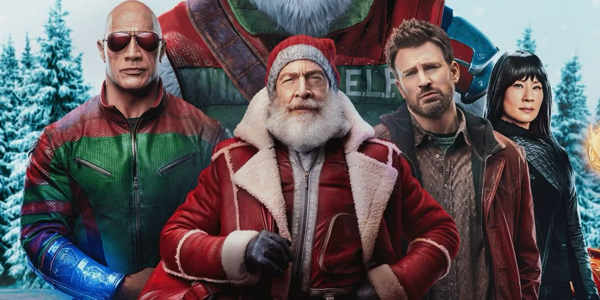
I won’t say it completely holds together, because I’m not sure it does. But it keeps turning in on itself and musical movie making in ways as daring as the titular character’s mission. In that lead role Karla Sofía Gascón is excellent, as are Zoe Saldaña as the lawyer, and Selena Gomez as the wife of the cartel boss.

But, it is Jacques Audiard’s work as a director that stands above all. Unfurling a story of transformation and redemption, this isn’t the first film featuring a story about a trans character, but it is certainly the one that spins out its story this way. I’d call it a pop-opera, but that too simple a definition as is calling it a musical.

The film was controversial when it debuted and won awards at Cannes, and in today’s climate I’m sure it will remain so. Quite frankly, that’s what gives the film some of its allure.

At its heart it is a story of transformation, mashed up with music, love, violence and full of surprise. Again, I’m not sure it holds together completely, but if you’re looking for something that plays around with convention while telling a surprising story, it is more than worth a watch.

Emilia Pêrez is playing on Netflix and you can watch the trailer below.

You can find more of my writings on a variety of topics on Medium at this link, including in the publications Ellemeno and Rome. I can also be found on social media under my name as above. 
Sound and Fury with Apple TV Enhance Dialogue

Apple TV’s Enhance Dialogue works well until it doesn’t.

Apple introduced a feature I was very much looking forward to trying out this fall for tvOS 18. It’s called Enhance Dialogue. The theory behind the feature is simple: enhance the dialogue of what you’re watching so you can hear it. When my wife and I initially tested it we were quite pleased with the feature. But last night there was some weirdness.

Like so many features Apple (and others) release, new things seem to work out of the box. But then as updates rollout and things burn in, a bit of oddness creeps in.

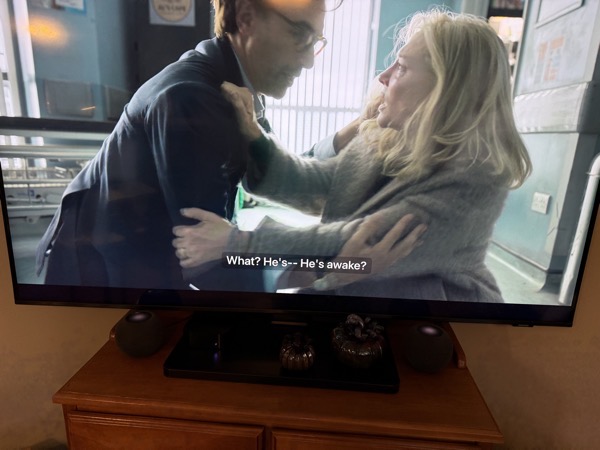
Last night we were watching the finale of the Apple TV+ series Disclaimer. Things were rolling along just fine and then towards the end of the episode we stopped hearing dialogue. Characters became silent film stars and mimes with moving mouths, but no sound of dialogue was coming out. Underscoring continued.

Initially we thought this might be an artistic choice (a poor one.) What was happening in the story as it headed to its conclusion and then denouement could reasonably be understood without dialogue. But a tertiary character behind a nurse’s station uttered one line of dialogue, breaking the silence, and then immediately we went back to a silent film again.

I shouldn’t say completely silent. Background noises and conversations from background characters were coming through as ambience over the underscoring. Then a few moments later we heard some of the dialogue, but it was muffled and echo-y as though picked up by a distant microphone or layered on top in post of what we were supposed to be hearing. Every now and then we’d occasionally get those clear, one line bursts of dialogue. The conclusion I reached after this whole thing was over is that those lines in the clear must have been overdubbed and the muffled lines were due to be enhanced later.

We paused the episode and I turned on subtitles, revealing that there was indeed dialogue being spoken. We stopped the episode and tried again. Same result. I then went back to settings and turned off Enhance Dialogue. Voila. We were able to hear all the dialogue again.

I know lots of things are going on in the backend at Apple has they continue to roll out betas at a crazy pace trying to play catch up in the Artificial Intelligence game. I’ve written before on how this can have an effect on even non-beta users. What’s puzzling to me is that this doesn’t seem like a feature that should be affected by backend services. Perhaps I’m wrong. But we’ve watched several shows without this issue since first turning on Enhance Dialogue.

Here’s the thing. In my opinion, both the visual and audio elements of film making have pushed new technology envelopes a bit too far. We shouldn’t need a feature to enhance dialogue to overcome bad sound mixes that try to be as realistic, or unrealistic, as possible in the same way that we should still be able to view actors in dark scene. If you can’t see or hear the story, what’s the point of the story, or the technology? Sound and fury signifying not much.

Then again, I get it. Artists will tell you they are trying to make things look and sound as real as possible, or craft an environment that is all encompassing with all of the elements at their disposal. Too often they get carried away and lose us to ineffective story telling.

I had planned to write up a blog post saying how much the Enhance Dialogue feature was a winner after some success with the new feature. I can’t say for sure that there is direct causation between the new Enhance Dialogue feature and the dialogue dropout we experienced. I will say, that it’s easy to point a finger of correlation after new features are released and something, anything goes awry. For now, I’ll leave it as the Enhance Dialogue feature looks like it could possibly be a winner in our household. If it works as advertised. All the time. Every time.

I will also say again that if filmmakers did their jobs correctly this wouldn’t be necessary except for those watching who might need assistive technology. In my opinion, if story tellers start relying on this feature to be present (I know it exists on many smart TVs,) it will be to the detriment of their craft and artistry.

You can find more of my writings on a variety of topics on Medium at this link, including in the publications Ellemeno and Rome. I can also be found on social media under my name as above. 

Ghostlight Is a Must See

One of the best films of the year.

Perhaps it’s because I’m an old theatre hand who knows all the tricks of the trade in what some consider the world’s second oldest profession. Perhaps it’s because I’m just an old guy trying to figure out the ups and downs of  life. Either way, the film Ghostlight touched a nerve. It is one terrific story that uses the magic, hilarity, and hubris of making theatre to help tell an unerring tale of humans dealing with a grief so profound it can take your breath away, while breathing abundant life and delivering layers of complexity into a remarkably simple and well told story.

Ghostlight e1705769964581.

Ghostlight is a tender and intimate independent film featuring a family dealing with their grief after the suicide of a son and brother. By accident, the struggling blue collar father stumbles into participating in a small town community theatre production of Romeo and Juliet. Eventually his family also folds into the production, while he stumbles further into playing Romeo.

It might sound like something out of the Mischief Theatre Company’s misadventures with the Cornley Polytechnic Drama Society and The Play That Goes Wrong, but this little backstage adventure takes a different tack to find its way into your heart.

The story takes its time unfolding and revealing its mysteries with great care and surprise. And the surprises are many. The cast is superb and the direction is sublime. Ghostlight is in limited distribution in art houses currently but deserves a wider audience, which I hope it finds once it begins to stream.

If you get the chance or can make one, this is one to see. I expect this to end up on many best of the year lists.

A couple of side notes: The three leads playing the family are a family in real life, adding yet another layer to this marvel. Also, as a Chicago theatre practitioner it was great to see so many Chicago faces in the ensemble all doing remarkable work.

You can find more of my writings on a variety of topics on Medium at this link, including in the publications Ellemeno and Rome. I can also be found on social media under my name as above. 
Ripley: A Feast for the Eyes

A splendid visual feast well worth your viewing.

Sometimes you just need to let your eyes swim in the visuals. That’s how I felt as we watched the Netflix series Ripley over the weekend. It’s luxurious to look at and linger on. But you can’t linger long. Every time different pixels reveal a different shot you’re treated to something equally magnificent. 

Steven Zaillian’s take on the Ripley series is almost too rich to watch in a binging fashion. But that’s what my wife and I did over the weekend and we felt richer for the experience. Typically in my viewing, visuals are just another story-telling element that need to meld well with the other elements to create a satisfactory whole. Not in this case. The visuals are enough. 

The black and white cinematography by Robert Eslwit and the Production Design led by David Gropman and Art Direction by Karen Schulz Gropman are beyond exquisite. Almost to the point of being overwhelming. They must have had one helluva time scouting locations and picking camera locations. It doesn’t get more sumptuous than this and it makes this remake of a well told tale worth viewing and celebrating.

In fact, beyond Andrew Scott’s performance, which is excellent but not his best, the remake needed this level of visual panache to make it more than just another retelling of a story about a difficult and troubling man.

Scott’s fellow cast members also do excellent work adhering like glue to Zailllian’s spare emotionless approach to the text. That approach works surprisingly well, especially in the later episodes. There’s more mystery and mirth left unindicated than in most fare, revealing as much, but not too much, as the many shots of statues observing the tale as it unfolds. Marry that to the visual story telling artistry and one amazing cat, and the entire experience is thrillingly satisfying and entertainingly unsettling in the best possible sense.

Highly recommended.

You can find more of my writings on a variety of topics on Medium at this link, including in the publications Ellemeno and Rome.